Table of Contents
Reading the Microscopic History Preserved Inside a Gem
Look through a gemstone with the unaided eye and you may see:
colour, brilliance and transparency.
Place the same gemstone beneath a gemmological microscope and an entirely different landscape can appear.
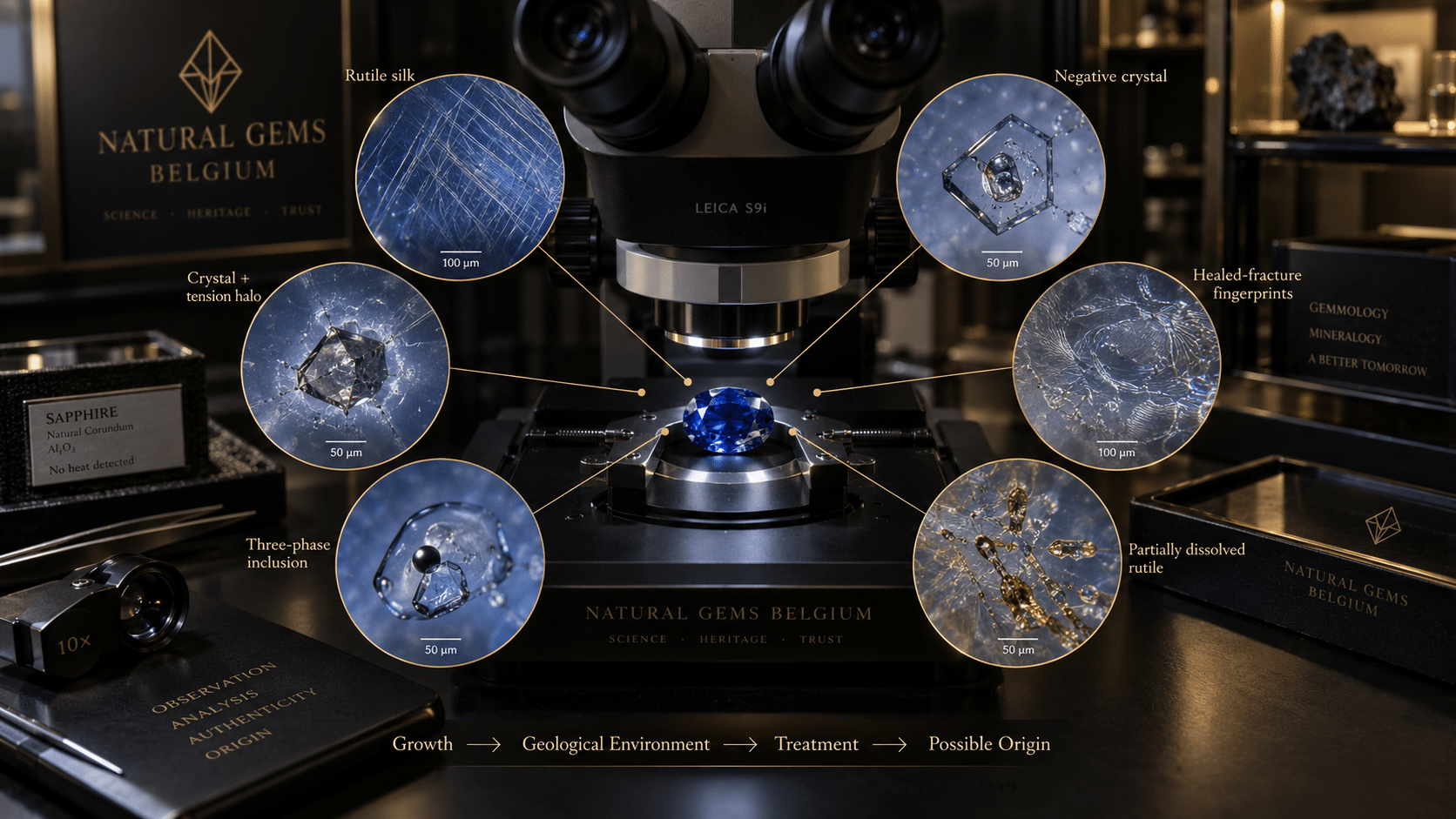
A tiny crystal floats beneath a facet.
Needle-like inclusions cross one another in geometric directions.
A microscopic cavity contains liquid, a gas bubble and a minute crystal.
A delicate network resembles a human fingerprint.
A fracture has partially healed.
A dark crystal is surrounded by a circular stress halo.
These features are collectively described as:
Gemstone inclusions and internal characteristics.
To a consumer, an inclusion may initially seem to be little more than an imperfection.
To a gemmologist, it can be:
evidence.
An inclusion may help answer questions such as:
- Is the gemstone natural?
- In what geological environment did it grow?
- Did another mineral exist before the host crystal?
- Was a fluid trapped while the gemstone was growing?
- Did the gemstone fracture and heal later?
- Has it been heated?
- Is it laboratory-grown?
- Could its inclusion population support a particular geographic origin?
Some gemstone inclusions even contain microscopic samples of the environment in which the gemstone formed.
In that sense, a gemstone can function as:
a geological time capsule.
But inclusion interpretation comes with an equally important warning.
A feature can be:
compatible with
an identification or origin without being:
diagnostic of
that identification or origin.
Understanding that distinction is one of the foundations of professional gemmology.
PART I — WHAT IS A GEMSTONE INCLUSION?
1. More Than a Crystal Trapped Inside a Gem
The word inclusion is often used casually to mean:
a foreign crystal inside a gemstone.
The scientific concept is broader.
Gemstone inclusions can include:
- solid mineral crystals;
- liquids;
- gases;
- combinations of solid, liquid and gas;
- cavities;
- negative crystals;
- healed fractures;
- exsolved particles or needles;
- growth structures;
- internal reaction features.
GIA describes inclusions as mineral crystals or cavities containing fluid and/or gas within a host gemstone.
They can range from features easily visible under a loupe to structures approaching microscopic or even submicroscopic scale.
2. The Host and the Guest
It is useful to distinguish:
host gemstone
from:
included material.
If a zircon crystal occurs inside sapphire:
sapphire = host
zircon = inclusion
The inclusion and host may have formed:
- at different times;
- simultaneously;
- or through processes occurring after the host crystal initially formed.
That timing relationship gives us one of the most important inclusion classifications.
PART II — PROTOGENETIC, SYNGENETIC AND EPIGENETIC
3. Protogenetic Inclusions
A protogenetic inclusion existed:
before the host gemstone formed around it.
Imagine a small mineral crystal already present in a rock.
Later, a sapphire begins growing in that environment.
The growing sapphire surrounds and traps the older crystal.
The inclusion is therefore older than its host.
Such inclusions may show:
- irregular shapes;
- partially dissolved surfaces;
- evidence that the host grew around them.
The crucial concept is:
inclusion first → host later.
4. Syngenetic Inclusions
A syngenetic inclusion forms approximately:
at the same time as the host crystal.
The gemstone and included material are products of the same general crystallisation environment.
Examples can include:
- mineral crystals trapped during growth;
- fluids trapped along growing crystal faces;
- melt inclusions.
The relationship becomes:
host and inclusion grow together.
5. Epigenetic Inclusions
An epigenetic or secondary inclusion forms:
after the host gemstone has already crystallised.
A typical mechanism is:
- the gemstone forms;
- it later fractures;
- fluid enters the fracture;
- geological conditions allow part of the fracture to heal;
- tiny remnants of the fluid remain trapped.
This can produce the beautiful networks gemmologists often call:
fingerprints.
The sequence is:
host first → later geological event → secondary inclusion.
6. Why Timing Matters
These categories help reconstruct:
geological history.
An inclusion can tell us not only what materials were present but also something about:
when events occurred.
That transforms microscopic observation from simple description into geological interpretation.
PART III — SOLID INCLUSIONS
7. Minerals Inside Minerals
A natural gemstone may contain tiny crystals of other minerals.
Examples encountered in gemmological research include:
- zircon;
- apatite;
- rutile;
- mica;
- calcite;
- dolomite;
- spinel;
- pyrite;
- chromite;
- feldspar.
The precise population depends on the host gemstone and geological environment.
8. Why Solid Inclusions Matter
Suppose an emerald contains:
mica.
That may be consistent with formation in a mica-rich schist.
Suppose another emerald contains carbonate minerals associated with a hydrothermal vein environment.
The inclusion population begins to reflect the geology surrounding gemstone formation.
GIA notes that emeralds from schist-related environments such as some Russian deposits often contain mica, whereas Colombian hydrothermal emeralds commonly contain inclusions related to carbonate-rich geological environments.
The gemstone has effectively captured fragments of its surroundings.
9. Shape Alone Is Not Always Enough
A colourless crystal inside a gemstone may resemble:
- zircon;
- apatite;
- feldspar;
- quartz.
Visual morphology can suggest an identity.
It does not always prove one.
This is where advanced laboratory techniques can extend microscopy.
A Raman microscope can sometimes target the inclusion and determine its vibrational spectrum without physically removing it from the host.
The workflow becomes:
observe → hypothesise → analyse → confirm.
PART IV — FLUID INCLUSIONS
10. Tiny Samples of Ancient Fluids
During gemstone formation, microscopic quantities of geological fluid can become trapped.
These are:
fluid inclusions.
They can preserve evidence about fluids present during:
- crystal growth;
- metamorphism;
- hydrothermal activity;
- later fracture healing.
Some contain only one visible phase.
Others are far more complex.
11. Two-Phase Inclusions
A two-phase inclusion may contain:
liquid + gas
for example.
Under the microscope, a bubble may be visible moving within the liquid when conditions permit.
The proportions of the phases depend on:
- composition;
- temperature;
- pressure;
- subsequent history.
12. Three-Phase Inclusions
A classic three-phase inclusion contains:
liquid + gas + solid.
In emerald, for example, one may observe:
- a fluid;
- a gas bubble;
- a crystalline daughter mineral.
These microscopic worlds can be extraordinarily beautiful.
They can also be scientifically important.
But they provide one of gemmology’s best lessons in avoiding overconfidence.
PART V — THE COLOMBIAN EMERALD TRAP
13. A Historical Shortcut
For many years, three-phase inclusions in emerald were strongly associated with:
Colombian origin.
The logic appeared convincing.
Colombian emeralds frequently contain characteristic jagged multiphase inclusions.
Therefore:
three-phase inclusion → Colombia
became a tempting shortcut.
Scientific research showed why that shortcut was unsafe.
14. Similar Inclusions Elsewhere
GIA documented emeralds containing comparable three-phase inclusions from:
- Afghanistan;
- China;
- Zambia;
as well as Colombia.
Some Zambian Musakashi emeralds showed multiphase inclusions remarkably similar to features traditionally associated with Colombian stones.
The implication was fundamental:
one visually familiar inclusion could no longer be treated as proof of one country.
15. Characteristic Is Not Necessarily Diagnostic
This distinction deserves careful definition.
Compatible
The feature can occur in the proposed material or origin.
Characteristic
The feature occurs sufficiently often to be useful as supporting evidence.
Diagnostic
The feature provides sufficiently specific evidence to establish a conclusion under the relevant circumstances.
Many gemstone inclusions are:
characteristic
without being individually:
diagnostic.
This vocabulary prevents overinterpretation.
16. Modern Emerald Origin Determination
For difficult emerald origin cases, a professional laboratory may combine:
- microscopic inclusions;
- UV-Vis-NIR spectroscopy;
- FTIR spectroscopy;
- trace-element chemistry.
The microscope remains extremely important.
But it becomes one component of an:
evidence system.
PART VI — NEGATIVE CRYSTALS
17. A Crystal-Shaped Hole
The term:
negative crystal
sounds contradictory.
It is not a crystal of another mineral.
It is a cavity whose shape reflects the crystallography of the host gemstone.
Instead of containing a solid crystal with crystal faces, the gemstone contains:
a void shaped by its own crystal structure.
18. What Can a Negative Crystal Contain?
A negative crystal may contain:
- liquid;
- gas;
- crystals;
- combinations of these phases.
GIA has documented spectacular negative crystals in sapphire containing:
- CO₂;
- marcasite;
- diaspore;
- siderite.
Raman spectroscopy was used to identify several of these microscopic components.
A single cavity can therefore preserve an astonishing amount of geological information.
19. Negative Crystal Does Not Mean Empty
This is an important terminology point.
A negative crystal describes primarily:
the crystallographically controlled cavity shape.
The cavity itself may contain multiple phases.
So:
negative crystal ≠ empty hole.
PART VII — FINGERPRINT INCLUSIONS
20. Why Do They Look Like Fingerprints?
A gemstone can fracture naturally underground.
Under suitable geological conditions, the fracture begins to heal.
Material recrystallises across the opening.
But healing may be incomplete.
Tiny fluid-filled channels or cavities remain.
Under magnification these can form:
- networks;
- loops;
- lines;
- cellular patterns.
Their appearance may resemble:
a fingerprint.
21. A Record of Damage and Repair
A fingerprint therefore records a sequence:
crystal growth → fracture → fluid entry → partial healing.
It is evidence not simply of formation, but of:
post-growth geological history.
This is one reason inclusion scenes can be much richer than a simple list of trapped minerals.
22. Fingerprints Are Not Unique to One Gemstone
Fingerprints occur in several minerals.
They can be seen in:
- corundum;
- spinel;
- other gemstones.
Therefore:
fingerprint present
is not itself a species identification.
The morphology and surrounding evidence must be considered.
PART VIII — RUTILE SILK
23. Needles Inside Corundum
Natural ruby and sapphire frequently contain tiny needles or particles of:
rutile — TiO₂.
When numerous fine rutile inclusions occur together, gemmologists often use the term:
silk.
These inclusions can be oriented along crystallographic directions.
24. Silk and Optical Phenomena
When appropriately oriented and sufficiently abundant, needle-like inclusions can scatter light in an organised way.
In cabochon-cut corundum this can contribute to:
asterism — the star effect.
The inclusion is therefore not merely a clarity feature.
It can create one of the gemstone’s most desirable optical phenomena.
25. Silk as Treatment Evidence
Rutile is also extremely important in detecting:
heat treatment.
High-temperature heating can cause rutile needles to:
- dissolve;
- shorten;
- break into particles;
- become diffuse.
Experimental heating of sapphire documented by GIA shows dramatic alteration of rutile silk at sufficiently high temperatures.
The inclusion therefore acts as:
a thermal witness.
26. But Intact Silk Does Not Automatically Mean Unheated
This qualification is essential.
Lower-temperature heat treatment may leave rutile relatively intact.
Experimental studies show that other inclusions can begin changing before rutile silk visibly dissolves.
Therefore:
intact rutile alone does not prove absence of all artificial heating.
The complete inclusion scene must be evaluated.
PART IX — INCLUSIONS AS THERMOMETERS
27. Different Minerals React Differently to Heat
An included crystal may respond to heating by:
- cracking;
- melting;
- becoming cloudy;
- developing bubbles;
- changing transparency;
- producing stress fractures;
- reacting chemically with its surroundings.
If the behaviour of that inclusion under known experimental conditions has been studied, its present appearance can provide evidence about treatment.
28. Experimental Gemmology
One of the most powerful ways to understand heat-treatment features is to examine the same gemstone:
before and after controlled heating.
GIA researchers have performed such experiments on ruby and sapphire.
This allows a direct comparison:
before heat → after 800°C → after 1000°C → after higher temperatures
depending on the experiment.
The resulting photomicrographs turn treatment interpretation from folklore into experimentally supported evidence.
29. Sapphire Example
In experiments on Montana sapphire, rutile silk that initially contained long and medium needles changed substantially during high-temperature treatment.
Longer needles decomposed, leaving much finer particles.
Other inclusions developed alteration halos or residual material.
These changes became evidence of:
artificial heating.
30. Ruby Example
Low-temperature experiments on Burmese ruby showed that some sulfide inclusions could begin developing fissures and other changes at temperatures where rutile remained intact.
At higher temperatures, additional features developed and rutile eventually dissolved.
This demonstrates why treatment detection cannot rely on one universal inclusion reaction.
Different inclusions respond at different thresholds.
PART X — CARBON DIOXIDE INCLUSIONS
31. An Especially Valuable Corundum Clue
Some metamorphic corundum contains intact:
CO₂ fluid inclusions.
GIA research established an important treatment implication.
Intact unruptured CO₂ inclusions cannot survive the heating conditions associated with artificial heat treatment of corundum.
Their presence can therefore provide powerful evidence for:
natural colour without artificial heat treatment.
32. Watching a Phase Change
Carbon dioxide has a critical temperature around:
31°C.
Under suitable conditions, cooling or warming a CO₂-bearing inclusion can cause the internal phases to change visibly.
GIA documented a sapphire negative crystal in which CO₂ transitioned between:
- liquid + gas;
- homogenised supercritical fluid.
The inclusion is therefore not a static speck.
It is a microscopic physical system.
PART XI — STRESS HALOS AND DISCOID FRACTURES
33. When Inclusion and Host Respond Differently
A mineral inclusion and its host gemstone may respond differently to:
- pressure;
- temperature;
- expansion;
- contraction.
Stress can develop around the inclusion.
This may produce:
- tension fractures;
- discoid fractures;
- halos.
Such features are common components of microscopic inclusion scenes.
34. Peridot’s Lily Pads
Peridot provides a familiar example.
Small crystals such as chromite may be associated with rounded reflective fractures often described as:
lily pads.
The visual feature results from a relationship between:
- inclusion;
- host;
- stress/fracturing.
As discussed in our green gemstone identification workshop, lily pads are highly characteristic of peridot.
But good gemmology still confirms the species with independent optical properties.
PART XII — INCLUSIONS AND NATURAL ORIGIN
35. Can an Inclusion Prove a Gemstone Is Natural?
Sometimes inclusion evidence can be extremely strong.
A convincing assemblage of naturally formed mineral and fluid inclusions can establish geological growth.
But the gemmologist must identify the features correctly.
Synthetic gemstone manufacturers can also produce:
- crystals;
- flux residues;
- bubbles;
- growth features.
The question is not:
“Does it contain inclusions?”
It is:
“What process produced these inclusions?”
36. Synthetic Inclusions Tell Their Own Story
Laboratory-grown gemstones may contain evidence of their growth method.
Examples include:
Flame fusion
- curved growth structures;
- gas bubbles.
Flux growth
- residual flux;
- flux veils or fingerprints;
- metallic inclusions in some materials.
Hydrothermal growth
- characteristic growth structures;
- seed-related features;
- inclusions associated with the synthetic growth environment.
Synthetic gemstones are not necessarily:
internally flawless.
Their inclusions can be as informative as natural ones.
37. Why “Bubble = Glass” Is Dangerous
Gas bubbles are famously associated with:
glass.
But bubbles can also occur in:
- synthetic gemstones;
- fracture fillers;
- flux residues;
- multiphase natural inclusions.
The context matters.
A bubble inside a natural fluid inclusion is fundamentally different from a spherical manufacturing bubble in glass.
The microscope requires interpretation, not merely pattern recognition.
PART XIII — NATURAL-LOOKING SYNTHETICS
38. When the Inclusion Scene Becomes Deliberately Difficult
Synthetic gem production has sometimes created material with internal features intended—or capable of appearing—to resemble natural gemstones.
GIA has documented synthetic ruby containing both:
- curved flame-fusion growth;
- flux-related fingerprint-like inclusions.
Without careful examination, one feature might point in one direction while another appears more natural.
39. Composite Growth Histories
An especially instructive example is a flame-fusion synthetic ruby core with:
flux-grown synthetic ruby overgrowth.
Microscopy revealed:
- curved striae in the core;
- flux fingerprints in the outer synthetic growth;
- a boundary between the two growth environments.
The gemstone effectively contained:
two synthetic histories.
This demonstrates why professional microscopy considers the entire three-dimensional inclusion scene.
PART XIV — INCLUSIONS AND GEOGRAPHIC ORIGIN
40. The Most Tempting Interpretation
A gemmologist sees an inclusion known from:
Myanmar.
Can the report now state:
Myanmar origin?
Usually not from that observation alone.
Geographic origin determination is one of the areas where inclusion interpretation must be particularly disciplined.
41. Why Inclusions Can Help
Different geological deposits contain different:
- host rocks;
- associated minerals;
- fluids;
- pressure-temperature histories.
Gemstones growing in those environments may trap different inclusion populations.
Consequently, certain assemblages can strongly support particular geological sources.
42. A Spinel Example
GIA documented Burmese red spinel containing complex negative crystals with:
- sulfur-rich yellow liquid;
- sulfides;
- carbonate daughter crystals;
- diaspore fibres;
- gas.
This unusual inclusion assemblage was considered a useful indicator of Burmese origin in the studied material.
That is far stronger than merely saying:
“This spinel has a bubble.”
The entire assemblage matters.
43. Emerald Again Demonstrates the Limitation
Three-phase inclusions can occur in emerald from multiple countries.
Therefore modern origin analysis may require combining:
- inclusion morphology;
- mineral assemblages;
- spectroscopy;
- trace-element chemistry.
An inclusion can point toward an origin.
It should not be forced to prove more than it actually proves.
PART XV — INCLUSIONS AND GEOLOGICAL ORIGIN
44. Geographic Origin and Geological Origin Are Different
This distinction is important.
Geological origin
Describes the geological environment or process in which a gemstone formed.
Examples:
- metamorphic;
- basalt-related;
- hydrothermal;
- pegmatitic.
Geographic origin
Describes a physical locality or country.
Examples:
- Sri Lanka;
- Myanmar;
- Mozambique;
- Colombia.
An inclusion may provide strong evidence for:
geological environment
without uniquely identifying:
country.
45. A Geological Story May Be Stronger Than a Passport
A calcite inclusion may support growth in a carbonate-rich environment.
Mica may support a schist-related environment.
A fluid inclusion may reveal hydrothermal activity.
Those are geological interpretations.
Several countries can contain similar geological environments.
This is why:
geology ≠ geography.
PART XVI — INCLUSIONS CAN EVEN BE DATED
46. Zircon as a Geological Clock
Some inclusions contain radioactive isotope systems that can be dated.
Zircon is particularly important in geochronology because uranium isotopes decay to lead at known rates.
GIA-associated research examined zircon inclusions in sapphires from Sri Lanka using:
U-Pb dating by LA-ICP-MS.
Some zircon inclusions yielded ages of approximately:
549 million years.
47. What Does That Date Mean?
The date does not automatically mean:
“the sapphire is exactly 549 million years old.”
The relationship between inclusion and host must first be understood.
In the studied Sri Lankan material, the zircon ages were interpreted alongside:
- trace-element chemistry;
- inclusion evidence;
- regional geology.
The results linked sapphire formation to an ancient metamorphic event associated with Gondwana.
This is an extraordinary example of how an inclusion can move gemmology into:
geochronology.
PART XVII — TREATMENT CAN CREATE NEW INCLUSION FEATURES
48. Heat Does Not Merely Destroy Inclusions
Heating can also create or modify microscopic structures.
Fractures may:
- expand;
- partially heal;
- become glassy;
- develop rounded channels.
Included minerals can:
- react;
- melt;
- recrystallise.
The resulting structures become part of the treatment record.
49. Artificial Fingerprint-Like Features
Experimental sapphire heating has shown that existing fissures can change during treatment.
Tube-like channels may round off.
Glassy areas can develop.
At sufficiently high temperatures, channels may partially heal into structures resembling fingerprints.
Therefore even the morphology of a fingerprint must be interpreted in context.
50. Low-Temperature Treatment Is Particularly Challenging
At lower treatment temperatures, obvious features such as completely dissolved rutile may not develop.
The gemmologist may need to examine more sensitive inclusions for:
- subtle fissuring;
- dehydration;
- opacity changes;
- small bubbles;
- chemical alteration.
This is one reason advanced treatment detection requires continual research.
PART XVIII — INCLUSIONS AND CLARITY ENHANCEMENT
51. Foreign Material Inside a Natural Fracture
An inclusion scene can also reveal treatment material deliberately introduced into a gemstone.
Emerald is the classic example.
Surface-reaching fissures may be filled with:
- oil;
- resin;
- other clarity-enhancing substances.
Microscopic evidence can include:
- flattened gas bubbles;
- flash effects;
- flow structures.
The host gemstone may be entirely natural.
The material inside the fracture may not be.
52. Separate Identity from Treatment
This reinforces an important NGB principle:
natural gemstone
does not automatically mean:
untreated gemstone.
Microscopy may simultaneously establish evidence of:
natural growth
and:
human intervention.
Both belong in the final interpretation.
PART XIX — INCLUSIONS AND OPTICAL PHENOMENA
53. Not Every Inclusion Is Undesirable
The word inclusion is often associated with reduced clarity.
Yet some of the world’s most beautiful gemstone phenomena depend on inclusions.
Examples include:
- asterism;
- chatoyancy;
- aventurescence.
Without appropriately oriented internal structures, these optical effects would not exist.
54. Star Ruby and Star Sapphire
Fine oriented rutile can scatter light along specific directions.
When a suitable corundum crystal is cut as a cabochon, the reflected light can form:
a star.
The inclusion responsible for reduced transparency in one context becomes the source of exceptional beauty in another.
55. Cat’s-Eye Effect
Parallel needles, tubes or other oriented features can create a concentrated reflective band:
chatoyancy.
The cutter must orient the stone correctly to display the effect.
Inclusions therefore influence:
- identification;
- appearance;
- cutting;
- value.
PART XX — INCLUSIONS AND FACETING
56. The Cutter Sees Them Differently
To the gemmologist, an inclusion may be evidence.
To the cutter, the same inclusion may be:
- a durability risk;
- a yield problem;
- an optical obstruction;
- a useful orientation marker;
- a feature worth preserving.
A surface-reaching fracture near a planned corner may dictate a completely different design.
57. Remove or Preserve?
Imagine valuable rough containing a mineral crystal.
Removing it might:
- improve clarity;
- reduce finished weight substantially.
Keeping it might:
- preserve weight;
- provide fascinating natural character;
- reduce apparent clarity.
There is no universal answer.
The decision depends on:
- gemstone species;
- value;
- rarity;
- durability;
- inclusion position;
- intended market.
This links inclusion science directly with practical faceting.
PART XXI — INCLUSIONS AND CLARITY GRADING
58. Inclusion Does Not Equal Poor Quality
Different gemstone species have very different typical clarity characteristics.
An inclusion population acceptable in:
emerald
may be evaluated very differently in:
aquamarine.
Likewise, an attractive mineral inclusion in a collector gemstone may increase scientific or aesthetic interest.
Clarity must therefore be evaluated in:
species-specific context.
59. Natural Characteristics
At Natural Gems Belgium, the term:
Natural Characteristics
is useful precisely because it avoids treating every internal natural feature as a defect.
A gemstone may contain evidence of its geological formation while remaining:
- attractive;
- durable;
- transparent;
- highly desirable.
Scientific description should distinguish:
natural character
from:
quality judgement.
PART XXII — THE INCLUSION EVIDENCE LADDER
60. Level 1 — Observation
I see a colourless crystal.
This is description.
61. Level 2 — Hypothesis
Its morphology resembles zircon.
This is interpretation.
62. Level 3 — Analytical Identification
Raman spectroscopy identifies the inclusion as zircon.
This is stronger evidence.
63. Level 4 — Geological Interpretation
Zircon is compatible with the proposed geological environment.
This connects the inclusion to formation.
64. Level 5 — Geographic Interpretation
The complete inclusion population, spectroscopy and chemistry support Sri Lankan origin.
This requires multiple evidence streams.
The error occurs when a gemmologist jumps directly from:
Level 1
to:
Level 5.
PART XXIII — A PRACTICAL MICROSCOPY WORKFLOW
65. Step 1 — Do Not Name the Feature Too Early
First describe what is actually visible:
- transparent or opaque;
- colour;
- shape;
- relief;
- orientation;
- mobility;
- associated fracture;
- relationship with zoning.
Description should precede interpretation.
66. Step 2 — Change Illumination
Use appropriate combinations of:
- darkfield;
- brightfield;
- fibre-optic illumination;
- diffused transmitted light;
- reflected light;
- crossed polarizers.
A feature invisible under one lighting geometry can become obvious under another.
67. Step 3 — Rotate the Gemstone
An inclusion is three-dimensional.
One viewing direction can be misleading.
Rotate the gemstone and observe:
- depth;
- shape;
- orientation;
- relationship with crystal axes;
- relationship with surface-reaching fractures.
68. Step 4 — Examine the Entire Inclusion Scene
Do not isolate one attractive feature.
Ask:
What else is present?
A single crystal may be ambiguous.
A coherent assemblage of:
- minerals;
- fluids;
- zoning;
- growth structures
can be far more informative.
69. Step 5 — Compare with Known References
Use:
- authoritative photomicrographs;
- peer-reviewed research;
- laboratory reference collections.
Memory alone is unreliable, particularly for rare inclusion scenes.
70. Step 6 — Escalate When Necessary
If a visual identification matters to the conclusion but remains uncertain:
analyse it.
Possible techniques include:
- Raman spectroscopy;
- FTIR;
- UV-Vis-NIR;
- XRF;
- LA-ICP-MS.
The appropriate method depends on the question.
PART XXIV — COMMON INCLUSION INTERPRETATION ERRORS
71. Error: “Inclusions Mean Natural”
Incorrect.
Synthetic gemstones can contain characteristic inclusions.
72. Error: “Bubbles Mean Glass”
Incorrect as a universal rule.
Bubbles can occur in glass, synthetics, fillers and natural multiphase inclusions.
73. Error: “Three-Phase Emerald Means Colombia”
Incorrect.
Comparable multiphase inclusions occur in emerald from several countries.
74. Error: “Intact Rutile Means Unheated Sapphire”
Too absolute.
Lower-temperature heating may leave rutile intact.
75. Error: “Fingerprint Means Natural”
Incorrect as a universal rule.
Natural healed fractures can produce fingerprints, but treatment and synthetic growth can also create fingerprint-like structures.
76. Error: “Negative Crystal Is a Mineral Crystal”
Incorrect.
It is a crystallographically shaped cavity in the host.
77. Error: “One Inclusion Determines Geographic Origin”
Usually incorrect.
Origin determination normally evaluates a population of evidence.
78. Error: “An Inclusion That Looks Like Zircon Is Zircon”
Not necessarily.
Visual morphology may generate a hypothesis.
Analytical identification can be required for confirmation.
79. Error: “Inconclusive Inclusion Evidence Is Useless”
Incorrect.
An inclusion may still narrow possibilities or establish geological context even when it cannot support a final origin determination.
PART XXV — EVIDENCE CLASSIFICATION
| Observation | Appropriate Interpretation |
|---|---|
| Fine oriented rutile in corundum | Compatible with natural corundum; evaluate complete scene |
| Heat-altered rutile | Evidence supporting heat treatment |
| Intact CO₂ fluid inclusion in appropriate corundum | Powerful evidence against artificial heat treatment |
| Curved striae in flame-fusion corundum | Diagnostic synthetic-growth evidence when correctly identified |
| Residual synthetic flux | Evidence of flux-grown synthetic material when correctly identified |
| Three-phase inclusion in emerald | Useful but not uniquely Colombian |
| Mica in emerald | Potential geological/origin evidence; not a country determination alone |
| Negative crystal | Crystallographically controlled cavity, possibly containing several phases |
| Fingerprint | Partially healed fissure; interpret context and possible alteration |
| Mineral crystal identified by Raman | Strong mineral-identification evidence |
| Single characteristic inclusion | Usually supporting evidence, not an automatic origin conclusion |
| Coherent inclusion assemblage + spectroscopy + chemistry | Potentially strong combined identification/origin evidence |
PART XXVI — INCLUSIONS AS GEOLOGICAL ARCHIVES
80. The Stone Can Preserve Its Environment
A gemstone may survive geological events that destroy or transform much of the surrounding rock.
Inside it, inclusions can preserve:
- ancient minerals;
- fluids;
- gases;
- pressure-related structures;
- chemical signatures.
The host crystal becomes a protective container.
81. From Gemmology to Earth Science
This is why inclusion research extends beyond the gem trade.
Geologists study inclusions to investigate:
- mineral formation;
- metamorphism;
- hydrothermal systems;
- mantle processes;
- tectonic history;
- ancient fluids.
A microscopic bubble in a gemstone can therefore contribute to understanding processes vastly larger than the gemstone itself.
PART XXVII — THE BEAUTY OF IMPERFECTION
82. A Different Way to Look at Clarity
Gemstone marketing often celebrates:
cleanliness.
Gemmology teaches us to appreciate something more complicated.
A perfectly clean-looking stone may reveal little about its history under ordinary magnification.
An included stone may contain an extraordinary geological archive.
That does not mean more inclusions always increase value.
It means:
clarity and scientific interest are different dimensions.
83. Every Inclusion Scene Is Unique
The exact combination of:
- crystal growth;
- trapped minerals;
- fluids;
- fractures;
- healing;
- exsolution
creates microscopic landscapes that may never be duplicated exactly.
At sufficient magnification, a natural gemstone can contain its own:
one-of-a-kind internal world.
PART XXVIII — THE PROFESSIONAL RULE
84. Describe Before You Diagnose
The strongest habit in inclusion interpretation is simple:
describe what you see before deciding what it means.
Instead of:
“Colombian three-phase inclusion.”
begin with:
“Jagged multiphase cavity containing a liquid, gas bubble and solid phase.”
Then investigate.
Instead of:
“zircon inclusion.”
begin with:
“high-relief colourless crystal with surrounding tension feature.”
Then confirm where necessary.
Observation should not be contaminated by the conclusion we hope to reach.
85. Build Conclusions from Convergence
One inclusion can be fascinating.
Several independent observations are stronger.
For example:
angular natural zoning + mineral assemblage + characteristic fluid inclusions + spectroscopy + trace chemistry
may support an origin conclusion much more strongly than any feature alone.
This is the same principle used throughout NGB Practical Gemmology:
independent evidence should converge.
Conclusion
An inclusion is not simply something that makes a gemstone less clean.
It can be:
a trapped mineral.
a preserved geological fluid.
a cavity shaped by crystal structure.
a record of fracture and healing.
evidence of heat treatment.
evidence of laboratory growth.
a clue to geological environment.
a possible clue to geographic origin.
Sometimes it can even contain material old enough to help date geological events hundreds of millions of years in the past.
Protogenetic inclusions tell us about material that existed before the host crystal surrounded it.
Syngenetic inclusions preserve events associated with growth.
Epigenetic inclusions record events occurring later.
Fluid inclusions can trap microscopic samples of ancient geological environments.
Negative crystals reproduce the crystallographic geometry of their host as cavities.
Fingerprints preserve fracture-healing histories.
Rutile silk can create stars in corundum while also acting as a sensitive witness to high-temperature treatment.
Mineral inclusions can connect a gemstone to the rocks in which it formed.
And altered inclusions can preserve evidence of what humans subsequently did to the stone.
But the greatest lesson of inclusion gemmology is restraint.
A three-phase inclusion does not automatically mean Colombia.
A bubble does not automatically mean glass.
A fingerprint does not automatically mean natural.
Intact rutile does not automatically prove that no artificial heating occurred.
A mineral that visually resembles zircon has not necessarily been analytically proven to be zircon.
The microscope is extraordinarily powerful because it reveals evidence.
It becomes dangerous when evidence is converted into certainty too quickly.
Professional inclusion interpretation therefore follows a disciplined sequence:
Observe → Describe → Compare → Test → Combine → Conclude
and, when necessary:
Escalate.
Raman spectroscopy can identify an uncertain microscopic mineral.
Spectroscopy can reveal aspects of growth and treatment.
Trace-element chemistry can strengthen geographic-origin analysis.
Geochronology can even extract ages from suitable mineral inclusions.
Yet all of those techniques begin with the same act:
looking carefully.
That is why the gemmological microscope remains central even in laboratories equipped with lasers, mass spectrometers and advanced spectroscopy.
Before the chemistry is measured, before the spectrum is interpreted and before an origin is assigned, there is often a microscopic clue waiting inside the stone.
A gemstone’s surface shows us its beauty.
Its inclusions can show us:
its history.
References & Further Reading
Shigley, J. E., Palke, A. C., Koivula, J. I. & Renfro, N. D. — “Inclusions in Gemstones.” Gems & Gemology, Summer 2022.
The principal modern reference for this article. It explains solid, fluid and gas inclusions; protogenetic, syngenetic and epigenetic relationships; geological formation environments; healed fractures; natural/synthetic/treatment identification; and the scientific and aesthetic importance of gemstone inclusions.
GIA — Inclusions in Gemstones
Saeseaw, S., Pardieu, V. & Sangsawong, S. — “Three-Phase Inclusions in Emerald and Their Impact on Origin Determination.” Gems & Gemology, Summer 2014.
Essential research demonstrating why three-phase inclusions cannot be treated as automatic proof of Colombian emerald origin. Comparable inclusions were documented in emeralds from Afghanistan, China and Zambia, illustrating the need to combine microscopy with spectroscopy and trace-element chemistry.
GIA — Three-Phase Inclusions in Emerald and Their Impact on Origin Determination
Renfro, N. D., Koivula, J. I., Muyal, J., McClure, S. F., Schumacher, K. & Shigley, J. E. — “Inclusions in Natural, Synthetic, and Treated Sapphire.” Gems & Gemology, Summer 2017.
Extensive visual reference showing microscopic features in natural, treated and laboratory-grown sapphire and illustrating how inclusion populations contribute to growth-origin and treatment determination.
GIA — Inclusions in Natural, Synthetic, and Treated Sapphire
Renfro, N. D., Koivula, J. I. & Muyal, J. — “Inclusions in Natural, Synthetic, and Treated Emerald.” Gems & Gemology, Winter 2016.
Visual reference comparing natural emerald inclusion scenes with synthetic-growth features and clarity-enhancement evidence such as flattened gas bubbles and flash effects in filled fissures.
GIA — Inclusions in Natural, Synthetic, and Treated Emerald
Raynaud, V. & Vertriest, W. — “Negative Crystals in Sapphires.” Gems & Gemology, Spring 2017.
Excellent practical study of negative crystals and multiphase fluid inclusions in sapphire from Myanmar. Raman spectroscopy identified CO₂, marcasite, diaspore and siderite within microscopic inclusion systems.
GIA — Negative Crystals in Sapphires
Renfro, N. D., Koivula, J. I. & Skalwold, E. A. — “A Fantastic Display of Phase Changes in a Sapphire’s Fluid Inclusion.” Gems & Gemology, Spring 2016.
Remarkable documentation of CO₂ phase changes inside a sapphire negative crystal and a useful illustration of why intact CO₂ fluid inclusions can provide important evidence regarding absence of artificial heat treatment.
GIA — Phase Changes in a Sapphire Fluid Inclusion
Koivula, J. I. — “Carbon Dioxide Fluid Inclusions as Proof of Natural-Colored Corundum.” Gems & Gemology, Fall 1986.
Classic research establishing the treatment significance of intact CO₂ fluid inclusions in ruby and sapphire and explaining why their survival provides powerful evidence against artificial heat treatment.
GIA — Carbon Dioxide Fluid Inclusions in Corundum
Palke, A. C. et al. — “Gemological Characterization of Montana Sapphire from the Secondary Deposits at Rock Creek, Missouri River, and Dry Cottonwood Creek.” Gems & Gemology, Spring 2023.
Detailed modern study including controlled heat-treatment experiments that document rutile dissolution, inclusion alteration and the relationship between remnant silk and heat-modified blue colour.
GIA — Gemological Characterization of Montana Sapphire
Hughes, E. B. — “A Canary in the Ruby Mine: Low-Temperature Heat Treatment Experiments on Burmese Ruby.” Gems & Gemology, Winter 2022.
Important experimental study demonstrating that heat-sensitive mineral inclusions can show treatment alteration at temperatures where rutile remains intact, explaining why “intact silk equals unheated” is too simplistic.
GIA — Low-Temperature Heat Treatment Experiments on Burmese Ruby
Hughes, E. B. & Perkins, R. — “Madagascar Sapphire: Low-Temperature Heat Treatment Experiments.” Gems & Gemology, Summer 2019.
Controlled heating research documenting the progressive development of fissures, altered inclusions, rounded channels and fingerprint-like structures during sapphire treatment.
GIA — Madagascar Sapphire Heat-Treatment Experiments
Vertriest, W. & Raynaud, V. — “Complex Yellow Fluid Inclusions in Red Burmese Spinel.” Gems & Gemology, Winter 2017.
Microscopic study of an unusual Burmese spinel inclusion assemblage containing sulfur-rich liquid, sulfides, carbonate daughter crystals, diaspore fibres and gas, illustrating how a complete inclusion assemblage can contribute to geographic-origin interpretation.
GIA — Complex Yellow Fluid Inclusions in Red Burmese Spinel
Guo, H. et al. — “Inclusion and Trace Element Characteristics of Emeralds from Swat Valley, Pakistan.” Gems & Gemology, Fall 2020.
Advanced example combining microscopy, Raman spectroscopy and trace-element analysis. Raman analysis identified individual solid, liquid and gaseous components within multiphase emerald inclusions.
GIA — Inclusion and Trace Element Characteristics of Swat Emeralds
Sun, Z. & Breitzmann, H. — “Flame-Fusion Synthetic Ruby Boule with Flux Synthetic Ruby Overgrowth.” Gems & Gemology, Fall 2014.
Unusual but highly instructive case combining curved flame-fusion striae with fingerprint-like flux residue in one synthetic specimen, demonstrating why isolated inclusion features should never be interpreted without examining the complete growth structure.
GIA — Flame-Fusion Synthetic Ruby with Flux Synthetic Overgrowth
Karampelas, S. et al. — “U-Pb Ages of Zircon Inclusions in Sapphires from Ratnapura and Balangoda (Sri Lanka) and Implications for Geographic Origin.” Gems & Gemology, Spring 2019.
Advanced research using LA-ICP-MS U-Pb dating of zircon inclusions in Sri Lankan sapphire. Zircon ages of approximately 549 million years were interpreted together with trace chemistry, inclusion evidence and regional geology, demonstrating how inclusions can contribute to geochronological reconstruction.
GIA — U-Pb Ages of Zircon Inclusions in Sri Lankan Sapphire