Table of Contents
Introduction: How Humanity Learned to Discover the Earth’s Hidden Treasures
Long before geological maps, scientific instruments or modern mining equipment existed, people were already discovering gemstones.
Some of these discoveries were probably made in riverbeds.
Others occurred where natural erosion exposed attractive crystals within rock formations.
A particularly colourful pebble might attract attention because of its unusual transparency.
A hard red crystal could survive in gravel long after the surrounding rock had disintegrated.
A green mineral might appear within a fracture in otherwise ordinary-looking stone.
Over time, the repeated discovery of valuable materials in particular locations encouraged people to return, collect and eventually excavate them.
These activities contributed to the development of gemstone mining.
Yet the geological processes responsible for gemstone deposits began long before humans existed.
Minerals crystallised deep within the Earth.
Mountain-building events transformed rocks through heat and pressure.
Magma transported some minerals toward the surface.
Weathering gradually destroyed exposed rock formations.
Rivers redistributed resistant crystals and concentrated them in particular sedimentary environments.
The gemstones eventually recovered by miners may therefore have travelled through several geological stages before discovery.
Some are extracted directly from the rocks in which they formed.
Others are recovered from gravels located considerable distances from their original geological sources.
This distinction has shaped gemstone mining throughout history.
It also explains why certain regions produce extraordinary combinations of minerals.
Modern geological research has transformed our understanding of these processes.
Scientists can now investigate the geological environments associated with gemstone formation, identify promising exploration areas and study the relationship between individual deposits and regional geological history.
However, despite these advances, gemstone discovery remains a challenging activity.
The presence of suitable geology does not guarantee that economically valuable gemstones will be found.
Understanding gemstone mining begins with a fundamental question: where did the gemstone form, and how did it arrive at the place where it was discovered?
1. Gemstone Formation and Gemstone Discovery Are Different Events
A natural gemstone begins its geological history when its constituent material forms under suitable natural conditions.
These conditions depend on the mineral species.
Some gemstones crystallise from magma or fluids associated with igneous processes.
Others develop during metamorphism, when existing rocks are transformed by changes in temperature, pressure and chemical environment.
Certain gemstones form through the precipitation of minerals from aqueous solutions.
Still others develop through biological or sedimentary processes.
The geological conditions required for ruby are different from those associated with emerald, diamond or opal.
Consequently, gemstone deposits are not distributed randomly across the Earth’s surface.
They occur where geological processes have created suitable environments.
However, gemstone formation does not necessarily determine the location of eventual discovery.
A crystal may remain enclosed within its original host rock.
Alternatively, geological processes may expose, release and transport it.
A sapphire recovered from river gravel may have crystallised millions of years before the river deposited it.
A ruby discovered within weathered rock may remain close to its original formation environment.
An aquamarine crystal extracted from a pegmatite pocket may still occupy part of the geological structure in which it grew.
These differences are central to gemstone geology.
They also determine which mining and exploration methods may be appropriate.
2. Primary Gemstone Deposits: Where Minerals Originally Occur
A primary gemstone deposit contains gemstones within their original geological setting or within a rock that transported them from their formation environment.
The distinction requires some care.
For example, diamonds commonly form at great depths in the Earth’s mantle.
They may subsequently be transported toward the surface by rapidly ascending kimberlitic magma.
A diamond-bearing kimberlite body is generally classified as a primary diamond deposit, even though the diamond did not crystallise from the kimberlite magma itself.
For many coloured gemstones, primary deposits occur in metamorphic or igneous rocks.
Ruby may occur in marble or other metamorphic environments.
Emerald may form where chemically distinct rocks and mineralising fluids interact.
Aquamarine and certain tourmalines may crystallise within granitic pegmatites.
Primary deposits preserve valuable geological relationships.
The gemstone may remain associated with minerals that formed alongside it.
Its host rock can provide information about the chemical environment in which crystallisation occurred.
Structural relationships may reveal the influence of faults, fractures or metamorphic events.
These associations help geologists reconstruct the formation history of a deposit.
However, primary deposits are not necessarily easy to mine.
Gemstones may be scattered irregularly throughout large volumes of rock.
Some occur in narrow veins.
Others occupy small pockets.
A deposit may contain attractive crystals but insufficient recoverable material to support a commercial mining operation.
The existence of gemstones and the economic viability of a gemstone mine are therefore separate questions.
3. Secondary Gemstone Deposits: When Nature Becomes the First Miner
Many important gemstone deposits are not located in the rocks where their minerals originally formed.
Instead, the gemstones occur within sediments produced by weathering and erosion.
These are secondary deposits.
The process begins when rock becomes exposed near the Earth’s surface.
Physical weathering may fracture the rock.
Chemical weathering may alter or dissolve susceptible minerals.
Over time, the original rock structure gradually breaks down.
Some minerals deteriorate relatively quickly.
Others resist weathering more effectively.
Gemstones such as sapphire, ruby, spinel, garnet and zircon can survive under conditions that destroy or weaken many surrounding minerals.
As the host rock disintegrates, these resistant crystals may be released.
Gravity, flowing water and other geological processes can then redistribute them.
Under favourable conditions, gemstones become concentrated in particular sedimentary layers.
This process is sometimes described as natural concentration.
The geological environment has effectively separated some durable minerals from less resistant material.
However, not every released gemstone survives.
Transport can damage crystals.
Fractured material may break into smaller fragments.
Some minerals undergo chemical alteration.
The surviving gemstones represent only part of the material originally present.
This explains why secondary deposits may contain rounded or water-worn crystals.
Their shapes can preserve evidence of geological transport.
4. Eluvial, Colluvial and Alluvial Deposits
Secondary gemstone deposits can be classified according to the processes responsible for concentrating the minerals.
Three important categories are eluvial, colluvial and alluvial deposits.
Eluvial deposits
Eluvial deposits develop through weathering close to the original source rock.
The gemstones remain near the location from which they were released.
There may be relatively little lateral transport.
Weathering removes or alters surrounding material, leaving more resistant minerals concentrated within residual sediments.
Colluvial deposits
Colluvial deposits contain material that has moved downslope.
Gravity plays an important role.
Movement may involve soil creep, slope wash, landslides or related processes.
The transported material can accumulate near the base of slopes.
Colluvial deposits may contain angular rock fragments because the material has not necessarily undergone prolonged river transport.
Alluvial deposits
Alluvial deposits are associated with rivers and streams.
Flowing water transports sediment and can concentrate dense, resistant minerals in favourable locations.
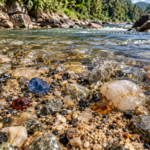
Gemstones may accumulate within gravel layers, channels, depressions or other sedimentary traps.
Alluvial gemstone deposits are often called placers.
However, placer is a broader geological term that can also include concentrations formed through other sedimentary processes.
These distinctions are important because not every secondary gemstone deposit is an ancient riverbed.
Research on ruby deposits in Mozambique has demonstrated that some extensive gravel concentrations previously interpreted as alluvial may instead have developed through predominantly residual or slope-related processes.
Accurate geological interpretation therefore requires examination of the sediments themselves.
5. Why Rivers Concentrate Gemstones
Rivers transport sediment through moving water.
The ability of a river to move particles depends on several factors.
These include water velocity, turbulence, particle size, particle shape and density.
A mineral’s specific gravity is particularly relevant.
Specific gravity compares the density of a material with that of water.
Corundum, the mineral species that includes ruby and sapphire, has a specific gravity of approximately 4.
Quartz has a specific gravity of approximately 2.65.
Consequently, corundum is substantially denser than quartz.
However, sediment transport cannot be predicted from density alone.
Particle size and shape also influence whether a mineral remains in motion.
Under suitable hydraulic conditions, relatively dense minerals can become concentrated as lighter sediment is transported elsewhere.
Changes in river flow may create favourable traps.
These can occur in depressions within bedrock, behind natural obstructions or within particular gravel layers.
Former river channels can also preserve gemstone concentrations.
Such abandoned channels are often described as paleochannels.
A paleochannel may lie beneath younger sediments.
It may no longer contain flowing water.
Nevertheless, its ancient gravel layers can preserve gemstones deposited by earlier river systems.
This explains why gemstone miners sometimes excavate beneath modern ground surfaces to reach sediments formed by rivers that disappeared or changed course long ago.
6. Why Different Gemstones Can Be Found Together
One of the most fascinating characteristics of secondary deposits is that they can contain gemstones with very different geological origins.
Consider a hypothetical river system draining several rock formations.
One formation contains corundum.
Another contains garnet.
A third contains quartz and tourmaline.
Weathering releases minerals from each formation.
The river transports the resulting sediment into a shared drainage system.
Over time, the more resistant minerals may become concentrated within the same gravel layer.
A miner could therefore recover sapphire, garnet, quartz and tourmaline from one deposit.
Yet these minerals did not necessarily crystallise together.
Their original geological environments may have been entirely different.
Research published by the Gemological Institute of America in 2025 examines precisely this phenomenon.
The study explains that the diversity of gemstones found in regions such as Mogok in Myanmar and Ratnapura in Sri Lanka reflects the interaction of several geological environments.
Different source rocks contribute minerals to shared sedimentary systems.
The resulting deposits can contain an extraordinary range of gemstones.
This is particularly important when interpreting mineral associations.
Finding two gemstones together in gravel does not prove that they formed together.
Their shared location may result entirely from later geological transport.
A gemstone deposit can preserve the history of several geological environments within one layer of sediment.
7. Gem-Bearing Pegmatites: Crystals Hidden Within Igneous Rocks
Not all gemstone mining involves river gravels.
Some important gemstones are recovered directly from igneous rock formations.
Granitic pegmatites are particularly significant.
Pegmatites are generally coarse-grained igneous rocks.
Some contain exceptionally large crystals.
They may also contain unusual concentrations of elements that are relatively uncommon in the Earth’s crust.
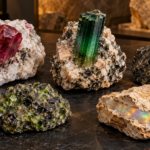
Gem-bearing pegmatites can produce aquamarine, tourmaline, topaz, spodumene and several other minerals.
Their internal structures can be complex.
Some contain distinct mineralogical zones.
Others contain cavities or pockets in which well-formed crystals developed.
These pockets can be exceptionally valuable.
A relatively small cavity may contain several attractive crystals.
However, gemstone distribution within a pegmatite is frequently irregular.
Large volumes of rock may contain little material suitable for jewellery.
A nearby pocket may produce an important mineral specimen or valuable faceting rough.
This irregularity makes pegmatite mining particularly challenging.
Geological knowledge can help identify promising zones, but it does not eliminate uncertainty.
Research published in Gems & Gemology in 2025 provides a detailed review of granitic pegmatites and their importance as gemstone sources.
The study explains how mineral chemistry, crystallisation conditions and internal zoning influence the distribution of gem minerals.
For collectors, pegmatites are particularly interesting because they may preserve crystals with well-developed natural faces.
Such specimens can reveal information about mineral growth that is no longer visible after cutting and polishing.
8. Ancient Gemstone Mining: Rivers, Gravels and Accessible Deposits
Gemstone mining has a long history.
However, the archaeological evidence varies considerably between regions.
Ancient written accounts, mining remains, tools and surviving jewellery provide different forms of information.
It is important not to assume that every historically important gemstone locality was continuously mined from the earliest periods associated with its reputation.
Nevertheless, accessible secondary deposits offered practical opportunities for early gemstone recovery.
River gravels could be examined using relatively simple methods.
Sediment could be collected, washed and sorted.
Attractive minerals could be recognised by their colour, hardness, transparency or crystal form.
The relative accessibility of some placer deposits made them important sources of gemstones before modern industrial mining techniques existed.
Sri Lanka provides a particularly significant historical example.
The island has been associated with gemstone production and trade for approximately two millennia or longer.
Its historical reputation as a source of sapphires and other gemstones is documented in both regional traditions and accounts of long-distance trade.
The Gemological Institute of America’s 2014 expedition report examines this history alongside the island’s modern gemstone industry.
However, the precise methods used at individual ancient sites must be reconstructed from available historical and archaeological evidence.
Modern descriptions of traditional mining should not automatically be treated as exact representations of practices from two thousand years ago.
9. Sri Lanka: A Geological Landscape Rich in Gemstones
Sri Lanka is among the world’s most historically significant gemstone-producing regions.
Its gemstone deposits are closely connected with the island’s complex metamorphic geology.
Large areas contain high-grade metamorphic rocks.
These formations have experienced substantial geological transformation.
Over time, weathering and erosion released resistant minerals from their source rocks.
The resulting sediments accumulated in valleys and drainage systems.
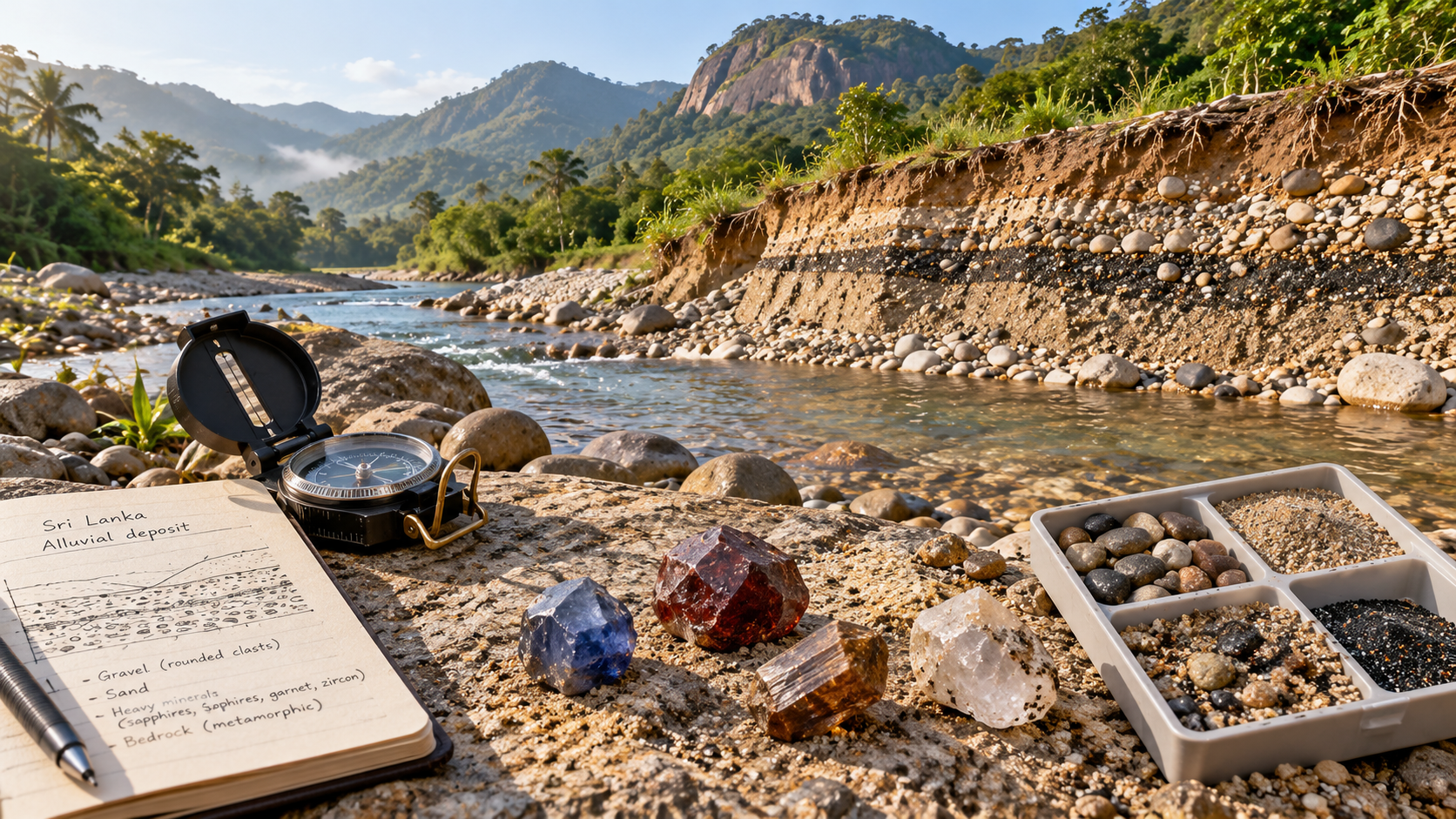
The Ratnapura region is especially well known for gemstone-bearing gravels.
These deposits can contain several mineral species.
Examples include sapphire, chrysoberyl, garnet, zircon, spinel and quartz.
The diversity reflects the geological characteristics of the wider region.
Different minerals formed under different conditions.
Subsequent erosion brought them into shared sedimentary environments.
Traditional gemstone mining in Sri Lanka has frequently involved excavating pits to reach gem-bearing gravel layers.
The material is then separated and examined.
However, the depth, composition and economic value of individual deposits vary.
Not every gravel layer contains gemstones.
Not every recovered crystal is suitable for faceting.
The distinction between mineral occurrence and commercial gemstone quality remains important.
Sri Lanka demonstrates how long-term geological processes can create gemstone concentrations that support mining activities across many generations.
10. Mogok: The Geological Complexity Behind a Historic Ruby Region
The Mogok Stone Tract in Myanmar is one of the world’s most famous ruby-producing regions.
Its reputation developed through centuries of gemstone production and trade.
However, Mogok is geologically more diverse than the expression Valley of Rubies might suggest.
The region contains several rock types associated with different gemstones.
Ruby and spinel occur in marble-related environments.
Other gemstones are associated with different igneous and metamorphic formations.
Pegmatites contribute additional mineral species.
Weathering and erosion have redistributed many of these materials into secondary deposits.
Consequently, a single mining region can contain gemstones with different formation histories.
The Gemological Institute of America’s research on Mogok documents the historical development of mining activities and the complexity of the region’s gemstone deposits.
Historical mining methods included working gemstone-bearing gravels.
Later operations introduced more mechanised approaches.
However, mechanisation did not remove the geological uncertainty associated with gemstone recovery.
The distribution of valuable crystals remained irregular.
Mogok illustrates an important distinction.
A famous gemstone locality is not necessarily a single geological deposit.
It may represent an entire district containing multiple mineralising environments and several generations of sedimentary concentration.
11. Madagascar: The Discovery of Ilakaka
Modern gemstone history provides examples of major deposits becoming internationally important within a relatively short period.
One of the most notable is Ilakaka in southern Madagascar.
The gemstone-producing area became widely known following discoveries in 1998.
Its extensive sapphire-bearing sediments attracted substantial mining activity.
The deposits are associated with ancient drainage systems.
Gem-bearing gravel layers occur within former river channels and related sedimentary environments.
These paleochannels are particularly important because they can preserve concentrations of durable minerals.
Ilakaka produces sapphire, but other gemstones also occur.
These include chrysoberyl, spinel, garnet, tourmaline and zircon.
The mineral diversity reflects the wider geological history of the region.
In 2015, GIA published a field report documenting gemstone mining at Ilakaka.
Researchers examined mining areas, geological conditions and the methods used to recover gemstones.
The report also described the importance of collecting well-documented reference samples.
These samples help laboratories investigate the characteristics of gemstones from known localities.
Ilakaka demonstrates that modern gemstone discoveries can still emerge from geological environments shaped by processes operating over immense periods.
The gemstones themselves are ancient geological materials.
Their recognition as an important commercial resource is comparatively recent.
12. Mozambique: A Modern Ruby Discovery
The Montepuez region of Mozambique provides another important example.
Major ruby deposits were discovered there in 2009.
The discovery significantly influenced the international ruby market.
The geological environment differs from that of many traditional marble-hosted ruby deposits.
Ruby mineralisation in the Montepuez area is associated with metamorphic rocks, including amphibole-rich formations.
Both primary and secondary deposits occur.
Some rubies remain within strongly weathered host rocks.
Others occur in sediments formed through weathering and redistribution.
An important scientific development concerns the interpretation of these secondary deposits.
Early explanations emphasised alluvial transport.
However, subsequent field investigations demonstrated that some extensive ruby-bearing gravel layers were not consistent with ordinary river deposition.
Their sedimentary characteristics suggested a stronger influence from residual weathering and related processes.
This distinction matters.
Rounded, well-sorted river gravels provide different geological evidence from poorly sorted residual concentrations.
The interpretation influences exploration strategies.
It also demonstrates that scientific explanations can change when additional field evidence becomes available.
The history of Montepuez is therefore not only a story of gemstone discovery.
It is also an example of how geological models are revised through continued investigation.
13. Emerald Deposits: Why Geology Matters More Than Colour
Emerald is the green variety of beryl.
Its chemical composition is Be₃Al₂Si₆O₁₈.
Its green colour is associated principally with chromium and/or vanadium.
However, emerald deposits do not all form in the same geological environment.
Some are associated with interactions between pegmatitic or other magmatic-related fluids and suitable host rocks.
Others develop through different fluid-rock processes.
Zambia provides an important example of emerald mineralisation associated with metamorphic rocks and chemically reactive geological environments.
The Kafubu emerald district has been studied extensively.
Research published in Gems & Gemology describes emerald formation in reaction zones associated with beryllium-bearing veins and chromium-bearing host rocks.
The necessary chemical components were brought together through geological processes.
Colombian emerald deposits present a different geological model.
Important Colombian emerald mineralisation occurs within sedimentary formations affected by faults, fractures and mineralising fluids.
The contrast demonstrates why gemstone exploration must be based on the geology of the target mineral.
A geological model suitable for sapphire placers cannot simply be transferred to every emerald deposit.
Likewise, the presence of green minerals does not establish that a region contains commercially significant emerald.
Colour is not a geological exploration method.
The relevant evidence concerns mineral composition, host rocks, structures and the processes responsible for mineralisation.
14. Diamonds: When the Mining Rock Is Not the Formation Rock
Diamonds provide one of the clearest examples of the distinction between gemstone formation and geological transport.
Many natural diamonds crystallised at considerable depths within the Earth’s mantle.
Their formation required conditions very different from those found near the surface.
They were subsequently transported upward by rapidly ascending magmas.
Kimberlite is the most important rock type associated with this transport.
Lamproite has also transported diamonds to the surface.
An essential scientific distinction is that diamonds generally did not crystallise from the kimberlite magma.
The magma acted as a transport mechanism.
Once the diamond-bearing rock reached the surface, weathering could release the diamonds.
They could then enter secondary sedimentary systems.
Consequently, diamonds are recovered from both primary kimberlite-related deposits and secondary concentrations.
Some secondary deposits occur in river sediments.
Others occur in coastal or marine environments.
The Gemological Institute of America’s research on kimberlites explains how these unusual magmas transported diamonds from great depth.
The example demonstrates that a gemstone’s geological history may include several fundamentally different stages.
Formation, transport, exposure, erosion and eventual recovery are not necessarily part of one continuous process.
15. How Modern Geologists Explore for Gemstone Deposits
Modern gemstone exploration combines geological knowledge with field investigation.
The methods used depend on the target mineral and deposit type.
There is no universal exploration procedure suitable for every gemstone.
Nevertheless, several approaches are widely relevant.
Geological mapping
Geologists examine rock types, structures and their relationships.
They identify formations associated with known gemstone occurrences.
Faults, contacts, veins and metamorphic zones may provide important clues.
Historical and geological research
Existing geological maps, published studies and historical mining records can help identify promising areas.
However, historical reports require critical interpretation.
An old reference to gemstones does not necessarily establish the existence of a commercially viable deposit.
Remote sensing
Satellite imagery and aerial surveys can provide information about surface geology, drainage patterns and landscape structures.
Remote sensing is particularly useful for identifying features that require further field investigation.
However, imagery alone generally cannot establish the presence of gem-quality crystals.
Geochemical investigation
Geochemical analysis can identify variations in elemental concentrations.
These patterns may help geologists recognise geological environments associated with particular minerals.
The relevant elements and analytical methods depend on the target deposit.
Geophysical investigation
Geophysical methods can provide information about subsurface structures and variations in physical properties.
Their usefulness depends on whether the target deposit produces a detectable contrast with surrounding materials.
Not every gemstone deposit can be identified effectively through geophysical surveys.
Sediment sampling
In regions containing potential placer deposits, geologists may examine sediment samples.
Heavy-mineral concentrates can provide information about resistant minerals present within a drainage system.
The mineral assemblage may help identify possible source environments.
Drilling and excavation
Where geological evidence justifies further investigation, drilling or excavation may provide direct information about subsurface materials.
The resulting samples can be examined for gemstone content and geological characteristics.
However, finding gemstones in one sample does not establish the continuity or economic value of an entire deposit.
Modern exploration is therefore a process of progressively reducing geological uncertainty.
16. Why Gemstone Exploration Remains Difficult
Gemstone deposits differ from many conventional mineral deposits.
Commercial value may depend heavily on the quality of individual crystals rather than the total quantity of a mineral present.
A rock formation can contain abundant corundum without producing attractive ruby or sapphire.
A pegmatite may contain numerous tourmaline crystals but relatively little transparent material suitable for faceting.
An emerald deposit may contain substantial mineralisation while producing only limited quantities of high-quality gemstones.
This creates a challenge for resource evaluation.
A deposit’s commercial potential depends on several interacting factors.
These include recoverable quantity, gemstone quality, mining conditions, processing requirements and market demand.
Gemstone distribution may also be irregular.
One area can produce exceptional crystals.
Nearby material may contain little of commercial interest.
This is particularly evident in some pegmatite deposits, where valuable pockets may be separated by large volumes of comparatively unproductive rock.
Consequently, gemstone exploration cannot rely solely on identifying the correct mineral species.
The distribution and quality of recoverable material are equally important.
17. From Geological Discovery to Gemstone Recovery
Discovering a promising gemstone occurrence is only the beginning.
A potential deposit must be investigated before commercial extraction can be evaluated.
The necessary work depends on the deposit type.
For primary deposits, geological investigation may focus on mineralised zones, host-rock characteristics and the distribution of gem-bearing material.
For secondary deposits, attention may concentrate on sedimentary layers, gravel thickness, depth and concentration patterns.
Sampling can provide information about recoverable gemstones.
However, gemstone quality can vary considerably within a deposit.
A small sample may not represent the wider mineralisation.
The distinction between mineral occurrence and economically recoverable gemstones is therefore essential.
Extraction methods also vary.
Some deposits are worked through open excavations.
Others require underground mining.
Certain secondary deposits are processed through washing and separation systems.
Pegmatite mining may involve careful excavation around mineral pockets.
The most appropriate approach depends on geology, deposit geometry, material characteristics and operational conditions.
No single mining method is suitable for every gemstone deposit.
18. What the Shape of Rough Gemstones Can Reveal
Rough gemstones can preserve information about their geological history.
A crystal with well-developed natural faces may indicate relatively limited mechanical abrasion after its formation.
A rounded crystal may suggest transport or prolonged contact with surrounding sediment.
Fractured surfaces can reflect geological stress, weathering or later damage.
However, these observations must be interpreted cautiously.
A rounded appearance does not establish a precise transport distance.
Some minerals develop naturally rounded-looking crystal forms.
Other crystals may have been modified by dissolution or resorption.
Similarly, a sharp crystal face does not prove that a gemstone was recovered directly from its original host rock.
Short-distance transport may preserve delicate features under favourable conditions.
Surface characteristics therefore provide clues rather than definitive proof.
For rough gemstone buyers, this distinction is important.
The external appearance of a crystal can provide information about its condition and possible history.
It does not independently establish geographical origin.
19. Why Geological Origin Is Not the Same as Commercial Provenance
The word origin can describe several different things.
In geology, it may refer to the environment in which a gemstone formed.
In gemmology, geographical origin commonly refers to a country or region associated with a gemstone’s source.
In commercial documentation, provenance may refer to the documented history of a particular specimen.
These concepts overlap, but they are not identical.
A sapphire may possess characteristics consistent with a particular geological environment.
A laboratory may compare its inclusions, chemistry and spectroscopy with reference material from known localities.
However, similar geological environments can produce gemstones with overlapping characteristics.
This can make geographical origin determination difficult.
A gemstone’s geological characteristics do not necessarily provide a complete record of its commercial journey.
Likewise, a supplier’s country-of-origin statement is not equivalent to an independent laboratory origin opinion.
Documented chain-of-custody information represents another category of evidence.
These distinctions are particularly important for gemstone collectors and buyers.
Reliable descriptions should not claim more certainty than the available evidence supports.
20. The Importance of Field Research and Reference Collections
Modern gemmological laboratories benefit from well-documented reference samples.
Such specimens may be collected during geological field expeditions.
Their value lies partly in the reliability of the information associated with them.
A gemstone collected directly from a documented mining location can provide a useful reference for laboratory comparison.
Researchers may investigate its inclusions, trace-element composition and spectroscopic characteristics.
These results can then be compared with gemstones of uncertain origin.
However, reference collections require careful management.
Samples must be identified accurately.
Their collection circumstances should be recorded.
Analytical data must be interpreted within the geological context of the source.
The Gemological Institute of America’s field research programme has documented gemstone-producing regions including Sri Lanka, Madagascar, Myanmar and Mozambique.
Such research contributes to a better understanding of both gemstone geology and laboratory identification.
Nevertheless, geographical origin determination remains an evidence-based interpretation.
It is not always possible to identify a gemstone’s source with complete certainty.
21. Ancient Experience and Modern Science
The development of gemstone mining illustrates a gradual expansion of geological knowledge.
Ancient miners learned to recognise productive locations through observation and experience.
They discovered that particular river gravels could contain valuable minerals.
They identified rock formations associated with attractive crystals.
They developed methods for recovering and separating gemstones.
Modern geology provides a scientific explanation for many of these observations.
It explains why certain minerals occur within particular rock types.
It identifies the processes responsible for releasing gemstones through weathering.
It describes how sediment transport concentrates durable crystals.
It also reveals why some gemstone districts contain multiple mineral species.
However, modern science has not eliminated the practical importance of field experience.
Local knowledge can remain valuable when investigating gemstone occurrences.
The most reliable understanding emerges when observations are examined within a sound geological framework.
Traditional experience and scientific research need not be opposing approaches.
They can provide different forms of evidence about the same natural environment.
22. Common Misconceptions About Gemstone Mining
Several misconceptions can distort our understanding of gemstone deposits.
All gemstones are mined from solid rock.
Incorrect.
Many gemstones are recovered from secondary sediments, including river gravels and other placer deposits.
A gemstone found in a river must have formed there.
Incorrect.
It may have crystallised in a distant geological formation before being transported into the river system.
Gemstones found together always formed together.
Incorrect.
Secondary deposits can combine minerals from different source rocks.
Every secondary deposit is alluvial.
Incorrect.
Eluvial and colluvial processes can also produce gemstone concentrations.
Hardness alone determines whether a gemstone survives erosion.
Incorrect.
Chemical stability, toughness, cleavage, particle size and transport conditions also influence survival.
A gemstone’s external shape proves its geographical origin.
Incorrect.
Crystal morphology and surface characteristics can provide clues but rarely establish geographical origin independently.
All pegmatites contain valuable gemstones.
Incorrect.
Many pegmatites contain no commercially significant gem-quality material.
A mineral-rich deposit must be economically valuable.
Incorrect.
Commercial viability depends on recoverable quality, quantity and operating conditions.
Modern exploration guarantees successful mining.
Incorrect.
Geological investigation reduces uncertainty but cannot eliminate it.
A country famous for gemstones contains only one deposit type.
Incorrect.
Major gemstone-producing regions can contain several geological environments and different mineralising processes.
23. What Gemstone Mining Teaches Modern Collectors
Understanding gemstone deposits changes the way natural rough material can be appreciated.
A water-worn sapphire represents more than a crystal of corundum.
It may preserve evidence of an ancient geological source and a later history of erosion and sedimentary transport.
An aquamarine crystal from a pegmatite may preserve natural crystal faces that reveal aspects of its growth environment.
A ruby recovered from marble may remain associated with minerals that formed during metamorphism.
A garnet discovered in river gravel may have originated from a completely different rock formation than the sapphire found beside it.
These geological histories contribute to the scientific interest of natural gemstones.
However, they should not be confused with commercial value.
A scientifically interesting specimen is not necessarily a high-value faceting gemstone.
Likewise, a visually exceptional gemstone may have lost much of its original geological context through extraction and processing.
For collectors, both perspectives are valuable.
Gemstone quality concerns the characteristics of the specimen.
Geological history concerns the natural processes responsible for its formation and occurrence.
Understanding both provides a more complete appreciation of the material.
Conclusion: From Geological Formation to Human Discovery
Gemstone mining represents the meeting point between geological history and human exploration.
Natural gemstones form under particular physical and chemical conditions.
Their distribution reflects the complex evolution of the Earth’s crust and mantle.
Some remain within their original geological environments.
Others are transported toward the surface through volcanic processes.
Weathering can release resistant minerals from surrounding rock.
Rivers and other sedimentary systems may redistribute and concentrate them.
These processes create the deposits eventually discovered by miners.
Throughout history, people have learned to recognise and recover gemstones from these environments.
Ancient mining traditions developed around accessible mineral occurrences and productive gravels.
Modern geological exploration builds on these observations through mapping, sampling, scientific analysis and increasingly sophisticated investigations.
Yet the fundamental challenge remains unchanged.
Gemstones are not distributed evenly throughout the Earth.
Their occurrence depends on exceptional geological circumstances.
Their commercial value depends on much more than mineral abundance.
And their eventual discovery may occur millions of years after their formation.
Perhaps the most remarkable lesson is that a gemstone’s history does not end when crystallisation is complete.
The surrounding rock may change.
Mountains may rise and erode.
Rivers may alter their courses.
Sediments may accumulate and become buried.
The crystal may survive these transformations until it is eventually recovered.
Every natural gemstone is therefore the product of two histories: the geological processes that created it and the geological journey that made its discovery possible.
Understanding these histories transforms gemstone mining from a simple extraction activity into a fascinating study of the Earth’s changing landscapes.
References & Further Reading
The following references have been selected from recognised geological institutions and professional gemmological research publications.
They provide scientific and historical support for the geological classifications, mineral formation processes, sedimentary transport mechanisms and mining examples discussed in this article.
All references lead to educational, scientific or research resources rather than commercial gemstone product pages.
1. Giuliani, Gaston, and Groat, Lee A. – Geology of Corundum and Emerald Gem Deposits: A Review
Publication: Gems & Gemology
Volume: 55, Number 4
Published: Winter 2019
Institution: Gemological Institute of America
A comprehensive scientific review of ruby, sapphire and emerald deposits.
The research explains primary and secondary deposits, magmatic and metamorphic environments, sedimentary concentration and the geological processes associated with major gemstone-producing regions.
https://www.gia.edu/gems-gemology/winter-2019-geology-of-corundum-and-emerald-gem-deposits
2. Palke, Aaron C., Shigley, James E., and Vertriest, Wim – The Diversity of Gemstone Deposits
Publication: Gems & Gemology
Volume: 61, Number 4
Published: Winter 2025
Institution: Gemological Institute of America
A recent scientific examination of why different gemstones occur together in particular geological environments.
The publication explains how primary mineral associations differ from mixed gemstone concentrations produced through weathering and sedimentary transport.
https://www.gia.edu/gems-gemology/winter-2025-colored-stones-unearthed
3. Shigley, James E., Bassoo, Roy, and Palke, Aaron C. -Gems Recovered from Sedimentary Rocks
Publication: Gems & Gemology
Volume: 59, Number 4
Published: Winter 2023
Institution: Gemological Institute of America
An authoritative review of gemstones occurring in sedimentary environments.
The study explains placer deposits, mineral durability, sedimentary concentration and the differences between minerals formed within sediments and gemstones transported into them.
https://www.gia.edu/gems-gemology/winter-2023-colored-stones-unearthed
4. United States Geological Survey – Natural Gemstones: Geologic Environment
Institution: United States Geological Survey
Resource: Natural Gemstones educational publication
An accessible geological reference explaining gemstone occurrences in igneous, metamorphic and sedimentary environments.
The resource discusses pegmatites, placer deposits and the geological conditions associated with gemstone concentration.
https://pubs.usgs.gov/gip/gemstones/environment.html
5. Palke, Aaron C., and Shigley, James E. – Gem Granitic Pegmatites
Publication: Gems & Gemology
Volume: 61, Number 2
Published: Summer 2025
Institution: Gemological Institute of America
A detailed scientific review of granitic pegmatites.
The publication examines their mineralogy, formation, internal structure and importance as sources of aquamarine, tourmaline, topaz, spodumene and other gemstones.
https://www.gia.edu/gems-gemology/summer-2025-colored-stones-unearthed
6. Shigley, James E., and Kamp, Anthony R. – Gem-Bearing Pegmatites: A Review
Publication: Gems & Gemology
Volume: 20, Number 2
Published: Summer 1984
Institution: Gemological Institute of America
A foundational geological review of gem-bearing pegmatites.
The study explains crystal growth, mineral pockets and the conditions associated with the formation of valuable gemstone deposits.
https://www.gia.edu/gems-gemology/summer-1984-pegmatite-shigley
7. Gemological Institute of America – Sri Lanka: Expedition to the Island of Jewels
Publication: Gems & Gemology
Published: Fall 2014
Institution: Gemological Institute of America
A detailed field report examining Sri Lanka’s gemstone history, geological environments, mining practices and gemstone industry.
The publication provides valuable information about the island’s longstanding importance as a source of sapphire and other gemstones.
https://my.gia.edu/jp/gems-gemology/fall-2014-sri-lanka-expedition-island-of-jewels
8. Gemological Institute of America – Mogok Expedition Series, Part 1: The Valley of Rubies
Institution: Gemological Institute of America
Published: 2014
Resource: Field research and historical investigation
An educational field report examining the history of ruby mining in Mogok, Myanmar.
The publication discusses historical mining activities, geological conditions and changes in mining methods.
https://www.gia.edu/gia-news-research-expedition-to-the-valley-of-rubies-part-1
9. Gemological Institute of America – Field Gemology Team Explores Sapphire Mines at Ilakaka, Madagascar
Institution: Gemological Institute of America
Published: 28 August 2015
Resource: Field expedition report
A documented investigation of the Ilakaka sapphire-producing region.
The report explains the importance of paleochannels, gemstone-bearing gravels, mining methods and field reference samples.
https://www.gia.edu/gia-news-research/sapphire-mines-ilakaka-madagascar-field-expedition
10. Gemological Institute of America – A Decade of Ruby from Mozambique: A Review
Publication: Gems & Gemology
Published: Summer 2019
Institution: Gemological Institute of America
A comprehensive review of ruby mining in Mozambique.
The publication examines the Montepuez discovery, geological formation, primary and secondary deposits and the interpretation of ruby-bearing sedimentary layers.
https://www.gia.edu/gems-gemology/summer-2019-decade-of-ruby-from-mozambique
11. Zwaan, J. C., et al. – Emeralds from the Kafubu Area, Zambia
Publication: Gems & Gemology
Volume: 41, Number 4
Published: Winter 2005
Institution: Gemological Institute of America
A scientific investigation of emerald deposits in Zambia.
The research examines the geological conditions associated with emerald formation, host-rock interactions, mineral inclusions and gemmological characteristics.
https://www.gia.edu/gems-gemology/winter-2005-emeralds-kafubu-zambia-zwaan
12. Gemological Institute of America – Kimberlites: Earth’s Diamond Delivery System
Publication: Gems & Gemology
Published: Summer 2019
Institution: Gemological Institute of America
A scientific explanation of how kimberlitic magmas transport diamonds from deep geological environments toward the Earth’s surface.
The publication distinguishes diamond formation from the geological processes responsible for bringing diamonds into mineable deposits.
https://www.gia.edu/gems-gemology/summer-2019-kimberlites-earths-diamond-delivery-system
Scientific and Historical Interpretation
Gemstone deposits develop through different geological processes.
The classification of a deposit as primary, eluvial, colluvial or alluvial depends on its geological characteristics and the evidence available.
Not all gemstone occurrences can be assigned to a single simplified category.
Historical mining practices should be interpreted according to archaeological and documentary evidence.
Modern mining methods do not necessarily represent the techniques used in antiquity.
Likewise, the presence of gemstones within a geological formation does not automatically establish that commercial extraction is economically viable.
Geographical origin determination and documented commercial provenance are separate forms of information.
Scientific investigations can provide evidence about geological formation and possible source regions, but they do not always establish the precise mining location of an individual gemstone.
The purpose of this article is to explain gemstone geology, historical mining development and modern exploration through established scientific evidence.