Table of Contents
Introduction: Why Are Gemstones Found in Certain Places?
Understanding the geological formation of gemstones is essential for appreciating their value and rarity.
Why are exceptional rubies associated with some metamorphic mountain belts?
Why do certain granite pegmatites contain remarkable tourmaline and beryl crystals?
Why are diamonds recovered from volcanic rocks even though most natural diamonds formed much deeper within the Earth?
And why can opal develop in comparatively shallow geological environments while other gemstones require extreme pressures and temperatures?
The answers lie in the geological processes that create, transport and preserve mineral crystals.
Gemstones are not distributed randomly throughout the Earth’s crust.
Their occurrence is controlled by a complex combination of geological conditions, including chemical composition, temperature, pressure, fluid activity, tectonic history and the availability of space for crystal growth.
These conditions determine which minerals can form and whether they can develop into crystals suitable for jewellery or collecting.
However, an important distinction must be made from the beginning.
The geological environment in which a gemstone is discovered is not necessarily the environment in which it originally formed.
A sapphire recovered from river gravel may have crystallised within a metamorphic or magmatic environment millions of years earlier.
A diamond discovered in kimberlite formed at depths far greater than those at which the kimberlite magma originated.
A crystal found in a weathered deposit may have passed through several geological environments before being recovered.
The study of the geological formation of gemstones reveals their unique histories and connections to Earth’s processes.
It also reveals why gemstones are extraordinary geological records of the processes that have shaped our planet.
1. The Fundamental Conditions Required for Gemstone Formation
Every mineral possesses a characteristic chemical composition and crystal structure.
However, the presence of the necessary chemical elements does not automatically produce that mineral.
The surrounding geological environment must also permit its formation.
Several factors are particularly important.
Chemical composition
The necessary elements must be available in suitable proportions.
For example, corundum consists primarily of aluminium oxide.
Emerald is a variety of beryl containing trace elements responsible for its characteristic green colour.
Diamond consists of carbon.
Yet aluminium, beryllium and carbon can participate in many different minerals or chemical compounds.
The resulting material depends on the conditions under which crystallisation occurs.
Temperature
Temperature influences chemical reactions, mineral stability and the movement of atoms.
Some gemstones crystallise from high-temperature magmas.
Others form through solid-state mineral reactions during metamorphism.
Still others precipitate from relatively low-temperature aqueous solutions.
Pressure
Pressure affects mineral stability and the physical conditions under which crystals develop.
Some minerals form only within particular pressure-temperature ranges.
The three aluminium silicate minerals kyanite, andalusite and sillimanite provide a classic example.
All three have the chemical composition Al₂SiO₅, but possess different crystal structures.
Their stability depends on pressure and temperature.
Fluids
Water and other geological fluids can transport dissolved chemical components.
They can also promote reactions between different rocks.
In many gemstone deposits, fluid circulation is essential to mineral formation.
Geological time
Crystal formation requires suitable conditions to persist long enough for growth to occur.
However, time alone does not guarantee the development of large, transparent crystals.
Growth rate, chemical supply, available space and environmental stability are also important.
Gemstone formation is therefore controlled by the interaction of chemistry, physics and geological history.
2. Four Major Geological Environments
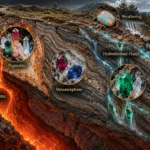
Gemstone formation can be discussed through four broad geological environments.
These categories provide a useful framework, although their boundaries are not always sharply defined.
Magmatic environments
Minerals crystallise from molten rock or from processes closely associated with magma.
Metamorphic environments
Existing rocks undergo mineralogical changes through temperature, pressure and deformation, generally without complete melting.
Hydrothermal environments
Minerals crystallise or recrystallise through interactions involving hot, chemically active fluids.
Sedimentary and near-surface environments
Minerals may precipitate from aqueous solutions, form through weathering processes or become concentrated through erosion and sediment transport.
These categories overlap.
A hydrothermal fluid may originate from a cooling magma.
Metamorphism may involve extensive fluid circulation.
Sedimentary rocks may later undergo metamorphism.
Consequently, geological classifications should be understood as descriptions of dominant processes rather than completely isolated systems.
3. Magmatic Gemstones: Crystallisation from Molten Rock
Magma is molten or partially molten rock beneath the Earth’s surface.
As magma cools, minerals may begin to crystallise.
The sequence of crystallisation depends on several factors, including the chemical composition of the magma, temperature, pressure and the presence of dissolved volatile components.
Different minerals become stable under different conditions.
For example, olivine commonly crystallises at relatively high temperatures in magnesium- and iron-rich magmas.
Quartz and potassium-rich feldspar are characteristic of more silica-rich systems and generally crystallise at lower temperatures within the conventional silicate crystallisation sequence.
The sequence is often introduced through Bowen’s reaction series.
This model provides an important foundation for understanding igneous petrology.
However, natural magmatic systems can be more complicated than a single idealised crystallisation sequence.
Magma mixing, fractional crystallisation, assimilation of surrounding rocks and volatile activity can all influence the final mineral assemblage.
4. Peridot: A Gemstone Connected to the Earth’s Mantle
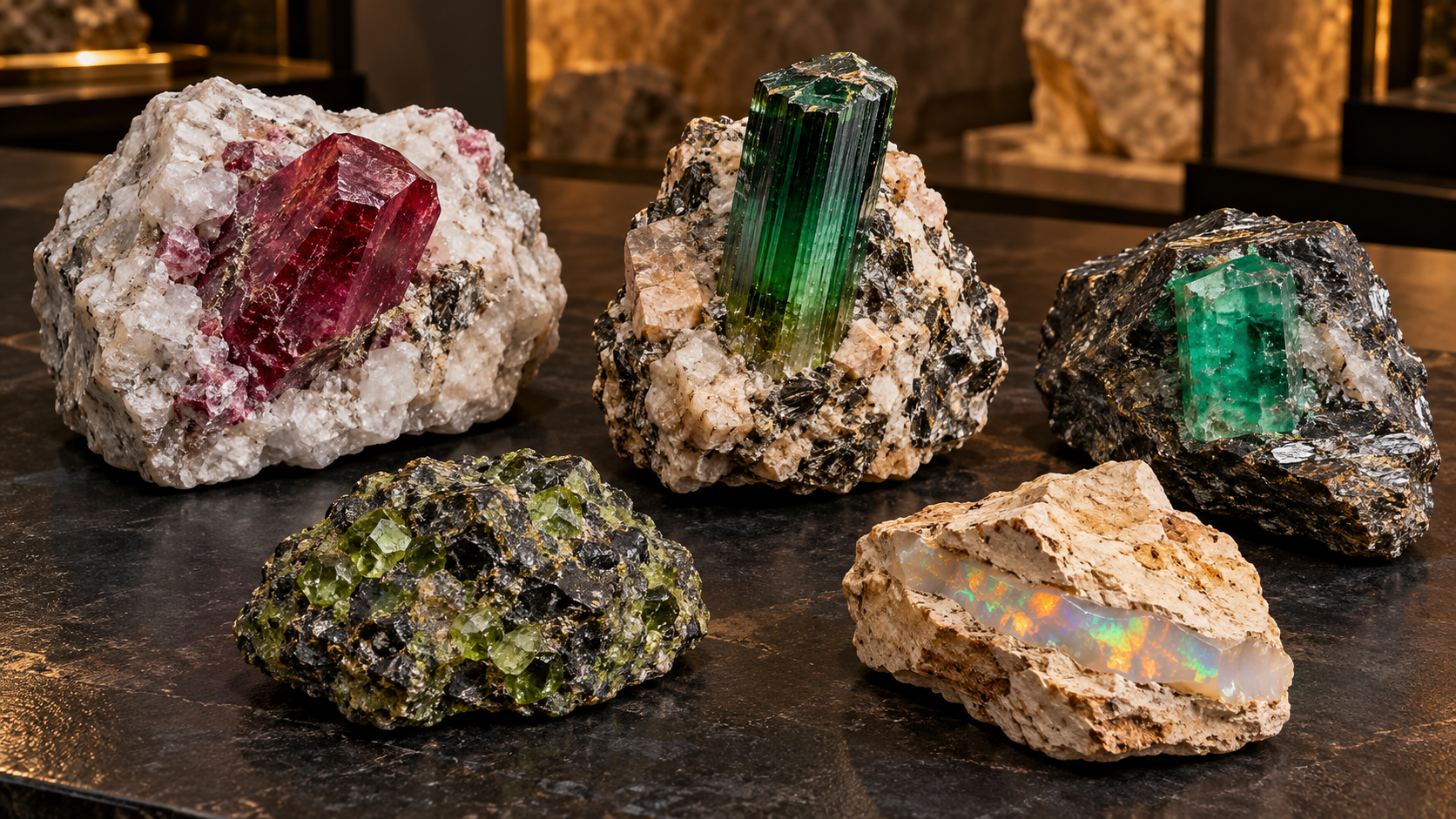
Peridot is the yellowish-green to green gemstone variety of olivine.
Olivine is a magnesium-iron silicate.
Its general chemical formula is:
(Mg,Fe)₂SiO₄
The magnesium-rich end member is forsterite.
The iron-rich end member is fayalite.
Most gem-quality peridot belongs to the magnesium-rich portion of the olivine solid-solution series.
Olivine is an important constituent of the Earth’s upper mantle.
Some peridot deposits are associated with basaltic volcanic activity.
In these occurrences, volcanic magma can transport fragments of mantle rock toward the surface.
Such fragments are called xenoliths.
They may contain olivine crystals that formed before the volcanic eruption.
This distinction is important.
The basalt may have transported the crystals without being the original environment in which they grew.
Gem-quality peridot also occurs in other geological settings.
Some deposits are associated with altered mantle-derived rocks and fluid-related processes.
Consequently, the geological history of peridot cannot be reduced to one universal formation mechanism.
Nevertheless, its relationship with mantle-derived rocks makes peridot an especially interesting gemstone for understanding the Earth’s interior.
5. Why Some Magmas Produce Exceptional Gem Crystals
Not every magma produces gemstones.
Most igneous rocks consist of relatively common rock-forming minerals.
These may include feldspar, quartz, pyroxene, amphibole and mica.
For exceptional gemstone crystals to form, additional conditions may be necessary.
The magma must contain the appropriate chemical elements.
Those elements must become concentrated sufficiently.
Crystal growth must occur under favourable physical and chemical conditions.
The resulting crystals must also survive later geological processes.
Some gemstones form as relatively small accessory minerals within igneous rocks.
Others grow in cavities or specialised late-stage environments where chemical components become concentrated.
This leads to one of the most important gemstone-producing geological settings:
Pegmatites.
6. Pegmatites: Environments Capable of Producing Extraordinary Crystals
A pegmatite is a very coarse-grained igneous rock.
Many gemstone-bearing pegmatites are associated with granitic magmatic systems.
Some contain exceptionally large mineral crystals.
Gem-bearing pegmatites may contain minerals such as:
- Tourmaline
- Beryl
- Spodumene
- Topaz
- Garnet
- Quartz
- Feldspar
However, not every pegmatite contains valuable gemstones.
Most are dominated by common rock-forming minerals.
Certain chemically evolved pegmatites become enriched in elements such as lithium, beryllium, boron, fluorine, phosphorus and other components.
These elements can be important for the development of specialised mineral assemblages.
Volatile-rich conditions may also influence crystallisation.
The presence of water and other volatile components can modify melt behaviour and facilitate the transport of chemical species.
Large crystals can develop where growth conditions and available space are favourable.
However, exceptionally large crystals are not simply the result of extremely slow cooling.
Modern pegmatite research recognises the importance of complex crystallisation kinetics, volatile behaviour and chemical evolution.
The unusual mineralogy of certain pegmatites results from the evolution of specialised geological systems rather than crystal size alone.
7. Tourmaline: Why One Mineral Group Produces So Many Colours
Tourmaline is a complex group of borosilicate minerals.
Its chemistry permits extensive substitution between different elements.
This contributes to the remarkable variety of tourmaline colours.
Tourmaline can occur in:
- Black
- Green
- Pink
- Red
- Blue
- Yellow
- Brown
- Multicoloured combinations
Several tourmaline species are important in gemmology.
Elbaite, for example, is commonly associated with lithium-rich pegmatites.
Other tourmaline species occur in metamorphic rocks and hydrothermal environments.
This demonstrates an important geological principle.
A mineral group may occur in several geological environments, even though particular species or compositions are strongly associated with certain deposit types.
The chemistry of the surrounding system influences which elements can enter the growing crystal.
Growth conditions may also change during crystallisation.
This can produce colour zoning.
Some tourmaline crystals display several distinct colour regions.
These variations can record changes in chemical conditions during crystal growth.
A multicoloured tourmaline is therefore not merely visually interesting.
It may also preserve evidence of the changing environment in which it crystallised.
8. Beryl: One Mineral, Several Geological Histories
Beryl is a beryllium aluminium cyclosilicate.
Its chemical formula is:
Be₃Al₂Si₆O₁₈
The mineral occurs in several gemstone varieties.
These include:
- Emerald
- Aquamarine
- Morganite
- Heliodor
- Goshenite
Although these varieties share the same fundamental mineral structure, their colours and geological occurrences differ.
Aquamarine, morganite and some other beryl varieties are commonly associated with granitic pegmatites.
Emerald often forms in more chemically specialised environments.
The difference is particularly interesting because emerald requires the coexistence of beryllium with suitable colour-producing elements, principally chromium and/or vanadium.
These elements are not necessarily concentrated in the same rocks.
Their interaction may require geological processes that bring chemically different materials together.
This helps explain why emerald deposits are comparatively unusual.
9. Metamorphic Gemstones: Minerals Created by Geological Transformation
Metamorphism occurs when existing rocks experience changes in temperature, pressure or chemical conditions.
These changes can produce new mineral assemblages.
The original rock is known as the protolith.
Metamorphism generally takes place without complete melting of the rock.
Minerals may become unstable under the new conditions.
Chemical reactions can then produce different minerals.
For example, clay-rich sedimentary rocks may undergo progressive metamorphism during burial and mountain-building processes.
As temperature and pressure increase, their mineral assemblages change.
Certain metamorphic minerals are useful indicators of the conditions experienced by the rock.
Garnet, kyanite, sillimanite and other minerals can provide valuable information about metamorphic history.
However, their interpretation depends on the complete mineral assemblage and chemical composition of the rock.
A single mineral does not necessarily establish one unique pressure-temperature condition.
10. Continental Collisions and Gemstone Formation
Some of the world’s most important coloured gemstone deposits are associated with ancient mountain-building events.
These events are known as orogenies.
When continental plates converge, rocks may be buried, compressed, heated and deformed.
The resulting metamorphic conditions can favour the formation of particular gemstones.
Two major geological episodes are especially important in the history of ruby and sapphire deposits.
The first involves the assembly of Gondwana during late Neoproterozoic to early Paleozoic tectonic events.
The second involves the collision of the Indian subcontinent with Asia and the development of the Himalayan mountain system.
These events contributed to gemstone-bearing metamorphic regions extending across parts of Africa and Asia.
However, not every gemstone deposit within these broad regions formed at exactly the same time or through identical processes.
Each deposit has its own geological history.
The significance of these mountain-building events lies in the extensive pressure-temperature transformations and fluid interactions they produced.
11. Ruby: Why Some Deposits Form in Marble
Ruby is the red gemstone variety of corundum.
Corundum consists primarily of aluminium oxide:
Al₂O₃
Ruby’s characteristic red colour results principally from chromium substituting for aluminium within the crystal structure.
Some important ruby deposits occur in metamorphosed carbonate rocks.
Marble-hosted ruby deposits in Myanmar provide a well-known example.
The original carbonate rocks underwent metamorphism during regional tectonic activity.
Under suitable chemical conditions, corundum crystallised within the metamorphic environment.
The formation of ruby requires more than the presence of aluminium and chromium.
The surrounding mineral assemblage and chemical conditions must favour corundum stability.
In particular, silica activity is important.
Corundum is not generally stable in equilibrium with abundant free silica under ordinary crustal conditions.
This helps explain why ruby may occur in particular chemically restricted environments rather than throughout all aluminium-bearing rocks.
Scientific studies of marble-hosted ruby deposits have documented formation conditions involving temperatures of several hundred degrees Celsius and significant crustal pressures.
However, these conditions vary between deposits.
Ruby also occurs in other geological environments, including deposits associated with mafic and ultramafic rocks.
Therefore, marble-hosted ruby represents one important formation pathway, not the only one.
12. Sapphire: Metamorphic and Magmatic Origins
Sapphire is also corundum.
The distinction between ruby and sapphire is primarily related to colour classification.
Sapphire occurs in blue and numerous other colours.
Blue sapphire commonly owes its colour to interactions involving iron and titanium.
However, the geological environments responsible for sapphire formation are diverse.
Important sapphire deposits can be broadly associated with metamorphic or magmatic processes.
Metamorphic sapphire
Some sapphires formed during regional metamorphism.
Their geological histories may involve high-grade metamorphic rocks, fluid activity and chemical reactions.
Important examples occur in regions such as Sri Lanka, Madagascar and Kashmir.
Magmatic-related sapphire
Other sapphires are associated with igneous environments.
Some are transported toward the surface by alkali basalt magmas.
These sapphires may occur as foreign crystals within volcanic rocks.
The volcanic host rock does not necessarily represent the magma in which the sapphire originally crystallised.
This is particularly important for interpreting basalt-related sapphire deposits.
The relationship between the sapphire, its original formation environment and the magma that transported it may be complex.
A sapphire found in basalt is not automatically a sapphire that crystallised directly from that basalt.
13. Garnet: A Mineral Group That Records Geological Conditions
Garnet is not one mineral species.
It is a group of related silicate minerals.
Important gemstone species include:
- Almandine
- Pyrope
- Spessartine
- Grossular
- Andradite
- Uvarovite
Their chemical compositions differ.
Many garnets also form solid-solution series.
Garnet is particularly important in metamorphic petrology.
Certain garnet compositions develop during metamorphism as temperature and pressure change.
Their chemical zoning may preserve evidence of the conditions experienced during crystal growth.
Geologists can investigate these patterns to reconstruct aspects of metamorphic history.
However, not all garnets form through metamorphism.
Some occur in igneous rocks.
Others are associated with metasomatic or hydrothermal environments.
Pyrope-rich garnets can occur in mantle-derived rocks.
Spessartine may occur in certain granitic and pegmatitic environments.
Grossular and andradite are important in some calcium-rich metamorphic and metasomatic systems.
This diversity makes garnet an excellent example of why geological environment cannot always be inferred from gemstone group name alone.
14. Hydrothermal Gemstones: Crystals Formed Through Geological Fluids
Hydrothermal processes involve chemically active fluids circulating through rocks.
These fluids can transport dissolved elements.
Their composition may change as they interact with surrounding minerals.
Changes in temperature, pressure, acidity, oxidation conditions or fluid chemistry can cause minerals to precipitate.
Hydrothermal systems occur in several geological settings.
They may be associated with:
- Cooling magmatic bodies
- Tectonic faults
- Metamorphic fluid release
- Deep sedimentary basins
- Other geological fluid systems
The word hydrothermal does not necessarily mean that the fluid originated directly from magma.
Some hydrothermal systems involve circulating groundwater or basin-derived fluids.
This distinction is particularly important when examining emerald deposits.
15. Emerald: Why Its Geological Formation Is So Unusual
Emerald is the green variety of beryl.
Its colour is principally associated with chromium and/or vanadium.
Beryllium is relatively uncommon in the Earth’s crust.
Chromium and vanadium are often associated with geological materials different from those typically enriched in beryllium.
Consequently, emerald formation frequently requires unusual chemical interactions.
One important geological model involves beryllium-bearing fluids or rocks interacting with chromium- or vanadium-bearing host rocks.
This may occur where pegmatitic or hydrothermal systems encounter mafic or ultramafic rocks.
The interaction can produce metasomatic mineral assemblages.
Metasomatism involves chemical changes in a rock caused by interaction with fluids.
Emerald may crystallise where the appropriate elements become available under suitable conditions.
However, this model does not explain every emerald deposit.
Modern geological research has demonstrated that emerald can form through several different geological pathways.
16. Colombian Emeralds: A Different Geological Model
The emerald deposits of Colombia provide an especially important example.
Many Colombian emeralds occur within sedimentary sequences containing black shale and carbonate rocks.
Their formation is associated with hydrothermal fluid circulation and tectonic activity.
These deposits are unusual because the relevant emerald-forming processes do not require direct involvement of a nearby granitic magma.
Research indicates that saline fluids circulated through sedimentary rocks and interacted with their chemical constituents.
Under appropriate conditions, the fluids transported and redistributed elements necessary for emerald formation.
Emerald crystallised within veins, fractures and related geological structures.
The geological environment differs substantially from the classic model involving pegmatites interacting with chromium-bearing rocks.
This distinction demonstrates why the phrase:
Emeralds form in pegmatites
is too simplistic.
Some emerald deposits are associated with pegmatitic and metasomatic processes.
Others, including important Colombian deposits, formed through different hydrothermal mechanisms.
Understanding these differences is essential for accurate geological interpretation.
17. Crystal Growth in Hydrothermal Veins
Hydrothermal veins develop when mineral-bearing fluids move through fractures or other openings.
As conditions change, minerals may precipitate.
Quartz is a familiar example.
Hydrothermal quartz crystals can develop within fractures and cavities.
Other minerals may crystallise alongside quartz.
The resulting assemblage depends on the composition of the fluid and surrounding rocks.
Crystal growth can occur over multiple stages.
A fracture may open.
Minerals may begin to crystallise.
Later tectonic movement may reopen the fracture.
New fluids may enter.
Additional minerals may then grow.
This sequence can produce complicated mineral relationships.
Individual crystals may preserve evidence of more than one growth episode.
Some contain fluid inclusions.
Others display growth zoning or trapped mineral inclusions.
These features can help researchers reconstruct the conditions under which the crystals developed.
However, geological interpretation requires examination of the complete evidence.
A single inclusion or growth feature rarely provides a complete geological history.
18. Sedimentary and Near-Surface Gemstone Formation
Not all gemstones require deep geological environments.
Some form through processes operating at or near the Earth’s surface.
Water plays an especially important role.
As water moves through rocks, it can dissolve and transport chemical components.
When environmental conditions change, those components may precipitate.
This can produce mineral deposits in:
- Fractures
- Cavities
- Sedimentary layers
- Weathered rock zones
- Other near-surface environments
Opal and turquoise provide important examples.
However, sedimentary gemstone deposits must be divided into two categories.
The first includes gemstones that actually formed within sedimentary or near-surface environments.
The second includes gemstones that formed elsewhere and were later transported into sedimentary deposits.
These processes are fundamentally different.
19. Opal: A Gemstone Formed from Silica-Rich Water
Opal is a hydrated form of silica.
Its composition is commonly represented as:
SiO₂·nH₂O
Unlike crystalline quartz, opal does not possess the same long-range crystalline structure.
Precious opal can display play-of-colour.
This optical phenomenon results from the interaction of light with appropriately ordered microscopic silica spheres.
The size and arrangement of these spheres influence the observed colours.
Opal formation can involve silica-bearing water moving through porous rocks, fractures or cavities.
As conditions change, silica-rich material may accumulate.
Over time, this can produce opal deposits.
Important sedimentary opal deposits occur in Australia.
However, opal can also form in volcanic geological environments.
Some deposits are associated with cavities in volcanic rocks.
Consequently, not every opal has the same geological origin.
The distinction between sedimentary and volcanic opal environments is important for understanding deposit formation.
It should not automatically be interpreted as a distinction in gemstone quality.
20. Turquoise: A Product of Weathering and Chemical Interaction
Turquoise is a hydrated copper-aluminium phosphate mineral.
Its chemical formula is commonly represented as:
CuAl₆(PO₄)₄(OH)₈·4H₂O
Turquoise can form through near-surface chemical processes involving copper-bearing rocks.
One important mechanism begins with the weathering and oxidation of copper sulfide minerals.
Water moving through the rock can transport dissolved copper.
Under suitable chemical conditions, reactions involving aluminium-bearing minerals and phosphate can produce turquoise.
The mineral may fill fractures, seams or cavities.
This process differs substantially from the deep metamorphic formation of ruby or the crystallisation of minerals from magma.
Turquoise therefore demonstrates that attractive gemstone materials can develop through relatively shallow geological processes.
Its formation depends on a suitable combination of chemical components and environmental conditions.
Not every copper deposit produces turquoise.
The necessary geological chemistry must be present.
21. Primary and Secondary Gemstone Deposits
One of the most important distinctions in gemstone geology concerns primary and secondary deposits.
Primary deposits
A primary deposit contains gemstones within their original geological setting or closely associated host material.
For example, ruby crystals may occur within the metamorphic rock in which they formed.
Tourmaline may occur within a gemstone-bearing pegmatite.
Emerald may occur within the veins or altered rocks associated with its formation.
Secondary deposits
A secondary deposit contains gemstones that have been removed from their original geological setting.
Weathering and erosion can release crystals from the host rock.
Water, gravity or other processes may transport them.
The crystals can then accumulate in sedimentary deposits.
River gravels are particularly important.
These are commonly called alluvial deposits.
Gemstones recovered from such deposits may have formed millions of years before their transport and concentration.
The location where a gemstone is mined does not necessarily identify the geological environment in which it crystallised.
22. Why Rivers Can Concentrate Gemstones
River systems transport sediment particles of different sizes, densities and shapes.
As water velocity changes, the ability of the river to transport particles also changes.
Dense and resistant minerals may become concentrated in particular parts of the sedimentary system.
Gemstones such as sapphire, ruby, spinel and certain garnets can survive considerable transport.
Their hardness and resistance to weathering contribute to their preservation.
However, survival depends on more than Mohs hardness.
Cleavage, fracture behaviour, existing cracks and chemical stability also influence durability.
Some minerals are more likely to survive transport than others.
Over time, repeated erosion and sediment movement can produce economically important gemstone concentrations.
These deposits are known as placers.
Alluvial gemstone mining has played an important role in several major producing regions.
Examples include sapphire deposits in Sri Lanka and Madagascar.
The gemstones recovered from these sediments may provide information about geological source regions even when the original host rocks are difficult to identify.
23. Diamonds: Formation and Transport Are Different Geological Events
Diamond provides one of the clearest examples of the distinction between gemstone formation and transport.
Diamond is crystalline carbon.
Most gem diamonds formed deep within the Earth’s mantle.
Many formed at depths of approximately 150–200 kilometres beneath ancient continental regions.
These stable continental regions are known as cratons.
Their thick lithospheric roots provide conditions favourable for diamond preservation.
Some diamonds formed at substantially greater depths.
These are commonly described as sublithospheric or superdeep diamonds.
The geological processes responsible for diamond formation involve carbon-bearing fluids or melts under high-pressure conditions.
However, most diamonds are not mined directly from the mantle environment in which they formed.
They are brought toward the surface by rare volcanic processes.
Kimberlite eruptions are particularly important.
Kimberlite magma can transport diamonds from deep within the Earth.
The diamonds generally formed before their incorporation into the transporting magma.
Therefore:
Kimberlite is principally a diamond transport and host system, not necessarily the environment in which the diamonds crystallised.
Diamonds may later be released from kimberlite through weathering.
They can then become concentrated in secondary alluvial deposits.
A single diamond may therefore have experienced several distinct geological environments before being discovered.
24. Why Gem-Quality Crystals Are Uncommon
The formation of a mineral does not guarantee the formation of a gemstone.
Most mineral crystals are not suitable for faceting.
They may be too small.
They may contain extensive fractures.
They may be opaque.
Their colour may be unattractive for the intended application.
They may also possess unsuitable shapes or internal structures.
Gem-quality material requires a favourable combination of characteristics.
These include:
Adequate crystal size
Suitable transparency
Acceptable internal integrity
Desirable colour or optical properties
Sufficient material for cutting or polishing
Crystal growth conditions influence these characteristics.
Rapid or interrupted growth may produce zoning or internal defects.
Changes in fluid composition may create chemical variations.
Fracturing may occur during later tectonic events.
A crystal may form under excellent conditions but subsequently suffer damage during uplift, weathering or transport.
Consequently, the geological history of a gemstone does not end when crystallisation stops.
Its preservation is equally important.
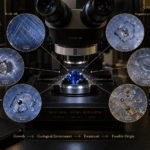
25. Why Inclusions Can Reveal Geological History
Mineral inclusions are materials trapped within a gemstone.
Some formed before the host crystal.
Others formed during crystal growth.
Certain features developed after crystallisation.
These different relationships can provide geological information.
For example, mineral inclusions may help identify the environment in which a gemstone formed.
Fluid inclusions can preserve samples of ancient geological fluids.
Growth zoning may record changes in chemical conditions.
Some inclusions provide information about temperature or pressure.
However, interpretation requires caution.
An inclusion must be correctly identified.
Its relationship to the host crystal must be understood.
Researchers must also determine whether the feature is primary, secondary or associated with a later geological event.
Modern scientific studies often combine inclusion examination with chemical analysis and geological field evidence.
The objective is to reconstruct the gemstone’s history from several independent lines of evidence.
This is especially important when investigating geographic origin.
26. Geological Origin Is Not the Same as Geographic Origin
The terms geological origin and geographic origin are related but different.
Geological origin describes the processes and environment responsible for mineral formation.
Examples include metamorphic, magmatic and hydrothermal environments.
Geographic origin describes the location or region from which a gemstone was obtained.
Examples include Madagascar, Sri Lanka, Colombia and Mozambique.
Two gemstones from different countries may have formed through similar geological processes.
Conversely, gemstones from the same country may originate from very different geological environments.
For example, emerald deposits in different regions can share certain mineralogical characteristics while having distinct geological histories.
Sapphires from separate geographic regions may also display overlapping chemical and inclusion characteristics.
Therefore, identifying a gemstone’s broad geological environment does not automatically establish its country of origin.
Professional geographic origin determination requires comparison with reliable reference data and consideration of analytical limitations.
27. Can Gemstone Chemistry Reveal Its Formation Environment?
Chemical composition can provide valuable evidence about geological formation.
Trace elements may reflect the chemistry of the environment in which a crystal grew.
For example, researchers studying corundum may examine concentrations and relationships involving:
- Iron
- Titanium
- Chromium
- Vanadium
- Magnesium
- Gallium
These elements can provide information relevant to geological classification and geographic origin research.
However, their interpretation is not always straightforward.
Different geological environments can produce overlapping chemical signatures.
A single trace-element concentration rarely establishes a unique origin.
The distribution of elements may also vary within one gemstone.
Modern research therefore combines chemical data with other observations.
These may include mineral inclusions, growth structures, spectroscopy and geological reference collections.
The resulting interpretation is strongest when several independent characteristics support the same conclusion.
28. A Comparative Overview of Gemstone Formation Environments
| Geological environment | Principal process | Representative gemstones | Important geological consideration |
|---|---|---|---|
| Magmatic | Crystallisation from magma or closely associated processes | Peridot, certain sapphires, zircon, some garnets | Mineral chemistry and magmatic evolution |
| Pegmatitic | Crystallisation in specialised coarse-grained igneous systems | Tourmaline, aquamarine, morganite, spodumene, topaz | Chemical enrichment and favourable crystal growth |
| Metamorphic | Mineral reactions during changes in pressure and temperature | Ruby, sapphire, garnet, kyanite, spinel | Host-rock chemistry and metamorphic conditions |
| Hydrothermal | Mineral precipitation and reactions involving geological fluids | Emerald, quartz and certain other gem minerals | Fluid chemistry, pathways and rock interaction |
| Sedimentary and near-surface | Precipitation, weathering and chemical alteration | Opal, turquoise, certain chalcedony varieties | Water chemistry and environmental conditions |
| Secondary alluvial | Erosion, transport and concentration of existing minerals | Sapphire, ruby, spinel, garnet, diamond | The gemstones formed elsewhere before deposition |
| Deep mantle | Mineral formation under high-pressure conditions | Diamond, certain olivines and garnets | Deep formation followed by geological transport |
Important: These categories are not mutually exclusive. A gemstone species may occur in more than one environment, and several geological processes may contribute to the development of one deposit.
29. What Geological Environments Tell Us About Gemstone Rarity
Gemstone rarity is often discussed in commercial terms.
However, geological rarity is more complicated.
A mineral may be relatively common in nature but rarely occur as transparent crystals suitable for faceting.
Another mineral may form only in specialised geological environments.
The rarity of a particular gemstone may therefore reflect several factors.
These include:
- Availability of necessary chemical elements
- Frequency of suitable geological conditions
- Crystal growth limitations
- Preservation during later geological events
- Accessibility of deposits
- Quantity of recoverable gem-quality material
For example, corundum is not restricted to one unique geological environment.
However, transparent, attractively coloured gem-quality corundum is considerably less common than ordinary mineral material.
Emerald requires unusual chemical circumstances that permit beryllium and suitable colouring elements to participate in crystal growth.
Large, high-quality tourmaline crystals require favourable geological conditions within particular mineral-forming systems.
Diamond formation and preservation require specialised deep-Earth conditions.
These examples demonstrate that geological rarity is not simply a question of how common a chemical element is.
It is a question of how frequently the necessary geological conditions occur together.
30. What Modern Gemstone Buyers Can Learn from Geology
Understanding geological formation does not replace professional gemmological identification.
However, it provides valuable context.
A gemstone’s geological history can help explain why particular inclusions occur.
It may clarify why certain mineral species are associated with particular rock types.
It can also explain why gemstones of the same species may differ in colour, transparency or internal characteristics.
Nevertheless, buyers should avoid drawing conclusions that exceed the available evidence.
For example:
A sapphire’s colour alone cannot establish its geological origin.
An inclusion cannot always establish a specific country.
A gemstone recovered from river gravel did not necessarily crystallise within sedimentary rock.
A mineral associated with volcanic activity may have formed before the volcanic event that transported it.
These distinctions are essential for scientifically responsible gemstone descriptions.
31. The Natural Gems Belgium Perspective
At Natural Gems Belgium, natural gemstones are approached as geological materials with individual characteristics.
Each gemstone possesses its own combination of:
- Mineral identity
- Colour
- Transparency
- Clarity
- Crystal growth features
- Natural inclusions
- Cutting characteristics
- Optical performance
- Treatment history
Geological formation provides the background against which these characteristics developed.
A natural sapphire may contain growth structures reflecting its crystallisation history.
A tourmaline may display colour zoning associated with changing chemical conditions.
An emerald may contain inclusions that record aspects of a fluid-rich formation environment.
A garnet may preserve chemical variations associated with metamorphic growth.
These characteristics contribute to the scientific interest of natural gemstones.
However, geological interpretation and commercial quality evaluation serve different purposes.
The NGB individual grading system evaluates the characteristics of a particular gemstone.
It does not independently establish geological provenance or geographic origin.
Similarly, the presence of a natural inclusion does not automatically establish a gemstone’s complete formation history.
Responsible gemmology requires distinguishing direct observations from interpretations.
32. Why Gemstone Geology Matters Beyond Jewellery
Gemstones are valuable scientific materials.
They can preserve evidence of geological processes that occurred millions or billions of years ago.
Mineral inclusions in diamonds provide information about the Earth’s mantle.
Metamorphic garnets can record changes in pressure and temperature.
Fluid inclusions in emeralds may provide evidence about ancient hydrothermal systems.
Sapphire chemistry can contribute to the investigation of complex geological environments.
These studies extend beyond the commercial gemstone industry.
They contribute to research in:
Mineralogy
Petrology
Geochemistry
Plate Tectonics
Economic Geology
Earth History
Gemstones therefore occupy an unusual position.
They are simultaneously natural materials, objects of aesthetic appreciation and scientific records of geological events.
Conclusion: Every Gemstone Has a Geological History
The formation of natural gemstones is one of the most remarkable consequences of Earth’s geological activity.
Some gemstones crystallise from magma.
Others form when existing rocks are transformed through metamorphism.
Certain minerals develop through reactions involving hydrothermal fluids.
Others precipitate from water or form during near-surface weathering processes.
Some, including diamonds, originate deep within the Earth and reach the surface through later volcanic events.
Many gemstones are subsequently released from their original host rocks and concentrated in secondary deposits.
These processes explain why gemstone occurrences are unevenly distributed across the planet.
They also demonstrate why a gemstone’s geological history cannot always be determined from its appearance alone.
The same mineral species may form in several different environments.
Different minerals may occur together within one geological system.
And a gemstone recovered from a particular rock or sediment may have formed somewhere else entirely.
Modern geological research continues to improve our understanding of these processes.
Chemical analysis, inclusion studies, geological mapping and experimental petrology provide increasingly detailed evidence about the conditions responsible for gemstone formation.
For collectors and gemmology enthusiasts, this scientific perspective adds another dimension to gemstone appreciation.
A gemstone is not simply a beautiful crystal.
It is the surviving result of a particular sequence of geological events.
Its existence depended on the availability of the correct chemical elements, favourable physical conditions, successful crystal growth and preservation through later geological history.
Every natural gemstone represents a specific chapter in the geological evolution of the Earth.
Understanding that chapter allows us to appreciate not only the beauty of the finished stone, but also the extraordinary natural processes responsible for its creation.
References & Further Reading
The following references are authoritative scientific and educational publications. They include peer-reviewed gemmological research and government geological information. No commercial gemstone product listings are included.
1. Palke, Aaron C. & Shigley, James E. — Gems Formed in Magmatic Rocks
Gems & Gemology, Winter 2022, Volume 58, Number 4.
Gemological Institute of America.
A detailed scientific examination of gemstone formation in magmatic environments, including magma crystallisation, olivine, garnet, corundum, quartz and the distinction between mineral formation and volcanic transport.
https://www.gia.edu/gems-gemology/winter-2022-colored-stones-unearthed
2. Palke, Aaron C. & Shigley, James E. — Gems Formed in Metamorphic Rocks
Gems & Gemology, Summer 2023, Volume 59, Number 2.
Gemological Institute of America.
An authoritative discussion of metamorphism, pressure-temperature conditions, metamorphic mineral assemblages and the geological formation of important ruby and sapphire deposits.
https://www.gia.edu/gems-gemology/summer-2023-colored-stones-unearthed0
3. Shigley, James E., Bassoo, Roy & Palke, Aaron C. — Gems Recovered from Sedimentary Rocks
Gems & Gemology, Winter 2023, Volume 59, Number 4.
Gemological Institute of America.
Explains gemstone formation within sedimentary environments, including opal and turquoise, and distinguishes primary mineral precipitation from secondary alluvial gemstone concentration.
https://www.gia.edu/gems-gemology/winter-2023-colored-stones-unearthed
4. Giuliani, Gaston & Groat, Lee A. — Geology of Corundum and Emerald Gem Deposits: A Review
Gems & Gemology, Winter 2019, Volume 55, Number 4.
Gemological Institute of America.
A comprehensive geological review of ruby, sapphire and emerald deposits.
Discusses magmatic, metamorphic, metasomatic and hydrothermal environments, including Colombian emerald deposits and the geological classification of corundum occurrences.
https://www.gia.edu/gems-gemology/winter-2019-geology-of-corundum-and-emerald-gem-deposits
5. Gemological Institute of America — Geographic Origin Determination of Blue Sapphire
Gems & Gemology, Winter 2019.
Examines the geological and analytical differences between metamorphic and basalt-related blue sapphires.
Particularly useful for understanding the distinction between geological formation, volcanic transport and geographic origin determination.
https://www.gia.edu/gems-gemology/winter-2019-blue-sapphire-geographic-origin-determination
6. Gemological Institute of America — Geographic Origin Determination of Emerald
Gems & Gemology, Winter 2019.
A scientific reference explaining how emerald deposits from different geological environments may be distinguished through gemmological characteristics and analytical evidence.
https://www.gia.edu/gems-gemology/winter-2019-emerald-geographic-origin-determination
7. Gemological Institute of America — Diamonds from the Deep: How Do Diamonds Form in the Deep Earth?
Gems & Gemology, Winter 2018.
Explains the formation of diamonds within the Earth’s mantle, including the importance of ancient cratonic lithosphere, carbon-bearing fluids and sublithospheric diamond formation.
https://www.gia.edu/gems-gemology/winter-2018-how-do-diamonds-form-in-the-deep-earth
8. Gemological Institute of America — Kimberlites: Earth’s Diamond Delivery System
Gems & Gemology, Summer 2019.
Examines the geological processes responsible for transporting diamonds from deep mantle environments toward the Earth’s surface.
Provides an important scientific distinction between diamond formation and volcanic emplacement.
https://www.gia.edu/gems-gemology/summer-2019-kimberlites-earths-diamond-delivery-system
9. United States Geological Survey — Natural Gemstones: Geologic Environment
USGS geological information publication.
An educational overview of geological environments associated with natural gemstones, including pegmatites, metamorphic rocks and stream-gravel deposits.
https://pubs.usgs.gov/gip/gemstones/environment.html
10. Gemological Institute of America — Peridot from the Central Highlands of Vietnam: Properties, Origin, and Formation
Gems & Gemology, Fall 2016.
A scientific study of mantle-derived peridot associated with alkaline basaltic volcanism.
Provides mineralogical and geochemical evidence relevant to peridot formation and geological transport.
11. Zwaan, J. C. et al. — The Origin of Montana’s Alluvial Sapphires
Gems & Gemology, Winter 2015.
A detailed investigation of mineral inclusions and geochemical characteristics in Montana sapphires.
Demonstrates the scientific challenges of reconstructing the original geological environment of gemstones recovered from secondary deposits.
12. Gemological Institute of America — GIA Colored Stone Research
An educational overview of ongoing scientific research into coloured gemstones, geological formation, inclusions and origin determination.
Provides access to additional peer-reviewed research and geological reference material.