

Table of Contents
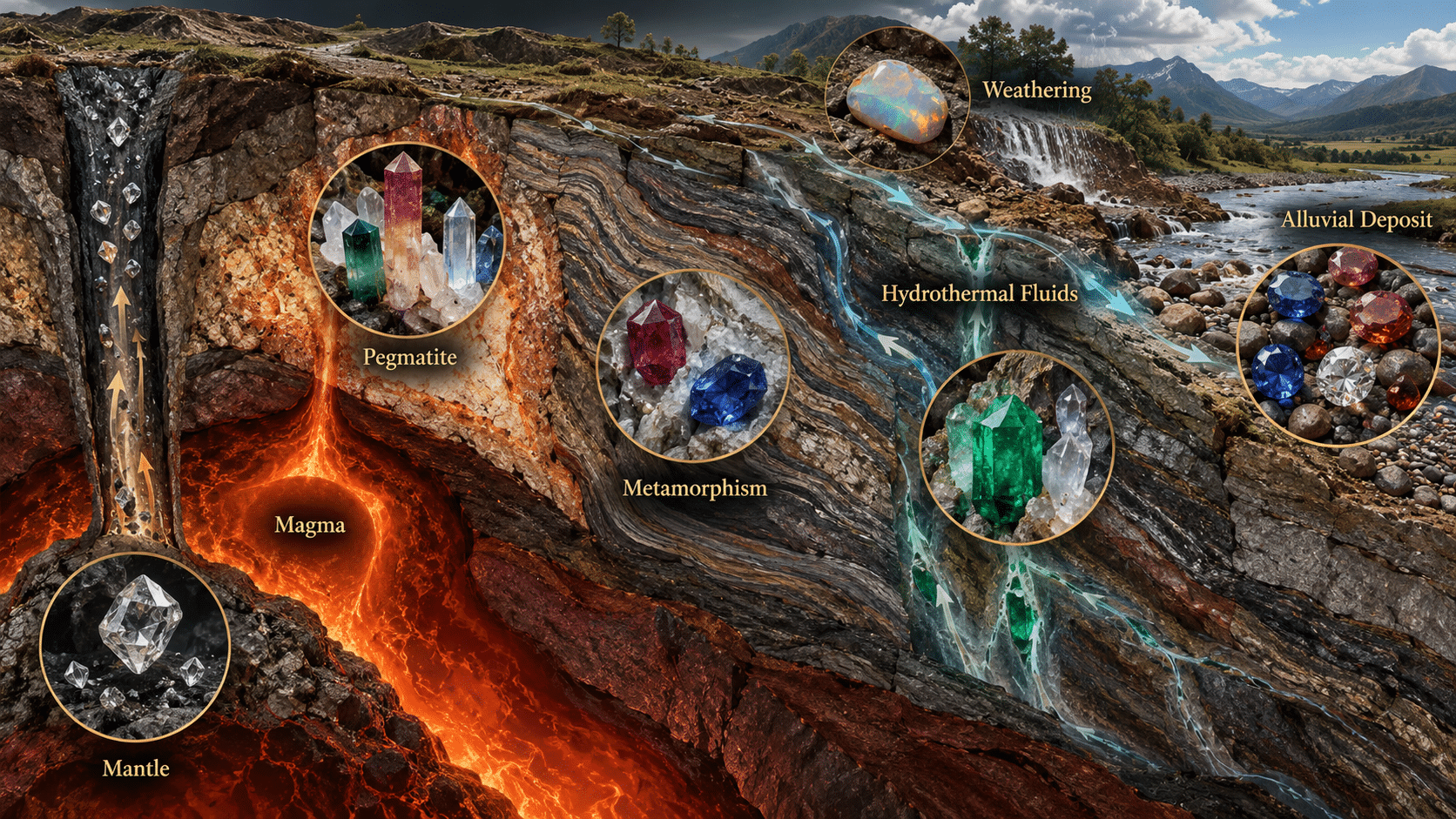
From Deep Mantle to River Gravel: The Geological Journeys Behind Natural Gemstones
A sapphire is lifted from river gravel in Sri Lanka.
An emerald is extracted from a mineralised vein.
A tourmaline crystal is discovered inside a pegmatite pocket.
An opal fills a cavity in ancient rock.
A diamond is recovered from a kimberlite pipe—or perhaps from sediment hundreds of kilometres from its original volcanic source.
All are gemstones.
But they did not form in the same way – and we willlearn here how gemstones form.
Natural gemstones are products of geology, and geology provides an extraordinary range of environments in which crystals can develop.
Some gemstones crystallise from melts.
Others grow while existing rocks are transformed by heat, pressure and fluids.
Some precipitate from hot aqueous solutions.
Others form much nearer Earth’s surface.
Diamond takes the story deeper still, forming predominantly within the mantle before being transported rapidly toward the surface by unusual magmas.
And after formation, the story may continue.
A gemstone can be:
formed → uplifted → exposed → weathered from its host rock → transported → rounded → concentrated in gravel → mined millions of years later.
This creates one of the most important distinctions in gemstone geology:
where a gemstone formed is not necessarily where it is eventually found.
To understand natural gemstones properly, we therefore need to distinguish:
formation environment
from:
deposit environment.
Let us begin inside the Earth.
PART I — A GEMSTONE IS A GEOLOGICAL PRODUCT
1. Crystals Need the Right Conditions
A gemstone crystal does not form simply because its chemical ingredients exist somewhere in a rock.
The geological environment must provide appropriate combinations of:
- chemical composition;
- temperature;
- pressure;
- fluids or melts;
- space for crystal growth;
- sufficient time;
- appropriate oxidation-reduction conditions.
Change those variables and a different mineral may form—or no gem-quality crystal may form at all.
Gemstone formation is therefore fundamentally a problem of:
chemistry + physics + geology.
2. Mineral Stability
Minerals are stable only under particular ranges of:
pressure, temperature and chemical environment.
A mineral that forms deep underground may not be the mineral favoured under surface conditions.
Diamond provides the most dramatic example.
At Earth’s surface, graphite is the stable crystalline form of pure carbon under equilibrium conditions.
Diamond requires the high-pressure environment of the mantle to crystallise naturally in the geological settings responsible for most gem diamonds.
Once transported rapidly to the surface, however, diamond can persist because its transformation back to graphite is kinetically extremely slow.
The gemstone therefore preserves evidence of conditions that no longer surround it.
3. Why Gem-Quality Crystals Are Uncommon
A mineral itself may be common while transparent, attractive crystals suitable for gemstones are rare.
Why?
A crystal may be:
- too small;
- heavily fractured;
- opaque;
- chemically impure;
- intergrown with other minerals;
- poorly coloured;
- destroyed during later geological events.
Producing a fine gemstone therefore requires more than producing the mineral species.
Nature must also create unusually favourable:
growth and preservation conditions.
PART II — THE ROCK CYCLE
4. Three Major Rock Families
Geologists traditionally divide rocks into three broad families:
Igneous rocks
Form from cooling and crystallisation of molten material.
Sedimentary rocks
Form through deposition, precipitation, accumulation and lithification of material at or near Earth’s surface.
Metamorphic rocks
Form when pre-existing rocks are transformed by heat, pressure, deformation and chemically active fluids without complete melting.
These categories are connected through the:
rock cycle.
A sedimentary rock can become metamorphic.
A metamorphic rock can melt and contribute to magma.
Igneous rock can weather into sediment.
Gemstones participate in this dynamic geological system.
PART III — IGNEOUS GEMSTONE FORMATION
5. Crystallising from Melt
Magma is molten or partially molten rock beneath Earth’s surface.
As magma cools, minerals crystallise.
But they do not all crystallise simultaneously.
Different minerals become stable at different stages as:
- temperature falls;
- magma chemistry evolves;
- elements are removed into earlier crystals;
- water and volatile components become concentrated.
This progressive evolution can eventually create environments exceptionally favourable for certain gem minerals.
6. Magmatic Differentiation
Imagine a magma beginning to crystallise.
Early-forming minerals remove particular chemical elements from the melt.
The remaining liquid therefore changes composition.
Some elements that do not fit easily into the structures of common early-forming minerals become increasingly concentrated in the residual melt.
These include elements important to many gem minerals.
The late stages of magmatic evolution can consequently produce chemically unusual rocks.
Among the most important are:
pegmatites.
PART IV — PEGMATITES: NATURE’S CRYSTAL FACTORIES
7. What Is a Pegmatite?
Pegmatites are exceptionally coarse-grained igneous rocks.
Gem-bearing granitic pegmatites can contain spectacular crystals of minerals including:
- tourmaline;
- beryl;
- spodumene;
- topaz;
- quartz;
- garnet.
GIA describes gem-bearing pegmatites as crystalline igneous rocks distinguished by:
- unusually large crystals;
- concentrations of elements otherwise relatively rare in Earth’s crust;
- unusual mineral assemblages.
Many famous gem crystals come from these geological systems.
8. Why Can Pegmatite Crystals Become So Large?
Late-stage granitic melts can become enriched in:
- water;
- boron;
- fluorine;
- lithium;
- phosphorus;
- other volatile and incompatible components.
These components can influence melt viscosity, mineral stability and element transport.
Under favourable conditions, rapid transport of chemical components to growing crystal surfaces allows exceptionally large crystals to develop.
Pegmatites can therefore produce crystals far larger than those found in ordinary granite.
9. Gem Pockets
Some pegmatites develop open cavities:
pockets.
Inside these spaces, crystals can grow without being physically constrained by surrounding solid rock.
A pocket may contain:
- tourmaline;
- beryl;
- quartz;
- feldspar;
- topaz;
- other minerals.
The result can be beautifully terminated, gem-quality crystals.
This is one reason pegmatites are so important both to:
gem mining
and:
mineral collecting.
10. Tourmaline
Tourmaline is strongly associated with many evolved granitic pegmatites.
Its complex chemistry allows numerous elements to enter its crystal structure.
Pegmatitic tourmalines can display extraordinary colour diversity:
- green;
- pink;
- red;
- blue;
- yellow;
- multicolour;
- colour zoning.
The famous copper-bearing Paraíba-type tourmalines provide a particularly interesting example.
Brazilian copper-bearing tourmaline occurs in pegmatites related to major ancient tectonic events, and GIA research indicates that Brazilian material crystallised from a hydrous melt rich in boron and lithium during pegmatite development.
11. Beryl
The beryl family includes:
- emerald;
- aquamarine;
- morganite;
- heliodor;
- colourless goshenite.
Aquamarine, morganite and many other beryls are classic pegmatite gemstones.
But emerald presents a more complicated story.
That complication teaches us an important geological principle:
members of the same mineral species can form in very different geological environments.
PART V — WHY EMERALD IS GEOLOGICALLY UNUSUAL
12. Beryllium Meets Chromium or Vanadium
Emerald is green beryl whose colour is associated primarily with:
- chromium;
- vanadium;
- or both.
The geological challenge is that:
beryllium
and:
chromium
often occur in very different rock environments.
Beryllium is typically enriched in evolved crustal magmatic systems.
Chromium is commonly associated with mafic and ultramafic rocks.
To create emerald, geology must somehow bring these chemically contrasting ingredients together.
13. Fluid-Rock Interaction
Many important emerald deposits formed where chemically active fluids interacted with suitable host rocks.
Fluids can transport elements through:
- fractures;
- shear zones;
- permeable rock;
- contacts between contrasting rock units.
When conditions change, emerald may crystallise.
This process illustrates:
metasomatism.
PART VI — METASOMATISM
14. More Than Heat and Pressure
Metamorphism is often simplified as:
heat + pressure.
That is incomplete.
Fluids can profoundly alter rock chemistry.
When fluids introduce or remove chemical components from a rock, geologists describe the process as:
metasomatism.
This is extremely important in many gemstone deposits.
15. Fluids as Geological Transport Systems
Hot geological fluids can transport dissolved components.
As they move through rock, changes in:
- temperature;
- pressure;
- pH;
- oxidation state;
- host-rock chemistry
can trigger mineral crystallisation.
A fluid may therefore acquire one ingredient in one rock and react with another rock elsewhere.
This creates highly localised environments suitable for gemstone formation.
PART VII — METAMORPHIC GEMSTONES
16. Transforming Existing Rock
Metamorphism occurs when a pre-existing rock experiences new conditions without fully melting.
Changes can include:
- recrystallisation;
- new mineral growth;
- deformation;
- fluid-rock reaction.
The original rock—called the:
protolith
—may become mineralogically transformed.
17. Marble
Limestone consists predominantly of carbonate minerals.
Under metamorphic conditions it can recrystallise into:
marble.
Some marble environments host famous deposits of:
- ruby;
- spinel.
These deposits are particularly important in Asia.
18. Ruby in Marble
Ruby is chromium-bearing corundum.
Corundum is:
Al₂O₃.
For corundum to form, the geological environment must be aluminium-rich while sufficiently deficient in silica under the relevant conditions; otherwise aluminium can become incorporated into silicate minerals instead.
Metamorphosed carbonate rocks can provide favourable low-silica environments.
When chromium is available, ruby may form.
This geological association occurs in some of the world’s most celebrated ruby districts.
19. Mogok
The Mogok region of Myanmar is historically famous for:
- ruby;
- sapphire;
- spinel;
- numerous other gem minerals.
Its geology is complex, but metamorphic carbonate rocks are central to many important ruby and spinel occurrences.
The gemstones are frequently recovered not only from primary rock but also from:
secondary gravels.
Already we see formation and recovery becoming separate stages.
20. Metamorphic Sapphire
Not all sapphire forms in the same geological setting.
GIA’s geological classification distinguishes major corundum deposits including:
- magmatic-related;
- metamorphic;
- metamorphic-metasomatic environments.
Metamorphic sapphires occur in several historically important regions, including Sri Lanka.
Their trace-element chemistry and inclusions can preserve evidence of these different geological histories.
PART VIII — MAGMATIC-RELATED SAPPHIRE
21. Sapphire Carried by Basalt
Some sapphires are associated with alkali basalt volcanic provinces.
Examples occur in regions including:
- Thailand;
- Cambodia;
- Australia;
- Madagascar;
- Ethiopia;
- Nigeria;
- Cameroon.
These sapphires are often called:
basalt-related sapphires.
22. Did the Basalt Necessarily Create the Sapphire?
This requires care.
A gemstone found in volcanic rock did not necessarily crystallise directly from the magma that carried it.
Some crystals are:
xenocrysts
—older crystals incorporated into a younger magma.
Likewise, pieces of foreign rock carried by magma are:
xenoliths.
The transport rock and the gemstone’s original growth environment may therefore differ.
This distinction becomes even more dramatic with diamond.
PART IX — DIAMOND: THE DEEP-EARTH EXCEPTION
23. Most Gemstones Form in the Crust
Most coloured gemstones form within Earth’s crust.
Diamond is fundamentally different.
Most mined gem diamonds crystallised deep within:
Earth’s mantle.
GIA’s modern diamond review places the majority of mined diamonds in the lithospheric mantle beneath old continental regions, commonly at approximately:
150–200 km depth
and roughly:
900–1300°C.
Some rare diamonds formed much deeper.
24. Superdeep Diamonds
Some diamonds contain mineralogical evidence indicating formation below the continental lithosphere.
These:
sublithospheric or superdeep diamonds
may originate from depths of approximately:
200–800 km.
They provide scientists with rare physical samples of parts of Earth that humans cannot directly access.
25. Diamond Does Not Simply Crystallise from Kimberlite
This is one of the most important corrections to a common gemstone myth.
Diamonds generally did not crystallise from the kimberlite magma in which they are mined.
Many diamonds are vastly older than their kimberlite host.
They formed in the mantle and remained there for enormous periods.
Later, kimberlite or related magmas captured them and transported them rapidly toward Earth’s surface.
Diamond is therefore usually:
a passenger, not a product, of kimberlite magma.
26. Kimberlite as an Elevator
Kimberlite magmas originate deep within Earth and can ascend rapidly.
During ascent they incorporate:
- mantle rock fragments;
- minerals;
- diamonds.
Rapid transport is crucial because prolonged exposure to unsuitable conditions could resorb or destroy diamond.
Kimberlite acts, conceptually, like:
a geological express elevator.
27. Ancient Cratons
Most economic diamond deposits are associated with old, stable continental regions called:
cratons.
Beneath these ancient crustal blocks, thick lithospheric mantle roots can extend deep enough to provide environments where diamonds can form and remain preserved.
This explains why diamond exploration is intimately connected with:
continental tectonic history.
PART X — HYDROTHERMAL GEMSTONE FORMATION
28. Hot Water as a Geological Agent
Hydrothermal processes involve:
hot, chemically active aqueous fluids.
These fluids can move through:
- fractures;
- faults;
- pores;
- shear zones.
They may derive from:
- cooling magma;
- metamorphic reactions;
- circulating groundwater heated at depth;
- mixtures of different fluid sources.
29. Dissolve, Transport, Precipitate
Hydrothermal gemstone formation can be simplified into three stages:
1. Dissolution or acquisition
The fluid obtains dissolved chemical components.
2. Transport
The fluid moves through rock.
3. Precipitation
Changes in physical or chemical conditions cause minerals to crystallise.
The triggers can include changes in:
- temperature;
- pressure;
- fluid composition;
- pH;
- oxidation state;
- interaction with wall rock.
30. Quartz Veins
Quartz provides a familiar example.
Silica-bearing fluids can move through fractures and precipitate:
quartz.
Open fractures may provide space for well-developed crystals.
Associated minerals can crystallise from the same fluid system.
This produces the mineralised veins familiar to geologists and collectors.
31. Emerald and Hydrothermal Systems
Some emerald deposits are strongly associated with hydrothermal fluid activity.
Colombia is particularly important.
Its emerald geology differs substantially from many schist-hosted emerald deposits elsewhere.
Hot saline fluids moved through sedimentary rocks and interacted chemically in ways that permitted emerald crystallisation in veins and related structures.
This helps explain why Colombian emeralds possess distinctive inclusion and chemical characteristics.
32. Hydrothermal Does Not Mean Synthetic
The term:
hydrothermal
can describe a natural geological process.
It can also describe a laboratory crystal-growth technique.
Natural hydrothermal emerald formed underground through geological fluid activity.
Hydrothermal synthetic emerald was grown artificially using high-temperature, high-pressure aqueous solutions designed to reproduce aspects of natural crystal growth.
Therefore:
hydrothermal ≠ synthetic.
Context matters.
PART XI — FLUID INCLUSIONS RETURN
33. Yesterday’s Inclusions Now Make Geological Sense
In the previous Learning Center article, we examined:
- fluid inclusions;
- negative crystals;
- three-phase inclusions.
We can now understand why these features matter.
A gemstone growing in a fluid-rich geological environment can trap:
microscopic portions of that fluid.
The inclusion becomes a physical remnant of the formation environment.
34. A Microscopic Geological Sample
A fluid inclusion may contain:
- liquid;
- gas;
- dissolved salts;
- daughter crystals.
Researchers can study these inclusions to investigate the:
- composition;
- temperature;
- pressure;
- evolution
of gemstone-forming fluids.
The microscopic inclusion is therefore a bridge between:
gemmology
and:
geology.
PART XII — NEAR-SURFACE AND SEDIMENTARY FORMATION
35. Not Every Gemstone Requires Great Depth
Some gem materials form much closer to Earth’s surface.
These environments involve processes such as:
- weathering;
- groundwater movement;
- evaporation;
- chemical precipitation;
- oxidation.
Opal is one of the most important examples.
36. Opal
Opal is hydrated silica, commonly written approximately as:
SiO₂·nH₂O.
Unlike quartz, opal lacks the long-range atomic order of a conventional crystalline mineral and is commonly described as a:
mineraloid.
It can form when silica-bearing water moves through:
- fractures;
- pores;
- cavities;
- weathered rock.
Silica is subsequently deposited as conditions change.
37. Australian Sedimentary Opal
Many famous Australian opal deposits occur in sedimentary geological environments.
Silica-rich water moved through porous rocks and cavities.
Repeated silica deposition and dehydration contributed to opal formation.
Under exceptional structural conditions, ordered silica particles produce:
play-of-colour.
38. Ethiopian Opal Shows Why Geology Is Complicated
Ethiopian Wollo opal occurs within a volcanic rock sequence.
It was therefore naturally described as:
volcanic opal.
Yet detailed research identified features suggesting an important near-surface or pedogenic component to formation, including:
- clay minerals;
- desiccation structures;
- plant-related features.
Nature does not always fit comfortably into simplified textbook boxes.
PART XIII — WEATHERING CAN CREATE GEM MATERIAL
39. Destruction Can Also Be Creative
Weathering is usually imagined as:
rock destruction.
But chemical weathering can also create new minerals.
Near Earth’s surface:
- water;
- oxygen;
- carbon dioxide;
- biological activity
can transform primary minerals into secondary ones.
Some of these products are gem materials.
40. Malachite and Azurite
Malachite and azurite commonly develop in oxidised zones associated with copper deposits.
Copper-bearing fluids interact with:
- oxygen;
- carbonate;
- water.
The resulting secondary minerals can form:
- botryoidal masses;
- veins;
- crusts;
- stalactitic forms;
- crystals.
Their formation is therefore connected to the chemical transformation of an older ore system.
PART XIV — PRIMARY VERSUS SECONDARY DEPOSITS
41. One of the Most Important Gem-Geology Distinctions
A:
primary deposit
preserves a gemstone in or closely associated with the geological environment in which it formed—or, in some classifications, in the primary rock that transported it from its deeper formation zone.
A:
secondary deposit
contains gemstones that have been released from earlier host rocks and concentrated by later surface processes.
This distinction is fundamental.
42. Weathering Releases the Gem
Imagine sapphire locked inside rock.
Over geological time:
- rain;
- temperature changes;
- chemical alteration;
- erosion
break down the host rock.
Sapphire is exceptionally durable.
It survives while less resistant minerals decompose.
The sapphire is released.
Its geological journey continues.
43. Gravity Moves It Downslope
Material may first accumulate near its source through:
- in-place weathering;
- gravity;
- slope movement.
Geologists distinguish various secondary deposit types, including:
- eluvial;
- colluvial;
- alluvial.
The terminology describes different transport and concentration processes.
PART XV — ALLUVIAL GEM DEPOSITS
44. Rivers as Natural Concentrators
A river carries particles of many sizes and densities.
As water velocity changes, minerals are:
- transported;
- sorted;
- deposited;
- reworked.
Dense, durable minerals can become concentrated in gravel layers.
This produces:
placer deposits.
45. Which Gemstones Survive?
Gemstones commonly found in placer deposits tend to be:
- physically durable;
- chemically resistant;
- relatively dense.
Important examples include:
- diamond;
- ruby;
- sapphire;
- spinel;
- garnet;
- zircon;
- chrysoberyl.
Softer or fragile minerals are less likely to survive prolonged transport intact.
46. Natural Selection in a River
Transport can destroy poor-quality material.
Highly fractured crystals may break apart.
Less resistant minerals may weather away.
More durable gemstone fragments survive.
Consequently, placer processes can create natural concentrations enriched in:
resistant gem material.
47. Rounded Rough
Water transport can abrade gemstone surfaces.
Sharp crystal faces may become:
- worn;
- frosted;
- rounded.
A rounded sapphire pebble therefore does not mean sapphire originally crystallised as a rounded object.
Its present shape may record:
transport after formation.
PART XVI — SRI LANKAN GEM GRAVELS
48. A Classic Secondary Deposit
Sri Lanka is one of the world’s great gemstone regions.
Many gems are recovered from secondary gravels rather than directly from their original primary host rocks.
These gravels can contain multiple gem species.
The gemstones were:
formed elsewhere → weathered out → transported → concentrated together.
49. Different Histories in One Gravel
A single gem gravel can contain minerals that could not have crystallised together under one equilibrium geological environment.
This is an exceptionally important concept.
Recent GIA research highlights secondary deposits containing both:
corundum
and:
quartz.
Under most crustal equilibrium conditions, corundum and quartz are chemically incompatible.
Yet a river can collect both because it is not creating them.
It is:
mixing gemstones from different geological sources.
50. A Gravel Deposit Is Not a Formation Environment
This deserves emphasis:
finding two gemstones together does not prove they formed together.
A secondary deposit is a geological collection assembled after formation.
It can combine stones whose histories began:
- kilometres apart;
- at different depths;
- at different temperatures;
- in different rocks;
- potentially at very different times.
PART XVII — DIAMONDS IN SECONDARY DEPOSITS
51. From 150 km Deep to a Riverbank
The diamond journey can be extraordinary.
A simplified sequence is:
1. Diamond crystallises in the mantle.
2. It remains stored beneath an ancient continent.
3. Kimberlite captures it.
4. Kimberlite rapidly transports it to the crust/surface.
5. The kimberlite weathers.
6. Diamond is released.
7. Rivers transport it.
8. It accumulates in alluvial gravels.
9. Humans recover it.
A diamond found in river sediment therefore has a geological history extending far beyond that river.
52. Marine Diamonds
Transport can continue beyond rivers.
Diamonds eroded from continental deposits can ultimately reach:
coastal and marine sediments.
Important marine diamond deposits occur off southwestern Africa.
The gemstone may therefore travel from:
deep mantle → volcanic pipe → river → ocean
before being mined.
PART XVIII — RUBY AND SAPPHIRE: ONE MINERAL, MANY GEOLOGIES
53. Corundum as a Geological Case Study
Ruby and sapphire are both varieties of:
corundum.
Yet gem corundum occurs in remarkably diverse geological settings.
GIA’s modern classification includes major deposits associated with:
- magmatic environments;
- metamorphic environments;
- metamorphic-metasomatic environments;
- secondary placer deposits.
The mineral species alone does not reveal one universal formation story.
54. Marble-Hosted Ruby
Typical geological associations can include:
metamorphosed carbonate rocks.
These are fundamentally different from:
basalt-related sapphire systems.
Yet both produce corundum.
This geological difference influences:
- trace-element chemistry;
- inclusions;
- colour mechanisms;
- treatment behaviour;
- origin determination.
55. Geology Enters the Laboratory
When a laboratory investigates geographic origin, it is not simply comparing country labels.
It is examining evidence created by:
geological processes.
For corundum, relevant evidence may include:
- iron;
- titanium;
- gallium;
- magnesium;
- vanadium;
- chromium;
- mineral inclusions;
- growth structures;
- spectroscopy.
The laboratory is effectively asking:
Which geological environment best explains this combination of evidence?
Only then does geography enter the interpretation.
PART XIX — GEMSTONE CHEMISTRY IS GEOLOGICAL MEMORY
56. Trace Elements
A gemstone’s ideal chemical formula tells only part of its story.
Tiny amounts of other elements can enter the crystal lattice during growth.
These:
trace elements
can influence:
- colour;
- fluorescence;
- spectroscopy;
- geographic-origin interpretation.
Their concentrations reflect the chemistry of the gemstone-forming environment.
57. Ruby
Pure corundum would be colourless.
Chromium replacing small amounts of aluminium can produce:
red ruby colour.
The availability of chromium is geological.
Therefore colour itself ultimately depends on:
formation environment.
58. Blue Sapphire
Blue sapphire commonly owes its colour largely to interactions involving:
iron and titanium.
Again, those elements had to be available during the gemstone’s geological history.
The beauty we see at the surface is connected directly to:
crystal chemistry underground.
59. Emerald
Emerald requires the unusual meeting of:
beryllium-bearing chemistry
with:
chromium and/or vanadium-bearing chemistry.
Its rarity is therefore not merely mineralogical.
It reflects the rarity of geological systems capable of bringing those ingredients together under suitable crystallisation conditions.
PART XX — INCLUSIONS AS FORMATION EVIDENCE
60. The Previous Article Revisited
We can now reinterpret several inclusion types from the previous NGB article.
Mica in emerald may reflect a schist-related environment.
Carbonate minerals may reflect carbonate-rich host rocks or fluids.
Fluid inclusions may preserve gemstone-forming solutions.
Zircon inclusions may preserve older geological information.
Rutile silk reflects conditions within corundum during or after crystal growth.
The inclusion scene is therefore a microscopic expression of:
geology.
PART XXI — PRESSURE AND TEMPERATURE
61. Gemstones as Geological Thermometers and Barometers
Some mineral assemblages are stable only within particular ranges of:
- pressure;
- temperature.
If those minerals occur together in equilibrium, geologists may estimate the conditions under which they formed.
This field is called:
geothermobarometry.
Gemstone inclusions can contribute valuable information.
62. Diamond Inclusions
Minerals trapped inside diamond can preserve high-pressure phases from Earth’s mantle.
Because diamond is exceptionally strong and chemically resistant, it can protect inclusions during transport to the surface.
Some superdeep diamonds contain evidence from depths otherwise inaccessible to direct sampling.
A gem diamond can therefore be both:
jewellery material
and:
a scientific capsule from the deep Earth.
PART XXII — TIME
63. Gemstone Formation Is Also a Question of When
A gemstone’s geological story has a time dimension.
Some diamonds are:
billions of years old.
Many pegmatites formed hundreds of millions of years ago.
Metamorphic gemstones may record ancient continental collisions.
Secondary gravels can be much younger than the gemstones they contain.
Therefore:
deposit age ≠ gemstone age.
64. An Ancient Stone in Young Sediment
Imagine a sapphire crystallising during an ancient metamorphic event.
Hundreds of millions of years later:
- mountains rise;
- rocks erode;
- the sapphire is released;
- a river transports it;
- young sediment accumulates around it.
The sediment may be geologically young.
The sapphire may be vastly older.
Again:
where something is found does not tell us when it formed.
PART XXIII — PLATE TECTONICS
65. The Larger Engine
Many gemstone-forming processes ultimately connect to:
plate tectonics.
Plate movements produce:
- mountain building;
- subduction;
- magmatism;
- metamorphism;
- crustal melting;
- hydrothermal circulation;
- uplift;
- erosion.
Gemstone deposits are therefore not randomly scattered across Earth.
They occur where geological history created the necessary conditions.
66. Continental Collision
When continents collide:
- rocks are buried;
- pressure increases;
- temperatures rise;
- fluids move;
- rocks deform;
- partial melting can occur.
These processes can create:
- metamorphic gemstones;
- pegmatites;
- hydrothermal systems.
Several major gemstone provinces are related to ancient mountain-building events.
67. Gondwana and Gemstones
Some modern gemstone deposits on continents now separated by oceans formed during geological events associated with the assembly of:
Gondwana.
GIA’s research on Paraíba-type tourmaline, for example, places Brazilian, Nigerian and Mozambican deposits within geological regions affected by related Neoproterozoic tectonic events.
The gemstones now occur on different continents.
Their geology preserves evidence of an ancient world in which those continental regions were connected through major tectonic processes.
PART XXIV — FORMATION VERSUS TRANSPORT
68. Ask Two Questions
Whenever discussing gemstone geology, ask:
Question 1
Where and how did the gemstone crystallise?
Question 2
How did it arrive at the deposit where humans found it?
These may have completely different answers.
69. Diamond Example
Formation:
Deep mantle.
Primary transport:
Kimberlite.
Possible mining deposit:
Kimberlite pipe, alluvial gravel or marine sediment.
70. Sapphire Example
Formation:
Metamorphic or magmatic-related geological environment.
Later history:
Uplift and erosion.
Possible mining deposit:
River gravel.
71. Tourmaline Example
Formation:
Often pegmatitic.
Possible mining deposit:
Primary pegmatite or secondary alluvium.
72. Opal Example
Formation:
Silica-rich fluids at comparatively shallow crustal or near-surface conditions.
Deposit:
Often remains within cavities, fractures or porous host rock where silica was deposited.
Different gemstones therefore require different geological models.
PART XXV — COMMON GEOLOGICAL MISCONCEPTIONS
73. Error: “All Gemstones Form in Magma”
Incorrect.
Gemstones form in igneous, metamorphic, metasomatic, hydrothermal, sedimentary, weathering and deep-mantle environments.
74. Error: “Diamond Forms in Kimberlite”
Usually incorrect.
Most diamonds formed in the mantle before the kimberlite magma transported them upward.
75. Error: “A River Deposit Created the Sapphire”
Incorrect.
The river generally:
transported and concentrated
a pre-existing sapphire.
76. Error: “Gemstones Found Together Formed Together”
Incorrect.
Secondary deposits can mix minerals from entirely different geological environments.
77. Error: “Hydrothermal Means Synthetic”
Incorrect.
Hydrothermal processes occur naturally and can also be reproduced artificially for synthetic crystal growth.
78. Error: “Metamorphism Means the Rock Melted”
Incorrect.
Metamorphism transforms rocks primarily in the solid state.
Complete melting moves the geological system into igneous processes.
79. Error: “Pegmatite Is Just a Giant Crystal Cave”
Incorrect.
Pegmatite is an igneous rock with distinctive coarse-grained texture and geochemistry.
Some pegmatites contain open pockets with spectacular crystals; many do not.
80. Error: “All Opal Forms the Same Way”
Incorrect.
Opal occurs in several geological settings, including sedimentary and volcanic-associated environments, and individual deposits can have complex formation histories.
81. Error: “Geographic Origin Is Written Directly Into the Stone”
Too simplistic.
A laboratory interprets geological evidence preserved in:
- inclusions;
- chemistry;
- spectroscopy;
- growth structures
against known-origin reference populations.
PART XXVI — FORMATION ENVIRONMENT SUMMARY
| Geological Environment | Principal Process | Representative Gem Examples |
|---|---|---|
| Deep mantle | High-pressure crystallisation from mantle fluids/melts | Diamond |
| Magmatic | Crystallisation associated with melts | Some sapphire, zircon and other gems |
| Pegmatitic | Late-stage evolved igneous crystallisation | Tourmaline, aquamarine, morganite, spodumene, topaz, quartz |
| Metamorphic | Recrystallisation under heat, pressure and deformation | Ruby, sapphire, spinel, garnet |
| Metamorphic-metasomatic | Metamorphism plus strong fluid-rock chemical interaction | Ruby, sapphire, some emerald |
| Hydrothermal | Precipitation/reaction involving hot aqueous fluids | Emerald, quartz and numerous collector gems |
| Near-surface/sedimentary | Precipitation, groundwater and weathering processes | Opal, some chalcedony |
| Oxidation/weathering | Chemical alteration near surface | Malachite, azurite |
| Secondary placer | Erosion, transport and mechanical concentration | Diamond, ruby, sapphire, spinel, garnet, zircon |
Important:
a placer is a deposit environment, not the original crystallisation environment of the gemstones it contains.
PART XXVII — FROM GEOLOGY TO GEMMOLOGY
82. Why Should a Gem Buyer Care?
Geology may appear distant from jewellery.
It is not.
Formation environment influences:
- mineral chemistry;
- colour;
- inclusions;
- clarity;
- crystal size;
- rough morphology;
- durability features;
- geographic-origin evidence;
- rarity.
The characteristics evaluated by a gemmologist began as:
geological processes.
83. Why Does Origin Affect Appearance?
It is dangerous to claim that every gemstone from one country has one appearance.
But different geological environments can produce statistically different:
- trace-element concentrations;
- inclusion populations;
- colour tendencies;
- growth features.
These differences allow laboratories to investigate origin.
The connection is:
geology → crystal chemistry → measurable gemmological evidence.
84. Why Does Origin Determination Sometimes Fail?
Because nature overlaps.
Two deposits can share similar:
- host rocks;
- geological processes;
- trace chemistry.
A gemstone may also fall outside the typical range of its deposit.
This is why professional laboratories maintain large collections of:
known-origin reference samples.
Geographic-origin determination is comparative science, not a simple country detector.
PART XXVIII — A GEMSTONE’S COMPLETE JOURNEY
85. Stage 1 — Ingredients
The necessary chemical elements exist within:
- mantle;
- crust;
- magma;
- rock;
- fluids.
86. Stage 2 — Geological Process
Tectonics, magmatism, metamorphism or fluid movement creates suitable conditions.
87. Stage 3 — Crystal Growth
Atoms arrange into an ordered structure—or, in the case of materials such as opal, silica becomes organised through a different non-crystalline or poorly crystalline process.
The gemstone begins to form.
88. Stage 4 — Inclusions Are Trapped
Minerals, fluids or gases may become enclosed.
These become the microscopic evidence examined by gemmologists millions of years later.
89. Stage 5 — Geological Modification
The gemstone may experience:
- deformation;
- heating;
- fluid activity;
- fracturing;
- healing.
Its inclusion scene evolves.
90. Stage 6 — Uplift and Exposure
Tectonic processes eventually bring deep rocks closer to Earth’s surface.
Erosion begins.
91. Stage 7 — Weathering
Host rock decomposes.
Durable gemstones can survive.
92. Stage 8 — Transport
Gravity, rivers, glaciers or coastal processes may move the gemstone.
93. Stage 9 — Concentration
Dense resistant gemstones accumulate in favourable sedimentary traps.
94. Stage 10 — Discovery
A miner finally uncovers the stone.
The human part of its story begins only after:
the geological story has already lasted millions—or billions—of years.
PART XXIX — READING THE STONE BACKWARDS
95. The Gemmologist’s Task
Geology creates the gemstone in chronological order:
environment → growth → modification → erosion → transport.
The gemmologist encounters the final product and works backwards:
stone → properties → inclusions → chemistry → geological interpretation.
This is why gemstone identification can resemble forensic science.
We reconstruct events from surviving evidence.
96. The Microscope and the Landscape
A tiny mineral inclusion seen beneath the microscope may correspond to a rock unit extending across kilometres.
A trace element measured at parts-per-million concentration may reflect an ancient magma.
A fluid inclusion smaller than a grain of dust may preserve evidence of an extinct hydrothermal system.
Gemstone geology connects:
microscopic evidence
with:
planetary-scale processes.
PART XXX — THE CENTRAL LESSON
A gemstone is not an isolated object.
It is the product of a system.
Ruby records aluminium-rich, silica-poor conditions and the availability of chromium.
Emerald records the rare geological meeting of beryllium with chromium and/or vanadium.
Tourmaline can record the chemical evolution of pegmatitic systems.
Opal records the movement and precipitation of silica-bearing water.
Diamond records conditions deep within Earth’s mantle.
Alluvial sapphire records not only crystallisation but also:
uplift, erosion, transport and concentration.
Every gemstone therefore has at least two stories:
how it formed
and:
how it reached us.
Conclusion
Natural gemstones are products of a dynamic Earth.
They do not emerge from one universal “gemstone layer,” nor do they all crystallise in magma-filled caves.
Their formation spans an extraordinary range of geological environments.
Deep beneath ancient continents, carbon-bearing fluids can crystallise diamond within the mantle.
Higher in the crust, evolving magmas produce unusual late-stage melts from which pegmatites can develop, creating exceptional crystals of tourmaline, beryl, topaz, spodumene and quartz.
During mountain building, existing rocks are transformed by heat, pressure, deformation and fluids. These metamorphic and metasomatic systems can produce ruby, sapphire, spinel, garnet and emerald.
Hydrothermal fluids move dissolved components through fractures and chemically reactive rocks, precipitating new minerals as physical and chemical conditions change.
Closer to Earth’s surface, groundwater, weathering, oxidation and silica deposition can create materials such as opal, malachite and azurite.
But crystallisation is often only the first chapter.
Mountains rise.
Rocks fracture.
Weathering attacks them.
Rivers remove the softer material.
Durable gemstones survive.
They are transported, rounded and eventually concentrated in gravels.
A sapphire formed during ancient metamorphism may therefore be mined from comparatively young river sediment.
A diamond formed 150 kilometres or more beneath an ancient continent may eventually be found on a beach.
A river gravel may contain sapphire and quartz side by side even though those minerals originated in fundamentally different geological environments.
This leads to the most important distinction in this article:
formation environment is not the same as deposit environment.
The location where miners recover a gemstone represents only the final geological stage preserved today.
To understand the stone itself, we must reconstruct the journey backwards.
Its trace elements tell us about chemistry.
Its inclusions tell us about minerals and fluids present during its history.
Its fractures may record deformation.
Its rounded surface may record transport.
Its host rock may reveal a primary formation environment.
Its position in river gravel may reveal a secondary concentration process.
And sometimes the gemstone preserves information about parts of Earth we could otherwise never sample directly.
This is especially true of diamond.
But the principle applies broadly:
gemstones are geological archives.
Their beauty is visible.
Their history must be read.
Once we understand how gemstones form, many concepts encountered throughout gemmology begin to connect:
colour → trace elements
inclusions → formation environment
growth structures → crystallisation
geographic origin → geology
rough shape → growth and transport
secondary deposits → erosion and concentration
The gemstone in a display case is therefore the endpoint of processes operating across scales from:
atoms
to:
continents
and across timescales from crystal growth to hundreds of millions—or even billions—of years of geological history.
Understanding that journey changes the way we look at a natural gemstone.
It is no longer simply a beautiful mineral.
It is a surviving fragment of:
Earth history.
References & Further Reading
Giuliani, G. et al. — “Geology of Corundum and Emerald Gem Deposits: A Review.” Gems & Gemology, Winter 2019.
The principal geological reference for ruby, sapphire and emerald in this article. It distinguishes magmatic, metamorphic, metamorphic-metasomatic and secondary corundum deposits and explains the contrasting geological processes responsible for major emerald deposits.
GIA — Geology of Corundum and Emerald Gem Deposits
Shigley, J. E. & Kamp, A. R. — “Gem-Bearing Pegmatites: A Review.” Gems & Gemology, Summer 1984.
Foundational overview of gem-bearing pegmatites, their unusually large crystals, chemical enrichment and gem pockets. Particularly useful for understanding why tourmaline, beryl, topaz and other gem minerals are strongly associated with evolved pegmatitic systems.
GIA — Gem-Bearing Pegmatites: A Review
Shirey, S. B. & Shigley, J. E. — “Recent Advances in Understanding the Geology of Diamonds.” Gems & Gemology, Winter 2013.
Comprehensive review of natural diamond formation, mantle keels, diamond-forming fluids, superdeep diamonds and the role of kimberlite and related magmas in transporting pre-existing diamonds toward Earth’s surface.
GIA — Recent Advances in Understanding the Geology of Diamonds
Smith, E. M. & Shigley, J. E. — “The Extraordinary Backstory of Natural Diamonds: A Diamond Is (and Has Been) Forever.” Gems & Gemology, Fall 2024.
Modern review explaining lithospheric and superdeep diamond formation, mantle fluids, ancient diamond ages, kimberlite transport and the connection between diamond formation and Earth’s deep carbon cycle.
GIA — The Extraordinary Backstory of Natural Diamonds
Vertriest, W., Palke, A. C. & Renfro, N. D. — “Field Gemology: Building a Research Collection and Understanding the Development of Gem Deposits.” Gems & Gemology, Winter 2019.
Important bridge between geology and modern gemmological origin research. Reviews major ruby, sapphire, emerald and other gemstone localities while explaining why reliable known-origin field samples are essential for laboratory comparison.
GIA — Field Gemology and the Development of Gem Deposits
Shigley, J. E. et al. — “Gems Recovered from Sedimentary Rocks.” Gems & Gemology, Winter 2023.
Detailed overview of gemstones associated with sedimentary environments and secondary placer deposits. Explains weathering, transport, sorting and concentration of durable gem minerals and discusses sedimentary opal, malachite, azurite and other materials.
GIA — Gems Recovered from Sedimentary Rocks
Palke, A. C. et al. — “The Diversity of Gemstone Deposits.” Gems & Gemology, Winter 2025.
Recent synthesis demonstrating how different geological processes can produce multiple gem species and how secondary deposits can mix gemstones with entirely different formation histories. Particularly relevant to the example of corundum and quartz occurring together in gem gravels despite their normal incompatibility during primary formation.
GIA — The Diversity of Gemstone Deposits
Sun, Z. et al. — “Geographic Origin Determination of Paraíba Tourmaline.” Gems & Gemology, Winter 2019.
Explains the geological settings of copper-bearing tourmaline in Brazil, Nigeria and Mozambique and demonstrates how pegmatite geology and trace-element chemistry are combined in modern geographic-origin determination.
GIA — Geographic Origin Determination of Paraíba Tourmaline
Rondeau, B. et al. — “Play-of-Color Opal from Wegel Tena, Wollo Province, Ethiopia.” Gems & Gemology, Summer 2010.
Major study of Ethiopian Wollo opal occurring within volcanic rocks. Useful for understanding opal-CT, hydrophane behaviour, volcanic geological context and why apparently simple formation classifications can require more detailed investigation.
GIA — Play-of-Color Opal from Wegel Tena, Ethiopia
Rondeau, B. et al. — “On the Origin of Digit Patterns in Gem Opal.” Gems & Gemology, Fall 2013.
Research into silica organisation, dehydration and structural development in precious opal. Provides useful scientific context for understanding opal as a hydrated silica material whose optical properties are intimately connected with its microscopic structure.
GIA — On the Origin of Digit Patterns in Gem Opal
Vertriest, W. et al. — “Land of Origins: A Gemological Expedition to Ethiopia.” Gems & Gemology, Spring 2019.
Field-based review of Ethiopian gem deposits, including the volcanic sequence hosting Wollo opal and evidence that its formation may include an important near-surface or pedogenic component despite its volcanic host-rock association.
GIA — Land of Origins: A Gemological Expedition to Ethiopia
Shigley, J. E. et al. — “Methods and Challenges of Establishing the Geographic Origin of Diamonds.” Gems & Gemology, Fall 2022.
Useful comparison between mantle-derived diamond and crustal coloured gemstones. The article explains how different crustal geological environments can produce distinguishable trace-element populations and why geological setting underpins much of coloured-stone geographic-origin research.
GIA — Methods and Challenges of Establishing the Geographic Origin of Diamonds
Lahti, S. I. & Kinnunen, K. A. — “A New Gem Beryl Locality: Luumäki, Finland.” Gems & Gemology, Spring 1993.
A practical pegmatite case study documenting gem beryl, topaz and quartz in a pegmatite dike and illustrating how individual gemstone occurrences can be related directly to their primary geological host.
GIA — A New Gem Beryl Locality: Luumäki, Finland
Pardieu, V. et al. — “A Decade of Ruby from Mozambique: A Review.” Gems & Gemology, Summer 2019.
Field-based account of Mozambique’s important ruby deposits, including the distinction between primary and secondary material and the processes by which weathering can leave resistant corundum concentrated in gem-bearing gravel layers.
GIA — A Decade of Ruby from Mozambique