

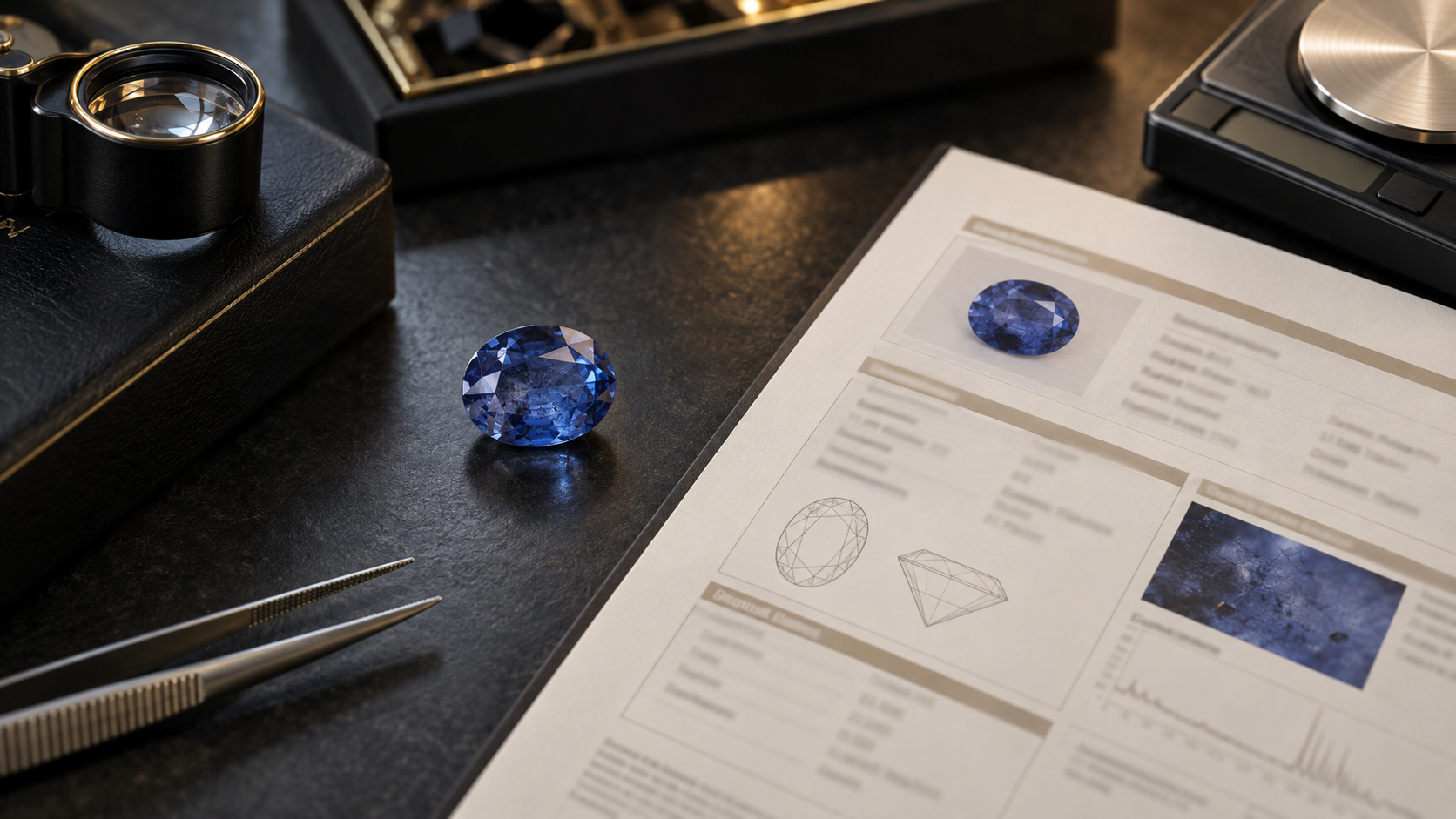
A gemstone is offered for sale with a laboratory report.
The report looks impressive.
It has:
- a laboratory name;
- a report number;
- measurements;
- colour;
- gemstone identity;
- perhaps treatment information;
- perhaps geographic origin;
- a photograph.
So the obvious conclusion might be:
“This laboratory has certified that this is a high-quality gemstone worth the asking price.”
That conclusion can be completely wrong.
A professional coloured-stone laboratory report is primarily an analytical document.
Its central purpose is usually to answer questions such as:
What is this material?
Is it natural or laboratory-grown?
Is there evidence of treatment?
And, for certain gemstones and certain report services:
Can a geographic origin be determined?
Those are enormously important questions.
But they are not the same as:
How beautiful is this gemstone?
How well is it cut?
How rare is this particular specimen?
What is its retail value?
Is the asking price reasonable?
Should I buy it?
Understanding this distinction is one of the most useful skills a gemstone buyer can develop.
This guide explains how to read a coloured-stone laboratory report systematically, what the major entries mean, and where the limits of laboratory reporting begin.
Table of Contents
1. FIRST: REPORT OR “CERTIFICATE”?
In everyday gemstone trading, people frequently use the word:
certificate.
You may see phrases such as:
- certified sapphire;
- ruby certificate;
- gemstone certificate;
- certificate of authenticity.
But major gemmological laboratories commonly call their documents:
REPORTS.
That terminology matters.
A laboratory is reporting the results of an examination performed using the techniques and equipment available to it at that time.
For example, GIA explicitly states that its report is not a guarantee, valuation or appraisal.
Therefore, when reading a document, begin by asking:
WHAT TYPE OF DOCUMENT IS THIS?
Is it:
- an independent laboratory identification report?
- an identification and origin report?
- a grading report?
- an appraisal?
- a seller’s own guarantee?
- an internal evaluation report?
These documents serve different purposes.
They should not be treated as interchangeable.
2. IDENTIFICATION IS THE FOUNDATION
The most fundamental laboratory question is:
WHAT IS THE MATERIAL?
A professional report may identify a stone at different levels.
For example:
Species: Corundum
Variety: Natural Sapphire
or:
Species: Beryl
Variety: Emerald
or:
Species: Garnet
Variety: Spessartine
Species and variety are not simply decorative terminology.
They describe different levels of gemmological classification.
3. SPECIES VERSUS VARIETY
A mineral species is defined by its fundamental:
- chemical composition;
- crystal structure.
Corundum is a mineral species.
Within corundum, colour and accepted gemmological nomenclature create varieties such as:
- ruby;
- sapphire.
Beryl is another mineral species.
Its gem varieties include:
- emerald;
- aquamarine;
- morganite;
- heliodor or golden beryl.
A good report therefore tells you something far more precise than:
“red gemstone”
or:
“green stone.”
It identifies the material gemmologically.
4. NATURAL OR LABORATORY-GROWN?
This may be one of the most commercially important lines on the entire report.
Two stones can have essentially the same:
- chemical composition;
- crystal structure;
- optical properties
while having fundamentally different origins.
A laboratory-grown ruby is still corundum.
A laboratory-grown sapphire is still corundum.
A laboratory-grown emerald is still beryl.
The question is whether the crystal formed through:
natural geological processes
or:
human-controlled crystal growth.
Major laboratories specifically investigate this distinction.
Never assume that “ruby” or “sapphire” alone automatically means:
natural.
Read the complete identification statement.
5. SYNTHETIC DOES NOT MEAN IMITATION
This is an important distinction.
A:
SYNTHETIC OR LABORATORY-GROWN GEMSTONE
has essentially the same fundamental chemical and crystal structure as its natural counterpart.
An:
IMITATION
merely resembles another gemstone visually.
For example, a red material might imitate ruby while actually being:
- glass;
- another mineral;
- manufactured material.
A laboratory report should make these distinctions clear.
6. THE REPORT NUMBER
Most professional reports carry a unique:
REPORT NUMBER.
This connects the physical document with the laboratory’s database.
Treat this number as important.
It can often be used through the laboratory’s official verification service to confirm that a report with those details exists.
But there is a crucial limitation:
A VALID REPORT NUMBER DOES NOT BY ITSELF PROVE THAT THE STONE IN FRONT OF YOU IS THE STONE DESCRIBED BY THAT REPORT.
Why?
Because report numbers can be:
- copied;
- misrepresented;
- paired with another gemstone;
- counterfeited.
GIA has documented cases in which counterfeit inscriptions referenced genuine report numbers belonging to different diamonds.
Report verification is therefore necessary—but matching the report to the actual gemstone is equally important.
7. CHECK THE DATE
A laboratory report normally records when the gemstone was examined.
The date matters because the report describes the gemstone:
AT THE TIME OF EXAMINATION.
Since then, a gemstone could theoretically have been:
- recut;
- repolished;
- damaged;
- treated;
- replaced.
Analytical technology can also improve over time.
GIA explicitly notes that later examination results can differ as techniques and equipment develop.
An older report is therefore not automatically invalid.
But its age is relevant context.
8. SHAPE
The report may describe the gemstone’s outline:
- oval;
- round;
- cushion;
- pear;
- rectangular;
- octagonal;
- marquise;
- other forms.
This is:
SHAPE.
Do not confuse shape with:
CUTTING STYLE.
An oval stone can have several different facet arrangements.
Shape tells you the outline.
Cutting style tells you more about how the surfaces are arranged.
9. CUTTING STYLE
A report may describe a stone as:
- brilliant cut;
- step cut;
- mixed cut;
- cabochon;
- modified brilliant;
- other recognised styles.
This helps identify the submitted gemstone.
But a cutting-style description does not necessarily mean the laboratory has judged:
how well the stone was cut.
That distinction is essential.
“Cushion mixed cut” is primarily descriptive.
It does not automatically mean:
excellent cut.
10. WEIGHT
Gemstones are normally weighed in:
CARATS.
One metric carat equals:
0.20 GRAM.
Therefore:
5 carats = 1 gram.
Weight is objective and commercially important.
But weight alone tells you remarkably little about beauty or value.
Two sapphires weighing exactly 2.00 ct can differ dramatically in:
- colour;
- transparency;
- clarity;
- cut;
- treatment;
- origin;
- rarity.
Never use carat weight as a shortcut for quality.
11. MEASUREMENTS
A laboratory report normally records dimensions in:
MILLIMETRES.
For many fancy-shaped stones this is approximately:
length × width × depth.
For round stones the format may use minimum and maximum diameter followed by depth.
Measurements help:
- distinguish the gemstone;
- understand proportions;
- compare apparent size;
- match a stone to its report.
They can also reveal something consumers frequently overlook:
TWO STONES OF THE SAME CARAT WEIGHT CAN LOOK VERY DIFFERENT IN FACE-UP SIZE.
A deep stone may hide considerable weight below the girdle.
A shallower stone may present a larger face-up area.
Neither observation alone determines whether the cut is good.
But measurements help you ask the right question.
12. COLOUR DESCRIPTION
A laboratory may give a general colour description such as:
- blue;
- green;
- purplish red;
- yellowish green;
- orangy pink.
Read this as:
A DESCRIPTION.
Do not automatically interpret it as:
A QUALITY GRADE.
For many coloured-stone reports, a laboratory is identifying and describing colour rather than telling you:
this colour is commercially excellent.
That distinction becomes especially important when comparing two stones whose reports both simply say:
Blue.
Their actual colours may differ significantly in:
- hue;
- tone;
- saturation;
- zoning;
- visual appeal.
13. COLOUR NAMES CAN HAVE COMMERCIAL POWER
Terms such as:
- pigeon blood;
- royal blue;
- vivid green
can strongly affect buyer perception and sometimes price.
But colour terminology is not perfectly universal across laboratories.
Different laboratories can apply different criteria.
CIBJO and laboratory organisations have worked for years toward greater harmonisation of terminology.
Therefore, when a premium depends heavily on a special colour designation:
READ WHICH LABORATORY ISSUED IT AND UNDER WHICH SYSTEM.
Do not treat every descriptive term from every document as equivalent.
14. TRANSPARENCY
Some reports describe:
- transparent;
- translucent;
- opaque.
Transparency refers to the degree to which light passes through the material.
It is not synonymous with:
CLARITY.
A transparent gemstone can contain visible inclusions.
A translucent material can be entirely appropriate for its gemstone variety.
Transparency should therefore be interpreted in the context of:
what the gemstone is.
15. THE TREATMENT SECTION
For many coloured gemstones, this is one of the most important areas of the report.
Treatments can alter:
- colour;
- clarity;
- apparent transparency;
- durability;
- market value.
Examples include:
- heating;
- fracture filling;
- oiling;
- resin impregnation;
- diffusion;
- dyeing;
- irradiation;
- coating.
Not every treatment has the same:
- purpose;
- permanence;
- acceptance;
- effect on value.
Therefore:
“TREATED” IS NOT ONE SINGLE CATEGORY.
16. HEAT TREATMENT
Heating is widely encountered in certain gemstone varieties, particularly:
- ruby;
- sapphire.
Heat can alter characteristics including:
- colour;
- clarity appearance.
A report may state evidence such as:
indications of heating
or use laboratory-specific terminology.
Conversely, it may report:
no indications of heating
when the observations and analytical evidence support that conclusion.
For certain fine rubies and sapphires, the distinction between heated and no-indications-of-heating material can be commercially significant.
17. “NO INDICATIONS OF HEATING” DOES NOT MEAN “PERFECT”
A gemstone showing no evidence of heat treatment can still have:
- poor colour;
- poor cut;
- heavy inclusions;
- low transparency;
- surface-reaching fractures.
Treatment status is one characteristic.
It is not a complete quality grade.
An untreated gemstone is not automatically a:
GOOD GEMSTONE.
And a heated gemstone is not automatically a:
BAD GEMSTONE.
The correct evaluation considers the entire stone.
18. “NO INDICATIONS” IS CAREFUL SCIENTIFIC LANGUAGE
Why do laboratories often say:
no indications of heating
rather than:
this gemstone has definitely never been heated?
Because science reports what can be supported by:
OBSERVABLE EVIDENCE.
A laboratory examines the material using available techniques.
If recognised evidence of treatment is absent, it reports accordingly.
That is different from claiming omniscient knowledge of everything that has ever happened to the gemstone.
This wording is not weakness.
It is scientific precision.
19. SOME TREATMENTS MAY BE DIFFICULT OR IMPOSSIBLE TO DETECT
This is another important limitation.
Not every possible treatment can necessarily be established scientifically in every material.
CIBJO has specifically discussed situations in which absence of a treatment comment should not automatically be interpreted as proof that no treatment occurred.
Detection depends on:
- gemstone material;
- treatment;
- analytical evidence;
- current technology.
Therefore:
ABSENCE OF EVIDENCE IS NOT ALWAYS EVIDENCE OF ABSENCE.
This is one reason professional reports use carefully controlled wording.
20. CLARITY ENHANCEMENT
Emerald provides a classic example.
Natural emerald commonly contains surface-reaching fissures.
These can be filled with substances such as:
- oils;
- resins.
The purpose is generally to reduce the visual prominence of fissures.
Some laboratories may describe the degree of clarity enhancement using terms such as:
- minor;
- moderate;
- significant
or their own reporting system.
The degree matters because two emeralds that are both “clarity enhanced” may have very different levels of intervention.
21. TREATMENT TYPE AND TREATMENT EXTENT ARE DIFFERENT
Consider two emeralds.
Both contain fissure-filling material.
Gemstone A has very limited filling.
Gemstone B has extensive filling.
Simply stating:
“both are treated”
does not communicate the whole situation.
Where available, read:
- treatment type;
- extent;
- filling material;
- laboratory comments.
AGL, for example, reports degrees of certain clarity enhancements and may identify filling materials on its higher-level reports.
The details matter.
22. TREATMENT CAN AFFECT CARE
Treatment information is not relevant only to price.
It may also affect:
DURABILITY AND MAINTENANCE.
Some filling materials can react differently to:
- heat;
- chemicals;
- ultrasonic cleaning;
- steam cleaning;
- repair procedures.
A jeweller needs to know what material is being handled.
Treatment disclosure therefore protects not only the buyer’s financial decision but potentially the gemstone itself.
23. GEOGRAPHIC ORIGIN
For certain gemstones, some laboratories offer an opinion on:
GEOGRAPHIC ORIGIN.
Examples may include:
- ruby;
- sapphire;
- emerald;
- alexandrite;
- red spinel;
- Paraíba-type tourmaline;
- selected other gemstones depending on laboratory and service.
This does not mean a laboratory possesses a magical geological barcode reader.
Origin determination is sophisticated comparative gemmology.
24. HOW IS ORIGIN DETERMINED?
Laboratories can combine evidence such as:
- internal inclusions;
- growth structures;
- trace-element chemistry;
- absorption spectra;
- fluorescence;
- other analytical characteristics.
These are compared against:
REFERENCE DATA FROM KNOWN DEPOSITS.
The laboratory asks:
Which known geological population is this gemstone most consistent with?
That is why strong reference collections are so important.
25. ORIGIN IS AN OPINION BASED ON EVIDENCE
GIA explicitly describes geographic origin as its:
OPINION
on the country or region where the gemstone was mined, based on gemmological properties and analytical data.
That wording matters.
Geographic-origin determination is not always possible.
Gemstone deposits can overlap in their properties.
A laboratory may therefore report:
inconclusive
rather than forcing an unsupported answer.
An inconclusive result is scientifically preferable to false certainty.
26. ORIGIN IS NOT AVAILABLE FOR EVERY GEMSTONE
This is a common misunderstanding.
A buyer might ask:
“Why doesn’t my topaz report say whether it came from Brazil?”
Because geographic-origin determination is not routinely offered or scientifically meaningful at the same confidence level for every gemstone variety.
Major laboratories restrict origin services to materials for which they have sufficient:
- scientific criteria;
- reference samples;
- comparative data.
No origin line does not automatically mean:
something is missing.
It may simply mean origin is not part of that report service.
27. ORIGIN CAN AFFECT VALUE—BUT DOES NOT CREATE QUALITY
Certain geographic origins carry strong reputations.
Examples commonly discussed in the market include:
- Kashmir sapphire;
- Burmese/Myanmar ruby;
- Colombian emerald.
Origin can affect rarity, desirability and price.
But:
A FAMOUS ORIGIN DOES NOT MAKE EVERY STONE FROM THAT REGION EXCELLENT.
A poorly coloured sapphire does not become beautiful simply because it came from a prestigious locality.
Likewise, a superb gemstone from a less celebrated origin can be exceptional.
Origin and quality are:
related market factors, not synonyms.
28. THE PHOTOGRAPH
Many modern reports include a photograph of the submitted gemstone.
This is useful for:
- general visual matching;
- documentation;
- report verification.
But a small report photograph should not be used to judge precise:
- colour;
- brilliance;
- extinction;
- windowing;
- inclusions.
Photography is affected by:
- lighting;
- camera;
- display;
- printing.
The physical gemstone remains the primary object.
29. MATCH THE STONE TO THE REPORT
Before relying on a report, compare:
- shape;
- cutting style;
- weight;
- measurements;
- photograph;
- inscriptions if applicable.
If significant details do not correspond:
STOP.
Do not assume a report belongs to the gemstone merely because it was handed to you in the same parcel.
Professional verification should connect:
DOCUMENT
to:
PHYSICAL STONE.
30. VERIFY THE REPORT WITH THE LABORATORY
Where the issuing laboratory offers online report verification, use it.
Check:
- report number;
- date;
- gemstone identity;
- weight;
- measurements;
- treatment statement;
- origin statement where applicable.
Use the:
OFFICIAL LABORATORY WEBSITE.
Do not rely solely on:
- a seller screenshot;
- a PDF forwarded through messaging;
- a QR code without checking its destination.
Verification adds another layer of protection.
31. A QR CODE IS CONVENIENT—NOT MAGICAL
A QR code is simply a method of encoding information or a web destination.
It does not prove authenticity by itself.
A fraudulent document can also contain a QR code.
What matters is:
WHERE THE QR CODE LEADS
and whether the official laboratory database confirms the corresponding report details.
Technology is useful.
Critical verification remains necessary.
32. DOES THE REPORT GRADE THE GEMSTONE?
This is one of the most important questions in this guide.
Many coloured-stone identification reports:
DO NOT PROVIDE AN OVERALL QUALITY GRADE.
For example, GIA’s standard coloured-stone reports identify and describe the gemstone, treatment and—in eligible services—origin.
That is not the same as assigning a universal:
- Excellent;
- Very Good;
- AAA;
- AA
quality grade.
Some other laboratories do offer coloured-stone grading services.
AGL, for example, offers report levels incorporating assessment of:
- colour;
- clarity;
- cutting;
- other quality factors.
Therefore always ask:
WHAT EXACTLY DID THIS LABORATORY GRADE?
Never infer grading information that the report does not contain.
33. “AAA” REQUIRES PARTICULAR CAUTION
In the coloured-gemstone market you will frequently encounter labels such as:
- AAA;
- AAAA;
- AAAAA;
- premium grade;
- investment grade.
Unlike the internationally standardised diamond 4Cs framework, coloured gemstones do not have one universally adopted global quality scale in which every seller’s “AAA” means exactly the same thing.
Therefore ask:
Who assigned the grade?
What criteria were used?
Can I see the grading methodology?
A grade without a defined system has limited analytical meaning.
34. LABORATORY REPORT VERSUS NGB GRADING
This distinction is particularly important at Natural Gems Belgium.
An independent laboratory report may establish:
- identity;
- natural or laboratory-grown status;
- detectable treatments;
- geographic origin when available.
NGB grading serves a different function.
It evaluates the individual gemstone through defined quality criteria.
For a faceted gemstone, these may include:
- colour;
- clarity;
- cut;
- optical performance;
- overall appeal.
These two documents therefore answer different questions.
LABORATORY REPORT:
What is the gemstone and what can scientifically be established about it?
NGB GRADING:
How does this individual gemstone perform as a gem under the defined NGB evaluation system?
They complement one another.
They should never be presented as though they are the same thing.
35. DOES THE REPORT TELL YOU THE VALUE?
Usually:
NO.
A standard gemmological identification report is not a valuation.
GIA explicitly states that its reports are not:
- guarantees;
- valuations;
- appraisals.
Market value depends on many additional variables:
- colour quality;
- clarity;
- cut;
- carat weight;
- treatment;
- origin;
- rarity;
- demand;
- market conditions;
- seller context.
A laboratory can identify a sapphire without telling you whether:
€500
or:
€5,000
is an appropriate price.
36. REPORT AND APPRAISAL ARE DIFFERENT
An:
IDENTIFICATION REPORT
asks what the gemstone is.
An:
APPRAISAL
estimates monetary value for a stated purpose and market context.
These functions require different expertise.
An insurance appraisal may also use a value basis different from an immediate resale value.
Therefore never read an appraisal number as though it were:
guaranteed cash value.
And never read a gemmological report as though it were:
an appraisal.
37. A LAB REPORT DOES NOT GUARANTEE A GOOD PURCHASE
Suppose a laboratory confirms:
- natural sapphire;
- no indications of heating;
- geographic origin: Sri Lanka.
Excellent information.
But you still need to evaluate:
- Is the colour attractive?
- Is there severe extinction?
- Is there a large window?
- Is the cut symmetrical?
- Are inclusions distracting?
- Are fractures durability risks?
- Is the price appropriate?
A report reduces:
INFORMATION UNCERTAINTY.
It does not replace:
BUYING JUDGEMENT.
38. THE LABORATORY NAME MATTERS
A report is only as meaningful as:
- the competence of the laboratory;
- its equipment;
- its reference data;
- its procedures;
- its independence;
- its quality controls;
- its reputation.
The phrase:
“laboratory certified”
means very little unless you know:
WHICH LABORATORY.
Worldwide, oversight of organisations calling themselves gem laboratories is not completely uniform.
CIBJO has explicitly raised this issue and developed detailed laboratory guidelines.
Therefore, evaluate the issuer—not merely the existence of paper.
39. INDEPENDENCE MATTERS
There is an important difference between:
a seller describing their own gemstone
and:
an independent laboratory analysing it.
Seller information can still be useful and responsible.
At NGB, for example, internal grading provides detailed evaluation and transparency.
But independent laboratory analysis has a separate role because the laboratory is not the party selling the stone.
When commercially significant claims require independent verification, a respected external laboratory can add valuable evidence.
40. DIFFERENT LABORATORIES CAN REACH DIFFERENT CONCLUSIONS
Gemology is analytical science, but not every question produces a perfectly binary answer.
Two respected laboratories can occasionally differ regarding:
- geographic origin;
- special colour terminology;
- degree of treatment;
- certain borderline observations.
This does not automatically mean one laboratory is fraudulent.
Some determinations require interpretation of complex overlapping evidence.
That is particularly true for:
GEOGRAPHIC ORIGIN.
41. WHY LABORATORY HARMONISATION MATTERS
Organisations such as CIBJO and the Laboratory Manual Harmonisation Committee work toward greater consistency in:
- terminology;
- disclosure;
- analytical reporting.
Why?
Because inconsistent language can confuse:
- traders;
- retailers;
- consumers.
A gemstone market functions better when terms have:
CLEAR, CONSISTENT MEANINGS.
But complete global uniformity does not yet exist.
The informed buyer therefore reads the actual laboratory wording rather than assuming every report uses identical standards.
42. WHAT ABOUT MOUNTED GEMSTONES?
Many laboratories can examine gemstones while mounted in jewellery.
But mounting can restrict:
- access;
- weight determination;
- certain observations;
- some measurements;
- analytical positioning.
A laboratory may therefore report the item differently from a loose stone.
Gem-A notes that mounted gems can require more examination time and may impose limitations on testing.
If maximum analytical access is important, loose examination is generally preferable when practical.
43. CHECK WHETHER WEIGHT IS MEASURED OR ESTIMATED
A loose gemstone can normally be weighed directly.
A mounted gemstone may not be removable without risk.
Therefore a report or appraisal may sometimes provide an:
estimated weight
rather than a direct measurement.
Never treat:
estimated 2.00 ct
as analytically identical to:
measured 2.00 ct.
Read the wording.
44. COMMENTS CAN CONTAIN CRITICAL INFORMATION
Consumers often read only the large gemstone name.
That can be a mistake.
The:
COMMENTS
section may contain important information regarding:
- treatments;
- special testing;
- limitations;
- nomenclature;
- additional observations.
Never stop reading after:
Natural Sapphire.
Read the complete document.
45. FOOTNOTES MATTER TOO
Laboratory reports are deliberately concise.
Some definitions or limitations may appear in:
- footnotes;
- reverse-side text;
- online explanatory pages;
- report-check information.
If a treatment or origin statement affects a major purchase decision:
READ THE LABORATORY’S DEFINITION OF THAT TERM.
Do not rely entirely on a seller’s paraphrase.
46. REPORT AUTHENTICITY AND GEMSTONE AUTHENTICITY ARE TWO QUESTIONS
Ask:
QUESTION 1
Is this report genuine?
Then:
QUESTION 2
Does this genuine report belong to this gemstone?
A buyer who checks only Question 1 can still be deceived.
This distinction is fundamental.
47. COUNTERFEIT REPORT NUMBERS ARE A REAL RISK
GIA documented a 1.497 ct HPHT-processed diamond carrying a counterfeit inscription linked to a genuine GIA report number for a different untreated diamond.
The weights and grading parameters were deliberately similar.
Careful comparison revealed discrepancies.
The lesson extends beyond diamonds:
VERIFY BOTH DATA AND OBJECT.
A number alone is not enough.
48. DOES A REPORT EXPIRE?
A gemstone’s mineral species does not normally expire.
Corundum does not stop being corundum because a report is ten years old.
But circumstances can change.
The stone might be:
- recut;
- damaged;
- treated after reporting.
Laboratory techniques can improve.
A laboratory may therefore offer:
- recheck;
- update;
- re-evaluation
services.
For a high-value transaction involving an old report, updated verification may sometimes be sensible.
49. WHAT A GOOD REPORT CAN ESTABLISH VERY WELL
Depending on laboratory and report type, it can provide strong evidence regarding:
IDENTITY
What material is it?
NATURAL VERSUS LABORATORY-GROWN STATUS
How did the crystal originate?
DETECTABLE TREATMENTS
What evidence of enhancement is present?
PHYSICAL DESCRIPTION
Shape, cutting style, dimensions, weight, colour.
GEOGRAPHIC ORIGIN
For eligible gemstones when sufficiently determinable.
This information can dramatically reduce uncertainty.
50. WHAT A STANDARD IDENTIFICATION REPORT USUALLY DOES NOT ESTABLISH
Do not automatically expect it to tell you:
MARKET VALUE
RETAIL PRICE
INVESTMENT POTENTIAL
FUTURE PRICE APPRECIATION
WHETHER THE CUT IS BEAUTIFUL
WHETHER YOU PERSONALLY SHOULD BUY IT
WHETHER THE SELLER’S PRICE IS FAIR
UNIVERSAL COLOURED-STONE QUALITY GRADE
unless the particular laboratory and report service explicitly provides such grading.
This boundary is critical.
51. THE THREE-LAYER NGB APPROACH
For an informed gemstone purchase, it is useful to think in three layers.
LAYER 1 — SCIENTIFIC IDENTITY
What is it?
Natural or laboratory-grown?
Treatment?
Origin where determinable?
This is the laboratory domain.
LAYER 2 — GEM QUALITY
Colour?
Clarity?
Cut?
Optical performance?
Overall appeal?
This is where systematic gemstone evaluation becomes important.
LAYER 3 — COMMERCIAL DECISION
Price?
Rarity?
Personal preference?
Intended use?
Budget?
Only when all three layers are considered does the buyer have a complete decision framework.
52. THE REPORT READING WORKFLOW
When a laboratory report accompanies a gemstone, use this order.
STEP 1 — IDENTIFY THE ISSUER
Is it a recognised independent gemmological laboratory?
↓
STEP 2 — IDENTIFY THE REPORT TYPE
Identification?
Identification + origin?
Grading?
Appraisal?
↓
STEP 3 — VERIFY THE REPORT NUMBER
Use the laboratory’s official verification system where available.
↓
STEP 4 — MATCH THE GEMSTONE
Compare:
- shape;
- weight;
- measurements;
- photograph;
- inscription where relevant.
↓
STEP 5 — READ THE IDENTIFICATION
Species?
Variety?
Natural?
Laboratory-grown?
↓
STEP 6 — READ TREATMENT INFORMATION
Not just the heading.
Read every comment.
↓
STEP 7 — READ ORIGIN CAREFULLY
Is origin actually stated?
Is it inconclusive?
Is origin even offered for this material?
↓
STEP 8 — CHECK WHAT WAS NOT GRADED
Do not invent conclusions absent from the report.
↓
STEP 9 — EVALUATE THE PHYSICAL GEMSTONE
Colour.
Clarity.
Cut.
Optical performance.
Durability considerations.
↓
STEP 10 — EVALUATE PRICE SEPARATELY
A genuine report does not automatically make the asking price reasonable.
53. FIVE QUESTIONS TO ASK BEFORE BUYING
If a gemstone comes with a laboratory report, ask:
1. WHAT EXACTLY DID THE LAB CONFIRM?
2. WHAT TREATMENTS DID IT DETECT OR COMMENT ON?
3. DOES THE REPORT ACTUALLY INCLUDE ORIGIN?
4. DOES THE PHYSICAL GEMSTONE MATCH THE REPORT?
5. WHAT IMPORTANT QUALITY OR VALUE QUESTIONS ARE NOT ANSWERED BY THE REPORT?
These five questions prevent many misunderstandings.
54. THE MOST DANGEROUS WORD IS “THEREFORE”
A report says:
Natural Ruby.
Therefore it is valuable?
No.
It says:
No indications of heating.
Therefore it is high quality?
No.
It says:
Origin: Myanmar.
Therefore the price is justified?
No.
It says:
3.02 carats.
Therefore it is rare?
Not necessarily.
The laboratory finding is evidence.
The conclusion must still be justified.
55. LAB REPORTS SHOULD INCREASE TRANSPARENCY—NOT END THE CONVERSATION
The best use of a laboratory report is not:
“There is a certificate, so stop asking questions.”
It is:
“Here is independent analytical information; now we can evaluate the gemstone more accurately.”
That is a completely different mindset.
A report should encourage:
INFORMED QUESTIONS.
Not blind trust.
56. WHY THIS MATTERS MORE ONLINE
When buying online, the customer cannot always:
- hold the gemstone;
- rotate it under different lighting;
- inspect it microscopically;
- compare several stones side by side.
Documentation therefore becomes particularly important.
Useful information includes:
- accurate photographs;
- video;
- measurements;
- weight;
- treatment disclosure;
- gemmological data;
- independent laboratory report where appropriate;
- structured quality evaluation.
No single element replaces all the others.
Together they build:
TRANSPARENCY.
57. A REPORT IS A SNAPSHOT OF ANALYTICAL KNOWLEDGE
This is perhaps the most scientifically important concept.
A laboratory report records the conclusions supported by:
- the gemstone;
- the analytical methods;
- the reference data;
- the scientific knowledge
available at the time of examination.
Science evolves.
Detection methods improve.
New deposits are discovered.
Reference databases expand.
A responsible report is therefore not a mystical declaration of eternal truth.
It is:
A PROFESSIONAL ANALYTICAL CONCLUSION.
That is precisely why reputable laboratories use controlled terminology.
58. WHAT MAKES A LABORATORY REPORT VALUABLE?
Not expensive paper.
Not holograms alone.
Not a prestigious-looking logo.
Its real value comes from:
- scientific expertise;
- appropriate instrumentation;
- reference collections;
- reproducible methodology;
- quality control;
- independence;
- careful terminology;
- willingness to report uncertainty.
A laboratory that says:
inconclusive
when evidence is insufficient demonstrates something valuable:
SCIENTIFIC DISCIPLINE.
59. THE INFORMED BUYER’S FINAL CHECK
Before purchasing a significant coloured gemstone, separate these questions:
IDENTITY
What is it?
NATURAL STATUS
Natural or laboratory-grown?
TREATMENT
What has been detected?
ORIGIN
Is a geographic opinion available and relevant?
QUALITY
How good is the individual stone?
VALUE
Is the asking price reasonable for those characteristics?
PERSONAL SUITABILITY
Do I actually want this gemstone?
No single laboratory line answers all seven.
Conclusion
A gemstone laboratory report can be one of the most valuable documents accompanying a coloured stone.
But only when it is read correctly.
Its greatest strength is:
SCIENTIFIC CHARACTERISATION.
A professional laboratory can help establish:
- gemstone identity;
- natural or laboratory-grown status;
- detectable treatments;
- physical characteristics;
- and, for certain stones and services, geographic origin.
That information can be extremely important.
But a standard identification report does not automatically tell you:
- whether the gemstone is beautiful;
- whether the cut is excellent;
- whether its price is fair;
- whether it will increase in value;
- whether you should buy it.
Nor does the presence of a genuine report automatically prove that the physical gemstone offered to you is the gemstone described by that report.
A responsible buyer therefore verifies:
THE LABORATORY
↓
THE REPORT
↓
THE REPORT NUMBER
↓
THE PHYSICAL GEMSTONE
↓
THE IDENTIFICATION
↓
THE TREATMENT INFORMATION
↓
THE ORIGIN STATEMENT
↓
THE QUALITY OF THE ACTUAL STONE
↓
THE PRICE.
Most importantly, learn to distinguish three separate concepts:
IDENTIFICATION IS NOT GRADING.
GRADING IS NOT VALUATION.
VALUATION IS NOT A GUARANTEE.
Once those distinctions are clear, a laboratory report becomes far more useful.
It stops being an impressive piece of paper.
It becomes what it should be:
A TOOL FOR INFORMED GEMSTONE DECISIONS.
References & Further Reading
Gemological Institute of America — Colored Stone Reports & Services Details.
GIA’s official description of its coloured-stone reporting services. It explains that reports identify gemstone type, distinguish natural from synthetic material, report detectable treatments and, where determinable for eligible stones, may include geographic origin. It also lists the physical information included on reports.
https://www.gia.edu/gia-website/gem-lab-service/colored-stone-analysis-report-service
Gemological Institute of America — Sample Colored Stone Reports.
Official examples explaining the structure and purpose of GIA coloured-stone identification and identification-and-origin reports, including identity, natural/laboratory-grown status, treatment information, dimensions, colour and gemstone photographs.
https://www.gia.edu/gia-website/analysis-grading-sample-report-colored-stone
Gemological Institute of America — How to Read a GIA Identification and Origin Report.
A field-by-field explanation of an identification and origin report, including species, variety, treatment, geographic-origin opinion, measurements and other descriptive information. Particularly useful for understanding that origin conclusions are based on inclusions, gemmological properties, spectroscopy and chemical analysis.
https://www.gia.edu/doc/How_to_Read_a_GIA_Identification_and_Origin_Report.pdf
Gemological Institute of America — Important Limitations for GIA Reports and Their Facsimiles.
Essential reading for understanding what a laboratory report does not represent. GIA explicitly explains that a report is not a guarantee, valuation or appraisal and that conclusions reflect examination using the techniques and equipment available at the time.
https://www.gia.edu/terms
Barrie, E., Teuthof, S. & Eaton-Magaña, S. — “HPHT-Processed Diamond with Counterfeit GIA Inscription.” Gems & Gemology, Fall 2021. Gemological Institute of America.
A useful real-world case demonstrating why a genuine report number or inscription alone is insufficient. GIA documented an HPHT-treated diamond carrying a counterfeit inscription referencing the report number of a different untreated diamond.
https://www.gia.edu/gems-gemology/fall-2021-hpht-processed-diamond-counterfeit-gia-inscription
CIBJO — The Blue Books. World Jewellery Confederation.
CIBJO maintains internationally recognised industry reference documents covering nomenclature and standards for coloured gemstones, diamonds, pearls, precious metals and gemmological laboratories. The documents are periodically reviewed and provide an important framework for consistent terminology and disclosure.
https://cibjo.org/the-blue-books/
CIBJO — Responsible Sourcing Guidance: Product Integrity.
CIBJO’s guidance emphasises correct representation and disclosure of gemstone materials and treatments throughout the jewellery supply chain and explains the role of the CIBJO Blue Books in maintaining product integrity.
https://cibjo.org/rstoolkit/rsg-step-7/
American Gemological Laboratories — The Prestige Report.
AGL’s official explanation of its coloured-stone reporting structure. Particularly useful for understanding how some laboratories extend beyond identification into treatment extent, geographic origin and optional quality grading, illustrating why buyers must identify exactly which report service they are reading.
https://www.aglgemlab.com/the-prestige-report
Gem-A — From the Laboratory. The Gemmological Association of Great Britain.
Professional discussion of laboratory report formats, treatment and origin reporting, practical submission considerations and limitations when gemstones are mounted. It also explains why laboratory testing must be performed on the actual material being reported.
https://gem-a.com/wp-content/uploads/2017/04/GJ-26-3-2017.pdf
[…] to GIA, its Colored Stone Identification & Origin Report can indicate whether an emerald is natural or laboratory-grown, identify detectable treatment and, […]