

Table of Contents
A Gemstone May Be Found Far from Where It Formed
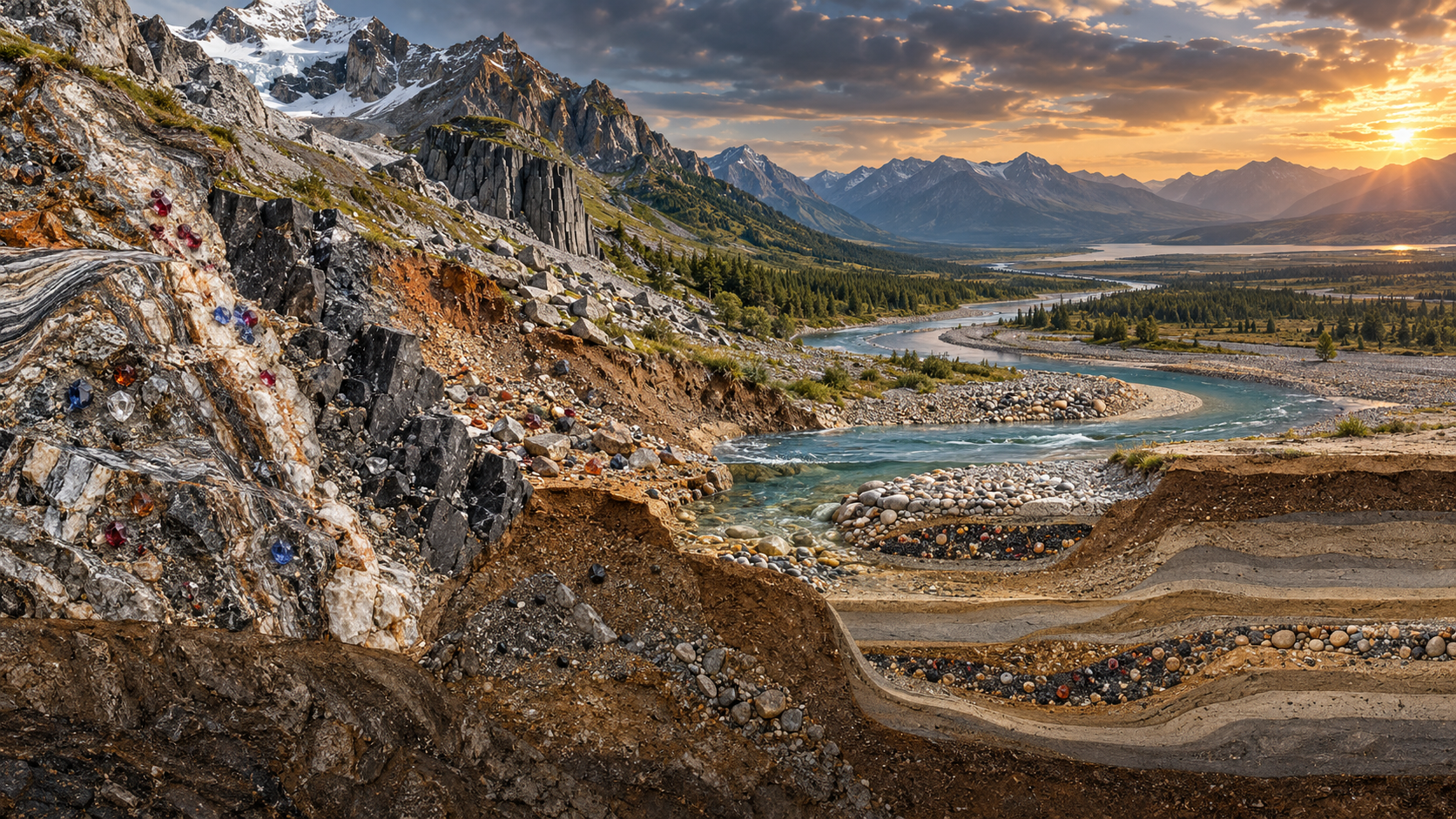
Imagine finding a rounded blue sapphire in a gravel layer beneath several metres of soil.
There is no sapphire-bearing crystal pocket beside it.
No obvious corundum-rich host rock.
No beautiful sapphire crystal still attached to its geological source.
Instead, the stone lies among:
- quartz pebbles;
- clay;
- sand;
- zircon;
- garnet;
- spinel;
- other resistant minerals.
Did the sapphire form there?
Usually:
no.
It may have crystallised millions—or hundreds of millions—of years earlier in a completely different geological environment.
Later:
weathering exposed it.
erosion released it.
gravity moved it.
water transported it.
sediments buried it.
And geological processes concentrated it with other dense, durable minerals.
This journey explains why many important gemstones are mined not from the rocks in which they originally formed, but from:
SECONDARY DEPOSITS.
To understand gemstone mining properly, we therefore need to separate two questions:
WHERE DID THE GEMSTONE FORM?
and:
WHERE IS THE GEMSTONE FOUND TODAY?
They are not always the same place.
PRIMARY AND SECONDARY GEMSTONE DEPOSITS
The most fundamental distinction is between:
PRIMARY DEPOSITS
and:
SECONDARY DEPOSITS.
A primary deposit contains the gemstone within, or very close to, the geological rock environment in which it formed.
A secondary deposit contains gemstones that have been:
- released from their original host;
- moved;
- concentrated;
- redeposited.
That difference is essential.
A ruby can form in metamorphic marble.
A sapphire can form in metamorphic or magmatic geological environments.
A diamond can form deep within the mantle and later be transported toward the surface by kimberlitic magma.
But after those stones reach rocks exposed at Earth’s surface, a completely different geological chapter begins.
PART I — PRIMARY GEMSTONE FORMATION
A gemstone begins as a mineral crystal.
Its formation requires a particular combination of:
- chemical elements;
- temperature;
- pressure;
- fluid composition;
- crystal-growth environment;
- geological time.
Different gemstone species require different environments.
Some form from:
magma.
Some form during:
metamorphism.
Some crystallise from:
hydrothermal fluids.
Others precipitate from lower-temperature solutions.
Understanding a gemstone deposit therefore begins with:
GEOLOGICAL CONTEXT.
PART II — MAGMATIC SOURCES
Some gemstone minerals are associated with igneous or magmatic processes.
Magma cools and crystallises.
During that crystallisation, different minerals become stable at different temperatures and chemical conditions.
Gem-quality material can occur in:
- volcanic rocks;
- intrusive igneous rocks;
- pegmatites;
- cavities;
- late-stage magmatic systems.
Examples include important occurrences of:
- topaz;
- zircon;
- feldspar;
- some sapphire;
- some spinel;
- tourmaline;
- beryl.
Diamond requires an especially unusual history.
Most natural diamonds formed far deeper than ordinary crustal gemstones and were later carried upward rapidly by kimberlitic or related magmas.
The rock that brings a gemstone to the surface is not always the same environment in which the gemstone originally crystallised.
This distinction becomes especially important for diamond.
PART III — METAMORPHIC SOURCES
Many important coloured gemstones formed during:
METAMORPHISM.
Metamorphism occurs when pre-existing rocks experience changes in:
- pressure;
- temperature;
- stress;
- fluid conditions
without complete melting.
Old minerals may become unstable.
New minerals can grow.
Large tectonic collisions can therefore create conditions favourable for gem formation.
Important metamorphic gemstones include examples of:
- ruby;
- sapphire;
- garnet;
- tanzanite;
- tsavorite;
- spinel;
- kyanite;
- sillimanite.
Some of the world’s most important ruby and sapphire deposits are associated with major mountain-building events.
The gemstone may originally form deep within a metamorphic rock package and only become accessible much later when:
uplift and erosion expose the deposit.
PART IV — PRIMARY DOES NOT MEAN EASY TO FIND
A primary deposit might sound straightforward.
Find the host rock.
Extract the gemstones.
But nature is rarely so simple.
Gem-bearing zones may be:
- narrow;
- discontinuous;
- folded;
- faulted;
- weathered;
- buried;
- altered.
Gemstones can occur only in specific reaction zones or lenses within a much larger rock formation.
An entire mountain may be composed of broadly similar rock, while economic gemstone mineralisation occurs in only a few small zones.
Therefore primary gemstone exploration requires:
geology, not merely digging.
PART V — THEN WEATHERING BEGINS
Once gemstone-bearing rocks are exposed at or near Earth’s surface, they begin to break down.
This process is:
WEATHERING.
Weathering can be:
PHYSICAL
Rock breaks into smaller pieces without major chemical transformation.
CHEMICAL
Minerals react with:
- water;
- oxygen;
- acids;
- dissolved ions.
BIOLOGICAL
Roots, microorganisms and other biological processes contribute to decomposition.
Over long periods, host rocks can be profoundly altered.
But not all minerals weather at the same rate.
PART VI — WHY SOME GEMSTONES SURVIVE
Many gemstones found in secondary deposits share several useful characteristics.
They may possess:
- significant hardness;
- mechanical durability;
- relatively high density;
- chemical stability;
- resistance to weathering.
If the host rock decomposes faster than the gemstone, the gemstone can be:
liberated.
Imagine corundum enclosed in a metamorphic host rock.
The surrounding minerals weather.
The rock becomes friable.
Eventually the sapphire crystal is released.
The gemstone has now begun its journey from:
PRIMARY DEPOSIT
toward:
SECONDARY DEPOSIT.
PART VII — RESISTANCE TO WEATHERING MATTERS
Not every mineral survives prolonged transport.
Some:
- dissolve;
- alter chemically;
- fracture easily;
- abrade rapidly.
Others can survive for very long periods.
This is why certain gemstones occur commonly in placer deposits.
GIA notes that important placer gem minerals tend to combine resistance to weathering with sufficient durability and density.
Typical examples include:
- diamond;
- corundum;
- spinel;
- garnet;
- zircon;
- quartz;
- jade minerals.
The mineral must survive the journey before it can become concentrated.
PART VIII — THE ROLE OF DENSITY
A river carries sediment of many different densities.
As water velocity changes, particles do not all behave identically.
Dense minerals can become concentrated in locations where the current loses enough energy to drop them.
These dense mineral assemblages are commonly described as:
HEAVY-MINERAL CONCENTRATIONS.
Gemstones may therefore occur alongside other dense minerals that have experienced the same transport and sorting processes.
This is one reason associated minerals can help geologists understand a secondary deposit.
PART IX — SECONDARY DEPOSITS ARE NOT ONE THING
“Secondary deposit” is a broad term.
The gemstones may have moved:
- almost nowhere;
- a few metres downslope;
- kilometres through river systems;
- all the way to a coastline;
- offshore onto a continental shelf.
The geological processes therefore produce several different categories.
The most useful for gemstone geology are:
ELUVIAL
COLLUVIAL
ALLUVIAL
and:
PALEOPLACER.
PART X — ELUVIAL DEPOSITS
An eluvial gemstone deposit forms close to the original source.
Weathering destroys or decomposes the host rock.
More mobile material may be removed.
Resistant gemstones remain concentrated in the weathered zone.
Transport is:
minimal.
The gemstone is therefore still geographically close to its source rock.
This is valuable geologically because the original primary mineralisation may still lie nearby.
PART XI — WHAT ELUVIAL GEMS MAY LOOK LIKE
Because transport has been limited, eluvial gemstones may retain:
- sharper crystal edges;
- recognisable crystal faces;
- less rounding;
- less abrasion.
Compare this with a gemstone that has travelled repeatedly through river gravel.
That stone may become much more rounded.
Shape can therefore sometimes offer clues about:
transport history.
But it should never be interpreted alone.
Crystal habit, fracture, mining method and local geology must also be considered.
PART XII — COLLUVIAL DEPOSITS
Colluvial deposits involve:
GRAVITY.
Weathered material moves downslope.
Processes can include:
- slope wash;
- soil creep;
- landslides;
- debris movement.
The gemstone may move farther than in a strictly eluvial deposit, but usually far less systematically than in a major river system.
Material often accumulates:
at the base of slopes.
These deposits can form an important bridge between:
primary source
and:
fully alluvial system.
PART XIII — TOPOGRAPHY CONTROLS COLLUVIAL DEPOSITS
A steep slope can act as a conveyor.
Weathering releases rock fragments.
Gravity pulls them downward.
Heavy resistant gemstones may accumulate where:
- slope angle decreases;
- debris is trapped;
- valleys begin;
- erosion slows.
This is why understanding landform is essential.
Gemstone geology is not limited to the rock itself.
It also involves:
GEOMORPHOLOGY.
PART XIV — ALLUVIAL DEPOSITS
When moving water becomes the dominant transporting agent, we enter the realm of:
ALLUVIAL DEPOSITS.
Rivers and streams erode material from upstream areas.
They transport:
- clay;
- sand;
- gravel;
- rock fragments;
- resistant heavy minerals;
- gemstones.
As water velocity changes, particles are sorted and deposited.
Over geological time, repeated transport and deposition can create rich concentrations of gemstones.
These are among the world’s most important secondary gem deposits.
PART XV — WHAT IS A PLACER DEPOSIT?
A:
PLACER
is a natural concentration of valuable, usually dense and resistant minerals within secondary sediments.
The term is not restricted to gemstones.
Classic placer minerals include:
- gold;
- platinum;
- cassiterite;
- ilmenite;
- magnetite;
- diamond;
- corundum.
In gemstone contexts, the terms:
alluvial deposit
and:
placer deposit
are sometimes used together.
But placer emphasises:
natural concentration through sedimentary sorting.
PART XVI — WHY RIVER BENDS MATTER
A river does not move at the same speed everywhere.
At:
- bends;
- pools;
- obstacles;
- slope changes;
- depressions;
- bedrock irregularities,
water velocity can change dramatically.
Heavy particles may settle where the river loses energy.
Therefore valuable mineral concentrations can occur in:
- gravel bars;
- inner bends;
- channels;
- potholes;
- natural traps.
The richest deposit may therefore occupy only a small portion of a much larger river system.
PART XVII — BEDROCK TRAPS
Imagine a river flowing over irregular bedrock.
The water transports gravel and dense minerals.
A depression or fracture in the bedrock creates a protected zone.
The current cannot easily remove the densest material from that pocket.
Gemstones accumulate.
These geological traps can become exceptionally important.
A miner may therefore be searching not simply for:
river gravel
but for:
THE RIGHT GRAVEL IN THE RIGHT POSITION.
PART XVIII — THE GEM-BEARING GRAVEL LAYER
In many alluvial gem fields, the richest material occurs in a particular coarse gravel horizon.
Fine sediment above it may contain little gemstone material.
The productive layer may include:
- quartz;
- resistant rock fragments;
- heavy minerals;
- rounded pebbles;
- gemstone fragments.
In Sri Lanka, gem-bearing gravel is famously known as:
ILLAM.
The miner’s task is often to reach this productive horizon rather than process every sediment layer equally.
PART XIX — SRI LANKA: THE CLASSIC ALLUVIAL GEM ENVIRONMENT
Sri Lanka provides one of the world’s best examples of secondary gemstone concentration.
The island is underlain largely by ancient high-grade metamorphic rocks.
Yet most commercial gemstones are recovered not from primary host rocks but from:
secondary gem-bearing gravels.
GIA reports that almost all major Sri Lankan gem sources are alluvial.
These gravels can contain:
- sapphire;
- spinel;
- chrysoberyl;
- zircon;
- garnet;
- moonstone;
- tourmaline;
- numerous rarer gem minerals.
The mixture itself tells a geological story.
PART XX — MANY PRIMARY SOURCES, ONE SECONDARY BASIN
An alluvial deposit can receive material from:
multiple source rocks.
That makes secondary deposits geologically fascinating.
A river basin may collect gemstones originally formed in different:
- metamorphic rocks;
- pegmatites;
- skarns;
- other geological environments.
Those gems become mixed together downstream.
This is one reason secondary deposits can produce extraordinary gemstone diversity.
It is also one reason reconstructing the original geology can become difficult.
PART XXI — WATER-WORN GEMSTONES
A crystal released from its primary source may begin with:
- sharp edges;
- well-developed crystal faces;
- angular fractures.
Long transport changes it.
Repeated collisions with sediment can:
- round corners;
- abrade surfaces;
- break weak portions;
- remove fragile material.
Eventually the gem can resemble a:
rounded pebble.
In Sri Lanka, GIA notes that gemstones transported farther from their source are generally more rounded than crystals recovered close to primary occurrences.
PART XXII — TRANSPORT CAN SELECT FOR DURABILITY
Transport is destructive.
A badly fractured crystal may not survive kilometres of river movement.
It can break apart.
A robust crystal has a greater chance of remaining intact.
Therefore long transport can create a form of:
NATURAL MECHANICAL SELECTION.
The final deposit may contain a proportion of material that survived because it was physically durable enough to endure transport.
That does not mean every alluvial gemstone is high quality.
But it helps explain why secondary deposits can yield remarkably durable gem fragments.
PART XXIII — TRANSPORT DOES NOT IMPROVE THE CRYSTAL
This idea must be phrased carefully.
A river does not “heal” a gemstone.
It does not improve its clarity internally.
Instead:
weaker material may be preferentially destroyed.
What remains can therefore represent a more mechanically resistant subset of the original population.
That is fundamentally different from saying:
river transport makes gemstones better.
PART XXIV — MADAGASCAR: ILAKAKA
The Ilakaka region of Madagascar is one of the great modern examples of alluvial sapphire geology.
The region became famous for extensive secondary deposits containing:
- blue sapphire;
- pink sapphire;
- fancy-colour sapphire;
- other gem minerals.
GIA describes important deposits there as:
buried paleoplacers.
These old gemstone-bearing sediment systems occur within and around ancient sedimentary formations and can require shafts or open pits to reach productive gravel layers.
PART XXV — WHAT IS A PALEOPLACER?
A normal placer deposit forms through sedimentary concentration.
But rivers change.
Landscapes evolve.
Sediments become buried.
Old river channels disappear.
A gemstone-rich placer may survive beneath younger sediments.
This ancient preserved concentration is:
A PALEOPLACER.
“Paleo” refers to:
ancient.
A paleoplacer therefore represents an old sedimentary concentration that may no longer correspond to the modern drainage system.
PART XXVI — WHY PALEOPLACERS ARE DIFFICULT TO RECOGNISE
A modern river reveals itself visibly.
An ancient river may not.
Its deposits may now lie:
- beneath soil;
- beneath younger sediment;
- inside partially lithified sedimentary units;
- far from a modern watercourse.
The original river valley may have disappeared completely.
Exploration therefore requires reconstructing:
ancient landscapes.
This is sedimentary geology applied directly to gemstone exploration.
PART XXVII — DIAMONDS: A MUCH LONGER JOURNEY
Diamond provides perhaps the most dramatic example of the difference between:
formation site
and:
recovery site.
Most gem diamonds formed deep within Earth at depths far greater than ordinary crustal gemstone deposits.
They were transported upward by kimberlitic or related magmas.
That created a primary geological source.
But surface erosion could then release diamonds from the kimberlite.
Rivers transported them again.
Thus one diamond can experience:
TWO COMPLETELY DIFFERENT TRANSPORT EVENTS.
First:
deep mantle → surface by magma
and later:
primary surface deposit → secondary placer by erosion and water.
PART XXVIII — SOUTHERN AFRICAN DIAMOND TRANSPORT
Southern Africa offers an extraordinary example.
Diamonds eroded from inland primary sources entered major river systems such as the:
- Vaal;
- Orange.
Over geological time they were transported westward.
Some eventually reached:
THE ATLANTIC OCEAN.
Today, secondary diamond deposits occur not only in river systems but also:
- along beaches;
- in coastal sediments;
- offshore on the continental shelf.
A diamond mined from marine gravel can therefore be hundreds of kilometres from the geological environment through which it originally reached Earth’s surface.
PART XXIX — MARINE PLACERS
Rivers are not the final possible stage.
Once sediment reaches the coast, waves and currents can continue sorting it.
Dense resistant minerals can become concentrated in:
- beaches;
- shorelines;
- marine terraces;
- shallow offshore sediments.
These are:
MARINE PLACER DEPOSITS.
The principle is similar to river placers:
transport + sorting + concentration.
The transporting system has simply changed from river water to:
coastal processes.
PART XXX — WHY DIAMONDS CAN SURVIVE THIS
Diamond combines:
- extraordinary hardness;
- strong chemical resistance;
- relatively high density.
Although diamonds can cleave or break, crystals capable of surviving extensive transport can persist through very long sedimentary journeys.
GIA notes that inferior stones may be lost through mechanical breakdown during transport.
This helps explain why some coastal diamond deposits contain high proportions of:
gem-quality surviving material.
Again, this is selection by survival—not improvement by transport.
PART XXXI — PRIMARY AND SECONDARY RUBY AT MONTEPUEZ
The Montepuez region of Mozambique demonstrates something especially useful:
a mining district can contain:
BOTH PRIMARY AND SECONDARY GEMSTONE DEPOSITS.
Ruby occurs in metamorphic host rocks.
Weathering releases some of those rubies.
They then enter:
- eluvial;
- colluvial
secondary deposits nearby.
This creates a geological continuum:
ruby in host rock
↓
weathered ruby near host
↓
downslope secondary concentration.
Nature does not always divide deposits into perfectly separate textbook categories.
PART XXXII — GEOLOGY IS A CONTINUUM
Terms such as:
- primary;
- eluvial;
- colluvial;
- alluvial
are useful classifications.
But actual landscapes can contain transitions.
A gemstone may begin:
in situ.
Move a metre through soil.
Move another fifty metres downslope.
Enter a stream.
Travel several kilometres.
Become buried in an old terrace.
At which exact centimetre did it become:
“eluvial,” “colluvial,” or “alluvial”?
The categories describe dominant processes.
Nature itself is continuous.
PART XXXIII — PRIMARY SOURCE UNKNOWN
One of the most fascinating situations occurs when geologists know the:
secondary deposit
but cannot confidently locate the:
primary source.
This is common in gemstone geology.
Alluvial sapphires may be abundant.
Yet their exact original host rock can remain uncertain.
Why?
Because:
- source rocks may be deeply weathered;
- the original outcrop may be eroded away;
- several sources may contribute;
- ancient drainage systems may differ from modern ones.
Secondary deposits can therefore outlive the geological evidence of their source.
PART XXXIV — WHY THIS MATTERS FOR SAPPHIRE
Sapphire is especially instructive.
Corundum can form in different geological environments.
Broadly, important sapphire deposits can be related to:
- metamorphic environments;
- magmatic environments.
But the stones may later be mixed in secondary deposits.
The miner sees:
sapphire gravel.
The geologist asks:
Which geological source produced these sapphires?
That can be a much more difficult question.
PART XXXV — PROVENANCE VERSUS DEPOSIT TYPE
A secondary deposit does not automatically reveal:
geographic origin at the scale of a specific source rock.
Suppose a sapphire is recovered from:
Ilakaka, Madagascar.
Its mining locality is known.
But Ilakaka’s secondary deposits can contain sapphire populations derived from more than one geological source.
Therefore:
RECOVERY LOCATION
and:
ORIGINAL CRYSTALLISATION ENVIRONMENT
are related but not identical concepts.
This is important in modern origin research.
PART XXXVI — INCLUSIONS CAN PRESERVE THE OLDER HISTORY
The outside of an alluvial sapphire may be rounded.
But its interior formed:
before erosion began.
Mineral inclusions inside it can preserve evidence of:
- original crystallisation;
- metamorphic or magmatic environment;
- age;
- geological associations.
Thus an alluvial stone contains two histories:
INTERNAL HISTORY
How and where the crystal formed.
EXTERNAL HISTORY
How the crystal was weathered, transported and deposited.
Gemology and geology meet inside the same stone.
PART XXXVII — ZIRCON INCLUSIONS AS GEOLOGICAL CLOCKS
Zircon is exceptionally useful in geology because certain isotopic systems can be used for:
radiometric dating.
When zircon is trapped inside a sapphire, the inclusion can sometimes help constrain the age of the geological event associated with sapphire formation.
The alluvial position of the stone might tell us where it was:
found.
The zircon inclusion can provide information about when the sapphire’s geological system:
formed.
This is a striking example of why internal inclusions are more than clarity features.
PART XXXVIII — GEM SHAPE AS TRANSPORT EVIDENCE
A rough gemstone’s morphology can sometimes provide clues to secondary history.
A sharp, well-preserved crystal may suggest:
limited transport.
A strongly rounded pebble may suggest:
longer or more energetic mechanical transport.
But interpretation must remain cautious.
Mineral cleavage, original crystal shape, host-rock weathering and depositional environment also influence morphology.
Shape is:
evidence
—not a distance meter.
PART XXXIX — SIZE SORTING
Water sorts sediment partly by:
- particle size;
- density;
- flow velocity.
Large gemstones require sufficient energy to be moved.
When flow slows, they may settle earlier than smaller grains.
This means different areas within one river system can contain different:
grain-size populations.
The largest gems are not necessarily distributed uniformly through the deposit.
PART XL — WHY QUARTZ PEBBLES ARE COMMON IN GEM GRAVELS
Quartz is:
- abundant;
- chemically resistant;
- mechanically durable.
It therefore survives many weathering and transport environments.
Gem-bearing gravels often contain abundant quartz fragments and pebbles.
This does not mean quartz caused the gemstones to form.
It means both survived the processes that destroyed less resistant materials.
Sedimentary association does not automatically imply:
genetic association.
PART XLI — THE IMPORTANCE OF HEAVY MINERALS
Geologists can examine the heavy-mineral assemblage within sediment.
Associated minerals may provide clues about:
- upstream geology;
- erosion sources;
- possible gemstone-bearing rocks.
In diamond exploration, certain resistant mantle-derived minerals can help indicate geological environments associated with diamondiferous systems.
In coloured-stone deposits, combinations of:
- zircon;
- garnet;
- spinel;
- corundum;
- other resistant minerals
can help reconstruct the geological system.
PART XLII — FINDING A GEM DOES NOT ALWAYS FIND THE SOURCE
Imagine discovering a sapphire in a river.
You walk upstream.
You find another.
Then another.
Eventually they disappear.
Does the primary deposit lie exactly there?
Not necessarily.
The source might be:
- beneath weathering cover;
- on a tributary;
- already eroded away;
- concealed beneath younger deposits.
Secondary deposits can point toward a source.
They do not always reveal it directly.
PART XLIII — EXPLORATION IS REVERSE ENGINEERING
Geologists often work backward.
They begin with:
the deposited gemstone.
Then ask:
- What minerals accompany it?
- How rounded is it?
- What is the drainage pattern?
- Which rock types occur upstream?
- Where could that gemstone have formed?
- What ancient geological structures existed?
This is:
GEOLOGICAL REVERSE ENGINEERING.
The modern deposit becomes evidence for reconstructing the lost source.
PART XLIV — MINING PRIMARY DEPOSITS
Primary gemstone mining targets the:
host rock.
Methods can include:
- underground workings;
- open pits;
- trenches;
- selective extraction.
The miner must separate gem-bearing zones from barren rock.
Primary mining often requires detailed understanding of:
- structure;
- veins;
- reaction zones;
- folds;
- contacts;
- mineral assemblages.
The gemstone may represent only a tiny fraction of the total rock removed.
PART XLV — MINING SECONDARY DEPOSITS
Secondary deposits often require a different strategy.
Instead of breaking hard host rock, miners may process:
- gravel;
- soil;
- sand;
- weathered clay.
The objective is often to:
concentrate dense resistant material.
Techniques can include:
- washing;
- sieving;
- panning;
- sluicing;
- mechanical separation.
The physics of mining mirrors the geology that created the deposit.
Water concentrated the gemstones naturally.
The miner uses separation techniques to concentrate them again.
PART XLVI — ARTISANAL MINING
Secondary gemstone deposits are particularly important to:
artisanal mining.
Why?
Because loose or semi-consolidated sediment can sometimes be processed using:
- hand tools;
- baskets;
- sluices;
- small pits.
This requires less infrastructure than extracting some hard-rock primary deposits.
Sri Lanka provides a classic example of traditional mining of buried gem-bearing gravels.
Similar small-scale methods occur across many gem-producing regions.
PART XLVII — SIMPLE MINING DOES NOT MEAN SIMPLE GEOLOGY
A miner may wash gravel with a basket.
The technique appears simple.
But the geological history behind that handful of gravel may include:
- continental collision;
- metamorphism;
- uplift;
- millions of years of erosion;
- river migration;
- sediment burial.
A simple mining method can therefore exploit a:
highly complex geological system.
PART XLVIII — THE ROCK CYCLE CONNECTS EVERYTHING
Gemstone deposits make much more sense when viewed through:
THE ROCK CYCLE.
A simplified sequence might be:
MAGMA
↓
crystallisation
↓
IGNEOUS ROCK
↓
weathering and erosion
↓
SEDIMENT
↓
burial and lithification
↓
SEDIMENTARY ROCK
↓
pressure and temperature
↓
METAMORPHIC ROCK
↓
melting
↓
MAGMA AGAIN
Gemstones can enter and leave this cycle at multiple stages.
PART XLIX — A SAPPHIRE CAN HAVE MULTIPLE GEOLOGICAL LIVES
Consider one sapphire.
LIFE 1 — FORMATION
It crystallises during metamorphism.
LIFE 2 — UPLIFT
Tectonic processes slowly bring the host rock closer to the surface.
LIFE 3 — WEATHERING
The host rock begins to decompose.
LIFE 4 — RELEASE
The sapphire becomes loose.
LIFE 5 — COLLUVIAL MOVEMENT
Gravity moves it downslope.
LIFE 6 — ALLUVIAL TRANSPORT
A stream carries it farther.
LIFE 7 — DEPOSITION
It settles into heavy-mineral gravel.
LIFE 8 — BURIAL
New sediment covers the deposit.
LIFE 9 — MINING
Millions of years later, humans recover it.
The gemstone’s history is not one event.
It is:
A GEOLOGICAL SEQUENCE.
PART L — WHY THIS MATTERS TO GEMMOLOGY
Deposit geology can influence features later observed inside the gemstone.
Different formation environments may produce different:
- inclusions;
- trace-element chemistry;
- spectra;
- growth structures.
This information contributes to:
geographic-origin research.
But secondary transport itself can also alter the exterior appearance of rough.
Therefore laboratory evidence and field geology complement each other.
PART LI — WHY THIS MATTERS TO ROUGH BUYERS
A rough gemstone from a primary source may show:
- stronger crystal habit;
- sharper faces;
- host-rock attachment.
Alluvial rough may be:
- rounded;
- water-worn;
- smoother;
- partially abraded.
For faceters, this influences:
- orientation;
- preforming;
- yield;
- interpretation of original crystal axes.
A rounded alluvial pebble can hide much of the original morphology.
PART LII — ALLUVIAL DOES NOT MEAN UNTREATED
One common conceptual error is to confuse:
geological deposit type
with:
treatment status.
An alluvial sapphire may be:
natural and unheated.
It may also later be:
heat treated.
“Alluvial” describes where and how the gemstone was deposited geologically.
“Unheated” describes whether humans subsequently subjected it to heating.
These are completely different classifications.
PART LIII — ALLUVIAL DOES NOT MEAN HIGH QUALITY
Another mistake:
“Alluvial gemstone = better gemstone.”
Not necessarily.
Secondary deposits can produce:
- fine material;
- commercial material;
- fractured material;
- opaque material.
Transport can destroy weak pieces and concentrate resistant ones, but it does not guarantee:
- clarity;
- colour;
- size;
- cut potential.
Every gemstone still requires individual evaluation.
PART LIV — PRIMARY DOES NOT MEAN SUPERIOR
Likewise:
primary-source gemstone ≠ automatically better gemstone.
Primary deposits can produce magnificent crystals.
They can also produce heavily fractured or included material.
Deposit type is geological information.
Quality is a separate evaluation.
PART LV — GEMSTONE QUALITY AND GEOLOGY INTERACT
Geology nevertheless matters.
Formation environment can influence:
- crystal size;
- chemistry;
- colour;
- inclusion population;
- fracture history.
Secondary history can influence:
- abrasion;
- rounding;
- breakage;
- survivability.
The final gemstone reflects:
FORMATION + TRANSPORT + PRESERVATION.
PART LVI — WHEN THE SOURCE ROCK DISAPPEARS
Over immense time, erosion can remove an entire primary deposit.
Yet its gemstones survive in younger sediment.
This creates a remarkable geological situation:
THE GEMSTONE OUTLIVES ITS SOURCE.
Geologists can then be left with secondary evidence only.
The surviving stones become fragments of a geological environment that may no longer exist at the surface.
PART LVII — GEMSTONES AS GEOLOGICAL MESSENGERS
An alluvial gem is therefore not simply:
a stone washed from a river.
It is a messenger from upstream geological history.
Its:
- chemistry;
- inclusions;
- age;
- associated minerals;
- exterior abrasion
may collectively reveal where it came from.
The sedimentary deposit is:
the final chapter, not necessarily the first.
PART LVIII — A PRACTICAL DEPOSIT CLASSIFICATION
| Deposit Type | Main Process | Typical Position | Transport |
|---|---|---|---|
| Primary | Gem remains in geological formation environment | Host rock | None |
| Eluvial | Weathering concentrates resistant gems near source | Weathered source zone / hillside | Minimal |
| Colluvial | Gravity transports material downslope | Base of slopes / debris zones | Short distance |
| Alluvial | Flowing water transports and sorts sediment | Rivers, streams, gravel terraces | Short to long distance |
| Paleoplacer | Ancient placer is buried or preserved | Old channels / sedimentary units | Historical transport |
| Marine placer | Waves/currents rework transported material | Beaches / offshore sediments | River + coastal transport |
The boundaries between them can be transitional.
PART LIX — SRI LANKA IN ONE LINE
The geological model is:
ancient metamorphic source rocks
↓
weathering
↓
erosion
↓
river concentration
↓
GEM-BEARING ILLAM.
This helps explain why one Sri Lankan gravel can contain an extraordinary assortment of gemstone species.
PART LX — ILAKAKA IN ONE LINE
The model is:
older gemstone-forming geological sources
↓
erosion and sedimentary transport
↓
ancient river concentration
↓
burial
↓
PALEOPLACER SAPPHIRE DEPOSITS.
Mining may therefore target a river system that:
no longer exists.
PART LXI — SOUTHERN AFRICAN DIAMONDS IN ONE LINE
The model is:
deep mantle diamond formation
↓
kimberlite transport to crust
↓
erosion of primary kimberlite
↓
river transport through Vaal and Orange systems
↓
Atlantic coastline
↓
MARINE DIAMOND PLACERS.
Few gemstones demonstrate the difference between formation location and mining location more dramatically.
PART LXII — THE NGB GEOLOGICAL WORKFLOW
When describing the geology of a gemstone deposit, ask:
STEP 1 — WHAT MINERAL IS THE GEMSTONE?
↓
STEP 2 — IN WHAT ENVIRONMENT CAN IT FORM?
Magmatic?
Metamorphic?
Hydrothermal?
Sedimentary/diagenetic?
↓
STEP 3 — IS THE MINED DEPOSIT PRIMARY OR SECONDARY?
↓
STEP 4 — IF SECONDARY, WHAT TRANSPORT PROCESS DOMINATED?
Minimal?
Gravity?
Water?
Marine reworking?
↓
STEP 5 — WHAT EVIDENCE REMAINS OF THE PRIMARY SOURCE?
Host rocks?
Associated minerals?
Inclusions?
Trace chemistry?
↓
STEP 6 — HAS THE MATERIAL BEEN ROUNDED OR ABRADED?
↓
STEP 7 — COULD MULTIPLE SOURCES FEED THE DEPOSIT?
↓
STEP 8 — IS THE DEPOSIT MODERN OR ANCIENT?
Active alluvial system?
Terrace?
Paleoplacer?
↓
GEOLOGICAL INTERPRETATION.
PART LXIII — THE MOST IMPORTANT DISTINCTION
A sapphire recovered from sediment did not necessarily:
form in sediment.
A diamond recovered from a beach did not:
form at the beach.
A ruby recovered from slope debris did not:
form in loose soil.
The mining environment tells us:
WHERE THE STONE WAS FOUND.
The primary geology tells us:
WHERE THE STONE FORMED.
Those are separate questions.
PART LXIV — SOME GEMS REALLY DO FORM IN SEDIMENTARY SETTINGS
To make the distinction even clearer, some gem materials genuinely can form in sedimentary or near-surface environments.
Examples discussed by GIA include materials such as:
- opal;
- turquoise;
- certain rhodochrosite occurrences.
These did not necessarily crystallise in deep metamorphic or magmatic rock and then simply get washed into sediment.
Their formation involved processes operating:
within or associated with the sedimentary environment itself.
Therefore:
GEMSTONE IN SEDIMENT
does not always mean:
TRANSPORTED GEMSTONE.
Geological context decides.
PART LXV — DEPOSIT GEOLOGY AND RESPONSIBLE SOURCING
Understanding deposit type also matters beyond mineralogy.
Different deposits favour different mining systems.
A narrow primary hard-rock deposit may require one style of extraction.
A shallow alluvial deposit may support:
- artisanal mining;
- small-scale washing;
- dispersed workings.
A marine diamond deposit may require:
industrial-scale offshore equipment.
Environmental and social impacts therefore vary strongly with geology.
Responsible sourcing begins partly with understanding:
what kind of deposit is being mined.
PART LXVI — GEOLOGY BEFORE GENERALISATION
Statements such as:
“alluvial mining is small-scale”
or:
“primary mining is industrial”
are too simplistic.
Many alluvial deposits are worked artisanally.
But some secondary deposits are exploited with:
- excavators;
- large washing plants;
- offshore vessels.
Likewise, primary deposits can range from:
- tiny hand-worked veins;
- to enormous industrial mines.
Deposit geology influences mining.
It does not determine the social model by itself.
PART LXVII — WHY GEMSTONE ORIGIN IS SO COMPLEX
When a laboratory investigates geographic origin, it may compare:
- inclusions;
- trace elements;
- spectra;
- growth structures
against reference material collected from known deposits.
But a secondary deposit may contain material from:
multiple geological sources.
This is one reason origin determination is probabilistic and comparative rather than a simple map lookup.
The gemstone’s chemistry reflects formation.
The gravel only records its last major geological resting place.
PART LXVIII — THE DEEPER LESSON
A finished gemstone may appear:
timeless.
But geologically it can have experienced an extraordinary sequence.
It may have:
- crystallised during continental collision;
- remained buried for hundreds of millions of years;
- been uplifted;
- exposed;
- weathered free;
- rolled through a river;
- buried again;
- uncovered by miners;
- cut and polished.
The gemstone did not simply:
come from a mine.
It passed through:
A GEOLOGICAL HISTORY.
Conclusion
Gemstone deposits are often described with simple labels:
primary
or:
alluvial.
But the geology behind those words is remarkably complex.
A primary gemstone deposit preserves the stone within, or close to, the geological environment in which it crystallised.
That formation may have occurred through:
- magmatic processes;
- metamorphism;
- hydrothermal activity;
- other specialised geological conditions.
Once that host rock reaches Earth’s surface, a new sequence begins.
Weathering attacks the rock.
Resistant minerals survive.
Erosion releases them.
Gravity may move them downslope.
Streams can carry them into valleys.
Rivers can transport them for kilometres.
Changes in water velocity sort sediment.
Dense and resistant gemstone minerals settle into:
natural traps.
The resulting secondary deposits can be classified broadly as:
eluvial
when transport is minimal;
colluvial
when gravity dominates short-distance transport;
alluvial
when water becomes the main transporting and sorting agent;
and:
paleoplacer
when an ancient placer system has been preserved or buried.
Some gemstone journeys continue even farther.
Diamonds eroded from southern African primary deposits entered major river systems and were eventually transported toward the Atlantic, where additional coastal processes produced:
marine placer deposits.
Sri Lanka demonstrates another remarkable outcome.
Ancient metamorphic rocks supplied a huge diversity of durable minerals to secondary gem gravels.
Today those gravels can yield:
- sapphire;
- spinel;
- chrysoberyl;
- zircon;
- garnet;
- numerous rarer gems
from the same sedimentary system.
Ilakaka in Madagascar demonstrates yet another stage:
ancient alluvial deposits preserved as paleoplacers.
These examples reveal the central geological principle:
WHERE A GEMSTONE IS FOUND IS NOT NECESSARILY WHERE IT FORMED.
That distinction has consequences for:
- exploration;
- mining;
- gemmology;
- geographic-origin research;
- rough evaluation;
- responsible sourcing.
It also changes the way we look at an apparently simple rounded sapphire pebble.
Its smooth exterior may record:
transport.
Its inclusions may record:
formation.
Its chemistry may record:
the geological environment of its birth.
Its gravel bed records:
the landscape in which it was finally concentrated.
One gemstone can therefore preserve several geological histories at once.
The complete journey may be:
CRYSTALLISATION
↓
UPLIFT
↓
WEATHERING
↓
RELEASE
↓
TRANSPORT
↓
SORTING
↓
DEPOSITION
↓
BURIAL
↓
RECOVERY.
Understanding that journey turns a gemstone deposit from merely:
a place where stones are mined
into:
A RECORD OF EARTH IN MOTION.
References & Further Reading
Shigley, J. E., Bassoo, R. & Palke, A. C. — “Gems Recovered from Sedimentary Rocks.” Gems & Gemology, Winter 2023, Vol. 59, No. 4. Gemological Institute of America.
The principal geological reference for this article. It explains weathering, erosion, sediment transport and placer formation and distinguishes eluvial, colluvial, alluvial and paleoplacer gemstone deposits. It also provides detailed case studies from Sri Lanka, Ilakaka, Montana, Mozambique, Brazil and southern African diamond fields.
https://www.gia.edu/gems-gemology/winter-2023-colored-stones-unearthed
Palke, A. C. & Shigley, J. E. — “Gems Formed in Metamorphic Rocks.” Gems & Gemology, Summer 2023, Vol. 59, No. 2. Gemological Institute of America.
Authoritative overview of metamorphic gemstone formation, including ruby, sapphire, tanzanite, tsavorite and garnet. Particularly useful for understanding the primary geological environments from which many later secondary gemstone deposits are derived.
https://www.gia.edu/gems-gemology/summer-2023-colored-stones-unearthed0
Palke, A. C. & Shigley, J. E. — “Gems Formed in Magmatic Rocks.” Gems & Gemology, Winter 2022, Vol. 58, No. 4. Gemological Institute of America.
Provides the complementary primary-deposit framework for magmatic gemstones. The article also explains how resistant minerals such as diamond and corundum can later be weathered from igneous source rocks and concentrated in secondary alluvial deposits.
https://www.gia.edu/gems-gemology/winter-2022-colored-stones-unearthed
Lucas, A., Sammoon, A., Jayarajah, A. P., Hsu, T. & Padua, P. — “Sri Lanka: Expedition to the Island of Jewels.” Gems & Gemology, Fall 2014, Vol. 50, No. 3. Gemological Institute of America.
Extensive field report on Sri Lankan gemstone geology and mining. GIA documents that almost all important Sri Lankan gem sources are alluvial and describes the gem-bearing gravel known as illam, traditional mining methods and the contrast between sharp primary crystals and more rounded transported material.
https://www.gia.edu/gems-gemology/fall-2014-sri-lanka-expedition-island-of-jewels
Bowen, D. C., Ferraris, R. D., Palmer, C. E., Ward, J. D. & Jacob, R. J. — “Letšeng’s Unique Diamond Proposition.” Gems & Gemology, Fall 2015. Gemological Institute of America.
Detailed geological discussion of southern African diamond systems. Particularly relevant to the transition from primary kimberlite deposits to alluvial and marine diamond deposits created by erosion and transport through the Vaal and Orange River systems toward the Atlantic coast.
https://www.gia.edu/gems-gemology/fall-2015-letseng-unique-diamond-proposition
Gemological Institute of America — Colored Stone Research: Colored Stones Unearthed.
GIA’s research hub brings together its geological series on magmatic, metamorphic and sedimentary gemstone formation and provides useful context on how tectonics, host rocks, field geology and reference collections contribute to modern gemstone-origin research.
https://www.gia.edu/gia-website/colored-stone-research
Giuliani, G. et al. / related corundum-origin research — “An Evaluation of the Potential for Determination of the Geographic Origin of Ruby and Sapphire Using an Expanded Trace Element Suite Plus Sr–Pb Isotope Compositions.” Minerals, 2020, 10(5), 447.
Peer-reviewed research discussing the geological complexity of ruby and sapphire origin, including metamorphic and secondary sapphire deposits and the multiple geological sources contributing to deposits such as Ilakaka in Madagascar.
https://www.mdpi.com/2075-163X/10/5/447
[…] Pseudomorphs may provide clues about the geological processes affecting a mineral deposit. […]