

Table of Contents
One Gemstone. More Than One Colour.
Take a fine crystal of iolite.
Look through it in one direction.
It may appear:
violetish blue.
Turn the same crystal.
It can become:
yellowish or nearly colourless.
Rotate it again.
A darker:
blue-violet
may appear.
Nothing has been added to the gemstone.
Its chemistry has not changed.
The light source has not necessarily changed.
Yet the colour has.
Now examine tanzanite.
One crystal can display different combinations of:
blue
violet
and, particularly in unheated material:
greenish yellow or brownish components.
Ruby can show different red components.
Tourmaline can appear much darker in one crystallographic direction than another.
Blue sapphire can show:
blue
and:
greenish-blue
components.
This remarkable optical behaviour is called:
PLEOCHROISM.
Pleochroism is not simply a beautiful curiosity.
It connects:
crystal structure
to:
light absorption
to:
gemstone identification
to:
cutting orientation
and ultimately:
face-up colour and value.
To understand why one crystal can appear to possess several colours, we must return to a principle established in gemstone colour science:
A CRYSTAL DOES NOT NECESSARILY ABSORB LIGHT EQUALLY IN EVERY DIRECTION.
PART I — WHAT IS PLEOCHROISM?
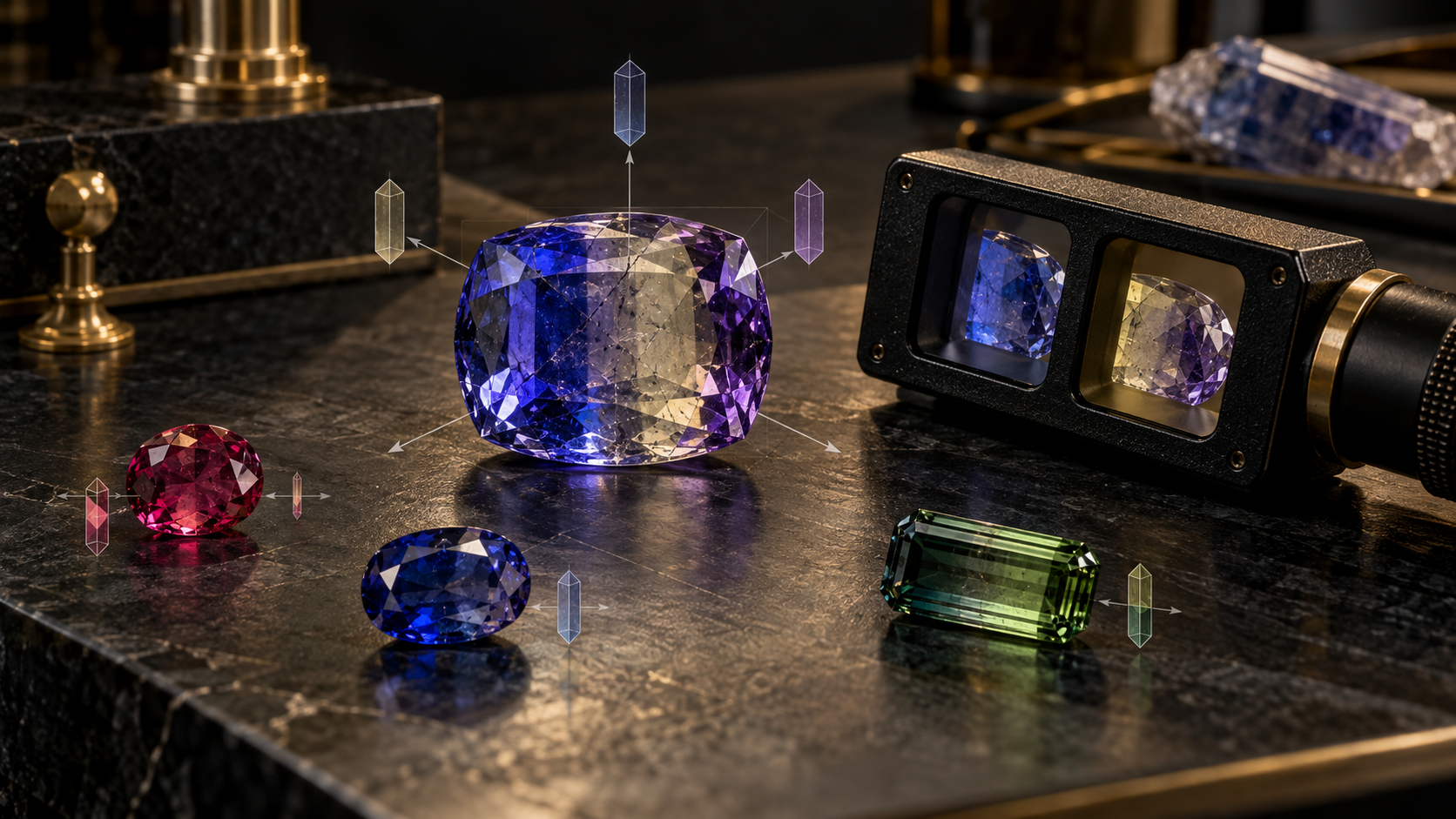
Pleochroism is the ability of certain coloured anisotropic crystals to display different colours—or different intensities of colour—when viewed in different crystallographic directions.
The word derives from Greek roots referring broadly to:
more colours.
In gemmology, pleochroism results from:
direction-dependent selective absorption of light.
That phrase is fundamental.
The gemstone is not changing its chemical composition as we rotate it.
Instead, light travelling and vibrating in different crystallographic directions interacts differently with the crystal.
Different wavelengths are absorbed to different degrees.
Different colours therefore reach our eyes.
PART II — WHY CRYSTAL STRUCTURE MATTERS
A crystal is not merely a chemically homogeneous piece of transparent material.
Its atoms occupy an:
ordered three-dimensional structure.
In some crystals, optical behaviour is the same in every direction.
In others, it is direction-dependent.
This gives us an important distinction between:
ISOTROPIC
and:
ANISOTROPIC
materials.
Pleochroism belongs primarily to the second group.
PART III — ISOTROPIC GEMSTONES
Isotropic materials have equivalent optical behaviour in all crystallographic directions.
Gemstones belonging to the:
cubic crystal system
are optically isotropic under ideal conditions.
Examples include:
- spinel;
- garnet;
- diamond.
Glass is also normally isotropic, although it is not crystalline.
An isotropic gemstone does not display true pleochroism.
Why?
Because it does not possess the directional difference in refractive and absorptive behaviour required to produce separate pleochroic colours.
Therefore:
TRUE PLEOCHROISM IS EVIDENCE OF ANISOTROPY.
But—as we will discover later—the absence of visible pleochroism does not prove that a stone is isotropic.
PART IV — ANISOTROPIC GEMSTONES
Most non-cubic crystalline gemstones are:
anisotropic.
Their optical properties vary according to crystallographic direction.
When light enters an anisotropic gemstone, it generally separates into two plane-polarised rays travelling through the material with different optical behaviour.
These are commonly described as:
doubly refracted rays.
Because the rays vibrate in different directions relative to the crystal lattice, they can experience different:
- refractive indices;
- velocities;
- absorption.
It is that last difference—
differential absorption
—that produces pleochroism.
PART V — DOUBLE REFRACTION AND PLEOCHROISM ARE NOT THE SAME THING
This distinction is essential.
Double refraction means that an anisotropic crystal can split light into two differently polarised rays.
Pleochroism means that those differently oriented light vibrations are:
absorbed differently enough to produce visibly different colours or colour intensities.
Therefore:
double refraction is not automatically visible pleochroism.
A gemstone may be anisotropic yet display pleochroism too weakly to see.
GIA explicitly notes that not all uniaxial gemstones show visible dichroism and not all biaxial gemstones show visible trichroism.
Some show only very subtle differences.
Others produce spectacular colour separation.
PART VI — UNIAXIAL GEMSTONES
Gemstones in the:
- tetragonal;
- trigonal;
- hexagonal
crystal systems are:
uniaxial.
They possess one:
OPTIC AXIS.
Along the optic axis, light behaves as though the crystal were singly refractive.
Away from that direction, the crystal exhibits two principal vibration directions traditionally called:
omega (ω)
and:
epsilon (ε).
These correspond to the ordinary and extraordinary rays.
If these two vibration directions absorb visible wavelengths differently, the gemstone can show:
TWO PRINCIPAL PLEOCHROIC COLOURS.
This is called:
DICHROISM.
PART VII — DICHROISM
“Di” means:
two.
A dichroic gemstone possesses two principal pleochroic colour components.
Important examples include:
- ruby;
- sapphire;
- tourmaline;
- aquamarine;
- some zircon.
Ruby and sapphire belong to trigonal corundum.
Tourmaline belongs to the trigonal system.
They are therefore:
uniaxial.
Their directional absorption can create two distinguishable colour components.
But those two colours are not necessarily equally easy to observe from every direction.
Orientation matters.
PART VIII — BIAXIAL GEMSTONES
Gemstones belonging to the:
- orthorhombic;
- monoclinic;
- triclinic
crystal systems are:
biaxial.
They possess:
two optic axes.
Their three principal vibration directions are traditionally designated:
X, Y and Z
or, in terms of refractive indices:
alpha (α), beta (β) and gamma (γ).
If absorption differs sufficiently among these three principal directions, three different colour components may occur.
This is:
TRICHROISM.
PART IX — TRICHROISM
“Tri” means:
three.
Strongly trichroic gemstones can display three principal colours associated with their crystallographic optical directions.
Classic examples include:
IOLITE
and:
TANZANITE.
But there is an important practical subtlety.
Even though a biaxial gemstone possesses three principal pleochroic components, a conventional dichroscope shows:
two colour fields at one viewing orientation.
The third component is revealed by changing the gemstone’s orientation.
This is why observing pleochroism requires:
rotation and multiple viewing directions.
PART X — IOLITE: THE CLASSIC PLEOCHROIC GEM
Few gemstones demonstrate pleochroism more dramatically than:
IOLITE.
Iolite is gem-quality:
cordierite.
GIA describes it as strongly pleochroic and notes that three distinct colours can be observed in three crystal directions.
Depending on the stone’s body colour, those directions may appear approximately:
- blue or blue-grey;
- dark violet;
- colourless to yellow.
In violet material, GIA reports combinations including:
- light violet;
- dark violet;
- yellow-brown.
This means the same crystal can appear:
blue from one direction
and:
nearly colourless or yellow from another.
Few demonstrations make the directional nature of gemstone colour clearer.
PART XI — WHY IOLITE WAS CALLED “WATER SAPPHIRE”
Historically, iolite has sometimes been incorrectly called:
water sapphire.
The name reflects its blue-to-violet appearance.
But iolite is not sapphire.
Sapphire is:
corundum.
Iolite is:
cordierite.
Its striking pleochroism can also help distinguish it from visually similar blue gemstones.
GIA specifically notes that iolite can show blue-to-violet colour in one direction and pale yellow to colourless appearance in another.
This is a useful reminder:
trade resemblance does not equal mineral identity.
PART XII — THE VIKING “SUNSTONE” STORY
Iolite is often connected with a famous story:
Viking navigators supposedly used thin pieces of iolite as polarising filters to locate the Sun through cloudy skies.
This story is frequently repeated.
But it should be presented carefully.
GIA itself describes it as:
legend.
The optical concept is plausible in broad terms because cordierite is strongly pleochroic and polarising behaviour can interact with skylight.
But the popular claim that Viking navigators specifically used iolite should not be presented as established archaeological fact without qualification.
Historical romance should never replace evidence.
PART XIII — TANZANITE: THREE COLOURS IN ONE CRYSTAL
Tanzanite is the blue-to-violet gem variety of:
zoisite.
It is:
orthorhombic
and therefore:
biaxial.
Tanzanite can be strongly:
TRICHROIC.
GIA notes that tilting tanzanite can reveal three distinct colours in three crystal directions.
Historical scientific descriptions of tanzanite reported components approximately:
- red-violet;
- deep blue;
- yellow-green.
In an unheated crystal, these directional differences can be spectacular.
PART XIV — HEAT TREATMENT AND TANZANITE PLEOCHROISM
Most commercial tanzanite is heated to improve its blue-to-violet appearance.
Heating does not make tanzanite isotropic.
The crystal remains anisotropic.
But treatment changes the relative absorption responsible for its visible colours.
Gem-A notes that heating around approximately 400–500°C can remove or substantially reduce the greenish-yellow component while deepening the blue appearance.
The result is typically a more commercially desirable combination dominated by:
blue
and:
violet.
This gives us an important principle:
TREATMENT CAN MODIFY PLEOCHROIC COLOUR WITHOUT REMOVING THE UNDERLYING ANISOTROPIC OPTICAL STRUCTURE.
PART XV — PLEOCHROISM VERSUS COLOUR CHANGE
Tanzanite helps us distinguish two phenomena that are sometimes confused.
Pleochroism
Colour changes because:
the viewing direction relative to the crystal changes.
Colour change
Colour changes because:
the spectral composition of the illumination changes.
Alexandrite provides the classic example of colour change.
A gemstone can possess:
both phenomena simultaneously.
Indeed, alexandrite is biaxial and pleochroic while also displaying its famous daylight-to-incandescent colour change.
The two effects have different physical causes.
PART XVI — ALEXANDRITE: TWO VARIABLES AT ONCE
Alexandrite demonstrates how complex gemstone colour can become.
Its appearance depends on:
crystallographic orientation
because of pleochroism.
But it also depends on:
light source
because of colour change.
GIA research has demonstrated that the face-up appearance of faceted alexandrite depends significantly on:
- orientation;
- cut;
- pleochroic components;
- illumination.
Therefore when an alexandrite changes appearance, we must ask:
Did the illumination change?
Did the viewing direction change?
or:
both?
PART XVII — TOURMALINE: EXTREME DICHROISM
Tourmaline is among the most strongly pleochroic gemstones.
GIA notes that its pleochroism can be so pronounced that tourmaline crystals were historically used to make simple polarising devices known as:
tourmaline tongs.
Tourmaline is uniaxial.
It therefore possesses two principal pleochroic colour components.
In many tourmalines, one direction is dramatically darker than the other.
This creates a serious practical challenge for:
gem cutters.
PART XVIII — THE DARK O-RAY OF TOURMALINE
In tourmaline, GIA notes that the ordinary ray—the:
o-ray
—is the darker of the two principal colour components.
Imagine a dark green tourmaline crystal.
If the cutter chooses the wrong orientation, the finished gemstone may appear:
almost black.
Choose another orientation and the same rough may become:
rich green.
Nothing about the chemical composition changed.
The difference is:
cutting orientation relative to directional absorption.
PART XIX — LIGHT TOURMALINE AND DARK TOURMALINE
This creates an interesting cutting strategy.
For lighter-coloured tourmaline, the cutter may want to exploit the darker colour direction to produce richer saturation.
For excessively dark tourmaline, the cutter may orient the stone to minimise the influence of the very dark o-ray.
GIA’s technical work describes these opposing strategies.
Therefore the “best” orientation is not universal.
It depends on:
the rough gemstone’s colour strength.
PART XX — PLEOCHROISM AND CUTTING
Before faceting a strongly pleochroic rough gemstone, a cutter must ask:
Which crystallographic direction should become the table direction?
The answer affects:
- hue;
- tone;
- saturation;
- brightness;
- extinction;
- weight retention.
This creates a fundamental compromise.
The orientation that produces the best colour may not produce:
maximum carat weight.
The orientation that preserves the most weight may produce:
inferior colour.
Professional cutting therefore balances optical quality against yield.
PART XXI — IOLITE AND CUTTING ORIENTATION
Iolite makes this problem exceptionally clear.
GIA states that its strong pleochroism makes it difficult to cut for the best colour.
Imagine a crystal with three directional appearances:
deep violet-blue
blue-grey
pale yellow
If the cutter places the pale yellow direction prominently face-up, the finished stone may appear washed out.
If the rough is oriented correctly, the face-up appearance can become:
rich violetish blue.
The gemstone’s value can therefore depend heavily on orientation before the first major facet is cut.
PART XXII — TANZANITE AND CUTTING ORIENTATION
Tanzanite presents a similar decision.
GIA notes that cutters can orient tanzanite to favour:
violetish blue
or:
bluish violet
depending partly on how the rough is positioned and how much weight the cutter wishes to retain.
This means that two gemstones cut from similar rough can show different face-up colours because:
the cutters chose different crystallographic orientations.
Cutting is therefore not simply shaping the stone.
It is:
MANAGING LIGHT WITHIN A CRYSTAL.
PART XXIII — CORUNDUM: RUBY AND SAPPHIRE
Ruby and sapphire belong to:
corundum.
Corundum is trigonal and therefore:
uniaxial.
Coloured corundum can be:
dichroic.
Ruby commonly displays two red-related components.
Blue sapphire commonly shows two blue-related components that may differ in:
- hue;
- saturation;
- brightness.
But the visibility of pleochroism in a faceted stone depends strongly on:
orientation.
PART XXIV — WHY A DICHROIC GEM MAY APPEAR NON-PLEOCHROIC
Suppose you examine a faceted sapphire through its table with a dichroscope.
You see almost no colour difference.
Does that prove the stone is not sapphire?
NO.
If the gemstone is oriented so that you are viewing close to the optic axis, the pleochroic separation can be minimal or absent in that direction.
GIA’s study of faceted gemstones stresses this important limitation.
Pleochroism depends on:
viewing geometry.
Therefore:
FAILURE TO SEE PLEOCHROISM IS NOT PROOF OF ITS ABSENCE.
PART XXV — THE OPTIC AXIS
The optic axis is a special direction in an anisotropic crystal.
For a uniaxial gemstone, light travelling exactly along the optic axis does not separate into two differently refracted rays.
Consequently, pleochroic colour separation disappears along this direction.
GIA experiments with transparent mineral spheres show that maximum separation of the ordinary and extraordinary colours in dichroic uniaxial minerals occurs approximately:
90° to the optic axis.
Along the optic-axis direction:
no pleochroism is observed through the dichroscope.
This is critical for correct testing.
PART XXVI — WHY FACETED GEMS COMPLICATE THE PICTURE
A rough crystal can sometimes be examined directly along known crystallographic directions.
A faceted gemstone is more complicated.
Light entering through the crown may:
- refract;
- reflect from pavilion facets;
- cross different crystallographic directions;
- mix pleochroic components before leaving the stone.
The face-up colour therefore becomes a:
mixture of directional colours.
Pleochroism does not disappear simply because the stone has been faceted.
Its expression becomes more complex.
PART XXVII — PLEOCHROISM CAN BE VISIBLE WITHOUT A DICHROSCOPE
Strong pleochroism may be visible:
with the unaided eye.
GIA illustrates this clearly with tanzanite.
Iolite can also show dramatic colour differences simply by rotating the gemstone.
Tourmaline may become obviously lighter or darker.
The dichroscope does not create pleochroism.
It merely makes directional colour differences:
easier to isolate and compare.
PART XXVIII — THE DICHROSCOPE
The traditional gemmological instrument for examining pleochroism is the:
DICHROSCOPE.
Two important forms are:
calcite dichroscope
and:
polarising / London-type dichroscope.
Their optical construction differs.
Their practical purpose is similar:
to allow two differently polarised colour components from a gemstone to be viewed:
side by side.
This makes subtle pleochroism much easier to detect.
PART XXIX — THE CALCITE DICHROSCOPE
A calcite dichroscope uses the strong double refraction of:
calcite.
Looking through the instrument produces two adjacent viewing fields.
Each field transmits a different polarisation component from the gemstone.
If the stone is pleochroic, the two fields may show:
different colours
or:
different intensities of the same colour.
Gem-A produces wide-field calcite dichroscopes specifically designed to make weak dichroism and trichroism easier to observe, even in small gemstones.
PART XXX — THE LONDON DICHROSCOPE
Another design is the:
London dichroscope.
Gem-A describes this instrument as a simple method for assessing dichroic and trichroic colours in both:
- rough gemstones;
- faceted gemstones.
Instead of relying on the observer to judge sequential colour changes while rotating a stone, the instrument makes directional components easier to compare.
But the operator still needs correct technique.
PART XXXI — HOW TO USE A DICHROSCOPE
A practical procedure is:
1. Use transmitted white light.
The gemstone should be illuminated from behind or beneath where practical.
2. Bring the dichroscope close to the eye.
3. Position the gemstone close to the instrument.
4. Observe the two adjacent colour windows.
5. Rotate the gemstone.
6. Change the viewing direction.
7. Record the strongest repeatable colour differences.
For a biaxial gemstone, multiple orientations are needed to investigate all three principal pleochroic components.
Do not test from one direction and stop.
PART XXXII — WHAT SHOULD YOU RECORD?
Suppose the two fields appear:
blue
and:
greenish blue.
Write:
Dichroism observed: blue / greenish blue.
Do not immediately write:
Sapphire confirmed.
Why?
Because multiple gemstones can display similar pleochroic colours.
Pleochroism is:
evidence.
It is not usually a complete identification by itself.
PART XXXIII — PLEOCHROISM AS AN IDENTIFICATION TOOL
Pleochroism can be extremely useful when combined with:
- refractive index;
- birefringence;
- optic character;
- specific gravity;
- spectrum;
- microscopy.
For example:
A violet-blue stone shows:
strong trichroism
with:
- blue;
- violet;
- pale yellowish components.
This strongly suggests materials such as:
iolite
may deserve investigation.
Now add:
RI approximately 1.542–1.551
and:
SG approximately 2.61.
The evidence converges strongly toward:
IOLITE / CORDIERITE.
PART XXXIV — PLEOCHROISM CAN ELIMINATE POSSIBILITIES
Suppose an unknown red stone shows:
strong dichroism.
Could it be normal natural spinel?
Unlikely.
Spinel is cubic and therefore isotropic.
True pleochroism is incompatible with normal spinel optical behaviour.
Could it be ruby?
Yes.
Ruby is anisotropic and dichroic.
Thus pleochroism can be particularly useful for:
eliminating incompatible hypotheses.
PART XXXV — BUT BEWARE OF ANOMALOUS DOUBLE REFRACTION
Isotropic gemstones can sometimes show:
anomalous double refraction
because of internal strain.
This can produce unusual patterns in the polariscope.
But anomalous double refraction is not equivalent to genuine crystallographically controlled pleochroism.
Do not confuse:
strain effects
with:
directional selective absorption inherent to an anisotropic crystal.
Different instruments answer different questions.
PART XXXVI — PLEOCHROISM AND SYNTHETIC CORUNDUM
Pleochroism can sometimes contribute to natural-versus-synthetic investigation indirectly through:
growth and cutting orientation.
GIA has documented an interesting historical pattern.
Natural ruby and sapphire are often fashioned with the table approximately perpendicular to the c-axis to optimise colour and yield.
Some Verneuil-grown synthetic corundum boules are conventionally cut in orientations related to the boule geometry.
As a result, pleochroism through the table can sometimes differ systematically.
GIA reports that Verneuil synthetic corundum may show obvious dichroism through the table where many naturally oriented corundum gemstones show little or none.
But this is:
SUPPORTING EVIDENCE — NOT A STAND-ALONE IDENTIFICATION RULE.
A cutter can choose another orientation.
PART XXXVII — WHY ORIENTATION CAN REVEAL MANUFACTURING HISTORY
Synthetic crystal growth produces material with specific:
- growth directions;
- seed orientations;
- boule shapes.
Commercial cutting often follows economically convenient orientations.
Therefore the orientation of optical properties in a finished synthetic gemstone can sometimes reflect:
manufacturing geometry.
This is a fascinating example of how:
crystallography + industrial process + cutting
can leave evidence in a faceted gem.
PART XXXVIII — AQUAMARINE
Aquamarine is the blue-to-greenish-blue variety of:
beryl.
Beryl is hexagonal and therefore:
uniaxial.
Aquamarine can show:
dichroism.
The two components may differ subtly between:
- blue;
- pale blue;
- nearly colourless;
- greenish blue
depending on the material.
Pleochroism is generally less spectacular than in iolite or tourmaline.
This demonstrates again:
anisotropy does not guarantee strong visible pleochroism.
PART XXXIX — EMERALD
Emerald is also beryl.
It too can display:
dichroism.
Typical directional colours may include variations between:
yellowish green
and:
bluish green.
But the exact appearance depends on:
- chromium;
- vanadium;
- iron;
- concentration;
- orientation;
- locality.
Pleochroism therefore contributes both to:
visual character
and:
gemmological investigation.
PART XL — RUBY
Ruby’s pleochroic components are often described approximately as combinations of:
orangy red
and:
purplish red.
The precise appearance depends on the stone.
Pleochroism can influence the face-up colour significantly.
A cutter may therefore orient ruby to favour the most attractive combination.
But the orientation must also consider:
- rough shape;
- inclusions;
- colour zoning;
- weight retention.
Again:
crystallography becomes economics.
PART XLI — BLUE SAPPHIRE
Blue sapphire can display directional components commonly involving variations of:
blue
and:
greenish blue.
Because colour quality is critical to sapphire value, orientation is important.
A cutter must consider:
- colour zoning;
- pleochroism;
- tone;
- saturation;
- extinction.
A strongly saturated rough crystal can become either:
beautiful blue
or:
unattractively dark
depending on how its directional absorption is managed.
PART XLII — WHY THE DARKEST DIRECTION IS NOT ALWAYS THE BEST
It may seem logical that the darkest pleochroic direction should always face upward.
But gemstone beauty requires more than saturation.
If absorption becomes too strong, the stone can lose:
brightness.
Large areas may appear:
extinct
or almost black.
Therefore the cutter balances:
colour strength
against:
light return.
The optimal orientation is the one that creates the best overall face-up appearance—not necessarily the darkest colour.
PART XLIII — PLEOCHROISM AND EXTINCTION
Extinction refers to dark areas in a faceted gemstone where little light returns to the observer.
Strong directional absorption can contribute to this effect.
Tourmaline demonstrates the problem dramatically.
If the dark pleochroic direction dominates the optical path, pavilion reflections may become extremely dark.
This is why cutters sometimes use:
unusual proportions
to manage strongly pleochroic material.
The physics of the crystal can influence the geometry of the cut.
PART XLIV — PLEOCHROISM AND COLOUR ZONING ARE DIFFERENT
Do not confuse:
PLEOCHROISM
with:
COLOUR ZONING.
Pleochroism:
The colour changes because the:
viewing direction changes.
Colour zoning:
Different physical regions of the crystal actually contain different colour-producing concentrations or defect populations.
A sapphire can possess:
both.
Rotate it and directional colour changes.
Move your observation across the crystal and growth zones may also differ in colour.
The two phenomena can interact visually.
PART XLV — PLEOCHROISM AND DISPERSION ARE DIFFERENT
Dispersion separates white light into spectral colours because refractive index varies with:
wavelength.
Pleochroism creates different body-colour components because absorption varies with:
crystallographic direction.
A gemstone may possess both properties.
But they arise from different optical mechanisms.
Rainbow flashes are not pleochroism.
PART XLVI — PLEOCHROISM AND IRIDESCENCE ARE DIFFERENT
Iridescence commonly results from:
- interference;
- diffraction;
- thin films;
- microscopic structures.
Pleochroism results from:
directional absorption in an anisotropic crystal.
Both may appear to change with viewing direction.
But the underlying physics differs fundamentally.
This is why gemmological terminology matters.
Similar visual effects can have very different causes.
PART XLVII — THE THREE VARIABLES OF OBSERVED GEMSTONE COLOUR
When examining a coloured gemstone, ask whether colour changes because of:
1. VIEWING DIRECTION
Potential:
pleochroism
2. LIGHT SOURCE
Potential:
colour change / metameric behaviour
3. PHYSICAL POSITION WITHIN THE CRYSTAL
Potential:
colour zoning
This simple distinction prevents many observational errors.
PART XLVIII — A PRACTICAL IOLITE TEST
Take a faceted iolite.
Observe it face-up under neutral white light.
Record the colour.
Now view it:
through the side.
Rotate it 90°.
Observe again.
A strongly pleochroic specimen may shift dramatically among:
- violet-blue;
- blue-grey;
- pale yellow;
- nearly colourless.
Now use the dichroscope.
The directional colours become easier to isolate.
The gemstone becomes a practical demonstration of:
crystallographic optics.
PART XLIX — A PRACTICAL TOURMALINE TEST
Choose a transparent coloured tourmaline.
Look down the length of the crystal if rough orientation is known.
Then view:
across the crystal.
One direction may appear dramatically darker.
With a dichroscope, the difference between the two principal components becomes clearer.
This simple exercise explains why tourmaline cutting orientation is so important.
You are seeing:
the cutter’s problem before cutting begins.
PART L — A PRACTICAL TANZANITE TEST
Rotate a tanzanite slowly under neutral white illumination.
Observe:
- through the crown;
- through opposite pavilion directions;
- through the sides where accessible.
Different blue and violet contributions may become apparent.
In suitable material, particularly rough or less strongly modified specimens, additional colour components may appear.
Then use a dichroscope.
Remember:
a single viewing orientation reveals only two polarised components at once.
Rotate the stone to explore the complete biaxial colour behaviour.
PART LI — WHY THE DICHROSCOPE DOES NOT SHOW “THE TRUE COLOUR”
A gemstone does not possess one hidden “correct” colour that the dichroscope reveals.
Instead, the instrument separates:
directional polarisation-dependent components.
The face-up colour of a faceted gemstone normally combines these components through:
- refraction;
- reflection;
- facet geometry;
- viewing angle.
Therefore the dichroscope provides:
analytical information
rather than a replacement for normal colour observation.
PART LII — PLEOCHROISM AND GEMSTONE PHOTOGRAPHY
Strongly pleochroic stones can be difficult to photograph accurately.
A small change in:
- camera angle;
- gemstone orientation;
- lighting geometry
can alter the apparent hue significantly.
This means two photographs of the same gemstone may legitimately show different colour balances.
For online gemstone sales, professional photography should therefore aim to represent:
the realistic face-up appearance
rather than selecting an unusual pleochroic direction merely because it creates a more saturated image.
Accurate colour representation is part of responsible disclosure.
PART LIII — PLEOCHROISM AND ONLINE PURCHASING
For strongly pleochroic gemstones such as:
- iolite;
- tanzanite;
- tourmaline
a single photograph may not communicate the complete optical character.
Video can be particularly valuable.
Slow rotation allows the viewer to see how:
directional colour changes in real space.
This is one reason gemstone video can provide information that a static photograph cannot.
PART LIV — PLEOCHROISM AND ROUGH GEMSTONES
Pleochroism is especially important when evaluating rough intended for faceting.
Before sawing or preforming, the cutter should determine:
- crystallographic orientation;
- strongest colour direction;
- weakest colour direction;
- colour zoning;
- inclusions;
- cleavage;
- potential yield.
The highest-yield orientation may not produce the best colour.
The best-colour orientation may sacrifice substantial weight.
This is a central problem in:
rough valuation.
PART LV — PLEOCHROISM AND NGB ROUGH EVALUATION
For rough-for-faceting evaluation, pleochroism can influence several practical categories:
FACETING POTENTIAL
Can the attractive colour direction be oriented face-up?
USABLE YIELD / SHAPE
How much weight must be sacrificed to achieve that orientation?
NATURAL CHARACTERISTICS
Does zoning or crystallographic structure complicate orientation?
OVERALL ROUGH QUALITY
Will the finished stone display attractive colour and brightness?
Pleochroism is therefore not merely a textbook optical property.
It can directly affect:
cutting potential and economic value.
PART LVI — COMMON MISTAKE 1
“THE STONE CHANGES COLOUR WHEN I TURN IT, SO IT IS ALEXANDRITE.”
Wrong.
Colour change and pleochroism are different.
If the light source remains constant and the colour changes with:
orientation
you may be observing pleochroism.
Alexandrite’s famous colour change requires comparison under:
different illumination spectra.
PART LVII — COMMON MISTAKE 2
“I CANNOT SEE PLEOCHROISM, SO THE STONE MUST BE ISOTROPIC.”
Wrong.
Pleochroism may be:
- weak;
- obscured by pale colour;
- hidden by viewing orientation;
- difficult to observe through the chosen facet.
An anisotropic gemstone can show little or no visible pleochroism in a particular direction.
Always combine tests.
PART LVIII — COMMON MISTAKE 3
“A BIAXIAL STONE SHOULD SHOW THREE COLOURS AT ONCE.”
Wrong.
A conventional dichroscope shows:
two polarised components at a given viewing orientation.
To investigate trichroism, the stone must be:
reoriented.
Three principal colours belong to the three principal vibration directions of the biaxial crystal.
They are not necessarily displayed simultaneously in one simple view.
PART LIX — COMMON MISTAKE 4
“STRONG PLEOCHROISM IDENTIFIES THE GEMSTONE.”
Not by itself.
Strong trichroism may suggest iolite or tanzanite.
Strong dichroism may suggest tourmaline or corundum.
But identification requires convergence with:
- RI;
- birefringence;
- SG;
- spectrum;
- microscopy;
- other observations.
Pleochroism narrows possibilities.
It rarely replaces the rest of gemmology.
PART LX — COMMON MISTAKE 5
“THE CUTTER SHOULD ALWAYS FACE THE BEST COLOUR UP.”
Not necessarily.
The ideal colour direction may require:
- excessive weight loss;
- poor proportions;
- dangerous orientation relative to cleavage;
- retention of major inclusions;
- severe extinction.
Professional cutting balances multiple constraints.
Colour is critical.
But it is not the only variable.
PART LXI — PLEOCHROISM AS A CRYSTALLOGRAPHIC MAP
Pleochroism provides something remarkable.
Without seeing individual atoms, the observer can detect evidence that the crystal has:
directional internal structure.
Rotate an iolite and its colour changes.
That visible change tells us that light travelling through different crystallographic orientations encounters:
different absorption environments.
Pleochroism therefore makes crystallography:
VISIBLE TO THE HUMAN EYE.
PART LXII — FROM ELECTRONS TO FACETING
The chain is extraordinary.
At the atomic scale:
electronic transitions absorb selected wavelengths.
↓
Crystal structure makes those transitions direction-dependent.
↓
Different crystallographic directions develop different absorption.
↓
The gemstone becomes pleochroic.
↓
The cutter chooses an orientation.
↓
Facet geometry mixes the directional colours.
↓
The finished gemstone acquires its face-up hue.
↓
The observer judges:
beauty and value.
The sequence runs:
ELECTRON → CRYSTAL → DIRECTION → CUT → COLOUR → VALUE
Pleochroism connects all of them.
PART LXIII — THE NGB PLEOCHROISM WORKFLOW
When examining a coloured gemstone:
STEP 1 — OBSERVE UNDER NEUTRAL WHITE LIGHT
Record the normal face-up colour.
↓
STEP 2 — ROTATE THE GEMSTONE
Does colour or colour intensity change with orientation?
↓
STEP 3 — DISTINGUISH THE CAUSE
Same illumination + different viewing direction?
→ Investigate pleochroism.
Different illumination?
→ Investigate colour change.
Different region of crystal?
→ Investigate zoning.
↓
STEP 4 — USE THE DICHROSCOPE
Compare the two adjacent polarised colour components.
↓
STEP 5 — ROTATE AND REORIENT
Do not test only one direction.
↓
STEP 6 — DETERMINE OPTICAL CHARACTER
Uniaxial?
→ Potential dichroism.
Biaxial?
→ Potential trichroism.
Isotropic?
→ No true pleochroism expected.
↓
STEP 7 — COMBINE WITH RI
Does refractive index support the suspected material?
↓
STEP 8 — ADD SG, SPECTRUM AND MICROSCOPY AS REQUIRED
↓
STEP 9 — CONSIDER CUT ORIENTATION
Does the face-up colour represent the most attractive pleochroic direction?
↓
EVIDENCE-BASED INTERPRETATION
PART LXIV — FIVE USEFUL EXAMPLES
IOLITE
Optical character:
Biaxial
Pleochroism:
Strong trichroism
Possible components:
violet-blue / blue-grey / yellowish to nearly colourless
Practical significance:
Identification + cutting orientation
TANZANITE
Optical character:
Biaxial
Pleochroism:
Strong trichroism
Unheated material can display components approximately:
blue / violet-red / yellow-green to brownish
Practical significance:
Colour evaluation + treatment context + cutting orientation
TOURMALINE
Optical character:
Uniaxial
Pleochroism:
Often strong dichroism
Practical significance:
Critical cutting orientation; dark o-ray can strongly affect face-up appearance
RUBY / SAPPHIRE
Optical character:
Uniaxial
Pleochroism:
Dichroism
Practical significance:
Identification support + colour orientation
SPINEL
Optical character:
Isotropic
Pleochroism:
None in normal material
Practical significance:
Absence expected; useful when separating spinel from anisotropic look-alikes when combined with other tests
PART LXV — THE MOST IMPORTANT LESSON
Pleochroism is sometimes described simply as:
“a gemstone showing different colours from different directions.”
That definition is correct.
But it hides the deeper science.
The real phenomenon is:
DIRECTION-DEPENDENT SELECTIVE ABSORPTION IN AN ANISOTROPIC CRYSTAL.
Once we understand that, several observations become connected.
Why is iolite difficult to cut?
Because its directional colours differ dramatically.
Why can tourmaline become nearly black in one orientation?
Because one polarisation direction can be absorbed much more strongly.
Why might sapphire show little dichroism through its table?
Because the viewing direction may lie near the optic axis.
Why can a dichroscope aid identification?
Because it separates differently polarised colour components.
Why can the same rough produce finished gemstones of different apparent colour?
Because cutters can orient the crystal differently.
Pleochroism is therefore not an isolated optical trick.
It is a visible consequence of:
crystal structure.
Conclusion
A gemstone can appear to possess several colours without changing its chemistry, treatment or light source.
The explanation lies in the directional nature of:
anisotropic crystals.
When light enters such a crystal, its differently polarised components interact with different crystallographic directions.
Those directions may absorb visible wavelengths differently.
If the difference is sufficiently strong, we observe:
PLEOCHROISM.
Uniaxial gemstones possess two principal vibration directions and may therefore show:
DICHROISM.
Biaxial gemstones possess three principal vibration directions and may show:
TRICHROISM.
Iolite provides one of the most dramatic demonstrations.
The same crystal can move from:
deep violet-blue
to:
blue-grey
to:
yellowish or nearly colourless
depending on direction.
Tanzanite can display strong blue, violet and additional yellow-green or brownish components, particularly in unheated material.
Tourmaline demonstrates how pleochroism becomes a cutting problem: one direction can be so strongly absorbed that an incorrectly oriented finished stone appears excessively dark.
Ruby and sapphire demonstrate that even familiar gemstones possess directional colour.
Yet pleochroism must be interpreted carefully.
A doubly refractive gemstone does not necessarily show strong visible pleochroism.
A stone viewed near an optic axis may appear to show little or none.
A biaxial gemstone does not display all three principal colours simultaneously through a conventional dichroscope.
And pleochroism alone rarely proves gemstone identity.
The professional approach remains:
OBSERVE
↓
ROTATE
↓
SEPARATE THE COLOUR COMPONENTS
↓
MEASURE RI AND OPTICAL CHARACTER
↓
COMPARE WITH OTHER GEMMOLOGICAL EVIDENCE
↓
INTERPRET.
The dichroscope is valuable because it transforms a subtle colour difference into two directly comparable fields.
But the instrument does not create the phenomenon.
The colours were already encoded within the crystal’s directional interaction with light.
For the gem cutter, this physics has immediate consequences.
Orientation can determine whether a gemstone becomes:
bright
or:
dark,
blue
or:
violet,
richly saturated
or:
washed out.
A few degrees of orientation in rough can influence both:
beauty
and:
value.
Pleochroism therefore forms a remarkable bridge between:
quantum-scale electronic absorption
and:
the practical decisions of a gemstone cutter.
The chain begins with electrons.
It passes through crystal structure.
It becomes visible as directional colour.
And it ends in the face-up appearance of the finished gemstone.
That is why pleochroism matters.
It is not merely several colours inside one stone.
It is:
CRYSTALLOGRAPHY MADE VISIBLE.
References & Further Reading
Hughes, R. W. — “Pleochroism in Faceted Gems: An Introduction.” Gems & Gemology, Fall 2014, Vol. 50, No. 3. Gemological Institute of America.
One of the most useful modern technical treatments of pleochroism in faceted gemstones. It explains uniaxial and biaxial colour behaviour, the principal vibration directions, dichroism and trichroism, optic-axis effects, tourmaline cutting orientation and the practical complexities created when pleochroic colours mix within faceted stones.
https://www.gia.edu/gems-gemology/fall-2014-introduction-pleochroism-faceted-gems
Gemological Institute of America (GIA) — “Iolite.” Gem Encyclopedia.
Authoritative overview of iolite/cordierite and its exceptionally strong pleochroism. GIA notes that rotation can reveal three distinct colours in three crystal directions and provides standard gemmological properties including RI 1.542–1.551 and SG approximately 2.61.
https://www.gia.edu/iolite
Gemological Institute of America (GIA) — “Iolite Description.”
Detailed discussion of iolite colour and cutting. Particularly useful for the directional colours described in this article: violet iolite may show light violet, dark violet and yellow-brown components, while bluish stones may display colourless-to-yellow, blue-grey and dark-violet directions.
https://www.gia.edu/iolite-description
Gemological Institute of America (GIA) — “Iolite Buyer’s Guide.”
Practical reference explaining why strong pleochroism creates a significant cutting challenge. GIA emphasises that the cutter must orient iolite carefully so that the most attractive colour is presented through the finished gemstone’s table.
https://www.gia.edu/iolite/buyers-guide
Gemological Institute of America (GIA) — “Tanzanite.” Gem Encyclopedia.
Authoritative reference for tanzanite’s biaxial pleochroism, discovery and gemmological properties. GIA describes three distinct directional colours and explains how cutting orientation can favour violetish-blue or bluish-violet appearance.
https://www.gia.edu/tanzanite
Gemological Institute of America (GIA) — “Tanzanite Description.”
Provides further scientific and historical context for tanzanite pleochroism. GIA cites early scientific descriptions of directional colours including red-violet, deep blue and yellow-green and explains the importance of pleochroism to tanzanite’s appearance.
https://www.gia.edu/tanzanite-description
Gem-A — “Understanding Tanzanite.”
Useful complementary treatment of tanzanite colour, pleochroism and heating. Gem-A describes the strong trichroism of unheated material and explains that heating at approximately 400–500°C can substantially reduce the greenish-yellow component while strengthening commercially desirable blue colour.
https://gem-a.com/gem-hub/tanzanite-gemstone-facts/
Schmetzer, K. — “Pleochroism and Color Change in Faceted Alexandrite: Influence of Cut and Sample Orientation.” Gems & Gemology, Spring 2019, Vol. 55, No. 1.
Advanced study showing why pleochroism and colour change must be treated as distinct but interacting phenomena. Particularly valuable for understanding how the three biaxial colour components, gemstone orientation, facet arrangement and illumination collectively influence face-up colour in alexandrite.
https://www.gia.edu/gems-gemology/spring-2019-pleochroism-color-change-in-faceted-alexandrite-influence-cut-orientation
Gem-A Instruments — “Wide View Calcite Dichroscope.”
Instrument reference describing the use of a calcite dichroscope for observing pleochroic colours. The wide-field design is intended to make dichroism and trichroism easier to recognise, including weak effects in small gemstones.
https://shop.gem-a.com/product/gem-a-wide-view-calcite-dichroscope/
Gem-A Instruments — “London Dichroscope.”
Practical instrument reference for the London-style dichroscope. Gem-A describes its use for assessing dichroic and trichroic colours in both rough and faceted gemstones.
https://shop.gem-a.com/product/gem-a-london-dichroscope/
[…] One of tanzanite’s defining visual characteristics is pleochroism. […]