A Practical Evidence-Based Gemstone Identification Exercise
A transparent blue gemstone is placed on the gemmologist’s desk.
There is no laboratory report.
No trustworthy identification.
No declared treatment.
No geographic origin.
It is simply:
an unknown blue stone.
At first glance it could easily be sapphire.
But it could also be:
aquamarine
blue topaz
blue zircon
—or another blue gem entirely.
That is precisely why colour cannot be allowed to make the identification.
In this workshop we will investigate how to identify a blue gemstone as though nothing is known about it.
Our five working candidates are:
Sapphire
Spinel
Aquamarine
Topaz
Zircon
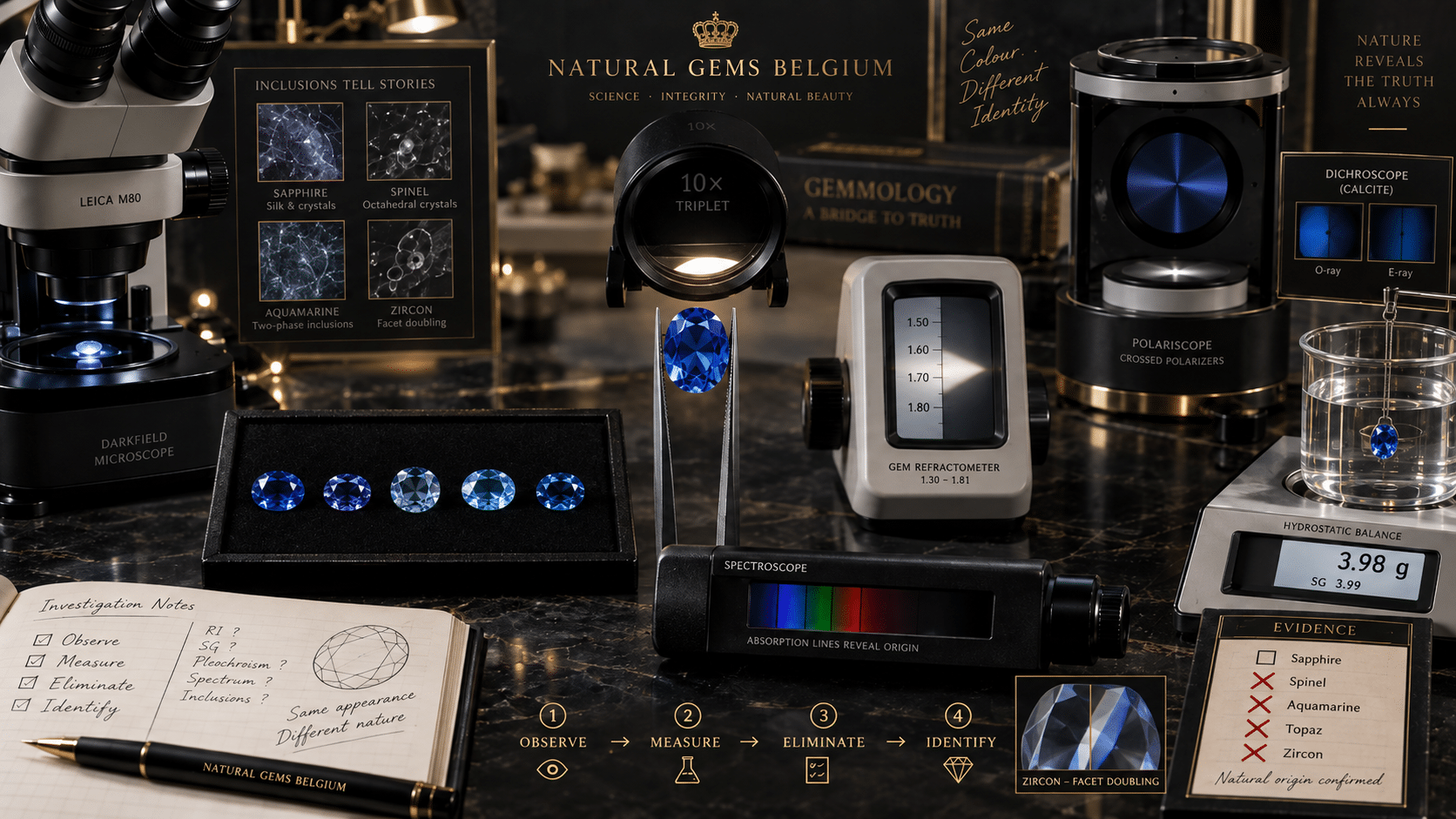
The exercise follows the same evidence-based sequence established in the Natural Gems Belgium Practical Gemmology series:
Observe → Measure → Eliminate → Compare → Combine → Conclude
Do not try to identify the gemstone immediately.
Instead ask:
What does each measurement allow us to eliminate?
Table of Contents
PART I — THE UNKNOWN BLUE STONE
1. Initial Observation
The specimen is a:
transparent medium-dark blue oval mixed-cut gemstone.
Weight:
2.68 ct
Dimensions:
approximately 8.1 × 6.5 × 4.9 mm
Unaided observation shows:
- vitreous lustre;
- strong blue body colour;
- good transparency;
- no obvious assembled construction;
- no visible coating;
- several subtle internal features;
- moderate brilliance.
Nothing here establishes identity.
2. Establish the Candidate List
Candidate A — Blue Sapphire
Sapphire is:
corundum — Al₂O₃.
GIA gives sapphire approximately:
RI 1.762–1.770
Birefringence 0.008–0.010
SG 4.00
Sapphire is anisotropic and uniaxial.
Candidate B — Blue Spinel
Spinel is:
MgAl₂O₄.
Typical gem spinel has approximately:
RI 1.718
Birefringence: none
SG 3.60
Spinel belongs to the cubic crystal system and is normally:
singly refractive / isotropic.
Candidate C — Aquamarine
Aquamarine is the blue to greenish-blue variety of:
beryl — Be₃Al₂Si₆O₁₈.
GIA lists approximately:
RI 1.577–1.583
Birefringence 0.005–0.009
SG 2.72
Aquamarine is anisotropic and uniaxial.
Candidate D — Blue Topaz
Topaz has the chemical formula:
Al₂(F,OH)₂SiO₄.
GIA lists approximately:
RI 1.619–1.627
Birefringence 0.008–0.010
SG 3.53
Topaz is anisotropic and biaxial.
Candidate E — Blue Zircon
Zircon is:
ZrSiO₄.
Its physical properties can vary considerably because radiation damage can modify the crystal structure.
GIA divides zircon broadly into high, medium and low property ranges.
High-type zircon can reach approximately:
RI 1.925–1.984
with birefringence reaching approximately:
0.059
and zircon SG overall approximately:
3.90–4.73.
Already we can see why measurement should separate these stones far more effectively than colour.
PART II — WHY BLUE IS DECEPTIVE
3. Colour Is the First Trap
Blue gemstones can occupy overlapping regions of:
- hue;
- tone;
- saturation.
A pale sapphire may resemble aquamarine.
A strongly coloured aquamarine may resemble some blue topaz.
A cobalt-coloured spinel can rival sapphire in saturation.
Blue zircon can display spectacular brilliance and strong blue colour.
A treated topaz can display a vivid blue that is uncommon in untreated material.
Therefore:
blue does not equal sapphire.
4. Tone Does Not Identify the Mineral
It is tempting to use rules such as:
“Aquamarine is pale.”
or:
“Sapphire is dark.”
These may describe market tendencies.
They are not reliable identification rules.
Natural aquamarine can be strongly saturated.
Sapphire can be pale.
Topaz can range from very pale to intensely treated blue.
Spinel can range from greyish blue to vivid cobalt-like blue.
Identify the material from properties, not colour stereotypes.
PART III — LOUPE AND MICROSCOPY
5. Start with 10× Magnification
Inspect:
- crown;
- girdle;
- pavilion;
- facet junctions;
- internal features.
Our unknown reveals:
- fine straight needles;
- subtle angular colour zoning;
- a small crystal inclusion;
- several healed fissure features.
No obvious round gas bubbles are seen.
No obvious curved growth banding is visible.
Record those observations.
Do not yet write:
sapphire.
6. Move to the Microscope
Under darkfield and fibre-optic illumination the internal scene becomes clearer.
We observe:
fine intersecting needle-like inclusions
angular blue colour zoning
a small transparent crystal
partially healed fissures
These features are compatible with natural corundum.
But compatibility is not identification.
Now we measure.
PART IV — REFRACTIVE INDEX
7. The First Major Measurement
Clean the stone and refractometer prism.
Apply the appropriate contact liquid.
Place a suitable polished facet on the prism.
The first shadow edge is approximately:
1.762
Rotate the stone.
A second reading reaches:
1.770
Repeated measurements produce:
RI = approximately 1.762–1.770
Now compare the candidates.
8. Sapphire
GIA lists sapphire:
1.762–1.770.
Our unknown matches exceptionally well.
Sapphire remains strongly compatible.
9. Aquamarine
Aquamarine is approximately:
1.577–1.583.
This is far below our measurement.
Aquamarine can be eliminated.
This is a powerful example of why visual similarity matters far less than physical measurement.
10. Topaz
Topaz is approximately:
1.619–1.627.
Again, substantially below the unknown.
Topaz can be eliminated.
11. Ordinary Spinel
Typical spinel has RI around:
1.718.
That is lower than our unknown.
Ordinary blue spinel therefore becomes highly unlikely.
But there is an important advanced caution.
The spinel group can show compositional variation.
Zinc-rich members can reach higher RI values.
So we should still examine optical character rather than stopping with one number.
12. Zircon
High zircon lies:
above the normal refractometer limit.
Medium zircon is also usually far above corundum.
Low zircon may approach approximately:
1.810–1.815.
Our clear corundum-range reading is therefore inconsistent with ordinary gem zircon.
Zircon becomes highly unlikely.
13. Calculate Birefringence
Our readings are:
1.770 − 1.762 = 0.008
The unknown therefore shows birefringence of approximately:
0.008.
GIA lists sapphire birefringence:
0.008–0.010.
Again:
excellent agreement.
PART V — POLARISCOPE
14. Confirm Optical Behaviour
Place the gemstone between crossed polarizers.
Rotate it through:
360°.
The stone alternates regularly:
light → dark → light → dark.
This establishes anisotropic behaviour.
15. What Does That Eliminate?
Ordinary spinel is cubic and normally:
isotropic.
Our gemstone is clearly anisotropic.
That independently eliminates ordinary spinel.
Aquamarine, topaz, zircon and sapphire are all anisotropic, so optical character alone would not separate those four.
But RI already eliminated the first three.
This is how tests work together.
16. Conoscopic Observation
With suitable orientation, the conoscope produces an interference figure consistent with:
uniaxial behaviour.
That supports sapphire.
Aquamarine and zircon are also uniaxial.
Topaz is:
biaxial.
Therefore optic character would also oppose topaz if RI had not already done so.
PART VI — DICHROSCOPE
17. Examine Pleochroism
View the stone through the dichroscope.
Rotate it.
Two directional colours become apparent:
deep blue
and:
greenish blue.
This is distinct dichroism.
It is compatible with blue sapphire.
18. Compare with Spinel
Ordinary spinel is cubic.
It should not show true crystallographic pleochroism.
Therefore distinct dichroism provides another independent reason to reject spinel.
19. Compare with Aquamarine
Aquamarine can also be dichroic.
GIA research on Pakistani aquamarine recorded directional colours ranging from saturated blue or greenish blue to very pale blue, greenish blue or nearly colourless.
Therefore:
dichroism alone cannot separate sapphire from aquamarine.
But RI already can.
This distinction is important.
A useful test is not necessarily a unique test.
20. Compare with Topaz
Blue topaz can show weak pleochroism.
A GIA-published natural star topaz produced:
very weak colourless to light-blue pleochroism.
Again, intensity may provide supporting evidence, but RI remains the stronger separator.
PART VII — SPECIFIC GRAVITY
21. Add Density
The gemstone is loose and suitable for hydrostatic weighing.
Weigh it:
in air
then:
suspended completely in water.
Check for air bubbles.
Repeat the reading.
Calculated specific gravity:
SG ≈ 4.00
Now compare.
22. Sapphire
GIA lists sapphire:
SG 4.00.
Excellent match.
23. Aquamarine
GIA lists aquamarine:
SG 2.72.
Far too low.
Aquamarine is decisively incompatible.
24. Topaz
GIA lists topaz:
SG 3.53.
Again significantly below the unknown.
25. Ordinary Spinel
Typical spinel:
SG around 3.60.
Lower than the unknown.
26. Zircon
Here SG becomes less decisive.
Zircon can occupy approximately:
3.90–4.73.
Therefore an SG around 4.00 can overlap some zircon.
If SG were our only measurement, zircon could not necessarily be excluded.
But the RI data separate them.
This is exactly why independent properties matter.
PART VIII — ZIRCON AND FACET DOUBLING
27. Zircon Has a Particularly Useful Visual Clue
High-type zircon can display very strong:
birefringence.
When viewed through the crown toward pavilion facet junctions, those edges can appear:
doubled.
This is known as:
facet doubling.
It can be conspicuous in high zircon.
28. Why the Doubling Occurs
In a doubly refractive material, light entering the crystal can divide into two rays travelling with different refractive behaviour.
If birefringence is strong enough, internal features and facet junctions can appear doubled.
Zircon can reach birefringence around:
0.059.
Sapphire is only around:
0.008–0.010.
The difference can be visually dramatic.
29. Examine Our Unknown
Under the loupe and microscope, our stone does not show the conspicuous pavilion facet doubling expected from strongly birefringent high zircon.
This supports the existing evidence against zircon.
But again:
absence of obvious doubling should not replace measurement.
Orientation, cut and zircon type influence visibility.
PART IX — SPECTROSCOPY
30. Examine the Visible Spectrum
Now use the handheld spectroscope.
The stone displays absorption compatible with an iron-bearing blue sapphire.
The spectrum is not treated as a standalone identification.
Instead it contributes another independent observation.
31. Why Sapphire Is Blue
Blue sapphire commonly derives colour from interactions involving:
iron and titanium.
An important mechanism is intervalence charge transfer involving:
Fe²⁺ and Ti⁴⁺.
This produces broad visible absorption responsible for blue coloration.
Other iron-related absorptions can also occur.
32. Spectroscopy and Origin
Spectroscopic differences can help advanced laboratories study sapphire populations.
But a handheld spectrum should not be used to declare:
Sri Lankan
Madagascan
Kashmir
or another geographic origin.
Origin determination requires a much broader evidential framework.
PART X — THE EVIDENCE TABLE
33. Compare Everything
| Property | Unknown | Sapphire | Spinel | Aquamarine | Topaz | Zircon |
|---|---|---|---|---|---|---|
| Colour | Blue | Compatible | Compatible | Compatible | Compatible | Compatible |
| RI | 1.762–1.770 | Strong match | Usually lower | Much lower | Much lower | Usually much higher |
| Birefringence | ~0.008 | Strong match | None normally | Overlap possible | Overlap possible | Variable, often stronger |
| Optical character | Uniaxial DR | Match | Isotropic | Uniaxial DR | Biaxial DR | Uniaxial DR |
| Pleochroism | Distinct | Compatible | None normally | Can occur | Usually weak in blue material | Can occur |
| SG | ~4.00 | Strong match | Usually lower | Much lower | Lower | Can overlap |
| Strong facet doubling | Absent | Expected absent/subtle | Absent | Absent/subtle | Absent/subtle | Often conspicuous in high zircon |
| Microscopy | Corundum-compatible | Compatible | Less compatible | Less compatible | Less compatible | Less compatible |
The answer does not come from one row.
It comes from the:
pattern.
PART XI — THE IDENTIFICATION
34. Species and Variety Conclusion
The complete standard gemmological dataset is consistent with:
Blue Sapphire — Corundum
Supported by:
- RI 1.762–1.770;
- birefringence approximately 0.008;
- uniaxial anisotropic behaviour;
- distinct dichroism;
- SG approximately 4.00;
- compatible absorption;
- compatible microscopic features.
The alternative candidates accumulate multiple contradictions.
35. But Have We Proven Natural Origin?
Not necessarily from physical constants alone.
A laboratory-grown sapphire is still:
corundum.
It can therefore share sapphire’s:
- RI;
- SG;
- birefringence;
- optical character.
Natural versus laboratory-grown determination requires additional evidence.
36. Microscopy and Natural Origin
Our hypothetical unknown contains:
- angular natural-looking colour zoning;
- fine needles;
- mineral inclusion;
- healed fissure structures.
Together these provide support for:
natural origin.
A responsible standard-gemmological conclusion could therefore be:
Natural blue sapphire, based on observed gemmological and microscopic evidence.
For a commercially significant specimen, laboratory confirmation remains appropriate.
37. Why Clean Stones Can Be Difficult
GIA documented a 1.70 ct light-blue synthetic sapphire in 2025.
Its standard properties included:
RI 1.760–1.768
and:
SG 3.99.
Those values are entirely consistent with corundum.
The specimen was internally clean and lacked obvious curved colour banding or Plato lines.
Additional investigation was therefore necessary.
This is an excellent warning:
correctly identifying corundum does not automatically establish natural origin.
PART XII — WHAT IF IT HAD BEEN AQUAMARINE?
38. Alternative Dataset
Imagine the unknown instead produced:
RI 1.577–1.583
Birefringence 0.006
Uniaxial DR
SG 2.72
Blue to near-colourless dichroism
Now the evidence converges strongly toward:
aquamarine / beryl.
39. Real Aquamarine Evidence
GIA lists aquamarine approximately:
RI 1.577–1.583
SG 2.72
Birefringence 0.005–0.009.
A 778 g aquamarine crystal examined in China produced:
RI 1.577–1.583
and:
SG 2.69.
Infrared and Raman spectroscopy confirmed aquamarine.
This demonstrates how standard properties can establish the mineral family before advanced methods provide confirmation.
40. Natural Aquamarine Microscopy
Aquamarine may contain:
- two-phase inclusions;
- three-phase inclusions;
- elongated cavities;
- fingerprint-like healed fissures;
- mineral crystals.
GIA research on Pakistani aquamarine documented abundant multiphase inclusions and elongated features related to beryl crystallography.
Such inclusions can contribute to natural-origin assessment.
PART XIII — WHAT IF IT HAD BEEN BLUE TOPAZ?
41. Alternative Dataset
Imagine:
RI 1.619–1.627
Birefringence 0.008–0.010
Biaxial optical behaviour
SG around 3.53–3.56
Weak pleochroism
The evidence now points strongly toward:
topaz.
42. Natural Blue Topaz Exists
Not every blue topaz is artificially coloured.
Natural blue topaz occurs.
GIA research on topaz from Mason County, Texas examined numerous naturally blue specimens.
Their mean RI was approximately:
1.620
and mean SG approximately:
3.55.
So blue colour itself does not prove treatment.
43. But Much Commercial Blue Topaz Is Treated
Colourless topaz can be transformed into blue material through:
irradiation
often followed by controlled heating depending on the treatment route.
GIA specifically notes electron irradiation as a method capable of producing sky-blue topaz.
Therefore identifying:
blue topaz
does not automatically determine whether the colour is natural.
Species identification and treatment determination remain separate questions.
PART XIV — WHAT IF IT HAD BEEN BLUE SPINEL?
44. Alternative Dataset
Suppose we measured:
RI 1.718
Polariscope: isotropic
Birefringence: none
SG around 3.60
Pleochroism: none
That dataset would strongly favour:
spinel.
45. Real Blue Spinel Data
GIA research on blue spinel from Vietnam recorded:
RI 1.711–1.718
SG 3.578–3.673
and:
isotropic optical behaviour.
Microscopy revealed features including:
- healed fractures;
- tubes;
- opaque crystal inclusions.
These measurements clearly distinguish ordinary blue spinel from sapphire.
46. Cobalt Blue Spinel
Some exceptional blue spinels are coloured partly or strongly by:
cobalt.
Such stones can display highly saturated blue colour.
Colour intensity does not transform them into sapphire.
The cubic optical behaviour remains a crucial separator.
47. The Gahnospinel Complication
The spinel group illustrates why experienced gemmologists avoid rigid memorisation.
GIA examined an intense cobalt-blue:
gahnospinel
with:
RI 1.742
and:
SG 3.96.
Its higher zinc content shifted its physical properties significantly away from ordinary Mg-rich spinel.
Chemical analysis was required to characterise it fully.
Therefore:
RI 1.718 is typical spinel—not an immutable value for every spinel-group composition.
PART XV — WHAT IF IT HAD BEEN BLUE ZIRCON?
48. Alternative Dataset
Imagine instead:
RI over the refractometer limit
strong birefringence
conspicuous facet doubling
SG 4.52
sharp visible absorption around 654 nm
This would strongly support:
zircon.
49. A Real Blue Zircon Example
GIA examined blue zircon reportedly from Malawi.
The material produced:
RI over the 1.81 refractometer-liquid limit
hydrostatic SG 4.52
and a handheld visible spectrum with a prominent sharp line around:
654 nm.
The properties were consistent with zircon.
This is a beautiful example of what to do when the refractometer says:
OTL.
The test has not failed.
It has eliminated every candidate whose RI should lie below the instrument limit.
50. Zircon Is Not Cubic Zirconia
This distinction deserves emphasis.
Zircon
is the natural mineral:
ZrSiO₄.
Cubic zirconia
is a different manufactured material based on zirconium oxide.
Despite the similar names:
zircon ≠ cubic zirconia.
Confusing them is a terminology error.
51. Radiation Damage Makes Zircon Unusual
Zircon commonly contains trace radioactive elements such as uranium and thorium.
Over geological time, radioactive decay can damage the crystal lattice.
This process can produce:
metamictization.
As structural damage increases, properties such as:
- RI;
- birefringence;
- SG;
- hardness
can decrease.
That is why zircon has unusually broad published property ranges.
52. High and Low Zircon
A well-crystallised:
high zircon
can display very high RI, strong birefringence and high density.
A heavily radiation-damaged:
low zircon
can have substantially reduced properties.
The stone remains zircon.
Its structural state has changed.
This is an important example of why mineral properties can exist as ranges rather than single textbook numbers.
PART XVI — BLUE ZIRCON AND HEAT
53. Most Commercial Blue Zircon Is Heat Treated
GIA reports that nearly all blue and near-colourless zircon has undergone:
heat treatment
because these colours are rare naturally.
Brown zircon is commonly used as starting material.
Heating can produce attractive blue colours in suitable zircon.
54. Cambodian Blue Zircon
Cambodia is particularly associated with commercial blue zircon.
GIA notes that blue zircon from Cambodia is generally recovered as:
brown material
that turns blue after heating.
This treatment is an accepted commercial practice when properly disclosed.
55. Treatment Does Not Change Mineral Identity
A heated blue zircon remains:
zircon.
Again we encounter the same hierarchy:
identify mineral → investigate treatment → disclose treatment.
These are separate steps.
PART XVII — A SECOND IDENTIFICATION CHALLENGE
56. Unknown Blue Stone A
RI: 1.762–1.770
Birefringence: 0.008
Optical character: uniaxial DR
SG: 4.00
Best identification?
Sapphire.
57. Unknown Blue Stone B
RI: 1.580
Birefringence: ~0.006
Optical character: uniaxial DR
SG: 2.72
Best identification?
Aquamarine.
58. Unknown Blue Stone C
RI: 1.620–1.627
Optical character: biaxial DR
SG: 3.56
Pleochroism: very weak
Best identification?
Topaz.
59. Unknown Blue Stone D
RI: 1.718
Polariscope: isotropic
Pleochroism: none
SG: 3.60
Best identification?
Spinel.
60. Unknown Blue Stone E
RI: OTL
Strong facet doubling
SG: 4.52
Best identification?
Zircon.
PART XVIII — WHICH TEST IS MOST USEFUL?
61. Refractometer
For this particular candidate set, RI is exceptionally powerful.
Approximate typical regions:
Aquamarine — 1.58
Topaz — 1.62
Spinel — 1.72
Sapphire — 1.76–1.77
High zircon — OTL / above 1.81
That is unusually convenient separation.
62. Polariscope
The polariscope immediately separates:
isotropic spinel
from the anisotropic candidates.
It can also help establish:
- uniaxial;
- biaxial
behaviour when combined with conoscopic observation.
63. Dichroscope
Pleochroism provides supporting evidence.
It is particularly useful for:
- sapphire;
- aquamarine.
Its absence is expected in ordinary spinel.
But pleochroism alone does not identify the species.
64. Specific Gravity
SG provides another excellent separation:
Aquamarine ~2.72
Topaz ~3.53
Spinel ~3.60
Sapphire ~4.00
Zircon broadly ~3.90–4.73
Notice the overlap:
topaz and spinel are relatively close.
Sapphire and some zircon can overlap.
Therefore density must be combined with optical data.
65. Microscope
Microscopy addresses different questions.
It may reveal:
- natural growth;
- synthetic growth;
- treatment;
- inclusions;
- colour zoning;
- structural condition.
Once species has been established, microscopy often becomes central to the next stage.
PART XIX — COMMON ERRORS
66. Error: “Dark Blue Means Sapphire”
Incorrect.
Colour intensity is not species identity.
67. Error: “Pale Blue Means Aquamarine”
Incorrect.
Topaz, sapphire, zircon and spinel can also occur in pale blue.
68. Error: “RI Over the Limit Means Diamond”
Incorrect.
Many high-RI materials can exceed a conventional refractometer’s range.
Blue zircon is one example.
OTL is a measurement category, not an identification.
69. Error: “SG 4.00 Means Sapphire”
Incorrect.
Zircon can overlap that density region, and unusual spinel-group compositions can approach it.
Use RI and optical behaviour too.
70. Error: “Blue Topaz Is Always Irradiated”
Too absolute.
Natural blue topaz exists.
However, treatment is extremely important in commercial blue topaz and should be investigated and disclosed appropriately.
71. Error: “Blue Zircon Is Naturally Blue”
Often incorrect for commercial material.
GIA reports that nearly all blue and near-colourless zircon has been heat treated.
72. Error: “Zircon Means Cubic Zirconia”
Incorrect.
They are different materials.
73. Error: “Correct RI Proves Natural Sapphire”
Incorrect.
Synthetic sapphire is corundum and can reproduce the same fundamental physical constants.
74. Error: “No Inclusions Means Synthetic”
Incorrect.
Fine natural gemstones can be very clean.
Likewise, some synthetic gemstones can contain inclusions.
Interpret the entire evidence scene.
PART XX — EVIDENCE CLASSIFICATION
| Statement | Classification |
|---|---|
| Sapphire is corundum | Established mineralogical fact |
| Aquamarine is beryl | Established mineralogical fact |
| Spinel is normally isotropic | Established optical property |
| Sapphire is doubly refractive | Established optical property |
| Topaz is biaxial | Established optical property |
| Zircon can display very strong birefringence | Established optical property |
| High zircon may show conspicuous facet doubling | Established practical observation |
| Zircon properties vary with radiation-related structural damage | Established mineralogical fact |
| Most commercial blue zircon is heat treated | Established gem-trade fact |
| Commercial blue topaz can be produced by irradiation | Established treatment practice |
| Blue colour alone can distinguish sapphire from aquamarine | Incorrect |
| SG alone always distinguishes sapphire from zircon | Incorrect |
| Identifying sapphire proves natural origin | Incorrect |
| Identifying the species automatically establishes treatment status | Incorrect |
| Zircon and cubic zirconia are the same material | Incorrect |
PART XXI — THE PROFESSIONAL CONCLUSION
Our original unknown produced:
RI 1.762–1.770
Birefringence approximately 0.008
Uniaxial anisotropic behaviour
Distinct blue/greenish-blue dichroism
SG approximately 4.00
Corundum-compatible spectrum
Natural-compatible microscopic features
The strongest evidence-based identification is therefore:
Natural Blue Sapphire — Corundum
based on the standard gemmological evidence available.
But the identification should not automatically be expanded into:
unheated natural sapphire from a particular country.
Those are additional claims requiring additional evidence.
PART XXII — THE BIGGER LESSON
The blue-stone workshop demonstrates something more sophisticated than yesterday’s red-stone exercise.
Some properties overlap.
Sapphire and zircon can overlap in density.
Aquamarine and sapphire are both:
uniaxial and doubly refractive.
Topaz and sapphire can have similar birefringence values.
Spinel-group chemistry can shift RI and SG.
Colour overlaps almost everywhere.
Yet the complete combinations are very different.
That is why gemmologists do not identify gemstones by memorising one number.
They recognise:
property sets.
Aquamarine behaves like beryl.
Topaz behaves like topaz.
Spinel behaves like a cubic spinel-group mineral.
Sapphire behaves like corundum.
Zircon displays its own unusual high-RI, high-density and frequently strongly birefringent behaviour.
The identification emerges from the intersection of those properties.
Conclusion
Five blue gemstones began this workshop looking deceptively similar:
sapphire
spinel
aquamarine
topaz
zircon.
Colour could not solve the problem.
The refractometer could.
Our unknown produced:
RI 1.762–1.770.
Aquamarine fell away.
Topaz fell away.
Ordinary spinel became incompatible.
Zircon became highly unlikely.
Then birefringence measured:
approximately 0.008.
The polariscope established:
anisotropic behaviour.
The conoscope supported:
uniaxial character.
The dichroscope revealed:
directional blue colours.
Specific gravity measured:
approximately 4.00.
Microscopy showed:
corundum-compatible natural features.
Each observation added another constraint.
Together they converged on:
natural blue sapphire.
But the investigation also revealed why professional gemmology must remain cautious.
Synthetic sapphire can reproduce corundum’s fundamental physical constants.
Blue topaz may be natural or treatment-produced.
Most commercial blue zircon is heat treated.
Zircon’s properties can shift because radioactive decay damages its crystal structure over geological time.
Unusual spinel-group compositions can depart significantly from textbook values.
The lesson therefore goes beyond memorising:
aquamarine 1.58
topaz 1.62
spinel 1.72
sapphire 1.76
zircon OTL.
Those values are useful.
But the real skill is understanding what each measurement means and how independent observations interact.
A gemmologist does not ask one instrument:
“What is this stone?”
The gemmologist asks several instruments different questions.
Then compares the answers.
When those answers converge, identification becomes defensible.
When they contradict each other, testing continues.
And when standard gemmology cannot resolve natural origin, treatment or geographic source, the correct decision is not to guess.
It is to escalate the specimen to appropriate laboratory analysis.
That is the difference between recognising a blue gemstone and:
identifying one scientifically.
References & Further Reading
Gemological Institute of America — Sapphire.
Authoritative reference for sapphire’s mineral identity and principal gemmological constants. GIA lists corundum with RI 1.762–1.770, birefringence 0.008–0.010, SG 4.00 and Mohs hardness 9.
https://www.gia.edu/sapphire
Gemological Institute of America — Aquamarine.
Authoritative reference for aquamarine as beryl, with RI 1.577–1.583, birefringence 0.005–0.009 and SG 2.72.
https://www.gia.edu/aquamarine
Gemological Institute of America — Spinel.
Authoritative reference for ordinary gem spinel, including RI approximately 1.718, absence of normal birefringence and SG approximately 3.60.
https://www.gia.edu/spinel
Gemological Institute of America — Topaz.
Authoritative reference for topaz properties, including RI 1.619–1.627, birefringence 0.008–0.010, SG 3.53 and information concerning irradiation used to produce blue colour.
https://www.gia.edu/topaz
Gemological Institute of America — Zircon.
Authoritative overview of zircon’s unusually broad gemmological properties. GIA gives high zircon RI 1.925–1.984, medium zircon 1.875–1.905, low zircon 1.810–1.815, birefringence up to approximately 0.059 and SG 3.90–4.73.
https://www.gia.edu/zircon
Chauviré, B. et al. — Blue Spinel from the Luc Yen District of Vietnam. Gems & Gemology, Spring 2015.
Detailed study of natural blue spinel documenting RI 1.711–1.718, SG 3.578–3.673 and isotropic optical behaviour, together with microscopic and spectroscopic characteristics.
https://www.gia.edu/JP/gems-gemology/spring-2015-blue-spinel-luc-yen-district-vietnam
Renfro, N., Sun, Z. & Palke, A. — Blue Zircon Reportedly from Malawi. Gems & Gemology, Winter 2021.
Useful practical identification study. The examined blue zircon produced RI over the 1.81 refractometer-liquid limit, hydrostatic SG 4.52 and a characteristic sharp visible absorption line near 654 nm. The article also discusses heat conversion of brown zircon to blue.
https://www.gia.edu/gems-gemology/winter-2021-gemnews-blue-zircon-reportedly-from-malawi
Sehgal, A. — Chemical Analysis of Zircon. Gems & Gemology, Summer 2015.
Important reference on zircon colour and treatment. GIA notes that nearly all blue and near-colourless zircon has undergone heat treatment and discusses the relationship between radiation damage, crystallinity, trace-element chemistry and colour modification.
https://www.gia.edu/gems-gemology/summer-2015-labnotes-chemical-analysis-zircon
Rizzo, J. — Large Faceted Gahnospinel. Gems & Gemology, Spring 2019.
Advanced example demonstrating how zinc substitution within the spinel group can substantially alter RI and SG, illustrating why gemmological constants should be interpreted in compositional context rather than as immutable single values.
https://www.gia.edu/gems-gemology/spring-2019-labnotes-large-faceted-gahnospinel
Jaisanit, N. — A “Cobalt Blue” Gahnospinel. Gems & Gemology, Winter 2022.
GIA laboratory example of an intense blue Zn-bearing spinel-group gemstone with RI 1.742 and hydrostatic SG 3.96. LA-ICP-MS established the unusual zinc-bearing composition.
https://www.gia.edu/gems-gemology/winter-2022-lab-notes-cobalt-blue-gahnospinel0
Hu, Y. et al. — Aquamarine from Pakistan. Gems & Gemology, Spring 2018.
Detailed gemmological study documenting aquamarine RI, birefringence, SG, dichroism and characteristic natural multiphase inclusions and healed fissures.
https://hongkong.gia.edu/gems-gemology/spring-2018-gemnews-aquamarine-from-pakistan
Gemological Institute of America — A Large Aquamarine with Unusual Etch Features from Xinjiang. Gems & Gemology, Summer 2022.
Standard testing yielded RI 1.577–1.583 and SG 2.69; infrared and Raman spectroscopy confirmed aquamarine, while natural etch structures and associated material supported natural origin.
https://www.gia.edu/gems-gemology/summer-2022-gemnews-aquamarine-etch-features-china
Gemological Institute of America — Topaz from Mason County, Texas. Gems & Gemology, Winter 2023.
Large study of 83 natural topaz specimens, including naturally blue material. Mean SG was approximately 3.55 and mean RI approximately 1.620, providing useful comparison with commercial treated blue topaz.
https://www.gia.edu/gems-gemology/winter-2023-texas-topaz
Gemological Institute of America — Irreversible Photochromism in Synthetic Sapphire. Gems & Gemology, Spring 2025.
Important modern example demonstrating that a laboratory-grown blue sapphire can reproduce standard corundum properties. The specimen gave RI 1.760–1.768 and SG 3.99 while lacking obvious diagnostic inclusions, illustrating why physical constants establish species but do not necessarily establish natural origin.
https://www.gia.edu/gems-gemology/spring-2025-lab-notes-irreversible-photochromism-synthetic-sapphire
Gemological Institute of America — Sapphires from the Sutara Placer in the Russian Far East. Gems & Gemology, Fall 2016.
Detailed natural-sapphire study documenting RI approximately 1.758–1.770, birefringence around 0.008–0.010, SG approximately 3.98–4.02 and natural inclusions including rutile, zircon, feldspar, mica and fluid inclusions.
https://www.gia.edu/gems-gemology/fall-2016-sapphires-sutara-placer-russian-far-east