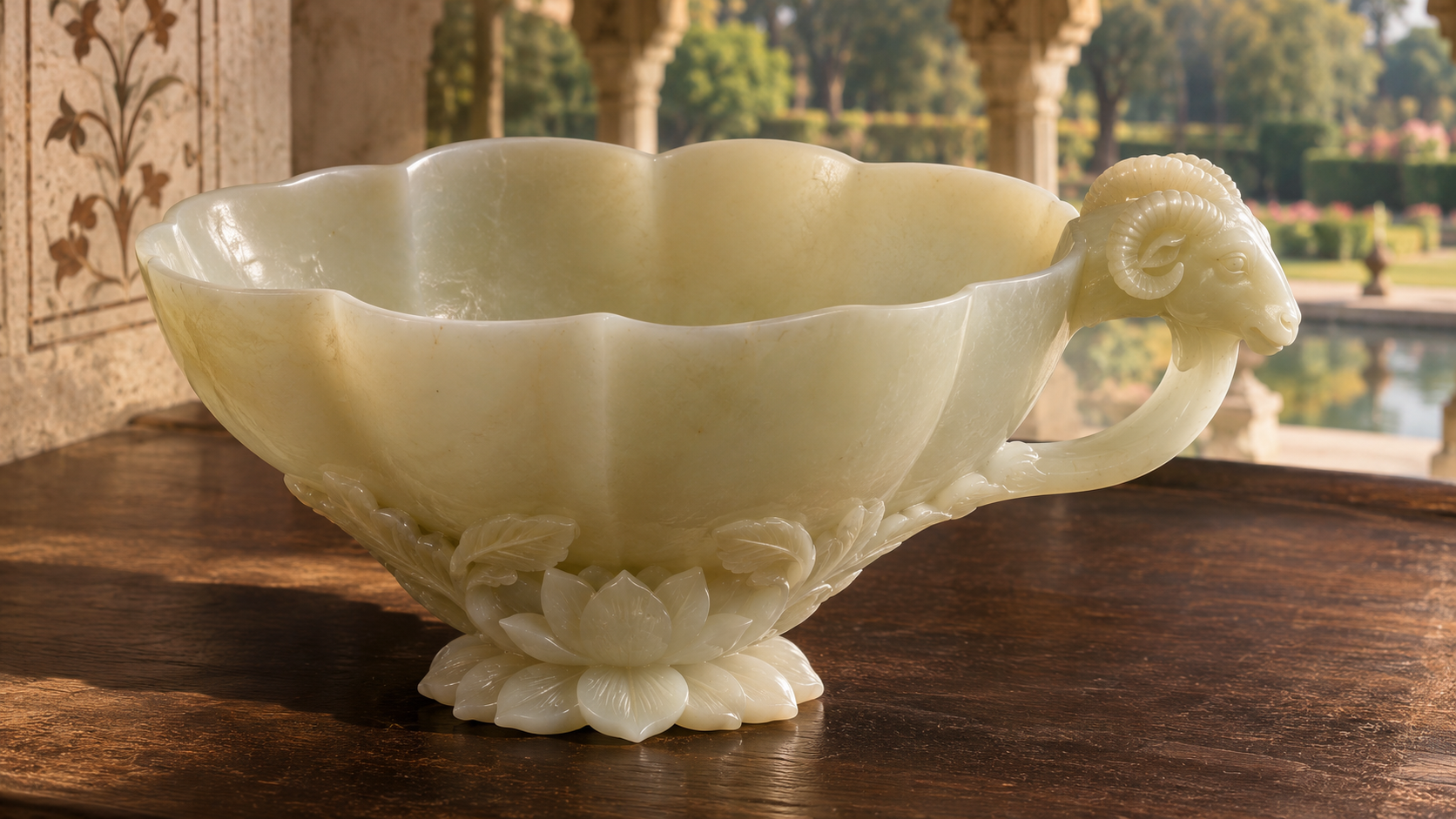
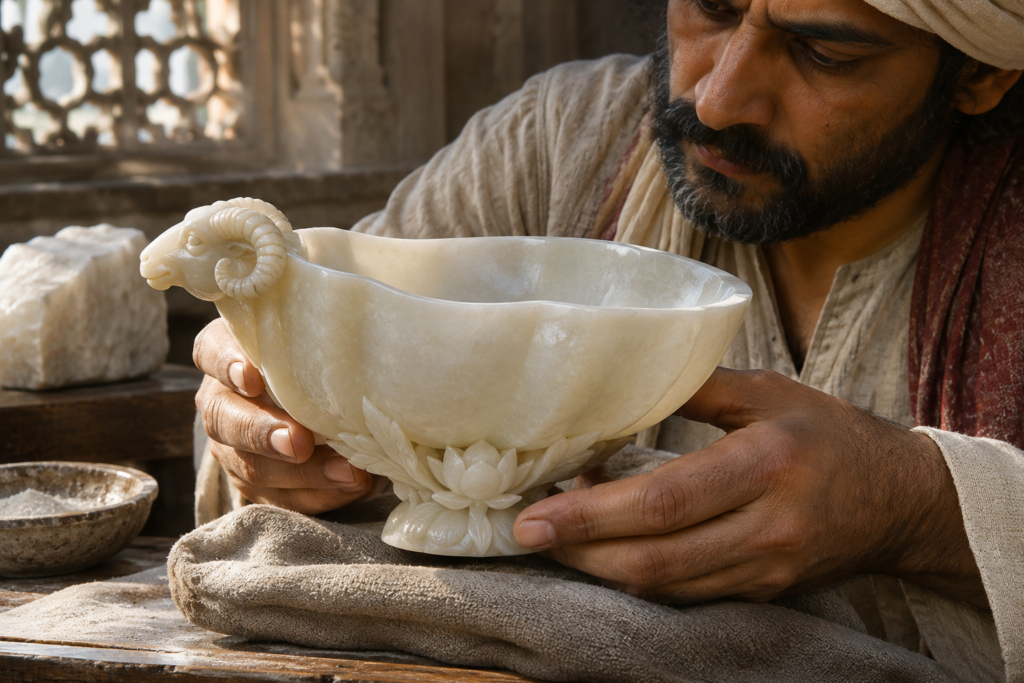
Shah Jahan’s jade cup turns a compact piece of white nephrite into a remarkably fluid composition. The shallow bowl recalls a gourd, its handle becomes a ram’s head, and the underside develops into sculpted leaves and a flower-shaped support. Despite these transformations, the object retains the visual continuity of worked stone.
Made for the Mughal emperor in 1657, the cup is now in the Victoria and Albert Museum, where it is catalogued as IS.12-1962. Its importance extends beyond imperial association. It brings together the behaviour of a distinctive mineral aggregate, demanding lapidary work and a courtly interest in forms drawn from the natural world.
For gemstone enthusiasts, it demonstrates why a material’s suitability for carving cannot be explained by hardness alone. For historians, its inscription and design offer different kinds of evidence about the culture that commissioned it.
Table of Contents
A Dated Object at the End of a Reign
The cup’s date places it close to a major political transition. Shah Jahan ruled from 1628 until his deposition in 1658; the vessel was made in 1657, shortly before the succession struggle that ended his rule.
According to the V&A, the inscription includes a date corresponding to 1657 and the imperial title commonly translated as “Second Lord of the Conjunction.” This title referred back to the emperor’s Timurid ancestry and the language of auspicious planetary conjunctions.
The inscription therefore does more than identify a period. It connects a portable luxury object with a statement of dynastic identity.
That does not mean it supplies every part of the cup’s biography. An inscribed imperial association does not automatically establish the individual carver, exact workshop sequence or geological source of the raw material.
A Small Vessel With Several Natural Forms
The V&A describes the bowl as gourd-shaped, with a ram’s-head handle and a base combining acanthus leaves with a lotus flower raised into a pedestal.
These elements have practical as well as visual roles. The animal head gives character to the handle, while the floral underside helps organise the transition between the bowl and its support.
The museum interprets the design as a synthesis of influences welcomed at the Mughal court: a Chinese-inspired vessel form, Indian traditions of floral and animal representation, and European associations for certain ornamental elements.
Such an interpretation concerns artistic relationships rather than the nationality of every person involved in production. The achievement lies in the integration of these forms into a coherent vessel, not simply in assembling a list of borrowed motifs.
What “White Nephrite Jade” Means
Jade is a material name encompassing substances with different mineralogical structures. Nephrite and jadeite may resemble one another, but they are not interchangeable names for the same mineral.
Nephrite is a compact aggregate dominated by amphibole minerals in the tremolite–actinolite compositional range. Its chemistry involves calcium, magnesium, silicon and, in varying amounts, iron. Jadeite belongs instead to the pyroxene group.
The Australian Museum records nephrite’s refractive index at approximately 1.61 and its specific gravity generally between 2.90 and 3.10. These are reference properties of the material, not measurements newly taken from Shah Jahan’s cup.
Iron content influences nephrite colour: relatively iron-poor material can be pale or white, while more iron-rich material tends towards darker greens. However, the cup’s appearance alone should not be converted into an exact chemical analysis.
Hardness and Toughness Are Different Properties
Hardness measures resistance to scratching. Toughness concerns resistance to fracture and the energy required for a crack to develop or propagate.
Nephrite illustrates why the distinction matters. Its hardness is commonly placed around 6–6.5 on the Mohs scale, below corundum and diamond, yet its compact microstructure can give it exceptional resistance to breaking.
The Government of South Australia describes a mesh of very fine, interlocking amphibole fibres. Their arrangement matters: fine bundles with interlocking orientations generally provide greater toughness than coarser or strongly aligned structures.
This does not make every piece of nephrite equally durable or every thin carving safe from damage. It means that texture, orientation and pre-existing defects must be considered alongside mineral composition.
For a carver, selecting an appropriate piece is therefore part of the technical achievement.
How Microscopic Structure Supports Delicate Carving
Research on jade fracture surfaces has connected nephrite’s toughness with its fibrous texture. The material is not one large, transparent crystal; it is an aggregate whose internal architecture affects how it responds to force.
This distinction helps explain the possibility of producing projections, thin edges and curved transitions in nephrite. The material can support forms that would be difficult in a more brittle stone of comparable hardness.
Nevertheless, a successful carving should not be treated as evidence of unlimited material strength. The junction between a handle and a bowl, for example, must still accommodate changes in thickness and direction.
The cup’s graceful appearance conceals these structural decisions. Its maker had to preserve sufficient material where required while removing enough to create visual lightness and a usable interior.
“Carving” Through Abrasion
Hardstone carving often works differently from carving wood or modelling clay. Abrasion removes small amounts of material through repeated contact with a suitably hard abrasive.
The V&A’s discussion of Mughal jade working describes drills and small lap wheels used in shaping nephrite, connecting these methods with established rock-crystal working skills.
The word “carving” remains useful, but it should not suggest that the cup was simply cut out with a knife. Hollowing, refining curves and polishing involve different stages and working surfaces.
Archaeological research on Chinese jades has shown how microscopic traces can help distinguish techniques, including the use of rotary tools. Such comparative studies explain what investigators can look for; they do not establish the precise tools used on Shah Jahan’s cup.
An object-specific reconstruction would require access to its surviving marks and an assessment of how much later polishing may have obscured them.
Hollowing a Vessel Without Losing Its Shape
A hollow stone vessel presents a connected design problem. The interior, exterior, rim and support must work together, because removing material from one surface changes the thickness remaining beneath another.
On a naturalistic vessel, that relationship becomes more demanding. The maker is not merely producing a uniform hemisphere: changes in outline must remain compatible with the intended exterior modelling.
The ram’s-head handle adds another challenge. Its recognisable features need sufficient definition without weakening the areas that connect it to the bowl.
These observations are deductions from the object’s geometry rather than a documented reconstruction of the workshop process. They explain the kinds of constraints the maker faced without inventing a tool-by-tool account.
Why White Jade Can Look Luminous
The visual effect of pale nephrite depends on more than surface colour. Light can be reflected at the polished surface, scattered within the fine-grained material and transmitted through sufficiently thin areas.
Consequently, a rim may appear more translucent than the thicker body even when both belong to the same piece. Curvature and illumination can also make neighbouring areas appear different.
This provides a physical explanation for the soft luminosity often admired in pale jade. It is an interaction between material structure, thickness and light, rather than an internal glow.
For photography, strongly backlighting a thin edge may reveal translucency while giving a misleading impression of the whole object. A balanced view should preserve the distinction between clearer margins and more opaque masses.
Naturalism Across Mughal Jade Objects
The cup belongs to a wider tradition in which animals and plants were transformed into functional hardstone objects.
A useful comparison is the Metropolitan Museum of Art’s nephrite dagger hilt in the form of a nilgai, dated around 1640. Its bluish-green stone contributes to the animal’s appearance, while a leafy scroll and lotus connect the head with the rest of the design.
The museum interprets its sensitive modelling as evidence of close attention to nature. The comparison shows that naturalism was not confined to vessels: the same broad artistic interest could shape courtly weapons and personal accessories.
It does not establish that the dagger and cup came from one workshop or one hand. Similar artistic priorities can be shared across several makers and commissions.
Jade, Courtly Taste and Cultural Exchange
The Ashmolean Museum places Mughal jade carving within a longer appreciation of the material among the dynasty’s Central Asian predecessors.
Under Shah Jahan, floral decoration appeared across several media. Jade objects could remain largely unadorned or receive precious-stone inlays in gold, while related plant forms appeared in architecture and other courtly arts.
The white cup demonstrates how strongly a design could depend on the stone itself. Its effect does not require a surface crowded with faceted gems: modelling, polish and changes of thickness provide the principal visual interest.
This is an important lesson for historical gemmology. A material’s value need not be expressed through transparency, strong colour or brilliance alone. A controlled pale surface can become an equally demanding vehicle for craftsmanship.
Where Did the Raw Nephrite Come From?
The V&A discusses nephrite imported from Khotan in the history of Mughal jade production, including routes through Tibet and Kashmir.
That context is significant, but it should not be expanded into a proven geological provenance for this individual cup. Identifying a historic supply region is different from assigning a surviving object to a specific deposit.
Several stages must be distinguished: where the jade formed, where it was collected, where it was shaped and where the finished vessel entered a treasury.
Museum attribution can firmly connect an object with an artistic and historical setting while leaving some of those earlier stages unresolved.
What Scientific Examination Can Add
Material identification and manufacture can be investigated through different analytical approaches. Raman microscopy has been used in research on historical jades to confirm nephrite, while close surface examination can reveal evidence of grinding, drilling and polishing.
Mechanical testing of reference materials addresses another question: how particular nephrite textures respond to force. Results from such samples should not be treated as measured properties of the cup itself.
Conservation also shapes the available methods. A test that removes material may be appropriate for a geological sample but unsuitable for an exceptional museum object.
A careful scientific account therefore identifies both what a method can establish and whether it has actually been applied to the artefact under discussion.
An Imperial Object Understood Through Its Material
Shah Jahan’s jade cup brings together several histories. Its inscription connects it with imperial identity, its naturalistic form belongs to Mughal artistic culture, and its worked surfaces reflect the possibilities and constraints of nephrite.
Its distinction lies in the coordination of those elements. Material selection, hollowing, sculptural detail and polish had to succeed together.
At Natural Gems Belgium, the cup offers a compelling example of why gemstone knowledge extends beyond identification. Understanding how a material behaves helps explain the decisions that made an extraordinary historical object possible.
References & Further Reading
Victoria and Albert Museum. “A Wine Cup for a Mughal Emperor.”
The principal museum interpretation of the white nephrite cup, its 1657 date, natural forms and artistic influences. Museum number IS.12-1962.
https://www.vam.ac.uk/articles/the-wine-cup-of-shah-jahan
Victoria and Albert Museum. “The Arts of the Mughal Empire.”
Museum scholarship discussing jade working, imperial inscriptions, material supply and Shah Jahan’s artistic and political setting.
https://www.vam.ac.uk/articles/the-arts-of-the-mughal-empire
Australian Museum. “Nephrite Jade.”
Mineralogical background covering nephrite’s composition, colour, physical properties and fibrous structure.
https://australian.museum/learn/minerals/gemstones/nephrite-jade/
Government of South Australia, Department for Energy and Mining. “Nephrite Jade.”
Geoscientific information explaining mineral composition, interlocking texture and the distinction between hardness and toughness.
https://www.energymining.sa.gov.au/industry/minerals-and-mining/mineral-commodities/nephrite_jade
“The Toughness of Jade.” American Mineralogist, 58, 727 onward.
Primary materials research relating fracture behaviour to jade microstructure. This concerns research specimens, not Shah Jahan’s cup.
https://pubs.geoscienceworld.org/msa/ammin/article-abstract/58/7-8/727/542863/The-toughness-of-jade
“The Identification of Carving Techniques on Chinese Jade.” Journal of Archaeological Science.
Comparative archaeological research using material identification and surface examination to investigate historical jade-working techniques. It does not examine the Mughal cup.
https://www.sciencedirect.com/science/article/pii/S0305440304000421
The Metropolitan Museum of Art. “Dagger with Hilt in the Form of a Blue Bull (Nilgai).” Approximately 1640.
A documented comparative example of naturalistic Mughal nephrite carving.
https://www.metmuseum.org/art/collection/search/453253
Ashmolean Museum, University of Oxford. “Jade Mirror-Back.” Eastern Art Online.
Museum discussion placing jade carving and floral ornament within the longer history of Mughal decorative arts. The catalogued mirror-back is a later object.
https://jameelcentre.ashmolean.org/collection/921/object/11214