Table of Contents
Is a Hard Gemstone Automatically a Durable Gemstone?
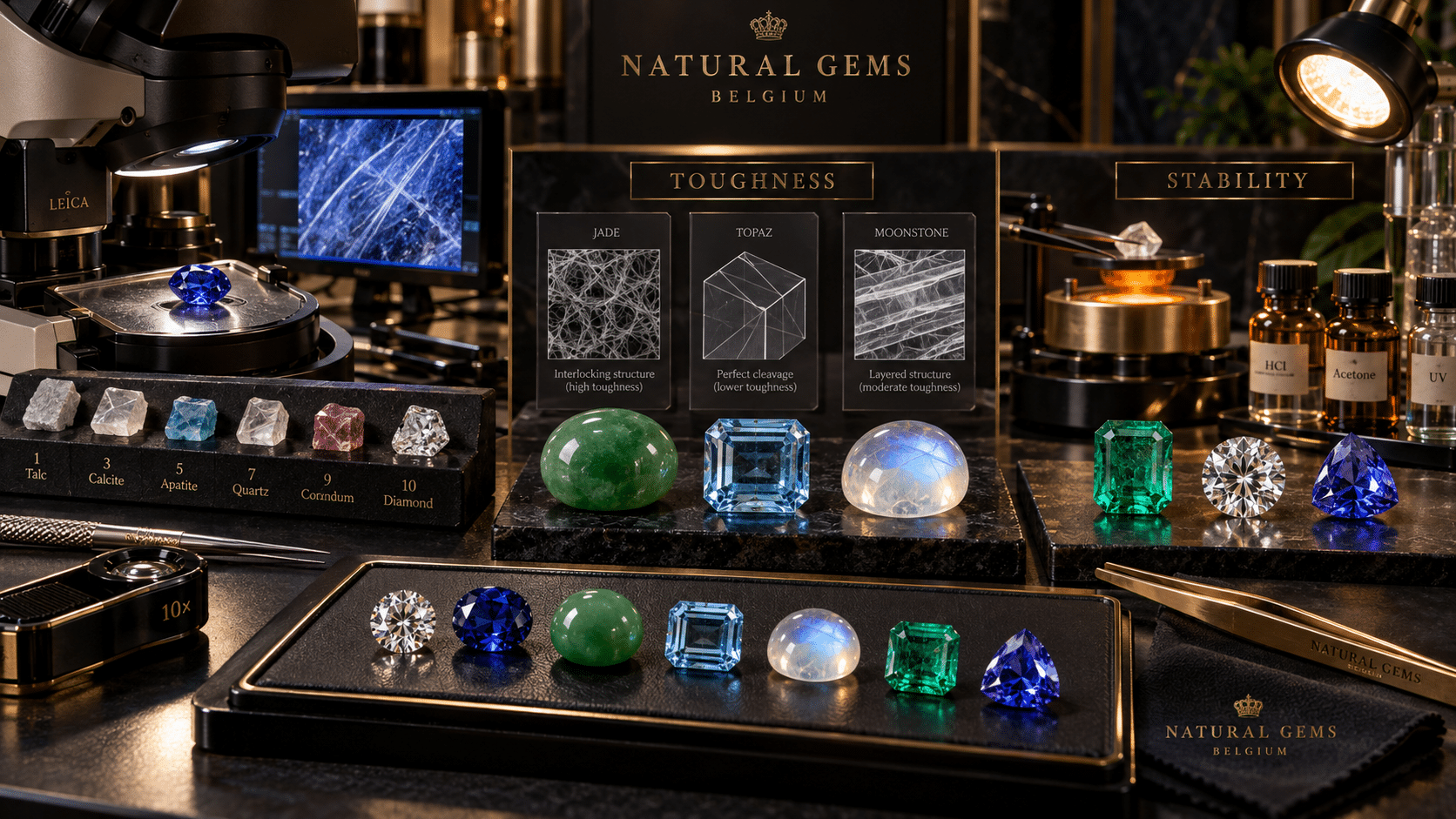
Diamond is the hardest natural material commonly encountered in gemmology.
Understanding gemstone hardness is essential for choosing the right gem for your needs.
Jade is much softer.
So which one is tougher?
The answer surprises many people:
jade can be exceptionally tough.
Now consider topaz.
Topaz reaches:
8 on the Mohs scale.
That sounds highly durable.
Yet topaz possesses pronounced cleavage and can split if struck in an unfortunate direction.
Moonstone is softer still and also possesses cleavage.
When considering durability, one must evaluate the gemstone hardness alongside other factors.
Ruby and sapphire, meanwhile, combine high hardness with excellent toughness and no cleavage.
These examples reveal a fundamental gemmological principle:
HARDNESS IS NOT THE SAME AS DURABILITY
To understand how a gemstone survives jewellery wear, cutting, setting, cleaning and storage, we need to separate at least three different concepts:
HARDNESS
TOUGHNESS
and:
STABILITY
They describe different physical behaviours.
Confusing them can lead to poor jewellery choices, inappropriate cleaning methods and damaged gemstones.
Understanding them gives us a much more realistic answer to the question:
“How durable is this gemstone?”
PART I — THE THREE COMPONENTS OF GEMSTONE DURABILITY
A useful gemmological durability model considers:
Hardness
Resistance to:
scratching and abrasion.
Toughness
Resistance to:
breaking, chipping and fracturing.
Stability
Resistance to environmental effects such as:
heat, light and chemicals.
A gemstone can perform exceptionally well in one category and poorly in another.
That is why a single number on the Mohs scale cannot describe total durability.
PART II — WHAT HARDNESS ACTUALLY MEANS
1. Hardness Is Primarily About Scratching
In mineralogy, hardness describes a material’s resistance to being scratched.
A harder material can scratch a softer material.
This property is commonly expressed using:
THE MOHS SCALE
The scale was introduced by German mineralogist Friedrich Mohs in the early nineteenth century.
It uses ten reference minerals.
From softest to hardest:
1 — Talc
2 — Gypsum
3 — Calcite
4 — Fluorite
5 — Apatite
6 — Orthoclase feldspar
7 — Quartz
8 — Topaz
9 — Corundum
10 — Diamond
This sequence remains one of the most familiar scales in gemmology.
But it is also frequently misunderstood.
PART III — THE MOHS SCALE IS ORDINAL, NOT LINEAR
2. Ten Is Not Simply “Twice as Hard” as Five
The numerical spacing of the Mohs scale does not represent equal increments in absolute hardness.
The difference between:
Mohs 9
and:
Mohs 10
is not equivalent to the difference between:
Mohs 5
and:
Mohs 6.
GIA specifically cautions that the scale can be deceptive because the steps are not evenly spaced.
Diamond is only one Mohs number above corundum.
Yet diamond is substantially harder in absolute terms.
Therefore:
Mohs numbers rank scratch resistance.
They are not percentages.
They are not linear engineering measurements.
And they are not overall durability ratings.
PART IV — WHY HARDNESS MATTERS IN JEWELLERY
Jewellery encounters abrasive contact constantly.
A ring may contact:
- tables;
- door handles;
- tools;
- dust;
- other jewellery;
- mineral particles.
Over time, abrasion can affect:
- facet junctions;
- polish;
- cabochon surfaces;
- carvings.
Harder gemstones generally retain a crisp polish and sharp facet junctions better under equivalent abrasive conditions.
This is one reason ruby and sapphire are so suitable for frequently worn jewellery.
Corundum has:
Mohs hardness 9.
PART V — QUARTZ CHANGES THE EVERYDAY ENVIRONMENT
Quartz is approximately:
Mohs 7.
Quartz is also extremely common in the Earth’s crust.
Tiny quartz-rich particles can occur in ordinary environmental dust and grit.
This helps explain why materials significantly softer than quartz can gradually develop surface abrasion during normal use.
A gemstone does not need to be deliberately attacked with a file to experience abrasive wear.
The environment supplies abrasive particles naturally.
PART VI — HARDNESS DOES NOT MEAN INDESTRUCTIBLE
Here we reach the critical misconception.
Suppose a gemstone has:
Mohs hardness 8.
Can it break?
Absolutely.
Hardness tells us primarily about:
resistance to scratching.
It does not tell us directly how the gemstone responds to:
impact.
For that, we need another property.
PART VII — TOUGHNESS
3. What Is Toughness?
Toughness describes a material’s resistance to:
- breaking;
- chipping;
- cracking;
- fracturing
when subjected to mechanical stress or impact.
This is fundamentally different from hardness.
A material can be:
hard but relatively vulnerable to breakage
or:
comparatively soft but extremely resistant to breaking.
The classic gemstone example is:
JADE
PART VIII — THE JADE PARADOX
Jadeite is approximately:
Mohs 6.5–7.
Nephrite:
Mohs 6–6.5.
Neither approaches corundum at 9 or diamond at 10.
Yet GIA describes both jadeite and nephrite as possessing:
exceptional toughness
and strong resistance to breaking or chipping.
This explains why jade has historically been suitable not only for jewellery but also for intricate carvings and objects where resistance to fracture matters greatly.
The lesson is immediate:
a lower Mohs number does not necessarily mean a gemstone breaks more easily.
PART IX — WHY JADE IS TOUGH
Toughness can be strongly influenced by microstructure.
Nephrite, for example, has an interlocking fibrous structure.
Jadeite aggregates can also possess interlocking granular textures.
These structures can make fracture propagation difficult.
A crack attempting to travel through such material does not necessarily find a simple uninterrupted path.
This contributes to jade’s extraordinary mechanical toughness.
So:
hardness depends on resistance to scratching.
But:
toughness depends strongly on how the material responds to fracture.
PART X — CLEAVAGE
4. A Hidden Weakness in Some Crystals
Some crystalline materials possess directions along which atomic bonding is weaker.
A crystal may therefore split preferentially along particular crystallographic planes.
This property is called:
CLEAVAGE
Cleavage is extremely important to gemstone durability.
A stone can possess high hardness yet still be vulnerable to a sharp impact along a cleavage direction.
PART XI — TOPAZ: THE PERFECT WARNING
Topaz has:
Mohs hardness 8.
Looking only at the Mohs scale, it appears extremely durable.
But topaz possesses:
basal cleavage.
GIA rates its toughness as poor because of that cleavage.
A sufficiently strong blow in an unfortunate direction can split the gemstone.
This has consequences during:
- cutting;
- polishing;
- setting;
- repair;
- daily wear.
GIA notes that cutters commonly orient faceted topaz so its cleavage direction is positioned at an angle to the table to reduce risk.
Thus:
Topaz is hard.
But:
topaz is not exceptionally tough.
Both statements are simultaneously correct.
PART XII — MOONSTONE
Moonstone provides another instructive example.
Its hardness is approximately:
6–6.5.
But moonstone also possesses:
two cleavage directions
and GIA rates its toughness as:
poor.
A hard blow can therefore break a moonstone.
High heat or sudden temperature changes can also cause damage.
For jewellery exposed to frequent impact, setting design becomes especially important.
PART XIII — TANZANITE
Tanzanite—blue to violet zoisite—ranks approximately:
6–7 on the Mohs scale.
Its toughness is:
fair to poor.
It also possesses cleavage.
This does not mean tanzanite cannot be worn as jewellery.
It means its physical properties must inform how it is:
- set;
- worn;
- cleaned;
- repaired.
GIA specifically recommends protecting tanzanite from hard blows and avoiding ultrasonic and steam cleaning.
PART XIV — IOLITE
Iolite ranks approximately:
7–7.5 on the Mohs scale.
That sounds relatively robust.
Yet iolite has:
perfect cleavage in one direction.
Its toughness is therefore not determined by its Mohs number alone.
GIA warns that a hard blow can split it and that sharp temperature changes may cause breakage.
Again:
hardness and toughness answer different questions.
PART XV — CORUNDUM: AN EXCELLENT COMBINATION
Ruby and sapphire are varieties of:
corundum.
Corundum combines several favourable durability properties.
It has:
Mohs hardness 9
excellent toughness
and:
no cleavage.
GIA therefore considers ruby and sapphire highly suitable for jewellery exposed to everyday wear.
This combination—not hardness alone—is what makes corundum particularly durable.
PART XVI — DIAMOND: HARDEST DOES NOT MEAN UNBREAKABLE
Diamond occupies:
Mohs 10.
It is the benchmark for mineral scratch hardness.
But a common statement follows:
“Diamond is the hardest material, so diamond cannot break.”
That conclusion is false.
Hardness and fracture resistance are different physical properties.
Diamond possesses cleavage directions.
A sufficiently sharp impact in an unfavourable direction can chip or cleave a diamond.
That is why diamond cutters historically used cleavage deliberately as one method of dividing rough diamond.
The hardest gemstone can still break.
PART XVII — AN IMPORTANT LANGUAGE RULE
Avoid saying:
“Diamond is the strongest gemstone.”
That word is too ambiguous.
A scientifically clearer statement is:
“Diamond has exceptionally high scratch hardness.”
Then discuss toughness separately.
Precision of language prevents conceptual mistakes.
PART XVIII — FRACTURE VERSUS CLEAVAGE
Not every break follows cleavage.
Cleavage
Breakage along structurally preferred crystallographic planes.
Fracture
Breakage that does not follow cleavage planes.
A material may have:
- perfect cleavage;
- good cleavage;
- poor cleavage;
- no cleavage.
The presence, quality and orientation of cleavage can strongly influence how a fashioned gemstone responds to impact.
PART XIX — THE THIRD COMPONENT: STABILITY
We now know that a gemstone can resist scratches yet still break.
But there is another category of damage.
A gemstone might survive both abrasion and impact and still be altered by:
- heat;
- light;
- chemicals.
This is:
STABILITY
PART XX — HEAT STABILITY
5. Jewellery Can Encounter Significant Heat
Heat exposure can occur during:
- jewellery manufacture;
- soldering;
- repair;
- steam cleaning;
- accidental environmental exposure.
Different gemstones respond differently.
Corundum is generally stable under normal wearing conditions.
But other gems can be much more sensitive.
PART XXI — THERMAL SHOCK
A gemstone does not always need to reach an extreme absolute temperature to be damaged.
Rapid temperature change can produce:
thermal shock.
Different parts of the stone expand or contract at different rates.
Internal stress can develop.
If that stress exceeds what the material can tolerate:
fracturing may occur.
GIA specifically warns about sudden temperature changes for stones including:
PART XXII — INCLUSIONS CAN CHANGE THE RISK
A gemstone’s theoretical material properties are only part of the story.
A natural stone may contain:
- fractures;
- fluid inclusions;
- mineral inclusions;
- cavities.
Heating can cause some inclusions or fracture systems to respond differently from the surrounding host crystal.
This means two gemstones of the same species can differ in practical risk.
The condition of the individual stone matters.
PART XXIII — LIGHT STABILITY
6. Can Gemstone Colour Fade?
Sometimes.
Many gemstones are highly stable under normal light exposure.
Others can show colour alteration after prolonged exposure to intense light.
Kunzite is a particularly useful example.
GIA warns that kunzite colour can fade with prolonged exposure to:
heat or intense light.
Some irradiated gemstones can also display light- or heat-related colour instability.
Therefore:
colour stability cannot be inferred from hardness.
A stone can resist scratches while its colour changes.
PART XXIV — CHEMICAL STABILITY
Gemstones can encounter:
- household cleaners;
- acids;
- alkalis;
- cosmetics;
- chlorine-containing products;
- jewellery-cleaning solutions.
Different gem materials react differently.
For example, GIA notes that feldspars can be attacked by hydrochloric acid and recommends avoiding inappropriate chemical cleaners for sunstone.
Chemical stability is therefore a separate durability consideration.
PART XXV — EMERALD: WHEN TREATMENT CHANGES CARE
Emerald has a hardness of approximately:
7.5–8.
If we looked only at Mohs hardness, we might assume relatively uncomplicated jewellery care.
But natural emeralds commonly contain fractures.
Many fashioned emeralds have surface-reaching fractures filled with:
- oils;
- resins;
- polymers
to improve apparent clarity.
This changes the practical durability picture.
GIA warns that:
- heat can extend existing fractures;
- light and chemicals can affect filling substances;
- ultrasonic vibration can endanger fractured stones;
- steam can cause some fillers to leave fractures.
For emerald, safe care cannot be determined from hardness alone.
PART XXVI — TREATMENT BECOMES PART OF DURABILITY
This introduces an important rule:
DURABILITY BELONGS TO THE ACTUAL GEMSTONE, NOT ONLY THE MINERAL SPECIES
A ruby may normally be extremely durable.
But a heavily fracture-filled ruby requires different care from an untreated or conventionally heated ruby without significant filling.
A coated topaz requires different surface-care considerations from uncoated topaz.
A fracture-filled gemstone may respond differently to cleaning from an untreated specimen of the same species.
Therefore the gemologist asks not only:
What is the material?
but also:
Has it been treated in a way that changes care requirements?
PART XXVII — ULTRASONIC CLEANING
7. Why Ultrasonic Cleaners Need Caution
Ultrasonic cleaners create high-frequency vibrations in a cleaning liquid.
They can be extremely effective for suitable jewellery.
But not every gemstone is suitable.
Existing fractures, cleavage, fillings or structural weaknesses can increase risk.
GIA advises against ultrasonic cleaning for several gems including:
- moonstone;
- tanzanite;
- topaz;
- iolite.
For emerald, the widespread presence of filled fractures makes ultrasonic cleaning particularly risky.
PART XXVIII — STEAM CLEANING
Steam introduces:
heat
and potentially:
rapid temperature change.
Again, suitability depends on the gemstone.
Ruby and sapphire without problematic treatments are generally much more tolerant than gemstones such as:
- tanzanite;
- moonstone;
- topaz;
- iolite.
The safest cleaning recommendation for many sensitive gemstones remains:
warm water + mild soap + gentle cleaning.
PART XXIX — THE THREE QUESTIONS BEFORE CLEANING
Before selecting a cleaning method, ask:
1. What gemstone is it?
Species and variety matter.
2. What condition is it in?
Are there fractures, cavities or damage?
3. Has it been treated?
Are there fillers, coatings, dyes or other treatment-related vulnerabilities?
Only then should cleaning method be selected.
PART XXX — THE MOHS SCALE AND JEWELLERY DESIGN
Hardness does influence jewellery suitability.
A softer stone used in a ring will generally experience more abrasive exposure than the same stone used in:
- earrings;
- pendant;
- brooch.
But toughness matters too.
A cleavage-prone gemstone in an exposed ring setting may be vulnerable to impact.
This is where jewellery design becomes part of gemstone protection.
PART XXXI — PROTECTIVE SETTINGS
A protective setting can reduce exposure to:
- edge impacts;
- knocks;
- abrasion.
This is especially useful for gemstones with:
- lower hardness;
- cleavage;
- modest toughness.
Bezel-style protection or designs that shield vulnerable edges can sometimes make a meaningful practical difference.
The gemstone and setting should be considered as a system.
PART XXXII — HARDNESS AND FACET WEAR
Under magnification, softer or heavily worn gemstones may show:
- rounded facet junctions;
- scratches;
- abrasions;
- reduced polish.
These observations can sometimes contribute to identification.
For example, a supposedly very hard gemstone displaying extensive facet-junction abrasion may encourage the gemologist to investigate alternative identities.
But wear is not diagnostic by itself.
Age and treatment history matter.
PART XXXIII — NEVER USE DESTRUCTIVE SCRATCH TESTING ON A VALUABLE GEMSTONE
The Mohs scale is based on scratch relationships.
That does not mean professional gem identification should involve casually scratching finished gemstones.
A scratch test can permanently damage:
- polished surfaces;
- facet junctions;
- carvings;
- collector specimens.
Modern gemmology provides non-destructive or minimally invasive alternatives.
Do not damage a gemstone merely to demonstrate that one material can scratch another.
PART XXXIV — WHY “SCRATCHES GLASS” PROVES VERY LITTLE
A popular gemstone test says:
“If it scratches glass, it must be real.”
This is scientifically poor identification practice.
Many minerals can scratch common glass.
A simulant can therefore pass such a test.
The test also risks damaging both objects.
Professional identification relies on a combination of appropriate properties—not internet scratch tricks.
PART XXXV — COMPARISON 1: SAPPHIRE VS TOPAZ
Consider two faceted gemstones.
Sapphire
Mohs:
9
Toughness:
excellent
Cleavage:
none
Stability:
generally excellent under normal wearing conditions
Topaz
Mohs:
8
Toughness:
poor
Cleavage:
pronounced basal cleavage
Stability:
vulnerable to high heat or sudden temperature change
The one-point Mohs difference does not tell the full story.
Their durability profiles are substantially different.
PART XXXVI — COMPARISON 2: JADE VS TOPAZ
Jadeite
Mohs:
6.5–7
Toughness:
exceptional
Topaz
Mohs:
8
Toughness:
poor
Which is harder?
Topaz.
Which is generally more resistant to breaking?
Jade.
This single comparison demonstrates why hardness and toughness must never be treated as synonyms.
PART XXXVII — COMPARISON 3: SAPPHIRE VS TANZANITE
Sapphire
Mohs:
9
Toughness:
excellent
Cleavage:
none
Tanzanite
Mohs:
6–7
Toughness:
fair to poor
Cleavage:
present
Tanzanite remains a beautiful jewellery gemstone.
But it requires more protection from impact and inappropriate cleaning.
Gem value does not change physics.
PART XXXVIII — COMPARISON 4: MOONSTONE VS JADE
Both can occupy broadly similar regions of the Mohs scale.
Yet:
Moonstone
Mohs:
6–6.5
Toughness:
poor
Cleavage:
two directions
Nephrite jade
Mohs:
6–6.5
Toughness:
exceptional
Same approximate hardness.
Completely different resistance to breakage.
This is perhaps the clearest demonstration of all.
PART XXXIX — A BETTER DURABILITY MATRIX
Instead of asking:
“What is its Mohs hardness?”
ask:
| Property | Question |
|---|---|
| Hardness | How easily can it be scratched or abraded? |
| Toughness | How easily can it chip, crack or break? |
| Cleavage | Does it possess structurally weak breakage directions? |
| Heat stability | Can high heat or thermal shock damage it? |
| Light stability | Can prolonged/intense light alter it? |
| Chemical stability | Can common chemicals attack it? |
| Treatment stability | Do treatments introduce additional vulnerabilities? |
That is a much more meaningful durability assessment.
PART XL — A PRACTICAL JEWELLERY MATRIX
Ruby / Sapphire
Daily-wear potential: Excellent
Main strengths: Very high hardness, excellent toughness, no cleavage
Caution: Treatments and existing fractures can modify care requirements
Jade
Daily-wear potential: Very good when appropriately designed
Main strength: Exceptional toughness
Caution: Lower scratch resistance than corundum; treatments may affect care
Topaz
Daily-wear potential: Requires protection
Main weakness: Cleavage and poor toughness despite Mohs 8
Tanzanite
Daily-wear potential: Possible with care
Main weaknesses: Moderate hardness, cleavage, fair-to-poor toughness
Moonstone
Daily-wear potential: Better protected from impact
Main weaknesses: Lower hardness, poor toughness, cleavage
Emerald
Daily-wear potential: Long-lasting with appropriate care
Main concern: Fractures and commonly used fracture-filling substances
PART XLI — THE INDIVIDUAL STONE STILL MATTERS
Reference tables describe typical properties of:
materials.
But jewellery contains:
individual gemstones.
One sapphire may be exceptionally clean.
Another may contain a large surface-reaching fracture.
One emerald may have minor clarity enhancement.
Another may contain extensive fracture filling.
One topaz may be securely protected in a pendant.
Another may be exposed in a ring.
Durability assessment therefore combines:
material properties
with:
individual condition
and:
intended use.
PART XLII — GEMSTONE DURABILITY AND CARVINGS
This is especially relevant to NGB’s carved gemstones.
A carving can contain:
- thin projections;
- sharp corners;
- undercut details;
- narrow structural bridges.
Even a reasonably tough material can become mechanically vulnerable when carved into a delicate geometry.
Therefore carving durability depends on:
material + internal structure + design + thickness.
A massive jade carving and a delicate fluorite carving should not be handled identically.
PART XLIII — GEMSTONE DURABILITY AND ROUGH
Rough material also requires informed handling.
Cleavage may influence:
- sawing;
- preforming;
- faceting orientation;
- polishing;
- yield.
A rough crystal can appear solid yet contain:
- cleavage;
- stress fractures;
- internal tension;
- liquid inclusions.
Understanding durability begins before cutting.
PART XLIV — WHY CUTTERS STUDY CLEAVAGE
A faceter does not merely ask:
“Where is the best colour?”
Orientation may also need to consider:
- cleavage;
- pleochroism;
- inclusions;
- crystal shape;
- optical performance;
- yield.
Topaz is a classic example where cleavage orientation matters during cutting.
The final gemstone is partly the result of managing its physical weaknesses intelligently.
PART XLV — WHY SETTERS NEED GEMMOLOGY
Jewellery setting can subject gemstones to:
- pressure;
- localised force;
- vibration;
- heat.
A setter working with sapphire can tolerate risks that would be inappropriate for a cleavage-prone or fracture-filled gemstone.
Knowing the identity and treatment of the stone is therefore not merely academic.
It influences workshop procedure.
PART XLVI — WHY REPAIRERS NEED GEMMOLOGY
A jeweller repairing a ring may use:
- torch heat;
- steam;
- ultrasonic cleaning;
- chemical solutions.
If the gemstone is misidentified, or its treatment is unknown, an otherwise routine repair can become hazardous.
This is why disclosure and identification matter throughout the gemstone’s life—not only at the moment of sale.
PART XLVII — DURABILITY EXERCISE 1
A gemstone is:
Mohs 8
Can you conclude that it is suitable for rough everyday wear?
No.
You still need to know:
- toughness;
- cleavage;
- stability;
- treatment;
- setting;
- condition.
If the stone is topaz, cleavage becomes highly relevant.
PART XLVIII — DURABILITY EXERCISE 2
A gemstone is:
Mohs 6.5
Does that automatically mean it breaks easily?
No.
Nephrite jade is approximately 6–6.5 yet exceptionally tough.
Hardness is not toughness.
PART XLIX — DURABILITY EXERCISE 3
A gemstone has:
Mohs hardness 9
Can it be placed automatically into an ultrasonic cleaner?
Not necessarily.
First establish:
- gemstone identity;
- treatment;
- fracture condition.
For example, conventional corundum is highly durable, but treatment-related features can alter cleaning recommendations.
PART L — DURABILITY EXERCISE 4
An emerald is:
Mohs 7.5–8.
Can it therefore be steam cleaned safely?
That conclusion would be unsafe.
Emerald commonly contains fractures and fracture-filling substances.
GIA recommends warm, soapy water as the safest cleaning approach.
The Mohs number cannot answer the cleaning question.
PART LI — DURABILITY EXERCISE 5
A moonstone and nephrite both measure around:
Mohs 6–6.5.
Do they have equivalent durability?
No.
Moonstone has poor toughness and cleavage.
Nephrite has exceptional toughness.
A hardness-only comparison would conceal the most important difference.
PART LII — A BETTER WAY TO DESCRIBE GEMSTONES
Instead of:
“This gemstone is very durable because it is Mohs 8.”
prefer:
“This gemstone has high scratch resistance, but its cleavage means it should be protected from sharp impacts.”
Instead of:
“Jade is only Mohs 6.5.”
prefer:
“Jade has moderate scratch resistance but exceptional toughness.”
Instead of:
“Sapphire is durable because it is Mohs 9.”
prefer:
“Sapphire combines very high hardness with excellent toughness, no cleavage and good stability under normal wearing conditions.”
The second formulation in each example is scientifically more useful.
PART LIII — THE NGB DURABILITY WORKFLOW
When evaluating a gemstone for jewellery use:
IDENTIFY THE GEM MATERIAL
↓
CHECK HARDNESS
How resistant is it to scratching and abrasion?
↓
CHECK TOUGHNESS
How resistant is it to chipping and breaking?
↓
CHECK CLEAVAGE
Are there crystallographic weakness directions?
↓
CHECK STABILITY
Heat?
Thermal shock?
Light?
Chemicals?
↓
CHECK TREATMENT
Fillers?
Coatings?
Dyes?
Other durability considerations?
↓
INSPECT THE INDIVIDUAL STONE
Fractures?
Cavities?
Surface-reaching inclusions?
↓
CONSIDER THE JEWELLERY TYPE
Ring?
Pendant?
Earrings?
Bracelet?
↓
CONSIDER SETTING PROTECTION
Exposed or protected?
↓
SELECT APPROPRIATE CARE
Only now do we have a meaningful durability assessment.
PART LIV — THE CENTRAL MISCONCEPTION
The statement:
“Diamond is 10, sapphire is 9, topaz is 8, therefore their durability differs by one step each.”
is wrong for two reasons.
First:
the Mohs scale is not linear.
Second:
Mohs hardness measures only one aspect of durability.
Real gemstone durability is multidimensional.
PART LV — THE THREE AXES
Think of every gemstone as occupying three separate axes.
AXIS 1 — HARDNESS
Resistance to scratching.
AXIS 2 — TOUGHNESS
Resistance to breakage.
AXIS 3 — STABILITY
Resistance to environmental alteration.
A genuinely useful gemstone profile must consider all three.
PART LVI — WHY THIS MATTERS TO COLLECTORS
Collectors may not subject gemstones to everyday jewellery wear.
But durability still matters during:
- handling;
- display;
- storage;
- cleaning;
- photography;
- transport.
A light-sensitive specimen should not be displayed indefinitely under intense illumination.
A cleavage-prone crystal should not be allowed to knock against harder specimens.
A chemically sensitive mineral should not be cleaned casually.
Knowledge protects the specimen.
PART LVII — WHY THIS MATTERS TO BUYERS
When purchasing jewellery, the useful question is not simply:
“Is this gemstone hard?”
Ask instead:
“Is this gemstone appropriate for the way I intend to wear it?”
A delicate gemstone can be entirely appropriate in a pendant.
The same stone might require a highly protective design if used in a frequently worn ring.
There is no universal rule that valuable gemstones must be physically indestructible.
There is only:
appropriate use based on known material properties.
PART LVIII — WHY THIS MATTERS TO NGB
For Natural Gems Belgium, durability information should remain:
species-specific
and, where necessary:
treatment-specific.
A gemstone product page should never reduce care advice to a Mohs number alone.
Where relevant, professional care guidance should distinguish:
- scratch resistance;
- impact sensitivity;
- cleavage;
- heat sensitivity;
- light sensitivity;
- chemical sensitivity;
- treatment-related precautions.
That gives the customer information that can actually protect the gemstone.
PART LIX — THE MOST IMPORTANT COMPARISON
If only one comparison from this article is remembered, make it this:
TOPAZ
Mohs:
8
Toughness:
poor
NEPHRITE JADE
Mohs:
6–6.5
Toughness:
exceptional
Topaz is substantially more resistant to scratching.
Jade is substantially more resistant to breaking.
Neither property contradicts the other.
They measure different things.
PART LX — THE SCIENTIFIC HABIT
This article continues the same discipline used throughout the NGB Learning Center.
Do not ask one measurement to answer a question it cannot answer.
A refractometer does not establish every treatment.
Specific gravity does not establish natural origin.
A thermal diamond tester does not establish natural diamond origin.
And:
Mohs hardness does not establish total durability.
Understanding the limits of a property is just as important as knowing its value.
Conclusion
The Mohs scale is enormously useful.
But it is also one of the most frequently misunderstood concepts in gemstones.
It tells us about:
relative scratch hardness.
It does not, by itself, tell us whether a gemstone will:
- chip;
- cleave;
- fracture;
- tolerate heat;
- survive thermal shock;
- resist chemicals;
- retain colour in intense light;
- tolerate ultrasonic cleaning;
- tolerate steam;
- survive a hard impact.
Those questions require:
toughness
and:
stability
as well.
This explains several apparent paradoxes.
Diamond is the hardest gemstone yet can still cleave.
Topaz is Mohs 8 yet has poor toughness because of its cleavage.
Nephrite jade is only around Mohs 6–6.5 yet possesses exceptional toughness.
Moonstone occupies a similar hardness region but has poor toughness and two cleavage directions.
Sapphire combines Mohs 9 hardness with excellent toughness and no cleavage, making it unusually well suited to regular jewellery wear.
Emerald demonstrates another layer of complexity: its Mohs hardness is relatively high, yet natural fractures and widespread clarity enhancement can substantially influence cleaning and repair procedures.
Treatment therefore becomes part of practical durability.
So does:
individual condition.
So does:
jewellery design.
So does:
how the owner intends to wear the stone.
The scientifically useful question is therefore not:
“How hard is this gemstone?”
It is:
“WHAT IS THIS GEMSTONE’S COMPLETE DURABILITY PROFILE?”
That profile considers:
HARDNESS
for resistance to scratching.
TOUGHNESS
for resistance to breaking.
CLEAVAGE
for structural weakness directions.
STABILITY
for resistance to heat, light and chemicals.
TREATMENT
for additional vulnerabilities.
CONDITION
for fractures and existing damage.
And:
USE
for the mechanical environment the gemstone will actually encounter.
Once these concepts are separated, the Mohs scale becomes more useful—not less.
It simply returns to the job it was designed to perform:
describing relative resistance to scratching.
And gemstone durability becomes what it really is:
a combination of physical properties, structure, condition, treatment and use.
References & Further Reading
Gemological Institute of America (GIA) — “Sapphire Care and Cleaning Guide.”
GIA describes corundum as Mohs 9 with excellent toughness and no cleavage and discusses its stability under normal wearing conditions. This is an important reference for understanding why sapphire and ruby combine several favourable durability properties rather than relying on hardness alone.
https://www.gia.edu/sapphire-care-cleaning
Gemological Institute of America (GIA) — “Ruby Care and Cleaning Guide.”
Provides the corresponding professional care and durability guidance for ruby. GIA identifies corundum as Mohs 9, with excellent toughness and no cleavage, while also noting that treatment-related factors can affect appropriate care.
https://www.gia.edu/ruby-care-cleaning
Gemological Institute of America (GIA) — “Jade Care and Cleaning Guide.”
An especially important reference for distinguishing hardness from toughness. GIA lists jadeite at Mohs 6.5–7 and nephrite at 6–6.5 while describing both as exceptionally tough and highly resistant to breaking or chipping.
https://www.gia.edu/articles/jade-care-cleaning
Gemological Institute of America (GIA) — “Topaz Care and Cleaning Guide.”
One of the clearest demonstrations that high Mohs hardness does not guarantee high toughness. Topaz ranks 8 on the Mohs scale but has poor toughness because of basal cleavage. GIA also discusses its vulnerability to high heat and sudden temperature changes.
https://www.gia.edu/topaz-care-cleaning
Gemological Institute of America (GIA) — “Moonstone Care and Cleaning Guide.”
GIA lists moonstone at Mohs 6–6.5, with poor toughness and two cleavage directions. The guide also explains its vulnerability to high heat and sudden temperature change and recommends warm soapy water rather than ultrasonic or steam cleaning.
https://www.gia.edu/moonstone-care-cleaning
Gemological Institute of America (GIA) — “Tanzanite Care and Cleaning Guide.”
GIA describes tanzanite/zoisite as Mohs 6–7 with fair-to-poor toughness and cleavage. It also documents heat and thermal-shock concerns and recommends against ultrasonic and steam cleaning.
https://www.gia.edu/tanzanite-care-cleaning
Gemological Institute of America (GIA) — “Iolite Care and Cleaning.”
A useful example of a gemstone with respectable scratch hardness but an important structural weakness. Iolite is Mohs 7–7.5 but has perfect cleavage in one direction, making protection from sharp blows and sudden temperature changes important.
https://www.gia.edu/gia-website/iolite-care-cleaning
Gemological Institute of America (GIA) — “Emerald Care and Cleaning Guide.”
Essential reading for understanding how inclusions and treatments modify practical durability. GIA lists emerald at Mohs 7.5–8 with fair-to-good toughness and explains why fractures and fracture-filling substances make ultrasonic and steam cleaning risky.
https://www.gia.edu/emerald-care-cleaning
Gemological Institute of America (GIA) — “Alexandrite Care and Cleaning Guide.”
Alexandrite provides a useful comparison with cleavage-prone stones. GIA lists it at Mohs 8.5 with excellent toughness and no cleavage and explains that it is stable under normal wearing conditions.
https://www.gia.edu/articles/alexandrite-care-cleaning
Gemological Institute of America (GIA) — “Tourmaline Care and Cleaning Guide.”
GIA lists tourmaline at Mohs 7–7.5 with fair toughness and explains that high heat can alter colour while thermal shock can cause fracturing. It also discusses treatment-related stability considerations.
https://www.gia.edu/tourmaline-care-cleaning
Gemological Institute of America (GIA) — “Garnet Care and Cleaning Guide.”
Useful for understanding why even a single gem family cannot always be assigned one simple durability number. GIA gives garnet hardness as approximately Mohs 6.5–7.5 depending on type, with fair-to-good toughness.
https://www.gia.edu/garnet-care-cleaning
Gemological Institute of America (GIA) — “Sunstone Care and Cleaning.”
GIA explains that feldspar varieties such as sunstone combine moderate hardness with cleavage-related durability concerns. The guide also discusses heat and chemical sensitivity and recommends avoiding ultrasonic and steam cleaning.
https://www.gia.edu/sunstone-care-cleaning
Gemological Institute of America (GIA) — “Zircon Care and Cleaning Guide.”
GIA lists zircon at approximately Mohs 6–7.5 with fair-to-good toughness, while noting brittleness, abrasion concerns and possible colour instability in some heat-treated material under prolonged bright light.
https://www.gia.edu/zircon-care-cleaning
Gemological Institute of America (GIA) — “Sapphire.” Gem Encyclopedia.
Authoritative reference data for corundum, including Al₂O₃ composition, refractive index 1.762–1.770, specific gravity 4.00 and Mohs hardness 9. Particularly useful when connecting durability data with the broader physical-property framework used throughout the NGB Learning Center.
https://www.gia.edu/sapphire