
Table of Contents
Introduction: When Existing Rocks Become Gemstone-Bearing Rocks
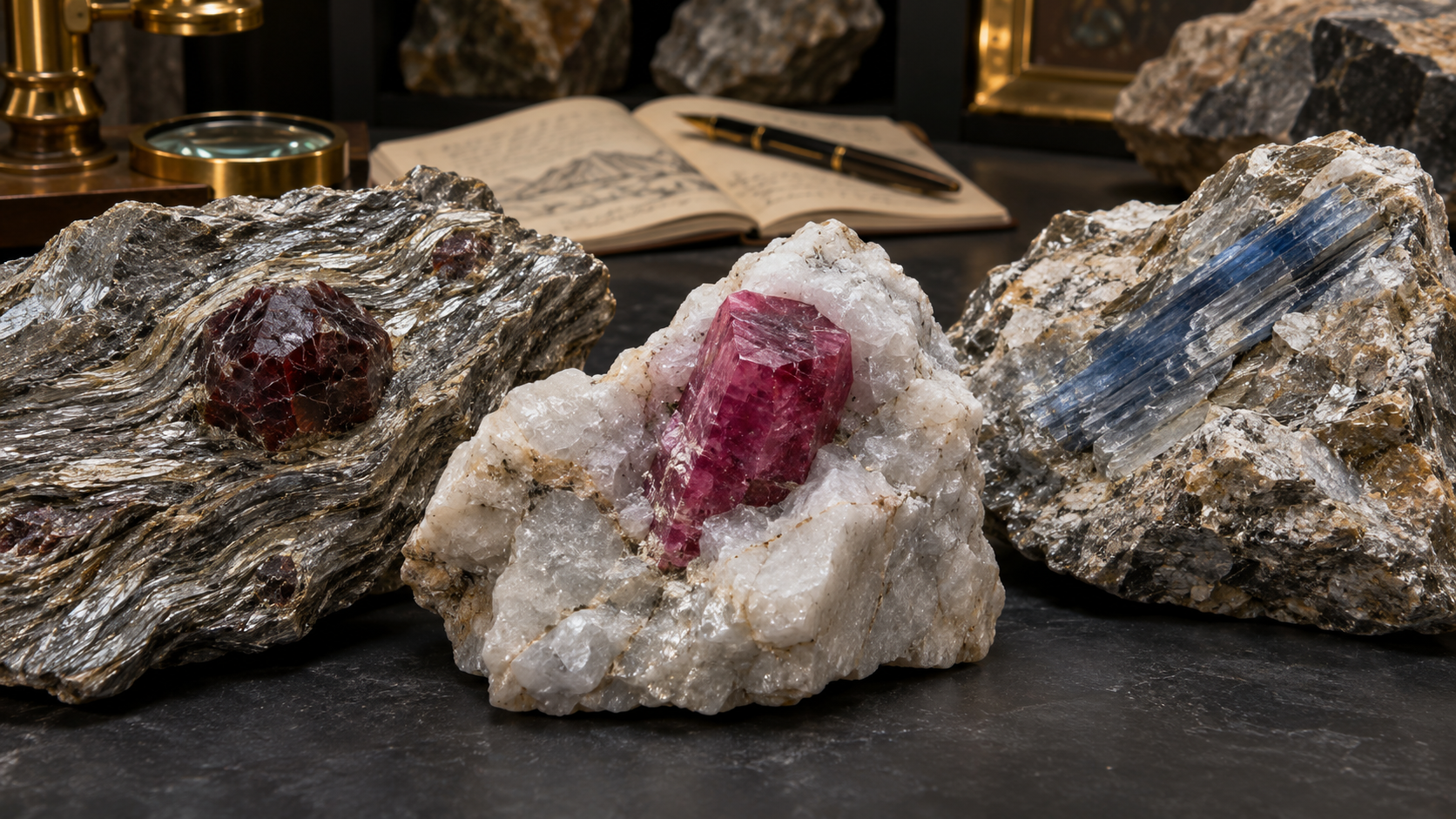
A natural ruby enclosed within white marble and a deep-red garnet embedded in mica schist may appear to have little in common.
Their colours, crystal structures and chemical compositions are different.
Yet both can originate through metamorphism: the mineralogical and structural transformation of existing rocks in response to changing geological conditions.
Metamorphism is often described simply as the effect of heat and pressure. Although both are important, this description is incomplete.
Mineral formation also depends on the original rock composition, chemical reactions, fluid availability, deformation and the duration of geological processes.
A rock does not become gemstone-bearing merely because it is heated or buried deeply.
It must contain, or acquire through chemical exchange, the necessary elements. Those elements must participate in reactions that favour the growth of particular minerals.
Even then, the resulting crystals may be too small, fractured, opaque or included to qualify as gem-quality material.
Understanding metamorphic gemstones therefore requires examining the relationship between geological conditions and mineral chemistry.
This article explores how metamorphism works, why different environments produce different gemstones, how ruby develops in marble and other rocks, and why garnet is one of the most scientifically informative minerals in metamorphic geology.
This article delves into the fascinating topic of gemstone metamorphism, exploring how different geological processes contribute to the formation of gemstones like ruby and garnet.
1. What Is Metamorphism?
Metamorphism is the transformation of a pre-existing rock through changes in mineral assemblage, texture, structure or composition, generally while the rock remains predominantly solid.
The original rock is called the protolith.
A sedimentary, igneous or previously metamorphosed rock can undergo further metamorphism.
For example, limestone can recrystallise into marble.
Mudstone can develop into slate, schist or gneiss under suitable metamorphic conditions.
Mafic igneous rocks may transform into amphibolite or other metamorphic assemblages.
The specific result depends on the protolith and its pressure-temperature-fluid history.
Metamorphism commonly occurs without wholesale melting. When partial melting becomes important, the geological system enters a transitional domain involving both metamorphic and magmatic processes.
2. Why Heat Changes Mineral Assemblages
Minerals are stable only within particular ranges of physical and chemical conditions.
As temperature increases, some mineral assemblages become less stable.
Chemical reactions can produce new minerals better suited to the changed environment.
Temperature also influences reaction rates and diffusion.
At low temperatures, mineral reactions may proceed extremely slowly.
At higher temperatures, atoms and ions can redistribute more readily, allowing new crystals to nucleate and grow.
However, temperature alone does not determine which minerals form.
A rock cannot produce abundant chromium-bearing ruby if the required chemical components are unavailable.
The chemical composition of the rock imposes fundamental constraints.
3. The Role of Pressure
Pressure influences mineral stability, density and the equilibrium relationships between mineral phases.
Increasing pressure can favour denser crystal structures or particular mineral assemblages.
In regional metamorphism, pressure commonly increases as rocks are buried during crustal thickening or subduction.
However, pressure is not simply a force that compresses ordinary minerals into gemstones.
New minerals form through thermodynamically favourable reactions involving available chemical components.
Pressure can change which reactions are possible, but it does not supply missing elements.
This distinction is especially important when explaining the formation of ruby, garnet and other metamorphic gemstones.
4. Lithostatic Pressure and Differential Stress
Two concepts are often confused.
Lithostatic pressure reflects the load imposed by overlying rock and is approximately equal in all directions at a point in an idealised static rock column.
Differential stress occurs when the stresses acting in different directions are unequal.
Differential stress can contribute to deformation, mineral alignment and the development of metamorphic fabrics.
Micas and other platy minerals may become preferentially oriented.
This can produce foliation in schists and gneisses.
However, foliation does not develop in every metamorphic rock.
Its presence depends on mineralogy, deformation and metamorphic history.
A marble containing ruby may remain relatively massive and non-foliated even when it formed during regional metamorphism.
5. Regional Metamorphism
Regional metamorphism affects extensive areas of the Earth’s crust.
It is commonly associated with mountain-building processes, crustal thickening and tectonic convergence.
During continental collision, rocks may be buried, heated, deformed and subsequently uplifted.
Different regions within the same mountain belt can experience different pressure-temperature histories.
Regional metamorphism can produce rocks containing garnet, kyanite, staurolite, sillimanite and other minerals.
Some of these minerals can occur as gem-quality crystals.
However, their presence depends on the chemistry of the original rocks and the conditions reached.
The metamorphic history of a mountain belt can therefore influence the distribution of gemstone deposits.
6. Contact Metamorphism
Contact metamorphism occurs when surrounding rocks are heated by an igneous intrusion.
The affected region is commonly called a metamorphic aureole.
Temperature generally increases toward the intrusion, although the actual thermal structure depends on intrusion geometry, duration, fluid movement and other factors.
Contact metamorphism can cause recrystallisation and the development of new mineral assemblages.
Limestone may recrystallise into marble.
Chemically reactive contacts between igneous intrusions and carbonate rocks can also develop metasomatic mineral assemblages.
Some of these environments are associated with gem-quality garnet and other minerals.
However, contact metamorphism and metasomatism are distinct processes that may operate together.
7. Metamorphic Grade
Metamorphic grade is a broad description of the intensity of metamorphic conditions, particularly temperature.
Low-grade metamorphism generally involves relatively modest temperatures.
Medium- and high-grade metamorphism involve progressively different mineral stability fields.
However, metamorphic grade is not a single universal temperature scale.
Pressure, rock composition and fluid conditions influence the minerals that appear.
A mineral characteristic of one rock composition may be absent from another rock that experienced similar conditions.
Therefore, metamorphic grade is interpreted through mineral assemblages and geological context rather than through the presence of one attractive crystal.
8. Metamorphic Facies
Metamorphic facies are groups of mineral assemblages associated with particular ranges of pressure and temperature.
Examples include greenschist, amphibolite, granulite, blueschist and eclogite facies.
Each facies represents a broad set of conditions rather than one exact temperature or pressure.
A mafic rock metamorphosed under amphibolite-facies conditions may contain amphibole and plagioclase.
Under eclogite-facies conditions, a suitable mafic composition may produce garnet and sodium-rich clinopyroxene.
These assemblages help geologists reconstruct the pressure-temperature evolution of rocks.
Gemstone formation may occur within several metamorphic facies, depending on the mineral species and geological environment.
9. Why the Original Rock Composition Matters
The chemical composition of the protolith strongly influences which minerals can form.
A calcium-rich limestone responds differently to metamorphism than an aluminium-rich mudstone.
A magnesium-rich ultramafic rock can develop mineral assemblages unlike those of a quartz-rich sandstone.
The same temperature and pressure can therefore produce very different minerals in different rocks.
This principle explains why metamorphic gemstone deposits are often associated with specific geological formations.
Ruby formation, for example, requires suitable aluminium availability and conditions that favour corundum stability.
Its red colour also requires an appropriate chromophore, principally chromium.
10. Metamorphic Reactions and Mineral Growth
Metamorphic minerals commonly form through reactions involving existing minerals.
As conditions change, an earlier assemblage may become unstable.
Its components can react to form new phases.
The new minerals may grow at grain boundaries, within existing grains or in regions where chemical components are transported.
Crystal growth can be influenced by nucleation sites, deformation, reaction kinetics and diffusion.
A large metamorphic crystal does not necessarily indicate a single uninterrupted growth episode.
It may contain multiple growth zones or preserve evidence of later alteration.
11. What Is Metasomatism?
Metasomatism is the chemical alteration of rock through interaction with fluids or other mobile phases that transfer material into or out of the rock.
Unlike approximately closed-system metamorphism, metasomatism involves significant chemical exchange.
Fluids can transport elements through fractures, grain boundaries and permeable zones.
This may produce new minerals that could not form from the original bulk-rock composition alone.
Metasomatism is particularly important in some ruby, sapphire, emerald and garnet deposits.
GIA’s geological review of corundum and emerald deposits identifies metamorphic-metasomatic environments as a major category of gem formation.
12. Why Fluid-Rock Interaction Matters
Fluids can affect metamorphism in several ways.
They may transport dissolved chemical components.
They can facilitate mineral reactions.
They may alter the effective chemical activities of components within a rock.
They can also influence deformation and recrystallisation.
However, fluid presence does not guarantee gemstone formation.
The fluid must interact with suitable rock chemistry under conditions favourable to the desired mineral.
In some environments, fluids promote the growth of corundum.
In others, they may favour different aluminium-bearing silicates.
The outcome depends on the complete chemical system.
13. Ruby: A Metamorphic Gemstone
Ruby is the red gem variety of corundum, Al₂O₃.
Its colour is primarily associated with chromium substituting for aluminium in the crystal structure.
Ruby can form in several geological environments.
Important metamorphic settings include marble-hosted deposits and deposits associated with metamorphosed mafic or ultramafic rocks.
The mineral assemblages and formation processes differ between these environments.
Consequently, not all natural rubies share the same geological history.
The distinction between marble-hosted and other metamorphic rubies is particularly important in modern gemmological research.
14. Why Ruby Can Form in Marble
Marble develops through the metamorphism of carbonate-rich rocks, commonly limestone.
Some marble-hosted ruby deposits formed through complex reactions involving aluminium-bearing components, carbonate rocks and chemically active fluids.
The availability of aluminium is essential because corundum consists of aluminium oxide.
Chromium must also be available for the characteristic red colour.
The formation of ruby is favoured where the chemical environment permits corundum stability rather than the formation of competing aluminium-bearing minerals.
This can involve silica-poor conditions and specific fluid-rock reactions.
Therefore, ruby does not form simply because ordinary limestone is heated.
Its formation requires a suitable geological and chemical history.
15. Marble-Hosted Ruby in Myanmar
The Mogok region of Myanmar is internationally important for ruby deposits.
Some of its rubies occur in metamorphosed carbonate rocks.
GIA’s geological research describes marble-hosted ruby formation associated with the Himalayan orogenic system.
For particular studied deposits, estimated formation conditions include temperatures around 620–670°C and pressures of approximately 2.6–3.3 kbar.
These figures represent geological estimates for specific ruby-forming systems, not universal formation conditions for every ruby.
The associated mineral assemblages may include calcite, mica, spinel and other metamorphic minerals.
Their relationships provide evidence about the reactions and fluids involved in ruby formation.
16. Ruby Formation in Mozambique
Mozambique is another major source of natural ruby.
The Montepuez region contains ruby associated with metamorphosed mafic and ultramafic geological environments.
These deposits differ from classic marble-hosted ruby systems.
The host-rock chemistry, associated minerals and geological evolution are not identical.
This helps explain why rubies from different deposits can display different inclusion populations and trace-element characteristics.
However, these characteristics may overlap.
Geographic-origin determination requires laboratory comparison rather than assuming that one feature uniquely identifies a country.
17. Why Chromium Produces Ruby’s Red Colour
Pure corundum is colourless when sufficiently free of colour-producing impurities and defects.
In ruby, chromium ions substitute for some aluminium ions in the crystal structure.
This substitution changes the way the crystal absorbs visible light.
The resulting absorption and fluorescence behaviour contribute to ruby’s red appearance.
However, the exact colour depends on more than chromium concentration alone.
Other trace elements, crystal defects, lighting conditions and the optical properties of the material can influence the observed appearance.
Metamorphic geology controls the availability and incorporation of these elements during growth.
Thus, ruby colour links crystal chemistry with geological formation.
18. Why Some Metamorphic Corundum Is Sapphire
Corundum formed through metamorphic processes is not necessarily ruby.
When the colour is not red, gem-quality corundum is generally classified as sapphire.
Blue sapphire commonly owes its colour to iron- and titanium-related absorption mechanisms.
Other trace elements and defects can produce additional colours.
Metamorphic sapphire deposits occur in several geological environments, including high-grade metamorphic terrains and metasomatically altered rocks.
Sri Lanka, Madagascar and Kashmir provide important examples of metamorphic or metamorphic-metasomatic sapphire associations.
However, sapphire can also have magmatic geological origins.
Colour alone does not establish formation environment.
19. Garnet: A Mineral Group, Not One Mineral
Garnet is a group of minerals sharing a related crystal structure but exhibiting substantial chemical variation.
Important end-member compositions include almandine, pyrope, grossular, spessartine, andradite and uvarovite.
Many natural garnets are solid solutions between end members.
This compositional flexibility makes garnet especially useful in metamorphic petrology.
As pressure, temperature and chemical conditions change, garnet may incorporate different proportions of iron, magnesium, manganese and calcium.
Its composition can therefore preserve evidence of the conditions under which it grew.
20. Garnet Growth in Metamorphic Rocks
Garnet commonly forms during metamorphism of suitable aluminium-bearing rocks.
As metamorphic reactions proceed, garnet crystals may nucleate and grow within the surrounding mineral matrix.
Some develop into relatively large porphyroblasts.
A porphyroblast is a comparatively large metamorphic crystal embedded in a finer-grained rock.
Garnet porphyroblasts may enclose earlier minerals or preserve internal growth zones.
These features can reveal the relationship between crystal growth, deformation and metamorphic reactions.
However, not every garnet porphyroblast is gem-quality.
Transparency, fractures, inclusions, colour and crystal size determine whether a specimen is suitable for cutting.
21. Chemical Zoning in Garnet
Garnet crystals can preserve chemical variations between their cores and rims.
For example, the relative proportions of manganese, iron, magnesium and calcium may change during growth.
These variations are known as compositional zoning.
In some metamorphic garnets, manganese concentration decreases from core to rim.
However, this pattern is not universal.
Different reactions, diffusion processes and metamorphic histories can produce other zoning patterns.
Scientists analyse garnet zoning to investigate changes in pressure, temperature and mineral equilibrium.
The interpretation requires knowledge of the surrounding mineral assemblage and the relevant chemical system.
22. Garnet as a Geological Recorder
Garnet is valuable to geological research because it can preserve growth-related chemical information.
Peer-reviewed studies of garnet porphyroblasts demonstrate how compositional zoning can be used to investigate metamorphic evolution.
However, a garnet’s composition is not always a perfectly preserved record.
Diffusion, deformation, dissolution and later overgrowth can modify earlier zoning.
A crystal may also contain fragments of older garnet incorporated into younger growth.
This means that a single garnet can preserve multiple metamorphic events.
The resulting internal structure may be far more complex than a simple core-to-rim growth sequence.
23. Pressure-Temperature-Time Paths
Metamorphic petrologists often reconstruct pressure-temperature-time paths, commonly abbreviated P–T–t paths.
These describe how a rock’s metamorphic conditions changed through geological time.
A rock may be buried and heated during mountain building.
It may subsequently cool, decompress and return toward the surface.
Mineral assemblages, chemical zoning, textures and geochronological evidence can help reconstruct this history.
Garnet is particularly useful because its growth zones may preserve changes in chemical equilibrium.
However, no single garnet composition automatically provides a complete P–T–t path.
Reliable reconstruction requires integrated petrological and geochronological evidence.
24. Metamorphic Garnet and Gem Quality
A garnet may be scientifically valuable even if it is unsuitable for jewellery.
Some crystals contain numerous inclusions or fractures.
Others are opaque or have colours that are less desirable for faceting.
Gem-quality garnet requires a favourable combination of transparency, colour, size and structural integrity.
These characteristics depend on the local growth environment.
A high metamorphic grade does not automatically produce higher-quality gemstones.
Indeed, deformation or later metamorphic events may damage crystals that formed earlier.
25. Kyanite, Andalusite and Sillimanite
Kyanite, andalusite and sillimanite are three minerals with the same ideal chemical formula, Al₂SiO₅.
They differ in crystal structure.
Their stability fields are strongly influenced by pressure and temperature.
This makes them important minerals in metamorphic petrology.
Kyanite is commonly associated with relatively high-pressure metamorphic conditions.
Andalusite is generally favoured at lower pressures.
Sillimanite is associated with higher-temperature conditions across a range of pressures.
These minerals demonstrate how the same chemical components can produce different crystal structures under different geological conditions.
Gem-quality kyanite and andalusite are commercially relevant, while sillimanite is also occasionally used as a gemstone.
26. Metamorphic Spinel
Spinel, MgAl₂O₄, can occur in metamorphic environments, including some marble-hosted gem deposits.
Its formation depends on suitable magnesium- and aluminium-bearing chemistry.
Chromium-bearing spinel can display red or pink colours.
Other trace elements contribute to additional colour varieties.
Spinel and ruby may occur in related geological environments, but they are different mineral species with different crystal structures.
Their coexistence does not imply identical formation conditions.
Mineral reactions and local chemical composition determine which phases are stable.
27. Skarn Deposits and Gemstone Formation
Skarns are metasomatic rocks commonly formed through fluid-rock interaction involving carbonate rocks and magmatic or other geological fluid sources.
They can contain calcium-, magnesium-, iron- and aluminium-bearing silicate minerals.
Certain skarn environments produce gem-quality garnet, including grossular and andradite varieties.
However, skarn formation is not simply ordinary contact heating.
It involves chemical exchange and mineral replacement.
The resulting mineral assemblages depend on fluid composition, host-rock chemistry and the evolving geological environment.
Skarn deposits therefore illustrate the close relationship between metamorphism and metasomatism.
28. Why Some Metamorphic Gemstones Are Rare
Metamorphic gemstone formation requires several favourable conditions to coincide.
The necessary elements must be present.
Pressure and temperature must favour the appropriate mineral.
Chemical reactions must proceed.
Crystals must have sufficient space and material to grow.
They must avoid excessive deformation, fracturing or later destruction.
Finally, geological uplift and erosion must make the material accessible.
Gem-quality rarity therefore reflects a chain of geological and preservation conditions.
The formation of a mineral species may be common while the formation of transparent, attractively coloured, cuttable crystals remains uncommon.
29. Metamorphism Versus Hydrothermal Gemstone Formation
Metamorphic and hydrothermal processes can overlap.
Metamorphism involves mineralogical and structural transformation of existing rocks.
Hydrothermal mineralisation involves the movement and precipitation of minerals from hot fluids.
In many geological environments, fluids contribute directly to metamorphic reactions.
Metasomatism can link these processes through chemical transfer.
The categories are therefore not always mutually exclusive.
A gemstone deposit may involve metamorphism, fluid-rock interaction and later hydrothermal activity.
A scientifically accurate description should identify the dominant processes rather than forcing every deposit into one oversimplified category.
30. Metamorphism Versus Magmatic Formation
Magmatic gemstones crystallise in association with molten rock or related magmatic processes.
Metamorphic gemstones form through reactions and recrystallisation of existing rocks under changing conditions.
However, the geological boundary can become complex where partial melting, fluid transfer or magmatic intrusions influence metamorphic rocks.
Some gemstone deposits involve several processes during their history.
A crystal may also be transported into a different rock by later geological events.
Therefore, the rock in which a gemstone is recovered does not always represent its original crystallisation environment.
31. How Geologists Identify Metamorphic Gemstone Deposits
Geologists investigate the regional geological setting and the relationships between mineral-bearing rocks.
They examine host-rock composition, structures, mineral assemblages and metamorphic textures.
Thin-section petrography can reveal mineral reactions and inclusion relationships.
Chemical analysis may identify zoning and trace-element distributions.
Geothermobarometry can help constrain formation conditions.
Geochronology may establish the timing of metamorphic events.
However, these methods must be interpreted together.
A gemstone’s appearance alone rarely provides enough evidence to reconstruct its complete geological history.
32. Why Geographic Origin Remains Difficult
Gemstones from different countries can form in geologically similar environments.
Marble-hosted rubies from separate regions may share certain mineralogical characteristics.
Metamorphic sapphires can also display overlapping inclusion and chemical features.
GIA’s geological research emphasises that similar formation environments can produce gemstones with similar gemmological properties.
This creates challenges for geographic-origin determination.
Laboratories therefore rely on reference collections and multiple lines of evidence.
A metamorphic origin does not, by itself, prove a particular country or mining locality.
33. Practical Observation: Recognising Metamorphic Associations
A collector examining a gemstone-bearing rock can document several features.
Host rock: Identify whether the specimen occurs in marble, schist, gneiss or another rock type.
Associated minerals: Record visible mica, calcite, quartz, amphibole, spinel or other minerals.
Crystal habit: Note the external form of the gemstone crystal.
Deformation: Look for foliation, fractures or mineral alignment.
Growth relationships: Observe whether the gemstone encloses surrounding minerals or cuts across existing structures.
Alteration: Record any visible replacement or reaction zones.
These observations can support geological interpretation.
However, a specimen without reliable locality documentation may not permit a definitive reconstruction of its formation environment.
34. Common Misconceptions About Metamorphic Gemstones
Heat and pressure automatically turn ordinary rocks into gemstones.
Incorrect. Suitable chemical composition and mineral reactions are essential.
Every ruby forms in marble.
Incorrect. Ruby also occurs in other metamorphic environments.
Every garnet forms through metamorphism.
Incorrect. Garnet can occur in igneous and other geological settings.
Higher metamorphic grade always produces better gemstones.
Incorrect. Gem quality depends on multiple growth and preservation factors.
Metamorphism always involves melting.
Incorrect. Metamorphism generally occurs predominantly in the solid state.
All metamorphic gemstones have identical inclusion features.
Incorrect. Inclusion populations vary with geology and growth history.
A metamorphic origin proves geographic provenance.
Incorrect. Similar environments exist in different regions.
A gemstone’s host rock always reveals its original formation environment.
Not necessarily. Geological transport and later events may complicate the relationship.
35. Why Metamorphic Gemstones Matter to Modern Gemmology
Metamorphic gemstones connect mineral chemistry with Earth’s tectonic evolution.
Ruby formation can reveal information about aluminium-rich reactions and chromium availability.
Garnet zoning can preserve evidence of changing metamorphic conditions.
Kyanite, andalusite and sillimanite demonstrate the influence of pressure and temperature on mineral stability.
Spinel and skarn garnets illustrate the importance of chemical composition and fluid-rock interaction.
These geological processes influence gemstone colour, inclusions, crystal habit and structural integrity.
Understanding them helps gemmologists interpret natural characteristics without making unsupported claims about origin or quality.
Conclusion: Gemstones Form Through Geological Chemistry, Not Pressure Alone
Metamorphism is one of the most important processes responsible for the formation of natural gemstones.
Existing rocks undergo mineralogical transformation as pressure, temperature, deformation and chemical conditions change.
New minerals develop through reactions involving available elements.
Fluids may accelerate reactions or introduce additional components.
Ruby can form in suitable marble-hosted and other metamorphic environments.
Garnet can preserve chemical zoning that records changes during metamorphic evolution.
Other minerals, including kyanite, andalusite, spinel and certain garnet varieties, demonstrate how geological conditions influence crystal stability and growth.
However, gemstone formation is never guaranteed.
The necessary chemistry, physical conditions, crystal growth environment and later preservation history must all be favourable.
The central scientific principle is:
Metamorphic gemstones form through specific mineral reactions governed by rock chemistry, temperature, pressure and fluid activity – not simply because rocks are subjected to heat and pressure.
For collectors, this provides a deeper understanding of natural mineral specimens.
For lapidaries, it explains why crystals from different geological environments can have different internal structures and cutting characteristics.
For gemmologists, it reinforces the importance of interpreting gemstones within their geological context.
And for Natural Gems Belgium, it supports scientifically accurate descriptions that distinguish observable mineral properties from broader geological interpretations.
References & Further Reading
1. Giuliani, G., & Groat, L. A. (2019) – Geology of Corundum and Emerald Gem Deposits: A Review
Gems & Gemology, 55(4), 464–489.
A major scientific review of magmatic, metamorphic and metamorphic-metasomatic gemstone deposits, including marble-hosted ruby, mafic-ultramafic ruby, sapphire and emerald formation.
https://doi.org/10.5741/GEMS.55.4.464
Full GIA research publication:
https://www.gia.edu/dam/jcr%3Abb44dc5b-9b83-43ae-a551-8c60cea64355/Winter-2019-Gems-Gemology.pdf
2. Gemological Institute of America (2023) – Gems Formed in Metamorphic Rocks
Gems & Gemology, Summer 2023.
An educational scientific review explaining metamorphic gemstone formation, geological environments, ruby-bearing marble and the relationship between tectonic processes and gem deposits.
https://www.gia.edu/gems-gemology/summer-2023-colored-stones-unearthed0
3. Dempster, T. J., et al. (2020) – Growth Zoning of Garnet Porphyroblasts: Grain Boundary and Microtopographic Controls
Journal of Metamorphic Geology, 38(9), 1011–1027.
A peer-reviewed investigation of garnet compositional zoning, mineral equilibrium and the interpretation of metamorphic growth histories.
https://doi.org/10.1111/jmg.12558
4. Decoding the Complex Internal Chemical Structure of Garnet Porphyroblasts from the Zermatt Area, Western Alps (2019)
Journal of Metamorphic Geology.
A scientific study demonstrating how garnet crystals can preserve multiple metamorphic events, older crystal fragments, overgrowths and later modification.
https://doi.org/10.1111/jmg.12506
5. Formation of Multistage Garnet Grains by Fragmentation and Overgrowth Constrained by Microchemical and Microstructural Mapping (2024)
Journal of Metamorphic Geology.
A peer-reviewed study showing how deformation, fragmentation and renewed garnet growth can preserve evidence of multiple geological events.
https://doi.org/10.1111/jmg.12761
6. Geological Society of Glasgow – Metamorphic Rocks
An educational geological reference explaining regional metamorphism, contact metamorphism, foliation, pressure, temperature and the transformation of existing rocks.
Scientific Interpretation and Limitations
Metamorphism generally involves mineralogical and structural transformation predominantly in the solid state.
Mineral formation depends on bulk-rock chemistry, pressure, temperature, fluid activity and reaction kinetics.
Regional metamorphism and contact metamorphism describe different geological settings, although multiple processes can overlap.
Metasomatism involves chemical transfer and may accompany metamorphism.
Ruby formation requires suitable aluminium-bearing chemistry and chromium availability for red colour.
Not all rubies form in marble, and not all garnets form through metamorphism.
Garnet chemical zoning can preserve metamorphic information but may be modified by diffusion, deformation and later growth.
Pressure-temperature estimates apply to specific geological systems and should not be generalised to every gemstone deposit.
Similar metamorphic environments can occur in different geographic regions.
Geological formation environment alone cannot conclusively establish a gemstone’s country of origin.
Gem quality depends on crystal growth and preservation conditions rather than metamorphic grade alone.