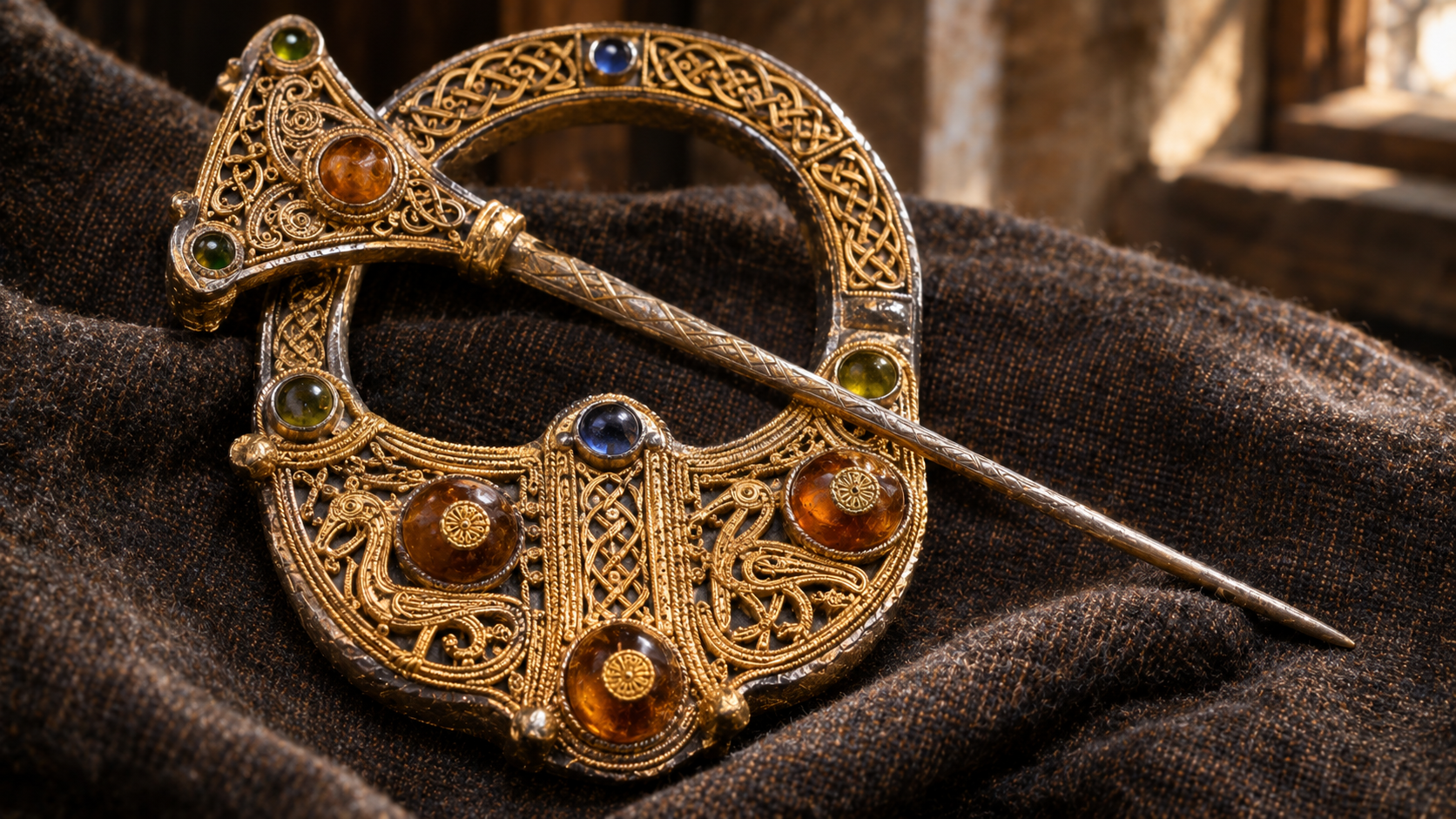
The Tara Brooch rewards two different distances of observation. From farther away, its long pin, curved body and raised ornaments form a striking object of personal display. Seen closely, that outline resolves into fine gold wires, interlaced creatures and coloured settings whose manufacture required several distinct kinds of material knowledge.
Amber and glass are particularly important to this achievement. They supplied contrasting appearances, but their differences also affected how the gold decoration could be attached. The brooch therefore offers more than a catalogue of precious ingredients: it preserves evidence of an artisan adapting construction to the behaviour of individual materials.
Its celebrated name introduces another question. The object was found near Bettystown, not at Tara, and its workmanship does not identify a particular royal owner.
Table of Contents
An Early Medieval Object With a Later Name
The National Museum of Ireland places the Tara Brooch in the eighth century, while Niamh Whitfield’s technical study dates it more specifically to around 700 CE, spanning the late seventh or very early eighth century.
The museum records its discovery near the seashore at Bettystown, County Meath, in 1850. “Tara” consequently describes a later association rather than an excavated findspot.
The distinction matters because an evocative name can quietly become an assumed provenance. A prestigious ornament may have belonged to someone of considerable standing, but its quality alone cannot establish ownership by a king of Tara.
What survives is an exceptional object with an incompletely known biography. Its original wearer and the circumstances of its loss remain separate questions from its date and manufacture.
Ireland’s Wider Artistic Setting
The brooch belongs to a period that the National Museum of Ireland describes as a flourishing of Irish art and craftsmanship from the late seventh to the early ninth century.
This was not an isolated artistic world. The museum’s Treasury interpretation emphasises the interaction of native and external influences, while placing secular ornaments alongside elaborate objects produced for Christian religious use.
The distinction between those settings is important. A richly decorated object from Christian-period Ireland was not necessarily a liturgical implement. The Tara Brooch is presented by the museum as secular metalwork.
Its ornament nevertheless belongs within the broader technical environment that also produced highly accomplished ecclesiastical objects. Different commissions could draw on related repertoires of colour, interlace, metalworking and small-scale assembly.
A Silver Body With Several Decorative Systems
The museum describes the brooch as silver-gilt, with gold filigree, cast animal ornament and settings for amber and glass. Its reverse also carries elaborate cast and inlaid decoration, and the pinhead is worked on both faces.
This makes the object more complex than a silver support decorated only where immediately visible. Examination of both sides reveals different approaches to surface design.
A knitted silver-wire attachment, connected through a hinged animal-head fitting, helped safeguard the brooch when worn. Such practical features remind us that the object was made for use as well as admiration.
Its structural body, applied decoration and coloured elements should therefore be considered together. Their relationship explains more than a list of metals and gems could convey.
Amber Is an Organic Gem Material
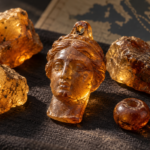
Amber differs fundamentally from quartz, garnet or corundum. It is fossilised plant resin, a product of biological material transformed over geological time, rather than a crystalline mineral with a single fixed chemical formula.
Its familiar yellow-to-orange colours can be accompanied by varying transparency. Small bubbles and other internal features may scatter light, contributing to a cloudy appearance, while clearer areas transmit light more readily.
These properties make amber visually effective in a metal setting. A curved polished surface can combine a bright reflection with a deeper body colour, allowing a small stud to remain conspicuous among surrounding goldwork.
That explanation concerns the material generally. It does not establish the exact botanical source, geological age or internal inclusions of each amber element on the Tara Brooch.
Softness Changes the Engineering Problem
GIA gives amber a Mohs hardness of approximately 2–2.5. This indicates comparatively low resistance to scratching, although hardness alone does not describe every aspect of durability.
In a composite ornament, the practical question is not simply whether a material is “strong.” The maker must consider where it will be supported, how it will be perforated or retained, and what stresses later assembly might introduce.
Amber’s presence therefore required an approach different from working the surrounding metal. It could be shaped and polished, but it could not be treated as another piece of gold.
A successful attachment demonstrates knowledge of the interface between materials. The small junctions are as informative as the visible ornament.
What Microscopic Study Revealed
Whitfield’s 2009 paper draws on microscopic examination and investigations carried out during conservation at the British Museum in 1962–1963.
The gold filigree was made on separate gold-sheet backplates. In recessed compartments, tiny projections of the silver walls – described as “jewellers’ stitches” – held those panels in position.
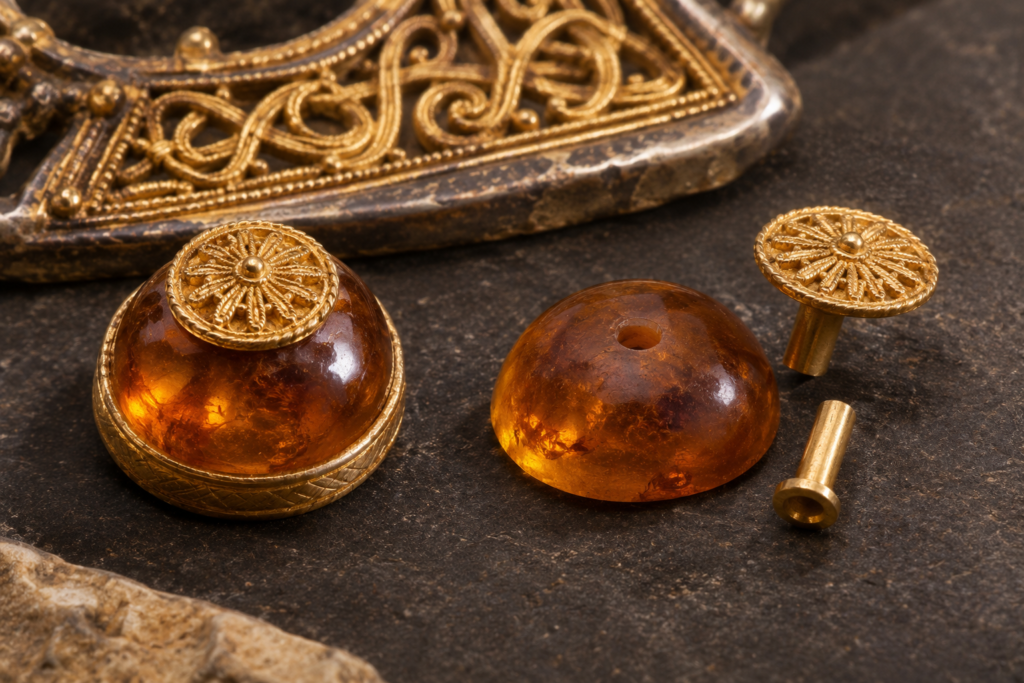
The amber and glass required different solutions. On amber studs, a decorated gold disc was connected to a hollow tube passed through a drilled opening and expanded beneath it, creating a mechanical fastening.
For certain glass studs, examination showed glass overlapping the edge of the gold panel. This supported the interpretation that the decoration had been placed against softened or molten glass and retained as it solidified.
These observations reveal a particularly sophisticated aspect of the brooch: a shared decorative aim was achieved through different joining methods, each suited to its substrate.
Why Glass Was a Skilled Material Choice
Glass is an amorphous material, lacking the long-range crystalline arrangement of minerals such as quartz. Historical glasses commonly consist of a silica-based network modified by other ingredients that affect melting, working behaviour and stability.
This distinction matters when interpreting the brooch’s coloured elements. Glass could be formed and worked through heat in ways that amber could not, while its composition allowed a range of visual effects.
Jennifer Gleeson’s research at Trinity College Dublin places embellished glass studs within a broader tradition of high-status Insular metalwork. The attention devoted to their construction and placement challenges the assumption that glass served only as an inferior replacement for a natural gemstone.
A manufactured material could be valued for the technical skill it embodied and the effects it made possible.
Glass Settings and Enamel Are Related but Distinct
The words “glass” and “enamel” are sometimes used loosely in descriptions of historic ornaments, but they do not necessarily identify the same construction.
A glass stud may be a separately formed element installed in a setting. Enamel generally refers to a vitreous layer fused to a supporting surface, often metal. Both involve glassy materials, yet their relationship to the object can differ.
For the Tara Brooch, it is therefore preferable to follow the documented description of a particular element rather than label every coloured inset “enamel.”
This care with terminology has a wider benefit. Describing how a material is attached can reveal whether the maker treated it as an independent component, a coating or part of a composite ornament.
Filigree as Structure, Texture and Light
Filigree is built from fine metal wires arranged into ornament, often with small granules contributing additional detail. It is not equivalent to an engraved line cut into a solid plate.
The distinction becomes clear when light moves across a worked surface. A raised wire has edges and curvature that reflect light differently from a recessed groove. Twisted or beaded wires introduce further changes in texture.
In an object combining filigree with polished studs, several optical effects coexist: sharp metallic highlights, broader reflections from smooth surfaces and colour seen through translucent material.
The brooch’s visual richness consequently depends on different substances and geometries responding to the same illumination. Its complexity is material as well as iconographic.
What Would Establish the Amber’s Origin?
Amber is frequently associated with the Baltic region, but colour and appearance alone do not prove a Baltic source for an archaeological inset.
Infrared spectroscopy can distinguish resin materials through absorption features related to molecular structure. GIA discusses the characteristic infrared pattern commonly called the “Baltic shoulder,” useful in identifying Baltic-type amber.
Even such an identification would not reconstruct a complete trading journey. The geological type of resin, the place where it was collected and its route to an Irish workshop are different questions.
No object-specific infrared identification of the Tara Brooch’s amber is presented in the sources used here. A general discussion of analytical capability must therefore remain separate from a reported result for the brooch.
Conservation Also Becomes Part of the Evidence
The object’s current condition is not a transparent record of its appearance around 700 CE.
Whitfield’s study distinguishes original attachment features from later materials encountered during conservation. This is important because an adhesive visible today may relate to repair or stabilisation rather than early medieval manufacture.
The same caution applies to missing components. An empty setting can preserve useful construction evidence, but a modern reconstruction of its contents introduces an interpretation.
Historical objects thus acquire material histories of maintenance and investigation. Reading them well requires identifying which features belong to production, wear, damage and later care.
Learning From a Composite Jewel
The Tara Brooch demonstrates why the study of historical jewellery benefits from both close observation and scientific analysis.
Museum documentation establishes its broad date, materials and discovery history. Microscopic research explains particular methods of assembly. Material science clarifies why amber, glass and metal demanded different treatment.
None of these approaches alone names its original wearer or supplies a complete map of its raw-material sources. Together, however, they recover something equally valuable: evidence of practical judgement at a remarkably small scale.
At Natural Gems Belgium, the brooch offers a reminder that gemstone history includes the settings and joins surrounding the material. A polished amber stud becomes more informative when we understand how it was held, decorated and integrated into a working object.
References & Further Reading
National Museum of Ireland. Guide to the National Museum of Ireland – Archaeology.
Museum documentation describing the Tara Brooch’s silver-gilt body, gold filigree, amber and glass settings, decorated reverse and historical name.
https://www.museum.ie/getmedia/1ff925b7-ac50-4adf-9fae-b4ba34225d79/ks_guide_web_en-%281%29.pdf
National Museum of Ireland. “Top 10 Things to See – The Tara Brooch.”
Institutional account recording the discovery near Bettystown in 1850.
https://source.museum.ie/ga-IE/Museums/Archaeology/Visitor-Information/Top-10-Things-to-See-%281%29
National Museum of Ireland. “The Treasury.”
Historical context for the interaction of native and external influences in early medieval Irish craftsmanship.
https://source.museum.ie/en-IE/Museums/Archaeology/Exhibitions/The-Treasury
Whitfield, N. (2009). “‘More like the work of fairies than of human beings’: The filigree on the ‘Tara’ brooch, a masterpiece of late Celtic metalwork.” ArcheoSciences, 33, 235–241.
The principal technical study used here, drawing on microscopy and British Museum conservation investigations. It discusses panel attachment, amber-stud construction and the relationship between glass and applied goldwork.
https://doi.org/10.4000/archeosciences.2257
https://journals.openedition.org/archeosciences/pdf/2257
Gleeson, J. M. (2006). The Significance of Glass Stud Gems in Insular Metalwork, 7th to 9th Century. M.Phil. thesis, Trinity College Dublin.
University research placing decorated glass studs within the technical and artistic context of high-status Insular metalwork.
https://www.tara.tcd.ie/items/19c4fe37-9705-43c1-ad83-6f930bb624d1
Gemological Institute of America. “Amber Description.”
Educational background on amber as an organic gem material and the sources of variation in its appearance.
https://www.gia.edu/amber-description
Gemological Institute of America. “Amber Care and Cleaning Guide.”
Reference information on amber’s low hardness and handling requirements. These general properties are not an object-specific conservation assessment.
https://www.gia.edu/amber-care-cleaning
Gemological Institute of America. “Infrared Spectroscopy and Its Use in Gemology.” Gems & Gemology, Winter 2024.
Research-based explanation of infrared identification, including the characteristic pattern associated with Baltic amber.
https://www.gia.edu/gems-gemology/winter-2024-infrared-spectroscopy
Canadian Conservation Institute. “Caring for Ceramic and Glass Objects — Preventive Conservation Guidelines for Collections.”
Government conservation information explaining glass structure, composition and deterioration.
https://www.canada.ca/en/conservation-institute/services/preventive-conservation/guidelines-collections/ceramics-glass-preventive-conservation.html
Centre for Archaeometry and Archaeological Research, CEZA. “Glass, Glaze and Enamel.”
Archaeometric background explaining glassy materials and their use as coatings and independent objects.
https://ceza.de/english/cezapedia/materials/glass-glaze-and-enamel