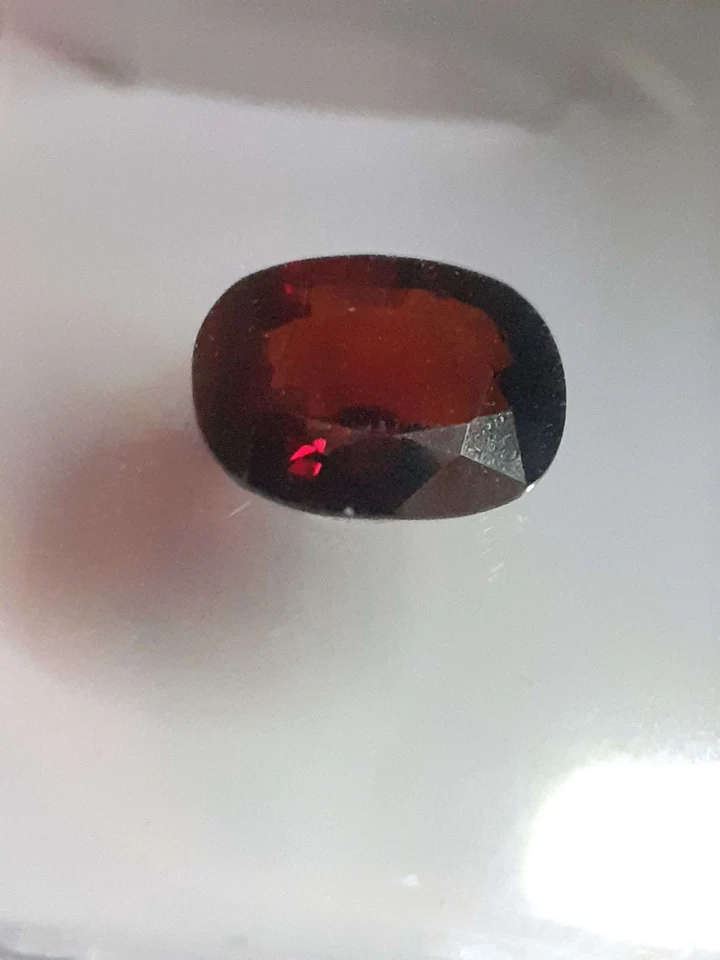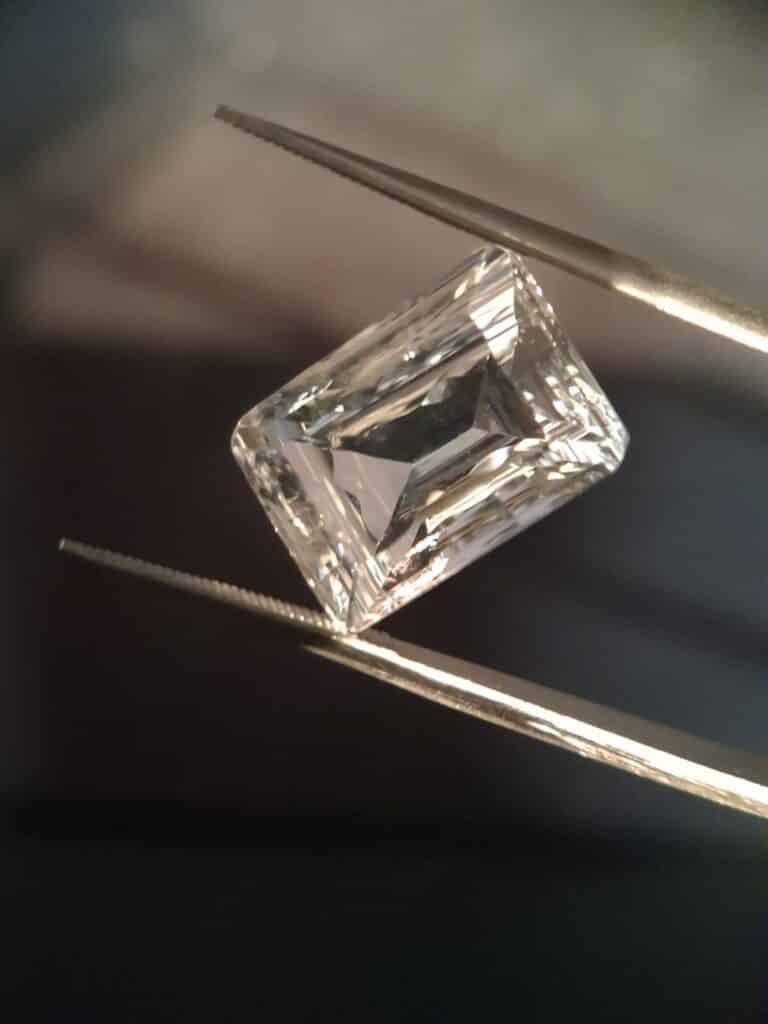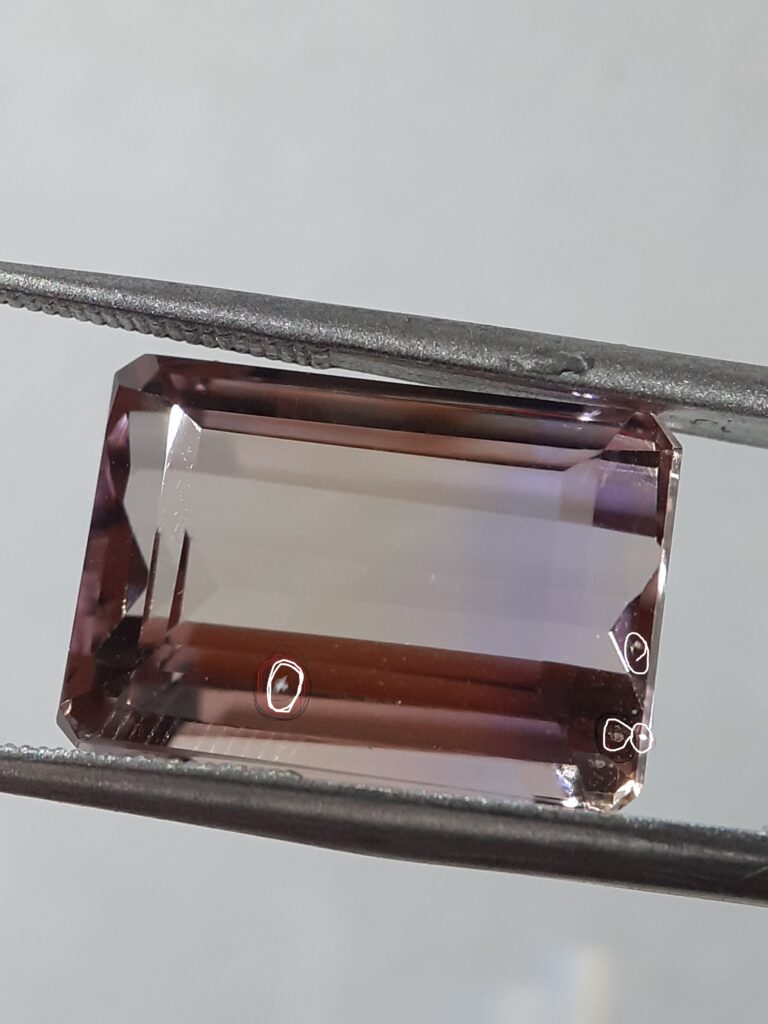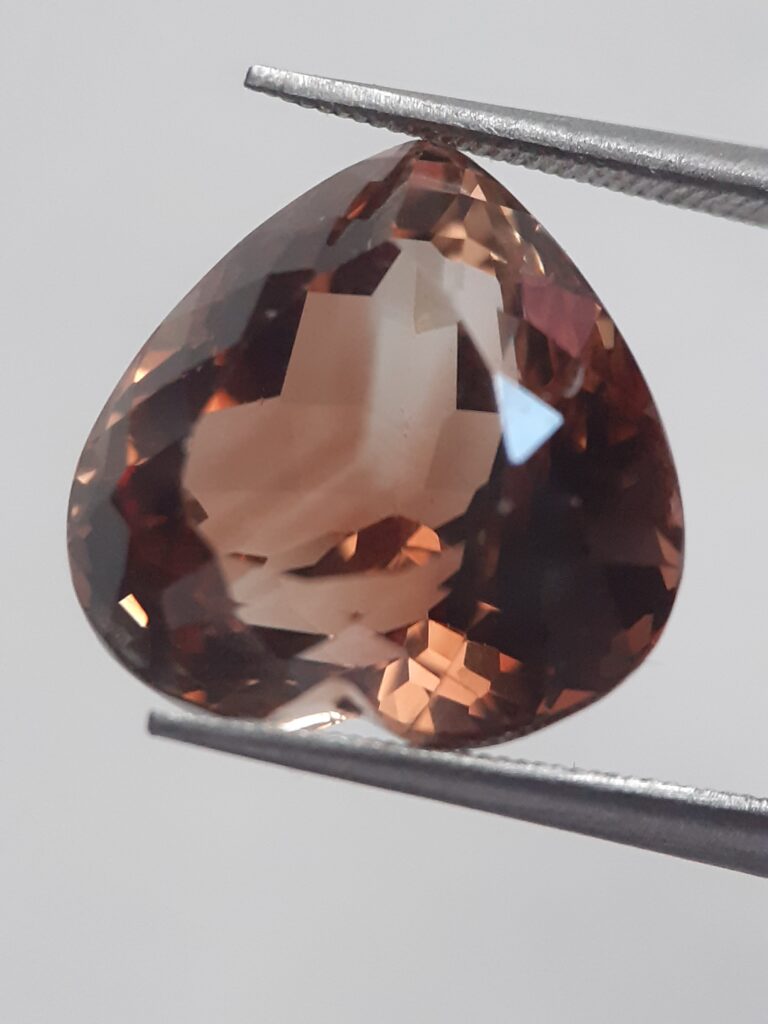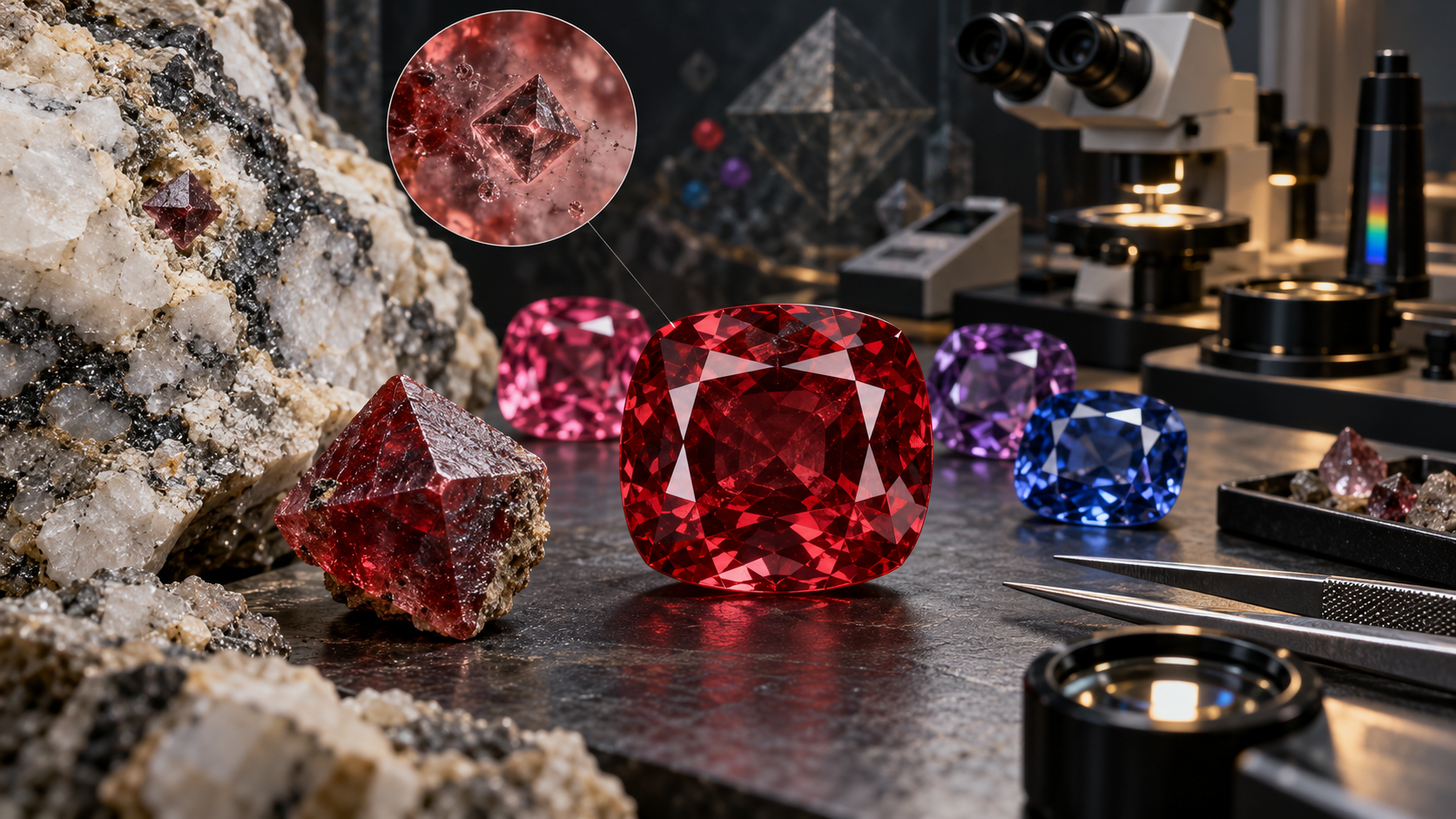
Spinel is a mineral species belonging to the oxide group, with the ideal chemical formula MgAl₂O₄. Its remarkable colour diversity, distinctive cubic crystal structure and complex trace-element chemistry make it one of the most scientifically interesting gemstones encountered in modern gemmology.
For centuries, red spinel was mistaken for ruby. Both gemstones can display exceptional red colour, and both may occur within the same geological environments. However, their mineralogical identities are fundamentally different. Spinel crystallises in the cubic system and is normally singly refractive, whereas ruby belongs to the trigonal corundum structure and is doubly refractive.
Spinel’s colour diversity provides another fascinating subject for investigation. Chromium and vanadium contribute to red, pink and orange varieties, while iron and cobalt are particularly important in blue and violet material. The interactions between these elements can produce complex absorption spectra and provide valuable evidence about the gemstone’s chemical composition.
Its geological formation is equally significant. Many important gem spinels crystallise during high-grade metamorphism of magnesium-rich carbonate rocks. Their internal inclusions, growth structures and trace-element chemistry can preserve evidence of these geological processes.
Professional spinel identification involves considerably more than measuring refractive index and specific gravity. Microscopic examination, absorption spectroscopy, photoluminescence and advanced chemical analysis may be necessary to distinguish natural from synthetic spinel, detect uncommon treatments and investigate geographic origin.
In this Nadia Gemstone Academy guide, we examine spinel from its atomic structure and geological formation to its optical properties, colour mechanisms, microscopic features, treatments, synthetic counterparts and modern laboratory identification.
Table of Contents
Spinel: A Gemmological Reference Guide
Introduction
Spinel is a mineral species belonging to the oxide group, with the ideal chemical formula MgAl₂O₄.
Its exceptional range of colours, characteristic cubic crystal structure and complex trace-element chemistry make it an important subject in both classical and advanced gemmology.
Historically, red spinel was frequently confused with ruby. Both gemstones may possess intense red colour, and both can occur within similar geological environments. Nevertheless, their chemical compositions, crystal structures and optical properties are fundamentally different.
Spinel is particularly important because it demonstrates how mineral identification, spectroscopy, geology and microscopic examination work together to establish gemstone identity.
Mineralogical Classification
Spinel belongs to the spinel group of minerals.
The ideal chemical formula is:
MgAl₂O₄
The structure contains magnesium and aluminium cations coordinated with oxygen.
In the ideal normal spinel structure, Mg²⁺ predominantly occupies tetrahedrally coordinated sites, while Al³⁺ occupies octahedrally coordinated sites.
The distribution of cations can become more complicated when other elements substitute into the structure.
Iron, chromium, vanadium, cobalt and zinc are particularly important because they can influence colour and physical properties.
The spinel group contains several distinct mineral species.
Examples include spinel itself, gahnite and hercynite.
These should not be confused with descriptive colour categories such as red spinel or blue spinel.
Spinel is a mineral species. Red spinel, pink spinel and blue spinel are descriptive colour types rather than separate mineral species.
Crystal Structure
Spinel crystallises in the cubic, or isometric, crystal system.
Its most characteristic natural crystal form is the octahedron.
An ideal octahedral crystal consists of eight triangular faces and resembles two square pyramids joined at their bases.
Spinel can also form modified octahedra and twinned crystals.
One characteristic type of twinning is known as spinel-law twinning.
This can produce flattened crystals that differ considerably in appearance from the familiar octahedral habit.
The crystal structure is directly responsible for one of spinel’s most useful gemmological characteristics: its optical isotropy.
Optical Isotropy
Unlike ruby and sapphire, which belong to the trigonal crystal system, spinel is cubic.
An ideal cubic crystal is optically isotropic.
This means that its refractive behaviour is the same in every crystallographic direction.
Consequently, spinel is normally singly refractive.
It has no ordinary birefringence and does not exhibit true pleochroism.
Under a polariscope, an ideal spinel should remain dark between crossed polarising filters during rotation.
However, some spinels exhibit anomalous double refraction.
This can result from internal strain, structural imperfections or other disturbances of ideal optical isotropy.
Anomalous double refraction does not automatically mean that a stone is doubly refractive in the conventional crystallographic sense.
This distinction is especially important when examining synthetic spinel.
Physical Properties
Spinel has a Mohs hardness of approximately 8.
This makes it highly resistant to scratching and suitable for many forms of jewellery.
Its specific gravity is commonly close to 3.60.
The refractive index of typical gem-quality spinel is approximately 1.718.
However, these values are not absolutely constant.
Chemical substitutions within the spinel structure can modify both refractive index and density.
Some chromium-rich, zinc-bearing or otherwise chemically unusual spinels may exhibit values outside the most commonly quoted reference ranges.
Spinel has no true cleavage.
Its fracture is generally conchoidal to uneven.
The lustre is vitreous to subadamantine.
Transparent gem-quality material is highly desirable, although translucent and opaque spinels also occur.
Why Spinel Has So Many Colours
Ideally pure magnesium aluminium spinel is colourless.
The remarkable colour diversity of natural spinel is caused primarily by transition-metal ions incorporated into its crystal structure.
Important chromophores include:
Chromium
Vanadium
Iron
Cobalt
These elements interact with light through electronic transitions that selectively absorb particular wavelengths.
The resulting colour depends not only on the concentration of each element but also on oxidation state, crystallographic site occupancy and interactions between different chromophores.
Red and Pink Spinel
Chromium is one of the most important colour-causing elements in red and pink spinel.
Cr³⁺ can substitute for Al³⁺ within the crystal structure.
This produces characteristic absorption within the visible spectrum, allowing red light to dominate the transmitted and reflected appearance.
Chromium is also responsible for the strong red fluorescence exhibited by many red and pink spinels.
However, not every red or pink spinel possesses the same chemical composition.
Vanadium and iron can also contribute to the final colour.
The balance between these elements affects hue, saturation and fluorescence.
Orange Spinel and Vanadium
Vanadium is particularly important in certain orange spinels.
A scientific study published in Gems & Gemology in summer 2026 examined red and orange spinel from Mogok in Myanmar and Lang Chap and An Phu in Vietnam.
The researchers found important differences in chromium-to-vanadium ratios.
Within the investigated samples, red spinels were comparatively chromium-rich, whereas orange spinels were comparatively vanadium-rich.
The study reported chromium-to-vanadium ratios of at least 1.7 in its red sample group and ratios of 1.0 or below in the orange group.
These results demonstrate that orange and red spinel colours can reflect measurable differences in trace-element chemistry.
The reported ratios describe the investigated populations and should not be treated as universal classification thresholds for all spinel worldwide.
Blue Spinel
Blue spinel provides another fascinating example of trace-element chemistry.
Iron can produce blue, violet-blue or greyish-blue appearances.
Cobalt can produce particularly saturated blue colours.
In cobalt-bearing spinel, Co²⁺ commonly substitutes for Mg²⁺ within tetrahedral sites.
Cobalt is a powerful chromophore, meaning that relatively small concentrations can create strong visible absorption.
However, the presence of cobalt alone does not guarantee exceptional blue colour.
Iron concentration and other chemical factors can substantially influence the final appearance.
The expression “cobalt-blue spinel” should therefore be understood as a descriptive gemmological term rather than a separate mineral species.
Cobalt-Blue Spinel from Vietnam
The Luc Yen district of northern Vietnam is one of the best-studied sources of vivid blue spinel.
Research published in Gems & Gemology in 2015 examined the geology, chemistry and spectroscopy of this material.
The researchers established that cobalt was the principal chromophore responsible for the unusually saturated blue colour of the studied stones.
Iron also contributed to their absorption behaviour.
The geological investigation identified a high-grade metamorphic environment involving marble and magnesium-rich mineral assemblages.
This provides an important connection between geological formation and trace-element chemistry.
The blue colour is therefore not simply an aesthetic characteristic; it reflects chemical processes that occurred during crystal growth.
Purple and Violet Spinel
Purple spinel can result from combinations of several chromophores.
Chromium, vanadium, iron and cobalt may all contribute, depending upon the specimen.
Research on purple spinel from Vietnam and Afghanistan has demonstrated that visually related purple colours can arise from substantially different chemical combinations.
A saturated Vietnamese specimen was influenced strongly by chromium and cobalt.
An Afghan specimen exhibited a different chemical profile dominated by iron-related colour mechanisms.
This illustrates an essential gemmological principle:
Similar colour does not necessarily imply similar chemistry or geological origin.
Geological Formation
Many important gem spinels form during high-grade metamorphism.
Magnesium-rich carbonate rocks provide particularly favourable geological environments.
Original sedimentary rocks such as dolomitic limestone can undergo extensive recrystallisation when subjected to elevated temperatures and pressures.
During metamorphism, reactions involving magnesium, aluminium and other chemical components may produce spinel.
The presence of appropriate bulk-rock chemistry is essential.
Aluminium availability, silica activity, fluid composition and temperature all influence which minerals crystallise.
Spinel may form alongside minerals such as calcite, dolomite, forsterite, phlogopite and amphiboles.
Different deposits can contain different mineral assemblages.
Therefore, there is no single universal spinel-forming reaction applicable to every gemstone locality.
Spinel in Marble
Marble-hosted spinel is particularly important in Southeast Asia.
High-grade metamorphism transforms carbonate rocks into crystalline marble.
Under appropriate chemical conditions, spinel may crystallise within the marble or within associated reaction zones.
Many historically important red and pink spinels originate from such environments.
Myanmar and Vietnam contain major examples.
The geological history of these regions includes substantial tectonic deformation and metamorphism related to continental collisions.
Spinel and the Himalayan Orogeny
The Himalayan mountain-building system influenced a broad region extending far beyond the present Himalayan mountain chain.
Collision-related deformation and metamorphism affected parts of Central and Southeast Asia.
These processes contributed to the development or modification of several important gemstone-bearing geological provinces.
Spinel deposits in Myanmar, Vietnam and the Pamir region reflect different aspects of these complex tectonic histories.
However, their individual formation histories are not identical.
The presence of spinel in all three regions does not mean that the same metamorphic conditions or fluid compositions were involved.
Myanmar — Mogok
The Mogok region of Myanmar is one of the world’s historically important gemstone-producing districts.
It is particularly associated with ruby, sapphire and spinel.
Spinel occurs in marble and associated metamorphic environments.
The regional geology includes marble, gneiss, schist, calc-silicate rocks and various igneous intrusions.
Gem spinel may contain mineral inclusions that reflect these geological environments.
Documented inclusions and associated minerals include apatite, calcite, dolomite, graphite, phlogopite, zircon, titanite and other species.
The precise assemblage varies between individual stones and deposits.
Mogok is also important for modern geographic-origin research.
Vietnam — Luc Yen
Luc Yen in northern Vietnam produces spinel in several colours.
Red, pink, purple and blue material are all associated with the region.
The geological environment is dominated by metamorphic rocks, including marble and associated calc-silicate assemblages.
Important primary blue-spinel occurrences are associated with magnesium-rich mineral lenses containing forsterite and amphiboles.
Weathering can subsequently release spinel crystals into secondary deposits.
These gravels may contain several different gemstones.
Luc Yen is especially important because scientific studies have documented relationships between spinel colour, trace-element chemistry and geological environment.
Tajikistan — Kuh-i-Lal
The Kuh-i-Lal region in the Pamir Mountains is historically associated with pink and red spinel.
The deposits occur within high-grade metamorphic rocks.
Spinel is associated with magnesium-rich skarn environments and forsterite-bearing lenses.
Scientific investigations have examined the trace-element chemistry and spectroscopic behaviour of this material.
The resulting data demonstrate that chromium, vanadium and iron can contribute to the colour of individual stones.
Kuh-i-Lal is also important in the history of gemstones formerly described as Balas rubies.
Afghanistan
Afghanistan contains important spinel occurrences, particularly in the Badakhshan region.
The geological environment includes metamorphosed carbonate rocks and associated mineral assemblages.
Research on purple spinel from Afghanistan has demonstrated chemical differences from visually similar Vietnamese material.
This is particularly relevant to geographic-origin determination.
Tanzania
Tanzania is an important modern source of spinel.
The Mahenge region is especially associated with vivid pink and red material.
Other Tanzanian deposits produce additional colours, including blue and purple.
The geological settings are related to metamorphic terrains, although individual deposits can differ substantially.
Sri Lanka
Sri Lanka has produced spinel for centuries.
Much material is recovered from secondary gem gravels derived from weathered metamorphic rocks.
Sri Lankan spinel occurs in several colours and may be found alongside corundum and other gem minerals.
The association of visually similar red spinel and ruby in secondary deposits contributed historically to confusion between the two mineral species.
Other Sources
Spinel also occurs in Pakistan, Madagascar, Malawi and other regions.
Not every occurrence produces transparent material suitable for faceting.
The broader mineral species is considerably more widespread than the relatively limited number of deposits producing fine-quality transparent gemstones.
Historical Confusion with Ruby
Spinel has one of the most fascinating identification histories in gemmology.
For centuries, transparent red gemstones were frequently classified by appearance rather than by mineral species.
Ruby and red spinel were therefore often grouped together.
The historical term “Balas ruby” was used for certain red and pink spinels associated with Central Asian sources.
Several famous royal gemstones traditionally described as rubies were eventually identified as spinel.
The Black Prince’s Ruby
One of the most famous examples is the Black Prince’s Ruby.
Despite its traditional name, this historic red gemstone is spinel.
It is mounted in the British Imperial State Crown.
Its historical association with royalty extends back to the fourteenth century.
The stone demonstrates how gemstone nomenclature developed long before modern mineralogical classification.
The Timur Ruby
The Timur Ruby is another famous historical gemstone that is actually spinel.
Its historical importance is reflected in inscriptions and its association with royal collections.
Like the Black Prince’s Ruby, it illustrates the limitations of historical gemstone identification based primarily on colour.
Scientific Separation of Spinel and Ruby
The distinction between spinel and ruby became scientifically established during the development of crystallography.
In 1783, Jean-Baptiste Louis Romé de l’Isle distinguished the minerals through their crystal forms.
Modern gemmology provides several additional methods.
Ruby belongs to the corundum species and has the chemical formula Al₂O₃.
Spinel is MgAl₂O₄.
Ruby is trigonal and optically uniaxial negative.
Spinel is cubic and normally singly refractive.
Their refractive indices and specific gravities also differ significantly.
These differences allow a gemmologist to separate the minerals without relying on colour.
Refractive Index
A typical refractive index for gem spinel is approximately:
1.718
However, natural spinel is chemically variable.
Values can extend beyond the most commonly quoted reference figure.
Chromium, iron, zinc and other substitutions can influence refractive index.
Research published in 2026 documented refractive indices between 1.710 and 1.728 in a studied population of red and orange spinel from Myanmar and Vietnam.
A refractive-index measurement should therefore be interpreted within an appropriate mineralogical context.
Specific Gravity
The commonly quoted specific gravity of spinel is approximately:
3.60
Natural gem-quality material frequently lies near this value.
However, chemical composition can cause measurable variation.
Specific gravity is particularly useful when distinguishing spinel from visually similar gemstones.
Ruby generally has a significantly higher specific gravity, close to 4.00.
The combination of RI and SG is therefore an effective classical identification method.
Birefringence and Pleochroism
Ideal spinel has no birefringence.
Because the crystal is isotropic, there is no ordinary separation into two refracted rays.
Consequently, spinel does not display true pleochroism.
This is fundamentally different from ruby, sapphire and many tourmalines.
Some natural and synthetic spinels may nevertheless show anomalous double refraction under crossed polarisers.
Such observations must be interpreted carefully.
Strong anomalous double refraction can occur in certain synthetic spinels, but it is not independently conclusive evidence of synthetic origin.
Absorption Spectroscopy
Spinel can display highly informative absorption spectra.
The spectrum depends strongly on the chromophores present.
Chromium-bearing red spinel exhibits characteristic Cr-related absorption.
Vanadium can modify the spectrum and contribute to orange or reddish colours.
Cobalt-bearing blue spinel displays distinctive absorption associated with Co²⁺.
Iron can contribute additional absorption in blue, purple and grey material.
A 2026 study of red and orange spinel documented absorption features near 390 nm and 534–540 nm in its investigated samples.
The precise position, intensity and shape of absorption features vary with composition.
Therefore, spectral interpretation should not be reduced to a single universal wavelength.
Fluorescence
Many chromium-rich red and pink spinels exhibit red fluorescence under ultraviolet radiation.
The intensity can be considerable.
Chromium-related photoluminescence is also scientifically important for treatment detection.
Blue, purple and iron-rich spinels may display different fluorescence behaviour.
The presence or absence of fluorescence must therefore be interpreted in relation to colour chemistry.
Fluorescence alone cannot establish natural origin or geographic provenance.
Microscopic Identification
Microscopic examination is central to professional spinel identification.
Natural spinel may contain:
Octahedral negative crystals
Mineral crystal inclusions
Fluid inclusions
Healed fissures
Growth structures
Twinning planes
Particulate clouds
Metal sulphides
Locality-specific mineral assemblages
The presence of well-developed octahedral negative crystals is particularly interesting because these cavities can reflect the crystallographic symmetry of the host mineral.
Some cavities contain fluids or solid inclusions.
However, the presence of an octahedral inclusion is not automatically proof of natural origin.
The entire inclusion scene must be evaluated.
Mineral Inclusions
Mineral inclusions in spinel can provide evidence about its geological environment.
Possible inclusions include apatite, calcite, dolomite, graphite, phlogopite, amphiboles and other minerals.
Their occurrence varies between deposits.
Some inclusion assemblages may support a particular geological interpretation.
However, many minerals occur in several different spinel-producing regions.
Consequently, one inclusion should not be treated as definitive evidence of geographic origin.
Spinel as an Inclusion in Spinel
An unusual but documented microscopic feature is a spinel crystal enclosed within another spinel crystal.
Because both crystals can possess nearly identical refractive indices, the enclosed crystal may have very low optical relief.
It can therefore be difficult to observe under ordinary illumination.
Polarised lighting may reveal its outline.
This illustrates the importance of using different illumination techniques during microscopic examination.
Asterism
Asterism is uncommon in spinel but has been documented.
Appropriately oriented needle-like or plate-like inclusions can reflect light in intersecting directions.
When the material is fashioned as a suitable cabochon, this may produce a star effect.
The phenomenon depends on inclusion orientation, distribution and cutting geometry.
It should not be assumed to occur in ordinary transparent faceted spinel.
Heat Treatment
Spinel is generally much less frequently heat treated than ruby or sapphire.
Nevertheless, heat treatment is documented.
Heating can modify colour or clarity in some material.
In certain cases, microscopic evidence may be subtle or absent.
Professional laboratories can use photoluminescence spectroscopy to investigate treatment.
Chromium-related emission features may change after heating.
Changes can include broadening and shifts in characteristic emission peaks.
These observations require comparison with appropriate reference spectra and should not be interpreted without considering natural compositional variation.
Scientific Evidence of Heated Spinel
A laboratory report published in Gems & Gemology in summer 2026 documented a natural purplish-red spinel exhibiting evidence of heat treatment.
The stone had initially been submitted as ruby.
Classical gemmological testing established that it was spinel.
Microscopic examination revealed altered crystal inclusions, discoidal fractures and foreign material within surface-reaching cavities.
Photoluminescence spectroscopy provided additional evidence of heating.
Raman spectroscopy helped identify glassy filling material.
The case demonstrates that even treatments considered uncommon for a gemstone species must remain part of professional laboratory investigation.
Fracture Filling
Fracture filling may be used to reduce the visibility of surface-reaching fractures.
The filling material changes the optical contrast between the fracture and surrounding gemstone.
Possible microscopic evidence includes differences in lustre, gas bubbles, unusual textures or foreign material within fissures.
Raman spectroscopy and other analytical methods may assist in identifying the filler.
The presence of filling should be disclosed because it can affect durability and cleaning recommendations.
Synthetic Spinel
Synthetic spinel has been produced commercially for many decades.
Because laboratory-grown spinel can possess essentially the same fundamental crystal structure and chemical composition as natural spinel, classical RI and SG measurements alone may not establish natural origin.
Two important synthetic-growth methods are flame fusion and flux growth.
The resulting materials can have different microscopic and chemical characteristics.
Flame-Fusion Synthetic Spinel
Flame-fusion spinel is widely encountered.
Some material exhibits curved growth structures, gas bubbles or strong anomalous double refraction.
Certain flame-fusion synthetic spinels have chemical compositions that deviate from ideal stoichiometric MgAl₂O₄.
This can influence refractive index and optical behaviour.
However, not every flame-fusion synthetic spinel displays all of these features.
Identification should be based on a combination of observations.
Flux-Grown Synthetic Spinel
Flux-grown synthetic spinel can be more difficult to identify.
Possible features include flux residues, metallic inclusions and characteristic growth structures.
Some synthetic stones may lack obvious diagnostic inclusions.
Research has demonstrated that trace-element chemistry can be valuable for separating certain natural and synthetic spinel populations.
For example, differences in zinc and other trace elements have been documented between natural spinel and some flux-grown synthetic materials.
Advanced chemical analysis may therefore be necessary when microscopic evidence is inconclusive.
Spinel Versus Ruby
The most important distinction is mineralogical.
Spinel:
MgAl₂O₄
Cubic crystal system
Singly refractive
Typical RI approximately 1.718
Typical SG approximately 3.60
Mohs hardness 8
Ruby:
Al₂O₃
Trigonal crystal system
Uniaxial negative
Typical RI approximately 1.762–1.770
Typical SG approximately 4.00
Mohs hardness 9
Although both may be coloured by chromium and may exhibit red fluorescence, their fundamental physical properties are clearly different.
Other Imitations and Look-Alikes
Spinel may resemble garnet, tourmaline, sapphire and various manufactured materials.
Some garnets are also singly refractive.
Consequently, single refraction alone does not establish spinel identity.
The gemmologist must consider RI, SG, absorption spectrum, inclusions and other diagnostic evidence.
Synthetic spinel has also historically been used to imitate other gemstones.
This creates an important distinction between a synthetic counterpart of natural spinel and a synthetic material used as a simulant for another gem species.
Geographic Origin Determination
Geographic origin is a separate question from mineral identification.
A laboratory may establish that a stone is natural spinel without being able to determine its geographic origin conclusively.
Modern origin investigation can combine:
Microscopic inclusion analysis
UV-Vis-NIR spectroscopy
Photoluminescence spectroscopy
Trace-element chemistry
EPMA
LA-ICP-MS
Reference samples of documented provenance
A particularly relevant 2026 study compared red and orange spinel from Myanmar and Vietnam.
The researchers identified useful chemical relationships involving titanium, zinc, chromium and vanadium.
Certain plots helped separate specific red-spinel populations.
However, other sample groups overlapped.
This demonstrates that geographic-origin determination remains probabilistic and evidence-dependent rather than a simple identification from one chemical element.
Durability and Jewellery Use
Spinel has a Mohs hardness of 8.
Its lack of true cleavage and generally good toughness make it suitable for many jewellery applications.
However, hardness is not equivalent to resistance against all forms of damage.
A gemstone can still chip or fracture under sufficiently strong impact.
Existing fractures can reduce practical durability.
Fracture-filled material may require additional precautions.
Cleaning and Care
Warm water, mild soap and a soft brush are generally suitable for cleaning spinel.
Ultrasonic and steam cleaning may be appropriate for some intact stones, but fractures and filling materials can create risks.
Where treatment status is uncertain, conservative cleaning is preferable.
High temperatures should also be avoided because some spinel colours can be modified by heating.
Jewellery repair involving heat should therefore be approached cautiously.
Why Spinel Matters to Modern Gemmology
Spinel demonstrates several fundamental principles of gemstone science.
Its history illustrates why visual appearance alone cannot establish mineral identity.
Its cubic crystal structure explains its isotropic optical behaviour.
Its trace-element chemistry demonstrates how chromium, vanadium, iron and cobalt can produce dramatically different colours.
Its geological occurrence reveals the importance of metamorphism, fluid interaction and host-rock chemistry.
Its inclusions preserve evidence of crystal growth.
Its spectroscopy provides information about colour mechanisms and possible treatment.
Its synthetic counterparts demonstrate why classical physical constants alone cannot always establish natural origin.
Finally, modern origin research shows that geographic provenance must be investigated through carefully interpreted evidence rather than assumed from colour or isolated inclusions.
Spinel is therefore much more than a historical alternative to ruby.
It is a scientifically important mineral whose structure, chemistry and geological history make it an exceptional subject for professional gemmological investigation.
References & Further Reading
1. Gemological Institute of America — Spinel Gem Encyclopedia
General mineralogical properties, colour, history, identification and gemmological characteristics.
2. Gemological Institute of America — Spinel Description
Crystal structure, octahedral morphology, twinning, optical behaviour and colour.
https://www.gia.edu/spinel-description
3. Aksorn, B. et al. — Characterization of Red and Orange Spinel from Myanmar and Vietnam
Gems & Gemology, Summer 2026.
Peer-reviewed investigation of trace-element chemistry, colour mechanisms, spectroscopy and geographic-origin differentiation.
https://www.gia.edu/gems-gemology/summer-2026-spinel-from-myanmar-and-vietnam
4. Gemological Institute of America — Heat-Treated Red Spinel
Gems & Gemology, Summer 2026.
Laboratory investigation documenting natural spinel with heat-treatment evidence and glassy filling material.
https://www.gia.edu/gems-gemology/summer-2026-lab-notes-heat-treated-spinel
5. Chauviré, B. et al. — Blue Spinel from the Luc Yen District of Vietnam
Gems & Gemology, Spring 2015.
Scientific study of cobalt-related colour, trace-element chemistry, geological formation and gemmological characteristics.
https://www.gia.edu/gems-gemology/spring-2015-blue-spinel-luc-yen-district-vietnam
6. Belley, P. M. & Palke, A. C. — Purple Gem Spinel from Vietnam and Afghanistan
Gems & Gemology, Fall 2021.
Comparative research on trace elements, absorption spectra, colour mechanisms and mineral inclusions.
https://www.gia.edu/gems-gemology/fall-2021-purple-gem-spinel-vietnam-afghanistan
7. Renfro, N. et al. — Micro-Features of Spinel
Gems & Gemology, Spring 2021.
Scientific photomicrographic reference covering natural, treated and synthetic spinel inclusions.
https://www.gia.edu/gems-gemology/spring-2021-visual-guide-to-micro-features-of-spinel
8. Muhlmeister, S. et al. — Flux-Grown Synthetic Red and Blue Spinels from Russia
Gems & Gemology, Summer 1993.
Research on synthetic spinel identification, inclusions, spectroscopy and trace-element chemistry.
https://www.gia.edu/gems-gemology/summer-1993-synthetic-spinel-russia-muhlmeister
9. Gemological Institute of America — Spinel History and Lore
Historical identification, Balas ruby, the Black Prince’s Ruby and the Timur Ruby.
https://www.gia.edu/gia-website/spinel-history-lore
10. Gemological Institute of America — Spinel Care and Cleaning Guide
Scientific guidance concerning hardness, durability, cleaning, heat stability and fracture-filled material.
https://www.gia.edu/spinel-care-cleaning
11. Gem-A — Understanding Spinel: A Gemstone with Brilliance and Vibrancy
Educational discussion of crystal morphology, optical properties, colour and gemmological identification.
https://gem-a.com/gem-hub/understanding-spinel-a-gemstone-with-brilliance-and-vibrancy
12. Liu, Y. et al. — Color Mechanism and Spectroscopic Thermal Variation of Pink Spinel Reportedly from Kuh-i-Lal, Tajikistan
Gems & Gemology, Fall 2022.
Scientific investigation of spinel colour chemistry, photoluminescence, heat-related spectral changes and geological context.
https://www.gia.edu/gems-gemology/fall-2022-pink-spinel-from-tajikistan