

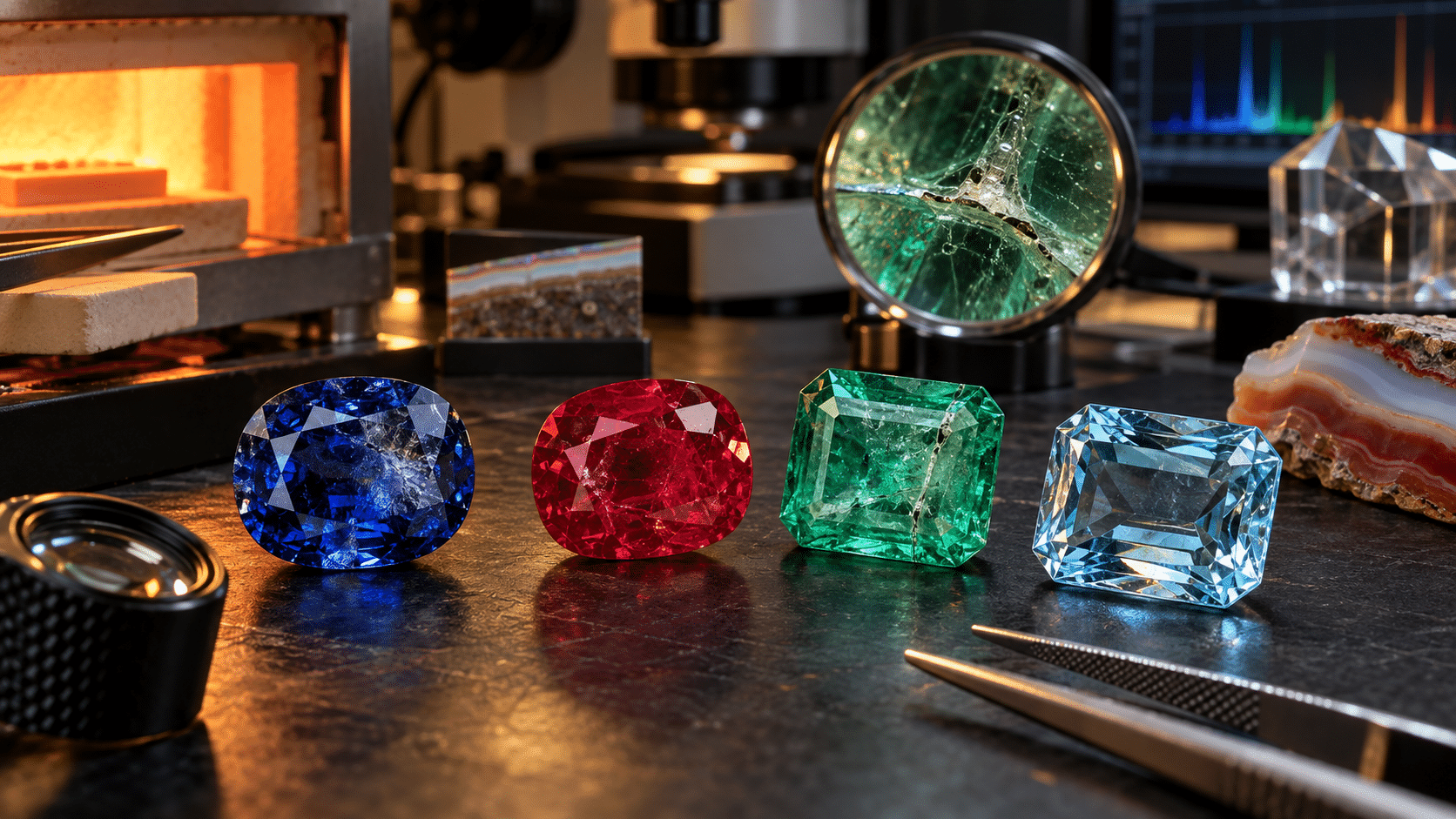
A natural gemstone is not necessarily an untreated gemstone.
This distinction is one of the most important concepts for anyone who wants to understand, collect or purchase coloured gemstones responsibly.
For centuries, people have developed techniques to modify the appearance of gem materials. Today, treatments can alter colour, improve apparent clarity, reduce the visibility of fractures or modify the surface appearance of a gemstone.
Some treatments are long-established and widely encountered in the gem trade. Others can dramatically alter the appearance, durability, rarity perception or commercial value of a stone.
The central question is therefore not simply whether a gemstone has been treated.
The more useful questions are: What treatment has been applied? How has it affected the gemstone? Is the treatment stable? Does it create special care requirements? Can it be detected? And has it been properly disclosed?
Watch Episode 1 — Understanding Gemstone Treatments
In the first episode of the Natural Gems Belgium Gemmology Series, Marnick Elskens, Founder of Natural Gems Belgium, introduces the principal gemstone treatments encountered in the trade and explains why the distinction between natural and untreated matters.
The video provides the practical introduction. The sections below examine the science behind these treatments in greater depth.
Table of Contents
Natural Does Not Mean Untreated
The terms natural and untreated describe different properties.
A natural gemstone originates through geological processes rather than being manufactured as a synthetic counterpart. Treatment occurs after the gem material has formed and been recovered.
A natural sapphire that has subsequently undergone heat treatment therefore remains natural in origin, but it is no longer untreated.
Likewise, an emerald containing a clarity-enhancing substance in surface-reaching fissures may still be a natural emerald. The filling does not convert the underlying beryl crystal into a synthetic material.
This distinction is fundamental because origin and treatment history are separate gemmological questions.
A complete description of a gemstone may therefore require information about both.
Why Are Gemstones Treated?
Gemstone treatments are generally intended to alter properties that influence visual appearance or commercial usability.
Depending on the material and process, treatment may:
- modify colour;
- improve colour uniformity;
- improve apparent clarity;
- reduce the visibility of fractures;
- alter transparency;
- modify surface appearance;
- or improve the visual marketability of material that might otherwise be less desirable.
The physical mechanism differs substantially from one treatment to another.
Heating can alter defects, inclusions or colour-producing mechanisms within a crystal. Filling introduces another substance into openings in the gemstone. Dyeing introduces artificial colour. Coating adds material to the surface.
For this reason, the word treated should never be interpreted as if it represented one single process.
Heat Treatment
Heating is among the oldest and most important gemstone treatments.
Ruby and sapphire—both varieties of the mineral corundum—are particularly important examples.
The colour of corundum is related to trace elements and interactions within its crystal structure. Heating under controlled conditions can modify colour-producing mechanisms and may alter certain inclusions or internal characteristics.
Depending on the starting material and heating conditions, the process can improve colour, change colour distribution or alter apparent clarity.
Heat treatment does not make a natural sapphire synthetic.
The crystal itself formed naturally. Its appearance has subsequently been modified through human intervention.
This distinction explains why two sapphires with similar visible quality may have substantially different rarity and market positions if one has credible evidence of being unheated while the other has undergone heating.
Treatment status should therefore be considered together with colour, clarity, cut, carat weight, provenance when reliably established, laboratory documentation and overall quality.
Emerald Oiling and Clarity Enhancement
Emerald is a variety of beryl whose geological formation commonly produces inclusions and fractures.
Some of these fractures reach the surface of the fashioned gemstone.
When a transparent or near-transparent liquid is introduced into a surface-reaching fissure, the optical contrast between the fracture and surrounding emerald can be reduced. The fracture becomes less visually prominent even though the fracture itself has not disappeared.
Traditionally, colourless oils have been associated with this practice, although other filling substances may also be encountered.
The extent and nature of clarity enhancement matter.
A minimally enhanced emerald and an emerald containing extensive filling should not automatically be regarded as equivalent simply because both contain natural emerald.
The filler can also influence care requirements.
Heat, chemicals, ultrasonic cleaning or other aggressive cleaning methods may affect filled fractures or the substances within them. Emerald therefore deserves particularly careful handling.
Fracture Filling
Fracture filling extends beyond emerald.
A surface-reaching fracture can create strong optical contrast because the refractive properties of air inside the opening differ greatly from those of the host gemstone.
Introducing another material into that fracture can reduce this contrast, making the fracture substantially less visible.
Depending on the gemstone and treatment, oils, resins, polymers or glass-like substances may be encountered.
Glass-filled ruby demonstrates how significant the visual effect can become.
Highly fractured corundum can be treated with glass-rich filling material that occupies fractures and cavities, substantially improving apparent transparency and visual continuity.
The resulting product still contains natural corundum, but the filling can be an important component of its apparent appearance.
This has implications for identification, value, durability, repair and cleaning.
Consequently, the nature of the treatment should be clearly disclosed rather than hidden behind the unqualified name of the gemstone.
Dyeing
Dyeing introduces artificial colouring material into a gemstone.
The process is particularly effective in porous materials or materials containing fractures and other pathways through which a colouring substance can penetrate.
Agate and other forms of chalcedony provide familiar examples.
Natural chalcedony can occur in relatively subdued colours, while dyed material can display intense colours that would be unusual or absent in comparable untreated material.
Dyeing has also been applied to numerous other gem materials.
Detection can sometimes involve examination of colour concentrations, particularly where dye accumulates within fractures, pores or structural boundaries. However, visual inspection alone should not always be considered conclusive.
The important commercial distinction is straightforward: the underlying material may be natural, while the observed colour has been artificially modified.
Irradiation
Ionising radiation can interact with defects and colour centres within a crystal and thereby alter the way the material absorbs visible light.
This can produce a different perceived colour.
Blue topaz is one of the best-known commercial examples. Irradiation, often followed by heating, can transform suitable topaz into commercially familiar blue colours.
Irradiation is also encountered in other gem materials.
The scientific mechanisms involved depend on the mineral and its defect chemistry, so irradiation should not be treated as one universal colour-producing reaction.
It is also important to distinguish the treatment history of a gemstone from assumptions about its condition as a consumer product. Commercially released irradiated gems are subject to applicable regulatory controls, and the mere term irradiated gemstone should not be sensationalised into the idea of a dangerously glowing stone.
From the buyer’s perspective, the relevant issue is that the colour has been artificially modified and should be described accordingly.
Surface Coatings
Not every treatment modifies the interior of a gemstone.
A coating adds material to part or all of its surface to alter colour, lustre, interference effects or general appearance.
Because the treatment is located at the surface, its durability can be very different from a modification occurring throughout the body of a gemstone.
Abrasion, repolishing, chemicals or inappropriate cleaning can damage certain coatings.
Magnification may reveal evidence such as worn facet edges, scratches, uneven colour concentrations or differences around damaged areas, but sophisticated coatings may require specialist examination.
For the buyer, disclosure is particularly important because the visible appearance may depend partly on a layer that is not an intrinsic property of the underlying gemstone.
Treatment Stability and Gemstone Care
Treatment is not merely a question of terminology.
It can affect how a gemstone should be worn, cleaned, repaired and stored.
A stable heat treatment in corundum presents very different practical considerations from an oil-filled emerald, a glass-filled ruby or a surface-coated gemstone.
For example, fracture-filled emeralds can require cautious cleaning because heat, chemicals or ultrasonic treatment may affect the filling material or already fractured gemstone.
This is why responsible treatment disclosure should include relevant care information where necessary.
Knowing the treatment allows the owner to protect the gemstone appropriately.
Can Treatments Be Detected?
Some treatments produce characteristic evidence visible under magnification.
Others are considerably more difficult to determine.
A gemmological microscope may reveal altered inclusions, filled fractures, colour concentrations, coating damage or other diagnostic features.
But modern gemstone treatment detection can extend far beyond conventional microscopy.
Professional laboratories may use combinations of techniques including:
- optical microscopy;
- ultraviolet-visible-near-infrared spectroscopy;
- infrared spectroscopy;
- Raman spectroscopy;
- fluorescence analysis;
- chemical analysis;
- and other advanced analytical methods.
The appropriate method depends on the gemstone and the suspected treatment.
Equally important, gemmologists must recognise the limits of testing. Not every treatment in every material can necessarily be established conclusively using routine examination.
Treated Does Not Mean Synthetic
A treated gemstone and a synthetic gemstone are fundamentally different concepts.
A treated natural gemstone began as naturally formed gem material and was subsequently modified.
A synthetic gemstone is produced artificially but has essentially the same chemical composition, crystal structure and corresponding physical properties as its natural counterpart.
A simulant is different again: it resembles another gemstone visually but does not necessarily share its composition or crystal structure.
These categories should never be used interchangeably.
For example:
Natural heated sapphire — naturally formed corundum subsequently heated.
Unheated natural sapphire — naturally formed corundum with no detected heat treatment.
Synthetic sapphire — artificially produced corundum.
Blue glass imitating sapphire — a simulant rather than sapphire.
Precise terminology prevents fundamentally different products from being presented as equivalent.
Does Untreated Automatically Mean Better?
Not necessarily.
Untreated status can contribute significantly to rarity and value in certain gemstones, particularly when exceptional quality is combined with credible laboratory evidence.
But treatment status is only one component of gemstone evaluation.
A poorly coloured, badly cut untreated gemstone is not automatically more beautiful than an exceptional heated example.
Conversely, two visually similar gemstones can have very different rarity and market values because one possesses an unusual combination of natural colour and untreated status.
Evaluation therefore requires context.
Colour, clarity, cut, carat weight, optical performance, durability, rarity, treatment status and overall appeal should be considered together.
Why Disclosure Matters
The fundamental issue surrounding gemstone treatment is transparency.
Treatment can affect value. Some treatments can influence durability. Others require specific care. Certain treatments can substantially change the appearance of relatively inexpensive starting material.
International jewellery-sector standards therefore place considerable emphasis on treatment disclosure.
For the buyer, this makes a few questions particularly valuable:
Is the gemstone natural?
Has it been treated?
What treatment has been applied?
Is the treatment stable?
Does the gemstone require special care?
Has an independent gemmological laboratory examined it where the value warrants such testing?
A professional seller should be prepared to answer these questions as accurately as the available evidence permits.
A Scientific Approach to Natural Gemstones
Gemstone treatments demonstrate why gemmology extends far beyond simply recognising attractive minerals.
A gemstone carries two histories.
The first is its geological history: crystallisation, chemical composition, inclusions, deformation and the geological environment in which it formed.
The second may be its post-recovery history: cutting, polishing and, where applicable, treatment.
Understanding both allows a gemstone to be described more accurately.
Treatment should therefore not automatically be regarded as something negative.
Nor should it be ignored.
It is information.
And in professional gemmology, accurate information is fundamental to meaningful identification, evaluation and consumer trust.
References & Further Reading
Gemological Institute of America (GIA) — An Introduction to Gem Treatments
Comprehensive overview of commonly encountered gemstone treatments, including heating, irradiation, dyeing, fracture filling, impregnation and surface coating.
https://www.gia.edu/gem-treatment
Gemological Institute of America (GIA) — What treatments does GIA test for?
Overview of treatment testing performed by GIA for diamonds, coloured gemstones and pearls.
https://www.gia.edu/FAQ/gia-faq-analysis-grading-treatment-test
Gemological Institute of America (GIA) — Emerald Care and Cleaning Guide
Practical information on emerald durability, fracture filling and appropriate care of clarity-enhanced emeralds.
https://www.gia.edu/emerald-care-cleaning
CIBJO — The World Jewellery Confederation — The Blue Books
International jewellery and gemstone industry standards and nomenclature resources, including the CIBJO Gemstone Blue Book.
https://cibjo.org/the-blue-books/
CIBJO — Industry Standards & Resources
Current access point for CIBJO gemstone, laboratory, responsible sourcing and retailer guidance.
https://cibjo.org/industry-standards-resources/
CIBJO — Responsible Sourcing Guidance: Product Integrity
Guidance concerning accurate representation, treatment disclosure and product integrity throughout the jewellery and gemstone supply chain.
https://cibjo.org/rstoolkit/rsg-step-7/
CIBJO — Do’s & Don’ts Guide
Practical trade guidance designed to support transparent descriptions of diamonds, coloured gemstones, pearls, corals and related products.
https://cibjo.org/dos-donts-guide/
Federal Trade Commission — In the Loupe: Advertising Diamond, Gemstones and Pearls
Consumer-protection guidance explaining circumstances in which gemstone treatments should be disclosed, particularly where treatments affect permanence, care requirements or value.
https://www.ftc.gov/business-guidance/resources/loupe-advertising-diamond-gemstones-pearls
[…] Opal can undergo several forms of treatment. […]