Table of Contents
When a Precious Gemstone Was Both Admired and Feared
A magnificent blue sapphire can inspire admiration through its colour alone.
Its deep blue appearance may evoke the evening sky, distant mountains or the extraordinary intensity of a clear tropical sea.
For centuries, sapphires have been incorporated into jewellery associated with wealth, authority and personal distinction.
Yet in certain South Asian astrological traditions, blue sapphire occupies a more complicated position.
It is not simply a beautiful gemstone.
It is associated with Shani, the planetary deity connected with Saturn.
Within these traditions, Shani can represent difficult experiences, responsibility and the consequences of human actions.
Consequently, blue sapphire has sometimes been regarded as a gemstone requiring particular consideration before being worn.
This belief contrasts sharply with the modern commercial presentation of sapphire as an almost universally beneficial stone of wisdom, serenity and protection.
The historical tradition is considerably more nuanced.
Some practitioners have considered blue sapphire potentially challenging when worn individually.
Others have incorporated it into navaratna, a nine-gem arrangement intended to represent the complete system of planetary influences.
The same natural gemstone could therefore participate in apparently contrasting interpretations.
The history of blue sapphire and Shani demonstrates that gemstone symbolism is not an intrinsic property of a mineral. It develops through religious traditions, cultural relationships and systems of interpretation.
Understanding these distinctions reveals a fascinating relationship between natural gemstones and South Asian intellectual history.
The Cultural World of Indian Planetary Gemstones
The Indian subcontinent possesses an exceptionally rich history of gemstone appreciation.
Precious stones have been used in jewellery, religious objects, royal ornaments and personal adornment for many centuries.
Their significance has not always been limited to appearance or economic value.
Within certain Hindu traditions, gemstones have also been associated with celestial bodies and divine beings.
These associations form part of a wider intellectual and religious environment that includes astronomy, astrology, mythology and ritual practice.
One important tradition is known as jyotisha.
The Sanskrit term is associated with the study and interpretation of celestial phenomena.
Historically, jyotisha developed through multiple strands of scholarship and practice.
Some concerned astronomical calculation and calendrical systems.
Others concerned the interpretation of celestial configurations in relation to human life.
These different activities should not be treated as scientifically equivalent.
Astronomical observation can produce testable measurements.
Astrological claims concerning destiny or the supernatural influence of gemstones require separate scientific evaluation.
What Is Shani?
Shani is a deity associated with the planet Saturn in Hindu religious and astrological traditions.
The name is also rendered as Śani.
Another traditional designation is Shanaishchara.
Within the planetary system known as the navagraha, Shani represents Saturn.
The Metropolitan Museum of Art identifies Shani as a deity associated with Saturn, Saturday and blue sapphire.
The deity’s character is complex.
Shani is frequently associated with difficulty, restraint and the consequences of human actions.
Some religious interpretations emphasise hardship and misfortune.
Others place greater emphasis on discipline, responsibility and the moral consequences of conduct.
These interpretations vary across texts, regions and communities.
It would therefore be misleading to describe Shani simply as an evil deity.
Within many religious understandings, difficult experiences are interpreted as part of a wider moral or spiritual order.
Saturn and the Meaning of Time
The association between Shani and Saturn is particularly interesting.
Saturn moves slowly across the night sky when observed against the background stars.
Its apparent motion was recognised by ancient astronomical traditions.
Within Indian astrology, the planet became associated with prolonged processes and difficult periods.
The symbolic relationship between slow movement and extended experience is understandable within the cultural framework.
However, the astronomical movement of Saturn and its proposed influence upon human destiny are different subjects.
The planet’s position can be calculated scientifically.
Its gravitational influence can be measured.
But there is no established scientific evidence that Saturn’s astrological position determines an individual’s personality, financial circumstances or future experiences.
The traditional symbolism remains historically and religiously significant without being scientifically verified.
Why Is Blue Sapphire Associated with Shani?
Blue sapphire is traditionally associated with Saturn within the nine-gem system.
The gemstone is commonly called neelam or nilam in several South Asian languages.
In contemporary Indian gemstone astrology, the expression often refers specifically to blue sapphire.
The association between sapphire and Saturn is documented in museum research.
The Metropolitan Museum explains that blue sapphires could be considered inauspicious when worn individually within certain Hindu traditions.
This interpretation reflects the gemstone’s relationship with Shani.
However, it should not be presented as a universal Hindu belief.
Hinduism encompasses many religious communities, philosophical traditions and regional practices.
Not every Hindu individual participates in gemstone astrology.
And those who do may interpret the relationship between a gemstone and its associated planet differently.
The Paradox of Blue Sapphire
One of the most revealing aspects of this tradition is that blue sapphire could be both desirable and potentially feared.
As a natural gemstone, sapphire possesses qualities that have made it highly valued.
Its hardness is exceptional.
Its colour can be extraordinarily attractive.
Fine specimens may possess excellent transparency and brilliance.
Yet within certain astrological interpretations, its association with Shani could introduce caution.
The concern was not necessarily that sapphire was physically dangerous.
Rather, the gemstone was understood as participating in a relationship with a potentially challenging planetary influence.
This illustrates the difference between material value and religious interpretation.
A gemstone could be expensive, beautiful and technically excellent while still possessing an ambiguous symbolic reputation.
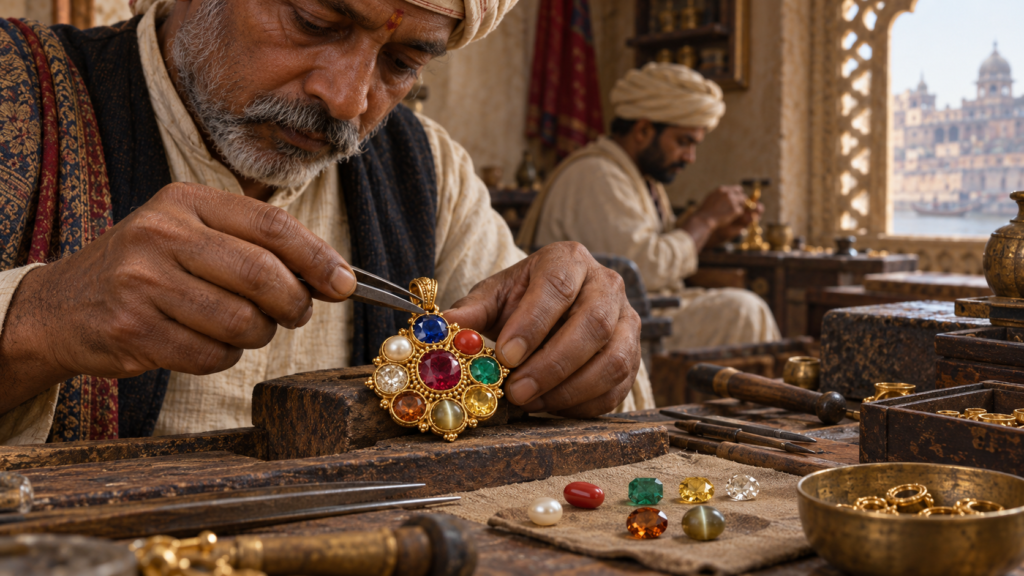
The Navagraha: Nine Celestial Influences
The wider system surrounding Shani is known as the navagraha.
The Sanskrit expression is commonly translated as nine celestial influences or nine planetary entities.
These include the Sun, Moon, Mars, Mercury, Jupiter, Venus and Saturn.
Two additional entities are Rahu and Ketu.
Rahu and Ketu are associated with the lunar nodes.
They are not physical planets.
The lunar nodes are the points where the Moon’s orbital plane intersects the plane of Earth’s orbit around the Sun.
They are important in the geometry of eclipses.
Within Indian astrology, however, they also possess symbolic and religious significance.
This distinction is essential.
The nine grahas do not correspond to nine physical planets in modern astronomy.
They belong to a historical celestial classification system with its own intellectual and religious development.
From Celestial Bodies to Gemstones
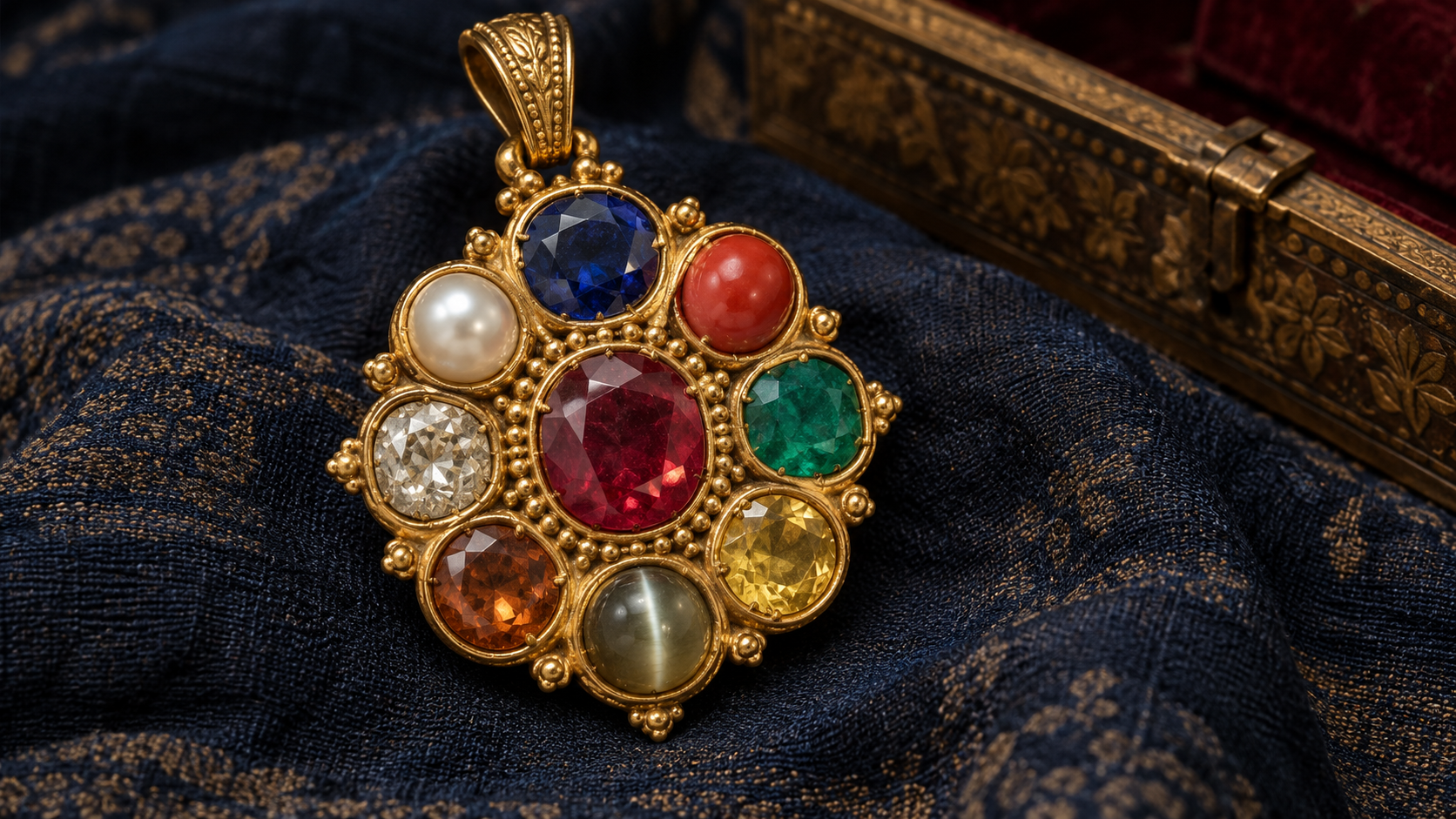
Within the navaratna tradition, particular gemstones correspond to the nine grahas.
The Gemological Institute of America documents the conventional associations.
Ruby represents the Sun.
Pearl represents the Moon.
Red coral represents Mars.
Emerald represents Mercury.
Yellow sapphire, or sometimes topaz, represents Jupiter.
Diamond represents Venus.
Blue sapphire represents Saturn.
Hessonite garnet represents Rahu.
Cat’s-eye chrysoberyl represents Ketu.
These correspondences are important to the historical tradition.
However, the precise gem materials used in surviving jewellery may vary.
Museum collections demonstrate that actual objects do not always follow a completely uniform arrangement.
Substitutions and additional stones occur.
This variation is important when interpreting historical jewellery.
What Is Navaratna?
The Sanskrit word navaratna means nine gems or nine jewels.
Within the gemstone tradition, the term refers to jewellery incorporating stones associated with the nine celestial influences.
The arrangement can appear in pendants, rings, bracelets and other ornaments.
The Metropolitan Museum identifies navaratna as one of the most important forms of talismanic jewellery produced in India.
The individual gemstones represent different planetary relationships.
When assembled together, they are traditionally understood as forming a complete symbolic system.
The intended significance concerns balance or harmony among the celestial influences.
This is a religious and astrological interpretation.
It does not establish that the gemstones physically alter planetary forces.
Why Is Ruby Usually Placed at the Centre?
Traditional navaratna arrangements commonly position ruby at the centre.
Ruby represents the Sun.
The surrounding gemstones represent the remaining grahas.
This arrangement creates a miniature symbolic representation of the celestial system.
The central ruby is therefore more than a decorative focal point.
Its position communicates the Sun’s importance within the traditional scheme.
However, this should not be interpreted as a precise scientific model of the modern solar system.
The navagraha system includes the Moon and lunar nodes.
It does not correspond directly to modern planetary classification.
The arrangement belongs to the symbolic language of Indian astrology.
Blue Sapphire Within the Nine-Gem Arrangement
Blue sapphire occupies the position associated with Saturn.
Its presence completes one part of the traditional nine-gem system.
This creates an interesting contrast with beliefs concerning sapphire worn individually.
Within some interpretations, a single blue sapphire may be approached cautiously because of its association with Shani.
Within navaratna jewellery, the same gemstone participates in an arrangement intended to harmonise the complete set of celestial influences.
The symbolism therefore depends on context.
The stone itself does not change.
Its chemical composition remains the same.
Its optical properties remain the same.
What changes is its relationship with the other gemstones and the meaning assigned to the complete object.
A Historical Navaratna Bracelet from Northern India
The Metropolitan Museum of Art preserves a remarkable nineteenth-century bracelet from northern India.
The object belongs to a pair.
It is made from gold and enamel and incorporates numerous gemstones.
The museum identifies it as a navaratna talismanic bracelet.
Its stones include sapphires, diamonds, emeralds, garnets, turquoise, agate, coral, pearls and topaz.
Interestingly, the bracelet contains ten gemstones rather than a strict group of nine.
The museum describes this as a variation of the traditional arrangement.
This detail is particularly important.
It demonstrates that historical jewellery did not always follow an inflexible formula.
The surviving object provides direct material evidence of how planetary gemstone symbolism could be adapted through craftsmanship.
The Meaning of Talismanic Jewellery
A talisman is an object believed to possess beneficial or protective significance.
In the case of navaratna jewellery, the intended effects were associated with planetary relationships.
The Gemological Institute of America documents traditional beliefs that the nine-gem arrangement could protect the wearer from harmful planetary influences.
The jewellery was also associated with aspirations concerning health, prosperity and wisdom.
These are historically documented beliefs.
They should not be presented as medically or scientifically established effects.
The existence of a talisman demonstrates that people attributed particular powers to an object.
It does not demonstrate that those powers operated through a measurable supernatural mechanism.
The Philadelphia Navaratna Pendant
Another particularly revealing object is preserved by the Philadelphia Museum of Art.
The museum identifies it as a navaratna pendant dating to the eighteenth century, with alterations made during the nineteenth century.
The object demonstrates the relationship between gemstone arrangement and planetary symbolism.
However, it also reveals the complexity of historical modification.
The museum explains that the ruby probably originally occupying the central position was removed.
It was replaced with an emerald bearing a Persian inscription.
This alteration is significant.
It shows that a jewellery object could acquire a new configuration during its history.
Its original symbolic arrangement was not necessarily preserved unchanged.
The object also demonstrates why museum documentation and provenance are essential.
A surviving gemstone arrangement may reflect several historical phases rather than one original design.
Gemstone Traditions Across Religious Communities
Although navaratna has important connections with Hindu religious and astrological traditions, its history is not restricted to one community.
The Gemological Institute of America documents its adoption within Muslim cultural environments in South Asia.
This does not mean that Islamic theology and Hindu planetary worship became identical.
Rather, gemstone traditions could circulate across social and religious boundaries.
Jewellery designs, craftsmanship and ideas about precious materials moved through complex networks of exchange.
Individual patrons might appreciate the beauty, prestige or talismanic associations of particular objects.
Their reasons for wearing them were not necessarily identical.
The history of Indian gemstone jewellery therefore reflects cultural interaction as well as religious distinction.
The Historical Development of Planetary Gemstone Beliefs
The relationship between gemstones and celestial influences developed over a long period.
The Metropolitan Museum discusses an early Indian gemological text known as Ratnapariksha.
Its research identifies traditions connecting gemstones with deities, celestial bodies and days of the week.
However, the precise chronology of individual gemstone correspondences requires careful historical study.
Not every modern astrological prescription can be traced directly to an ancient text.
The familiar navaratna arrangement developed through a complex history.
The Gemological Institute of America suggests that the established nine-gem talismanic tradition may have emerged around the tenth century.
This should be understood as an approximate historical interpretation rather than a universally agreed date.
The surviving jewellery provides particularly valuable evidence for later periods.
Gemstones as Material Expressions of Cosmic Order
One of the most interesting aspects of navaratna jewellery is its attempt to represent a complete celestial system within a small object.
A pendant may contain only a few centimetres of precious material.
Yet its arrangement can symbolically encompass the Sun, Moon, planets and lunar nodes.
Each gemstone possesses a distinct natural appearance.
Ruby is red.
Emerald is green.
Blue sapphire is blue.
Diamond may be colourless.
Pearl possesses an organic lustre.
Together, these materials create a visually diverse composition.
Within the religious framework, their arrangement communicates relationships extending beyond the physical object.
This is a powerful example of how jewellery can function as a miniature symbolic representation of the universe.
The Maharaja of Nawanagar and His Extraordinary Sapphire
One of the most fascinating historical examples discussed by the Metropolitan Museum concerns a magnificent sapphire ornament associated with Maharaja Shri Kumar Ranjitsinhji of Nawanagar.
Ranjitsinhji ruled Nawanagar during the early twentieth century.
He was also internationally known as a cricketer.
A spectacular ornament associated with him contains a sapphire weighing approximately 109.5 carats.
The piece dates to around 1920.
The Metropolitan Museum notes that the presence of such a prominent sapphire is interesting in light of the gemstone’s potentially challenging astrological associations.
The museum suggests that Ranjitsinhji’s connection with cricket may provide one possible explanation.
He played for Sussex, whose colours were blue and white.
However, this interpretation remains speculative.
The historical object is documented.
The precise personal motivation for wearing it is not established.
Why This Sapphire Matters
The Nawanagar sapphire illustrates the danger of assuming that every historical wearer followed a rigid astrological rule.
A gemstone might be selected for several reasons.
Its beauty could be important.
Its rarity might communicate prestige.
Its colour might possess personal significance.
Its association with a particular institution could influence its use.
Its astrological symbolism might also be relevant.
These motivations could overlap.
Without direct evidence from the wearer, the precise balance cannot always be reconstructed.
The object therefore reminds us that historical gemstone symbolism was not necessarily uniform.
What Is Natural Blue Sapphire?
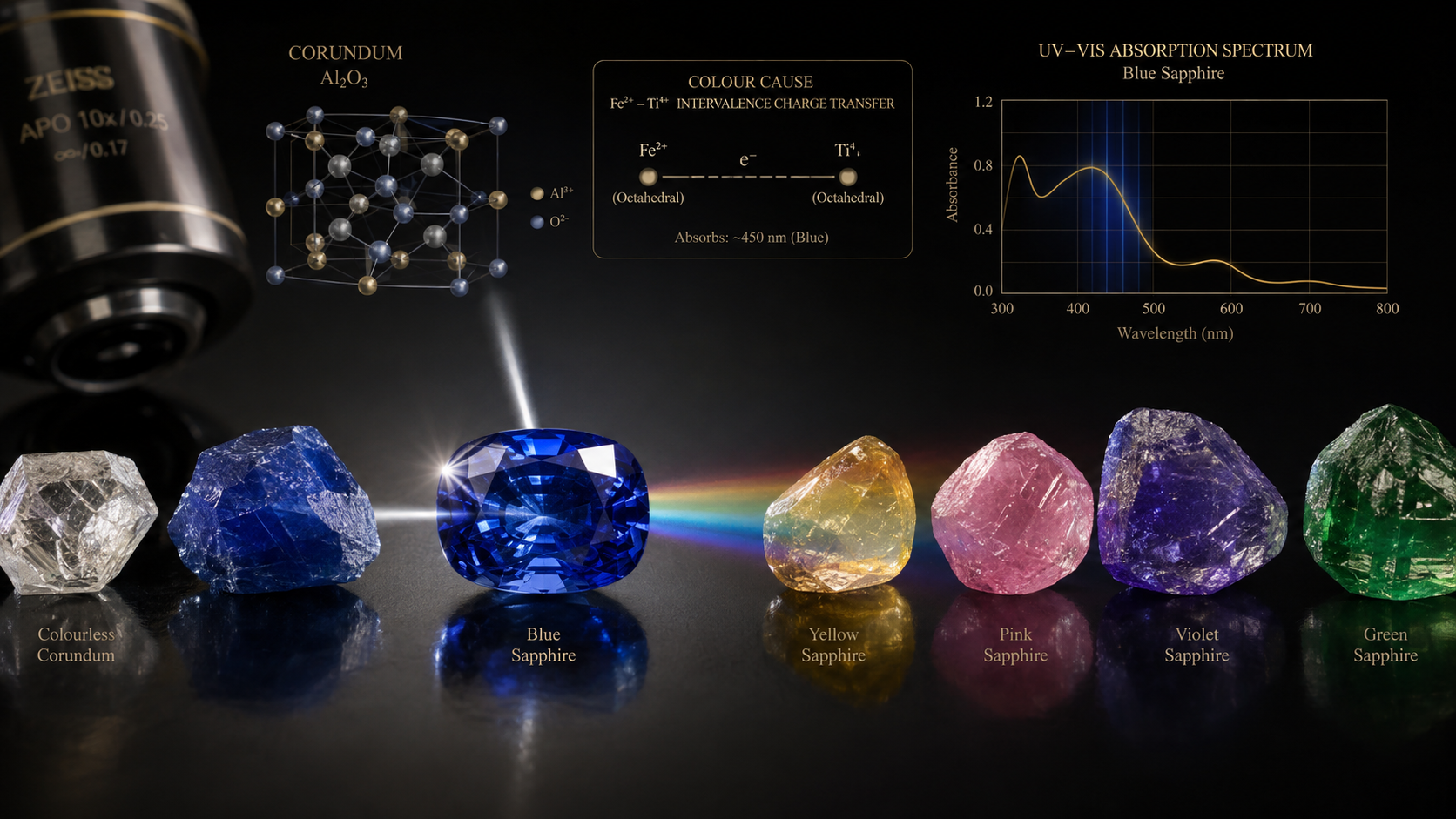
Blue sapphire is a variety of the mineral corundum.
Its chemical formula is:
Al₂O₃
Corundum is crystalline aluminium oxide.
It belongs to the trigonal crystal system.
Pure corundum is essentially colourless.
The colours observed in natural gemstones arise from trace elements and structural characteristics.
Blue sapphire commonly owes its colour to interactions involving iron and titanium.
The resulting optical absorption produces the characteristic blue appearance.
This is a scientifically measurable process.
It does not depend upon the gemstone’s religious or astrological associations.
The Science Behind Sapphire’s Blue Colour
The Gemological Institute of America has published extensive research concerning colour mechanisms in corundum.
One important mechanism involves intervalence charge transfer between iron and titanium.
This process influences the absorption of visible light.
The wavelengths that are absorbed and transmitted determine the colour perceived by the observer.
Different concentrations and arrangements of trace elements can produce different shades.
Some sapphires appear pale blue.
Others display intense royal-blue or violetish-blue colours.
Certain specimens show uneven colour distribution.
The resulting appearance is influenced by crystal chemistry, geological formation and the orientation of the gemstone.
These characteristics can be investigated using gemmological instruments.
They do not provide evidence of supernatural planetary energy.
The Physical Properties of Blue Sapphire
Natural sapphire possesses several distinctive gemmological properties.
Its hardness is 9 on the Mohs scale.
Its specific gravity is approximately 4.00.
Its refractive index is generally around 1.762–1.770.
Its birefringence is approximately 0.008–0.010.
Its crystal system is trigonal.
These properties help distinguish sapphire from other blue gemstones.
They also explain its durability and suitability for jewellery.
The Gemological Institute of America documents these characteristics through professional gemmological research.
The measurements are reproducible.
They belong to the scientific study of minerals.
Why Sapphire’s Hardness Matters
Sapphire is one of the hardest natural gemstones commonly used in jewellery.
Its hardness makes it resistant to scratching during ordinary wear.
This property contributed to its historical desirability.
A gemstone that can preserve a polished surface over long periods is particularly suitable for important ornaments.
However, hardness does not mean that sapphire is indestructible.
A strong impact can still damage a gemstone.
Existing fractures or inclusions may influence its durability.
The physical resilience of sapphire is scientifically established.
Its supposed ability to protect a person from misfortune is a separate cultural belief.
Are All Blue Sapphires Identical?
Natural blue sapphires vary considerably.
Their colour may differ in hue, tone and saturation.
Some are transparent.
Others contain numerous inclusions.
Their crystal growth histories may produce colour zoning.
Certain stones display rutile inclusions commonly described as silk.
The geographic origin of sapphire can also influence its internal characteristics.
However, the same general mineral species occurs in different geological environments.
No single appearance establishes a precise geographic origin.
Professional origin determination requires examination of multiple forms of evidence.
Does Sapphire Quality Affect Its Traditional Spiritual Meaning?
Certain historical gemstone traditions placed considerable emphasis on the quality of stones used in talismanic jewellery.
The Gemological Institute of America discusses traditional expectations that gemstones should be of high quality and free from significant defects.
Within these belief systems, the perceived purity or quality of a gemstone could influence its suitability.
However, historical concepts of perfection should not be confused with modern gemmological grading.
A modern grading assessment considers measurable and observable characteristics.
These may include colour, clarity, cut and optical performance.
A traditional astrological interpretation may assign additional symbolic significance to the same characteristics.
The two systems evaluate different questions.
The Difference Between Gemmological Quality and Astrological Suitability
Consider two natural blue sapphires.
One possesses excellent transparency, attractive colour and precise cutting.
The other contains visible inclusions and uneven colour distribution.
A gemmologist can evaluate their physical and optical characteristics.
The results may influence quality assessment and market value.
An astrologically oriented practitioner might interpret the stones through a different framework.
Such interpretations may involve beliefs concerning planetary compatibility.
However, there is no scientifically validated relationship between a sapphire’s gemmological quality and its ability to alter a person’s destiny.
The distinction should remain clear.
Natural, Treated and Synthetic Sapphire
Modern sapphire jewellery introduces additional considerations.
Some natural sapphires have been heat treated.
Heat treatment may alter colour or improve apparent clarity.
Other treatments can involve diffusion processes.
Synthetic sapphire can also be produced in laboratories.
Synthetic corundum possesses essentially the same fundamental chemical composition and crystal structure as natural corundum.
However, its formation history differs.
Imitation materials may look similar to sapphire while possessing different physical properties.
These distinctions matter for accurate gemstone identification and transparent commercial disclosure.
They should not be confused with unverified spiritual claims.
Can a Synthetic Sapphire Possess the Same Astrological Meaning?
This question illustrates the difference between gemmology and religious interpretation.
Scientifically, synthetic sapphire is crystalline corundum.
Its fundamental chemical and physical properties are comparable to those of natural sapphire.
Traditional gemstone astrology may nevertheless distinguish between naturally formed stones and laboratory-grown materials.
Such distinctions belong to particular belief systems.
There is no scientific evidence that natural sapphire possesses a planetary influence absent from synthetic sapphire.
Nor is there evidence that either material can independently change an individual’s future.
The religious interpretation and the mineralogical classification must therefore be considered separately.
Is Blue Sapphire Really a Dangerous Gemstone?
Popular discussions sometimes describe blue sapphire as exceptionally powerful or dangerous.
These claims often refer to its traditional association with Shani.
Some contemporary astrologers advise caution before wearing it.
Others interpret sapphire more positively.
These differences demonstrate that the tradition is not completely uniform.
However, there is no scientific evidence that wearing blue sapphire causes accidents, financial losses, illness or supernatural punishment.
The gemstone does not possess a scientifically established mechanism capable of producing such outcomes.
Its physical properties are those of corundum.
Any claimed astrological effect remains a matter of belief.
Shani, Responsibility and Moral Interpretation
The symbolism of Shani can be approached with greater nuance than simple fear.
Within some Hindu religious interpretations, Shani is associated with the consequences of conduct.
Difficult experiences may be understood as opportunities for discipline, responsibility or moral reflection.
Such interpretations belong to religious philosophy and devotional practice.
They should not be reduced to the commercial claim that purchasing a blue gemstone will eliminate life’s difficulties.
The historical tradition concerns a wider worldview.
The gemstone is only one element within that system.
Is Blue Sapphire a Protective Stone?
Within certain astrological traditions, blue sapphire is believed to influence the relationship between an individual and Saturn.
Some interpretations describe potentially beneficial effects.
Others emphasise caution.
The navaratna arrangement is traditionally associated with balancing planetary influences.
These are culturally documented beliefs.
They are not scientifically demonstrated protective effects.
A person may choose to wear sapphire as a personal symbol of discipline or responsibility.
Such symbolic use can be meaningful.
However, the gemstone should not be presented as a scientifically proven source of protection against misfortune.
Blue Sapphire and Modern Chakra Beliefs
Contemporary crystal-healing literature often associates blue sapphire with the Third Eye Chakra.
Some sources connect it with intuition, mental clarity or spiritual insight.
Others emphasise communication or wisdom.
These interpretations belong to modern metaphysical practices.
They should not automatically be attributed to the historical navaratna tradition.
Although chakra concepts have roots in South Asian religious systems, contemporary Western crystal-healing interpretations frequently combine ideas from different traditions.
The resulting associations may differ substantially from older textual or ritual frameworks.
The connection between blue sapphire and Shani is historically distinct from a modern claim about the Third Eye Chakra.
Astronomy and Astrology: An Essential Distinction
The scientific study of Saturn belongs to astronomy.
Astronomers investigate the planet’s orbit, atmosphere, rings, moons and physical characteristics.
These properties can be measured using observations and scientific instruments.
Astrology interprets celestial configurations as meaningful for human affairs.
NASA distinguishes astronomy from astrology on precisely this basis.
Astronomy follows scientific methods involving evidence and testable explanations.
Astrological claims concerning personality and destiny are not supported by comparable scientific evidence.
This distinction does not erase astrology’s historical importance.
It establishes the limits of its scientific status.
Does Saturn Physically Influence Sapphire?
Saturn exerts gravitational forces because it possesses mass.
Those forces can be described mathematically.
However, there is no established physical mechanism through which Saturn selectively activates blue sapphire because of its colour or traditional association with Shani.
The colour of sapphire arises from its crystal chemistry.
Its hardness arises from its atomic structure.
Its optical behaviour results from interactions between light and matter.
These properties are not controlled by the gemstone’s position within an astrological system.
The traditional relationship between Saturn and sapphire is symbolic rather than scientifically demonstrated.
Why the Historical Tradition Still Matters
The absence of scientific evidence for astrological gemstone effects does not make the historical tradition irrelevant.
Navaratna jewellery provides valuable information about South Asian cultural history.
It reveals relationships between astronomy, astrology and religious thought.
It demonstrates the importance of gemstones within systems of symbolic representation.
It documents sophisticated jewellery craftsmanship.
It also shows how different religious and cultural communities interacted through the exchange of precious materials.
The surviving objects are historically significant regardless of whether their supernatural effects can be verified.
The Role of Museums in Understanding Gemstone Beliefs
Museum collections provide an important foundation for responsible interpretation.
A historical object can be examined.
Its materials can be identified.
Its craftsmanship can be studied.
Its inscriptions may be translated.
Its provenance can be investigated.
Its cultural context can be compared with written sources.
The Metropolitan Museum’s navaratna bracelets and the Philadelphia Museum’s pendant provide particularly valuable examples.
They demonstrate that planetary gemstone traditions were expressed through actual historical objects.
Their existence is documented.
Their intended symbolic significance can be investigated.
Their supernatural efficacy remains unproven.
The Difference Between Historical Belief and Modern Marketing
Modern gemstone marketing sometimes presents spiritual associations as universal facts.
A gemstone may be described as attracting prosperity.
Another may supposedly guarantee protection.
A third may be advertised as correcting planetary problems.
Such claims often omit the cultural frameworks from which they originated.
The history of blue sapphire demonstrates why this approach is inadequate.
Within certain traditions, sapphire could be considered challenging rather than universally beneficial.
Its meaning depended on the relationship with Shani.
Its place within navaratna differed from its use as an individual stone.
Its interpretation could vary between communities.
A historically responsible description should preserve these distinctions.
A Contemporary Approach to Sapphire Symbolism
A modern wearer may appreciate blue sapphire for several reasons.
Its colour may be attractive.
Its durability may make it suitable for everyday jewellery.
Its rarity may contribute to its desirability.
Its historical associations may provide intellectual interest.
Someone familiar with Hindu astrological traditions may also attach personal spiritual meaning to the gemstone.
These motivations are not mutually exclusive.
However, personal belief should not be confused with scientific verification.
A gemstone can be culturally meaningful without possessing measurable supernatural powers.
What Can We Establish with Confidence?
The available museum, historical and gemmological evidence supports several important conclusions.
Blue sapphire is a variety of the mineral corundum.
Its chemical formula is Al₂O₃.
Its blue colour commonly results from interactions involving iron and titanium.
Its hardness is 9 on the Mohs scale.
Within Indian astrological traditions, blue sapphire is associated with Saturn and Shani.
Shani belongs to the navagraha system of nine celestial influences.
The navagraha include the Sun, Moon, five visible planets and two lunar nodes.
Navaratna jewellery incorporates gemstones associated with these nine influences.
Historical examples survive in major museum collections.
Traditional beliefs attribute protective or harmonising significance to certain nine-gem arrangements.
Some interpretations regard blue sapphire worn individually as potentially challenging.
Historical jewellery demonstrates that arrangements and materials could vary.
Modern synthetic and treated sapphires require accurate gemmological identification.
There is no established scientific evidence that sapphire changes planetary influences or determines human destiny.
A Gemstone Between Mineralogy and Cultural Belief
The history of blue sapphire and Shani demonstrates that a gemstone can participate in several systems of meaning.
Within mineralogy, sapphire is crystalline aluminium oxide.
Within gemmology, it is evaluated through its physical and optical properties.
Within jewellery history, it may represent wealth, craftsmanship or personal distinction.
Within certain Hindu astrological traditions, it is associated with Saturn.
Within modern metaphysical practices, it may be interpreted as a symbol of intuition or protection.
These meanings belong to different frameworks.
They should not be combined into one supposedly universal explanation.
Understanding their differences produces a more accurate appreciation of the gemstone.
Conclusion: Blue Sapphire, Saturn and the Meaning of Sacred Jewellery
Blue sapphire occupies a remarkable position in the history of South Asian gemstone beliefs.
Its natural beauty has made it desirable for centuries.
Its exceptional hardness and optical characteristics have contributed to its importance in jewellery.
Yet within certain Hindu astrological traditions, its relationship with Shani gives it a more complicated symbolic identity.
The gemstone has sometimes been regarded as potentially challenging when worn individually.
Within navaratna jewellery, however, it participates in a complete arrangement representing nine celestial influences.
Historical objects preserved by major museums demonstrate that these beliefs were expressed through sophisticated jewellery.
The Metropolitan Museum’s nineteenth-century bracelets reveal variations within the nine-gem tradition.
The Philadelphia Museum’s altered pendant demonstrates how symbolic arrangements could change over time.
And the extraordinary sapphire associated with the Maharaja of Nawanagar reminds us that individual choices cannot always be explained through a single religious interpretation.
The significance of blue sapphire in the Shani tradition lies not in scientifically proven planetary energy, but in the relationship between natural gemstones, religious symbolism, celestial observation and human attempts to understand the uncertainties of life.
For Natural Gems Belgium, this history illustrates an essential principle.
Gemstones deserve to be understood through both scientific investigation and cultural scholarship.
Their physical properties can be measured.
Their historical uses can be documented.
Their religious meanings can be studied respectfully.
Their supernatural claims must be distinguished from established scientific evidence.
Blue sapphire provides an especially compelling example.
A natural mineral formed through geological processes became part of an elaborate symbolic system connecting precious stones with the heavens.
Its colour belongs to crystal chemistry.
Its beauty belongs to the natural world.
And its spiritual significance belongs to the history of human belief.
References & Further Reading
The following references are selected from authoritative museum collections, gemmological research and scientific institutions. All sources are informational and non-commercial.
1. The Metropolitan Museum of Art – In the Stars: Gems and the Indian Tradition
https://www.metmuseum.org/perspectives/in-the-stars-gems-and-the-indian-tradition
Source description: Scholarly museum article by Courtney A. Stewart, published on 17 December 2014.
Examines the relationship between gemstones, Hindu planetary traditions and religious symbolism.
Discusses Shani, blue sapphire, navaratna jewellery and the remarkable sapphire ornament associated with the Maharaja of Nawanagar.
A principal historical source for this article.
2. The Metropolitan Museum of Art – Nine-Gem Navaratna Talismanic Bracelet
https://www.metmuseum.org/art/collection/search/446721
Source description: Official collection record for a nineteenth-century talismanic bracelet from northern India.
Documents the use of gold, enamel and multiple gemstones in a variation of the traditional navaratna arrangement.
Explains the relationship between precious stones and the nine celestial influences of Indian astrology.
3. The Metropolitan Museum of Art – Companion Navaratna Talismanic Bracelet
https://www.metmuseum.org/art/collection/search/454027
Source description: Museum catalogue for the companion bracelet from the same nineteenth-century pair.
Provides additional documentation of the materials, craftsmanship and historical context of planetary gemstone jewellery.
4. Philadelphia Museum of Art – Navaratna Pendant
https://www.philamuseum.org/objects/92800
Source description: Official museum record for an eighteenth-century navaratna pendant altered during the nineteenth century.
Explains the traditional relationship between gemstones and celestial bodies.
Documents the replacement of the central ruby with an inscribed emerald.
An important example of how historical gemstone arrangements could change over time.
5. Gemological Institute of America – Centuries of Opulence: Jewels of India
https://www.gia.edu/articles/jewels-of-india
Source description: Extensive historical and gemmological examination of Indian jewellery traditions.
Includes a dedicated discussion of navaratna gemstones, their planetary associations and their historical talismanic significance.
Provides valuable information concerning the development of gemstone traditions and their relationship with religious beliefs.
6. Gemological Institute of America – Sapphire Gemstone Overview
Source description: Authoritative gemmological reference documenting sapphire’s chemical composition, crystal properties, hardness, refractive index and quality characteristics.
Explains the distinction between natural, treated, synthetic and imitation sapphires.
7. Gemological Institute of America – Sapphire Series: Introduction to Sapphire and Synthetic Sapphire
Source description: Technical gemmological research concerning corundum, sapphire formation, crystal structure and synthetic sapphire.
Documents the trigonal crystal system and the physical characteristics responsible for sapphire’s durability and optical properties.
8. Gemological Institute of America – A Quantitative Description of the Causes of Color in Corundum
https://www.gia.edu/gems-gemology/spring-2020-corundum-chromophores
Source description: Advanced scientific research published in Gems & Gemology.
Examines the mechanisms responsible for colour in corundum, including the role of iron and titanium in blue sapphire.
Provides the scientific foundation for distinguishing gemstone colour chemistry from traditional spiritual interpretations.
9. Gemological Institute of America – Madagascar Sapphire: Low-Temperature Heat Treatment Experiments
https://www.gia.edu/gems-gemology/summer-2019-madagascar-sapphire-heat-treatment-experiments
Source description: Peer-reviewed gemmological research examining the effects of heat treatment on natural blue sapphire.
Explains how treatment can influence colour and how laboratory examination can identify evidence of heating.
Useful for distinguishing natural gemstone properties from modifications introduced through human intervention.
10. NASA Space Place – What Are Constellations?
https://spaceplace.nasa.gov/constellations/en
Source description: Official NASA educational resource explaining the scientific distinction between astronomy and astrology.
Clarifies that astronomy is based on scientific observations and evidence, whereas astrological claims concerning personality and destiny are not scientifically established.
11. The Metropolitan Museum of Art – Iconographic Drawing of Saturn
https://www.metmuseum.org/art/collection/search/45617
Source description: Official museum catalogue for a twelfth-century Japanese representation of Saturn.
Documents the transmission of Indian planetary concepts into East Asian Buddhist traditions.
Provides comparative historical evidence for the wider cultural movement of navagraha symbolism beyond the Indian subcontinent.
12. The Metropolitan Museum of Art – Tiger-Claw Necklace
https://www.metmuseum.org/art/collection/search/784629
Source description: Museum record for a nineteenth-century necklace from Tamil Nadu incorporating gemstones and tiger claws.
Discusses talismanic symbolism and the use of navaratna-style gemstone arrangements within South Asian jewellery.
Provides additional evidence of the relationship between precious materials, protective beliefs and historical craftsmanship.
Historical Tradition, Gemmological Science and Modern Metaphysical Beliefs
Scientifically established: Blue sapphire is a variety of the mineral corundum, with the chemical formula Al₂O₃.
Scientifically established: Corundum crystallises in the trigonal crystal system.
Scientifically established: Blue sapphire commonly owes its colour to interactions involving iron and titanium.
Scientifically established: Sapphire has a hardness of 9 on the Mohs scale.
Scientifically established: Sapphire’s refractive index, density and optical characteristics can be measured through professional gemmological examination.
Historically documented: Indian gemstone traditions have associated particular precious stones with celestial bodies and religious symbolism.
Historically documented: Blue sapphire is associated with Saturn and Shani within established navaratna traditions.
Religious tradition: Shani is a planetary deity associated with Saturn within Hindu religious and astrological systems.
Religious tradition: Certain interpretations associate Shani with hardship, responsibility and the consequences of human actions.
Historically documented belief: Some South Asian astrological traditions have regarded blue sapphire as potentially challenging when worn individually.
Historically documented belief: Navaratna jewellery is traditionally associated with the harmonisation of nine celestial influences.
Historically documented: Nineteenth-century navaratna bracelets survive in the Metropolitan Museum of Art.
Historically documented: An eighteenth-century navaratna pendant, subsequently altered, survives in the Philadelphia Museum of Art.
Historically documented: The navaratna tradition has circulated across different religious and cultural communities in South Asia.
Modern metaphysical belief: Contemporary crystal-healing systems may associate blue sapphire with intuition, spiritual insight or the Third Eye Chakra.
Scientific limitation: There is no established scientific evidence that blue sapphire changes planetary influences, alters destiny, balances chakras or independently produces medical healing.
Scientific distinction: Saturn’s astronomical properties are measurable, but its proposed astrological influence on an individual’s life is not scientifically established.
Gemmological consideration: Natural sapphire must be distinguished from synthetic sapphire, treated sapphire and imitation materials.
The history of blue sapphire and Shani provides a particularly revealing example of how gemstone symbolism develops through cultural and religious interpretation.
Its mineralogical properties are scientifically established.
Its planetary associations are historically documented.
Its spiritual significance belongs to specific traditions.
Its supernatural efficacy remains a matter of belief rather than scientific demonstration.
Understanding these distinctions allows both the gemstone and the cultural traditions surrounding it to be appreciated with greater accuracy and respect.