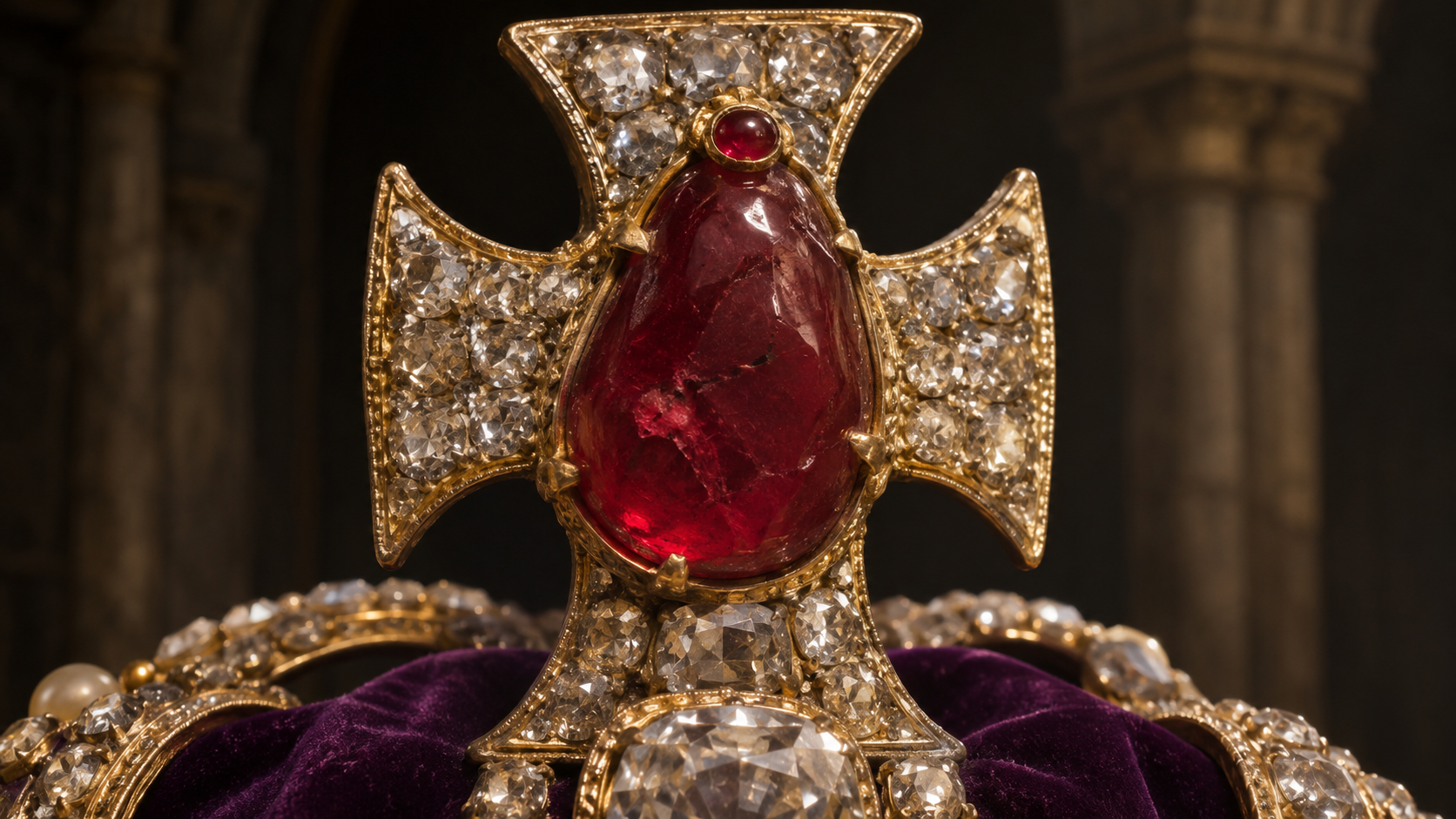
The Black Prince’s Ruby occupies a commanding position at the front of Britain’s Imperial State Crown, where its irregular red surface contrasts with the carefully cut diamonds surrounding it. Its name evokes medieval warfare and royal inheritance, yet the gemstone raises questions that reach beyond the familiar story of a jewel passed between kings.
The first concerns mineralogy: the stone is a red spinel rather than a ruby. The second concerns history: its association with Edward of Woodstock, the prince remembered as the Black Prince, is much less secure than popular accounts suggest. A third concerns the object itself, whose polished shape, piercing and later modification preserve evidence of a changing material life.
Examining these questions together reveals a gemstone whose scientific identity is clearer than its earliest ownership history.
Table of Contents
A Historic Stone in a Twentieth-Century Crown
The Imperial State Crown now associated with the gemstone was made for George VI in 1937, replacing the crown created for Queen Victoria in 1838. As the Royal Collection Trust explains, a crown used repeatedly for state occasions has required renewal, while historic gemstones have been incorporated into successive settings.
This distinction is essential. The age of a gemstone, the history of its ownership and the date of its present mounting are separate matters. A medieval tradition attached to a stone does not make its surrounding metalwork medieval.
The Black Prince’s Ruby sits in the crown’s front cross, above the Cullinan II diamond. Its broad, unevenly rounded surface differs markedly from the geometric facets of many neighbouring stones, allowing it to retain an individual appearance within a highly structured composition.
The crown provides its ceremonial setting, but the gemstone has a material history of its own.
What the Gemstone Actually Is
Ruby is the red variety of corundum, whose ideal chemical composition is aluminium oxide, Al₂O₃. Spinel is a different mineral, with the ideal composition magnesium aluminium oxide, MgAl₂O₄. The magnesium in spinel is part of a distinct crystal structure, rather than a minor ingredient that turns ruby into another variety.
Their crystallography is equally important. Spinel belongs to the cubic crystal system and is normally optically isotropic: its refractive behaviour is equivalent in different directions. Corundum belongs to the trigonal system and is optically anisotropic, producing two principal refractive indices.
Consequently, calling the Black Prince’s Ruby a spinel identifies a separate mineral species. It does not imply that the stone is artificial, nor that it is an inferior form of corundum. Its historical name and mineralogical identity answer different questions.
Red Spinel and Ruby: The Diagnostic Differences
| Property | Red spinel | Ruby |
|---|---|---|
| Mineral identity | Spinel | Red corundum |
| Ideal chemical formula | MgAl₂O₄ | Al₂O₃ |
| Crystal system | Cubic | Trigonal |
| Normal optical character | Singly refractive | Doubly refractive |
| Typical refractive index | Approximately 1.718, with compositional variation | Approximately 1.762–1.770 |
| Mohs hardness | Approximately 8 | 9 |
| Important cause of red colour | Chromium | Chromium |
These are reference properties of the materials, not a newly reported set of measurements taken from the Crown Jewel.
Their practical significance is that visual similarity can be tested against independent physical evidence. Refractive behaviour, for example, separates two red stones without relying on how strongly or attractively either appears coloured. Hardness also differs, although a scratch test would be inappropriate for a historic jewel.
No single observation should be asked to answer every question. Species identification, natural or synthetic origin, treatment history and geographical origin are distinct stages of gemmological investigation.
How the Same Element Produces Red in Different Minerals
Chromium helps explain why ruby and red spinel can resemble one another despite their different compositions. In both materials, chromium can occur as Cr³⁺, replacing some aluminium within the crystal structure.
The resulting colour depends on how these ions interact with the surrounding lattice. Their electronic transitions selectively absorb parts of the visible spectrum, so the light reaching the observer differs from the light entering the stone. Chromium’s local environment therefore matters as well as its presence.
Research on spinel also shows that colour cannot always be reduced to one element in isolation. Iron, vanadium and other constituents can modify absorption, while chromium-related luminescence contributes another aspect of optical behaviour.
It would nevertheless be unjustified to convert findings from a modern research sample into an exact chemical description of the Black Prince’s Ruby. General mineral science explains the mechanisms available; an object-specific analysis establishes which apply to a particular gemstone and to what extent.
Why Historical “Ruby” Does Not Always Mean Corundum
Historical gemstone language did not consistently follow modern mineral classification. Terms could reflect appearance, perceived quality, geographical associations or inherited naming traditions rather than a chemically defined species.
GIA’s historical reading resources discuss “balas ruby,” a name associated with spinel, alongside ruby literature. The survival of such vocabulary shows that earlier observers possessed distinctions of their own, even when those distinctions did not map neatly onto modern mineralogy.
It is therefore too simple to imagine that every historic reference to a ruby represents the same identification error. The language must be interpreted in its period and context.
The Black Prince’s Ruby retains a traditional proper name, much as other historical objects preserve names that no longer function as literal technical descriptions. Keeping that name is compatible with explaining its mineral identity precisely.
The Medieval Story: Compelling but Unproven
The familiar account links the gem with Pedro of Castile and Edward, Prince of Wales, following the Spanish campaign of 1367. Historic Royal Palaces presents this association as legend rather than an established chain of ownership.
Jack M. Ogden’s 2020 investigation in The Journal of Gemmology examined the documentary basis more critically. He concluded that the Black Prince probably acquired one or more large spinels in Spain, but that no surviving gemstone can be conclusively identified as one of them.
His research traces the present stone securely into royal regalia in the later seventeenth century, with an earlier sixteenth-century connection considered probable. The specific link with the Black Prince emerged only in the 1760s through an uncertain interpretation of a portrait.
Ogden also found no evidence supporting the often-repeated claim that Henry V wore this large spinel above his helmet at Agincourt in 1415.
The historical lesson is substantial: evidence that a prince possessed large red stones is not sufficient to identify one particular surviving stone.
The Stone’s Surface Records a Different Kind of History
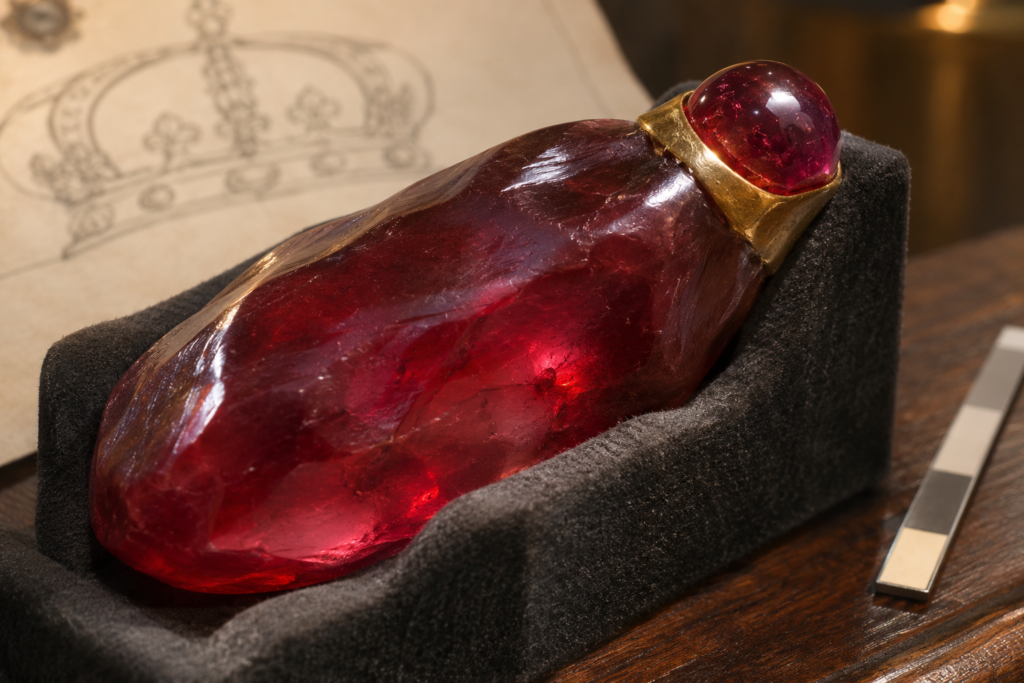
Some of the most informative evidence is physical rather than narrative. The official royal description identifies the gemstone as a large, irregular cabochon red spinel and records that it was pierced for use as a pendant. An upper opening was subsequently plugged with a small cabochon ruby held in a gold slip mount.
This creates an unusually revealing combination: a spinel traditionally called a ruby contains a later addition described as an actual ruby.
The modification also demonstrates why the object should not be called simply “uncut.” Its broad outline may preserve an irregular form, but polishing, piercing and mounting are deliberate interventions. A historic gemstone can retain much of its original mass while still having been extensively worked.
The hole does not establish a named medieval owner, yet it provides direct evidence that the stone’s use changed over time. Its material biography can therefore be investigated even where documentary ownership remains unresolved.
Badakhshan, Kuh-i-Lal and the Question of Origin
The historical association of large red spinels with Badakhshan provides an important geological setting, but it needs geographically careful wording. The historic region should not be treated as interchangeable with the boundaries of a single modern country.
The Smithsonian identifies the Kuh-i-Lal mines in present-day Tajikistan as one of the oldest known sources of gem spinel. Research describes spinel from this area within metamorphic rocks of the southwestern Pamir, including magnesium-rich mineral assemblages.
This setting is consistent with a broader geological principle: gem spinel can form where metamorphic processes bring suitable magnesium- and aluminium-bearing materials together. Its formation conditions differ from the later human processes that transport, polish and name the stone.
However, a historically plausible source region is not the same as an independently demonstrated mine attribution for the Crown Jewel. Naming an ancient mining district supplies context; proving the origin of an individual gemstone requires additional evidence.
What Modern Laboratories Can Investigate
The study of spinel now extends beyond conventional measurements. Microscopy can reveal internal crystals, growth features and fractures, while spectroscopic methods investigate how the material absorbs or emits light.
GIA’s research on spinel micro-features includes natural, synthetic and treated examples. It also notes that some heat treatments may leave limited microscopic evidence and require photoluminescence or visible spectroscopy for detection. This is a reminder that an apparently undisturbed appearance is not a complete analytical conclusion.
Geographical-origin research adds further complexity. Published studies have investigated Himalayan-belt spinels using conventional gemmology and trace-element analysis, comparing material from localities including Myanmar, Vietnam and Tajikistan.
These methods demonstrate the possibilities of modern research, but they should not be presented as tests performed on the Black Prince’s Ruby unless an object-specific publication documents them. Equally, a method involving removal of even minute quantities of material raises different conservation considerations from non-invasive examination.
Why the Name Still Matters
The gemstone’s name is itself part of its history. It records the endurance of a story, the cultural authority of royal objects and the tendency for repeated narratives to acquire the appearance of certainty.
Scientific identification does not erase that history. Instead, it adds another layer: a red stone admired under an inherited name can be understood through its composition, structure and optical properties without requiring the medieval narrative to be accepted as fact.
For gemstone enthusiasts, the object illustrates the limits of identification by colour. For historians, it illustrates the limits of tracing ownership through resemblance, evocative names or the presence of similar jewels in inventories.
Both disciplines benefit from asking what kind of evidence supports each claim.
A More Interesting Jewel Than the Legend Alone
The Black Prince’s Ruby deserves attention beyond the surprise that it is a spinel. Its position in the Imperial State Crown, its altered surface and its uncertain early history make it a meeting point between mineral science, craftsmanship and historical interpretation.
Its physical identity can be distinguished from ruby, while its earliest royal associations remain open to investigation. Recognising that difference does not diminish the gemstone. It allows the documented object to become more interesting than an unqualified repetition of its legend.
At Natural Gems Belgium, this is the value of historical gemmology: understanding what the material is, how people transformed it, and how confidently its story can be reconstructed.
References & Further Reading
Ogden, J. M. (2020). “The Black Prince’s Ruby: Investigating the Legend.” The Journal of Gemmology, 37(4), 360–373.
The central historical investigation used here, assessing the documentary evidence behind the gemstone’s association with the Black Prince and later royal ownership. The article is included in this journal issue.
https://doi.org/10.15506/JoG.2020.37.4.360
https://gem-a.com/wp-content/uploads/2023/10/2020_37_4.pdf
Royal Collection Trust. “The Imperial State Crown.” RCIN 31701.
Official collection documentation explaining the present crown’s date, purpose and incorporation of historic gemstones.
https://www.rct.uk/collection/stories/the-crown-jewels/the-imperial-state-crown
The Royal Family. “Coronation Day.”
Official description of the crown’s construction, the spinel’s position and the small ruby covering an earlier piercing.
https://www.everydayexceptional.royal.uk/coronation-guide
Historic Royal Palaces. “The Crown Jewels Up Close.”
Institutional interpretation identifying the stone as spinel and explicitly presenting the Black Prince association as legend.
https://www.hrp.org.uk/tower-of-london/crown-jewels/
Gemological Institute of America. “Spinel Description.”
Educational information about cubic symmetry, single refraction and natural crystal forms.
https://www.gia.edu/spinel-description
Gemological Institute of America. “Ruby Description.”
Educational information about ruby as corundum, chromium-related colour and fluorescence.
https://www.gia.edu/ruby-description
Gemological Institute of America. “Ruby.” Gem Encyclopedia.
Reference properties including chemical composition, refractive indices and hardness.
https://www.gia.edu/ruby
Gemological Institute of America. “Historical Reading List: Ruby and Balas Ruby (Spinel).”
A guide to historical and scientific literature concerning ruby, spinel and the development of their classification.
https://www.gia.edu/reading-list-ruby-balas-ruby-spinel
National Museum of Natural History, Sofia. “Spinel.”
Museum gemmological reference information covering spinel’s physical and optical properties.
https://www.nmnhs.com/gemmology/classification/gem_id_en-4BB05-Spinel.html
Gemological Institute of America. “Color Mechanism and Spectroscopic Thermal Variation of Pink Spinel Reportedly from Kuh-i-Lal, Tajikistan.” Gems & Gemology, Fall 2022.
Primary research discussing spinel chemistry, colour mechanisms, spectroscopy and the geological setting of Kuh-i-Lal material. This study concerns research samples, not the Black Prince’s Ruby.
https://www.gia.edu/gems-gemology/fall-2022-pink-spinel-from-tajikistan
Smithsonian National Museum of Natural History. “Spinel.” GeoGallery.
Museum information discussing spinel colour and the historic Kuh-i-Lal source in Tajikistan.
https://naturalhistory.si.edu/explore/collections/geogallery/10026908
Renfro, N., et al. (2021). “Micro-Features of Spinel.” Gems & Gemology.
Research-based guidance on internal features of natural, synthetic and treated spinel.
https://www.gia.edu/gems-gemology/spring-2021-visual-guide-to-micro-features-of-spinel
“Distinction of gem spinels from the Himalayan mountain belt.”
Primary research investigating material from Myanmar, Vietnam and Tajikistan using conventional gemmological testing and trace-element analysis. An abstract is available through PubMed.
https://pubmed.ncbi.nlm.nih.gov/21138164/