Table of Contents
Introduction: The Hidden Light of Gemstones
A gemstone may look ordinary under daylight yet display a remarkable glow when illuminated by ultraviolet light.
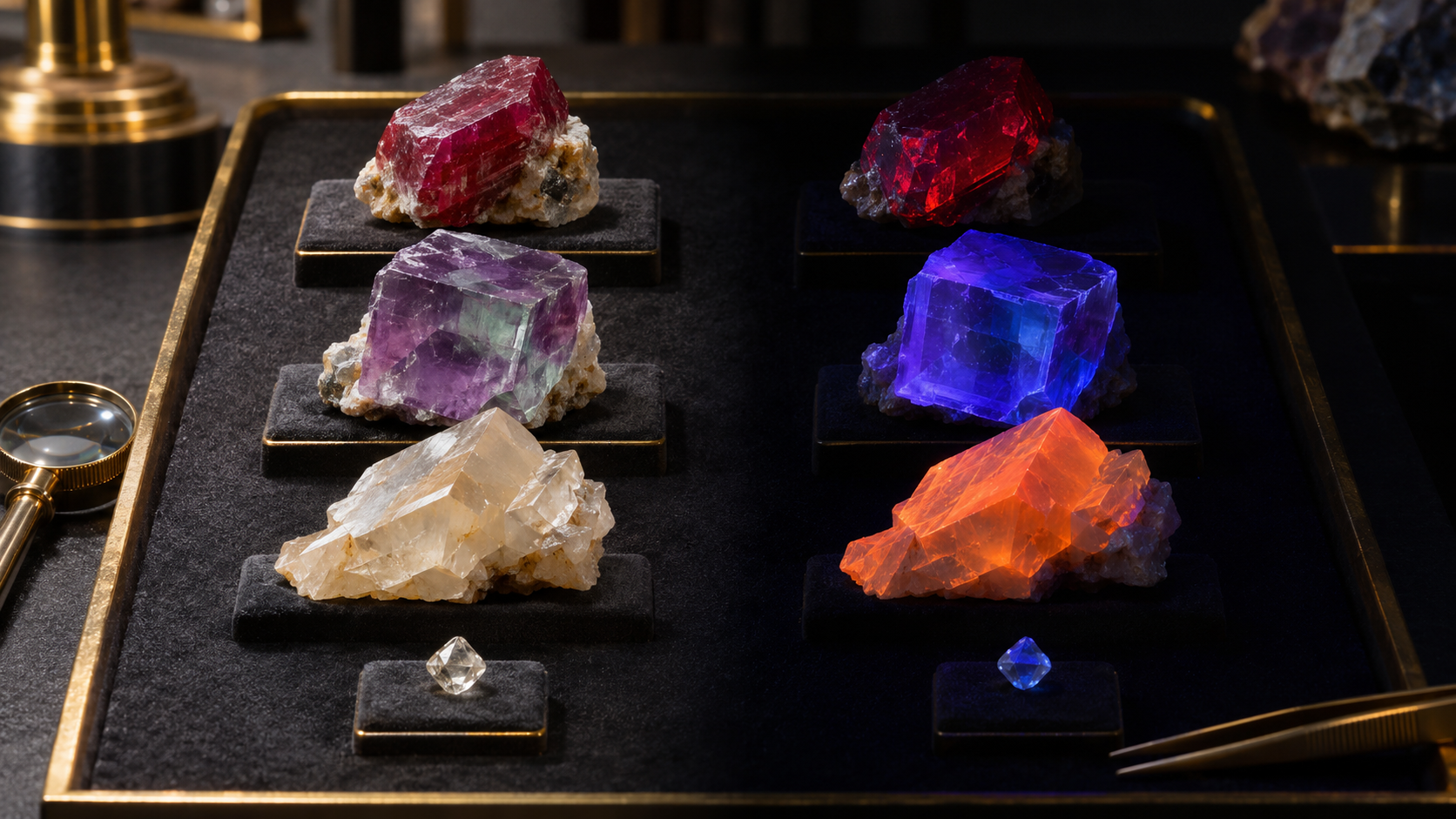
A ruby may emit vivid red light.
A diamond may appear blue.
Certain fluorite and calcite specimens can produce bright, unexpected colours.
Some minerals even continue glowing briefly after the ultraviolet source has been switched off.
These effects are examples of luminescence.
Luminescence is the emission of light by a material following an energy input. In gemstones, that energy may come from ultraviolet or visible light, although other excitation methods also exist.
Two particularly important forms are fluorescence and phosphorescence.
Both can provide valuable information about the electronic structure of minerals.
Their behaviour depends on impurities, crystal defects, excitation wavelength and other physical conditions.
However, fluorescence is not a universal gemstone identification method.
Two different minerals may display similar responses, while specimens of the same mineral may react differently.
This guide explains the underlying science, introduces important mineral examples and provides a practical approach to safe, non-destructive observation.
1. What Is Luminescence?
Luminescence occurs when a material emits light after receiving energy through a process other than ordinary thermal incandescence.
Different types of luminescence are classified according to the energy source.
Photoluminescence results from excitation by light.
Cathodoluminescence results from excitation by electrons.
Thermoluminescence involves light emission during heating after energy has previously been stored in suitable defect states.
Triboluminescence can occur through mechanical actions such as fracture or friction.
In routine gemstone examination, photoluminescence is especially important.
A gemstone absorbs incident radiation and subsequently emits light.
The emitted light may have a different wavelength from the excitation radiation.
For example, invisible ultraviolet radiation can stimulate visible red or blue emission.
This is why a gemstone may appear to glow under a UV lamp.
2. What Is Fluorescence?
Fluorescence is light emission associated with an excited electronic state that normally decays rapidly.
In practical gemmology, fluorescence is generally observed while the excitation source is operating.
When the source is switched off, the visible emission usually disappears too quickly for the human eye to detect any persistence.
The colour and intensity depend on the material and the excitation conditions.
A gemstone may fluoresce strongly under one UV wavelength but weakly under another.
Some gemstones show no detectable visible fluorescence with ordinary examination equipment.
The absence of visible fluorescence does not mean that the gemstone contains no luminescent centres.
Its response may simply be too weak, occur outside the visible spectrum or require a different excitation wavelength.
3. What Is Phosphorescence?
Phosphorescence is a form of luminescence involving longer-lived excited states or delayed emission mechanisms.
In practical gemstone observation, it is commonly recognised as an afterglow that remains visible after the excitation source is switched off.
Some diamonds exhibit phosphorescence lasting several seconds.
Certain mineral specimens may continue glowing for longer.
However, the scientific distinction between fluorescence and phosphorescence is more complex than a simple on/off rule.
It depends on the electronic transitions and decay processes involved.
A recent GIA scientific review discusses these distinctions and notes that terminology in practical gemmology does not always perfectly reflect the underlying photophysical mechanisms.
For routine observation, the presence and duration of an afterglow remain useful descriptive characteristics.
4. Fluorescence Versus Phosphorescence
The two phenomena can be compared through their practical behaviour.
| Property | Fluorescence | Phosphorescence |
|---|---|---|
| Energy input | Usually light excitation in gem testing | Usually light excitation in gem testing |
| Visible behaviour | Emission primarily during excitation | Delayed emission may remain visible after excitation stops |
| Typical observation | Gemstone glows under UV | Gemstone continues glowing after UV is switched off |
| Electronic mechanism | Generally rapid allowed transitions | Longer-lived states or delayed recombination processes |
| Diagnostic value | Useful supporting evidence | Useful supporting evidence |
| Definitive identification | No | No |
Both phenomena are forms of luminescence.
Neither should be confused with ordinary reflection of ultraviolet lamp light.
5. Why Ultraviolet Light Is Useful
Ultraviolet radiation has shorter wavelengths than visible violet light.
Its photons generally carry more energy than visible photons.
This makes UV radiation useful for exciting certain electronic states in minerals.
When these states relax, visible light may be emitted.
A mineral that looks colourless under daylight may therefore fluoresce brightly.
However, ultraviolet radiation is not the only possible excitation source.
Some gemstones exhibit luminescence under visible light or other forms of excitation.
The term fluorescence describes the emission mechanism, not exclusively the use of ultraviolet light.
6. Longwave and Shortwave Ultraviolet Light
Gemological UV testing commonly distinguishes two excitation ranges.
Longwave ultraviolet, or LWUV, is commonly represented by a wavelength near 365 nm.
Shortwave ultraviolet, or SWUV, is commonly represented by a wavelength near 254 nm.
These wavelengths can stimulate different responses within the same gemstone.
A specimen may fluoresce strongly under longwave UV but weakly under shortwave UV.
Another may show the opposite behaviour.
Some minerals also display different fluorescence colours under the two excitation conditions.
Consequently, a fluorescence observation should always record the wavelength or UV category used.
Simply describing a gemstone as fluorescent is incomplete when a detailed scientific record is required.
7. Ultraviolet Safety Comes First
Ultraviolet radiation can damage eyes and skin.
Shortwave UV is especially hazardous and must not be used casually.
A shortwave UV lamp should only be operated with suitable shielding, interlocks and protective equipment designed for the relevant wavelength.
Never look directly into a UV source.
Never direct a UV lamp toward another person’s eyes or skin.
Do not assume that ordinary sunglasses or clear spectacles provide adequate protection.
Longwave UV also requires precautions, particularly with powerful lamps or prolonged exposure.
For an introductory workshop, a properly specified low-power longwave UV viewing system is preferable.
Shortwave and deep-UV examinations should be reserved for suitably equipped professional or supervised laboratory environments.
GIA’s practical UV-testing guidance emphasises protective eyewear, avoidance of direct exposure and appropriate viewing equipment.
8. Why Some Minerals Fluoresce and Others Do Not
Fluorescence depends on the electronic structure of a mineral.
Certain impurities and defects can absorb excitation energy and subsequently emit visible light.
These are often called luminescence centres.
Transition-metal ions, rare-earth elements and crystal defects may all contribute.
However, some elements can suppress fluorescence.
These are sometimes called quenchers.
The final response depends on the interaction between activators, quenchers and the host crystal structure.
Therefore, two specimens of the same mineral species may have very different fluorescence intensities.
One may glow brightly.
Another may appear inert.
This variation is scientifically meaningful but not automatically diagnostic of geographical origin.
9. Ruby: The Classic Red-Fluorescing Gemstone
Ruby is the red variety of corundum.
Its red colour is principally associated with chromium.
Trivalent chromium also produces characteristic red luminescence in suitable corundum.
Under ultraviolet excitation, some rubies display a vivid red response.
The intensity varies considerably.
Rubies with relatively low iron concentrations may exhibit strong red luminescence.
Iron can suppress the chromium-related emission.
This helps explain why some rubies from marble-associated geological environments are strongly fluorescent.
However, intense red fluorescence is not exclusive to rubies from Myanmar or any single locality.
It cannot independently establish geographical origin.
10. Why Some Synthetic Rubies Also Glow Strongly
Synthetic ruby has the same fundamental mineral composition as natural ruby.
It can contain chromium responsible for red luminescence.
Some synthetic rubies display very strong fluorescence because they contain relatively little iron.
However, some natural rubies also fluoresce strongly.
Therefore, strong red fluorescence does not prove that a ruby is synthetic.
Similarly, weak fluorescence does not prove that it is natural.
GIA’s 2024 luminescence review explains that UV observations can contribute to natural-versus-synthetic investigations but are insufficient alone.
Crystal growth structures, inclusions and other analytical evidence remain necessary.
11. Sapphire Fluorescence
Sapphire is another variety of corundum.
Its fluorescence behaviour varies with colour, chemistry and treatment history.
Some pink sapphires display chromium-related red fluorescence.
Blue sapphires may show weak or undetectable visible fluorescence under common examination conditions.
Certain treated or synthetic corundum materials can exhibit distinctive luminescence patterns.
For example, some heated low-iron sapphires display chalky bluish fluorescence under shortwave UV.
However, similar reactions may occur in some synthetic materials.
Therefore, a chalky fluorescence response should be treated as a possible clue rather than definitive proof of heat treatment.
Professional interpretation requires additional examination.
12. Diamond Fluorescence
Diamond is one of the most extensively studied fluorescent gemstones.
Some natural diamonds fluoresce blue under longwave ultraviolet light.
Other fluorescence colours include yellow, green and orange.
GIA’s 2024 review reports that approximately 35% of natural diamonds in the D-to-Z colour range exhibit longwave UV fluorescence.
Among fluorescent diamonds in the referenced study population, blue was by far the most common response.
A major cause of blue fluorescence is the nitrogen-related N3 defect centre.
However, diamond luminescence is chemically and structurally complex.
Different defects can produce different emission colours.
The presence of fluorescence does not automatically indicate that a diamond is natural or laboratory-grown.
13. Does Diamond Fluorescence Affect Value?
Diamond fluorescence is a gemmological characteristic, but its commercial significance varies.
In some diamonds, fluorescence may influence appearance under ultraviolet-containing illumination.
Strong fluorescence is sometimes associated with a hazy or oily appearance.
However, GIA research indicates that most fluorescent diamonds do not show a noticeable transparency problem simply because they fluoresce.
Market preferences and pricing practices may differ.
Fluorescence should therefore not be treated as an automatic quality defect.
The individual diamond’s appearance, transparency and grading characteristics remain important.
For scientific documentation, fluorescence intensity and colour should be recorded separately from the conventional colour grade.
14. Diamond Phosphorescence
Some diamonds continue emitting visible light after ultraviolet excitation ends.
This is phosphorescence.
Certain boron-containing type IIb diamonds are known for blue-green or other afterglow responses.
The famous Hope Diamond has been studied for its unusual phosphorescence behaviour.
However, phosphorescence is not exclusive to natural diamonds.
Some laboratory-grown diamonds also display distinctive delayed emission.
The colour, intensity and decay time can provide useful information.
Yet a visible afterglow alone does not prove natural or synthetic origin.
Advanced laboratory analysis may be needed to interpret the underlying defects.
15. Fluorite: A Mineral Famous for Fluorescence
Fluorite has the chemical formula CaF₂.
Its name is historically connected with the term fluorescence.
Natural fluorite occurs in numerous colours and can display varied luminescence behaviour.
Some specimens fluoresce blue, violet or other colours.
However, not all fluorite fluoresces visibly.
The response depends on impurities, defects and geological conditions.
Some fluorite specimens show stronger fluorescence under longwave UV.
Others respond differently.
A fluorite specimen’s daylight colour does not reliably predict its fluorescence colour.
A purple fluorite crystal is not guaranteed to glow purple.
16. Calcite and Fluorescent Mineral Displays
Calcite is calcium carbonate, CaCO₃.
It occurs in a wide range of geological environments.
Some calcite specimens exhibit bright fluorescence.
Manganese-related luminescence is important in certain calcites.
However, iron and other impurities can modify or suppress the response.
Fluorescent calcite is particularly popular in mineral museum displays.
Under suitable ultraviolet illumination, specimens that appear pale or ordinary in daylight may emit vivid orange, red or other colours.
The effect is a property of the mineral’s electronic structure and impurities.
It is not evidence that the specimen contains an external light source.
17. Hyalite Opal and Green Fluorescence
Hyalite is a transparent to translucent variety of opal.
Certain hyalite specimens display striking yellow-green fluorescence.
Carnegie Museum of Natural History describes examples in which trace uranium-related species contribute to the fluorescent response.
However, the presence of a fluorescence mechanism involving uranium does not independently establish a specimen’s radiation level.
Radiological safety and visible fluorescence are separate questions.
Not every hyalite specimen exhibits the same response.
Some react strongly to longwave UV.
Others require different excitation conditions.
This illustrates the importance of mineral-specific observations rather than universal assumptions.
18. Tugtupite: Fluorescence, Phosphorescence and Tenebrescence
Tugtupite is a rare silicate mineral associated particularly with Greenland.
The Smithsonian National Museum of Natural History documents its unusual optical behaviour.
Some tugtupite specimens exhibit fluorescence under both longwave and shortwave ultraviolet light.
They can also display phosphorescence.
Additionally, tugtupite is known for tenebrescence.
Tenebrescence is a reversible change in the mineral’s ordinary body colour following exposure to suitable light.
A pale specimen may become more intensely pink or red after exposure.
The colour may later fade.
This is not the same phenomenon as fluorescence.
Fluorescence involves light emission.
Tenebrescence involves a change in the material’s absorption characteristics and therefore its visible body colour.
The distinction is important in scientific gemstone descriptions.
19. Fluorescence Versus Tenebrescence
Fluorescence is observed as emitted light during excitation.
Tenebrescence is observed as a change in the gemstone’s ordinary colour.
A tenebrescent specimen may retain its changed colour after the excitation source is removed.
That persistence should not automatically be described as phosphorescence.
In phosphorescence, the material continues emitting light.
In tenebrescence, the material’s absorption properties have changed.
Some minerals can exhibit both phenomena.
Therefore, an unusual colour change should be examined carefully before assigning the correct terminology.
20. Fluorescence Versus Adularescence and Iridescence
Not every glowing or shimmering gemstone exhibits fluorescence.
Moonstone displays adularescence, a characteristic optical sheen associated with light scattering in feldspar structures.
Labradorite displays labradorescence, another structural optical phenomenon.
Opal may display play-of-colour through diffraction and interference associated with its internal structure.
These phenomena are fundamentally different from UV-excited luminescence.
A gemstone that appears to shimmer under white light is not necessarily fluorescent.
The Smithsonian’s mineralogical description of moonstone explains the structural origin of its characteristic sheen.
Accurate gemmological terminology is essential when describing unusual optical effects.
21. What Can Fluorescence Tell a Gemmologist?
Fluorescence can provide supporting information about a gemstone.
It may help identify certain luminescent minerals.
It can reveal growth patterns.
It may highlight some fillers, coatings or treatment-related features.
It can provide clues about natural and synthetic growth environments.
It may also reveal variations in impurity distribution.
However, these observations are not universally diagnostic.
A single fluorescence response may be shared by multiple mineral species.
Different specimens of the same species may behave differently.
Therefore, fluorescence must be interpreted alongside other gemmological properties.
22. Can UV Testing Identify Treatments?
Some treatments introduce materials that fluoresce differently from the host gemstone.
Certain fracture fillers, resins or coatings may become more visible under UV illumination.
Some heat-treated corundum materials exhibit luminescence features that differ from untreated reference material.
However, untreated gemstones may sometimes show similar reactions.
Likewise, treated materials may show no obvious UV evidence.
Therefore, UV testing can suggest the need for further investigation but cannot universally confirm or exclude treatment.
GIA’s practical guidance describes fluorescence as a screening method rather than a final diagnosis.
23. Why UV Testing Cannot Prove Geographical Origin
Gemstones from different countries may have similar trace-element chemistry.
They may therefore exhibit similar fluorescence.
Conversely, gemstones from one deposit may vary considerably in luminescence intensity.
Strong ruby fluorescence, for example, is not exclusive to one country.
A gemstone’s UV response does not provide a unique geographical signature.
Origin determination requires comparison with appropriate reference material and additional analytical evidence.
Inclusions, trace-element chemistry and spectroscopy may all contribute.
Even then, some origin conclusions remain uncertain.
A UV lamp cannot replace professional provenance research.
24. Why Fluorescence Photography Can Be Misleading
Fluorescence photographs depend on camera settings and illumination conditions.
Different UV lamps produce different excitation spectra.
Some lamps emit visible violet light in addition to ultraviolet radiation.
Camera sensors and filters can influence recorded colours.
Automatic white balance may change the appearance of emitted light.
Long exposure times can exaggerate weak fluorescence.
Therefore, photographs from different sources are not necessarily directly comparable.
For scientific documentation, consistent equipment and settings are important.
A photograph should not be used as quantitative evidence of fluorescence intensity without appropriate calibration.
25. Practical Workshop: Safe Longwave UV Observation
This workshop is designed for gemstone collectors and students.
It uses non-destructive observation.
Safety requirement: Use a properly specified longwave UV viewing system with suitable UV shielding and protective eyewear. Do not use shortwave UV equipment in an unsupervised home setting.
Step 1 – Select suitable gemstones
Choose documented specimens such as ruby, fluorite, calcite or diamond.
Not every specimen will fluoresce.
Step 2 – Prepare a controlled environment
Use a stable examination surface and a suitable UV viewing enclosure.
Avoid unnecessary exposure to people nearby.
Step 3 – Record daylight appearance
Photograph each specimen under consistent visible illumination.
Record its colour, transparency and visible characteristics.
Step 4 – Record the UV source
Document the nominal wavelength, equipment type and relevant viewing conditions.
Step 5 – Observe under longwave UV
Use the shielded system according to the manufacturer’s safety instructions.
Record whether visible fluorescence occurs.
Step 6 – Describe fluorescence colour
Use clear terms such as red, blue, green, yellow or orange.
Avoid describing the response as strong without a meaningful comparison.
Step 7 – Record relative intensity
Use descriptive categories such as none observed, weak, moderate or strong.
These are observational categories, not absolute physical measurements.
Step 8 – Observe for an afterglow
After switching off the excitation source, note whether visible emission persists.
Do not assume that every afterglow has the same physical mechanism.
Step 9 – Compare specimens
Examine differences between specimens of the same mineral species.
Record variation without making unsupported origin or treatment conclusions.
Step 10 – Store the observations
Maintain a record containing the gemstone identity, illumination conditions, fluorescence colour, relative intensity and any visible afterglow.
The purpose is to understand luminescence as a supplementary gemmological property.
26. Suggested Observation Record
| Field | Information to record |
|---|---|
| Specimen identification | Mineral species or variety |
| Reference number | Collection or product identification |
| Daylight colour | Hue and general appearance |
| UV wavelength | Nominal excitation wavelength |
| Fluorescence | None observed, weak, moderate or strong |
| Emission colour | Observed visible colour |
| Afterglow | None observed or approximate visible duration |
| Treatment information | Documented status or unknown |
| Photograph | Consistent daylight and UV images |
| Scientific notes | Observations and limitations |
This format supports repeatable specimen documentation.
However, it does not replace a professional laboratory report.
27. Common Misconceptions About Fluorescence
Every gemstone fluoresces under UV light.
Incorrect. Many specimens show no detectable visible fluorescence under ordinary examination conditions.
Fluorescence proves that a gemstone is natural.
Incorrect. Synthetic gemstones may also fluoresce.
Strong ruby fluorescence proves Burmese origin.
Incorrect. Strong fluorescence is not geographically exclusive.
A diamond with fluorescence is defective.
Incorrect. Fluorescence is a characteristic that does not necessarily reduce transparency or beauty.
A gemstone that glows after the lamp is switched off is still fluorescing in the ordinary practical sense.
Not necessarily. The afterglow is generally described as phosphorescence, although the detailed scientific classification depends on the emission mechanism.
Tenebrescence and phosphorescence are the same.
Incorrect. One changes body colour; the other involves delayed light emission.
A UV lamp can confirm every gemstone treatment.
Incorrect. UV testing provides supplementary evidence.
Longwave UV is completely harmless.
Incorrect. Appropriate precautions remain necessary.
Fluorescence colour is identical to daylight colour.
Incorrect. The emitted colour can be entirely different.
28. Fluorescence and NGB Gemstone Evaluation
Fluorescence may be relevant to the scientific description of a gemstone.
It can provide useful supplementary information about its optical behaviour.
However, fluorescence should not automatically increase or decrease a gemstone’s quality score.
For faceted gemstones, colour, clarity, cut, optical performance and overall appeal remain the principal NGB evaluation categories.
A ruby with strong red fluorescence is not automatically superior to another ruby.
A diamond with blue fluorescence is not automatically inferior.
For mineral specimens, unusual luminescence may contribute to collector interest.
However, any claim about fluorescence should reflect actual observation or reliable documentation.
Treatment and origin conclusions must remain separate.
29. The Scientific Importance of Luminescence
Luminescence provides insight into the electronic structure of minerals.
It reveals how impurities and crystal defects interact with absorbed energy.
It can support mineralogical research and gemstone characterisation.
Advanced luminescence techniques can reveal growth structures and defect distributions not visible under ordinary lighting.
However, the interpretation of these observations requires care.
A bright glow may be visually impressive without being diagnostically unique.
A weak response may still be scientifically informative.
The value of fluorescence lies not simply in the appearance of light, but in understanding the physical mechanisms and limitations behind it.
Conclusion: A Hidden Optical Dimension of Natural Gemstones
Fluorescence and phosphorescence reveal an additional dimension of gemstone behaviour.
Certain minerals absorb energy and emit visible light.
Ruby may display chromium-related red luminescence.
Diamond may show nitrogen-related blue fluorescence.
Fluorite, calcite, hyalite and tugtupite demonstrate the diversity of luminescent mineral behaviour.
Some gemstones also exhibit delayed emission or reversible colour changes.
However, these phenomena must be distinguished carefully.
Fluorescence, phosphorescence, tenebrescence and ordinary optical effects are not interchangeable terms.
The central scientific principle is:
Gemstone luminescence results from electronic processes within minerals, and its colour, intensity and duration depend on the crystal structure, impurities, defects and excitation conditions.
For collectors, luminescence offers a fascinating way to explore natural minerals.
For gemmologists, it provides useful supplementary evidence.
For responsible gemstone descriptions, it reinforces the importance of accurate terminology, safe observation and scientifically justified conclusions.
References & Further Reading
The following references are authoritative scientific and educational sources from the Gemological Institute of America and major natural history museums. They cover luminescence mechanisms, fluorescence and phosphorescence, gemstone identification, mineral optical effects and safe observation.
1. D’Haenens-Johansson, U. F. S., Eaton-Magaña, S., Towbin, W. H., and Myagkaya, E. (2024) – Glowing Gems: Fluorescence and Phosphorescence of Diamonds, Colored Stones, and Pearls
Gems & Gemology, Winter 2024, Volume 60, Number 4.
A comprehensive scientific review of gemstone photoluminescence, including diamond, ruby, sapphire, coloured stones, pearls, fluorescence mechanisms, phosphorescence and laboratory applications.
https://www.gia.edu/gems-gemology/winter-2024-fluorescence-phosphorescence
2. Gemological Institute of America – How-To Guide: Testing Diamonds and Gems Using UV Light
A practical institutional guide explaining UV fluorescence observations, longwave and shortwave testing, gemstone screening, safety precautions and the limitations of UV-based identification.
https://www.gia.edu/gia-news-research/diy-fluorescence-guide-for-retailers
3. Smithsonian National Museum of Natural History – Tugtupite
An authoritative museum reference documenting the mineral’s discovery, physical properties, fluorescence, phosphorescence and reversible tenebrescence.
https://naturalhistory.si.edu/explore/collections/geogallery/10026711
4. Carnegie Museum of Natural History – Fluorescent Hyalite in Hillman Hall
A museum mineralogical article explaining green fluorescence in certain hyalite opal specimens and the role of uranium-related impurities.
5. Smithsonian National Museum of Natural History – Moonstone
A museum reference explaining the structural origin of adularescence and distinguishing feldspar optical phenomena from luminescence.
https://naturalhistory.si.edu/explore/collections/geogallery/10002882
Scientific Interpretation and Limitations
Fluorescence and phosphorescence are forms of luminescence, but their precise scientific classification depends on electronic transitions and emission lifetimes.
Visible fluorescence may be absent under one excitation wavelength and present under another.
A gemstone’s fluorescence response depends on impurities, defects, excitation conditions and measurement sensitivity.
Fluorescence does not independently prove natural origin, synthetic origin, treatment status or geographical provenance.
Shortwave ultraviolet radiation presents significant eye and skin hazards and requires properly shielded professional equipment.
Longwave ultraviolet exposure also requires suitable precautions.
Fluorescence photographs are influenced by lamp characteristics, filters, camera settings and exposure.
Tenebrescence, adularescence, labradorescence and play-of-colour are distinct from fluorescence.
The practical workshop is intended for safe, non-destructive observation and does not replace professional gemmological laboratory analysis.