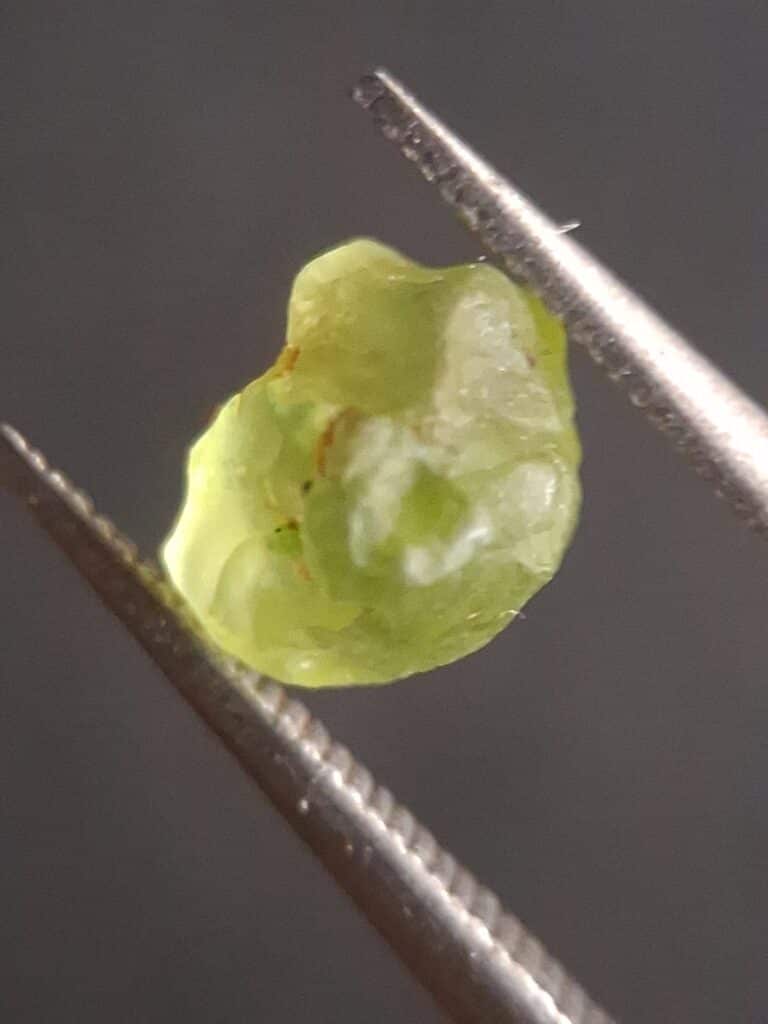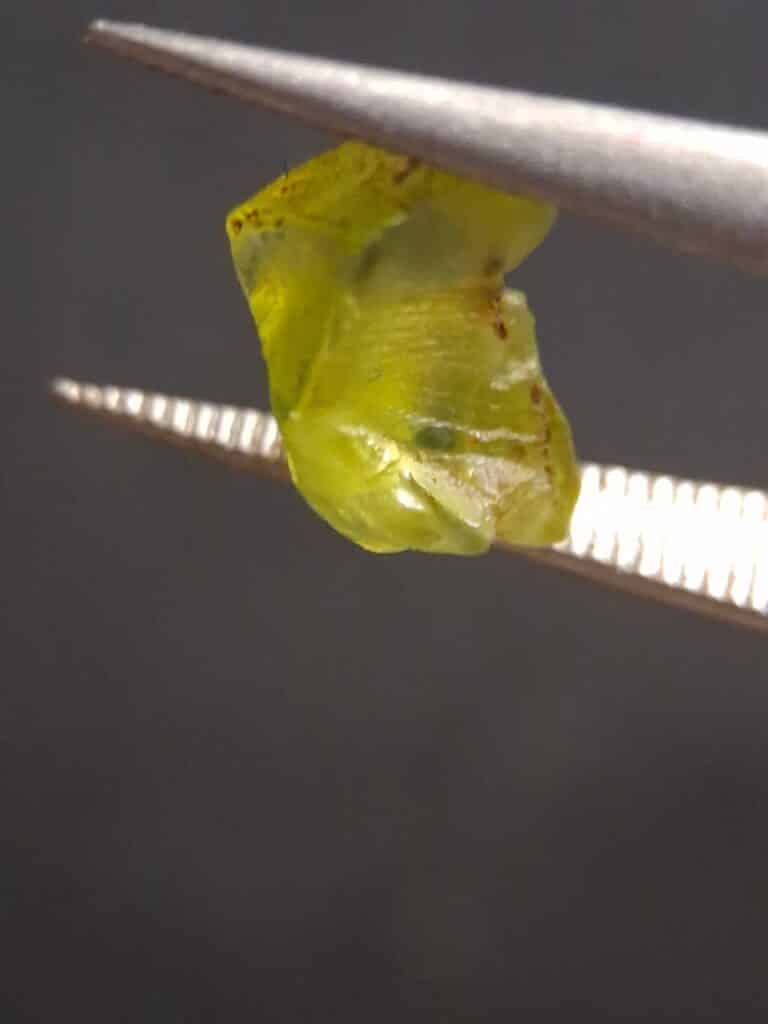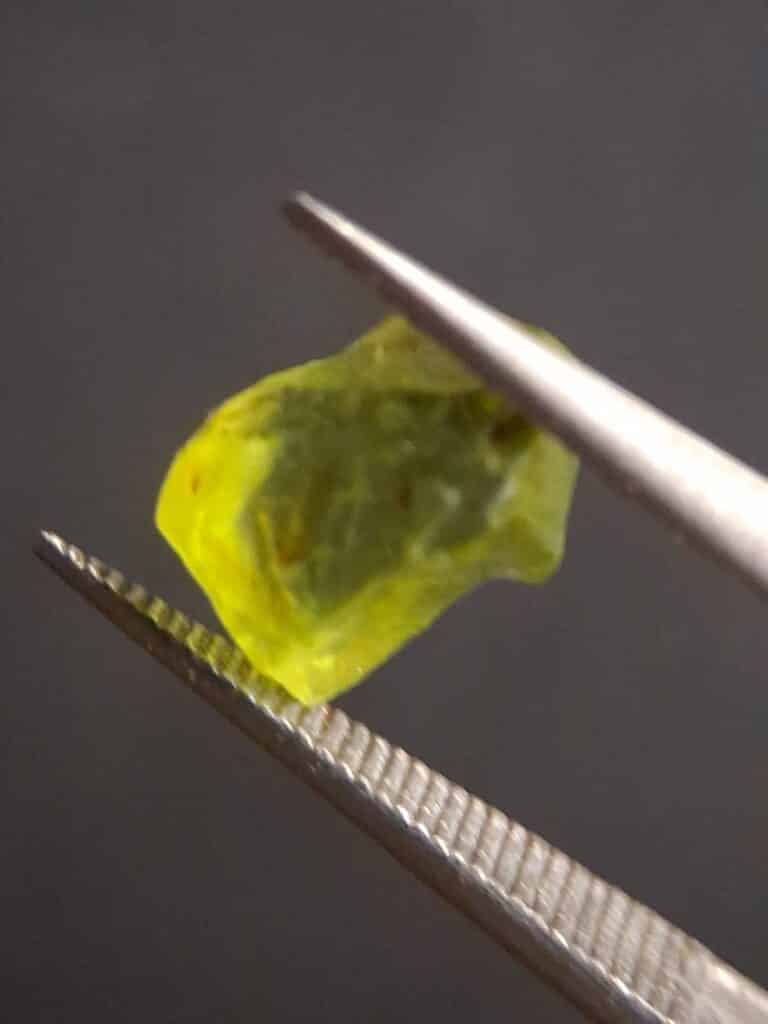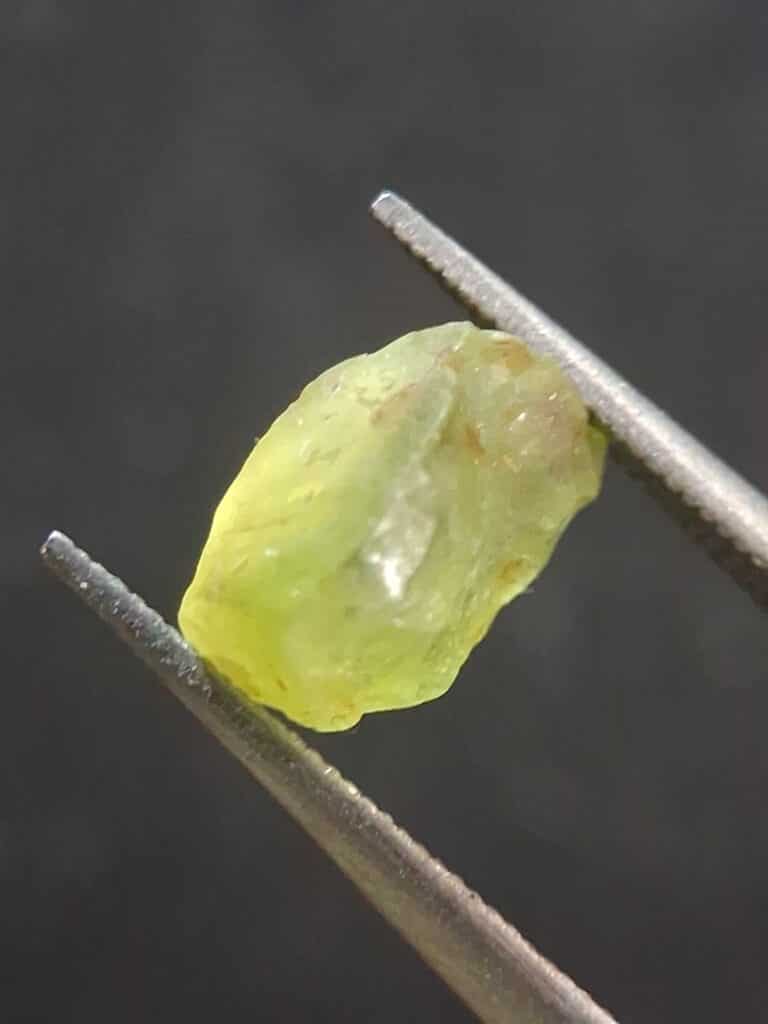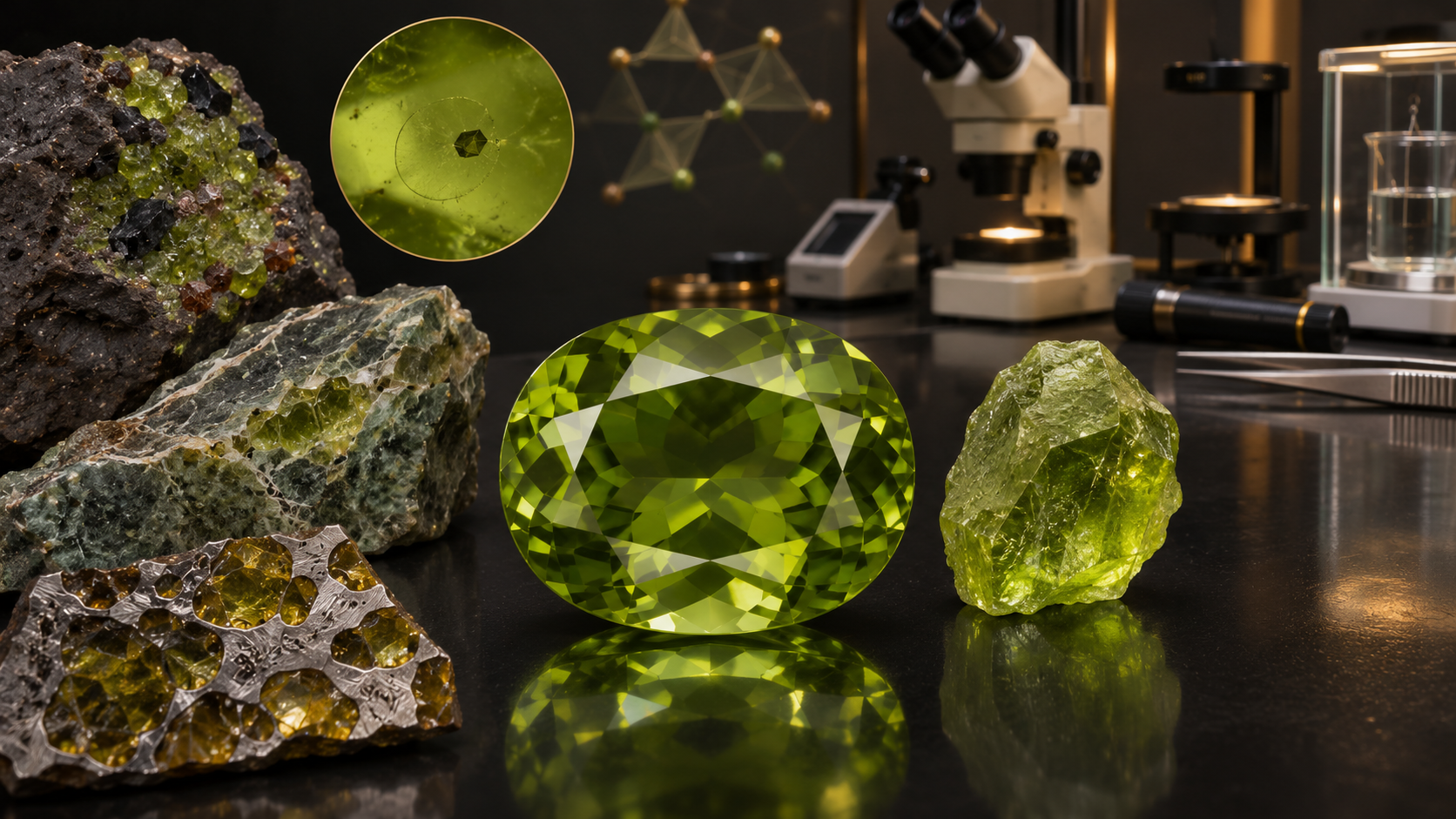
Peridot is the gemstone name given to transparent green, magnesium-rich olivine, a mineral system extending principally between the magnesium end member forsterite, Mg₂SiO₄, and the iron end member fayalite, Fe₂SiO₄.
This distinction is important. Peridot is a gemological variety or trade designation rather than a separate mineral species with one perfectly fixed composition. Fine gem peridot is normally strongly forsterite-dominant, while variations in the magnesium-to-iron ratio influence colour, refractive index, density and other measurable properties.
Few gemstones provide such a direct connection with the deep Earth.
Olivine is one of the major minerals of the upper mantle. Some gem peridot reaches the surface when rapidly ascending basaltic magma tears fragments of mantle rock from depth and transports them upward as xenoliths. Other important deposits, including those in Myanmar, Pakistan and the historic Zabargad locality in Egypt, are associated with ultramafic rocks that have experienced tectonic uplift, fluid alteration and recrystallisation.
Peridot is also one of the rare gemstones known from extraterrestrial material. Gem-quality olivine can occur within pallasite meteorites, where transparent crystals are enclosed in an iron-nickel metal framework.
Its green colour is fundamentally linked to iron within its own crystal chemistry rather than to a trace impurity acting on an otherwise colourless mineral. Ferrous iron, Fe²⁺, produces characteristic absorption that leaves the stone with its familiar yellowish-green to rich green appearance.
From a gemmological perspective, peridot is especially distinctive. It has relatively high birefringence, commonly around 0.035–0.038, which can produce conspicuous doubling of pavilion facet junctions when viewed through a faceted stone. Its refractive indices are generally around 1.65–1.69, while microscopic examination may reveal characteristic disk-like “lily-pad” fractures, chromite crystals, fluid inclusions and locality-specific mineral assemblages.
Recent research has pushed peridot identification further. Trace-element analysis can help separate material from important deposits, while Raman spectroscopy identifies microscopic inclusions and confirms unusual specimens. In 2026, GIA documented a rare two-phase inclusion in Pakistani peridot surrounded by numerous needle-like ludwigite inclusions.
In this Nadia Gemstone Academy guide, we examine peridot from mantle mineralogy and geological transport to colour chemistry, optical properties, spectroscopy, inclusions, treatments, synthetics, geographic-origin research and jewellery durability.
Peridot demonstrates exceptionally well that a gemstone can be both a beautiful object and a fragment of planetary geology.
Peridot: A Complete Gemmological Reference Guide
Table of Contents
Introduction
Peridot is the gemstone name applied to transparent green, magnesium-rich olivine.
Olivine is one of the most important rock-forming mineral systems on Earth and a major component of the planet’s upper mantle. For the gemmologist, this makes peridot unusually significant: many specimens are not simply minerals crystallised within shallow crustal rocks but fragments of geological systems that originated tens of kilometres beneath the Earth’s surface.
Its idealised composition is commonly expressed as:
(Mg,Fe)₂SiO₄
This formula reflects the solid-solution relationship between the magnesium-rich end member forsterite, Mg₂SiO₄, and the iron-rich end member fayalite, Fe₂SiO₄.
Fine gem peridot is normally magnesium rich and therefore strongly forsterite-dominant.
Peridot combines an unusually characteristic yellowish-green to green colour with relatively high birefringence. Under favourable viewing conditions, the double refraction can produce conspicuous doubling of pavilion facet junctions.
Microscopic examination may reveal disk-like “lily-pad” structures, chromite crystals, fluid inclusions and other features associated with the geological environment of formation.
The gemstone is also remarkable because natural olivine occurs beyond Earth. Transparent crystals are found in pallasite meteorites, and olivine has been identified in extraterrestrial materials from the early solar system.
Peridot therefore occupies a rare position at the intersection of gemmology, mantle petrology and planetary science.
1. Mineralogical Classification
Peridot must be described carefully from a nomenclature perspective.
It is not a separate mineral species with one fixed chemical composition.
Rather, peridot is the gemstone name used for transparent green, magnesium-rich olivine.
The olivine system includes a solid solution between major end members.
These include:
Forsterite — Mg₂SiO₄
and
Fayalite — Fe₂SiO₄
Manganese-rich members, including tephroite, occur within the broader olivine group but are not typical commercial peridot.
Most gem peridot lies much closer compositionally to forsterite than to fayalite.
A 2021 investigation of Pyaung-Gaung peridot from Myanmar, for example, measured compositions approximately 92.00–92.37% forsterite component in the studied material.
This value describes that deposit population and should not be presented as a universal composition for all peridot.
2. Crystal Structure
Olivine crystallises in the orthorhombic crystal system.
Its structure consists of isolated SiO₄ tetrahedra linked through magnesium and iron cations.
This classifies olivine as a nesosilicate or orthosilicate.
The relative proportions of magnesium and iron influence measurable properties including refractive index and specific gravity.
As iron content increases, both density and refractive indices generally rise.
Consequently, gemmological constants should be considered compositional ranges rather than perfectly fixed numbers.
3. Crystal Habit
Well-developed gem peridot crystals are less common than irregular grains or nodules.
Natural crystals can display short prismatic, tabular or rhombic forms.
Material transported within basalt may occur as irregular xenocrysts or as aggregates within mantle xenoliths.
In secondary deposits, crystals may become rounded through transport.
Material from ultramafic vein systems, such as certain deposits in Pakistan and Myanmar, can produce comparatively large crystals suitable for faceting.
Crystal morphology alone should never be treated as sufficient for gem identification.
4. The Forsterite–Fayalite Solid Solution
The Mg–Fe substitution in olivine is fundamental to understanding peridot.
Magnesium and ferrous iron can substitute for one another because their ionic behaviour allows them to occupy comparable structural sites.
At the magnesium-rich end lies forsterite.
At the iron-rich end lies fayalite.
Gem peridot usually occupies the magnesium-rich portion.
This has several consequences.
Higher magnesium and moderate iron contents generally support the attractive green colours associated with fine peridot.
Increasing iron can shift colour toward more yellowish, olive or brownish appearances.
The same compositional shift also modifies refractive index and density.
5. Why Peridot Is Green
Peridot differs from many famous coloured gemstones in the role played by its chromophore.
Ruby, for example, is essentially colourless corundum whose red colour results from chromium substitution.
Emerald similarly depends on chromium and/or vanadium entering the beryl structure.
In peridot, iron is an essential component of the olivine solid solution.
The gemstone is therefore often described as idiochromatic.
Ferrous iron, Fe²⁺, produces important absorption features that leave green and yellow-green wavelengths comparatively well transmitted.
The exact colour depends on composition, oxidation state and optical path length.
Most commercial peridot is yellowish green.
More strongly saturated green material with minimal brown or excessive yellow is particularly desirable.
6. Earth’s Upper Mantle
Olivine is one of the dominant minerals of Earth’s upper mantle.
This gives peridot an extraordinary geological context.
The upper mantle lies beneath Earth’s crust and extends to depths far beyond ordinary gemstone mining.
Humans cannot simply excavate directly to most mantle rocks.
Instead, geological processes must transport the material toward the surface.
One of the most important mechanisms is rapid volcanic ascent.
7. Mantle Xenoliths and Basalt
In several major peridot-producing regions, basaltic magma rises rapidly from depth.
During ascent, the magma can tear fragments from surrounding mantle rocks.
These fragments are known as xenoliths.
A mantle xenolith may contain olivine, pyroxene and spinel-group minerals.
When volcanic material reaches the surface, green olivine grains can remain trapped within the dark basalt.
Weathering and mining can subsequently liberate gem-quality crystals.
This geological model is particularly important for deposits in Arizona, China and Vietnam.
8. San Carlos, Arizona
The San Carlos Apache Reservation in Arizona is one of the world’s best-known peridot-producing regions.
The deposits are associated with basaltic volcanic rocks containing mantle-derived olivine-rich material.
Peridot occurs as grains and nodules within basalt.
The gemstone’s occurrence provides a direct demonstration of mantle xenolith transport.
Arizona produces large volumes of commercial peridot, although much of the material occurs in relatively modest sizes.
The deposit is scientifically important because the volcanic rocks have transported genuine upper-mantle mineral assemblages toward the Earth’s surface.
9. Vietnam – Central Highlands
The Central Highlands of Vietnam provide another well-studied basalt-associated deposit.
GIA research published in 2016 investigated the gemmological and geochemical characteristics of this material.
The researchers concluded that the peridot originated from a spinel lherzolite mantle source transported by alkaline basalt.
For the investigated geological system, estimated formation temperatures were approximately 910–980°C at an assumed pressure of about 2.0 ± 0.5 GPa.
This corresponds to an estimated depth of roughly 60 kilometres.
These numbers are particularly useful educationally because they demonstrate the deep-Earth origin of some peridot.
However, they must not be presented as universal formation conditions for all peridot deposits.
10. Ultramafic-Rock Deposits
Not all commercially important peridot reaches the surface inside young basaltic xenoliths.
Another important group occurs within ultramafic rocks that have been tectonically uplifted and subsequently modified.
These rocks may consist largely of olivine and related mantle minerals.
Hydrothermal alteration, serpentinisation, tectonic fracturing and recrystallisation can create veins or pockets containing transparent gem-quality olivine.
Myanmar, Pakistan and the historic Egyptian deposit of Zabargad provide important examples of these more complex geological histories.
11. Myanmar – Pyaung-Gaung
Myanmar is one of the world’s important sources of high-quality peridot.
The Pyaung-Gaung deposit near Mogok occurs within ultramafic rocks dominated by dunite.
Dunite is a rock composed principally of olivine.
The host rocks have undergone partial serpentinisation and substantial tectonic modification.
Gem-quality crystals occur in veins, pockets and fractures within the ultramafic body.
A detailed GIA study published in 2021 concluded that recrystallisation during tectonic events contributed to the formation of the gem material.
The studied stones were strongly forsterite-dominant and displayed rich olive-green to yellowish-green colours.
12. Myanmar Inclusion Assemblages
Pyaung-Gaung peridot contains a particularly informative suite of inclusions.
These include:
lily-pad structures
chromite
olivine
magnesite
chlorite
serpentine
talc
rutile
mica-related inclusions
fluid-like inclusions
and fine fibre tufts.
Some inclusion combinations reflect alteration and recrystallisation of the original ultramafic host rock.
The presence of protogenetic olivine inclusions within peridot was particularly notable in the GIA investigation.
Such internal features can contribute to geographic-origin assessment when interpreted together with chemical data.
13. Pakistan – Kohistan and Sapat
Pakistan has produced some exceptionally fine and large peridot crystals.
The Sapat region of Kohistan is particularly important.
The deposit is associated with ultramafic rocks modified by tectonic and hydrothermal processes.
Gem-quality olivine occurs in fractures and vein-like environments rather than simply as small xenocrysts within basalt.
Pakistani material is often recognised for attractive bright green colour and comparatively large crystal sizes.
Microscopically, some Pakistani peridot contains abundant fine ludwigite inclusions.
These needle-like structures can produce distinctive internal scenes.
14. A 2026 Pakistani Inclusion Discovery
GIA published an unusual peridot inclusion report in Summer 2026.
A 7.44 ct Pakistani peridot contained numerous needle-like ludwigite inclusions surrounding a cylindrical fluid-filled cavity.
The cavity contained both liquid and a movable gas bubble.
It was therefore classified as a two-phase inclusion.
The feature was scientifically interesting because cylindrical cavities are unusual and do not correspond to a normal crystallographic habit.
This observation demonstrates why even well-known gemstones continue to yield new microscopic information.
It should not, however, be presented as a routine diagnostic feature of Pakistani peridot.
15. Zabargad – The Historic Egyptian Source
Zabargad Island, also known historically as Saint John’s Island, lies in the Red Sea.
It is one of the most famous peridot localities in gem history.
The island exposes ultramafic rocks derived from the Earth’s lithospheric mantle.
Its geological history is connected with rifting and the tectonic development of the Red Sea.
Peridot crystals occur within altered ultramafic rocks.
Historical accounts suggest gemstone extraction from the island for more than two thousand years.
GIA published an updated historical reading list on Zabargad in 2026, integrating archaeological, geological and gemmological literature.
16. Ancient History
Ancient texts described green gemstones obtained from an island in the Red Sea.
The stones were not called peridot in the modern mineralogical sense.
Historical names included forms related to “topaz,” reflecting the absence of modern mineral classification.
Writers including Diodorus Siculus and Pliny the Elder recorded descriptions associated with the island and its stones.
Modern historical research associates these accounts with gem olivine from Zabargad.
Peridot therefore provides an excellent reminder that ancient gemstone names cannot automatically be translated into modern mineral species.
17. Peridot and “Emerald” Confusion
Green gemstones were frequently confused before the development of modern gemmology.
Historical green stones described as emerald were not always beryl.
Peridot could be mistaken for emerald because both can display attractive green colour.
Modern identification separates them easily.
Emerald belongs to the beryl species and possesses substantially lower refractive indices and density.
Peridot has much stronger birefringence and distinctly different spectroscopy.
Historical terminology should therefore be interpreted cautiously.
18. Physical Properties
Peridot has Mohs hardness approximately 6.5–7.
Its toughness is generally described as fair to good.
It lacks the exceptional hardness of ruby, sapphire or chrysoberyl.
Consequently, facet edges can abrade if the stone is worn or stored carelessly.
The fracture is generally conchoidal to uneven.
Cleavage is poor or indistinct and is not normally the principal durability concern.
The lustre is vitreous, although some rough material may appear slightly greasy.
19. Refractive Index
GIA lists a general refractive-index range for peridot of approximately:
1.65–1.69
The exact values depend on composition.
Iron-rich olivine generally exhibits higher refractive indices than more magnesium-rich material.
Detailed research can therefore produce ranges that extend somewhat beyond simplified reference values.
For example, Pyaung-Gaung peridot studied in Myanmar produced refractive-index values from approximately 1.648 to 1.689.
The correct professional approach is therefore to distinguish common gemmological reference values from deposit-specific analytical results.
20. Strong Birefringence
One of peridot’s most useful identification characteristics is its high birefringence.
GIA gives a general reference range of approximately:
0.035–0.038
This is high enough to create obvious visual effects in many faceted stones.
When viewed through the crown, pavilion facet junctions may appear doubled.
The observation depends on crystallographic orientation and viewing direction.
It is therefore not equally visible from every position.
Nevertheless, strong doubling can provide an immediate clue during microscopic examination.
21. Optical Character
Olivine is biaxial.
Typical Mg-rich gem peridot is generally described as biaxial positive.
However, the broader olivine compositional series can display changes in optic sign as chemistry varies.
For that reason, an optic sign should not be applied blindly to every member of the olivine group.
The distinction demonstrates again why gemstone terminology and mineralogical end-member chemistry must be separated carefully.
22. Specific Gravity
GIA lists a general specific gravity around:
3.34
Natural variation occurs.
The Myanmar study measured approximately 3.24–3.36 in its sample population.
Density generally increases with increasing iron content.
Specific gravity can therefore contribute to both mineral identification and compositional interpretation.
Hydrostatic measurements must also account for inclusions and possible fractures.
23. Pleochroism
Peridot generally displays weak pleochroism.
Directional colours commonly include green and yellowish green.
Because the effect is usually modest, pleochroism is less visually dramatic than in tourmaline, tanzanite or certain corundum varieties.
Nevertheless, it may provide supporting evidence in conjunction with other optical properties.
24. Spectroscopy
Iron-related absorption is central to peridot spectroscopy.
Fe²⁺ produces visible and near-infrared absorption features associated with the gemstone’s green colour.
A study of Vietnamese material documented visible features near approximately 455 and 484 nm, together with stronger absorption toward shorter wavelengths.
Research on Burmese material recorded a more complex pattern including a broad near-infrared feature centred around approximately 1050 nm.
These detailed positions depend on composition and measurement conditions.
They should therefore not be treated as one universal fixed spectrum for all peridot.
The broader diagnostic point is the presence of iron-related absorption compatible with olivine chemistry.
25. Lily-Pad Inclusions
Perhaps the most famous internal feature of peridot is the so-called “lily pad.”
These are disk-shaped fractures, healing planes or decrepitation halos associated with a small crystal, negative crystal or fluid inclusion.
The circular appearance can resemble a floating water-lily leaf under the microscope.
Lily pads are common enough to be useful identification clues.
However, they should not be regarded as mandatory.
A clean natural peridot may contain no obvious lily-pad features.
Conversely, disk-like fractures must be interpreted within the full microscopic context.
26. Chromite Inclusions
Dark chromite crystals occur in peridot from several important localities.
They may be octahedral.
Tension fractures or halos can form around the inclusion.
Chromite is geologically meaningful because it is a common accessory mineral in mantle and ultramafic rocks.
However, its presence is not unique to one geographic source.
Origin conclusions require combinations of inclusions and chemical data.
27. Other Mineral Inclusions
Depending on locality, peridot may contain:
olivine
enstatite
diopside
hercynite
serpentine
magnesite
chlorite
talc
mica-group minerals
rutile
ludwigite
and other phases.
Raman spectroscopy is particularly useful for identifying such microscopic mineral inclusions.
The assemblage can preserve evidence about the host rock and subsequent geological alteration.
28. Geographic-Origin Determination
Peridot origin determination has become increasingly sophisticated.
Standard RI, SG and colour observations are not sufficient to separate many localities reliably.
Trace-element chemistry can add discriminating power.
The 2021 Myanmar investigation used LA-ICP-MS and evaluated elements including Cr, V, Co, Sc, Ni and Ti.
Two- and three-dimensional chemical plots helped separate samples from Pyaung-Gaung, a Chinese deposit and Sapat in Pakistan within the researchers’ reference datasets.
However, the authors also emphasised the need for larger and carefully controlled reference populations.
Origin determination therefore remains a comparative scientific process rather than an absolute single-test identification.
29. Extraterrestrial Peridot
Peridot is one of the few gem materials that can genuinely occur in extraterrestrial objects.
Pallasites are rare stony-iron meteorites containing olivine crystals enclosed within iron-nickel metal.
Some crystals are sufficiently transparent to cut into gemstones.
These stones are extraordinarily rare compared with terrestrial peridot.
Their gemmological properties can overlap those of Earth-derived material.
Therefore, extraterrestrial origin should not be assigned solely from colour, visual appearance or standard RI measurements.
30. Chemical Separation of Pallasitic Material
Advanced chemical analysis can distinguish many extraterrestrial and terrestrial peridot populations.
GIA research has used LA-ICP-MS to compare elements such as lithium, vanadium, manganese, cobalt, nickel and zinc.
A particularly important difference involves nickel.
In pallasitic meteorites, nickel strongly partitions into the iron-nickel metal.
The associated olivine can consequently contain very little nickel.
Terrestrial mantle-derived gem peridot, by contrast, commonly contains substantially more nickel.
XRF and LA-ICP-MS can therefore provide valuable evidence in terrestrial-versus-pallasitic investigations.
31. Pallasitic Inclusions
GIA has documented unusual needle-like inclusions in faceted pallasitic peridot.
Some display striking interference colours under appropriate illumination.
Such features may provide clues about extraterrestrial formation history.
Nevertheless, inclusion morphology alone should not be considered proof of meteorite origin.
Chemical and contextual evidence remains important.
32. Olivine Beyond Earth
Olivine is not restricted to Earth.
It occurs in meteorites and other planetary materials.
GIA notes that olivine was also found in material collected from cometary dust by NASA’s Stardust mission.
This does not mean that commercial peridot commonly originates from comets.
It demonstrates instead that olivine is a widespread mineral component of early solar-system materials.
This adds an exceptional planetary-science dimension to the study of peridot.
33. Rare Asterism
Peridot is normally faceted to display its transparent green colour and strong brilliance.
Phenomenal peridot is rare.
Four-rayed star material has been documented, while six- and eight-rayed examples are exceptionally uncommon.
In 2025, a 34.16 ct Myanmar peridot exhibiting an eight-rayed star was reported in Gems & Gemology.
Microscopic investigation showed that two separate inclusion systems each produced a four-rayed star oriented approximately 45 degrees apart.
The combined effect created the apparent eight-rayed asterism.
This is an exceptional phenomenon rather than a normal property of peridot.
34. Treatment
Peridot is notable for the limited importance of routine colour enhancement.
GIA specifically states that no recognised heat-treatment process is known to be routinely used to improve peridot’s appearance.
Consequently, marketing a stone simply as “unheated peridot” provides little useful differentiation in the ordinary market.
This differs strongly from ruby and sapphire, where heating is an important commercial treatment consideration.
35. Fracture Filling
Peridot can contain fractures.
Surface-reaching fractures can potentially be filled with a clarity-enhancing substance.
Such treatment is not considered a routine defining feature of commercial peridot, but it is possible.
Microscopy can reveal evidence including differences in lustre, trapped bubbles or filler-related optical effects.
Filled stones require more conservative cleaning because heat or chemicals may affect the filling substance.
36. Synthetic Forsterite and Synthetic Peridot
Laboratory-grown olivine materials exist.
GIA published a detailed study in 1994 describing synthetic forsterite and experimental synthetic peridot.
Chromium-containing synthetic forsterite has been produced commercially for technological and laser applications.
Some material can resemble natural peridot.
True synthetic peridot with chemistry corresponding more closely to natural gem peridot has also been grown experimentally.
However, synthetic peridot has not developed into a major routine commercial jewellery material comparable with synthetic ruby, sapphire, spinel or emerald.
37. Identifying Synthetic Forsterite
Synthetic forsterite can differ from natural peridot in iron concentration.
Low-iron synthetic material may have lower refractive index and specific gravity than typical natural peridot.
Chromium-related spectral features can also provide evidence in certain synthetic materials.
Some laboratory-grown crystals may be unusually clean or contain growth-related features.
A confident conclusion should combine optical measurements, spectroscopy, microscopy and, where necessary, chemical analysis.
38. Imitations
Peridot can be imitated by both natural and manufactured materials.
Possible look-alikes include:
green glass
green synthetic spinel
green tourmaline
certain garnets
diopside
and other yellow-green gemstones.
GIA notes that glass and synthetic spinel have both been used as peridot simulants.
Peridot’s strong birefringence is a particularly useful distinguishing characteristic.
Glass and ordinary synthetic spinel are singly refractive.
Their refractive indices and densities also differ.
39. Peridot Versus Emerald
Emerald and peridot may both appear green but are fundamentally different minerals.
Emerald belongs to the beryl species.
Peridot belongs to the olivine system.
Emerald has lower refractive indices, lower birefringence and lower specific gravity.
Its green colour normally involves chromium and/or vanadium.
Peridot’s green colour is principally related to iron intrinsic to its Mg–Fe mineral chemistry.
These distinctions make laboratory separation straightforward.
40. Peridot Versus Green Tourmaline
Green tourmaline can occasionally resemble peridot.
Tourmaline generally has stronger pleochroism and a different RI range.
It is uniaxial rather than biaxial.
Tourmaline’s birefringence and absorption behaviour also differ.
A combination of refractometer, polariscope and dichroscope observations usually separates the materials readily.
41. Peridot Versus Glass
Green glass may imitate peridot visually.
Glass is amorphous and therefore normally singly refractive.
Peridot is crystalline and strongly doubly refractive.
Gas bubbles and flow lines may also be visible in glass.
Strong facet-junction doubling in peridot can be especially useful during microscopic examination.
However, no identification should rely on one visual characteristic when standard gemmological measurements are available.
42. Durability
Peridot has a Mohs hardness of approximately 6.5–7.
This makes it sufficiently durable for many jewellery applications but less resistant to scratching than quartz, topaz, chrysoberyl, corundum or diamond.
Its toughness is fair to good.
Sharp impact can cause fractures.
Facet junctions may abrade through prolonged wear.
Protective jewellery design is therefore sensible, especially for rings worn frequently.
43. Thermal Stability
Peridot can be vulnerable to sudden or uneven heating.
Rapid temperature change can produce fractures.
This is particularly important during jewellery repair.
A jeweller should avoid exposing an unknown mounted peridot to unnecessary torch heat.
GIA also advises against steam and ultrasonic cleaning.
Warm soapy water is the safest routine cleaning method.
44. Chemical Stability
Peridot is stable to ordinary light exposure.
However, it can be attacked by strong acids.
GIA specifically notes susceptibility to sulfuric acid and, to a lesser degree, hydrochloric acid.
Prolonged exposure to acidic perspiration can also affect the surface over time.
Ordinary jewellery care should therefore avoid harsh chemical cleaners.
45. Why Peridot Matters to Gemmology
Peridot connects several branches of science unusually directly.
Mineralogy explains the forsterite–fayalite solid solution.
Crystallography explains its orthorhombic structure and strong double refraction.
Solid-state chemistry explains the role of iron in colour.
Spectroscopy allows the Fe²⁺ absorption system to be investigated.
Microscopy reveals inclusions that preserve evidence of mantle rocks, alteration and recrystallisation.
Geology explains how some specimens formed at great depth and were transported upward by basaltic magma.
Tectonics explains deposits in uplifted and altered ultramafic rocks.
Trace-element chemistry assists geographic-origin investigation.
Planetary science introduces pallasitic meteorites and other extraterrestrial olivine.
Few gemstones provide such a direct connection between a jewellery material and the physical architecture of the planet.
Peridot is therefore much more than a yellowish-green gemstone.
It is a fragment of geological history that can record processes from Earth’s upper mantle to the earliest materials of the solar system.
References & Further Reading
The following references are scientific, educational or institutional resources and are not gemstone product pages.
1. Gemological Institute of America – Peridot Gem Encyclopedia
General reference for peridot classification, chemistry, refractive index, birefringence, specific gravity, hardness and sources.
2. Gemological Institute of America – Peridot Description
Educational reference covering olivine geology, basaltic occurrences, mantle origin, colour and major deposits.
https://www.gia.edu/peridot-description
3. Seneewong-Na-Ayutthaya, M., Chongraktrakul, W. & Sripoonjan, T. – Gemological Characterization of Peridot from Pyaung-Gaung in Mogok, Myanmar
Gems & Gemology, Winter 2021.
Detailed study of ultramafic host rocks, mineral inclusions, spectroscopy, chemistry and geographic-origin discrimination.
4. Thuyet, N. T. M. et al. – Peridot from the Central Highlands of Vietnam: Properties, Origin, and Formation
Gems & Gemology, Fall 2016.
Scientific investigation of mantle source, basaltic transport, spectroscopy, inclusions and estimated formation conditions.
5. Palke, A. C. & Shigley, J. E. – Colored Stones from the Deep
Gems & Gemology, Winter 2021.
Overview of mantle-derived gemstones and olivine-rich xenoliths transported by basalt.
https://www.gia.edu/gems-gemology/winter-2021-colored-stones-from-the-deep
6. Shigley, J. E. et al. – Gems Formed in Magmatic Rocks
Gems & Gemology, Winter 2022.
Scientific overview of olivine/peridot formation in magmatic, ultramafic and mantle-related geological environments.
https://www.gia.edu/gems-gemology/winter-2022-colored-stones-unearthed
7. Gübelin, E. – Zabargad: The Ancient Peridot Island in the Red Sea
Gems & Gemology, Spring 1981.
Classic geological and gemmological investigation of the historic Egyptian source.
https://www.gia.edu/gems-gemology/spring-1981-zabargad-peridot-gubelin
8. Gemological Institute of America – Historical Reading List: Peridot from Egypt
Updated June 26, 2026.
Extensive historical, archaeological and geological bibliography concerning the Zabargad deposit.
https://www.gia.edu/reading-list-peridot-from-egypt
9. Sinkankas, J., Koivula, J. I. & Becker, G. – Peridot as an Interplanetary Gemstone
Gems & Gemology, Spring 1992.
Scientific investigation of faceted olivine recovered from pallasite meteorites.
https://www.gia.edu/gems-gemology/spring-1992-interplanetary-peridot-sinkankas
10. LeCroy, B. – Two-Phase Inclusion in Peridot
Gems & Gemology, Summer 2026.
Recent microscopic report documenting an unusual liquid-and-gas inclusion associated with ludwigite needles in Pakistani peridot.
https://www.gia.edu/gems-gemology/summer-2026-microworld-two-phase-inclusion-in-peridot
11. Steinbach, M. P., Kiefert, L. & Fiedler, J. – Large Peridot from Myanmar with an Eight-Rayed Star
Gems & Gemology, Fall 2025.
Report on an exceptionally rare asteriated peridot and the two inclusion systems responsible for its eight-rayed star.
https://www.gia.edu/gems-gemology/fall-2025-gemnews-peridot-eight-rayed-star
12. Nassau, K. – Synthetic Forsterite and Synthetic Peridot
Gems & Gemology, Summer 1994.
Foundational study of chromium-bearing synthetic forsterite and experimental synthetic peridot.
https://www.gia.edu/doc/SU94.pdf
13. Gemological Institute of America – Peridot Care and Cleaning Guide
Professional guidance concerning hardness, toughness, thermal sensitivity and appropriate cleaning.
https://www.gia.edu/peridot-care-cleaning
14. Gemological Institute of America – Chemical Analysis in the Gemological Laboratory: XRF and LA-ICP-MS
Gems & Gemology, Winter 2024.
Modern discussion of elemental analysis, including differentiation of terrestrial and pallasitic peridot using trace-element chemistry.
https://www.gia.edu/gems-gemology/winter-2024-chemical-analysis
15. Australian Museum – Peridot
Updated 26 June 2026.
Institutional mineralogical reference covering gem-quality olivine, orthorhombic crystallography and Australian occurrences.