

Table of Contents
Introduction: When Gemstones Connected Civilisations
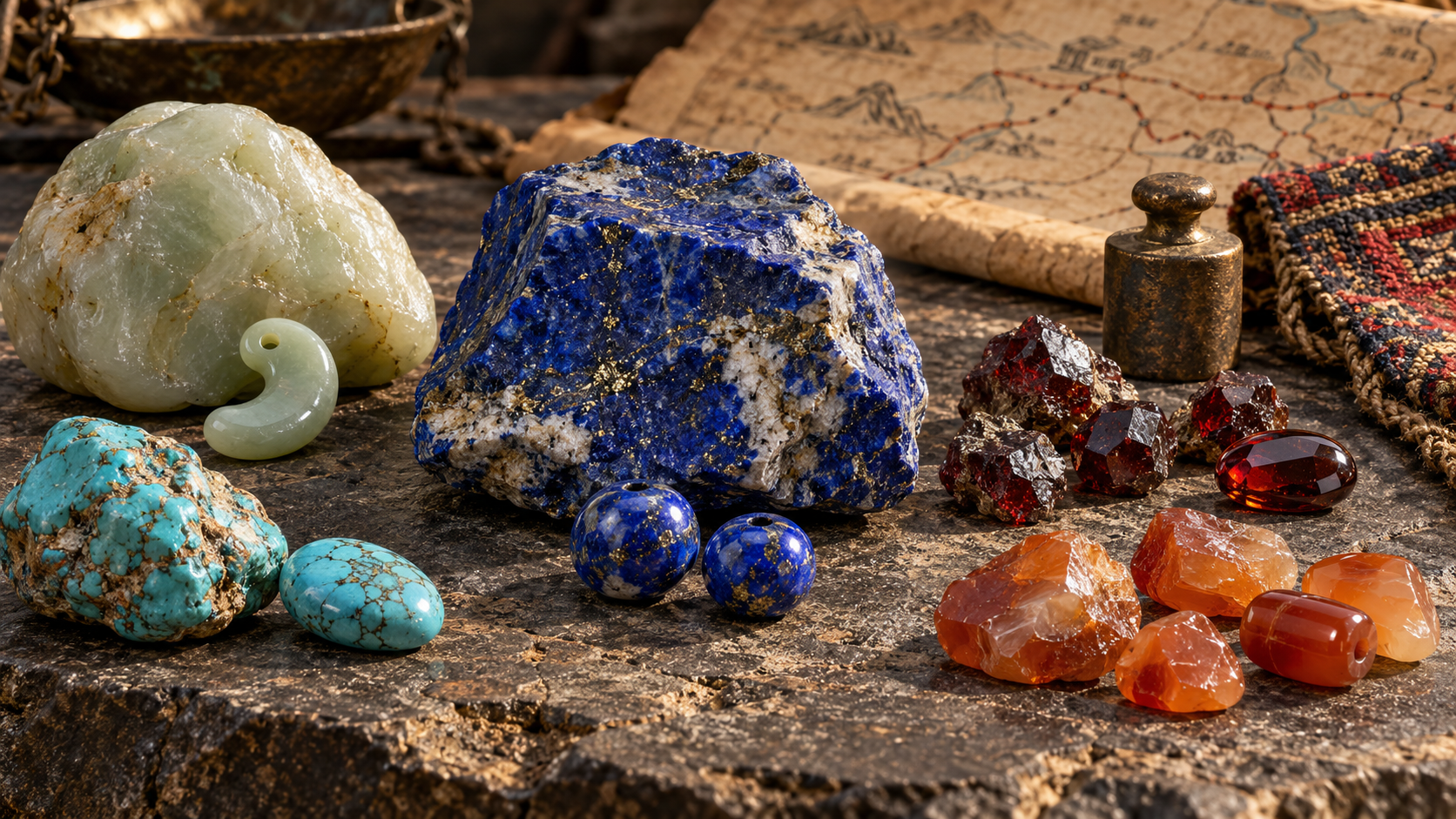
More than four thousand years ago, a piece of deep-blue lapis lazuli could begin its journey in the mountains of northeastern Afghanistan and eventually reach a workshop in ancient Mesopotamia.
There, an artisan might transform the material into beads, decorative inlays or ceremonial objects.
The finished gemstone could become part of a royal ornament, a religious object or an elaborate burial offering.
Its geological origin might lie thousands of kilometres from the place where it was ultimately used.
The people who possessed the gemstone did not necessarily know where it had been mined.
Nor would the original miners necessarily have known where the material would eventually arrive.
Between those two locations stood an extensive network of merchants, transporters, craftspeople and trading communities.
Over many centuries, such networks connected distant regions of Eurasia.
Today, historians collectively describe many of these interconnected land and maritime routes as the Silk Roads.
Although silk became one of their most famous commodities, the networks transported considerably more than textiles.
Precious stones, metals, ceramics, glass, spices, dyes and numerous other materials moved between societies.
The significance of gemstones along the Silk Roads cannot be overstated, as they played a crucial role in ancient trade and cultural exchange.
Religious ideas, artistic traditions and technical knowledge travelled alongside them.
Gemstones are particularly valuable for understanding this history.
Unlike many organic materials, minerals can survive in archaeological deposits for thousands of years.
Their chemical composition may preserve information about their geological formation.
Their cutting techniques can reveal technological traditions.
Their archaeological context can provide evidence about trade, wealth and cultural exchange.
A single gemstone may therefore connect several different histories.
Its geological formation.
Its extraction from the Earth.
Its transformation by human craftsmanship.
And its movement between civilisations.
Understanding these relationships reveals why gemstones were important not only as objects of beauty, but also as participants in the development of ancient international trade.
1. What Were the Ancient Silk Roads?
The expression Silk Roads does not describe one continuous road between China and Europe.
Instead, it refers to interconnected networks of trade and communication.
These networks included routes across Central Asia, the Iranian Plateau, the Indian subcontinent and the Mediterranean world.
Maritime routes connected ports around the Indian Ocean and beyond.
The routes changed over time.
Some became important because of political stability.
Others declined following warfare, environmental changes or shifts in commercial activity.
Trading centres developed near mountain passes, river crossings, desert oases and major cities.
These locations allowed merchants to exchange goods and obtain supplies before continuing their journeys.
According to UNESCO, the Silk Roads facilitated exchanges involving merchandise, scientific knowledge, artistic traditions, religious beliefs and technologies.
The historical term itself is comparatively recent.
It became established through nineteenth-century European geographical scholarship.
The ancient merchants who travelled these networks did not generally regard themselves as participants in one unified commercial system called the Silk Road.
Instead, they operated within regional and long-distance networks that overlapped and changed through time.
This distinction is important when examining gemstone history.
Some gemstone exchanges associated with these regions began thousands of years before the better-documented Silk Roads of the historical period.
2. Why Were Gemstones Valuable Trade Commodities?
Gemstones possess several characteristics that made them attractive to ancient merchants.
Many are relatively small.
Certain varieties have high value compared with their weight.
They can be transported without the substantial storage requirements associated with bulk commodities.
Some are also sufficiently durable to survive repeated handling and long journeys.
However, gemstone value was never determined by physical properties alone.
Cultural preferences played an important role.
A mineral prized in one society might have had a different significance elsewhere.
Colour could be associated with status, religious imagery or particular artistic traditions.
Some gemstones were valued for their rarity.
Others were appreciated because they could be carved into seals, beads or decorative objects.
The geographical distribution of mineral deposits was equally important.
Certain desirable materials were available only from a limited number of known sources.
This created opportunities for long-distance exchange.
A region possessing an important gemstone deposit could supply societies that had no comparable local resource.
Over time, such relationships helped connect mining districts with workshops and markets far beyond their immediate surroundings.
3. Lapis Lazuli: A Blue Stone That Crossed Ancient Asia
Lapis lazuli is among the most historically significant ornamental materials.
Its characteristic appearance is an intense blue colour, sometimes accompanied by white calcite and metallic-looking pyrite.
From a mineralogical perspective, lapis lazuli is not a single mineral species.
It is a rock composed of several minerals.
Its blue colour is principally associated with lazurite, a member of the sodalite group.
Other components may include calcite, pyrite and additional silicate minerals.
The famous deposits of Sar-e-Sang in the Badakhshan region of northeastern Afghanistan have supplied lapis lazuli since antiquity.
These deposits occur in a mountainous geological environment.
The extraction and transportation of the material required considerable effort.
Nevertheless, lapis lazuli reached distant societies.
Archaeological discoveries demonstrate its use in ancient Mesopotamia.
The Metropolitan Museum of Art preserves Sumerian necklace beads dating to approximately 2600–2500 BCE.
The necklace contains gold and lapis lazuli.
The museum identifies the Badakhshan region of Afghanistan as the source of the lapis material.
Such objects provide compelling evidence of long-distance gemstone exchange.
However, they predate the later historical Silk Roads.
They demonstrate that important trade connections existed long before the familiar Silk Road networks developed.
4. From Afghanistan to Mesopotamia: Reconstructing an Ancient Journey
How could lapis lazuli travel from Afghanistan to Mesopotamia thousands of years ago?
The journey probably involved several stages.
Material extracted from the mountains would first have entered regional trading networks.
Merchants could then exchange it at settlements and commercial centres.
Subsequent traders might transport it farther west.
The gemstone did not necessarily travel directly from the mine to its final destination.
It may have passed through several intermediaries.
Archaeological discoveries and written documents provide evidence of these commercial relationships.
One particularly interesting example is an Old Assyrian cuneiform tablet preserved by the Metropolitan Museum of Art.
The tablet records commercial investments associated with caravan shipments.
Among the traded materials mentioned is lapis lazuli.
The document demonstrates that gemstones could form part of organised commercial transactions involving transport costs, investment and other expenses.
This evidence helps move gemstone history beyond general assumptions about luxury objects.
It shows that precious minerals participated in identifiable economic systems.
However, the existence of a trading document does not reveal every stage of a gemstone’s journey.
The complete route followed by an individual stone often remains unknown.
5. Lapis Lazuli and the Development of Artistic Traditions
The historical importance of lapis lazuli extended beyond jewellery.
Its intense blue colour made it desirable for decorative objects, inlays and artistic applications.
In some societies, blue materials acquired associations with religious imagery, royal authority or the heavens.
These meanings were culturally specific.
They should not be interpreted as universal properties of the mineral.
Lapis lazuli also became an important source of blue pigment.
The pigment known as natural ultramarine could be produced through specialised processing of lapis lazuli.
Its preparation required considerable skill.
The blue mineral component had to be separated from other constituents of the rock.
The resulting pigment became important in artistic traditions, including manuscript illumination and painting.
This development demonstrates that gemstone trade involved more than the movement of finished ornaments.
Raw mineral materials could be transformed into entirely different products.
A rock extracted for its colour might become a carved object, a bead or a valuable artistic pigment.
Its economic significance depended partly on the knowledge and craftsmanship of the people who processed it.
6. Jade: A Different Gemstone Tradition
Jade occupies a particularly important position in the history of East Asian decorative arts.
However, the word jade requires mineralogical clarification.
Two different gem materials are commonly recognised as jade.
Nephrite is an exceptionally tough aggregate composed principally of minerals in the tremolite–actinolite series.
Jadeite jade is principally composed of jadeite, a pyroxene mineral.
These materials differ in chemical composition and geological formation.
Historically, nephrite played the dominant role in ancient Chinese jade culture.
The widespread appreciation of jadeite jade developed much later.
This distinction matters when discussing the ancient Silk Roads.
It would be misleading to assume that every historical reference to Chinese jade concerns jadeite.
Many important ancient and medieval jade objects were fashioned from nephrite.
The material was valued for its toughness, texture and suitability for carving.
Its significance also extended beyond jewellery.
Jade was used for ceremonial objects, ornaments, tools, seals and other culturally important artefacts.
7. Khotan: Jade and the Central Asian Trade Networks
The region around Khotan, also known as Hotan, in present-day Xinjiang has a long association with jade.
Located near the southern margins of the Tarim Basin, Khotan became an important settlement within Central Asian trade networks.
The surrounding region was historically associated with nephrite resources.
Jade from this area entered Chinese markets through established exchange relationships.
Historical scholarship describes early trade in which jade from Khotan was exchanged for Chinese silk.
This relationship illustrates an important feature of ancient commerce.
Trade did not necessarily begin as a single network connecting the Mediterranean directly with China.
Regional exchanges developed independently and later became interconnected.
Khotan was also an important centre of Buddhist culture.
Its location allowed commercial and religious connections to develop across Central Asia.
The Metropolitan Museum of Art identifies ancient Khotan as an important relay station on the southern branch of the overland Silk Road.
Thus, the region illustrates how mineral resources, commerce and cultural exchange could become closely associated.
However, an individual jade artefact cannot automatically be assigned to Khotan merely because it belongs to a historical Chinese tradition.
Scientific identification and provenance research remain necessary.
8. Why Nephrite Was Particularly Suitable for Ancient Carving
Nephrite possesses a physical characteristic that made it especially valuable to historical craftspeople.
Its exceptionally tough structure results from tightly interlocking mineral fibres.
This structure provides strong resistance to fracture.
Toughness should not be confused with hardness.
Hardness describes resistance to scratching.
Toughness describes resistance to breaking.
Nephrite’s combination of toughness and workable physical characteristics made it suitable for demanding carving techniques.
Ancient artisans could produce elaborate objects using abrasive materials and specialised tools.
The process often required substantial labour.
The resulting objects could preserve intricate shapes while remaining resistant to ordinary mechanical damage.
Gemmological research published by GIA confirms the importance of nephrite’s interlocking structure in explaining its toughness.
This illustrates how a mineral’s physical properties can influence the development of artistic traditions.
The cultural importance of jade was not created by geology alone.
Nevertheless, its material characteristics helped make particular forms of craftsmanship possible.
9. Turquoise: A Precious Material of the Iranian Plateau
Turquoise is another gemstone closely associated with historical trade.
It is a hydrated copper aluminium phosphate mineral.
Its characteristic blue and green colours are influenced by its chemical composition.
Copper is an important contributor to blue colour.
Iron and other factors can influence greener appearances.
Turquoise occurs in several geological environments.
Some historically important deposits are located in Iran.
The region around Nishapur became especially well known for turquoise.
Nishapur was also an important commercial centre.
Located within major routes connecting Central Asia and western regions, the city participated in extensive trade.
The Metropolitan Museum of Art’s archaeological research identifies Nishapur as both a source of turquoise and a centre of production.
Raw and worked turquoise formed part of the region’s commercial activity.
The city’s prosperity was associated with numerous products, including textiles, ceramics and other traded materials.
Turquoise therefore provides a useful example of a gemstone whose geological source was closely connected to an important trading city.
10. Nishapur: Archaeological Evidence of a Trading City
The historical importance of Nishapur is supported by archaeological research.
Excavations conducted by the Metropolitan Museum of Art revealed evidence of the city’s commercial and artistic activities.
The museum describes Nishapur as an important economic centre during the medieval period.
Its location helped connect regional and long-distance trading networks.
Goods moving through the city included textiles, ceramics, glass, precious stones and other commodities.
The archaeological evidence also includes coins originating from several regions.
Such discoveries help demonstrate the geographical reach of commercial relationships.
For gemstone history, the most important lesson is that a mining region could also become a centre of processing and exchange.
A gemstone might be extracted nearby.
It could then be shaped, polished or traded through local workshops and markets.
From there, it might travel to another region.
However, the presence of turquoise in an archaeological object does not automatically prove that it originated from Nishapur.
Other turquoise deposits existed.
The identification of a particular geological source requires additional evidence.
11. Garnet: A Gemstone That Connected India and Europe
Garnet provides one of the most scientifically interesting examples of ancient gemstone trade.
The name garnet refers to a group of related silicate minerals.
Different garnet species possess different chemical compositions.
Historically important red garnets include almandine, pyrope and compositions between these end members.
Garnets were used in beads, engraved gemstones and decorative metalwork.
During late antiquity and the early medieval period, red garnets became especially prominent in jewellery.
One important decorative technique was cloisonné.
In this method, gemstones or other materials were placed within small compartments formed by metal partitions.
The technique allowed artisans to create intricate patterns.
Garnets were particularly suitable because their red colour could produce a striking visual effect when combined with precious metals.
The resulting jewellery appeared in several regions of Europe.
However, the garnets themselves did not necessarily originate near the workshops where they were used.
Scientific research has demonstrated that some historical garnets travelled remarkable distances.
12. The Scientific Discovery of an Indian Garnet in Byzantine Jewellery
A study published in Gems & Gemology in 2018 investigated an early Byzantine engraved garnet.
The gemstone was dated to approximately the late sixth to eighth century CE.
Researchers examined its chemical composition and internal characteristics.
The investigation included microscopy, Raman spectroscopy, X-ray fluorescence and electron microprobe analysis.
The gemstone displayed distinctive chemical zoning.
It also contained an inclusion-rich central region surrounded by a more transparent outer zone.
The researchers compared these features with garnets from the Garibpet deposit in present-day Telangana, India.
The correspondence was particularly strong.
Its chemical characteristics and inclusion assemblage closely matched material from that deposit.
The researchers concluded that the historical gemstone most likely originated from Garibpet.
This finding provided evidence supporting the movement of garnets from India toward the Mediterranean world.
The study also connected the gemstone with historical accounts of maritime trade.
It demonstrates how modern mineralogical analysis can contribute directly to historical research.
Importantly, the conclusion was based on several independent characteristics.
The gemstone was not assigned to India simply because it was red or belonged to the garnet group.
13. The Maritime Silk Roads and Indian Gemstone Trade
The ancient Silk Roads included maritime networks as well as overland routes.
The Indian Ocean was particularly important.
Ports along the Indian coastline connected merchants with trading centres in western Asia, East Africa and the Mediterranean region.
Gemstones formed part of these exchanges.
Garnet provides a well-documented example.
The archaeological site of Arikamedu, on India’s southeastern coast, was an important centre of bead production and trade.
Research has identified garnet beads associated with material from the Garibpet deposit.
The 2018 GIA study linked these mineralogical characteristics with those of an early Byzantine engraved gemstone.
The evidence supports the existence of long-distance trade involving Indian garnet.
However, it does not establish the precise route followed by every individual gemstone.
Some materials may have passed through several ports.
Others may have been traded repeatedly before reaching their final destination.
The history of maritime gemstone exchange was therefore more complex than a direct voyage between one mine and one foreign market.
14. Sutton Hoo: Gemstones and Early Medieval England
The famous Sutton Hoo archaeological site in eastern England provides another example of the historical importance of garnet.
The early medieval ship burial contained extraordinary objects decorated with gold and gemstones.
Several ornaments incorporated red garnets.
The British Museum has investigated the origins of these materials and the techniques used to create the jewellery.
The research connects the decorative tradition with wider networks of craftsmanship and exchange.
Modern analytical techniques have contributed to this investigation.
Methods such as X-ray fluorescence and particle-induced X-ray emission can provide information about elemental composition.
Researchers compare these results with geological reference collections and archaeological materials.
Such studies have identified different chemical groups among garnets used in early medieval jewellery.
The evidence demonstrates that garnet supply networks extended across considerable geographical distances.
However, it is important not to assume that every garnet in the Sutton Hoo objects originated from the same deposit.
Nor should every red gemstone from early medieval Europe automatically be assigned to India or Sri Lanka.
Different sources supplied different workshops and periods.
The interpretation must remain specific to the analysed material.
15. Carnelian and the Trade in Stone Beads
Carnelian is a reddish-orange to brownish-red variety of chalcedony.
Chalcedony consists principally of microcrystalline quartz.
Carnelian’s colour is associated with iron-bearing components.
The material has been used for beads, seals and decorative objects since antiquity.
Its relatively good durability and attractive colour made it suitable for repeated handling and transport.
Carnelian beads appear in archaeological contexts across several regions of Asia and the Near East.
However, identifying the precise source of ancient carnelian is not always straightforward.
The material occurs in multiple geological regions.
Different workshops could also produce similar bead shapes.
Consequently, the discovery of carnelian in an archaeological site does not automatically establish a direct trading relationship with one particular country.
The Metropolitan Museum of Art has documented prehistoric stone beads from the region around Nishapur.
Its research discusses the broader trading networks through which materials such as lapis lazuli, carnelian and turquoise could move between Central Asia and Mesopotamia.
This evidence illustrates the importance of distinguishing between archaeological context, mineral identity and geological provenance.
16. How Gemstone Trade Influenced Artistic Techniques
Gemstone trade involved more than transporting raw materials.
Craftsmanship also moved between regions.
Artisans developed techniques for cutting, drilling, engraving and polishing gemstones.
These techniques could spread through trade, migration and cultural contact.
A workshop might adopt a decorative style that originated elsewhere.
An artisan might learn a new method for setting gemstones.
Merchants could transport both finished objects and raw materials.
The British Museum’s research on garnet cloisonné demonstrates the importance of studying craftsmanship alongside gemstone provenance.
The technique became prominent in early medieval European jewellery.
However, its development involved earlier artistic traditions associated with regions farther east.
The movement of gemstones and the movement of technical knowledge were therefore related but distinct processes.
A gemstone could be imported while the finished jewellery was produced locally.
Alternatively, a completed ornament might travel across several regions.
Determining which scenario occurred requires archaeological and technical evidence.
17. Gemstones, Religion and Cultural Exchange
Gemstones were used in many religious and ceremonial traditions.
However, their meanings differed between societies.
Lapis lazuli could be incorporated into sacred imagery or prestigious decorative objects.
Jade played important roles in Chinese ceremonial and artistic traditions.
Garnets appeared in jewellery containing Christian imagery.
Other materials were used in ornaments associated with Buddhist, Islamic and additional cultural contexts.
These uses demonstrate the relationship between material culture and religious practice.
However, a gemstone’s historical religious significance should not be confused with scientifically established physical properties.
For example, a society might associate a particular colour with spiritual authority.
That association is a historical and cultural fact.
It does not establish that the mineral possesses measurable supernatural effects.
UNESCO’s Silk Roads research emphasises the movement of religious beliefs and cultural traditions alongside commercial goods.
Gemstones sometimes participated in these exchanges as decorative, ceremonial or symbolic materials.
Their significance depended on the societies that used them.
18. How Modern Science Reconstructs Ancient Gemstone Trade
Modern gemmology provides several methods for investigating historical gemstones.
The objective is to determine what can be learned from their physical and chemical characteristics.
Mineral identification
The first step is establishing the identity of the material.
Historical terminology can be ambiguous.
Ancient names do not always correspond to modern mineral species.
Therefore, a gemstone described in an old document may require careful interpretation.
Microscopic examination
Inclusions and internal structures can provide evidence about a gemstone’s formation.
Certain inclusion assemblages may be associated with particular geological environments.
Chemical analysis
Different mineral deposits may produce gemstones with distinguishable chemical compositions.
Trace-element concentrations can be especially informative.
Raman spectroscopy
Raman spectroscopy can help identify mineral phases and certain inclusions.
It is particularly valuable when examining complex materials or small archaeological objects.
X-ray fluorescence
X-ray fluorescence can provide elemental information without necessarily removing material from the object.
This is useful when studying valuable archaeological artefacts.
Electron microprobe analysis
Electron microprobe techniques can provide detailed chemical information.
However, their application depends on the preservation requirements and accessibility of the object.
Comparison with geological reference collections
Analytical results are most useful when compared with well-characterised reference material.
A chemical pattern may support a particular geological source.
However, the strength of the conclusion depends on the available comparative data.
These methods can transform an archaeological gemstone into a source of scientific evidence.
19. Can Scientists Determine Exactly Where an Ancient Gemstone Was Mined?
Sometimes researchers can identify a highly probable geological source.
However, exact origin determination is not always possible.
Different deposits may produce gemstones with overlapping chemical characteristics.
Historical mining locations may no longer be accessible.
Some deposits may have been exhausted or destroyed.
Reference collections may also be incomplete.
Furthermore, an archaeological gemstone may have undergone treatment, recutting or reuse.
These factors complicate interpretation.
The strongest provenance studies combine several kinds of evidence.
These include:
- Mineralogical identification
- Chemical composition
- Inclusion characteristics
- Geological reference samples
- Archaeological context
- Historical documents
- Manufacturing techniques
Even when the evidence strongly supports a particular source, the exact commercial route may remain uncertain.
Identifying where a gemstone formed is not equivalent to reconstructing every transaction through which it passed.
This distinction is fundamental to responsible historical gemmology.
20. Geological Origin Versus Historical Provenance
The word provenance is frequently used in gemstone discussions.
However, it can describe different forms of information.
Geological origin
The location or geological environment in which the mineral formed.
Mining or recovery location
The place where the material was extracted or collected.
Manufacturing location
The workshop or region where the gemstone was cut, carved or mounted.
Archaeological context
The location and circumstances in which the historical object was discovered.
Commercial provenance
The documented history of ownership and exchange.
These categories should not be confused.
For example, a garnet may have formed in India.
It may have been transported through maritime trading networks.
A craftsman in the Mediterranean region may have engraved it.
The finished gemstone may then have been incorporated into an object used elsewhere.
Each stage represents a different part of its history.
The scientific identification of the geological source does not automatically reveal the location of the workshop.
Similarly, discovering a gemstone in a royal burial does not establish where it was mined.
A complete historical interpretation requires evidence connecting these different stages.
21. Why Ancient Gemstone Names Can Be Misleading
Historical gemstone terminology was often based on colour and appearance.
Modern mineralogical classification did not yet exist.
Consequently, ancient names sometimes referred to several different materials.
A red gemstone might be described using a term that included more than one mineral species.
Blue stones could also be grouped according to visual appearance rather than chemical composition.
This creates difficulties when interpreting historical documents.
A written reference to a precious stone does not always provide sufficient information for modern identification.
Archaeological specimens can sometimes resolve these uncertainties.
However, when no physical material survives, the identification may remain speculative.
It is therefore important to distinguish between historical terminology and modern gemmological classification.
A scientifically responsible article should avoid assigning a modern mineral species to an ancient gemstone name without adequate evidence.
22. Why Gemstones Are Important Archaeological Evidence
Gemstones can survive for exceptionally long periods.
Their durability makes them valuable archaeological materials.
A bead or carved stone may preserve information even when textiles, wood or other organic objects have deteriorated.
The gemstone’s mineral composition may provide evidence about its geological source.
Its shape may reveal manufacturing techniques.
Wear patterns may suggest prolonged use.
Its archaeological context may indicate social or ceremonial significance.
When combined, these observations can provide insight into ancient societies.
For example, a gemstone found far from its likely geological source suggests some form of material movement.
However, it does not automatically establish direct contact between the source region and the place of discovery.
The material may have passed through numerous intermediaries.
The interpretation must therefore distinguish between evidence of exchange and evidence of direct commercial relationships.
23. Five Gem Materials and Their Historical Trade Connections
The following comparison summarises several important examples.
| Gem material | Mineralogical identity | Important historical association | Principal research significance |
|---|---|---|---|
| Lapis lazuli | Rock containing lazurite and other minerals | Badakhshan, Afghanistan; ancient Mesopotamia | Early long-distance exchange |
| Nephrite jade | Tremolite–actinolite aggregate | Khotan and Chinese jade traditions | Regional trade and carving culture |
| Turquoise | Hydrated copper aluminium phosphate | Nishapur and the Iranian Plateau | Mining, urban commerce and decorative arts |
| Garnet | Group of silicate minerals | India, Mediterranean and early medieval Europe | Chemical provenance and maritime trade |
| Carnelian | Iron-coloured chalcedony | South and Central Asian bead networks | Bead manufacture and archaeological exchange |
These associations are historically significant examples.
They should not be interpreted as exclusive geological sources.
Each material occurs in additional regions.
The importance of a particular source also changed over time.
24. What the Ancient Silk Roads Teach Us About Gemstone Value
The history of gemstone trade demonstrates that value is not determined by rarity alone.
Several factors contributed to the desirability of a material.
Its colour.
Its geological availability.
Its suitability for carving.
Its durability.
Its cultural meaning.
Its association with prestige.
And the difficulty of obtaining it.
A gemstone could become valuable partly because it was difficult to transport.
Its appearance might also carry meanings established through religious or artistic traditions.
The development of new trade routes could increase access to previously rare materials.
Conversely, political instability or the disruption of trade could restrict supply.
These relationships changed over time.
Consequently, the historical value of a gemstone should not be assumed to correspond directly to its modern commercial price.
The market conditions, cultural preferences and available technologies were different.
25. The Natural Gems Belgium Perspective
At Natural Gems Belgium, gemstone education benefits from considering both scientific properties and historical context.
A natural gemstone is the result of geological processes.
However, the human history of that material begins when it is discovered, extracted, collected or transformed.
The ancient Silk Roads demonstrate how gemstones could connect distant societies.
They also show why accurate terminology matters.
A historical lapis lazuli object should not be described as though lapis lazuli were one mineral species.
An ancient Chinese jade carving should not automatically be identified as jadeite.
A red gemstone in early medieval jewellery should not be assigned to a particular garnet species without supporting evidence.
Likewise, a historical trading association should not be used to claim that a modern gemstone comes from the same geological source.
Responsible gemstone documentation distinguishes between mineral identity, geographical origin, treatment status and commercial provenance.
Historical information can enrich a gemstone’s description.
It should not replace scientific identification or reliable documentation.
26. Common Misconceptions About Ancient Gemstone Trade
Misconception 1: The Silk Road was one continuous road.
Incorrect.
The Silk Roads consisted of interconnected land and maritime networks.
Misconception 2: Gemstone trade began with the Silk Roads.
Incorrect.
Long-distance gemstone exchange existed thousands of years earlier.
Misconception 3: Every ancient lapis lazuli object travelled along the historical Silk Roads.
Incorrect.
Some important archaeological examples predate those networks.
Misconception 4: All ancient Chinese jade was jadeite.
Incorrect.
Nephrite was historically the dominant jade material in ancient Chinese traditions.
Misconception 5: Every early medieval European garnet originated in India.
Incorrect.
Scientific studies identify several different garnet source groups.
Misconception 6: A gemstone found in one country must have been mined there.
Incorrect.
Gemstones could travel considerable distances before being incorporated into archaeological objects.
Misconception 7: Ancient gemstone names always correspond to modern mineral species.
Incorrect.
Historical terminology frequently grouped materials according to appearance.
Misconception 8: Identifying a gemstone’s geological source reveals its complete trade route.
Incorrect.
The precise sequence of merchants, workshops and transactions may remain unknown.
27. The Continuing Scientific Importance of Historical Gemstones
The study of ancient gemstones remains an active field of research.
Advances in analytical technology allow researchers to investigate archaeological materials with increasing precision.
Non-destructive methods are particularly important.
They can provide valuable chemical and structural information while helping preserve historically significant objects.
Research into garnets from early medieval jewellery demonstrates how scientific methods can reveal connections that were previously difficult to establish.
Studies of lapis lazuli help reconstruct ancient exchange networks.
Investigations of nephrite provide information about geological sources and carving traditions.
Archaeological research into turquoise-producing centres contributes to understanding regional commerce.
Together, these studies show that gemstones are more than decorative objects.
They can serve as durable records of economic relationships, technological development and cultural exchange.
Conclusion: A Gemstone Can Carry More Than Geological History
The ancient Silk Roads connected distant regions through networks of commerce and communication.
Gemstones were among the materials that travelled through these systems.
Lapis lazuli from Afghanistan reached ancient Mesopotamia long before the historical Silk Roads became established.
Nephrite jade connected Central Asian sources with Chinese artistic and ceremonial traditions.
Turquoise contributed to the commercial importance of regions such as Nishapur.
Garnets travelled through networks linking India with the Mediterranean world.
Carnelian and other ornamental stones formed part of extensive bead-making and exchange traditions.
These materials were transformed by artisans and incorporated into objects that expressed wealth, identity, belief and craftsmanship.
Their journeys were rarely simple.
A gemstone might pass through several markets before reaching its final destination.
It could be cut in one region, mounted in another and eventually deposited in an archaeological context far from its geological source.
Modern gemmology provides tools for investigating these histories.
Chemical analysis, microscopy, spectroscopy and geological reference collections can help researchers identify likely sources.
Archaeology and historical documents provide the cultural context.
Neither discipline alone can always reconstruct the complete story.
But together, they reveal the extraordinary relationships between geology and civilisation.
A gemstone’s geological history begins within the Earth.
Its human history begins when people discover its beauty, recognise its usefulness and carry it beyond the place where it formed.
The ancient Silk Roads demonstrate how these two histories became connected across continents.
And they remind us that the value of natural gemstones has never been limited to their appearance alone.
References & Further Reading
The following references are selected from recognised museums, international cultural institutions and peer-reviewed gemmological research. They support the historical, archaeological, mineralogical and provenance-related discussions in this article.
All links below lead directly to educational, scientific or institutional sources rather than commercial gemstone product pages.
1. UNESCO – About the Silk Roads
Institution: UNESCO Silk Roads Programme
An authoritative introduction to the interconnected land and maritime networks known today as the Silk Roads.
The resource explains that the Silk Roads were not a single route, but evolving networks through which commodities, technologies, religions, ideas and artistic traditions travelled between communities across Eurasia.
https://www.unesco.org/en/silk-roads/about-silk-roads
2. UNESCO World Heritage Centre – Silk Roads: The Routes Network of Chang’an–Tianshan Corridor
Institution: UNESCO World Heritage Centre
A detailed historical and archaeological overview of the approximately 5,000-kilometre Chang’an–Tianshan corridor.
The UNESCO documentation explains how the network connected East and Central Asia and supported long-distance exchange in high-value commodities, religious traditions, scientific knowledge, technologies and artistic practices.
https://whc.unesco.org/en/list/1442
3. Shigley, James E. – Historical Reading List: Lazurite (Lapis Lazuli) from Afghanistan and Its Artistic Use as a Blue Pigment
Institution: Gemological Institute of America
Published: 15 December 2020
A substantial research bibliography and historical overview of lapis lazuli and lazurite.
The article identifies the Sar-e-Sang district of Badakhshan, Afghanistan, as the principal historic source of high-quality lapis lazuli and discusses the material’s long-distance trade into the Middle East, China and Europe.
It also explains the mineralogical composition of lapis lazuli and the extraction of lazurite for natural ultramarine pigment.
https://www.gia.edu/lazurite-afghanistan-reading-list
4. The Metropolitan Museum of Art – Necklace Beads from the Royal Cemetery at Ur
Culture: Sumerian
Period: Early Dynastic IIIa
Date: Approximately 2600–2500 BCE
Materials: Gold and lapis lazuli
These necklace beads were excavated from the Royal Cemetery at Ur in Mesopotamia.
The Metropolitan Museum states that the lapis lazuli originated in the Badakhshan region of Afghanistan, providing striking evidence for the long-distance movement of valuable mineral materials thousands of years before the historically documented Silk Roads reached their later development.
https://www.metmuseum.org/art/collection/search/322910
5. The Metropolitan Museum of Art – Cuneiform Tablet: Caravan Account
Culture: Old Assyrian Trading Colony
Date: Approximately twentieth–nineteenth century BCE
This commercial account from the Old Assyrian trading network records investments and expenses connected with caravan shipments.
In addition to tin and textiles, the document specifically mentions lapis lazuli sourced from Afghanistan.
It provides unusually direct documentary evidence that precious stones participated in organised long-distance commercial transactions during the early second millennium BCE.
https://www.metmuseum.org/art/collection/search/325851
6. The Metropolitan Museum of Art — The Metropolitan Museum’s Excavations at Nishapur
Institution: The Metropolitan Museum of Art
An archaeological overview of Nishapur in northeastern Iran.
The article describes Nishapur’s position on major east-west trading networks and identifies the region as an important source of turquoise as well as a centre of textile, ceramic and other forms of production.
It provides valuable context for the relationship between geological resources, urban centres and long-distance trade.
https://www.metmuseum.org/en/essays/the-metropolitan-museums-excavations-at-nishapur
7. Hsu, Tao; Makepeace, Kirk; Lucas, Andrew; Makepeace, Nikki — The Nephrite Jade Road: Evolution of the Green Nephrite Market
Institution: Gemological Institute of America
Published: 26 October 2015
A detailed study of nephrite geology, trade and Chinese jade culture.
The article explains the distinction between nephrite and jadeite jade and discusses the historical importance of Hetian/Hotan and other nephrite-producing regions.
It is particularly useful for understanding why references to historical Chinese jade cannot automatically be interpreted as references to jadeite.
https://www.gia.edu/gia-news-research/nephrite-jade-road-evolution-green-nephrite-market
8. The Metropolitan Museum of Art — Jade Basin, Qing Dynasty, Qianlong Period
Date: 1774
Material: Nephrite jade
This monumental jade basin contains an imperial inscription identifying Khotan in northwestern China as the source of the original jade boulder.
Although the object is much later than the early Silk Roads, it provides documented historical evidence of the enduring reputation of the Khotan region as an important nephrite source.
https://www.metmuseum.org/art/collection/search/42060
9. Gilg, H. Albert; Schmetzer, Karl; Schüssler, Ulrich — An Early Byzantine Engraved Almandine from the Garibpet Deposit, Telangana State, India: Evidence for Garnet Trade Along the Ancient Maritime Silk Road
Publication: Gems & Gemology
Volume: 54, Issue 2
Year: 2018
Institution: Gemological Institute of America
A particularly important archaeogemmological study.
Researchers examined an early Byzantine engraved garnet using microscopy, Raman spectroscopy, portable X-ray fluorescence and electron microprobe analysis.
Its chemical composition, zoning and inclusion assemblage corresponded closely with almandine from the Garibpet deposit in India.
The study provides strong physical evidence for garnet movement from India’s eastern coast toward the Mediterranean world during the early medieval period.
https://www.gia.edu/gems-gemology/summer-2018-byzantine-engraved-almandine
10. British Museum — Sri Lanka to Suffolk: Sutton Hoo and the Silk Roads
Author: Sue Brunning
Institution: British Museum
A museum research article examining garnet-decorated objects from the Sutton Hoo ship burial and their connections with wider early medieval exchange networks.
The article discusses gemstone sources, scientific analysis, cloisonné craftsmanship and the movement of both materials and technical knowledge.
It also demonstrates why early medieval garnets should not all be assigned automatically to a single geological source.
https://www.britishmuseum.org/exhibitions/silk-roads/sri-lanka-suffolk-sutton-hoo-and-silk-roads
11. The Metropolitan Museum of Art — Beads from Prehistoric Nishapur
Geography: Iran, Nishapur
Date: Third millennium BCE
These prehistoric stone beads demonstrate occupation and exchange in the Nishapur region long before the city’s later medieval prosperity.
The Metropolitan Museum notes that the area’s location on what later became the Great Khorasan Road connected it with trade networks through which materials such as lapis lazuli, carnelian and turquoise travelled from Central Asia toward Mesopotamia.
https://www.metmuseum.org/art/collection/search/323690
12. UNESCO Silk Roads Programme — The Exchange of Technical Knowledge Used to Craft Silk Roads Goods
Institution: UNESCO
An educational resource examining how the Silk Roads transmitted not only finished goods but also technical knowledge.
Precious stones, jewellery and luxury objects are discussed within the wider movement of specialised manufacturing skills and technologies.
This source is especially relevant to understanding how gemstone working traditions could travel separately from the raw gemstones themselves.
13. The Metropolitan Museum of Art — Buddhism Along the Silk Road: 5th–8th Century
Institution: The Metropolitan Museum of Art
An exhibition research resource examining connections among India, Pakistan, Afghanistan and Central Asia between the fifth and eighth centuries CE.
It documents how commercial routes facilitated not only material exchange but also the movement of Buddhist ideas and artistic traditions.
This provides important context for understanding gemstones as part of much wider cultural networks.
https://www.metmuseum.org/exhibitions/listings/2012/buddhism
14. The Metropolitan Museum of Art — Art of the First Cities in the Third Millennium BCE
Institution: The Metropolitan Museum of Art
A museum research essay examining the development of early urban societies and long-distance material exchange in the third millennium BCE.
The archaeological objects include gold, lapis lazuli and carnelian from Mesopotamian contexts and demonstrate that long-distance exchange in precious materials was already highly developed long before the historical Silk Roads.
https://www.metmuseum.org/essays/art-of-the-first-cities-in-the-third-millennium-b-c
Further Research Note
The historical movement of gemstones should be interpreted through several independent forms of evidence whenever possible:
- archaeological context;
- reliable historical texts;
- mineralogical identification;
- trace-element chemistry;
- inclusion analysis;
- geological reference collections;
- manufacturing technology;
- and securely documented chronology.
A gemstone’s geological source does not by itself reveal its complete historical trade route. Likewise, the discovery of a gemstone far from its geological source demonstrates movement or exchange, but does not necessarily prove direct contact between the mining region and the final place of deposition.
For archaeogemmology, the strongest conclusions are therefore those in which mineralogical evidence and archaeological context support one another.
[…] This ritual invites participants to engage deeply with the cosmos while using the powerful symbolism of Lapis Lazuli. […]