Table of Contents
One Gemstone. Two Lights. Two Colours.
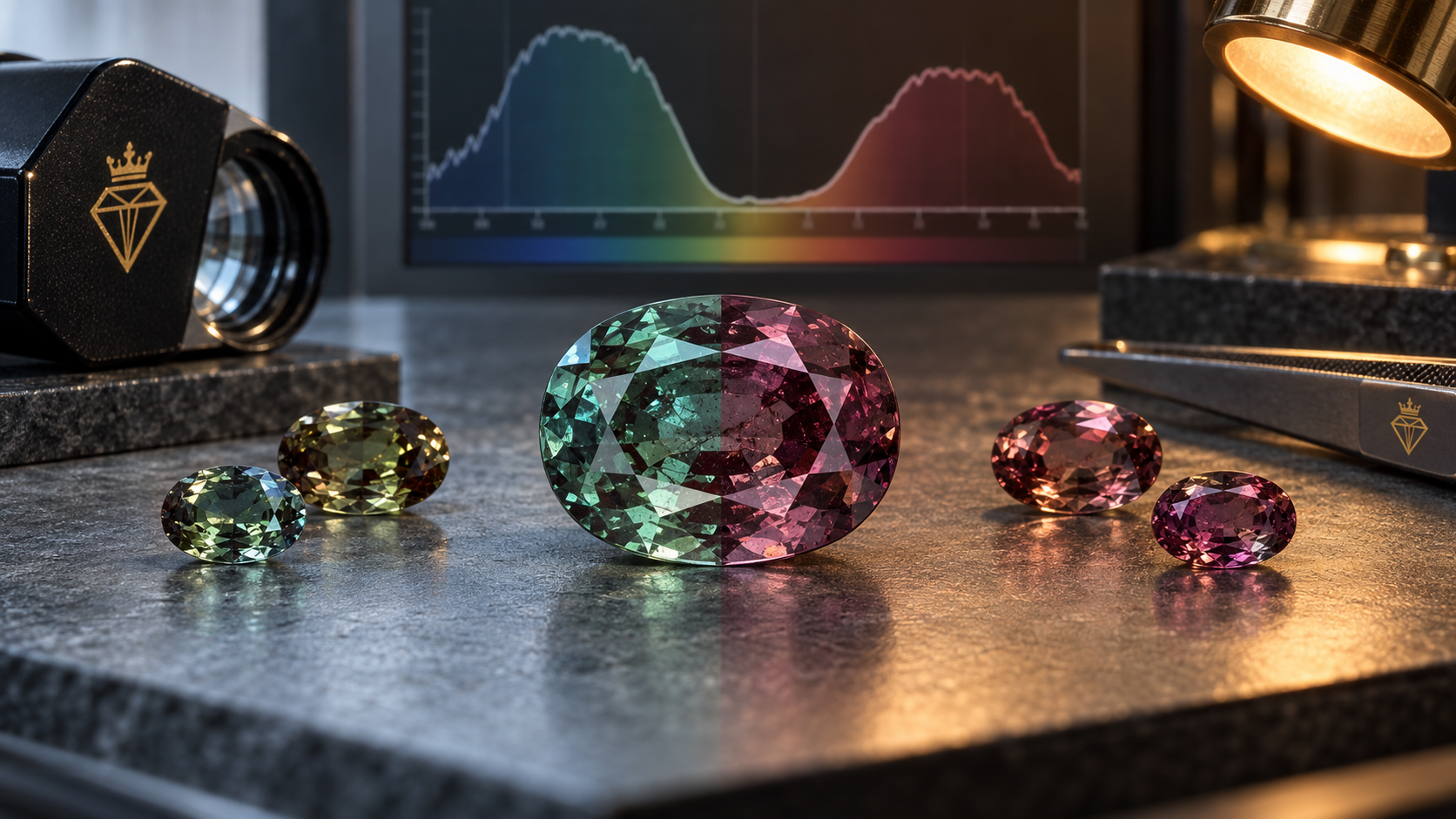
Place a fine alexandrite under daylight.
It may appear:
green
or:
bluish green.
Now move the same gemstone beneath warm incandescent light.
It can become:
purplish red
or:
reddish purple.
The gemstone has not been replaced.
Its chemical composition has not changed.
Its crystal structure has not changed.
No treatment has occurred between the two observations.
Only one major variable changed:
THE LIGHT.
This phenomenon is known as:
COLOUR CHANGE.
Alexandrite provides its most famous example.
Its transformation can be so striking that colour change in gemstones is frequently called:
THE ALEXANDRITE EFFECT.
But alexandrite is not alone.
Colour-change behaviour has also been documented in:
- garnet;
- sapphire and other corundum;
- spinel;
- kyanite;
- fluorite;
- diaspore;
- and several other gem materials.
Why can this happen?
The answer requires us to connect two things:
THE ABSORPTION SPECTRUM OF THE GEMSTONE
with:
THE SPECTRAL COMPOSITION OF THE LIGHT SOURCE.
Colour change is therefore not a property of the gemstone alone.
It is the result of an interaction:
LIGHT SOURCE × GEMSTONE × HUMAN VISION.
PART I — COLOUR DOES NOT EXIST IN ISOLATION
When we say:
“This gemstone is green,”
we are describing a visual result.
But for that result to exist, at least three components are required:
1. A LIGHT SOURCE
2. AN OBJECT
3. AN OBSERVER
Remove the light and the visible colour disappears.
Change the light and the colour may change.
This sounds obvious.
Yet it has profound consequences for gemmology.
PART II — WHITE LIGHT IS NOT ALWAYS THE SAME WHITE
Two lamps can both appear:
white
to our eyes.
But their spectral composition can be very different.
A light source can contain relatively more energy in:
- blue wavelengths;
- green wavelengths;
- yellow wavelengths;
- red wavelengths.
The distribution of energy across wavelength is called its:
SPECTRAL POWER DISTRIBUTION.
Sunlight has one spectral distribution.
An incandescent tungsten lamp has another.
Fluorescent lamps have another.
Modern LEDs can differ dramatically from one another.
Therefore:
“WHITE LIGHT” IS NOT A SINGLE PHYSICAL THING.
PART III — DAYLIGHT
Natural daylight contains a broad distribution of visible wavelengths.
Its precise spectral character varies with:
- time of day;
- latitude;
- cloud cover;
- atmospheric conditions;
- whether direct sunlight or diffuse skylight is used.
Nevertheless, daylight is comparatively rich in shorter visible wavelengths compared with traditional incandescent illumination.
This means that gemstones transmitting:
blue and green wavelengths
can appear strongly green or blue-green under daylight conditions.
PART IV — INCANDESCENT LIGHT
Traditional incandescent lamps produce light by heating a filament until it glows.
Their spectral distribution is heavily weighted toward:
longer wavelengths.
They therefore contain relatively more:
- orange;
- red;
- near-infrared
energy and comparatively less blue energy than daylight.
This is why incandescent illumination appears:
warm.
And this spectral difference is central to the classic alexandrite colour change.
PART V — SELECTIVE ABSORPTION
A coloured gemstone does not transmit all wavelengths equally.
It selectively:
absorbs
some wavelengths while transmitting others.
Its absorption pattern can be measured using:
UV-VIS-NIR SPECTROSCOPY.
The resulting graph is an:
absorption spectrum.
For colour-change gemstones, the shape of this spectrum is particularly important.
PART VI — TWO TRANSMISSION WINDOWS
Classic alexandrite-type colour change involves a gemstone that transmits significant light in two separated regions of the visible spectrum.
Broadly:
green / blue-green
and:
red.
Between them lies strong absorption in the:
yellow region.
GIA gives approximately:
580 nm
as an important absorption region associated with alexandrite’s colour behaviour.
This creates an unusual optical situation.
The gemstone can transmit enough:
green
and enough:
red
that either colour can dominate depending on the illumination.
PART VII — THE LIGHT SOURCE DECIDES WHICH WINDOW WINS
Imagine the gemstone has two major transmission opportunities:
GREEN
and:
RED.
Now illuminate it with daylight.
Daylight supplies substantial energy in the blue-green region.
The green transmission window receives abundant usable light.
The gemstone appears:
GREEN OR BLUISH GREEN.
Now illuminate it with traditional incandescent light.
That source contains much more relative red energy.
The red transmission window now dominates.
The gemstone appears:
REDDISH OR PURPLISH RED.
The stone did not change its absorption spectrum.
The:
available illumination changed.
PART VIII — THE ALEXANDRITE EFFECT
This interaction is called:
THE ALEXANDRITE EFFECT.
The classic form is approximately:
green / bluish green in daylight
↓
red / purplish red under incandescent light.
GIA describes fine alexandrite famously as:
“emerald by day, ruby by night.”
The phrase is poetic.
The physics is:
selective absorption interacting with different spectral power distributions.
PART IX — WHAT IS ALEXANDRITE?
Alexandrite is the colour-change variety of:
CHRYSOBERYL.
Its idealised chemical formula is:
BeAl₂O₄.
It belongs to the:
orthorhombic crystal system.
Its refractive index is approximately:
1.746–1.755.
Birefringence is approximately:
0.008–0.010.
Specific gravity is approximately:
3.73.
Mohs hardness:
8.5.
Alexandrite is therefore both:
optically distinctive
and:
mechanically durable.
PART X — CHROMIUM: THE KEY CHROMOPHORE
The classic alexandrite colour-change mechanism is principally associated with:
Cr³⁺.
Chromium substitutes for:
Al³⁺
within the chrysoberyl structure.
This is particularly fascinating because chromium also contributes to the colours of:
ruby
and:
emerald.
Yet the same Cr³⁺ ion produces different optical behaviour in each host.
Why?
Because the surrounding:
crystal field
changes the energy levels of the chromium ion.
As established in our earlier article on gemstone colour:
THE ELEMENT ALONE DOES NOT DETERMINE THE COLOUR.
The host crystal matters.
PART XI — WHY ALEXANDRITE IS NOT SIMPLY “GREEN CHRYSOBERYL”
Ordinary chrysoberyl can be:
- yellow;
- yellowish green;
- greenish yellow;
- brownish.
Alexandrite is defined by its distinctive:
colour-change behaviour.
The presence of chromium alone does not guarantee an ideal alexandrite effect.
The concentrations of:
- chromium;
- iron;
- vanadium
and the resulting absorption spectrum all influence appearance.
GIA research on unusually chromium-rich chrysoberyl has demonstrated that excessive chromium absorption can actually reduce the classic blue-green daylight component.
More chromophore is therefore not automatically better.
PART XII — THE ABSORPTION BALANCE
A strong alexandrite effect requires an unusual balance.
The gemstone must transmit enough light in:
green / blue-green wavelengths
while also transmitting enough:
red wavelengths.
If one transmission region dominates too strongly under both illuminants, colour change becomes weak.
The phenomenon therefore depends not simply on:
having chromium
but on:
the exact shape and intensity of the absorption spectrum.
This is why colour-change strength varies dramatically from one stone to another.
PART XIII — COLOUR CHANGE IS NOT PLEOCHROISM
This distinction is critical.
Alexandrite is:
strongly pleochroic.
It is also:
colour changing.
But these are:
TWO DIFFERENT PHENOMENA.
Pleochroism depends primarily on:
VIEWING DIRECTION RELATIVE TO THE CRYSTAL.
Colour change depends primarily on:
THE SPECTRAL COMPOSITION OF THE LIGHT SOURCE.
A gemstone can possess one phenomenon without the other.
PART XIV — THE SIMPLE TEST
Keep the light source constant.
Rotate the gemstone.
If the colour changes according to crystallographic direction, investigate:
PLEOCHROISM.
Now keep the gemstone in approximately the same orientation.
Change from daylight-equivalent illumination to incandescent illumination.
If the colour changes significantly, investigate:
COLOUR CHANGE.
The variables are different.
That distinction prevents one of the most common misunderstandings in phenomenal gemstones.
PART XV — ALEXANDRITE HAS BOTH
Alexandrite complicates matters because it can display:
both phenomena simultaneously.
Chrysoberyl is biaxial.
Alexandrite can therefore display three principal pleochroic components.
GIA describes typical alexandrite pleochroic colours including:
- green;
- orange;
- purple-red.
Yet GIA explicitly notes that the famous green-to-red colour change does:
not
arise simply from pleochroism.
It arises from:
the gemstone’s unusual absorption combined with changing illumination.
PART XVI — WHY CUT ORIENTATION STILL MATTERS
Although pleochroism does not cause the alexandrite effect, it can influence the final appearance.
Research published in Gems & Gemology examined specifically oriented faceted alexandrites.
Simple step-cut stones showed some colour differences according to orientation.
For example, stones oriented with the table perpendicular to different crystallographic axes could appear:
- more blue-green;
- more green;
- more yellowish green
in daylight.
Under incandescent illumination, they could vary between:
- intense purple;
- reddish purple;
- red-purple.
Thus:
colour change and pleochroism can interact visually.
PART XVII — COMPLEX CUTS MIX THE DIRECTIONS
Something especially interesting happens in brilliant and mixed cuts.
Light does not simply travel straight through one crystallographic direction.
It:
- enters through crown facets;
- refracts;
- reflects from pavilion facets;
- travels through multiple internal directions;
- returns through the crown.
These multiple paths mix pleochroic components.
GIA’s experimental work found that in complex faceted alexandrites, differences caused by table orientation could become:
almost negligible.
This is an excellent demonstration of how:
cut geometry can modify the visible expression of crystallographic optics.
PART XVIII — PATH LENGTH MATTERS
Colour strength also depends on how far light travels through the gemstone.
A longer path gives the material more opportunity to absorb wavelengths.
This is why a larger stone with lower chromophore concentration can sometimes display similar colour intensity to a smaller stone containing more chromium and vanadium.
GIA experiments with synthetic alexandrite demonstrated exactly this relationship.
Thus:
colour concentration cannot be interpreted independently of optical path length.
PART XIX — WHY A LARGE ALEXANDRITE CAN LOOK DARKER
As gemstone size and optical path length increase, absorption may become stronger.
This can improve saturation.
But excessive absorption can also make a gemstone:
too dark.
Therefore colour quality depends on a balance among:
- chromophore concentration;
- stone size;
- cut;
- light path;
- illumination.
Again:
MORE ABSORPTION IS NOT AUTOMATICALLY BETTER.
PART XX — THE HUMAN EYE IS PART OF THE SYSTEM
A spectrometer measures physical light intensity.
But colour is ultimately:
perceived by a human observer.
Human vision has three principal cone-response systems sensitive broadly to different wavelength ranges.
The brain interprets the relative stimulation of these receptors as:
colour.
Therefore colour change is not merely a change in the number of photons leaving the stone.
It is a change large enough to move our perception from one colour category toward another.
PART XXI — COLOUR CONSTANCY
The human visual system normally tries to compensate for changes in illumination.
A white sheet of paper still appears broadly white under many different lighting conditions even though the actual spectrum reaching our eyes changes.
This phenomenon is called:
colour constancy.
Colour-change gemstones challenge this visual compensation because their selective transmission interacts so strongly with the illumination spectrum.
The gemstone therefore appears to undergo a much more dramatic change than ordinary objects.
PART XXII — NOT EVERY LIGHTING DIFFERENCE IS TRUE COLOUR CHANGE
Almost every coloured object looks somewhat different under different lighting.
A ruby may look warmer under incandescent light.
A sapphire may look less vivid under a poor warm LED.
An emerald may look different outdoors than inside a shop.
That alone does not make every stone a:
colour-change gemstone.
The term is most useful when the hue difference is:
distinct, repeatable and substantial.
PART XXIII — COLOUR SHIFT VERSUS COLOUR CHANGE
Gemologists and the trade sometimes distinguish:
colour shift
from:
colour change.
A colour shift involves a noticeable but comparatively limited change within a related colour range.
For example:
bluish green → green
or:
purple → reddish purple.
A strong colour change moves more decisively between different hue regions:
green → red.
In practice, terminology and thresholds are not always applied identically throughout the trade.
Therefore precise description is preferable to exaggerated labels.
PART XXIV — DESCRIBE WHAT YOU ACTUALLY OBSERVE
Instead of merely writing:
“Colour-change gemstone.”
A stronger gemmological description is:
Daylight-equivalent illumination: greenish blue.
Incandescent illumination: purplish red.
Then, where appropriate:
Strong colour change.
This records:
- the illuminants;
- the observed colours;
- the strength of the phenomenon.
It is more informative and more reproducible.
PART XXV — COLOUR-CHANGE GARNET
Alexandrite is the most famous colour-change gemstone.
But some garnets can show remarkable colour change.
Scientific literature has documented alexandrite-like behaviour in:
garnet.
Some colour-change garnets can appear approximately:
- green;
- bluish green;
- brownish green
under daylight-type illumination and:
- red;
- purplish red;
- reddish purple
under incandescent illumination.
Others display different combinations.
PART XXVI — WHY GARNET CAN CHANGE COLOUR
Garnet is not one single chemical composition.
The garnet group contains complex solid solutions involving end-members such as:
- pyrope;
- almandine;
- spessartine;
- grossular;
- andradite;
- uvarovite.
Trace elements can further modify absorption.
Colour-change garnets often possess an absorption spectrum with transmission regions that allow different colours to dominate under different illuminants.
The principle is therefore analogous to alexandrite:
DIFFERENT LIGHT SOURCE + SELECTIVE TRANSMISSION = DIFFERENT PERCEIVED COLOUR.
PART XXVII — THE ALEXANDRITE EFFECT BEYOND ALEXANDRITE
Classic research by Gübelin and Schmetzer demonstrated alexandrite-like colour change in several gem materials, including:
- garnet;
- corundum;
- spinel;
- kyanite;
- fluorite;
- monazite.
Their spectra share an important general characteristic:
significant transmission in blue-green and red regions separated by strong absorption in the yellow region.
This is the spectral architecture that allows different illuminants to favour different transmitted colours.
Thus:
THE ALEXANDRITE EFFECT IS AN OPTICAL MECHANISM, NOT EXCLUSIVELY A MINERAL NAME.
PART XXVIII — COLOUR-CHANGE SAPPHIRE
Some sapphires can display colour change.
Examples may shift approximately between:
blue or violet-blue in daylight
and:
violet or purple under incandescent light.
Other combinations occur.
Because sapphire is also:
dichroic,
its appearance can be affected by both:
- viewing direction;
- illumination.
As with alexandrite, the observer must separate these variables carefully.
PART XXIX — COLOUR-CHANGE SPINEL
Spinel can also exhibit colour-change behaviour.
This is particularly instructive because spinel is:
cubic and isotropic.
Normal spinel does not show true pleochroism.
Yet colour-change spinel exists.
Therefore colour change clearly cannot require pleochroism.
The phenomenon depends on:
absorption + illumination,
not anisotropy.
PART XXX — COLOUR-CHANGE FLUORITE
Fluorite is another cubic, isotropic mineral.
Some specimens can display colour-change effects.
Again:
no true pleochroism is required.
This provides another elegant demonstration that:
COLOUR CHANGE AND PLEOCHROISM ARE FUNDAMENTALLY DIFFERENT.
PART XXXI — DIASPORE
Diaspore can display significant colour variation under different illumination.
Gem-quality colour-change diaspore may appear:
- greenish;
- yellowish green;
- olive
under daylight-type illumination and become:
- pinkish;
- orangy;
- brownish pink
under warmer illumination.
Diaspore is also anisotropic and pleochroic.
Consequently, orientation and illumination can both influence its appearance.
PART XXXII — WHY MODERN LEDs COMPLICATE EVERYTHING
Historically, colour-change descriptions often compared:
daylight
with:
incandescent tungsten light.
But many modern homes no longer use traditional incandescent bulbs.
Instead, we use:
LEDs.
Two LEDs labelled:
3000 K
can still have significantly different spectral power distributions.
One may contain strong narrow spectral peaks.
Another may have smoother spectral coverage.
A colour-change gemstone can therefore look different under:
two lamps with apparently similar white colour.
PART XXXIII — COLOUR TEMPERATURE IS NOT ENOUGH
A lamp labelled:
2700 K
is usually described as warm.
A lamp labelled:
6500 K
appears cooler or more daylight-like.
But correlated colour temperature does not tell us the complete spectral distribution.
Two lamps with the same nominal colour temperature can stimulate a gemstone differently.
For rigorous observation, we need to know more than:
warm white
or:
cool white.
We need to consider:
SPECTRAL POWER DISTRIBUTION.
PART XXXIV — WHY PHONE FLASHLIGHTS ARE POOR STANDARDS
A smartphone LED is convenient.
But it is not a standardised gemmological illuminant.
Its spectrum can vary by:
- manufacturer;
- model;
- LED technology;
- colour rendering design.
Therefore a phone flashlight may be useful for:
informal observation
but should not be treated as a rigorous standard for evaluating colour-change quality.
PART XXXV — DAYLIGHT IS VARIABLE TOO
“Daylight” sounds like a perfect standard.
But daylight itself changes.
Morning light differs from midday light.
Open shade differs from direct sun.
Cloudy daylight differs from clear sky.
Light entering through tinted or coated windows can be altered further.
Therefore professional comparison should use:
controlled daylight-equivalent illumination
where repeatability matters.
PART XXXVI — A PRACTICAL COLOUR-CHANGE TEST
A useful procedure is:
STEP 1
Use a neutral background.
STEP 2
Observe the gemstone under a known daylight-equivalent source.
STEP 3
Allow your eyes a moment to adapt.
STEP 4
Record the dominant hue.
STEP 5
Move the gemstone under a warm incandescent or appropriately characterised comparison source.
STEP 6
Keep viewing geometry as similar as practical.
STEP 7
Record the second hue.
STEP 8
Repeat the comparison.
STEP 9
If the gemstone is pleochroic, also test whether rotation contributes to the apparent change.
This separates:
illumination effect
from:
orientation effect.
PART XXXVII — DO NOT COMPARE FROM MEMORY
Human colour memory is poor.
If possible, switch rapidly between controlled illumination conditions or use a comparison arrangement designed for gemstone observation.
Do not inspect a gemstone outdoors at noon and then compare it several hours later under a restaurant lamp.
Your visual memory is not sufficiently precise for rigorous evaluation.
Repeatable testing requires:
controlled comparison.
PART XXXVIII — BACKGROUND MATTERS
The apparent colour of a gemstone is influenced by surrounding colours.
A red background can change perceived contrast.
A blue background can do the same.
For systematic observation, use a:
neutral white or neutral grey background.
This reduces environmental colour bias.
PART XXXIX — ADAPTATION MATTERS
Spend several minutes in a strongly warm-lit room and your visual system adapts.
Move into cooler light and colours can temporarily appear unusual.
This is another reason gemstone colour should not be evaluated casually.
Professional colour observation requires:
- controlled illumination;
- neutral surroundings;
- repeatable geometry;
- sufficient visual adaptation.
PART XL — CUT MATTERS
A faceted gemstone does not merely transmit light once.
Its facets redirect light repeatedly.
This affects:
optical path length.
A deeper stone may produce stronger absorption.
A shallow stone may produce weaker saturation.
Pavilion geometry affects how much light returns to the observer.
Therefore two stones with similar chemistry can display different colour-change strength because they are:
cut differently.
PART XLI — WINDOWING CAN WEAKEN THE EFFECT
A severely windowed gemstone allows substantial light to pass through without efficient internal reflection.
This shortens effective optical paths in important areas.
The colour may therefore appear:
paler
and the apparent colour change may be less impressive.
Good optical performance helps reveal the intrinsic phenomenon.
PART XLII — EXTINCTION CAN HIDE COLOUR
At the opposite extreme, excessive darkness can conceal colour information.
A stone may possess strong absorption characteristics but return so little light that the observer sees:
darkness rather than colour.
This means strong colour-change potential does not guarantee an attractive finished gemstone.
The stone must still return enough light.
PART XLIII — CHROMOPHORE CONCENTRATION MATTERS
Suppose two alexandrites contain different amounts of chromium.
The higher-chromium stone may show stronger absorption.
That can deepen colour.
But excessive absorption may suppress one of the transmission windows.
GIA research on chromium-rich chrysoberyl demonstrates this clearly.
High chromium levels can reduce blue-green transmission enough to weaken the classic daylight appearance.
Thus:
MORE CHROMIUM DOES NOT AUTOMATICALLY MEAN BETTER ALEXANDRITE.
PART XLIV — IRON MATTERS TOO
Iron can add additional absorption.
This may modify:
- hue;
- tone;
- saturation;
- transparency of spectral windows.
Therefore natural alexandrite from different geological deposits can show different colour characteristics even when chromium is the principal colour-change chromophore.
The complete trace-element environment matters.
PART XLV — VANADIUM
Vanadium can also contribute to colour in some natural and synthetic chrysoberyl.
GIA studies of synthetic alexandrite note chromium and vanadium as important colour-inducing trace elements in some materials.
Again, gemstone colour is rarely explained by one isolated chemical number.
What matters is:
how the complete absorption spectrum interacts with illumination.
PART XLVI — SPECTROSCOPY
The scientific tool that connects all these observations is:
UV-VIS-NIR SPECTROSCOPY.
A spectrometer measures absorption as a function of wavelength.
For a colour-change gemstone, we can compare:
where the stone transmits light
with:
where the illuminant supplies light.
The colour change then becomes understandable quantitatively.
What appears magical to the eye becomes:
measurable optical physics.
PART XLVII — THE HANDHELD SPECTROSCOPE
A traditional gemmological spectroscope can also provide useful evidence.
In chromium-bearing alexandrite, absorption features associated with chromium can be observed.
But a handheld spectrum should be interpreted together with:
- RI;
- birefringence;
- pleochroism;
- microscopy;
- other observations.
A spectacular colour change does not itself prove:
natural alexandrite.
PART XLVIII — SYNTHETIC ALEXANDRITE
Synthetic alexandrite exists.
Laboratory-grown chrysoberyl can have essentially the same fundamental:
- chemistry;
- crystal structure;
- optical properties
as natural material and can show:
excellent colour change.
Therefore:
ALEXANDRITE-LIKE COLOUR CHANGE DOES NOT PROVE NATURAL ORIGIN.
Identification of natural versus synthetic alexandrite requires examination of:
- inclusions;
- growth structures;
- trace-element chemistry;
- spectroscopy;
- sometimes advanced laboratory testing.
PART XLIX — SIMULANTS
Other materials can imitate an alexandrite-like colour change.
Historically and commercially, synthetic materials and other natural gems have sometimes been represented loosely as:
alexandrite.
But the term alexandrite properly refers to the colour-change variety of:
chrysoberyl.
A colour-change synthetic corundum is not chrysoberyl alexandrite.
A colour-change garnet is not alexandrite.
The optical phenomenon and the mineral identity must remain separate.
PART L — “ALEXANDRITE COLOUR” IS NOT A SPECIES
A gemstone seller may describe something as:
alexandrite colour
or:
alexandrite effect.
Neither phrase establishes mineral identity.
Correct gemmology asks:
What is the material?
and separately:
What optical phenomenon does it display?
A stone can exhibit an alexandrite-like effect without being alexandrite.
PART LI — HISTORICAL ORIGIN
Alexandrite was discovered in Russia’s:
Ural Mountains
in the early nineteenth century.
GIA places the discovery in:
1830
and historical gemmological research records that the material was named alexandrite in:
1834.
The name honoured the future:
Czar Alexander II.
Its extraordinary red-and-green appearance rapidly acquired symbolic significance in Imperial Russia.
PART LII — “EMERALD BY DAY, RUBY BY NIGHT”
The famous phrase:
“emerald by day, ruby by night”
captures the visual drama of fine alexandrite.
But it should not be interpreted literally.
Alexandrite does not become:
emerald
in daylight.
Nor does it become:
ruby
at night.
It remains:
CHRYSOBERYL.
Only its perceived colour changes.
The phrase describes appearance—not mineral identity.
PART LIII — WHY FINE ALEXANDRITE IS RARE
A fine alexandrite requires an unusually demanding combination:
- chrysoberyl of gem quality;
- appropriate chromium incorporation;
- favourable absorption balance;
- good transparency;
- attractive daylight colour;
- attractive incandescent colour;
- strong colour change;
- sufficient size;
- suitable cut.
Each requirement narrows the available material.
The intersection of all of them is:
rare.
PART LIV — WHAT MAKES A GOOD COLOUR CHANGE?
When evaluating a colour-change gemstone, consider:
DAYLIGHT COLOUR
Is it attractive?
INCANDESCENT COLOUR
Is it attractive?
DEGREE OF CHANGE
How complete is the transition?
SATURATION
Are both states vivid enough?
TONE
Is either state too dark?
BRIGHTNESS
Does the gemstone return sufficient light?
EVENNESS
Is the effect consistent across the face-up stone?
REPEATABILITY
Does the change persist under properly controlled illumination?
A dramatic transformation between two unattractive colours is not necessarily superior to a slightly less complete transformation between two beautiful colours.
PART LV — PERCENTAGE COLOUR CHANGE
The trade sometimes expresses colour-change strength as a:
percentage.
For example:
70% colour change
or:
90% colour change.
Such language can be useful descriptively.
But it should not create false precision unless a defined measurement method is used.
Human colour perception is multidimensional.
Hue, tone and saturation can all change.
Therefore a percentage based purely on visual estimation remains:
an observational grading judgement.
PART LVI — PHOTOGRAPHING COLOUR CHANGE
Colour-change gemstones are notoriously difficult to photograph accurately.
Automatic camera systems may alter:
- white balance;
- exposure;
- saturation;
- contrast.
A phone can therefore partially cancel the very lighting difference we are trying to record.
For meaningful comparison:
- use controlled light sources;
- lock white balance where possible;
- maintain identical exposure;
- maintain similar gemstone orientation;
- avoid aggressive automatic image enhancement.
Otherwise the photograph may document:
camera processing rather than gemstone behaviour.
PART LVII — ONLINE PRODUCT PRESENTATION
A colour-change gemstone should ideally be shown under:
both relevant illumination conditions.
A single photograph cannot communicate the phenomenon properly.
A useful product presentation can include:
Daylight-equivalent view
and:
Warm incandescent view.
Video can add further information.
But the illumination should be disclosed.
Without that information, the viewer cannot interpret the colour difference correctly.
PART LVIII — RESPONSIBLE DESCRIPTION
Avoid:
“Changes completely from emerald green to ruby red.”
unless the gemstone genuinely does so under controlled observation.
Prefer:
“Displays a distinct colour change from greenish blue under daylight-equivalent illumination to purplish red under warm incandescent illumination.”
This is:
- more precise;
- more credible;
- more gemmologically useful.
PART LIX — THE NGB COLOUR-CHANGE WORKFLOW
When examining a potential colour-change gemstone:
STEP 1 — IDENTIFY THE MATERIAL
Do not begin by assuming alexandrite.
↓
STEP 2 — ESTABLISH CONTROLLED ILLUMINATION
Use known daylight-equivalent and warm comparison sources.
↓
STEP 3 — RECORD DAYLIGHT COLOUR
Hue, tone and saturation.
↓
STEP 4 — RECORD INCANDESCENT COLOUR
Hue, tone and saturation.
↓
STEP 5 — KEEP ORIENTATION CONSISTENT
Especially important for pleochroic gemstones.
↓
STEP 6 — ROTATE SEPARATELY
Determine whether pleochroism also contributes.
↓
STEP 7 — EVALUATE STRENGTH OF CHANGE
Weak shift?
Moderate change?
Strong change?
↓
STEP 8 — EXAMINE WITH SPECTROSCOPE / UV-VIS-NIR WHERE APPROPRIATE
Does the absorption explain the observed effect?
↓
STEP 9 — INVESTIGATE NATURAL VS SYNTHETIC / TREATMENT STATUS
Colour change alone cannot answer this.
↓
DOCUMENT THE PHENOMENON.
PART LX — FIVE DIFFERENT SCENARIOS
ALEXANDRITE
Variable changed:
Light source
Typical phenomenon:
Green / bluish green → reddish / purplish red
Mechanism:
Selective absorption dominated by Cr³⁺ interacting with different illuminant spectra
IOLITE
Variable changed:
Viewing direction
Typical phenomenon:
Blue-violet → yellowish / nearly colourless
Mechanism:
Pleochroism
Not classic colour change.
COLOUR-CHANGE GARNET
Variable changed:
Light source
Possible phenomenon:
Greenish / brownish → reddish / purplish
Mechanism:
Alexandrite-like interaction between absorption spectrum and illumination
PRECIOUS OPAL
Variable changed:
Viewing angle
Phenomenon:
Moving spectral play-of-colour
Mechanism:
Physical optics / diffraction
Not colour change in the alexandrite sense.
BLUE SAPPHIRE UNDER WARM LIGHT
Variable changed:
Light source
Possible observation:
Blue appears duller or more violet
This may be ordinary illumination dependence rather than a sufficiently strong phenomenon to justify the term:
colour-change sapphire.
PART LXI — THE FOUR QUESTIONS
When a gemstone appears to change colour, ask:
1. DID THE LIGHT SOURCE CHANGE?
If yes:
investigate colour change.
2. DID THE VIEWING DIRECTION CHANGE?
If yes:
investigate pleochroism.
3. DID THE VIEWING ANGLE TO AN INTERNAL STRUCTURE CHANGE?
If yes:
investigate iridescence, diffraction or other phenomenal optics.
4. DID I MOVE TO A DIFFERENT PART OF THE CRYSTAL?
If yes:
investigate colour zoning.
These four questions eliminate enormous confusion.
PART LXII — WHY THIS MATTERS FOR GEM IDENTIFICATION
Colour change can be diagnostically useful.
But it is not sufficient alone.
Suppose a stone changes from:
green to red.
Possibilities include:
- alexandrite;
- colour-change garnet;
- synthetic colour-change material;
- other natural colour-change gems.
Now measure:
RI.
Alexandrite:
approximately 1.746–1.755.
Then determine:
- birefringence;
- optic character;
- SG;
- spectrum;
- inclusions.
Identification emerges from:
CONVERGING EVIDENCE.
PART LXIII — WHY THIS MATTERS FOR VALUE
For alexandrite, colour change is not merely a diagnostic curiosity.
It is one of the principal:
value factors.
Fine stones combine:
- attractive green or bluish-green daylight appearance;
- attractive red to purplish-red incandescent appearance;
- strong transition;
- good saturation;
- appropriate tone;
- transparency;
- good cut.
Weak or unattractive colour change can substantially reduce desirability.
The optical phenomenon is therefore directly connected to:
market value.
PART LXIV — FROM ATOM TO LIGHT SOURCE TO VALUE
The complete sequence is remarkable.
Cr³⁺ enters chrysoberyl.
↓
The chrysoberyl crystal field modifies chromium’s electronic energy levels.
↓
Specific visible wavelengths are absorbed.
↓
The gemstone develops two important transmission regions.
↓
Daylight supplies relatively abundant blue-green energy.
↓
The stone appears green or bluish green.
↓
Incandescent light supplies relatively abundant red energy.
↓
The same stone appears reddish or purplish red.
↓
Human vision perceives a dramatic hue transition.
↓
The quality of that transition becomes a commercial value factor.
The chain is:
ATOM → ABSORPTION → ILLUMINATION → PERCEPTION → VALUE.
PART LXV — THE DEEPER LESSON
A gemstone does not carry one immutable visual colour independent of its environment.
What we perceive depends on:
the gemstone’s optical properties
multiplied by:
the light that reaches it
and interpreted by:
the human visual system.
Alexandrite makes this relationship impossible to ignore.
Under one light:
green.
Under another:
red.
Both observations are correct.
Neither is the gemstone’s only “real” colour.
They are two outcomes of the same absorption system under:
different illumination spectra.
Conclusion
Colour-change gemstones provide one of the clearest demonstrations that gemstone colour is an:
interaction
rather than an isolated property.
Alexandrite does not physically transform from a green mineral into a red mineral.
Its crystal structure remains:
chrysoberyl.
Its chromium-related absorption remains present.
What changes is:
the spectral distribution of the illumination.
Daylight supplies comparatively abundant energy to the wavelengths that alexandrite can transmit in the green and blue-green region.
Traditional incandescent illumination supplies proportionally more red energy.
Because alexandrite possesses favourable transmission regions in both parts of the visible spectrum, the dominant colour reaching our eyes can switch dramatically.
That is:
THE ALEXANDRITE EFFECT.
But the phenomenon is not restricted to alexandrite.
Colour-change behaviour can occur in:
garnet
sapphire
spinel
kyanite
fluorite
and other materials when their absorption spectra possess the necessary structure.
This immediately teaches an important gemmological lesson:
PHENOMENON IS NOT IDENTITY.
A green-to-red colour change does not automatically prove alexandrite.
Just as a cat’s-eye effect does not automatically mean chrysoberyl, an alexandrite-like effect can occur in other minerals.
Identification still requires:
optic character
microscopy
and, where necessary:
advanced laboratory analysis.
We must also distinguish colour change from:
pleochroism.
Pleochroism changes colour when:
crystallographic viewing direction changes.
Colour change changes colour when:
illumination changes.
Alexandrite can show both.
Spinel can demonstrate why they are fundamentally different: spinel is isotropic and does not show true pleochroism, yet some spinels can show colour-change behaviour.
Modern lighting adds another layer of complexity.
The traditional comparison of:
daylight versus incandescent light
developed in a world dominated by sunlight and tungsten lamps.
Today we live among:
LEDs
with widely varying spectral distributions.
Two lamps that both appear “warm white” to the human eye may produce different responses in the same gemstone.
Therefore responsible modern colour-change evaluation requires more than simply switching between two arbitrary household lamps.
It requires:
known illumination
controlled viewing
consistent orientation
and:
repeatable observation.
For collectors and customers, this makes colour-change gemstones extraordinary.
For gemologists, it makes them even more interesting.
A fine alexandrite is not simply:
a green gemstone that becomes red.
It is a natural optical system in which:
crystal chemistry
electronic absorption
illumination physics
faceting
and:
human colour perception
all interact.
Change one part of that system—
the light—
and the gemstone appears transformed.
The stone has not changed.
THE INFORMATION CARRIED BY THE LIGHT HAS.
And that is the science behind one of gemmology’s most remarkable visual phenomena.
References & Further Reading
Gemological Institute of America (GIA) — “Alexandrite.” Gem Encyclopedia.
Authoritative overview of alexandrite’s mineralogical and gemmological properties. GIA identifies alexandrite as the rare colour-change variety of chrysoberyl, records its discovery in Russia’s Ural Mountains in the 1830s, and lists the characteristic bluish-green daylight to purplish-red incandescent appearance, RI 1.746–1.755, SG 3.73 and Mohs hardness 8.5.
https://www.gia.edu/alexandrite
Gemological Institute of America (GIA) — “Alexandrite Description.”
A particularly useful reference for separating colour change from pleochroism. GIA explains that alexandrite can appear green in daylight or fluorescent illumination and brownish to purplish red in incandescent light. It also explicitly notes that alexandrite’s strong pleochroism is a separate phenomenon from its famous light-source-dependent colour change.
https://www.gia.edu/alexandrite-description
Gübelin, E. J. & Schmetzer, K. — “Gemstones with Alexandrite Effect.” Gems & Gemology, Winter 1982, Vol. 18, No. 4. Gemological Institute of America.
Foundational scientific paper on the alexandrite effect beyond chrysoberyl. The authors describe alexandrite-like colour change in garnet, corundum, spinel, kyanite, fluorite and monazite and connect the phenomenon to characteristic transmission maxima in blue-green and red regions separated by a transmission minimum in the yellow region.
https://www.gia.edu/gems-gemology/winter-1982-alexandrite-effect-gubelin
Schmetzer, K. — “Pleochroism and Color Change in Faceted Alexandrite: Influence of Cut and Sample Orientation.” Gems & Gemology, Spring 2019, Vol. 55, No. 1.
Advanced investigation of the interaction between alexandrite’s biaxial pleochroism, crystallographic orientation, faceting and colour change. The study demonstrates that orientation can influence simple step-cut stones while complex brilliant and mixed cuts substantially mix directional colour components through multiple internal reflections.
https://www.gia.edu/gems-gemology/spring-2019-pleochroism-color-change-in-faceted-alexandrite-influence-cut-orientation
Palke, A. C. et al. — “Geographic Origin Determination of Alexandrite.” Gems & Gemology, Winter 2019. Gemological Institute of America.
Detailed modern study of natural alexandrite from major localities. The paper reviews the early-1830s discovery of colour-changing chrysoberyl in Russia’s Ural Mountains, its naming in 1834 in honour of the future Czar Alexander II, and the role of Cr³⁺ substituting for Al³⁺ in producing the characteristic colour-change behaviour.
https://www.gia.edu/gems-gemology/winter-2019-alexandrite-geographic-origin-determination
Stone-Sundberg, J. — “Titanium-Bearing Synthetic Alexandrite and Chrysoberyl.” Gems & Gemology, Winter 2013, Vol. 49, No. 4.
Useful reference for understanding why colour change cannot establish natural origin. The study examines laboratory-grown chrysoberyl and alexandrite, including strongly trichroic synthetic material showing red-green colour change, and discusses chromium, iron and vanadium chromophores in chrysoberyl.
https://www.gia.edu/gems-gemology/wn13-titanium-synthetic-alexandrite
Stone-Sundberg, J. — “‘Red’ Chrysoberyl versus Alexandrite: The Impact of Elevated Chromium Levels on Color and Color-Change Properties.” Gems & Gemology, Fall 2014.
Important research showing that simply increasing chromium concentration does not necessarily improve the classic alexandrite effect. Strong Cr³⁺ absorption can reduce blue-green transmission and therefore alter or weaken the desired daylight appearance.
https://my.gia.edu/gems-gemology/fall-2014-abstract-red-chrysoberyl-versus-alexandrite-elevated-chromium-levels-color-change-properties
Gem-A — “What Makes the Alexandrite Colour-Change Effect So Special?”
Accessible professional overview of alexandrite’s colour change, chromium-related colour and pleochroism. Particularly useful for explaining why daylight and incandescent illumination produce different appearances and why the strength and quality of colour change are major value factors.
https://gem-a.com/gem-hub/june-alexandrite-birthstone-guide/