
Table of Contents
Introduction: A Microscopic Record of Ancient Geological Fluids
A transparent gemstone may appear to be a single, continuous crystal. Under magnification, however, it can reveal an unexpectedly complex internal world.
Some crystals contain tiny cavities filled with liquid, vapour or a combination of fluid and solid phases. These are known as fluid inclusions.
Unlike an ordinary mineral inclusion, which consists of a solid mineral enclosed by the host, a fluid inclusion preserves a small portion of a fluid phase that existed during a particular event in the crystal’s history.
That fluid may have participated directly in crystal growth. Alternatively, it may have entered a fracture that formed after the crystal had already developed.
Fluid inclusions can therefore provide valuable evidence about mineral formation, later geological deformation and the movement of fluids through rocks.
In suitable circumstances, scientists can investigate their composition, phase behaviour and distribution to reconstruct aspects of the conditions under which a mineral formed.
However, a fluid inclusion is not a perfectly sealed, universally reliable thermometer or pressure gauge.
Its scientific value depends on how it formed, whether it remained intact and whether its present properties can be related to a specific geological event.
This article examines the formation, classification and interpretation of gemstone fluid inclusions in natural gemstones, with particular attention to quartz, emerald, topaz and tourmaline.
1. What Exactly Is a Fluid Inclusion?
A fluid inclusion is a small volume of fluid trapped within a mineral or other solid.
The term fluid includes liquids and gases, and in geological systems may encompass water-rich solutions, carbon dioxide-rich fluids, hydrocarbons or more complex mixtures.
Many gemstone inclusions are microscopic, although some are large enough to be visible with ordinary magnification.
The trapped material occupies a cavity within the host crystal.
That cavity may have formed during crystal growth, through fracture healing or through another geological process.
The contents can change their physical state as temperature and pressure change.
A fluid that was originally homogeneous at the time of trapping may later separate into liquid and vapour phases as the crystal cools.
Consequently, a two-phase inclusion observed at room temperature does not necessarily indicate that two separate phases were trapped originally.
This distinction is fundamental to fluid-inclusion science.
2. Why Geological Fluids Matter in Gemstone Formation
Fluids play an important role in many mineral-forming environments.
Hot aqueous solutions can transport dissolved chemical components through fractures, pores and reactive rocks.
Changes in temperature, pressure, acidity, oxidation state or fluid composition may cause minerals to precipitate.
Hydrothermal quartz, for example, can grow from silica-bearing fluids.
Emerald formation may involve fluid-rock interaction and the movement of components between chemically contrasting geological environments.
Tourmaline can crystallise in pegmatitic and hydrothermal systems involving boron-bearing melts or fluids.
However, not every gemstone forms directly from a hydrothermal fluid.
Corundum, garnet and other gemstones may crystallise through metamorphic or magmatic processes in which the role of fluids varies.
The presence of fluid inclusions must therefore be interpreted within the geological setting of the individual mineral.
3. How a Growing Crystal Traps Fluid
Crystal growth does not always proceed across a perfectly smooth surface.
Growth steps, irregularities, rapidly advancing faces and local changes in crystallisation conditions can create opportunities for small volumes of fluid to become enclosed.
As additional mineral material grows around the trapped volume, the cavity becomes isolated within the crystal.
The trapped fluid may preserve chemical and physical information about the environment at that stage of growth.
However, the inclusion is not necessarily a representative sample of the entire mineral-forming system.
Local chemical gradients, heterogeneous trapping or later modification can affect its contents.
Scientists therefore generally investigate populations of inclusions rather than relying on one isolated cavity.
4. Primary Fluid Inclusions
Primary fluid inclusions form during the growth of the host crystal.
They may occur along growth zones, crystal faces or other structures related to crystallisation.
A primary inclusion can preserve information about the fluid present while that part of the crystal was forming.
However, identifying an inclusion as primary requires evidence.
Its position within the crystal alone may not be sufficient.
Growth-related distribution patterns, relationships with internal zones and the absence of later fracture connections can support a primary interpretation.
Even then, care is necessary.
A primary inclusion assemblage may contain inclusions that underwent different degrees of post-entrapment modification.
5. Secondary Fluid Inclusions
Secondary fluid inclusions form after the relevant portion of the host crystal has crystallised.
A common mechanism involves the development of a fracture.
Fluid enters the fracture, and subsequent mineral growth or healing seals small portions of the fluid within the crystal.
The resulting inclusions may occur along planar trails that cut across earlier growth structures.
Such trails can provide evidence of later fluid movement.
They may record geological events that occurred long after the original gemstone formed.
For example, a quartz crystal can contain primary inclusions associated with its growth and secondary inclusions associated with later tectonic or hydrothermal activity.
These populations should not automatically be interpreted as recording the same temperature or fluid composition.
6. Pseudosecondary Fluid Inclusions
Pseudosecondary inclusions occupy an intermediate chronological category.
They form when a fracture develops in a crystal that is still growing.
The fracture traps fluid as it heals, and later crystal growth encloses the healed structure.
The inclusion trail may terminate at an earlier growth boundary rather than extending through the entire crystal.
This relationship can indicate that the fracture formed during the overall growth history of the host.
Pseudosecondary inclusions can be valuable because they may record fluid conditions during a particular stage of crystallisation.
However, distinguishing them from primary and secondary inclusions can be difficult when growth zoning is poorly preserved.
7. Why Classification Depends on Geological Relationships
The terms primary, pseudosecondary and secondary describe the timing of inclusion entrapment relative to crystal growth.
They do not directly describe the chemical composition of the fluid.
Nor do they indicate whether an inclusion contains one, two or three visible phases.
A primary inclusion can contain liquid and vapour.
A secondary inclusion can also contain liquid and vapour.
Both may contain additional solids.
Classification requires examination of the spatial relationships between inclusions, growth zones, fractures and crystal boundaries.
A visually impressive inclusion should not be assigned a chronological category merely because of its shape or number of phases.
8. Single-Phase Fluid Inclusions
A single-phase fluid inclusion contains one visible fluid phase at the temperature of observation.
It may appear entirely liquid or entirely vapour.
However, optical appearance alone does not always reveal its precise composition.
A single-phase inclusion may contain an aqueous solution, carbon dioxide-rich fluid or another fluid mixture.
The phase state can also depend on temperature.
An inclusion that appears single-phase at room temperature may develop a second phase when cooled or heated.
Consequently, the number of visible phases is a condition-dependent observation rather than a complete description of the inclusion’s original geological state.
9. Two-Phase Fluid Inclusions
Two-phase inclusions commonly contain a liquid and a vapour bubble.
In many aqueous inclusions, the vapour bubble forms during cooling after entrapment because the density of the trapped fluid remains constrained by the cavity volume.
The relative sizes of liquid and vapour phases may vary.
A small bubble within a larger liquid-filled cavity is a familiar appearance in quartz and other minerals.
However, bubble size alone cannot reliably determine trapping temperature.
It depends on fluid composition, density, cavity volume, pressure history and possible later changes.
The correct interpretation requires phase-equilibrium information and supporting geological evidence.
10. Three-Phase and Multiphase Inclusions
Some inclusions contain liquid, vapour and one or more solid phases.
These are often called three-phase or multiphase inclusions.
The solid phase may be a daughter mineral that crystallised from the trapped fluid during cooling.
Halite is a familiar example in highly saline aqueous inclusions.
Other solids may include carbonates or additional mineral phases, depending on the system.
However, not every solid within a fluid inclusion is necessarily a daughter crystal.
Some solids were trapped together with the fluid.
Others may have formed through later reactions.
Distinguishing these possibilities can require optical, spectroscopic and microanalytical investigation.
11. Daughter Crystals: Minerals Formed Inside the Inclusion
A daughter crystal forms from the fluid after entrapment.
As the inclusion cools, the solubility of certain dissolved components may decrease.
A solid mineral can then precipitate inside the sealed cavity.
The presence of a daughter crystal can provide information about the composition and concentration of dissolved substances.
However, identifying the mineral correctly is essential.
A small cubic solid may suggest halite in an appropriate geological context, but its shape alone is not definitive proof.
The interpretation becomes stronger when supported by microthermometric behaviour, spectroscopy or chemical analysis.
12. Accidentally Trapped Solids
A growing crystal can enclose both fluid and a pre-existing solid particle.
The solid may be an unrelated mineral grain present in the surrounding environment.
Such material is often described as an accidentally trapped solid.
It should not automatically be classified as a daughter crystal.
The distinction matters because a daughter crystal may participate in the phase equilibria of the trapped fluid, while an accidentally trapped mineral may not.
Incorrect classification can lead to misleading conclusions about salinity, temperature and fluid composition.
13. Fluid Inclusion Assemblages
Modern fluid-inclusion studies often emphasise fluid inclusion assemblages, or FIAs.
An FIA is a group of inclusions interpreted as having been trapped during the same identifiable event or interval.
For example, inclusions aligned along one healed fracture may represent a particular episode of fracture sealing.
Inclusions associated with a defined growth zone may represent a stage of crystal growth.
Studying an assemblage provides a way to test consistency.
If inclusions believed to have formed together display very different phase behaviour, this may indicate heterogeneous trapping, later modification or an incorrect grouping.
An individual inclusion is therefore best interpreted within its structural and geological context.
14. What Is Microthermometry?
Fluid inclusion microthermometry investigates the behaviour of trapped phases during controlled heating and cooling.
The method can provide information about fluid composition, density and phase transitions.
In aqueous inclusions, cooling may produce ice or other solid phases.
During subsequent warming, the temperatures at which these phases melt can help constrain fluid composition.
Heating may cause liquid and vapour phases to homogenise.
The temperature of homogenisation is an important measurement.
However, it is not automatically equal to the original trapping temperature.
Interpreting it correctly requires consideration of pressure, fluid composition and inclusion history.
15. Homogenisation Temperature
A fluid inclusion containing liquid and vapour may become a single fluid phase when heated.
The temperature at which the observed phases homogenise is called the homogenisation temperature.
For many liquid-rich aqueous inclusions, homogenisation occurs when the vapour bubble disappears.
Other inclusions may homogenise to vapour.
The measured temperature constrains the phase behaviour of the trapped fluid.
In many geological situations, the original trapping temperature was higher than the measured homogenisation temperature because the inclusion was trapped under pressure.
The difference depends on the pressure-volume-temperature properties of the fluid.
Therefore, a homogenisation temperature should not be reported as a precise formation temperature without appropriate pressure correction or independent geological constraints.
16. Freezing and Melting Behaviour
Cooling an aqueous fluid inclusion can cause ice or other solid phases to form.
When the inclusion is warmed, the temperatures of phase transitions can provide information about dissolved components.
For relatively simple water-salt systems, final ice-melting temperature can be used to estimate salinity.
However, natural fluids may contain several dissolved salts and gases.
A calculation based on a simple sodium chloride-water model may not accurately represent a chemically complex fluid.
Inclusions containing carbon dioxide or other volatile components require different phase-equilibrium interpretations.
The measured transitions must therefore be matched to an appropriate fluid system.
17. Salinity and Equivalent Sodium Chloride Concentration
Fluid inclusion salinity is often expressed as weight percent NaCl equivalent.
This is a model-based measure describing how an observed phase transition compares with behaviour in a reference sodium chloride-water system.
It does not necessarily mean that the trapped fluid contained only sodium chloride.
A natural inclusion may contain potassium, calcium, magnesium and other dissolved components.
The NaCl-equivalent value can be useful for comparison, but its meaning depends on the model used.
It should not be presented as a complete chemical analysis of the trapped solution.
18. Pressure and the Isochore Concept
A sealed fluid inclusion approximately preserves a fixed volume after entrapment, provided it remains mechanically intact and does not undergo significant post-entrapment change.
Its fluid density can therefore be used to calculate possible pressure-temperature relationships.
An isochore represents conditions of constant density for a specified fluid composition.
However, an isochore does not independently identify a unique trapping pressure and temperature.
Additional constraints are required.
These may come from mineral equilibria, geological context, independent thermometry or other evidence.
Fluid inclusion studies are strongest when integrated with broader petrological analysis.
19. Why Fluid Inclusions Are Not Perfectly Preserved
An inclusion may change after it forms.
Possible processes include stretching, leakage, decrepitation, necking down and chemical reactions with the host.
Stretching changes cavity volume.
Leakage allows material to escape.
Decrepitation involves rupture or failure of an inclusion under pressure-related stress.
Necking down occurs when an originally larger cavity separates into smaller inclusions during later modification.
These processes can alter the original density or phase proportions.
As a result, present-day measurements may no longer accurately represent the original trapping conditions.
20. Necking Down and Its Scientific Consequences
An elongated inclusion may develop constrictions that eventually divide it into smaller cavities.
If division occurs after the fluid has separated into liquid and vapour, the resulting inclusions may trap different proportions of those phases.
They can therefore show different homogenisation temperatures despite sharing an earlier history.
This is a classic source of misleading microthermometric data.
A population of inclusions with inconsistent phase ratios may require careful examination before geological conclusions are drawn.
The presence of several bubbles or unusual cavity shapes should not automatically be interpreted as evidence of multiple geological fluids.
21. Fluid Inclusions in Quartz
Quartz is one of the most extensively studied host minerals in fluid-inclusion research.
Its transparency, abundance and occurrence in hydrothermal veins make it particularly useful.
Quartz can contain primary inclusions associated with crystal growth and secondary trails formed through fracture healing.
Water-rich, carbon dioxide-bearing and other fluid systems may occur depending on the geological environment.
Some quartz crystals contain numerous inclusions visible under magnification.
Others are exceptionally clear.
The presence or absence of visible inclusions alone does not establish the geological origin of a quartz specimen.
Detailed interpretation depends on inclusion distribution, phase behaviour and the host’s geological setting.
22. Fluid Inclusions in Emerald
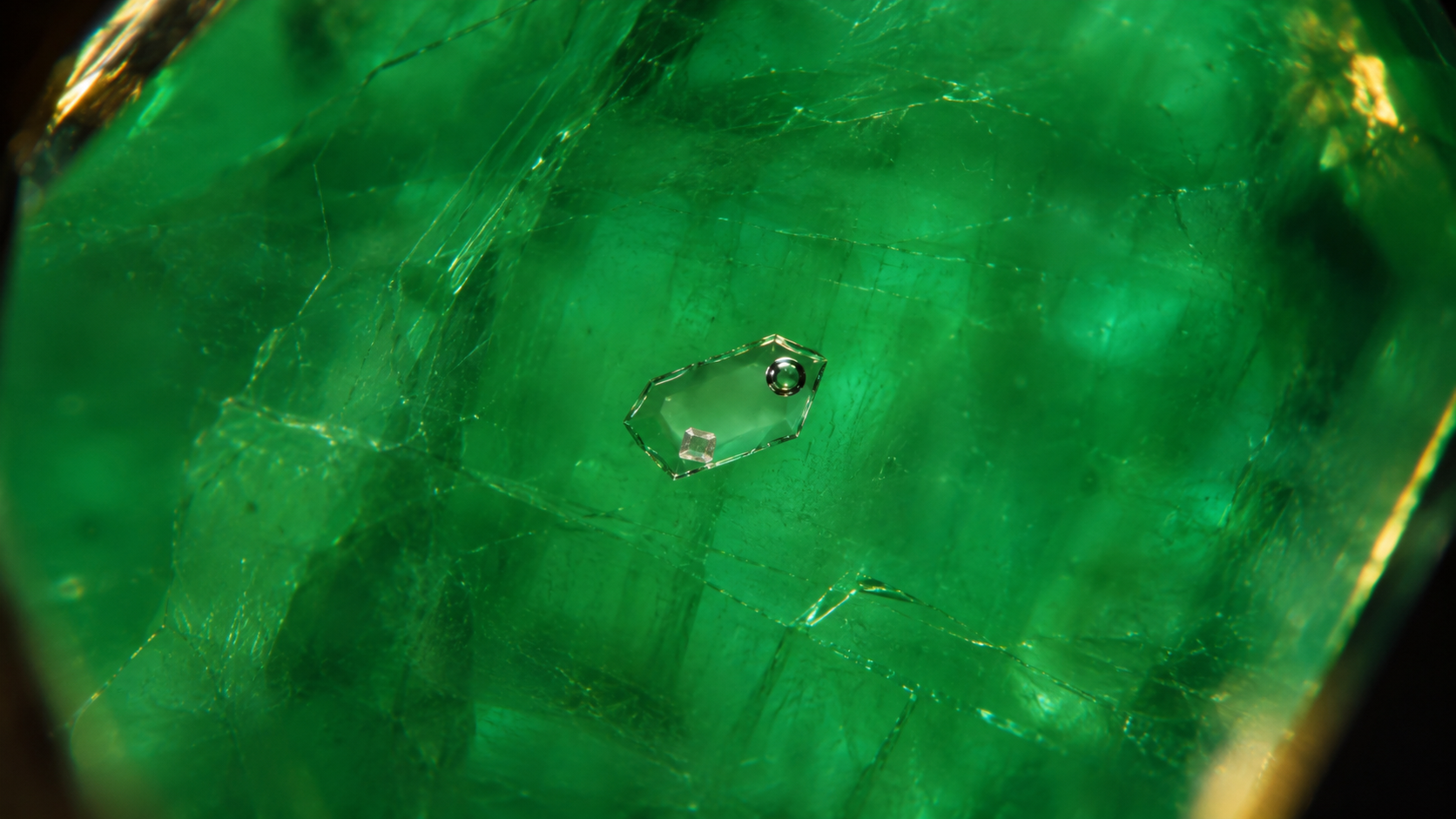
Emerald frequently contains complex inclusions.
Some natural emeralds exhibit cavities containing liquid, gas and a solid phase.
Such three-phase inclusions have historically attracted attention in geographic-origin studies.
However, similar inclusion appearances can occur in emeralds from more than one source.
Research by GIA has demonstrated that three-phase inclusions should not be treated as exclusive evidence of Colombian origin.
Their composition, morphology and associated features may provide useful information, but interpretation requires comparison with appropriate reference material.
A single inclusion type is not sufficient to establish geographic provenance.
23. Why Emerald Inclusion Interpretation Has Changed
Earlier gemmological literature sometimes associated particular inclusion appearances strongly with specific mining regions.
As new emerald deposits were studied, laboratories documented overlapping features.
This expanded the known range of inclusion populations.
The result was a more cautious approach to geographic-origin determination.
Fluid inclusions remain valuable, but their significance depends on a combination of observations.
Internal growth structures, mineral inclusions, trace-element chemistry and spectroscopy may all contribute.
The scientific lesson is that a diagnostic feature must be validated against sufficiently broad and reliable reference collections.
24. Fluid Inclusions in Topaz
Topaz can form in pegmatitic, hydrothermal and related geological environments.
Some topaz crystals contain fluid inclusions associated with their formation or later geological history.
These inclusions may provide evidence about the fluids involved in mineralisation.
However, topaz has perfect basal cleavage.
This mechanical characteristic is important when considering durability and the potential consequences of thermal or mechanical stress.
Not every topaz contains useful fluid inclusions, and not every inclusion can be safely subjected to experimental heating.
The scientific value of a specimen must be balanced against the risk of damaging it.
25. Fluid Inclusions in Tourmaline
Tourmaline occurs in a wide variety of geological environments, including granitic pegmatites and hydrothermal systems.
Its complex chemical structure accommodates numerous elements.
Fluid inclusions in tourmaline can provide information about the fluids associated with crystallisation and subsequent geological events.
However, tourmaline’s compositional diversity makes generalisation difficult.
Different tourmaline species and deposits may record very different fluid histories.
Fluid inclusion observations should therefore be interpreted alongside mineral chemistry and geological setting.
A fluid inclusion in one tourmaline specimen should not be assumed to represent the formation conditions of all tourmalines.
26. Can Fluid Inclusions Prove a Gemstone Is Natural?
Fluid inclusions can contribute to natural-versus-synthetic identification.
However, their presence alone is not proof of natural origin.
Laboratory-grown crystals can also contain trapped fluids or multiphase inclusions.
Certain synthetic emeralds, for example, may contain characteristic inclusions related to their growth method.
Natural and synthetic materials can therefore display superficially similar features.
Reliable identification requires assessment of the complete inclusion population and, where necessary, other gemmological evidence.
Fluid inclusions are supporting evidence rather than a universal standalone test.
27. Can Fluid Inclusions Reveal Treatment?
Some gemstone treatments can affect fluid inclusions.
Heating may cause pressure changes within trapped fluids.
In certain circumstances, inclusions may rupture, leak or produce fractures.
However, such changes are not universal.
Their occurrence depends on the host mineral, inclusion composition, treatment conditions and pre-existing structural features.
A ruptured inclusion is not automatically proof of heat treatment.
Natural geological heating and later deformation can also modify inclusions.
Treatment determination requires a broader evaluation of diagnostic features.
28. Fluid Inclusions and Gemstone Durability
Fluid inclusions are not automatically durability defects.
A small isolated cavity deep inside a gemstone may have little practical effect on ordinary use.
However, inclusion populations associated with fractures or weak zones can influence structural integrity.
Large cavities, surface-reaching fractures and interconnected inclusion networks may be more relevant.
Thermal changes can also create stress where trapped phases expand differently from the host.
The significance depends on the gemstone and the individual inclusion geometry.
A scientific description should therefore distinguish the mere presence of fluid inclusions from evidence of compromised durability.
29. Why Fluid Inclusion Research Is Important to Geology
Fluid inclusions can preserve evidence of geological fluids that are no longer present outside the mineral.
Their study contributes to research on hydrothermal mineral deposits, metamorphic processes, magmatic evolution and fluid-rock interaction.
When integrated with other evidence, fluid inclusions can help constrain the temperatures, compositions and pressure conditions associated with mineral formation.
They can also reveal multiple episodes of fluid movement.
However, interpretation is model-dependent.
A scientifically robust study should document inclusion petrography, phase transitions, fluid composition assumptions and possible post-entrapment changes.
The strength of a conclusion depends on the quality and consistency of the evidence.
30. Common Misconceptions About Fluid Inclusions
Every fluid inclusion formed when the gemstone originally crystallised.
Incorrect. Secondary inclusions may form much later.
A two-phase inclusion means two fluids were trapped.
Not necessarily. Phase separation may occur after trapping.
A three-phase inclusion proves Colombian emerald origin.
Incorrect. Similar features occur in emeralds from multiple sources.
The homogenisation temperature is always the formation temperature.
Incorrect. Pressure corrections and geological constraints may be necessary.
A daughter crystal is always identifiable from its shape.
Incorrect. Supporting analysis may be required.
Fluid inclusions prove natural origin.
Incorrect. Synthetic crystals can also contain fluid inclusions.
Every fluid inclusion weakens a gemstone.
Incorrect. Durability depends on size, position, associated fractures and the host mineral.
A single inclusion reveals the complete history of a gemstone.
Incorrect. Multiple inclusion populations and geological events may be present.
31. Practical Observation: Documenting Fluid Inclusions
Collectors and gemmologists can document visible inclusion features without attempting destructive analysis.
Begin by recording the gemstone’s identity and condition.
Observe whether inclusions occur individually, in clusters or along apparent planar trails.
Note the number of visible phases at the observation temperature.
Record any apparent solid crystals within cavities.
If possible, document the relationship between inclusions and visible growth zoning.
Avoid assigning precise trapping temperatures or fluid compositions from appearance alone.
Do not attempt heating or freezing experiments on valuable gemstones without suitable laboratory equipment and expertise.
A useful observation record separates direct visual evidence from scientific interpretation.
32. Suggested Fluid Inclusion Observation Record
| Property | Observation |
|---|---|
| Host mineral | Confirmed gemstone species or variety |
| Inclusion distribution | Isolated, clustered, planar trail or growth-related |
| Visible phases | Single, two-phase or multiphase |
| Cavity morphology | Rounded, elongated, irregular or negative-crystal-like |
| Solid phases | Present, absent or uncertain |
| Growth-zone relationship | Associated, cross-cutting or undetermined |
| Fracture association | Visible, absent or uncertain |
| Chronological classification | Primary, pseudosecondary, secondary or undetermined |
| Interpretation | Evidence-based conclusion with limitations |
This record can support educational documentation and later professional examination.
It does not replace laboratory fluid-inclusion analysis.
33. How Fluid Inclusions Relate to NGB Gemstone Grading
Natural Gems Belgium evaluates faceted gemstones through Color, Clarity, Cut, Optical Performance and Overall Appeal.
Fluid inclusions should be considered primarily in relation to their observable effects.
A visible inclusion may influence clarity.
An inclusion associated with a fracture may influence durability and cutting decisions.
A scientifically interesting inclusion may add collector interest without improving optical performance.
The presence of a rare inclusion type should not automatically increase a gemstone’s quality grade.
Scientific significance and visual quality are separate characteristics.
For mineral specimens and rough gemstones, unusual inclusion populations can be documented as part of the specimen’s natural character.
However, claims about formation temperature, geological age or geographic origin require appropriate supporting evidence.
Conclusion: Small Cavities, Complex Geological Histories
Fluid inclusions are among the most informative microscopic features preserved within natural minerals.
They may contain remnants of the fluids involved in crystal growth or later geological processes.
Their distribution can help distinguish growth-related entrapment from fracture healing.
Their phase behaviour can provide information about fluid composition and density.
Microthermometry can constrain geological conditions when interpreted with appropriate pressure-temperature models.
However, fluid inclusions are not perfect time capsules.
Their contents may change after trapping.
They may represent different geological events within the same crystal.
Their appearance may overlap between natural and synthetic gemstones or between different geographic sources.
The central scientific principle is:
Fluid inclusions preserve evidence of geological fluids, but their meaning depends on when they formed, how they were preserved and whether their present properties reliably represent the original trapping conditions.
For gemmologists, this encourages careful interpretation.
For mineral collectors, it reveals the extraordinary complexity hidden inside apparently simple crystals.
For geological researchers, it provides a means of investigating fluids that participated in ancient mineral-forming processes.
And for Natural Gems Belgium, it reinforces a commitment to distinguishing observable gemmological facts from interpretations that require specialised scientific evidence.
References & Further Reading
1. Roedder, E. (1984) – Fluid Inclusions
Reviews in Mineralogy, Volume 12. Mineralogical Society of America.
A foundational scientific reference covering fluid inclusion classification, phase behaviour, trapping mechanisms, post-entrapment modification and geological interpretation.
https://www.minsocam.org/msa/rim/RiM12.html
2. Goldstein, R. H., & Reynolds, T. J. (1994) – Systematics of Fluid Inclusions in Diagenetic Minerals
SEPM Short Course 31.
A major methodological reference explaining fluid inclusion petrography, assemblages and the interpretation of primary, pseudosecondary and secondary inclusion populations.
https://doi.org/10.2110/scn.94.31
3. Bodnar, R. J. (2003) – Introduction to Aqueous-Electrolyte Fluid Inclusions
In Fluid Inclusions: Analysis and Interpretation, Mineralogical Association of Canada, Short Course Volume 32.
A technical reference addressing aqueous fluid systems, phase equilibria, salinity calculations and microthermometric interpretation.
https://www.geol.vt.edu/fluids/publications.html
4. Gemological Institute of America – Three-Phase Inclusions in Emerald and Their Geographic Significance
Gems & Gemology research archive.
GIA’s research discusses the occurrence of three-phase inclusions in emeralds from multiple localities and the limitations of using a single inclusion type for origin determination.
https://www.gia.edu/gems-gemology
5. Gemological Institute of America – Emerald Gemstone Research and Identification
Institutional gemmological resources covering emerald inclusions, natural and synthetic material, treatments and geographic-origin research.
6. United States Geological Survey – Fluid Inclusions and Ore-Forming Processes
USGS scientific publications provide geological context for hydrothermal fluids, mineral deposition and fluid inclusion analysis in mineralised systems.
7. Mineralogical Society of America – Reviews in Mineralogy and Geochemistry
An authoritative scholarly publication series covering mineralogy, crystallography, geochemistry and fluid-related geological processes.
https://www.minsocam.org/msa/RIM
Scientific Interpretation and Limitations
Fluid inclusions can contain liquid, vapour, solids or multiple phases.
The number of phases visible at room temperature does not necessarily represent the number of phases present at trapping.
Primary, pseudosecondary and secondary classifications describe timing relative to host crystal growth.
Homogenisation temperature is not automatically equal to trapping temperature.
Salinity estimates depend on fluid composition and the phase-equilibrium model used.
Post-entrapment modification may alter inclusion density, volume and phase proportions.
Three-phase inclusions are not exclusive to Colombian emeralds.
Fluid inclusions alone cannot universally prove natural origin, geographic provenance or treatment status.
Reliable scientific interpretation requires appropriate inclusion petrography, analytical methods and geological context.