
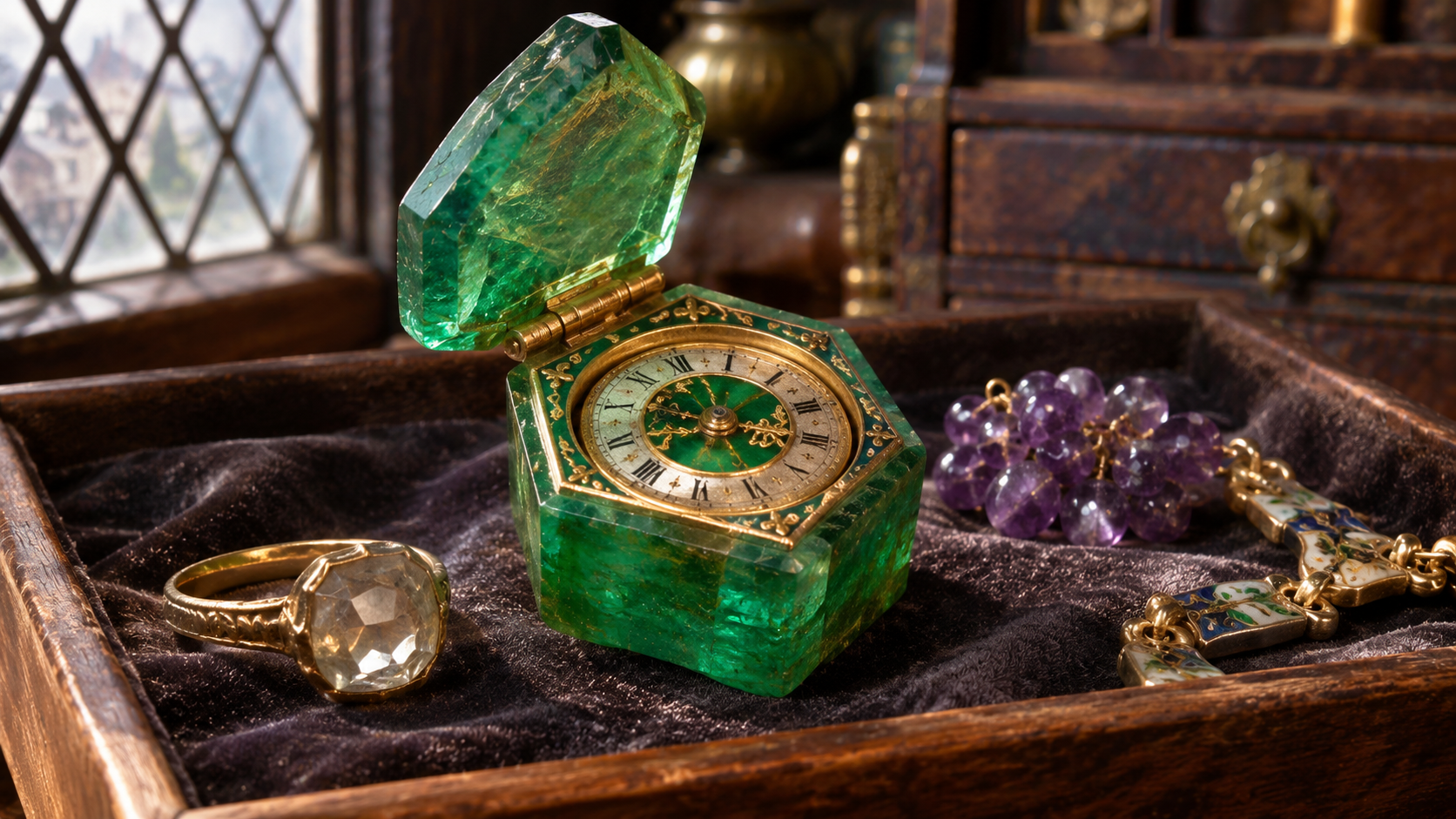
A watch housed inside an emerald is an unusual meeting of geological material and mechanical invention. The gemstone must provide colour, visual presence and sufficient structural integrity, while its hollowed interior accommodates components made for an entirely different purpose. In the Cheapside Hoard, this remarkable object survives alongside rings, chains, carved gems and loose stones that place it within a much broader history of craftsmanship and exchange.
Discovered beneath a cellar floor in London in 1912, the Cheapside Hoard contains around 500 objects. Its importance extends beyond the quality of individual jewels: the collection preserves evidence of a trade in which gemstones could be imported, reshaped, imitated, repaired and incorporated into new designs.
For gemstone enthusiasts and historians alike, it offers an opportunity to study precious materials as working objects rather than isolated treasures.
Table of Contents
Discovery Beneath a Commercial Street
The hoard emerged in June 1912 during the demolition of a timber-framed building near St Paul’s Cathedral. Workmen breaking through the cellar floor encountered jewellery and gemstones in the soil beneath it. The finds subsequently reached George Fabian Lawrence, the antiquities dealer known as “Stony Jack,” who secured them for London Museum.
The location helps explain the collection’s likely character. Cheapside was a commercial district closely associated with goldsmiths, and the combination of objects suggests a jeweller’s stock rather than a single person’s coordinated wardrobe.
Its survival is especially valuable because jewellery is readily transformed. Stones can be removed, settings melted and older designs remodelled. Concealment interrupted those processes, preserving objects that might otherwise have disappeared through the ordinary economics of reuse.
Cheapside and the Goldsmiths’ Trade
Cheapside’s name derives from a word associated with a market or bargaining place. By the early modern period, part of the street was known as Goldsmith’s Row, where displays of precious metalwork and jewels contributed to the district’s reputation.
London Museum records the impression made on a Venetian visitor in 1503, who described a concentration of exceptionally well-stocked goldsmiths’ shops. Such testimony places the hoard within an established commercial environment rather than an isolated workshop.
The trade was also geographically mobile. Rising rents and limited space encouraged goldsmiths to expand beyond Cheapside during the early seventeenth century, while the Great Fire of 1666 disrupted the district further.
“London’s lost jewellery trade” should therefore describe a particular surviving window onto that trade, not imply that London’s jewellery industry itself vanished.
When Was the Hoard Concealed?
The manufacture of a jewel and the concealment of a collection are separate events. An object made around 1600 could remain in use or stock for decades before burial, while an ancient carved gemstone could be reset in a much later mount.
Archaeologist Nigel Jeffries’s study of the surrounding properties places the hoard in a pre-Fire cellar beneath 30–32 Cheapside and describes concealment after 1640/41. A heraldic carnelian intaglio associated with William Howard’s acquisition of the title Viscount Stafford in 1640 provides an important chronological clue.
Such evidence supplies a lower boundary for deposition rather than an exact burial date. The Great Fire supplies the conventional later limit used in discussions of concealment.
The Civil Wars offer a plausible setting for hiding valuables, but the identity and motives of the person responsible remain unresolved. Neither political unrest nor fire should be presented as a proven explanation for why this particular collection was never recovered.
The Emerald-Cased Watch
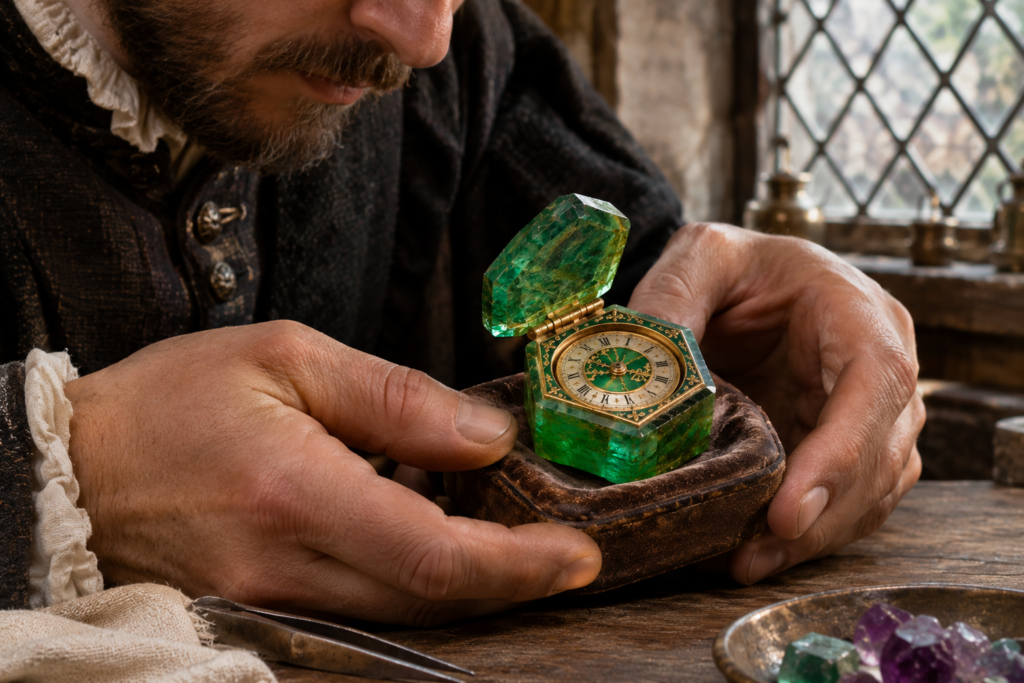
The outstanding timepiece is catalogued by London Museum as a hexagonal emerald-cased verge watch, dated approximately 1600–1610. The museum describes a single large Colombian emerald crystal fashioned into a case with a hinged lid, enclosing a dial plate decorated with translucent green enamel. The hand is missing.
The collection record gives overall dimensions of approximately 31.57 × 24.09 × 21.15 millimetres and a total weight of 32.4 grams. That weight belongs to the composite object, including its metal components; it is not the weight of the emerald alone.
This distinction matters because the watch is sometimes discussed as though it were simply a very large gemstone. It is a carefully assembled object combining emerald, gold, enamel and mechanical materials. Its significance lies in the relationship between them.
How Crystal Form Became Architecture
The watch’s hexagonal outline is particularly appropriate to its material. Emerald is a variety of beryl, whose ideal formula is Be₃Al₂Si₆O₁₈ and whose crystal symmetry is hexagonal. Its structure contains rings of six silicate tetrahedra arranged around channels running through the crystal.
A hexagonal crystal can therefore offer a natural starting geometry for an object with six principal sides. The maker still had to transform that geometry through cutting, hollowing, polishing and fitting; the completed watch should not be mistaken for an untouched crystal with a movement inserted into it.
The important relationship is between inherited mineral form and deliberate design. Working with an existing crystal outline could preserve a recognisable material character while turning the stone into a miniature architectural enclosure.
This interpretation does not establish the precise sequence of tools used on the surviving watch, which would require object-specific examination.
Why Hollowing Emerald Was Technically Demanding
Emerald’s hardness of approximately 7.5–8 on the Mohs scale describes its resistance to scratching. It does not describe resistance to fracture. GIA characterises emerald as having fair to good toughness and notes that heat can extend existing fractures.
For a hollowed object, that distinction becomes especially consequential. Removing material leaves thinner walls, and any pre-existing fracture can affect how those walls tolerate pressure or accidental impact. The maker had to achieve the required cavity while retaining a usable gemstone body.
It is reasonable to infer that careful material selection mattered, but the watch should not be called flawless. A successful finished object demonstrates that the selected crystal and workmanship were sufficient for the design; it does not reveal every internal feature or rejected blank involved in production.
Nor should modern knowledge about emerald fracture filling be treated as evidence that this historic object received a particular treatment.
Colombian Emeralds: Geological and Historical Context
Colombian emerald deposits offer an unusual geological setting compared with many other emerald sources. Research describes mineralisation in carbonate–silicate–pyrite veins, pockets and breccias within sedimentary successions containing black shale and limestone.
The emeralds formed through hydrothermal processes associated with tectonic activity and fluid–rock interaction. Saline fluids moved through the rock sequence, bringing together the chemical conditions needed for crystal growth.
This geological history precedes the gemstone’s human history by an immense interval. Once extracted and traded, the crystal entered systems of valuation and craftsmanship unrelated to the processes that formed it.
London Museum identifies the watch material as Colombian emerald. That attribution should nevertheless remain distinct from a claim about an exact mine or shipment. The museum’s documented identification can be reported without inventing a complete route from a particular excavation in Colombia to a particular London workshop.
What Inclusions Can – and Cannot – Establish
Fluid inclusions preserve tiny portions of the environment in which a gemstone grew. In emerald, a cavity may contain liquid, a gas bubble and a solid crystal, producing what gemmologists describe as a three-phase inclusion.
Jagged multiphase inclusions are important features of many Colombian emeralds, but the presence of three phases alone is not a universal geographical fingerprint. Research has documented comparable inclusion types elsewhere.
Modern origin determination therefore combines evidence, including microscopic inclusion characteristics, absorption spectroscopy and trace-element chemistry. The reliability comes from agreement among observations rather than a single attractive feature.
These methods explain how geographical attribution can be investigated. They are not a statement that every technique has been applied to the Cheapside watch, nor that inclusions illustrated in modern research have been observed inside it.
Diamonds and the Evidence of Historical Cutting
The hoard’s table-cut diamonds provide a different kind of material evidence. GIA’s documentation describes a gold ring with a diamond whose broad upper facet and pavilion arrangement preserve a cutting style that was frequently lost when older stones were recut.
A table cut should be evaluated within its own design logic. Its appearance differs from a modern round brilliant because its surfaces were organised differently, producing a different relationship between reflection, transparency and outline.
Calling it simply a less advanced modern diamond overlooks the historical choices embodied in the stone. A surviving cut can reveal how the maker approached the available rough and what visual effect the setting was intended to support.
The evidential value lies partly in the survival of the combined stone and mount. Recutting would alter the gemstone; resetting could remove information about how it originally functioned as jewellery.
Natural Forms, Artificial Gems and Reused Stones
The collection also shows that historical jewellers worked with more than one kind of material ingenuity.
London Museum identifies amethyst grapevine pendants, with related examples made from emeralds. In these objects, colour and rounded gemstone forms contribute to the representation of fruit. A ship-shaped pin uses a pearl as its hull, demonstrating how an irregular organic gem could suggest a design.
Other objects depended on imitation. The museum records a pendant containing red and green glass, as well as rock crystal pieces made to resemble balas rubies—the historical name associated with spinel.
Imitation therefore belongs within the historical evidence, although its presence alone does not establish how each object was described to a customer. Material substitution, contemporary understanding and deliberate deception are related questions, but they cannot automatically be equated.
The Hoard as Evidence of International Exchange
The geographical range of materials connects London’s goldsmiths with much wider networks. The museum identifies Colombian emeralds among the hoard’s stones and places the collection within the expanding international commerce of the sixteenth and seventeenth centuries.
That expansion occurred within unequal political systems, including European conquest and colonial extraction. The jewels preserve the attractive finished products of those networks without necessarily recording the conditions experienced by the people who mined, transported or worked their materials.
A gemstone’s geological origin is only one part of this history. Its route might include merchants, cutting centres, owners, repairs and resale before it reached the collection.
The hoard is consequently stronger evidence for interconnected commerce than for a single direct journey made by every stone.
Reading a Collection Without Flattening Its History
The objects do not all share one manufacturing date or one earlier biography. Antique carved gems, recent settings, loose stones and mechanical objects could coexist in a working stock.
This mixed character is precisely what makes the collection informative. A modern attempt to reconstruct a perfectly matching “Cheapside jewellery set” would conceal the variation that helps explain the trade.
The same principle applies to analysis. A chemical identification concerns material; a cut concerns manufacture; a mounting concerns assembly and use; and a dated heraldic image may help constrain chronology. Each answers a different question.
Bringing those observations together produces a richer account than treating the hoard as either a collection of beautiful stones or a single unresolved treasure mystery.
A Gemstone That Became a Timepiece
The emerald watch captures the collection’s significance with unusual clarity. Its crystal form influenced its outline, its physical properties constrained its manufacture, and its finished construction brought mineral carving into contact with metalwork, enamelling and mechanics.
Around it, the other jewels preserve different solutions to the same broad challenge: how to transform valuable materials into objects that people wanted to own, display and use.
For Natural Gems Belgium, the Cheapside Hoard demonstrates the value of studying gemstones within their surviving settings. Mineral science explains the possibilities and limitations of the material, while archaeology and historical research reveal how those possibilities became part of a trade.
References & Further Reading
London Museum. “The Cheapside Hoard.”
Museum overview covering discovery, the collection’s character, international materials and uncertainty about concealment.
https://www.londonmuseum.org.uk/collections/london-stories/cheapside-hoard/
London Museum. “Hexagonal emerald cased verge watch.” Object A14162.
The principal object record used for the watch’s date, materials, construction and dimensions.
https://www.londonmuseum.org.uk/collections/v/object-117832/hexagonal-emerald-cased-verge-watch/
London Museum. “Jewels of the Cheapside Hoard.”
Object-based museum interpretation covering gemstone designs, glass imitations, rock crystal substitutes and historical jewellery forms.
https://www.londonmuseum.org.uk/collections/london-stories/jewels-cheapside-hoard/
London Museum. “Cheapside: London’s Original High Street.”
Historical background on the commercial district and Goldsmith’s Row.
https://www.londonmuseum.org.uk/collections/london-stories/cheapside-londons-original-high-street/
Jeffries, N. (2015). “Cheapside in the 16th to 18th Century, an Archaeological History: Excavations at One New Change, City of London, EC4.” London and Middlesex Archaeological Society Transactions, 66, 17–46.
Archaeological investigation of the surrounding properties, including discussion of the hoard’s cellar context and chronology.
https://www.lamas.org.uk/images/documents/Transactions66/017-046%20Cheapside.pdf
Weldon, R., and Jonathan, C. (2013). “The Museum of London’s Extraordinary Cheapside Hoard.” Gems & Gemology, 49(3).
Gemmological documentation discussing historic cutting, the emerald watch, dating evidence and the collection’s significance for jewellery history.
https://www.gia.edu/gems-gemology/fa13-cheapside-hoard-weldon
Gemological Institute of America. “Emerald Description.”
Reference information explaining emerald as the green variety of beryl.
https://www.gia.edu/emerald-description
Gemological Institute of America. “Emerald Care and Cleaning Guide.”
Educational information distinguishing hardness, toughness and stability. General material properties should not be interpreted as an object-specific treatment assessment.
https://www.gia.edu/emerald-care-cleaning
“Incorporation and Substitution of Ions and H₂O in the Structure of Beryl” (2024). European Journal of Mineralogy, 36, 449 onward.
Peer-reviewed mineralogical research reviewing beryl’s structure, chemical substitutions and structural channels.
https://doi.org/10.5194/ejm-36-449-2024
Giuliani, G., and Groat, L. A. (2019). “Geology of Corundum and Emerald Gem Deposits.” Gems & Gemology.
Scientific background on emerald formation, including the sedimentary-hosted hydrothermal deposits of Colombia.
https://www.gia.edu/gems-gemology/winter-2019-geology-of-corundum-and-emerald-gem-deposits
“Geographic Origin Determination of Emerald” (2019). Gems & Gemology.
Research explaining the combined use of inclusions, spectroscopy and trace-element chemistry in geographical attribution.
https://www.gia.edu/gems-gemology/winter-2019-emerald-geographic-origin-determination