Table of Contents
When Precious Materials Became Offerings to the Buddha
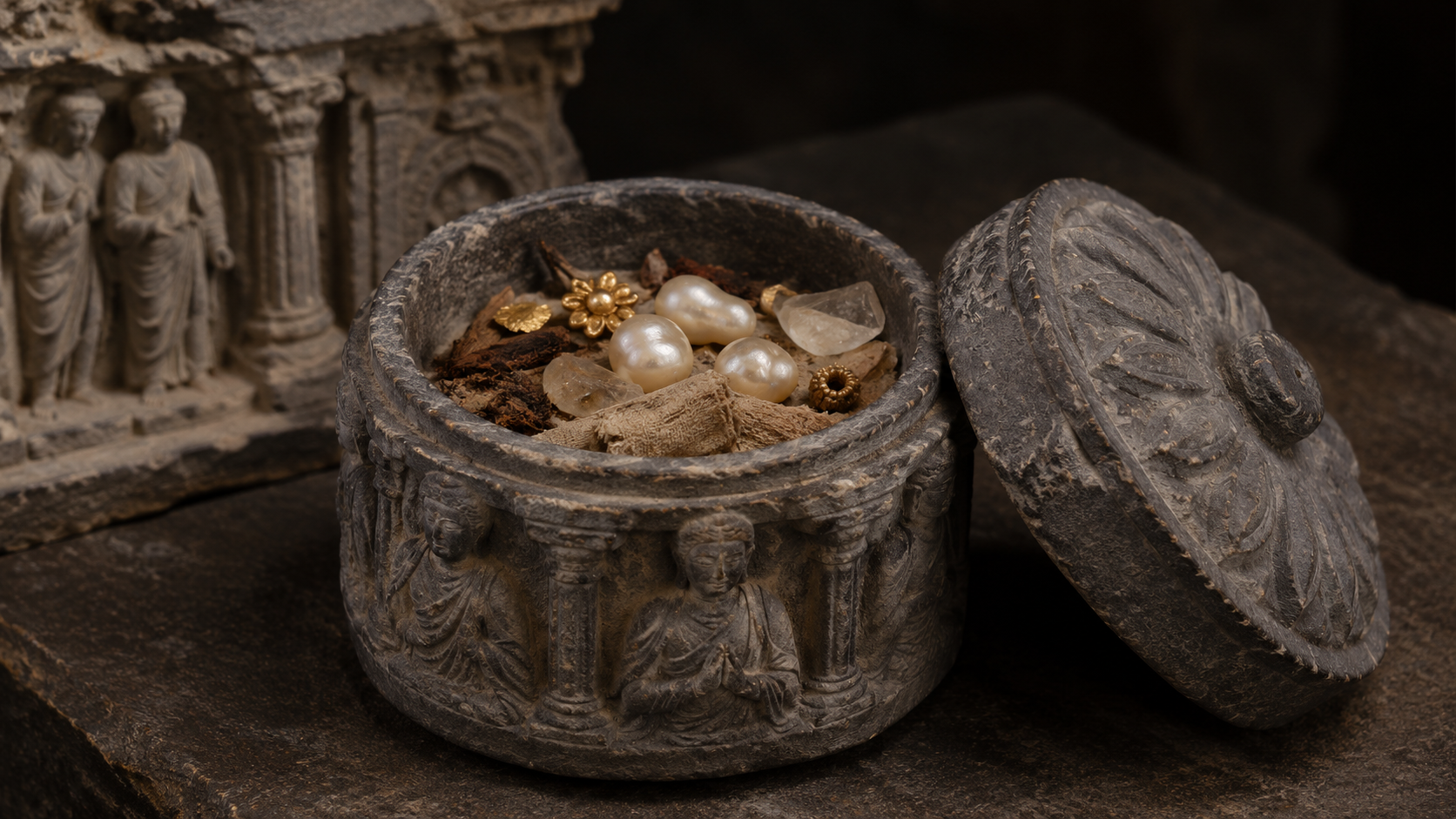
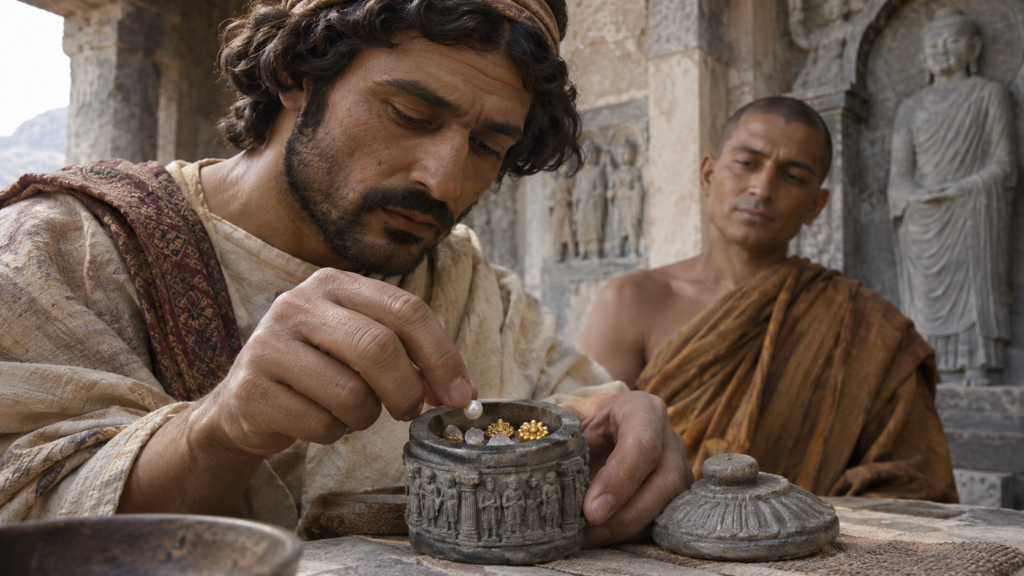
In the ancient region of Gandhara, nearly two thousand years ago, Buddhist communities placed small, carefully prepared containers within sacred monuments.
These containers were known as reliquaries.
Some were carved from dark stone. Others were fashioned from precious metals or other valued materials. Their contents could include cremated remains attributed to the Buddha or revered Buddhist teachers, accompanied by gold, pearls, crystals and small ornamental objects.
To a modern observer, the presence of pearls among such deposits might initially suggest wealth or personal adornment.
Yet their placement within a Buddhist reliquary reveals a more complex relationship between natural beauty, religious devotion and the practice of giving.
The Metropolitan Museum of Art preserves several remarkable Gandharan reliquaries dating from approximately the first to third centuries CE. Their contents demonstrate that precious materials could accompany relic deposits within early Buddhist religious practice.
These objects invite an important question: why would devotees place pearls and other beautiful substances inside containers that might never again be opened?
The answer lies partly in the Buddhist traditions of relic veneration, generosity and religious merit.
The significance of pearls in early Buddhist reliquaries was not based on a scientifically measurable healing energy. It arose from their value as precious offerings within a religious tradition centred on the Buddha, his teachings and the accumulation of merit through acts of devotion.
Their history also demonstrates that the spiritual importance of natural materials cannot always be understood through modern gemstone symbolism.
Gandhara: A Crossroads of Ancient Buddhist Culture
Gandhara was an important historical region encompassing parts of present-day northwestern Pakistan and eastern Afghanistan.
Its principal cultural centres included areas around the Peshawar Valley, Taxila and the wider northwestern subcontinent.
During the centuries surrounding the beginning of the Common Era, Gandhara occupied a significant position within networks connecting South Asia, Central Asia and territories farther west.
The region experienced changing political influences, including Indo-Greek, Indo-Scythian, Indo-Parthian and Kushan rule.
These historical developments contributed to a culturally diverse environment.
Buddhism became an important religious tradition in Gandhara, supported by monastic communities, donors and political elites.
The region is particularly famous for its Buddhist sculpture, architecture and reliquaries.
Its artistic traditions incorporated local and international influences, producing distinctive representations of the Buddha and Buddhist narratives.
The presence of precious materials in Gandharan religious deposits must be understood within this wider cultural setting.
What Is a Buddhist Reliquary?
A reliquary is a container intended to preserve sacred remains or objects associated with a revered religious figure.
In Buddhist contexts, relics may include bodily remains attributed to the Buddha or important teachers, as well as objects connected with their memory.
Relics became important focal points of devotion.
The Metropolitan Museum explains that early Buddhist worship included the veneration of relics housed within stupas.
A stupa is a Buddhist monument associated with relics, commemoration and religious practice.
Its architectural form developed over time and varied among regions.
Some stupas contained relic deposits within their foundations or internal structures.
These deposits could include small stone or metal containers.
The containers themselves sometimes held precious materials alongside the relics.
Their significance was therefore both material and religious.
The Buddha’s Relics and the Development of Stupa Worship
Buddhist traditions describe the distribution of the Buddha’s cremated remains following his death.
Accounts preserved in religious literature associate the relics with the establishment of stupas.
The details vary across textual traditions.
One influential narrative describes the division of the remains among eight recipients.
Later traditions connect the Mauryan emperor Ashoka, who ruled during the third century BCE, with the redistribution and enshrinement of Buddhist relics.
The Metropolitan Museum’s interpretation of the Ramaka Casket discusses these narratives and their importance for early Buddhist worship.
However, the traditional accounts should be distinguished from independently verified archaeological events.
The reported distribution of 84,000 relic portions under Ashoka, for example, belongs to Buddhist religious tradition rather than a historically verified numerical inventory.
What archaeology establishes is that relic deposits became important features of Buddhist religious monuments.
Why Were Precious Materials Placed with Relics?
Relic deposits could contain more than the remains themselves.
The Metropolitan Museum documents Gandharan reliquaries containing gold, copper, pearls, crystal, glass and other materials.
These additions were not necessarily personal possessions of the deceased.
They could be offerings made by donors.
Their inclusion expressed the importance of the sacred deposit.
The use of valuable substances also reflects the role of generosity in Buddhist religious life.
Giving to religious communities and sacred institutions was associated with the cultivation of merit.
A precious object could therefore become part of a religious act through its donation.
Its meaning depended upon the context of offering.
A pearl placed inside a reliquary was not equivalent to a pearl worn as jewellery.
The material remained physically the same, but its cultural function changed.
Pearls: Precious Objects from Living Organisms
Pearls are organic gemstones produced by certain molluscs.
They form when a mollusc deposits layers of nacre or other shell material around an internal irritant or biological structure.
The precise formation process depends upon the species and type of pearl.
Natural pearls develop without deliberate human intervention.
Cultured pearls form through processes initiated by human pearl cultivation.
Ancient pearls used in religious objects were natural rather than modern cultured pearls.
Their rarity, appearance and difficulty of acquisition contributed to their historical value.
Unlike crystalline mineral gemstones, pearls are biogenic materials.
Their principal mineral component is calcium carbonate, commonly in the aragonite form in nacreous pearls.
Organic substances help bind the mineral structures together.
This combination produces the characteristic appearance of pearl.
The Optical Beauty of Pearls
Pearls are valued for their lustre.
Their appearance results from interactions between light and the microscopic structure of their surfaces and internal layers.
Nacre consists of extremely thin mineral platelets arranged within an organic matrix.
Light reflected and transmitted through these structures can produce complex optical effects.
The result may include a soft surface sheen and subtle colour variations.
This appearance differs fundamentally from the brilliance of a faceted diamond or garnet.
Pearls do not require faceting to display their characteristic beauty.
Their rounded shapes and natural lustre made them suitable for jewellery and small precious offerings.
However, their optical properties do not establish supernatural powers.
Their beauty can be explained through materials science.
A First-Century Gandharan Reliquary with Pearls
The Metropolitan Museum preserves a reliquary with contents from ancient Gandhara, dated to approximately the first century CE.
The object consists of a schist container accompanied by materials including copper, gold, rock crystal and pearls.
Its museum accession number is 1987.258.2a–q.
The container is relatively small.
Its scale illustrates the intimate nature of many relic deposits.
The objects placed inside did not need to be large to possess religious significance.
The inclusion of pearls demonstrates that these organic gemstones formed part of the repertoire of precious materials available for Buddhist offerings.
However, the museum record does not establish that each pearl possessed an individually defined symbolic meaning.
Their significance is best interpreted within the larger practice of relic deposition.
The Importance of Archaeological Context
A pearl recovered from an archaeological site can have several possible functions.
It may have been worn as jewellery.
It may have formed part of a garment.
It may have been exchanged as a valuable object.
It may have been deposited as an offering.
The context determines which interpretation is most plausible.
In a reliquary, the pearl participates in a sacred deposit.
Its placement alongside other precious materials supports an interpretation involving religious offering.
Nevertheless, it would be misleading to assign a specific healing or protective function without additional evidence.
Archaeology can establish the presence and arrangement of materials.
It cannot always recover the precise intentions of every donor.
The Ramaka Casket: An Inscription That Explains Religious Giving
One of the most informative Gandharan reliquaries preserved by the Metropolitan Museum is the Ramaka Casket.
It dates to the first century CE and originates from the Bajaur region of ancient Gandhara.
The container is made from schist.
Its inscription records the donation of relics.
The museum’s interpretation explains that such deposits were associated with religious merit and the honouring of the Buddha.
This is particularly valuable evidence because the inscription provides information about the religious purpose of the object.
Rather than relying solely upon the appearance of the container, historians can examine a written statement connected with its use.
The Ramaka Casket demonstrates how relic deposition could unite devotion, patronage and religious identity.
It also illustrates why inscriptions are essential to understanding ancient sacred objects.
Merit: The Religious Meaning of Giving
In Buddhist traditions, generosity is an important ethical practice.
The concept of dāna, commonly translated as giving or generosity, occupies a significant place in Buddhist teaching.
Acts of giving may be understood as contributing to the cultivation of merit, often expressed through the term puñña in Pali or puṇya in Sanskrit.
Merit is connected with ethical action and its consequences within Buddhist understandings of karma.
The donation of valuable materials to a religious institution could therefore possess spiritual significance.
However, merit should not be confused with a measurable energy emitted by the donated material.
The religious importance lies in the action, intention and tradition surrounding the offering.
A pearl does not become a scientific source of spiritual radiation because it is deposited in a reliquary.
Its sacred role arises through the act of giving.
Pearls, Light and Buddhist Devotion
The Metropolitan Museum’s interpretation of Gandharan relic deposits notes an association between the Buddha’s enlightened remains and light.
Precious and reflective materials could be included among offerings.
Gold, crystal and pearls each interact with light differently.
Gold reflects strongly from its metallic surface.
Rock crystal can transmit and refract light.
Pearls display a softer lustre.
These visual qualities made them suitable for expressing preciousness and splendour.
However, it would be inaccurate to claim that every pearl represented enlightenment in precisely the same way.
The evidence supports a broader association between valuable, visually striking materials and religious offerings.
Specific symbolic meanings require specific textual or archaeological support.
The Difference Between Material Beauty and Sacred Power
The presence of pearls in Buddhist reliquaries raises a fundamental question about sacred materials.
Does a substance become sacred because of its physical properties?
Or does its significance arise through religious practice?
In early Buddhist relic deposits, the answer cannot be reduced to one physical characteristic.
Pearls were valued natural materials.
Their rarity and appearance made them appropriate offerings.
But their religious significance depended upon the context of donation and relic veneration.
The material’s value contributed to the offering.
The religious practice gave the offering its meaning.
This distinction is important when comparing ancient Buddhist traditions with contemporary crystal-healing beliefs.
A Second Gandharan Reliquary with Pearl and Coral
Another reliquary preserved by the Metropolitan Museum dates to approximately the second or third century CE.
Its contents include copper, gold, pearl, shell, glass, stone and coral.
This assemblage is particularly revealing.
It demonstrates that Buddhist relic deposits could incorporate several different categories of natural and manufactured materials.
Pearl and shell are biological materials.
Coral is also biogenic.
Gold is a metallic element.
Glass is an amorphous material.
Stone may include several different geological substances.
Their combination illustrates the diversity of objects considered suitable for religious deposits.
However, it does not establish a universal gemstone hierarchy.
The specific selection may have reflected availability, value, local traditions and donor preferences.
The Role of Coral and Other Precious Materials
Coral deserves particular attention because it frequently appears alongside other valued substances in historical jewellery and religious objects.
Precious coral is produced by marine colonial animals.
Its red or pink colour made it attractive for ornamentation.
In the Gandharan reliquary documented by the Metropolitan Museum, coral appears among several materials.
However, its presence should not automatically be interpreted through later Buddhist or modern crystal-healing symbolism.
The same caution applies to pearls.
A material can participate in a religious offering without possessing a universally fixed spiritual meaning.
Historical interpretation must begin with the object and its documented context.
The Religious Importance of Small Objects
A striking feature of many Gandharan reliquaries is their modest size.
Some containers measure only a few centimetres across.
Their contents may include tiny beads, fragments or ornaments.
Yet these small objects could become part of major religious monuments.
This contrast between physical scale and cultural significance is important.
The sacred value of a relic deposit did not depend solely upon the dimensions of its contents.
A small pearl could participate in a much larger religious structure.
Its meaning emerged through its association with the relics, the donor and the monument.
Stupas as Places of Devotion
Stupas became important centres of Buddhist religious practice.
Devotees could circumambulate them as an expression of reverence.
The movement around a stupa formed part of a broader devotional relationship with the Buddha and his teachings.
Relics housed within the monument contributed to its sacred significance.
The Metropolitan Museum explains that the enshrinement of relics helped establish new places of Buddhist worship.
This is important for understanding the role of pearls.
A pearl deposited inside a reliquary was not necessarily intended for repeated viewing.
It might remain concealed within a monument.
Its importance lay in the act of dedication and the sacred context.
The Relationship Between Donors and Religious Institutions
Relic deposits also provide evidence for the social history of Buddhism.
Donors could include rulers, wealthy individuals and other supporters of religious communities.
The Ramaka Casket demonstrates the importance of inscriptions recording donations.
Such inscriptions could preserve the identity of the donor and the religious purpose of the gift.
The donation of precious materials may have expressed devotion.
It could also strengthen relationships between patrons and religious institutions.
In some circumstances, religious patronage contributed to political legitimacy.
However, these social functions should not be treated as proof that religious devotion was insincere.
Ancient religious giving could involve several motivations simultaneously.
The Spread of Buddhist Relic Traditions
Buddhist relic practices developed across different regions and historical periods.
The Metropolitan Museum’s exhibition Tree & Serpent: Early Buddhist Art in India, 200 BCE–400 CE examined the development of early Buddhist visual and devotional traditions.
Its exhibition materials documented relic deposits containing gold, semiprecious stones, rock crystal, pearls and shell.
These examples demonstrate that the inclusion of precious materials was not confined to Gandhara.
However, regional traditions differed.
A relic deposit from northern India should not automatically be interpreted as identical to one from ancient Sri Lanka or Gandhara.
The broader practice of honouring relics provided a shared religious framework, but local forms varied.
Pearls in the Wider History of South Asian Ornament
Pearls were valued in South Asia long before modern pearl cultivation.
Their natural beauty made them suitable for jewellery and elite adornment.
They could be incorporated into necklaces, ornaments and ceremonial objects.
However, archaeological identification of pearls requires care.
Organic gemstones are vulnerable to deterioration.
Their survival depends upon burial conditions and subsequent conservation.
Ancient textual references may also use terminology that does not correspond precisely to modern gemmological categories.
Consequently, the history of pearls must be reconstructed through multiple forms of evidence.
Museum collections, archaeological reports and historical texts each contribute different information.
Natural Pearls and the Problem of Preservation
Pearls are more vulnerable to environmental damage than many mineral gemstones.
Their calcium carbonate structure can react with acidic conditions.
Organic components may deteriorate.
Their surfaces can become dull or damaged.
Burial environments may therefore affect their preservation.
This is important for archaeological interpretation.
The absence of pearls from a particular deposit does not necessarily prove that they were never present.
Conversely, surviving pearls provide valuable evidence for the materials selected by ancient donors.
Conservation specialists must handle them with particular care.
Could Pearls Have Represented Purity?
Modern spiritual descriptions frequently associate pearls with purity, wisdom and serenity.
Such symbolism appears in different cultural and religious settings.
However, it would be misleading to assign these meanings automatically to every early Buddhist pearl offering.
The Gandharan reliquaries provide direct evidence for the inclusion of pearls among sacred deposits.
They do not necessarily identify the exact symbolic interpretation attached to each pearl.
The broader Buddhist context supports associations with generosity, devotion and merit.
Specific claims about purity require additional textual or iconographic evidence.
This distinction prevents modern symbolism from being projected onto ancient objects.
Were Pearls Protective Talismans in Gandhara?
Precious materials have been used as protective objects in many societies.
However, the presence of pearls in a Buddhist reliquary does not establish that they were intended as personal talismans.
Their placement inside a sacred container suggests a different function.
They were part of a religious deposit.
A pearl worn on the body might have carried meanings different from one enclosed with relics.
The distinction between adornment, offering and amulet is essential.
An object cannot be assigned a protective function solely because it is precious.
Modern Pearl Crystal-Healing Beliefs
Contemporary metaphysical traditions sometimes associate pearls with emotional balance, feminine energy, intuition or spiritual calm.
These interpretations may hold personal significance for practitioners.
However, they should not be described as scientifically demonstrated effects.
Nor should they be presented as direct continuations of first-century Gandharan Buddhism.
The historical evidence supports the use of pearls as precious materials in religious deposits.
It does not establish that ancient Buddhist donors believed pearls balanced chakras or transmitted healing frequencies.
Modern crystal-healing systems and early Buddhist relic practices belong to different historical contexts.
Do Pearls Possess Healing Energy?
There is no reliable scientific evidence that pearls emit supernatural healing energy.
Their physical properties are measurable.
Their chemical composition can be analysed.
Their layered structure can be examined microscopically.
Their optical appearance can be explained through materials science.
However, these properties do not demonstrate that pearls cure illness or influence emotional states through an invisible energy field.
A person may experience comfort or meaning through wearing pearls or using them in personal reflection.
That experience is distinct from a scientifically established therapeutic mechanism.
The historical importance of pearls in Buddhist offerings does not depend upon supernatural claims.
The Ethical Interpretation of Buddhist Sacred Objects
Reliquaries are not simply containers of ancient valuables.
They belong to religious traditions that remain important to Buddhist communities today.
Their contents may possess devotional significance beyond their archaeological or market value.
Museum interpretation should therefore consider both historical evidence and living religious perspectives.
The removal of relic deposits from their original settings can also raise questions about provenance and cultural heritage.
Responsible scholarship must distinguish between studying an object and treating it as an ordinary collectible.
The cultural significance of a reliquary cannot be reduced to the value of its pearls or gold.
What the Archaeological Evidence Establishes
Museum collections provide several important conclusions.
Pearls were included among precious materials in some early Buddhist reliquaries.
Gandharan examples date from approximately the first to third centuries CE.
Reliquaries could contain materials such as gold, crystal, shell, coral and glass.
Relic deposits were associated with Buddhist devotional practice.
Donations could contribute to the cultivation of religious merit.
Inscriptions sometimes recorded donors and their intentions.
Precious materials could accompany relics within stupas.
However, the evidence does not establish one universal spiritual meaning for every pearl.
Nor does it demonstrate that pearls possessed supernatural healing powers.
Why Pearls Matter to the History of Sacred Gemstones
The history of pearls in Buddhist reliquaries challenges several modern assumptions about spiritual materials.
The pearl is not a crystalline mineral gemstone.
Its beauty originates from biological processes.
Its religious significance did not necessarily depend upon personal possession.
Some pearls were deliberately placed beyond ordinary view.
Their importance arose through the act of offering.
This is a fundamentally different understanding of sacred material from modern claims that gemstones must be worn against the body to influence energy.
The Gandharan evidence demonstrates that precious natural substances could become part of religious devotion through generosity and dedication.
Conclusion: The Pearl as an Offering Rather Than a Talisman
Pearls in early Buddhist reliquaries reveal an extraordinary relationship between natural beauty and religious practice.
Their formation belongs to marine biology.
Their lustre belongs to materials science.
Their value belongs to the history of ornament and exchange.
Their presence in Gandharan reliquaries belongs to the history of Buddhist devotion.
The surviving objects demonstrate that pearls could accompany sacred relics alongside gold, crystal and other precious materials.
Their deposition participated in a religious tradition concerned with generosity, merit and reverence for the Buddha.
The spiritual significance of pearls in early Buddhist reliquaries arose from their role as precious offerings—not from scientifically demonstrated supernatural healing properties.
For Natural Gems Belgium, this history offers an important perspective on the meaning of gemstones.
A natural material can become sacred without being a mineral.
A precious object can acquire significance without being worn.
And a gemstone can participate in religious practice without functioning as a protective talisman.
The pearls of ancient Gandhara remind us that the cultural history of gemstones is often more complex than modern crystal-healing descriptions suggest.
Their story belongs not only to gemmology but also to archaeology, religious studies and the history of human generosity.
References & Further Reading
1. Metropolitan Museum of Art – Reliquary with Contents, Gandhara, First Century CE
https://www.metmuseum.org/art/collection/search/38115
Source description: Official museum catalogue of a first-century Gandharan reliquary containing schist, copper, gold, rock crystal and pearl objects. Provides direct archaeological evidence for pearls among early Buddhist relic deposits.
2. Metropolitan Museum of Art – Reliquary with Contents, Gandhara, Second–Third Century CE
https://www.metmuseum.org/art/collection/search/38234
Source description: Museum record documenting a Gandharan reliquary containing copper, gold, pearl, shell, glass, stone and coral. Demonstrates the diversity of precious materials included in Buddhist sacred deposits.
3. Metropolitan Museum of Art – The Ramaka Casket, First Century CE
https://www.metmuseum.org/art/collection/search/38113
Source description: Scholarly catalogue of an inscribed Gandharan reliquary from Bajaur. Includes discussion of Buddhist relic worship, donation, religious merit and the relationship between sacred deposits and political patronage.
4. Metropolitan Museum of Art – Reliquary with Gold, Silver and Rock Crystal Objects
https://www.metmuseum.org/art/collection/search/38112
Source description: Museum record of a first- to third-century Gandharan reliquary containing gold, silver and rock-crystal objects, providing comparative evidence for the inclusion of precious materials in Buddhist relic deposits.
5. Metropolitan Museum of Art – Reliquary with Copper, Bronze, Gold and Crystal Objects
https://www.metmuseum.org/art/collection/search/38110
Source description: Official museum catalogue of another Gandharan reliquary, demonstrating the diversity of materials and container forms associated with early Buddhist relic deposits.
6. Metropolitan Museum of Art – Tree & Serpent: Early Buddhist Art in India, 200 BCE–400 CE
https://www.metmuseum.org/ko/exhibitions/tree-and-serpent/visiting-guide
Source description: Scholarly museum exhibition guide examining early Buddhist art, relic worship and sacred monuments. Includes archaeological examples of deposits containing gold, semiprecious stones, rock crystal, pearls and shell.
7. Metropolitan Museum of Art – Reliquary in the Form of a Miniature Stupa, Gandhara
https://www.metmuseum.org/art/collection/search/38105
Source description: Museum catalogue of a second- to third-century miniature stupa reliquary, explaining the architectural relationship between small relic containers and monumental Buddhist stupas.
8. Metropolitan Museum of Art – Reliquary in the Shape of a Stupa, Sri Lanka
https://www.metmuseum.org/art/collection/search/75406
Source description: Official catalogue of a third- to fourth-century Sri Lankan rock-crystal reliquary, illustrating the wider development of Buddhist relic-container traditions beyond Gandhara.
Historical, Cultural and Scientific Distinctions
Scientifically established: Pearls are biogenic gemstones produced by certain molluscs.
Scientifically established: Their characteristic lustre results from the interaction of light with their layered structure.
Archaeologically documented: Pearls were included in some early Buddhist reliquaries from Gandhara.
Historically documented: Gandharan reliquaries could contain gold, crystal, pearl, shell, coral and other precious materials.
Religious tradition: Buddhist relic veneration developed around remains attributed to the Buddha and revered teachers.
Religious concept: Generosity and the cultivation of merit are important elements of Buddhist ethical and devotional practice.
Historical interpretation: Precious materials deposited with relics could express devotion, generosity and religious patronage.
Historical uncertainty: The exact symbolic meaning of every individual pearl cannot be reconstructed from archaeological evidence alone.
Modern metaphysical belief: Contemporary crystal-healing traditions sometimes associate pearls with emotional balance, intuition or spiritual calm.
Scientific limitation: There is no reliable evidence that pearls emit supernatural healing energy or cure illness.
The history of pearls in Buddhist reliquaries demonstrates how a natural material could acquire religious significance through the act of offering.
Their biological formation belongs to marine science.
Their physical properties belong to gemmology.
Their archaeological presence belongs to the history of Gandhara.
Their sacred role belongs to Buddhist religious traditions.
Their alleged supernatural healing properties remain matters of belief rather than scientifically established facts.