Table of Contents
When the Beauty of the Sea Entered a Christian Empire
In the sixth century, the Byzantine Empire stood at the intersection of Mediterranean commerce, imperial political authority and an increasingly elaborate Christian visual culture.
Goldsmiths produced extraordinary jewellery for wealthy patrons.
Their creations incorporated precious metals, coloured gemstones, glass and pearls.
Among these materials, pearls possessed a distinctive visual quality.
Unlike transparent gemstones, whose brilliance depends partly on light entering and reflecting within a crystalline structure, pearls display a softer surface lustre.
Their appearance could complement polished gold, translucent stones and richly coloured enamel.
Surviving Byzantine jewellery demonstrates how these different materials were combined.
Some objects were primarily personal ornaments.
Others incorporated unmistakably Christian imagery.
A necklace might communicate both the wealth and religious identity of its owner.
A pendant cross might express faith while also functioning as a precious possession.
The history of pearls in Byzantine Christianity reveals how an organic gemstone became part of a sophisticated material culture in which beauty, status, religious devotion and beliefs about protection could intersect.
Yet this history requires careful interpretation.
Pearls were certainly valued.
Christian symbols were certainly incorporated into jewellery.
Some religious images were believed to protect their wearers.
But these facts do not establish that Byzantine Christians universally attributed independent supernatural powers to pearls.
Understanding the distinction is essential.
The Byzantine World: Christianity, Wealth and Visual Culture
The Byzantine Empire developed from the eastern Roman Empire, with Constantinople serving as its political centre.
Its inhabitants generally understood themselves as Romans.
Modern historians use the term Byzantine to distinguish the medieval eastern Roman state and its cultural traditions.
Christianity played a central role in the empire’s religious and political identity.
Churches, religious images, ceremonial objects and personal ornaments all participated in this visual environment.
However, Byzantine society was neither socially uniform nor religiously static.
Practices changed across centuries.
Regional traditions differed.
The jewellery of a wealthy sixth-century woman cannot automatically represent the beliefs of every inhabitant of the empire.
The surviving objects are particularly informative about people who possessed the resources to commission, acquire or preserve expensive ornaments.
They provide evidence of elite and prosperous material culture, rather than a complete picture of everyday life.
What Is a Pearl? The Science Behind an Organic Gemstone
Pearls differ fundamentally from most mineral gemstones.
Diamond is crystalline carbon.
Ruby is the red variety of corundum.
Emerald is a green variety of beryl.
A pearl, by contrast, is produced through biological processes within certain mollusks.
The Gemological Institute of America classifies pearl as an organic gem material.
Many pearls consist largely of calcium carbonate, combined with a small proportion of organic material.
The calcium carbonate commonly occurs as aragonite, although some pearls and related structures contain calcite.
The precise composition and structure depend upon the producing mollusk.
In many nacreous pearls, microscopic layers of calcium carbonate and organic material form the characteristic pearl structure.
These layers contribute to the pearl’s optical appearance.
A pearl is therefore a natural biological product rather than a conventional mineral crystal.
How Natural Pearls Form
Natural pearls form without deliberate human intervention.
A mollusk produces a pearl through biological processes involving specialised tissues and the deposition of mineralised material.
In nacreous pearls, successive layers of nacre may accumulate around a developing pearl structure.
The process can continue over an extended period.
Not every mollusk produces a pearl suitable for jewellery.
Nor are all natural pearls perfectly round.
They may be spherical, oval, button-shaped, drop-shaped or irregular.
Their colours also vary.
White and cream are familiar, but natural pearls can display many other hues.
The Gemological Institute of America documents variations in shape, colour, surface characteristics and lustre.
These properties arise from biological structure and optical behaviour.
They do not demonstrate supernatural energy.
Why Pearls Appear to Glow
One of the most attractive characteristics of a pearl is its lustre.
In nacreous pearls, light interacts with the surface and the layered internal structure.
Reflection, interference and other optical effects contribute to the characteristic appearance.
High-quality pearls may display bright, sharply defined reflections.
Some also show subtle iridescent colour effects.
Gemmologists sometimes use the term orient for particular iridescent appearances associated with nacre.
This luminosity is a measurable physical phenomenon.
It helps explain why pearls have been admired in many cultures.
However, describing a pearl as luminous should not be confused with claiming that it emits supernatural light.
The visual effect belongs to optics.
Its cultural interpretation belongs to history.
Pearls in Sixth- and Seventh-Century Byzantine Jewellery
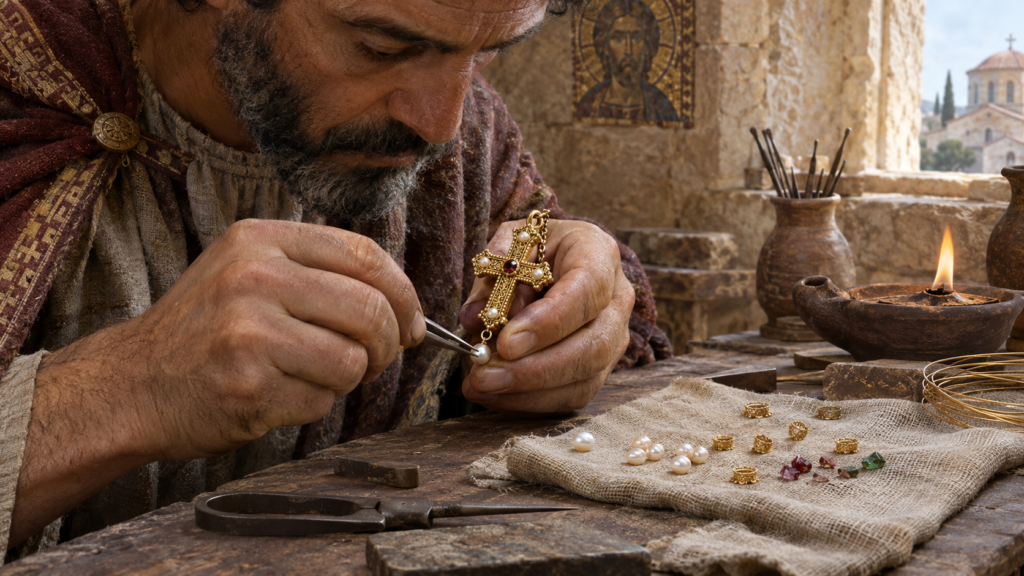
The Metropolitan Museum of Art preserves an exceptional collection of Byzantine jewellery.
Among its objects is a pair of gold earrings decorated with pearls and sapphires.
The earrings date to the sixth or seventh century.
The museum identifies pearls as particularly favoured ornaments in Byzantine jewellery.
Each earring combines gold construction with suspended pearls and coloured gemstones.
The surviving pair demonstrates the sophisticated relationship between materials, craftsmanship and visual display.
The pearls contribute rounded forms and soft lustre.
The sapphires introduce contrasting colour.
The gold provides structure and brilliance.
These objects were designed to be worn.
Their appearance would have changed as the wearer moved.
This is an important aspect of Byzantine jewellery.
It was not merely static decoration.
It participated in the social presentation of the person wearing it.
Jewellery as a Language of Social Identity
Jewellery communicates more than personal taste.
In historical societies, valuable ornaments could indicate wealth, rank, family connections and access to luxury materials.
Byzantine jewellery was no exception.
Art historian Alicia Walker, writing for Smarthistory, explains that Byzantine wearable objects communicated complex messages concerning social identity, religious beliefs and concerns about well-being.
This interpretation is particularly useful because it recognises several possible functions without reducing every object to a religious amulet.
An elaborate pearl earring could be fashionable.
It could communicate prosperity.
It might form part of ceremonial dress.
Its owner could also attach personal or religious meaning to it.
These possibilities could coexist.
However, the presence of pearls alone does not identify which interpretation applied to a particular wearer.
The Metropolitan Museum’s Pearl-and-Sapphire Earrings
The Metropolitan Museum preserves two matching Byzantine earrings under accession numbers 17.190.145 and 17.190.146.
Both are dated to the sixth or seventh century.
They are made from gold, sapphire and pearls.
The museum notes that sapphires became increasingly popular in Byzantine jewellery during the sixth century.
The earrings illustrate the combination of different ornamental materials within a single design.
Their significance is partly aesthetic and partly historical.
They demonstrate the availability of luxury gemstones.
They reveal sophisticated goldsmithing.
They preserve evidence of Byzantine fashion.
However, the museum catalogue does not identify the pearls as independent supernatural healing objects.
Any claim that these particular earrings were intended to balance spiritual energy would therefore be speculative.
Pearls and the Christian Meaning of Preciousness
Pearls also appear in Christian religious literature.
One particularly important passage is the Parable of the Pearl of Great Price in Matthew 13:45–46.
In the narrative, a merchant discovers a pearl of exceptional value and sells his possessions to obtain it.
The pearl functions as a metaphor for something of supreme importance.
Within the Gospel’s context, the parable concerns the kingdom of heaven.
This is an example of religious symbolism rather than gemstone magic.
The pearl’s value provides the foundation for the metaphor.
Its importance does not depend upon a claim that it emits protective energy.
The passage also demonstrates that pearls were recognisable objects of high value within the cultural world of early Christianity.
However, the parable predates the sixth-century Byzantine jewellery examined here.
It should not be treated as a direct explanation of every later pearl ornament.
The Pearl of Great Price: A Metaphor, Not a Crystal Prescription
The distinction between metaphor and material property is fundamental.
In Matthew’s parable, the pearl represents extraordinary value.
The narrative does not instruct believers to wear pearls to obtain spiritual benefits.
Nor does it describe the pearl as a mineral medicine.
Its religious meaning arises from the story.
The same principle applies to many forms of sacred gemstone symbolism.
A material may represent purity, preciousness or spiritual aspiration without being understood as a physical source of supernatural energy.
Later Christian writers and artists could draw upon such imagery in different ways.
But the existence of a biblical metaphor does not establish a universal doctrine of pearl healing.
Pearls and Christian Crosses
One of the clearest connections between pearls and Byzantine Christian identity appears in jewellery incorporating crosses.
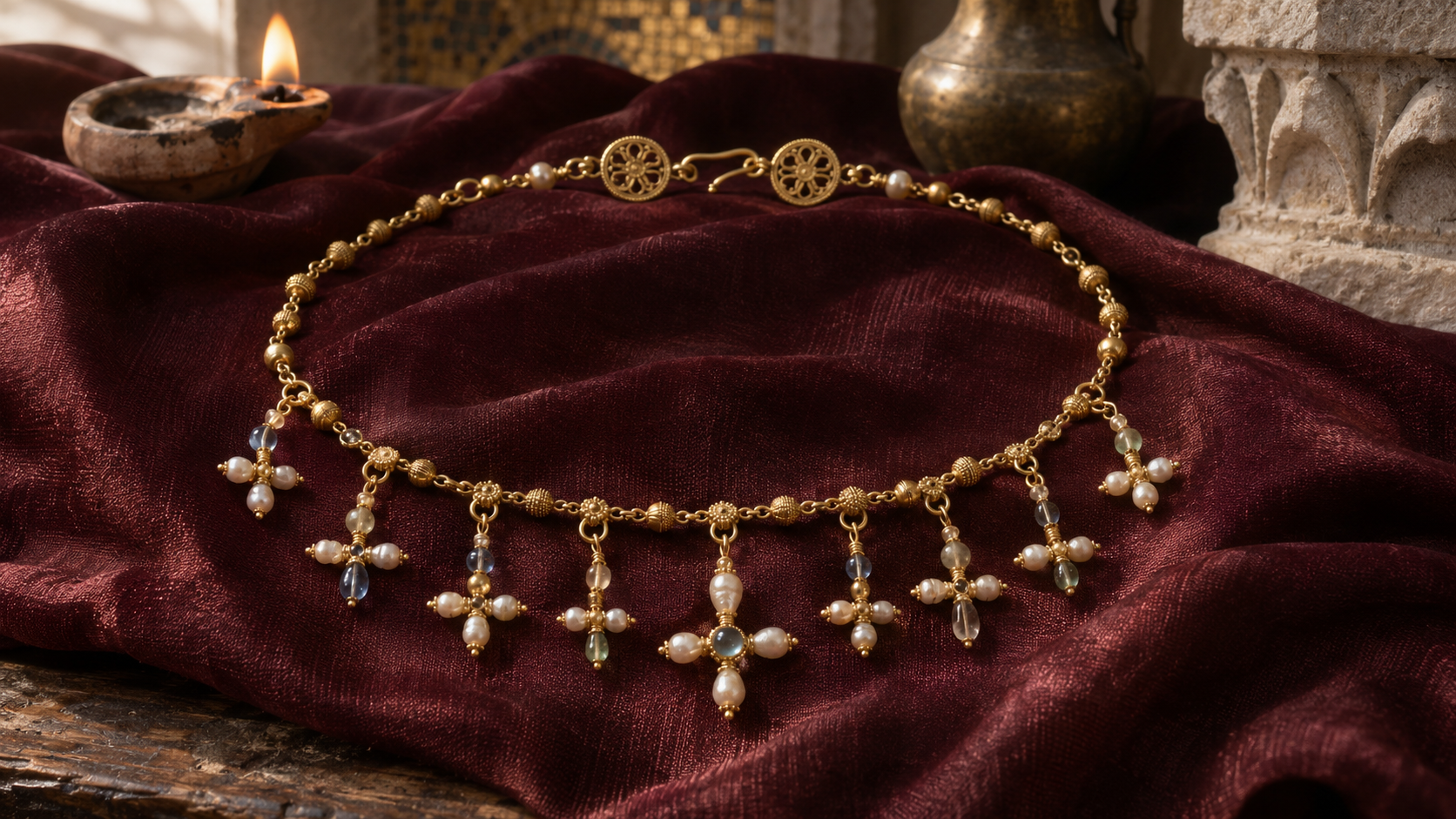
The Metropolitan Museum preserves a sixth- to seventh-century necklace titled Necklace with Pendant Crosses.
The object was probably made in Constantinople.
It combines gold, pearls, sapphire, smoky quartz and quartz.
Its small suspended crosses are worked in pearls and gemstones.
The museum explicitly interprets the necklace as an expression of both faith and wealth.
This is particularly important evidence.
The religious meaning is supported by the recognisable Christian cross.
The pearls contribute to the ornament’s precious appearance.
The necklace therefore combines devotional symbolism with elite jewellery.
However, the museum’s interpretation does not establish that each pearl possessed an independent protective function.
A Necklace That Displayed Both Faith and Wealth
The necklace with pendant crosses is approximately 45.2 centimetres long.
Its small crosses form part of an elaborate ornamental arrangement.
The design is an example of polychrome jewellery, in which materials of different colours and optical appearances are combined.
The pearls introduce pale luminous elements.
The other gemstones provide contrasting tones.
The gold creates a continuous visual framework.
The object would have been visible when worn.
Its Christian imagery could communicate the wearer’s religious affiliation.
At the same time, the quality of its materials communicated access to valuable possessions.
The necklace demonstrates that religious devotion and luxury were not necessarily separate categories within Byzantine material culture.
They could be expressed through the same object.
The Cross as a Protective Christian Symbol
Byzantine Christians sometimes attributed protective significance to religious images and objects.
The Metropolitan Museum documents this belief in its discussion of early Byzantine pendant crosses.
The cross represented Christ’s victory over death and the hope of eternal life.
It was also frequently understood by believers as possessing protective, or apotropaic, significance.
The term apotropaic refers to something intended to avert harm or evil.
This is a historically documented religious belief.
It should not be confused with scientifically demonstrated protection.
The relevant symbolism belongs primarily to the Christian cross and its religious associations.
If a cross was decorated with pearls, those pearls participated in the object’s appearance.
Their presence does not automatically establish that they independently generated the protection attributed to the cross.
Christian Images and the Hope of Divine Assistance
The Metropolitan Museum also preserves a Byzantine necklace with a gold cross and coloured gemstones.
Its catalogue explains that Christian imagery became increasingly common on jewellery as Christianity became dominant in Byzantine society.
Crosses appeared by the fifth century.
Images of the Virgin Mary, saints, angels and other holy figures became popular in the sixth century.
The museum notes that such images were believed to protect wearers, assist prayer and sometimes perform miracles.
These are descriptions of historical religious beliefs.
They are not scientific demonstrations of supernatural effects.
They also concern the sacred imagery rather than a universal property of any accompanying gemstone.
This distinction prevents historical religious objects from being inaccurately reinterpreted as modern crystal-healing devices.
A Later Byzantine Cross Decorated with Pearls
The Metropolitan Museum preserves a Byzantine gold cross decorated with pearls and dated approximately 1200–1400.
The object is catalogued under accession number 2005.38.
It features gold filigree, granulation and wirework.
Its form recalls earlier Byzantine crosses.
This object demonstrates that pearls continued to appear in Christian devotional ornamentation many centuries after the sixth-century jewellery discussed above.
The chronology matters.
A cross from the thirteenth or fourteenth century belongs to a different historical environment from an early Byzantine necklace.
The artistic techniques, religious practices and social circumstances were not necessarily identical.
Nevertheless, the later object illustrates the enduring compatibility of pearl ornamentation with Christian sacred imagery.
Did Pearls Symbolise Purity?
Pearls have been associated with purity and modesty in various European traditions.
GIA’s educational material records these broader cultural associations.
However, such symbolism should not automatically be assigned to every Byzantine pearl.
The meanings attached to jewellery depended on historical context.
A pearl necklace could express wealth.
A pearl-decorated cross could express religious identity.
A pearl earring might primarily reflect fashion.
Some viewers or wearers may have associated pearls with moral or spiritual qualities.
But without supporting texts or specific object documentation, one should not claim that all Byzantine pearl jewellery represented purity.
The distinction between a broad cultural association and the documented meaning of an individual artefact is essential.
The Difference Between Sacred Symbolism and Gemstone Energy
Modern metaphysical literature sometimes attributes emotional or energetic qualities to pearls.
They may be associated with serenity, intuition, emotional balance or feminine energy.
These interpretations belong to contemporary spiritual systems.
They should not automatically be projected onto Byzantine Christianity.
A sixth-century pearl earring is not evidence of chakra practice.
A pearl-decorated Christian cross is not proof that its owner believed the pearls emitted a measurable spiritual frequency.
The religious meaning of the cross can be studied through Christian history.
The physical properties of the pearls can be studied through gemmology.
Neither requires unsupported claims about invisible healing energies.
The Christian Empire and the Display of Luxury
The Byzantine Empire inherited traditions of Roman luxury while developing its own artistic conventions.
Precious jewellery played an important role in elite visual culture.
Gold, pearls and coloured gemstones appeared in personal ornaments.
Their combination could create an impression of extraordinary richness.
The Cleveland Museum of Art preserves a pair of seventh-century Byzantine earrings made from gold, pearls, glass and emeralds.
The museum describes them as jewellery worn by a woman in the fashionable courts of Byzantium.
These earrings demonstrate the use of pearls within elaborate courtly ornamentation.
Their significance is not exclusively religious.
They belong to a broader world of fashion, social identity and luxury craftsmanship.
The Cleveland Museum’s Byzantine Pearl Earrings
The Cleveland Museum’s pair of earrings dates to the seventh century.
The earrings measure approximately 10.2 centimetres in height.
They combine gold frameworks with pearls, glass and emeralds.
Their suspended elements would have moved when worn.
The design uses repeated arches and dangling ornaments.
Pearls appear both within the upper structure and among the hanging components.
The result is visually complex.
The museum’s interpretation connects the objects with fashionable Byzantine court life.
This provides a useful contrast with the Metropolitan Museum’s necklace of Christian crosses.
Both contain pearls.
One is documented principally as fashionable jewellery.
The other explicitly combines gemstones with Christian imagery.
The difference demonstrates why the function of a gemstone ornament cannot be inferred from its material alone.
Pearls in Byzantine Society: Beyond the Imperial Court
Surviving jewellery also suggests that certain forms circulated across different parts of the Byzantine world.
The Metropolitan Museum preserves a pair of sixth- to seventh-century gold earrings with pearls.
Its catalogue notes that earrings of this type were found throughout the Byzantine world.
This distribution indicates the popularity of particular designs.
However, it does not establish that all wearers belonged to the imperial court.
Nor does it reveal the personal religious beliefs of every owner.
The objects demonstrate a shared ornamental vocabulary across a geographically extensive society.
Their cultural significance must be investigated through provenance, dating, design and archaeological context.
Were Pearls Considered Miraculous?
Christian religious traditions contain accounts of miracles, sacred images and divine intervention.
Some Byzantine devotional objects were associated with protective or miraculous beliefs.
However, these beliefs should not be transferred automatically to pearls as a material.
The Metropolitan Museum’s documentation specifically connects protective expectations with Christian images and crosses.
It does not establish that every pearl was considered miraculous.
The difference is significant.
A religious object can be believed to possess sacred importance because of the figure or symbol it represents.
The gemstone used to decorate that object may contribute beauty and value.
Its presence does not necessarily determine the religious meaning.
The Pearl as a Symbol of Value
The Pearl of Great Price offers a useful interpretive framework.
In the biblical parable, a pearl represents something worth sacrificing ordinary possessions to obtain.
The metaphor depends upon the pearl’s recognised preciousness.
It does not depend upon a particular mineralogical property.
This helps explain how gemstones and organic gem materials can enter religious language.
Their rarity, beauty and value make them effective symbols.
A precious material can represent an abstract religious concept.
But the symbolic relationship remains distinct from a scientifically measurable property.
The pearl’s importance in Christian literature is therefore not equivalent to a claim that pearls generate supernatural power.
The Material Journey of Pearls
Pearls originate in aquatic environments.
Historically, natural pearls were obtained from marine and freshwater mollusks.
Their presence in Byzantine jewellery demonstrates the movement of organic gem materials into skilled goldsmithing workshops.
However, the exact source of a particular museum pearl is often unknown.
A sixth-century earring containing pearls cannot automatically be assigned to one specific harvesting region without supporting evidence.
Long-distance exchange networks connected different parts of the Byzantine world with neighbouring regions.
Precious materials could pass through multiple intermediaries.
The surviving jewellery documents the final artistic use of the pearls.
It does not necessarily preserve their complete commercial history.
Natural Pearls and Modern Cultured Pearls
A modern reader should distinguish natural pearls from cultured pearls.
Natural pearls develop without deliberate human initiation.
Cultured pearls are produced through human-assisted processes in living mollusks.
Both are genuine pearl materials.
They are not equivalent to plastic or glass imitations.
However, modern commercial pearl culturing developed many centuries after the Byzantine objects discussed here.
The sixth- and seventh-century jewellery in museum collections belongs to a historical context before modern pearl-culturing techniques.
This distinction matters when interpreting ancient jewellery.
A contemporary cultured pearl necklace may resemble historical ornaments.
But the method by which its pearls formed differs from that of naturally occurring historical pearls.
How Gemmologists Examine Pearls
Pearl identification involves several types of evidence.
Gemmologists examine surface characteristics, lustre, shape and structure.
Specialist laboratories may use radiography and other techniques to investigate internal features.
Such methods can help distinguish natural pearls from cultured pearls and certain imitations.
The Gemological Institute of America provides extensive research on pearl formation and identification.
The physical properties of pearls can therefore be investigated scientifically.
Their composition can be analysed.
Their internal structure can be studied.
Their optical characteristics can be measured.
However, these methods cannot establish that a pearl possesses supernatural healing powers.
They also cannot determine the personal religious beliefs of an ancient owner.
Why Pearls Require Special Care
Pearls are relatively soft compared with many crystalline gemstones.
GIA gives a Mohs hardness of approximately 2.5–3.
Their surfaces can be damaged by abrasion.
They may also be sensitive to certain chemicals and environmental conditions.
These properties are relevant to both modern jewellery and historical conservation.
A Byzantine pearl ornament surviving for more than a thousand years may have undergone changes in appearance.
Its original lustre may not be perfectly preserved.
Some components may have been repaired or altered.
Conservation specialists must therefore distinguish original materials from later interventions where possible.
The surviving appearance of a museum object is not always identical to its appearance when first worn.
What the Historical Evidence Actually Demonstrates
The surviving evidence supports several important conclusions.
Pearls were highly valued in Byzantine jewellery.
They were combined with gold and coloured gemstones.
Sixth- and seventh-century earrings demonstrate their use in elite personal adornment.
A Byzantine necklace preserved by the Metropolitan Museum incorporates pearls into Christian cross designs.
The museum interprets that necklace as expressing both faith and wealth.
Christian crosses and sacred images were sometimes believed to provide protection or divine assistance.
Pearls also decorated later Byzantine crosses.
The Christian Parable of the Pearl of Great Price uses a pearl as a metaphor for extraordinary spiritual value.
However, the evidence does not establish that every Byzantine pearl represented purity.
It does not prove that all pearl jewellery functioned as a religious amulet.
And it does not demonstrate that pearls possessed independent supernatural healing properties.
Modern Crystal Beliefs and Historical Responsibility
Modern spiritual traditions may associate pearls with emotional calm, wisdom, purity or personal harmony.
Such beliefs may be meaningful to individuals.
However, they should be described as contemporary metaphysical interpretations unless a specific historical source establishes an earlier connection.
A Byzantine Christian cross decorated with pearls belongs to a documented religious tradition.
Its symbolism should be interpreted through Christian imagery and historical context.
A modern pearl used in meditation belongs to a different setting.
The two should not be treated as identical merely because they involve the same organic gem material.
Respectful gemstone education requires this distinction.
What Science Can and Cannot Establish
Science can explain how pearls form.
It can investigate their chemical composition.
It can examine their internal structure.
It can measure their optical and physical properties.
It can distinguish natural pearls from cultured pearls and imitations through appropriate testing.
Historical research can document their use in jewellery.
Art history can investigate their relationship with Christian imagery and imperial visual culture.
Religious studies can examine beliefs about sacred symbols and protection.
However, there is no reliable scientific evidence that wearing pearls independently cures illness, balances chakras, prevents misfortune or produces supernatural protection.
Personal spiritual meaning and scientifically demonstrated physical effects are different categories.
Both should be described accurately.
Conclusion: The Luminous Pearls of a Christian Empire
The history of pearls in Byzantine Christianity connects natural biology with human artistry and religious tradition.
Pearls formed within living mollusks.
They entered networks of exchange.
They were selected by skilled craftspeople.
They became part of gold earrings, necklaces and crosses.
Their soft lustre complemented the brilliance of precious metals and coloured gemstones.
In fashionable jewellery, they communicated refinement and wealth.
In Christian ornaments, they could participate in objects expressing religious identity.
In the biblical Parable of the Pearl of Great Price, the pearl represented something of extraordinary value.
These meanings were cultural and historical.
They did not depend upon scientifically demonstrable supernatural properties.
The significance of pearls in Byzantine Christianity lies in the relationship between natural beauty, precious materials, religious imagery and the values assigned to objects by the people who wore them.
For Natural Gems Belgium, this history illustrates why gemstone education should move beyond simplified claims about crystal energy.
The formation of pearls belongs to biology and gemmology.
Their use in jewellery belongs to material culture and art history.
Their presence in Christian imagery belongs to religious history.
Their modern metaphysical associations remain matters of belief rather than established scientific fact.
A pearl may be small.
But its historical journey can connect the sea, the goldsmith’s workshop, the imperial court and the religious imagination of an entire civilisation.
That journey is extraordinary without the need to invent magical powers.
References & Further Reading
1. Metropolitan Museum of Art – Necklace with Pendant Crosses
https://www.metmuseum.org/art/collection/search/464073
Source description: Official museum catalogue for a sixth- to seventh-century Byzantine necklace probably made in Constantinople. Its pearl-and-gemstone crosses are explicitly interpreted as expressing both Christian faith and the owner’s wealth. A principal source for this article.
2. Metropolitan Museum of Art – Gold Earring with Pearls and Sapphires
https://www.metmuseum.org/art/collection/search/464028
Source description: Official record for a sixth- to seventh-century Byzantine gold earring decorated with pearls and sapphires. Documents the popularity of pearls in Byzantine jewellery.
3. Metropolitan Museum of Art – Matching Gold Earring with Pearls and Sapphires
https://www.metmuseum.org/art/collection/search/464029
Source description: Collection record for the matching Byzantine earring, providing its materials, dimensions, dating and historical context.
4. Metropolitan Museum of Art – Cross with Pearls
https://www.metmuseum.org/art/collection/search/476543
Source description: Official museum record for a Byzantine gold cross dated approximately 1200–1400 and decorated with pearls, filigree, granulation and wirework. Demonstrates the continued use of pearls in Christian devotional ornamentation.
5. Metropolitan Museum of Art – Gold Necklace with Pearls and Stones of Emerald Plasma
https://www.metmuseum.org/art/collection/search/464036
Source description: Official collection record for a sixth- to seventh-century Byzantine necklace combining luminous pearls with green quartz-based ornamental material. Provides comparative evidence of pearl use in fashionable jewellery.
6. Metropolitan Museum of Art – Early Byzantine Pendant Cross
https://www.metmuseum.org/art/collection/search/446234
Source description: Museum record explaining the Christian significance of the cross in early Byzantine society, including historical beliefs concerning protection and Christ’s triumph over death. The object is made from bone rather than pearl and is included as contextual religious evidence.
7. Metropolitan Museum of Art – Gold Necklace with Gold Cross and Gemstones
https://www.metmuseum.org/art/collection/search/464066
Source description: Official collection record documenting the increasing use of Christian imagery on Byzantine jewellery and historical beliefs that sacred images could protect wearers or assist prayer. This necklace is not a pearl object.
8. Cleveland Museum of Art — Byzantine Earrings, Pair
https://www.clevelandart.org/art/1947.178
Source description: Official museum record for seventh-century Byzantine earrings made from gold, pearls, glass and emeralds. Explains their association with fashionable courtly jewellery.
9. Metropolitan Museum of Art – Byzantine Gold and Pearl Earring
https://www.metmuseum.org/art/collection/search/464071
Source description: Official record for a sixth- to seventh-century Byzantine earring made from gold and pearls. Demonstrates the distribution of related jewellery forms across the Byzantine world.
10. Smarthistory – Wearable Art in Byzantium
https://smarthistory.org/wearable-art-byzantium
Source description: Scholarly art-historical essay by Dr Alicia Walker examining how Byzantine jewellery, clothing and bodily ornaments communicated social identity, religious belief and concerns about well-being.
11. Gemological Institute of America – Pearl Gem Encyclopedia
Source description: Authoritative gemmological reference explaining pearl formation, chemical composition, hardness, lustre, natural and cultured pearls, and important pearl quality factors.
12. Gemological Institute of America – Pearl Research
https://www.gia.edu/pearl-research
Source description: GIA scientific research resource discussing pearl biomineralisation, calcium carbonate structures, pearl-producing mollusks and modern analytical research.
13. Gemological Institute of America – Natural Shell Blisters and Blister Pearls
https://www.gia.edu/gia-news-research/natural-shell-blisters-and-blister-pearls
Source description: Specialist gemmological research explaining natural pearl formation, pearl sacs and the structural differences between free pearls and blister pearls.
14. Gemological Institute of America – Iridescent Abalone Shell
https://www.gia.edu/gems-gemology/summer-2021-iridescent-abalone-shell
Source description: Scientific article explaining optical interference and diffraction in nacreous shell materials, providing useful background for understanding pearl iridescence.
15. Bible – Matthew 13:45–46, The Pearl of Great Price
https://www.biblegateway.com/passage/?search=Matthew%2013%3A45-46&version=NRSVUE
Source description: Biblical passage in which a pearl of exceptional value serves as a metaphor for the kingdom of heaven. A primary religious text, not evidence of supernatural properties in pearls.
Historical, Religious and Scientific Distinctions
Scientifically established: Pearls are organic gem materials formed through biological processes within certain mollusks.
Scientifically established: Many pearls consist primarily of calcium carbonate and organic material, with optical effects arising from their structure.
Historically documented: Pearls were widely used in Byzantine gold jewellery during the sixth and seventh centuries.
Historically documented: Some Byzantine necklaces incorporated pearls into Christian cross designs.
Art-historical interpretation: Pearl-and-gemstone Christian jewellery could communicate both religious identity and social wealth.
Religious tradition: The Christian cross symbolised Christ’s triumph over death and the hope of eternal life.
Historically documented belief: Some Byzantine Christians attributed protective significance to sacred images and crosses.
Religious symbolism: The Parable of the Pearl of Great Price uses a valuable pearl as a metaphor for the kingdom of heaven.
Historical uncertainty: The precise personal meaning of individual pearl ornaments cannot always be reconstructed.
Modern metaphysical belief: Contemporary spiritual traditions sometimes associate pearls with serenity, purity, intuition and emotional balance.
Scientific limitation: There is no established scientific evidence that pearls independently generate supernatural protection, balance chakras or cure medical conditions.
The history of pearls in Byzantine Christianity demonstrates how natural materials can acquire meaning through artistic craftsmanship, social identity and religious tradition.
Their formation belongs to biology.
Their properties belong to gemmology.
Their use in Christian ornaments belongs to history and art.
Their supposed supernatural powers remain matters of belief rather than scientifically demonstrated fact.