

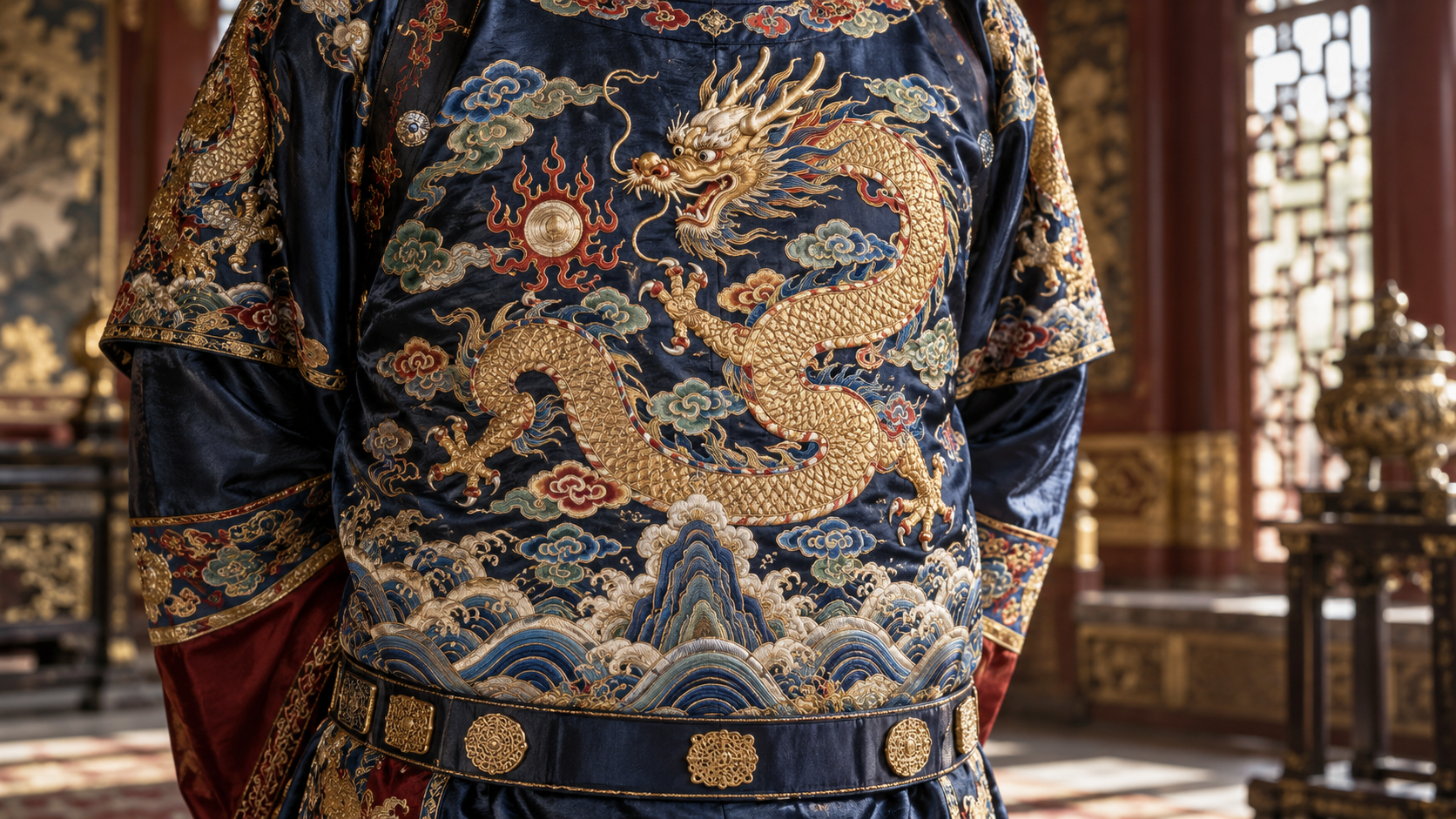
Across centuries of Chinese art, one mysterious object repeatedly appears before the dragon.
It floats among clouds.
It hovers above waves.
It appears on porcelain, metalwork, lacquer and embroidered silk.
Sometimes one dragon pursues it.
Sometimes two dragons confront one another with the object positioned between them.
Around the sphere are curling forms that resemble flames.
For modern viewers, the image has become immediately recognisable.
It is usually called the flaming pearl.
A common explanation identifies it as a symbol of wisdom, purity or enlightenment.
Another interpretation sees the glowing sphere as a celestial body.
Others connect it with rain, thunder or cosmic power.
Yet the historical evidence is more complicated.
A detailed Metropolitan Museum of Art study concluded that the meaning of the dragon’s pearl has never been explained with complete certainty. Chinese literary traditions do not simply identify the object as the sun or moon, while its artistic history suggests that the familiar dragon-and-pearl combination developed gradually rather than existing unchanged from China’s earliest dragon imagery.
This uncertainty makes the motif particularly interesting for the Natural Gems Belgium Learning Center.
Because the “pearl” demonstrates something fundamental about gemstone symbolism:
An object represented as a jewel in art does not necessarily correspond directly to the physical gem material carrying the same name.
The flaming pearl belongs to iconography.
Natural pearl belongs to gemmology.
At times those worlds intersect.
But they should not be confused.
Table of Contents
The Chinese Dragon Is Not the European Dragon
The first step is understanding the dragon itself.
In much European medieval tradition, dragons were frequently portrayed as dangerous creatures associated with destruction, guarded treasure or opponents to be defeated.
Chinese dragon traditions developed very differently.
The Metropolitan Museum of Art describes the Chinese dragon as a fundamentally benevolent creature associated particularly with the bringing of life-sustaining rain. It was frequently represented moving through clouds and interacting with a luminous pearl.
The British Museum likewise describes Chinese dragons as auspicious and historically associated with control over the water supply. Over time, the dragon also became a major symbol of imperial authority.
This association with water is essential.
Agricultural societies depended profoundly on rainfall.
Too little rain could threaten crops.
Too much could bring flooding.
A creature symbolically connected with clouds, rain and water therefore occupied an important position within religious and political imagery.
The dragon was not merely fantastic decoration.
It belonged to a visual system through which natural forces, good fortune and legitimate authority could be represented.
What Is the Flaming Pearl?
Visually, the flaming pearl is usually represented as a round object.
It may appear as:
a luminous sphere,
a circular jewel,
a spiral-filled ball,
or a rounded form surrounded by flame-like projections.
Its exact depiction varies considerably.
The term flaming pearl is convenient, but it can also create a misunderstanding.
It encourages modern viewers to imagine an actual spherical pearl produced by a mollusk.
That is not necessarily what the image represents.
The Metropolitan Museum study notes that the pearl in Chinese literature appears more generally as a treasure or object of exceptional value associated with the dragon. The scholar Helmut Nickel cautioned against assuming that every depiction was simply the sun or moon.
The Smithsonian’s National Museum of Asian Art offers one important Qing-period interpretation, describing the flaming pearl on a prince’s formal court robe as a symbol of wisdom and purity.
Both statements can be true within different interpretive frameworks.
Chinese symbols accumulated meanings over centuries.
One fixed translation may therefore oversimplify the motif.
The Difference Between a Pearl and a Jewel
In English, the expression “flaming pearl” sounds mineralogically precise.
It is not.
Iconographic terminology often uses words such as:
pearl,
jewel,
gem,
or precious stone
more broadly than professional gemmology would.
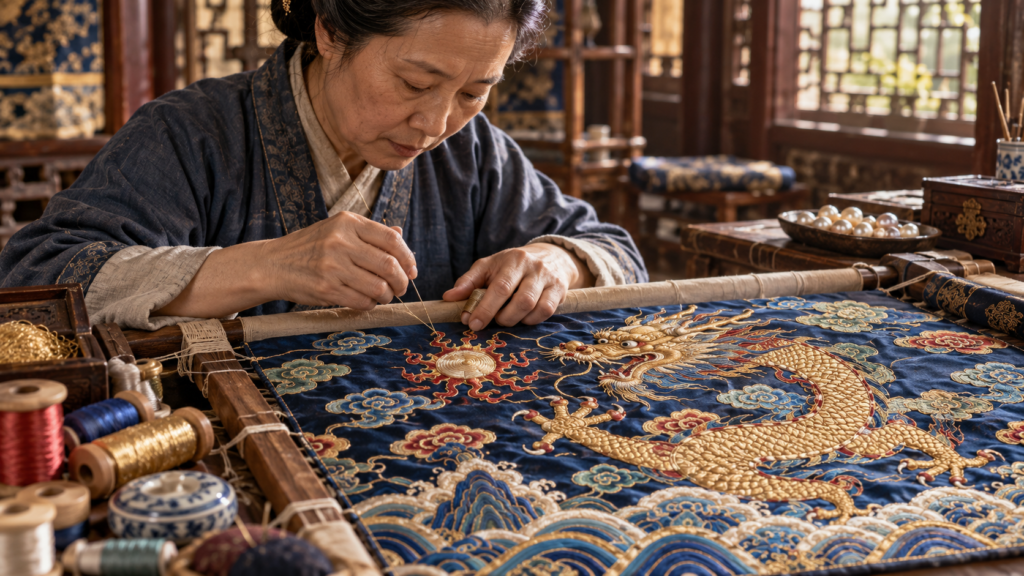
A circular sacred object depicted in embroidery is not automatically a representation of a particular pearl species.
It does not necessarily imply nacre.
It cannot be tested for natural or cultured origin.
It belongs to symbolic representation.
This distinction becomes particularly important when modern spiritual literature interprets the flaming pearl as evidence of ancient belief in the energetic properties of physical pearls.
The image does not establish such a conclusion.
The motif must first be understood within the history of Chinese art.
When Did the Dragon-and-Pearl Motif Appear?
Dragon imagery in China is extremely ancient.
But the familiar pairing of dragon and flaming pearl appears substantially later.
According to research published in the Metropolitan Museum Journal, the combination seems to emerge around the beginning of the Tang dynasty, which lasted from 618 to 907 CE.
The study notes that Central Asian artistic influences were significant during this period and suggests that the dragon-and-pearl motif may have developed partly through those wider intercultural connections.
One possible early example is associated with a sword dated to approximately 600 CE.
Its pommel incorporated two confronting dragons positioned around a now-lost flaming pearl.
The object combines Chinese workmanship with forms influenced by the equestrian cultures of the Eurasian steppe.
This is an important reminder that cultural symbols do not always develop in isolation.
Trade.
Migration.
Diplomacy.
War.
Religion.
And artistic exchange
can all influence visual traditions.
A Symbol Created Across Cultural Boundaries
The Silk Roads were not a single route.
They consisted of overlapping terrestrial and maritime networks through which people, materials and artistic ideas circulated across Eurasia.
China participated in these networks for centuries.
The Tang period in particular was characterised by extensive interaction with Central Asia.
Foreign musicians appeared at court.
New textile patterns circulated.
Religious traditions travelled.
Metalworking styles changed.
Luxury materials entered China from distant regions.
The possibility that the dragon-and-pearl motif was influenced by Central Asian imagery therefore belongs to a wider historical pattern.
This does not make the resulting symbol “less Chinese.”
Cultural traditions frequently absorb outside ideas and reinterpret them so thoroughly that they become part of a distinct local visual language.
Dragon, Clouds and Rain
Why was the dragon so often placed among clouds?
The answer is closely connected with rain.
Clouds are visible indicators of atmospheric change.
Rain sustains agricultural landscapes.
In Chinese traditions, dragons became closely associated with water and precipitation.
The Metropolitan Museum’s study describes the dragon as a bringer of life-sustaining rain.
The British Museum similarly describes dragons as controllers of the water supply.
This association helps explain why dragons appear:
among clouds,
above waves,
rising from seas,
and interacting with a luminous object.
The imagery places the dragon within a cosmic environment rather than simply depicting an animal.
Is the Flaming Pearl a Raindrop?
Some interpretations connect the pearl indirectly with the dragon’s rain-bringing role.
Others identify it with thunder.
Still others interpret it as a celestial light.
The evidence does not permit one universal explanation.
A Metropolitan Museum publication on Qing dragon robes even records competing interpretations of the flaming object as a pearl of cosmic knowledge or as a thunder disk associated with the dragon’s rain-bringing function.
This disagreement is historically valuable.
It shows that museum scholarship itself recognises interpretive complexity.
The correct approach is therefore not to declare:
“The flaming pearl definitely means X.”
A stronger statement is:
The motif accumulated several interconnected associations involving preciousness, cosmic imagery, rain, wisdom, auspicious power and imperial symbolism.
Dragons and the Imperial Court
Over time, dragon imagery became closely regulated within imperial visual culture.
Five-clawed dragons were particularly associated with the emperor and the highest ranks of the ruling house.
The Metropolitan Museum notes that by the sixteenth century dragons were widely used in decorative art, while the five-clawed form remained associated particularly with imperial status.
This means that a dragon on an imperial garment communicated more than mythological interest.
It could indicate rank.
It could help identify the wearer.
It formed part of an institutional language of power.
The pearl accompanying the dragon participated in that wider visual system.
The Qing Court and the Language of Clothing
During the Qing dynasty, which ruled from 1644 until 1912, formal court clothing was highly regulated.
Materials.
Colours.
Dragon forms.
Numbers.
Placement of motifs.
And accessories
could all indicate status.
The Smithsonian’s National Museum of Asian Art documents a formal summer court robe for a top-ranking prince decorated with multiple five-clawed dragons.
The museum identifies the flaming pearl on the chest as a symbol of wisdom and purity. The robe also contains mountains, waves, clouds and auspicious emblems arranged into a broader representation of the cosmos.
The meaning therefore does not reside in one isolated symbol.
The entire garment forms an integrated visual system.
A Dragon Robe as a Map of the Cosmos
The imagery on Qing court clothing can be remarkably complex.
Mountains represent the earthly realm.
Waves represent waters.
Clouds fill the celestial space.
Dragons move through this environment.
A luminous pearl appears within their reach.
Taken together, the design creates something resembling a symbolic cosmos worn on the body.
This matters because imperial authority was not understood only as political administration.
The emperor occupied a role connected with cosmic order and ritual responsibility.
Art and clothing helped communicate that relationship.
The dragon-and-pearl motif therefore functioned within a much larger symbolic environment.
The Five-Clawed Dragon and Imperial Authority
A bowl in the Metropolitan Museum dating to approximately 1735 provides a useful example of how regulated dragon imagery became.
The museum explains that the traditional dragon-and-flaming-pearl motif had auspicious associations and frequently appeared on objects intended for imperial use.
It also notes the historical distinction between five-clawed dragons associated with the emperor and four-clawed forms that could appear more broadly.
Such distinctions show why iconography must be interpreted carefully.
A dragon is not simply a dragon.
The number of claws may matter.
Its relationship to other symbols may matter.
The object on which it appears may matter.
The identity of the intended user may matter.
The Flaming Pearl on Ming Art
The motif was already firmly established before the Qing dynasty.
A late Ming cloisonné panel preserved at the Metropolitan Museum depicts two dragons chasing a flaming pearl among clouds.
The museum identifies the dragons as symbols of imperial power and benevolence.
A sixteenth-century carved lacquer dish in the same museum combines flaming pearls with the Chinese character shou, representing longevity, and other auspicious emblems.
These examples demonstrate that the flaming pearl could participate in broader visual programmes concerning:
good fortune,
imperial legitimacy,
longevity,
cosmic order,
and auspicious power.
Its meaning was not limited to one theological definition.
The Dragon and Pearl on Porcelain
Porcelain became one of the most important surfaces for transmitting the motif.
A Yuan-dynasty dish in the British Museum, dating to the fourteenth century, depicts a three-clawed dragon pursuing a flaming pearl.
Later Ming and Qing ceramics continued using related compositions.
A Kangxi-period dish in the British Museum shows a five-clawed dragon pursuing a flaming pearl among clouds.
Another Qing vessel depicts dragons rising from waves toward the pearl.
The recurrence of the motif across different media demonstrates its extraordinary durability.
Textile.
Porcelain.
Metalwork.
Lacquer.
Painting.
The same basic relationship remained recognisable.
Dragon.
Cosmic environment.
Precious luminous object.
Why Does the Pearl Have Flames?
A natural pearl does not burn.
So why is the symbolic pearl surrounded by flames?
The flame-like forms appear to indicate luminosity or supernatural brilliance rather than literal combustion.
The Metropolitan Museum study explicitly notes that these swirling projections suggest that the object emits light.
This visual convention is important.
Artists needed to communicate that the object was extraordinary.
A plain circle could appear ordinary.
Adding flame-like projections transforms it into a radiant jewel.
The “flames” are therefore best understood as part of the iconographic language of brilliance.
They should not be interpreted as evidence that ancient Chinese observers believed physical pearls were combustible.
Is the Pearl the Sun or Moon?
This interpretation has a long history in Western scholarship.
Because the dragon appears among clouds and the pearl emits light, scholars sometimes identified it as:
the sun,
the moon,
or another celestial body.
This is visually plausible.
But it is not securely established.
The Metropolitan Museum’s detailed study notes that Chinese literary references do not simply identify the dragon’s pearl as the sun or moon.
The celestial interpretation may therefore explain some artistic contexts without functioning as a universal solution.
This is an excellent example of why symbolic imagery should not be translated too aggressively.
A motif can remain intentionally multivalent.
Is the Flaming Pearl a Symbol of Wisdom?
The answer is: in some later interpretive contexts, yes.
The Smithsonian explicitly identifies the flaming pearl embroidered on a Qing prince’s robe as a symbol of wisdom and purity.
Its educational material on a Ming painting of eleven dragons describes flaming pearls as representing wisdom and enlightenment.
These are legitimate museum interpretations.
But they should not be transformed into a claim that every dragon-and-pearl image across every Chinese dynasty carried precisely this meaning.
Symbolic systems evolve.
The same motif can accumulate additional associations.
A Ming painting and a Qing court robe do not necessarily function identically.
The Pearl as an Object of Exceptional Value
Another important interpretation is more straightforward.
Pearls were precious.
Rare natural pearls could represent enormous wealth.
In Chinese literature, the dragon’s pearl sometimes appears as a treasure of extraordinary value.
The Metropolitan Museum’s scholarly study emphasises this aspect.
The pearl enhances the dragon because it is itself an exceptional treasure.
This interpretation may be easier to understand if we separate the physical pearl from later mass availability.
Before modern pearl cultivation, fine natural pearls were exceptionally scarce.
Finding a large, lustrous, well-shaped pearl required extraordinary luck.
That rarity helped make pearls natural metaphors for preciousness.
What Is a Natural Pearl?
A real pearl is an organic gem material formed within certain mollusks.
Unlike ruby or quartz, pearl is not a crystal extracted from rock.
GIA explains that natural pearls form within mollusks without deliberate human intervention.
Cultured pearls form after human intervention introduces tissue and, in many varieties, a bead nucleus that stimulates pearl formation.
This distinction is fundamental to modern gemmology.
Natural pearl.
Cultured pearl.
Imitation pearl.
These categories describe very different materials or formation histories.
A historical Chinese painting of a flaming pearl, however, cannot be classified gemmologically in this way.
It is an image.
Nacre and the Physical Beauty of Pearl
Many familiar pearls possess nacre.
Nacre is built from microscopic layers involving calcium carbonate, particularly aragonite, together with organic components.
These layers interact with light in complex ways.
The result produces the characteristic lustre and orient valued in fine pearls.
GIA explains that the luminous appearance of nacreous pearls results from interactions between light and the microscopic structure of the nacre.
This provides an interesting physical comparison with the flaming pearl.
A real pearl can genuinely appear luminous.
But that optical appearance has a scientific explanation.
The flaming pearl’s supernatural-looking brilliance belongs to artistic symbolism.
Natural Pearl and Symbolic Pearl Are Different Categories
This distinction deserves emphasis.
A biological pearl can be examined.
Its internal structure can be analysed by X-radiography.
Its nacre can be studied.
Its natural or cultured origin can often be determined.
The flaming pearl cannot.
It exists as an iconographic form.
Its meaning must be investigated through:
art history,
religious studies,
historical texts,
court regulations,
and cultural context.
Modern discussions sometimes blur these categories.
The result can create unsupported claims that physical pearls possess all the spiritual properties represented by the flaming jewel.
Historical evidence does not justify that shortcut.
Real Pearls at the Qing Court
Actual pearls also possessed major importance in Chinese court culture.
The distinction between symbolic and physical pearl does not mean real pearls were insignificant.
Portraits of Qing imperial women show elaborate jewellery incorporating pearls.
The Smithsonian’s portrait of Lady Wanyan, the primary wife of Prince Hongming, depicts her wearing a coronet decorated with five gold-and-pearl phoenix ornaments indicating her high rank.
The National Museum of Asian Art’s major exhibition on Qing empresses likewise documented pearl-rich imperial jewellery and headdresses.
Here, pearl is no longer merely painted symbolism.
It is real material incorporated into court hierarchy.
Pearl as Rank and Privilege
Court jewellery communicates social structure through material.
Rare materials are powerful partly because access can be controlled.
Gold.
Jade.
Pearl.
Kingfisher feather.
Precious stones.
Their use in regulated court dress helps distinguish rank.
The pearl therefore functioned in two parallel worlds.
In visual art, a flaming pearl could represent an auspicious, radiant or wisdom-related treasure.
In actual court jewellery, physical pearls could become indicators of elite status.
The two meanings may reinforce one another.
But they are not identical.
Phoenix, Pearl and Imperial Women
The portrait of Lady Wanyan provides an important comparison with the dragon.
Her coronet contains gold-and-pearl phoenix ornaments.
Within Chinese court imagery, phoenix motifs were strongly associated with high-ranking women.
The pairing of precious materials and symbolic creatures created a sophisticated visual language of rank.
Just as the dragon could communicate imperial or princely authority, the phoenix could participate in courtly representations of elite femininity.
Pearl therefore belonged not only to dragon symbolism.
It also functioned as a prestigious physical material within the broader court system.
A Precious Material from Living Organisms
Pearl occupies an unusual position in gemmology.
It is organic.
Its beauty develops through biological processes.
The same is true, in different ways, for materials such as coral.
This makes pearl fundamentally different from mineral gemstones formed through geological processes.
Yet historically, societies often placed pearls among the most prestigious gems.
Their rarity mattered more than whether they satisfied a modern mineralogical definition.
This is an important reminder.
The cultural category “precious stone” has never been identical to the scientific category “mineral.”
Why Pearls Became Powerful Symbols
Several natural characteristics make pearl particularly suitable for symbolic interpretation.
Its surface can appear luminous.
Its rounded form can resemble:
the moon,
a drop of water,
or a celestial sphere.
Its formation occurs hidden inside a living mollusk.
Its finest natural examples were historically rare.
Its smooth surface appears remarkably complete without faceting.
These physical characteristics can encourage symbolic interpretations involving:
purity,
perfection,
wisdom,
preciousness,
or celestial light.
But these associations vary between societies.
They are not physical properties measured in a laboratory.
The Dragon as Bringer of Rain
The dragon’s relationship with pearl imagery becomes especially interesting when water symbolism is considered.
Chinese dragons were strongly associated with rain.
Real pearls originate from aquatic mollusks.
The flaming pearl often appears among clouds or waves.
These relationships can tempt us to create an elegant unified explanation.
But historical interpretation should remain cautious.
The motif may draw strength from multiple associations simultaneously.
Water.
Light.
Preciousness.
Celestial order.
Wisdom.
Imperial authority.
A symbol does not always have to mean one thing.
Dragon, Pearl and the Sea
Some Qing porcelain images place dragons directly above waves.
The pearl hovers in the space between water and sky.
This creates a highly dynamic composition.
The dragon rises.
The pearl shines.
Clouds swirl.
Waves move beneath.
The natural world becomes animated.
The image can communicate auspicious power without requiring the viewer to decode it as a rigid formula.
In this sense, the dragon-and-pearl motif works partly because it remains visually suggestive.
It brings together several forces associated with prosperity and cosmic harmony.
Imperial Authority and Control of Water
The relationship between ruler and water possessed practical as well as symbolic importance.
Chinese states depended upon large agricultural systems.
Flood control and irrigation were central political concerns.
An imperial symbol associated with beneficial rain therefore possessed obvious resonance.
This should not be simplified into the claim that emperors literally believed they controlled weather through gemstone energy.
The imagery communicated ideals of legitimate order.
The dragon became a visual expression of authority harmonised with the forces of nature.
The pearl enhanced that symbolism as an auspicious and precious object.
The Dragon Is Not Always the Emperor
Although imperial dragon imagery became highly regulated, dragons appeared beyond the emperor’s personal possessions.
Different claw numbers, contexts and periods mattered.
The Metropolitan Museum notes that by the sixteenth century dragon motifs were broadly used, while five-clawed dragons retained particularly imperial associations.
Therefore:
dragon does not automatically equal emperor.
Likewise:
flaming pearl does not automatically equal imperial jewel.
Historical context remains essential.
The Pearl Is Not Always a Physical Pearl
The opposite mistake is equally important.
An embroidered flaming pearl should not automatically be described as mother-of-pearl or nacre.
A porcelain flaming pearl is made from ceramic material and glaze.
A cloisonné flaming pearl may consist entirely of enamel and metal.
A painted flaming pearl consists of pigments.
The symbolic identity survives despite changes in physical material.
This demonstrates something profound about gemstone symbolism.
The cultural idea of a jewel can become more important than the material from which its image is made.
Gemstone Symbolism Without a Gemstone
The dragon and flaming pearl therefore creates an unusual case for gemmological history.
We are studying gemstone symbolism through objects that frequently contain no pearl at all.
A dragon robe may depict the pearl in silk thread.
A porcelain bowl may depict it in enamel.
A lacquer dish may carve it from resinous lacquer layers.
A metal panel may construct it from enamel and copper alloy.
The “gemstone” exists as a concept.
This reveals how deeply precious materials can enter cultural imagination.
The Pearl as an Idea of Preciousness
Once a precious material becomes culturally recognisable, its name can acquire metaphorical meaning.
We still do this today.
A person may be called a gem.
Something exceptional may be described as a pearl.
The expression does not require actual mineral or organic gem material.
Historical societies used similar processes.
A pearl could become a metaphor for something rare, valuable or radiant.
The dragon’s treasure therefore belongs to a larger human tendency to transform precious materials into symbolic language.
Is the Flaming Pearl Buddhist?
Some later interpretations connect flaming-jewel imagery with Buddhist concepts.
Buddhist visual traditions certainly employ jewels as sacred symbols.
However, the dragon-and-pearl motif should not be reduced automatically to one Buddhist explanation.
The image appears across courtly, secular and religious decorative contexts.
Its history may involve multiple cultural influences.
The Metropolitan Museum’s research even suggests possible Central Asian contributions to the motif’s early development.
The safest interpretation therefore recognises overlap without declaring a single religious origin.
Is the Pearl Daoist?
A similar caution applies to Daoist explanations.
Dragons, immortality imagery, celestial symbolism and precious jewels all appear within Chinese religious environments.
But the flaming pearl occurs so widely that identifying it exclusively as a Daoist symbol would be misleading.
Chinese visual culture does not always follow the boundaries modern viewers expect between:
religion,
court ritual,
cosmology,
literature,
and decorative art.
Motifs could move between these contexts.
That flexibility is part of their historical power.
Wisdom and Purity: A Legitimate but Contextual Meaning
The Smithsonian’s identification of the Qing robe’s flaming pearl as a symbol of wisdom and purity is therefore useful when kept in context.
It tells us how the motif can function within an eighteenth-century imperial garment.
It should not be converted into:
“All ancient Chinese people believed every pearl crystal emitted wisdom energy.”
The first statement is art-historical interpretation.
The second is an unsupported modern metaphysical claim.
The difference is substantial.
Modern Crystal Beliefs About Pearl
Contemporary spiritual literature often associates pearl with:
purity,
calm,
feminine energy,
intuition,
emotional balance,
wisdom,
or lunar influence.
Some systems link pearl with particular chakras.
These interpretations belong to modern metaphysical practice.
They may be personally meaningful to practitioners.
But they should not automatically be attributed to imperial China.
The dragon’s flaming pearl and the natural pearl necklace belong to different historical contexts.
Neither establishes scientifically measurable spiritual energy.
Does Pearl Emit Calming or Purifying Energy?
There is no established scientific evidence that pearl emits an invisible energy field capable of:
purifying emotions,
balancing chakras,
improving intuition,
or treating medical conditions.
Pearls have measurable physical properties.
Their structure can be studied.
Their formation can be analysed.
Their surface and internal characteristics can be examined.
Their optical appearance can be explained.
Spiritual claims belong to cultural or personal belief.
The historical significance of pearl does not depend upon laboratory confirmation of those beliefs.
The Science Behind Pearl’s Glow
One of the reasons pearl attracts symbolic interpretations is its exceptional lustre.
The surface does not sparkle like a faceted diamond.
Instead, light seems to move through and across the nacre.
GIA explains that interactions between light and microscopic nacre layers produce the characteristic luminous appearance of many pearls.
This effect can appear almost internal.
For historical viewers unfamiliar with modern optical explanations, such a material could easily inspire poetic or symbolic language.
But the optical effect remains physical.
Its beauty does not require supernatural luminescence.
Natural Pearl Before Modern Cultivation
The historical rarity of pearl is another essential consideration.
Today cultured pearls are widely available.
That can make it difficult to appreciate how unusual fine pearls were historically.
Natural pearls form without human initiation.
Only a small proportion of mollusks produce pearls suitable for fine jewellery.
Large, spherical, highly lustrous natural pearls were therefore extraordinarily scarce.
Their rarity helped support their status in royal jewellery.
A Qing court headdress set with numerous pearls communicated access to resources far beyond those available to ordinary people.
Cultured Pearl Changed the Material World
Modern pearl cultivation transformed availability dramatically.
Cultured pearls are real pearls formed within living mollusks, but their production begins with deliberate human intervention.
This distinction matters gemmologically.
It also means that modern access to pearls differs fundamentally from historical access.
A pearl necklace today cannot be interpreted economically in exactly the same way as a collection of large natural pearls in an eighteenth-century imperial court.
Historical symbolism must consider historical scarcity.
Imperial Pearl and Rank
The Smithsonian portrait of Lady Wanyan demonstrates how actual pearls could be integrated into regulated court dress.
Her gold-and-pearl phoenix ornaments signified elevated rank.
This gives us much stronger evidence for the social meaning of physical pearls than generic claims about pearl energy.
The pearls communicated:
status,
access,
court identity,
and privilege.
These meanings were visible.
They were institutionally recognised.
And they were culturally specific.
The Flaming Pearl and the Imperial Pearl Are Not the Same Thing
We can now make an important distinction.
The flaming pearl
is primarily an iconographic object represented in art.
The imperial pearl
may be an actual organic gem incorporated into jewellery or ceremonial dress.
Both belong to Chinese court culture.
But they function differently.
The flaming pearl participates in symbolic imagery.
The physical pearl participates directly in material hierarchy.
Sometimes the meanings overlap through ideas of rarity, brilliance or purity.
But responsible interpretation keeps the categories separate.
What Does the Dragon Chase?
Perhaps “chase” itself deserves caution.
Museum catalogues frequently describe dragons as:
chasing,
pursuing,
playing with,
or sporting with
the pearl.
These verbs create different impressions.
Is the dragon trying to seize the jewel?
Protecting it?
Playing with it?
Circling it?
The artwork rarely provides a literal narrative answer.
The relationship is symbolic rather than necessarily narrative.
Even the action remains open to interpretation.
This uncertainty is part of what makes the motif so enduring.
Two Dragons and One Pearl
Many artworks show two dragons facing one another with the pearl between them.
This creates perfect visual tension.
Neither dragon owns the centre.
The pearl becomes the focal point.
The composition appears on:
textiles,
metalwork,
ceramics,
and architectural decoration.
A pair of gold plaques in the British Museum from the Ming period depicts two dragons and a flaming pearl among clouds. The plaques are also inlaid with semiprecious stones.
Here, the distinction becomes particularly fascinating.
Real gemstones surround an image of a symbolic jewel.
Material and metaphor occupy the same object.
When Real Gemstones Surround an Imaginary Jewel
The Ming plaques illustrate precisely why gemstone symbolism deserves careful study.
The surrounding stones are physical materials.
They can, in principle, be identified gemmologically.
The central flaming pearl is part of the design.
Its “preciousness” is symbolic.
Yet visually, all participate in one language of luxury.
This shows how historical objects combine:
material value,
symbolic value,
craftsmanship,
and social meaning.
Trying to reduce the entire object to the metaphysical property of one gemstone would miss almost everything important about it.
A Cosmic Jewel Rather Than a Crystal Tool
The flaming pearl is therefore better understood as a cosmic or auspicious jewel motif than as a historical crystal-healing instrument.
It does not need to have been held.
Meditated with.
Placed on the body.
Or used as a modern energy stone.
Its power lies in representation.
The jewel helps organise a visual universe inhabited by:
dragons,
clouds,
waves,
mountains,
and auspicious signs.
That is a very different form of spiritual gemstone symbolism.
What Can We Establish with Confidence?
Several conclusions are strongly supported.
Chinese dragons were historically associated with auspicious power and rain.
Dragon imagery eventually became closely associated with imperial authority.
The dragon-and-flaming-pearl motif appears by approximately the beginning of the Tang period, although its deeper origins remain debated.
The motif occurs extensively in later Chinese art.
It appears on porcelain, textiles, lacquer, metalwork and paintings.
Five-clawed dragons acquired particularly strong imperial associations.
Qing court interpretation could associate the flaming pearl with wisdom and purity.
The motif could also be understood more broadly as an exceptionally precious or luminous treasure.
The precise original and universal meaning of the pearl remains uncertain.
Real pearls simultaneously occupied important positions in Chinese elite and imperial jewellery.
These actual pearls were organic gem materials rather than mineral crystals.
What Should Remain Uncertain?
We should not claim that every flaming pearl represents:
the sun,
the moon,
a raindrop,
thunder,
Buddhist enlightenment,
Daoist immortality,
or one specific physical pearl.
Any of these ideas may contribute to particular interpretations.
None adequately explains every occurrence.
Likewise, we should not assume that historical Chinese people universally believed physical pearls emitted wisdom or spiritual energy.
The surviving evidence is richer and less uniform.
Responsible interpretation preserves that complexity.
Why This Matters for Gemstone History
The dragon and flaming pearl teaches us that gemstone symbolism can exist independently of physical gemstone material.
This is a crucial insight.
Humans do not only wear gems.
They imagine them.
Paint them.
Embroider them.
Carve representations of them.
Use their names metaphorically.
And place them within stories about the cosmos.
A gemstone can therefore influence culture even when no actual gemstone is present.
A Modern Reflection Inspired by the Flaming Pearl
For a contemporary reader, the motif offers an interesting reflective idea without requiring claims of ancient crystal therapy.
Imagine the pearl as a symbol of something genuinely valuable but difficult to define.
Wisdom.
Knowledge.
Integrity.
Understanding.
The dragon’s movement around the jewel can then become a modern metaphor for the effort required to approach that value.
This is a contemporary interpretation.
It is not a reconstruction of Qing ritual.
Making that distinction allows historical symbolism to inspire without being appropriated or misrepresented.
Conclusion: The Jewel the Dragon Never Stops Chasing
For more than a thousand years, Chinese artists repeatedly returned to the image of a dragon and a luminous pearl.
The motif travelled across media.
Across dynasties.
Across social environments.
It appeared on imperial robes.
On porcelain.
On lacquer.
On metalwork.
And in painting.
Its meaning was never entirely simple.
The dragon could bring rain.
It could represent auspicious power.
It could express imperial authority.
The pearl could represent preciousness.
Wisdom.
Purity.
Luminosity.
Or a broader cosmic treasure.
Different periods could emphasise different aspects.
Meanwhile, real pearls occupied their own important place in court jewellery, where their rarity and beauty could communicate rank and privilege.
At Natural Gems Belgium, the dragon and flaming pearl provides an unusually important lesson in the history of gemstone beliefs.
The symbolic meaning of a gem does not always come from the physical properties of the gem itself. Sometimes the gemstone becomes an idea.
A natural pearl is an organic gem formed within a mollusk.
Its nacre.
Its lustre.
Its structure.
Its natural or cultured origin.
These can be investigated scientifically.
The flaming pearl belongs to another field.
Art.
Religion.
Cosmology.
Political symbolism.
Human imagination.
Both deserve serious study.
But they should not be confused.
The dragon may still chase its mysterious jewel.
Its exact meaning may never be reduced to one sentence.
Perhaps that is why the image endured.
Not because the pearl offered one simple answer.
But because it was precious enough to hold many meanings at once.
References & Further Reading
1. The Metropolitan Museum of Art – Helmut Nickel, “The Dragon and the Pearl”
Source description: Detailed scholarly article published in Metropolitan Museum Journal 26. Examines the historical development of the dragon-and-pearl motif, possible Central Asian influences and competing interpretations of the flaming pearl.
Particularly important because the study cautions against reducing the pearl automatically to either the sun or moon and emphasises its broader status as an object of exceptional value.
2. Smithsonian National Museum of Asian Art – Summer Chaofu for a Top-Rank Prince
Source description: Detailed educational study of a Qing formal court robe.
Explains the symbolism of the five-clawed dragon, the flaming pearl, mountains, waves, clouds and Buddhist auspicious emblems. The museum identifies the pearl in this court context with wisdom and purity.
3. Smithsonian National Museum of Asian Art – Eleven Dragons
Source description: Museum resource on a Ming-dynasty dragon scroll.
Discusses the flaming pearl as an image associated with wisdom and enlightenment and provides useful context for the dragon in Chinese visual culture.
4. The Metropolitan Museum of Art – Panel with Dragons amid Clouds
https://www.metmuseum.org/art/collection/search/40747
Source description: Collection record for a late Ming cloisonné panel showing two dragons chasing a flaming pearl.
The museum identifies Chinese dragons as symbols of imperial power and benevolence and documents the established use of the motif in late-sixteenth- and early-seventeenth-century decorative art.
5. The Metropolitan Museum of Art – Bowl with Dragon
https://www.metmuseum.org/art/collection/search/208374
Source description: Collection record for an eighteenth-century Chinese porcelain bowl.
Explains the auspicious association of the dragon-and-flaming-pearl motif and discusses the distinction between five-clawed imperial dragons and four-clawed forms permitted more broadly.
6. British Museum – Yuan Dynasty Dish with Dragon and Flaming Pearl
https://www.britishmuseum.org/collection/object/A_PDF-A-562
Source description: Official collection record for a fourteenth-century Jingdezhen porcelain dish decorated with a dragon pursuing a flaming pearl.
Provides securely dated material evidence for the established motif during the Yuan period.
7. British Museum – Qing Dish with Dragons Chasing Flaming Pearls
https://www.britishmuseum.org/collection/object/A_PDF-B-710
Source description: Museum record for a nineteenth-century Qing porcelain dish.
The British Museum describes Chinese dragons as auspicious controllers of water that ultimately became symbols of imperial authority.
8. British Museum – Ming Gold Plaques with Dragons and Flaming Pearl
https://www.britishmuseum.org/collection/object/A_1949-1213-1-2
Source description: Official record for fifteenth-century gold plaques decorated with two dragons and a flaming pearl among clouds and additionally inlaid with semiprecious stones.
The objects provide an exceptional example in which real gemstones and a symbolic jewel motif occur together.
9. Smithsonian National Museum of Asian Art – Portrait of Lady Wanyan
https://asia.si.edu/explore-art-culture/collections/search/edanmdm%3Afsg_S1991.53
Source description: Qing court portrait of the primary wife of Prince Hongming.
The museum documents five gold-and-pearl phoenix ornaments on her coronet as jewellery signifying high rank, providing direct evidence for the use of actual pearls within imperial court hierarchy.
10. Smithsonian National Museum of Asian Art – Empresses of China’s Forbidden City, 1644–1912
https://asia.si.edu/whats-on/exhibitions/empresses-of-chinas-forbidden-city-1644-1912
Source description: Major museum exhibition examining Qing imperial women through portraits, court dress, jewellery, religious objects and symbols of authority.
Provides authoritative context for the role of pearl-rich jewellery and regulated adornment within the Forbidden City.
11. Gemological Institute of America – Pearl Gem Overview
https://origin.prod.gia.edu/pearl/gem-overview
Source description: Authoritative gemmological introduction to natural and cultured pearls.
Explains pearl formation, colour, shape, lustre and the distinction between naturally formed pearls and pearls produced through deliberate cultivation.
12. Gemological Institute of America – How GIA Analyzes Pearls
https://www.gia.edu/gia-news-research/guide-how-gia-analyzes-pearls
Source description: Scientific explanation of modern pearl identification using X-radiography, fluorescence spectroscopy and micro-CT.
Also discusses how the microscopic structure of nacre produces pearl’s characteristic luminous appearance.
13. Cleveland Museum of Art – Dragons Chasing Flaming Pearls
https://www.clevelandart.org/art/1988.33
Source description: Museum record for an early Chinese or Central Chinese silk tapestry showing repeated dragons pursuing flaming pearls.
The object provides useful evidence for the spread and adaptation of the dragon-and-pearl motif and its relationship with broader Central Asian artistic traditions.
Historical Symbolism, Physical Pearl and Modern Metaphysical Belief
The dragon and flaming pearl requires several categories of evidence to remain separate.
Scientifically established: Pearls are organic gem materials produced by certain mollusks.
Scientifically established: Many nacreous pearls derive their lustrous appearance from the microscopic layered structure of nacre.
Scientifically established: Natural and cultured pearls can often be distinguished through modern gemmological analysis.
Historically documented: Chinese dragon imagery was strongly associated with rain, water and auspicious power.
Historically documented: Dragon imagery became closely connected with imperial authority.
Historically documented: The dragon-and-pearl combination appears by approximately the beginning of the Tang period and becomes widespread in later Chinese art.
Historically documented: Flaming pearls appear on porcelain, textiles, lacquer, painting and metalwork.
Historically documented interpretation: In Qing court imagery, the flaming pearl could be associated with wisdom and purity.
Historically uncertain: The flaming pearl does not possess one universally established meaning across every dynasty and context.
Historically uncertain: It cannot always be identified securely with the sun, moon, thunder, rain or a literal physical pearl.
Historically documented: Actual natural pearls were used in Qing imperial jewellery and could communicate elevated rank.
Important distinction: An embroidered, painted or ceramic flaming pearl is an iconographic jewel rather than a biologically formed pearl that can be identified gemmologically.
Modern metaphysical belief: Contemporary spiritual traditions may associate pearl with purity, intuition, emotional calm, feminine energy or particular chakras.
Scientific limitation: There is no established scientific evidence that pearls emit supernatural energy, activate chakras or independently produce spiritual or medical healing.
The Chinese dragon and flaming pearl therefore offers an unusually sophisticated example of gemstone symbolism.
The physical pearl belongs to biology and gemmology.
The flaming pearl belongs primarily to art, symbolism and cultural history.
Their meanings can intersect.
But understanding the difference between them allows the historical tradition to remain much richer than a simple modern crystal-healing interpretation.
[…] history of pearls in Byzantine Christianity reveals how an organic gemstone became part of a sophisticated material […]