

Table of Contents
A Sacred Object Carried Close to the Heart
Across the Himalayan cultural world, religious devotion has often taken forms that can be carried, worn or held.
A prayer may be recited.
A sacred image may be placed in a household shrine.
A religious text may be carefully preserved.
And in some Tibetan Buddhist traditions, sacred objects may be carried inside a small container worn against the body.
Such a container is commonly known as a gau, also written ga-u, ga’u or ghau.
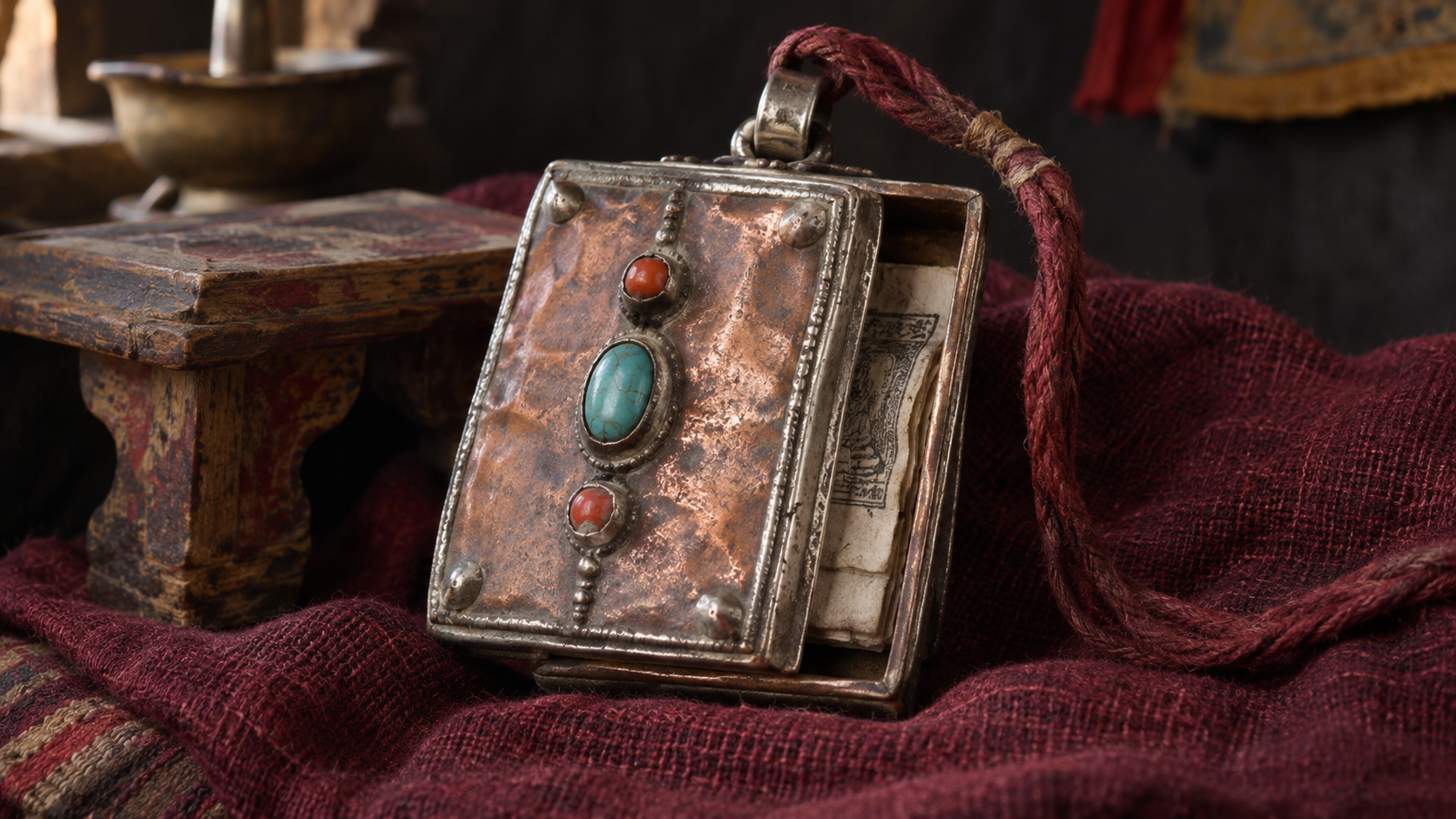
At first glance, a gau may resemble an ornamental pendant.
Some examples are fashioned from copper or silver. Others incorporate elaborate metalwork, coloured stones, glass or other decorative materials.
Yet its significance extends beyond jewellery.
The container may hold a miniature image of a Buddhist figure, a written prayer, a printed mantra or another object considered sacred within a particular religious context.
Its importance lies not simply in the value of the materials from which it is made, but in what it contains and the religious relationships it represents.
The Tibetan gau illustrates a form of sacred jewellery in which religious devotion, portability, protective belief and artistic craftsmanship come together.
Its history also reveals an important distinction between traditional Buddhist practices and contemporary claims about gemstone energy.
A precious stone may decorate a sacred object.
But the religious meaning of that object cannot automatically be attributed to the stone’s mineral composition.
What Is a Tibetan Gau?
A Tibetan gau amulet is a small portable container associated with Tibetan Buddhist religious practice.
Its primary function is to hold objects considered religiously meaningful.
This unique amulet serves as a significant artifact within the context of Tibetan Buddhism.
The container may be worn around the neck or suspended across the body.
Some are relatively plain.
Often, a Tibetan gau amulet is intricately designed, showcasing the artistic craftsmanship of Tibetan culture.
Others are highly decorated.
The nineteenth-century Tibetan gau preserved by Chiddingstone Castle in England provides a useful historical example.
The museum identifies the object as an amulet box made from incised copper with a silk cord.
Its documentation explains that gau containers could hold miniature Buddhist images, sacred texts and other objects.
The museum also records the use of blessed medicinal preparations in some examples.
This demonstrates that the gau was not merely a decorative pendant.
It could serve as a portable repository for religious objects and, in certain circumstances, practical materials.
However, not every gau contained the same objects.
Their contents and functions could vary according to period, region, owner and religious practice.
A Portable Shrine: The Tibetan Gau Amulet Rather Than an Ordinary Gemstone Pendant
The distinction between a gau and conventional jewellery is essential.
A gemstone pendant is often valued for the beauty, rarity or symbolism of its material.
A gau is fundamentally a container.
Its significance may depend upon a sacred image, prayer or other object placed inside.
The exterior can be decorative.
The interior can be devotional.
These two aspects are related but not identical.
A gau decorated with gemstones should therefore not automatically be interpreted as an amulet whose effectiveness derives from the gemstones themselves.
Within Buddhist religious contexts, prayers, sacred representations, blessings and ritual relationships may be more important than the physical properties of the decorative materials.
The container’s function is best understood through its religious use.
The Historical Setting: Tibetan Buddhist Material Culture
Tibetan Buddhism developed through centuries of religious exchange, translation, institutional growth and local adaptation.
Its traditions include different schools, lineages, practices and ritual systems.
Portable religious objects form part of this diverse material culture.
They allow individuals to maintain connections with sacred texts, religious images and devotional practices while travelling or carrying out daily activities.
However, Tibetan Buddhist traditions should not be treated as completely uniform.
An object used by one community may have a different role elsewhere.
A nineteenth-century gau from Tibet does not necessarily document every form of portable Buddhist reliquary used throughout the Himalayan region.
Museum collections provide evidence of particular objects.
They should not be used to construct an imaginary universal system of Tibetan amulet beliefs.
The Nineteenth-Century Gau at Chiddingstone Castle
Chiddingstone Castle’s collection includes a Tibetan gau dated to the nineteenth century.
The object is made from copper and retains its plaited silk cord.
Its surface is decorated with incised designs.
The museum explains that gau containers could be worn around the neck or across the body.
It also identifies their use in connection with nomadic life.
This is particularly revealing.
A portable sacred object can accompany its owner through changing environments.
It does not require a permanent architectural shrine.
Its size and construction allow religious significance to remain physically close to the person carrying it.
The museum’s example demonstrates the relationship between portability, personal devotion and craftsmanship.
Its historical importance does not depend upon the presence of a spectacular gemstone.
Indeed, the surviving copper object shows that a gau could possess religious significance without elaborate precious-stone decoration.
Sacred Images Inside the Gau
Some gau containers were used to carry small Buddhist images.
These might represent a Buddha, bodhisattva or another figure important within a particular religious tradition.
The significance of such an image depends upon its religious context.
It may serve as a focus of devotion or remembrance.
It may be associated with prayer.
In some traditions, a properly prepared sacred representation may be understood as carrying blessings or religious significance.
However, a miniature image should not automatically be treated as interchangeable with every other Buddhist figure.
Different figures have different iconographies and associations.
A responsible interpretation identifies the represented figure where evidence allows.
It also distinguishes the beliefs of practitioners from scientifically measurable properties of the material object.
Written Prayers and Sacred Texts
Another important category of gau contents is written religious material.
Chiddingstone Castle documents the use of sacred texts inside these containers.
The Pitt Rivers Museum at the University of Oxford provides related evidence through a Tibetan tsa-tsa, a small Buddhist votive object.
The museum describes a hole in the back of the object where printed Buddhist prayers could have been inserted.
Two additional perforations suggest that the object may once have been attached to a portable shrine or amulet box.
This example is especially informative.
It demonstrates how written religious material and sacred imagery could be incorporated into portable devotional objects.
The power attributed to such an object belongs to the religious tradition in which it was used.
It should not be interpreted as proof that paper, clay or metal produces a supernatural physical field.
The Tsa-Tsa and the Gau: Related but Different Objects
A tsa-tsa is not the same thing as a gau.
A tsa-tsa is generally a small moulded devotional object, commonly made from clay.
A gau is a container.
However, the two can be connected.
A tsa-tsa may be small enough to be placed within a portable shrine or associated with an amulet box.
The Pitt Rivers Museum’s example depicts Palden Lhamo, a protective female figure in Tibetan Buddhist traditions.
Its documentation identifies the figure and discusses the object’s potential connection with portable religious equipment.
This provides a concrete example of how different categories of sacred objects could interact.
The container and its contents formed part of a broader devotional practice.
Their relationship should not be reduced to a generic claim about gemstone protection.
Palden Lhamo and Protective Religious Imagery
The Pitt Rivers Museum preserves a Tibetan tsa-tsa representing Palden Lhamo.
The museum identifies her as a protective deity within Tibetan Buddhism.
The figure is represented in a forceful iconographic form.
Such imagery belongs to a religious visual language in which protective figures may be associated with overcoming obstacles, ignorance and other negative forces.
These are religious interpretations.
They are not laboratory demonstrations of supernatural effects.
The museum’s documentation also illustrates the importance of accurate iconographic identification.
An older label incorrectly associated the object with the Hindu goddess Kali.
The museum’s interpretation identifies Palden Lhamo instead.
This distinction matters because superficially similar religious imagery can belong to different traditions.
Historical objects should not be assigned meanings solely through visual resemblance.
Why Were Gau Amulets Believed to Offer Protection?
In some Tibetan Buddhist contexts, portable sacred objects were understood as sources of religious reassurance and protection.
Such beliefs could be connected with sacred images, prayers, blessings and religious practice.
The gau provided a way to carry these objects close to the body.
Its protective significance therefore arose from a religious framework.
The container’s metal or gemstones were not necessarily the primary source of that meaning.
A silver gau containing a prayer and a copper gau containing a sacred image could both be religiously important.
The materials might differ.
The devotional function could remain.
This is an important distinction from modern commercial descriptions that assign protective powers to gemstones solely because of their colour or chemical composition.
Blessed Substances and Historical Medical Beliefs
Chiddingstone Castle notes that some gau containers could hold blessed pills.
The museum describes such preparations in connection with religious blessing and practical use.
This reflects a historical environment in which religious and medical practices could intersect.
However, the term blessed medicine should not be confused with scientifically validated pharmacological treatment.
A substance may possess religious significance without having demonstrated medical efficacy.
The historical use of such preparations deserves careful study.
It should not be presented as evidence that blessing a substance necessarily changes its chemical or therapeutic properties.
For modern readers, the distinction between religious belief and medical effectiveness is particularly important.
A gau is not a substitute for evidence-based healthcare.
The Role of Gemstones in Gau Decoration
Some gau containers were decorated with precious or ornamental stones.
Chiddingstone Castle specifically notes that smaller examples could be incorporated into jewellery and ornamented with precious stones.
In the wider context of Himalayan jewellery, coloured stones and organic gem materials have long contributed to elaborate metalwork.
Turquoise and coral are particularly familiar in Tibetan ornamental traditions, although individual objects may incorporate other materials.
Their presence can contribute colour, visual richness and social value.
However, the precise symbolism of a particular gemstone should not be assumed without supporting evidence.
A blue stone in a historical pendant cannot automatically be identified as turquoise.
A red ornament may be coral, glass or another material.
Material identification and cultural interpretation are separate tasks.
Both require appropriate evidence.
Turquoise: A Mineralogical Perspective
Turquoise is a hydrated copper-aluminium phosphate.
Its commonly cited chemical formula is CuAl₆(PO₄)₄(OH)₈·4H₂O.
Its colours range from blue to green, with variation influenced by chemistry and other geological factors.
Turquoise is generally opaque.
It has a Mohs hardness of approximately 5–6, although natural material varies.
Its colour can create a striking contrast with silver or copper.
This helps explain its visual appeal in jewellery.
However, turquoise is not a necessary component of every gau.
Nor does its chemical composition establish that it can prevent misfortune or transmit Buddhist blessings.
If turquoise appears on a religious object, its cultural meaning must be investigated within that object’s particular tradition.
Coral: An Organic Gem Material
Coral is fundamentally different from turquoise.
Precious coral used in jewellery is an organic gem material derived from the calcium-carbonate skeletons of certain marine animals.
Its red and pink colours have made it valuable in many ornamental traditions.
Coral can be carved into beads or other small components.
However, not every red bead is coral.
Glass, dyed stone and other materials may resemble it.
Scientific identification may require specialist examination.
Its use in Himalayan jewellery should also be distinguished from its modern metaphysical reputation.
A red coral ornament may be culturally important.
That does not establish that coral alters blood circulation, increases physical energy or cures illness.
The Difference Between Ornament and Sacred Contents
Imagine two gau containers.
The first is a modest copper box suspended from a silk cord.
The second is an elaborate silver box decorated with colourful stones.
The second may appear more luxurious.
Yet its religious significance cannot be determined from the expense of its exterior.
The contents, religious context and personal history may be more important.
A simple container holding a sacred image could be deeply meaningful to its owner.
A highly decorated container might also communicate wealth or social status.
These possibilities are not mutually exclusive.
But they should not be confused.
The study of sacred jewellery requires attention to function, ownership and ritual context, not merely ornamental materials.
The Gau and Nomadic Life
The Chiddingstone Castle example is particularly relevant to the relationship between portable religious objects and mobility.
The museum associates the object with nomadic life in Tibet.
For people who travel regularly, portable possessions can acquire practical importance.
A small religious container can accompany the wearer without requiring a fixed shrine.
Its cord or suspension system allows it to remain close to the body.
Its construction protects its contents from ordinary handling.
The gau therefore combines physical portability with devotional significance.
This relationship is historically meaningful without requiring claims about supernatural energy.
It illustrates how religious practice can adapt to the practical circumstances of everyday life.
Sacred Objects and the Body
Wearing a religious object places it in direct relationship with the body.
A gau suspended around the neck can remain close to its owner throughout the day.
This proximity may reinforce its personal significance.
It may serve as a reminder of religious commitments.
It may represent a relationship with a sacred figure or lineage.
Within some traditions, the object may also be understood as protective.
However, physical proximity does not establish a measurable energetic effect.
A devotional object can influence attention, memory and personal experience through ordinary psychological and cultural processes.
Those experiences should be distinguished from claims that the object emits a scientifically detectable supernatural force.
The Craftsmanship of Tibetan Amulet Boxes
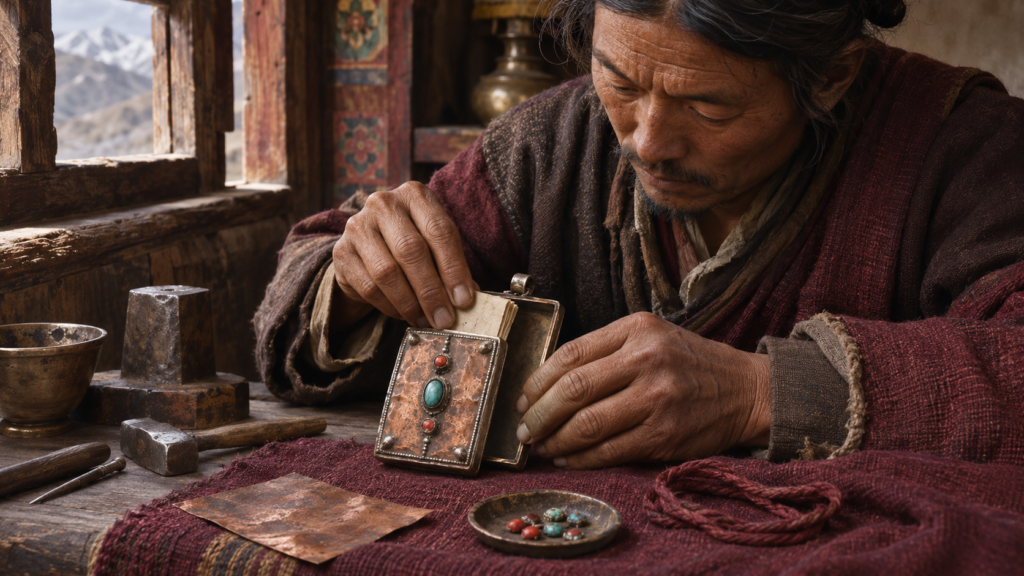
The making of a gau requires both functional and aesthetic decisions.
The container must be sufficiently secure to hold its contents.
It must also be practical to wear or carry.
Metalworkers may use engraving, repoussé, incising or other decorative techniques, depending on the object.
Suspension loops and cords provide portability.
Some examples include fitted covers or enclosed compartments.
More elaborate objects may incorporate gemstones or other decorative materials.
The resulting work can combine metalworking skill with religious imagery.
However, the exact techniques used for an individual historical gau should be established through examination rather than assumed from its general appearance.
Museum documentation provides a starting point.
Religious Authority and Personal Meaning
The significance of a gau may be shaped by its contents and by the religious relationships through which those contents were acquired.
A sacred image or prayer may be connected with a teacher, monastery, pilgrimage or devotional practice.
Such relationships can contribute to the object’s personal importance.
However, not every surviving gau has a documented history of ownership.
Museum records may identify its region, period and materials without preserving the identity of its original wearer.
This limits what can responsibly be claimed.
An anonymous nineteenth-century gau should not automatically be described as having belonged to a monk, pilgrim or religious leader.
Historical interpretation must distinguish evidence from plausible reconstruction.
Why a Gau Is Not a Chakra Necklace
Modern crystal-healing systems frequently assign gemstones to particular chakras.
Such associations may be meaningful within contemporary spiritual practices.
However, a Tibetan gau should not automatically be interpreted through a modern seven-chakra gemstone chart.
Tibetan Buddhist traditions possess their own sophisticated religious and contemplative systems.
These cannot be reduced to generic commercial descriptions of crystal energy.
A gau containing a Buddhist prayer is not simply a device for balancing a gemstone’s vibration.
Its significance depends on the religious tradition in which it was prepared and used.
Treating it as a generic chakra pendant risks obscuring its historical and cultural identity.
The Difference Between Religious Protection and Scientific Protection
A practitioner may believe that a sacred object offers protection.
That belief can be important within the person’s religious life.
However, scientific evaluation requires a different kind of evidence.
There is no reliable scientific evidence that wearing a gau prevents accidents, neutralises toxins or produces an invisible physical shield.
Nor is there evidence that decorative gemstones generate a supernatural protective field.
These limitations do not make the object historically insignificant.
They clarify the distinction between religious meaning and measurable physical effects.
The same distinction applies to many sacred objects across different religious traditions.
Modern Gau Jewellery and Cultural Responsibility
Gau-inspired pendants are sometimes produced for contemporary jewellery markets.
Some are intended for religious use.
Others are sold as decorative accessories.
The distinction should be communicated clearly.
A modern pendant resembling a Tibetan prayer box is not automatically an authentic historical religious object.
A mass-produced ornament should not be marketed as an ancient monastery relic without documentation.
Similarly, the presence of turquoise-coloured stones does not prove that an object contains natural turquoise.
Responsible descriptions should identify materials accurately and avoid invented provenance.
Where an object is associated with living religious traditions, its cultural significance should be treated respectfully.
Collecting Historical Gau Amulets
Collectors should examine several aspects of a historical gau.
Its construction may provide evidence of manufacturing techniques.
Its decoration may help identify stylistic traditions.
Its contents may offer clues about religious use.
Its provenance may help establish where and when it was acquired.
However, stylistic resemblance alone cannot securely determine age.
A recently made gau may imitate an older design.
Likewise, an old metal container may have acquired replacement stones, cords or contents.
Specialist examination may therefore be necessary.
Collectors should also consider cultural heritage concerns and the lawful origin of religious objects.
Sacred materials should not be treated merely as commodities detached from their communities of origin.
What the Historical Evidence Establishes
Museum evidence supports several important conclusions.
Gau containers were used in Tibetan Buddhist contexts.
They could be worn around the neck or across the body.
They could hold sacred images and religious texts.
Some examples were associated with protective religious beliefs.
Certain gau could also contain blessed preparations.
Some were decorated with precious stones.
A nineteenth-century copper gau with a silk cord survives in the Chiddingstone Castle collection.
The Pitt Rivers Museum preserves a Tibetan tsa-tsa whose construction suggests a possible relationship with portable shrine or amulet-box use.
However, these objects do not establish one universal Tibetan system of gemstone energies.
They do not demonstrate that all gau contained identical religious materials.
And they do not provide scientific evidence of supernatural protection.
Conclusion: The Sacred Meaning of What Is Carried
The Tibetan gau offers an unusually revealing example of the relationship between sacred objects and ornamental craftsmanship.
It is small enough to be worn.
It can be made from relatively modest materials.
It may also be elaborately decorated.
Its contents can connect the wearer with Buddhist imagery, prayers and devotional traditions.
Its portability allows religious meaning to accompany everyday life.
And its protective significance belongs to a historically documented religious framework.
The importance of a Tibetan gau lies primarily in the sacred relationships and practices associated with the object, not in scientifically demonstrable supernatural properties of its decorative gemstones.
For Natural Gems Belgium, the gau illustrates why the study of gemstone symbolism must extend beyond mineral identification.
Gemmology explains the physical properties of turquoise, coral and other ornamental materials.
Art history investigates the craftsmanship of the container.
Religious studies examines the meanings of sacred images and prayers.
Museum research documents surviving objects and their historical contexts.
Science establishes the limits of claims about supernatural physical effects.
Together, these perspectives reveal an object whose importance cannot be reduced to either jewellery or crystal healing.
A gau is a container.
But within its religious context, what it carries may matter far more than the precious materials visible on its surface.
References & Further Reading
1. Chiddingstone Castle – Amulet Box, Ga-u
Source description: Official museum article examining a nineteenth-century Tibetan copper gau with a silk cord. Documents the use of gau containers for sacred images, religious texts, blessed preparations and personal protection. Principal historical source for this article.
2. Pitt Rivers Museum, University of Oxford – Tsa-Tsa Votive
https://www.prm.ox.ac.uk/tsa-tsa-votive
Source description: University museum research on a Tibetan Buddhist votive object representing Palden Lhamo. Discusses its religious imagery, inserted prayers and possible connection with portable shrines or amulet boxes.
3. Gemological Institute of America – Turquoise Gem Encyclopedia
Source description: Authoritative gemmological information about turquoise, including its mineral identity, colour, physical characteristics, treatments and jewellery applications.
4. Gemological Institute of America – Coral Gem Encyclopedia
Source description: Scientific and gemmological reference explaining coral as an organic gem material, its biological origin, physical characteristics and use in jewellery.
5. Encyclopaedia Britannica – Tibetan Buddhism
https://www.britannica.com/topic/Tibetan-Buddhism
Source description: General academic background on the historical development, religious institutions and distinctive traditions of Tibetan Buddhism. Useful for understanding the broader religious environment, rather than as direct evidence about an individual gau.
Historical, Religious and Scientific Distinctions
Historically documented: Gau containers were used as portable religious objects in Tibetan Buddhist contexts.
Historically documented: Some gau held sacred images, prayers and other religiously meaningful materials.
Historically documented belief: Certain portable Buddhist objects were understood as offering religious protection.
Historically documented: Some gau were decorated with precious stones and incorporated into jewellery.
Religious tradition: Buddhist images, prayers and blessed objects can possess devotional significance within particular Tibetan Buddhist practices.
Scientific fact: Turquoise is a hydrated copper-aluminium phosphate mineral.
Scientific fact: Precious coral is an organic gem material formed from the skeletons of certain marine animals.
Historical uncertainty: The precise contents, ownership and ritual function of an individual gau cannot always be reconstructed.
Modern metaphysical belief: Some contemporary interpretations associate gau jewellery and its gemstones with protective energy, chakra balance or spiritual vibration.
Scientific limitation: There is no reliable scientific evidence that gau containers or their decorative gemstones emit supernatural protective fields, cure illnesses or prevent misfortune.
The Tibetan gau demonstrates how an object can combine artistic beauty, practical portability and religious meaning.
Its gemstones belong to gemmology.
Its metalwork belongs to material culture.
Its sacred contents belong to Buddhist religious traditions.
Its alleged supernatural physical effects remain matters of belief rather than scientifically established properties.
Related Products
-
18K Yellow Gold Rope Chain Bracelet · Adjustable 15 · 18 cm · Luxury NGB Jewelry
€ 224,54 -
Aventurine Bead Bracelet with Bridge · 8 mm · 19 cm · Unisex · Untreated · Good Polish
€ 34,95 -
Baltic Amber Chip Bracelet 10 mm · Natural Dark Honey Amber Bead Bracelet
€ 29,20 -
Bead Bracelet with bridge · Rose Quartz · 8mm · pink charm bracelet
€ 32,95