

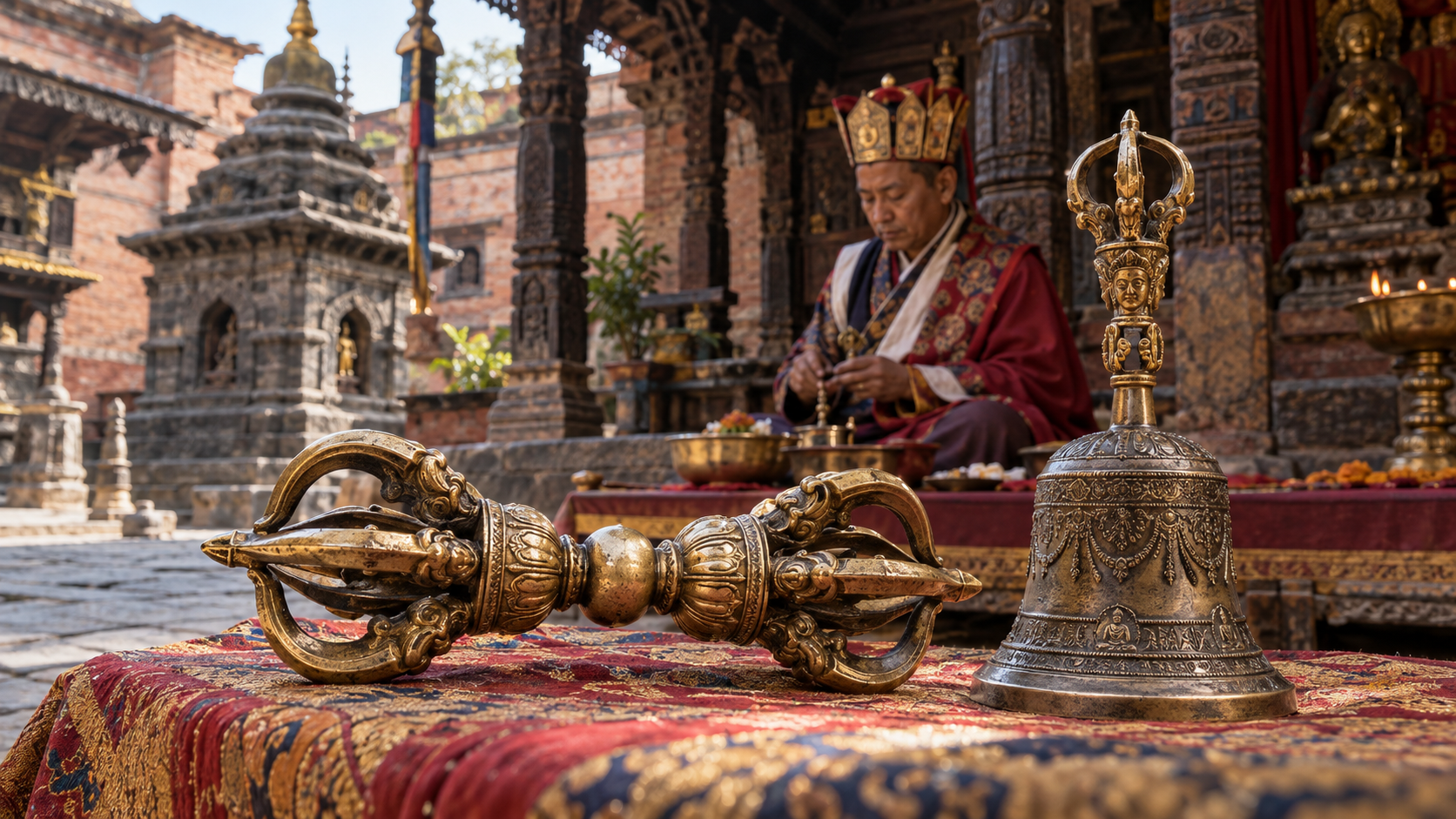
In a Buddhist monastery courtyard in Nepal’s Kathmandu Valley, a priest prepares for a religious ceremony.
He wears an elaborate ceremonial crown.
In one hand, he holds a small metal object with symmetrical, curved prongs.
In the other, he carries a ritual bell.
The objects appear simple compared with the elaborate gold and gemstone ornaments associated with royal treasures.
Yet their significance extends far beyond their material composition.
The small metal instrument is called a vajra.
In Nepalese and Tibetan Buddhist traditions, it represents qualities associated with spiritual awakening, particularly the firmness and clarity of enlightened understanding.
Its name has two closely connected meanings.
Thunderbolt.
These seemingly different natural phenomena became united within one of the most important symbolic objects of Vajrayana Buddhism.
The diamond contributed the idea of exceptional hardness.
The thunderbolt contributed associations with overwhelming power and decisive action.
Together, they helped express the religious ideal of a consciousness that cannot be shaken by ignorance or confusion.
But the relationship between diamonds and the vajra contains an important distinction.
The sacred vajra is usually not made from diamond. It is a ritual object whose significance draws partly upon the symbolic qualities attributed to the gemstone.
Understanding this distinction opens a fascinating chapter in the history of gemstones, religious symbolism and Himalayan craftsmanship.
It also demonstrates how a measurable physical characteristic of a natural mineral can become the foundation of a complex spiritual metaphor.
Table of Contents
What Is a Vajra?
The Sanskrit word vajra can mean thunderbolt or something exceptionally hard and indestructible, often translated as diamond or adamantine.
Its precise meaning depends upon the historical and religious context.
In early Indian religious literature, the vajra appears prominently as the thunderbolt weapon of Indra.
In later Buddhist traditions, it acquired additional meanings associated with spiritual awakening.
Within Vajrayana Buddhism, the vajra became both a religious symbol and a physical ritual implement.
The object commonly consists of a central handle with pronged terminals.
Some examples possess a single prong.
Others have three, five or more prongs.
The exact forms and interpretations vary among religious traditions.
Many examples are manufactured from bronze, copper alloys or other metals.
Some are gilded.
Their surfaces may include lotus motifs and other established Buddhist decorative elements.
The vajra’s importance lies primarily in its religious function and symbolism rather than in the intrinsic monetary value of its material.
Why Is the Vajra Associated with Diamond?
Diamond possesses an extraordinary physical characteristic.
It is exceptionally resistant to scratching.
This property contributed to its historical reputation as a material of remarkable strength.
In Buddhist philosophical symbolism, the diamond became a metaphor for something that cannot easily be broken, altered or overcome.
The vajra therefore expresses the ideal of indestructibility.
But this should not be understood as a claim that enlightened consciousness possesses the same physical properties as crystalline carbon.
The relationship is metaphorical.
A diamond is a natural mineral.
Enlightenment is a religious and philosophical concept.
The symbolism connects these different categories through the idea of firmness or indestructibility.
The comparison became so important that it contributed to the name of an entire Buddhist tradition.
Vajrayana: The Diamond Vehicle
Vajrayana is commonly translated as the Diamond Vehicle or Thunderbolt Vehicle.
It refers to traditions of esoteric Buddhism that developed in South Asia and subsequently spread across several regions.
These include Nepal, Tibet, Bhutan, Mongolia and parts of East Asia.
Vajrayana traditions employ religious practices involving mantras, ritual gestures, visualisation, sacred imagery and specialised ceremonial implements.
Understanding Vajra diamond symbolism enriches the significance of this important ritual object.
Some practices require formal initiation and instruction from qualified teachers.
The term Vajrayana expresses the importance of the vajra as a religious symbol.
It does not mean that all practitioners wear diamonds.
Nor does it suggest that physical diamonds are necessary for spiritual awakening.
The diamond represents an ideal.
The ritual practices belong to established religious traditions with their own philosophical foundations, historical development and institutional structures.
From the Thunderbolt of Indra to the Buddhist Vajra
The history of the vajra extends beyond Buddhism.
In ancient Indian religious traditions, Indra was associated with thunder, rain and martial power.
His weapon was the vajra.
Early Sanskrit literature describes the thunderbolt as an instrument through which Indra overcomes powerful opponents.
Over time, the imagery of the vajra developed new meanings within Buddhist traditions.
The Metropolitan Museum of Art preserves several ritual vajras demonstrating this historical transformation.
A gilded bronze example from China’s Tang dynasty, dated between 618 and 907 CE, incorporates five prongs, lotus imagery and decorative elements derived from Indian traditions.
The museum explains that the object symbolised the diamond-like power of enlightenment.
The earlier thunderbolt imagery remained recognisable.
But its religious significance had been transformed.
The weapon associated with divine power became a symbol of spiritual understanding and ritual action.
This development illustrates how religious symbols can acquire new meanings without completely abandoning their historical origins.
Nepal and the Development of Vajrayana Traditions
The Kathmandu Valley has been an important centre of Buddhist religious life, artistic production and intellectual exchange for many centuries.
Its communities developed sophisticated traditions of sculpture, painting, metalworking and ritual performance.
Among these are the Buddhist traditions of the Newar people.
Newar Buddhism combines elements of Mahayana and Vajrayana practice within distinctive local religious institutions.
It includes hereditary ritual specialists known as Vajracharya priests.
The term Vajracharya may be understood as referring to a master or teacher associated with the vajra.
These priests perform ceremonies involving consecration, initiation and other religious activities.
Their traditions are not identical to every form of Tibetan Buddhism.
Although the two share important religious concepts and historical connections, they possess distinct institutional and cultural characteristics.
Recognising these differences is essential when studying Himalayan religious practices.
The Vajracharya Priests of the Kathmandu Valley
The Rubin Museum of Himalayan Art has published detailed research on the ceremonial crowns worn by Vajracharya priests.
These crowns form part of an established tradition of religious regalia.
The priest’s ceremonial equipment includes three particularly important elements.
The crown.
The vajra.
And the ritual bell.
Together, these objects participate in ceremonies through which the priest performs a recognised religious role.
The crown is associated with the cosmic Buddha Vairocana.
The vajra expresses aspects of enlightened activity.
The bell represents wisdom.
The precise interpretation depends upon the ritual and doctrinal context.
These objects are not merely decorative possessions.
They belong to an established system of religious practice.
The Vajra and Bell: Two Objects, One Religious Principle
The vajra is frequently paired with a ritual bell.
In Tibetan, the vajra is commonly called dorje.
The bell is known as dril-bu.
In Sanskrit, the ritual bell is generally called ghaṇṭā.
The Metropolitan Museum of Art preserves a nineteenth-century Tibetan pair of these instruments.
Its curatorial description explains that the vajra and bell are used together during ritual recitation.
The vajra is ordinarily held in the right hand.
The bell is held in the left.
Their coordinated movements accompany prescribed religious actions.
The pair represents complementary aspects of Buddhist practice.
The vajra is associated with method, including compassionate action.
The bell is associated with wisdom, particularly insight into the nature of reality.
Their combination expresses the importance of bringing these qualities together.
Neither is intended to replace the other.
Why Is the Bell Associated with Wisdom?
Within Vajrayana Buddhist interpretation, wisdom involves more than the accumulation of information.
It concerns insight into the nature of existence.
Buddhist philosophical traditions examine concepts such as impermanence, dependent origination and emptiness.
The ritual bell symbolises aspects of this understanding.
Its sound also participates in the ceremonial environment.
However, the symbolic interpretation of the bell should not be reduced to the claim that its sound automatically produces enlightenment.
The instrument operates within a structured religious practice.
Its meaning depends upon ritual context, training and doctrinal understanding.
The bell and vajra together illustrate how material objects can represent abstract philosophical ideas.
Why Is the Vajra Associated with Compassionate Action?
The vajra is often interpreted as representing method or skilful means.
In Buddhist traditions, compassionate action is closely connected with the intention to benefit sentient beings.
The vajra can therefore symbolise the active dimension of the path toward awakening.
This is not simply a symbol of physical strength.
The thunderbolt’s power is reinterpreted through Buddhist religious concepts.
Rather than representing ordinary aggression, the vajra can express the determination to overcome ignorance and other obstacles to spiritual understanding.
The Rubin Museum identifies this relationship between vajra and bell as a central feature of tantric Buddhist ritual.
The pairing expresses the unity of method and wisdom.
The Five-Pronged Vajra
One of the most recognisable forms of the ritual vajra possesses five prongs at each end.
A central projection is surrounded by four curved prongs.
These typically emerge from a symmetrical central handle.
The Metropolitan Museum’s tenth-century Javanese vajra provides an important historical example.
Its curatorial description interprets the four surrounding prongs as representing the cardinal directions.
The central prong marks the cosmic axis.
Other Vajrayana traditions associate fivefold symbolism with the Five Transcendent Buddhas.
These interpretations demonstrate that the vajra can participate in elaborate cosmological systems.
However, it would be inaccurate to assume that every five-pronged vajra has exactly the same meaning in every Buddhist tradition.
Religious interpretations depend upon specific texts, schools and ritual contexts.
The Five Cosmic Buddhas
Within important Vajrayana systems, five Buddhas are associated with different directions and aspects of enlightened awareness.
They are commonly identified as:
Vairocana.
Akshobhya.
Ratnasambhava.
Amitabha.
Amoghasiddhi.
Their positions, colours and symbolic attributes can vary according to the particular mandala or religious system.
The Five Cosmic Buddhas appear prominently in Himalayan religious art.
Their representations may be arranged around a central figure or symbol.
In some artistic compositions, the vajra occupies a central position.
The relationship between these figures and the vajra demonstrates the instrument’s significance within Buddhist cosmology.
It is not simply an object held during ceremonies.
It can also represent the structure of a sacred visual and philosophical system.
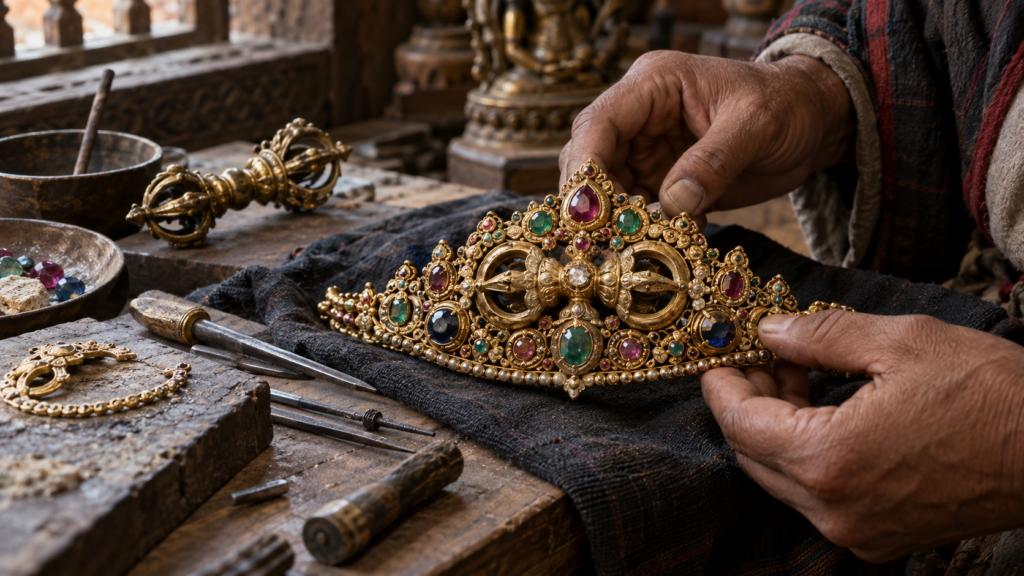
A Remarkable Gemstone Ornament from Nepal
One of the most extraordinary surviving examples of the relationship between gemstones and Vajrayana symbolism is preserved in the Metropolitan Museum of Art.
The object is a forehead ornament intended for a Buddhist deity image.
It was created by Newar craftspeople for the Nepalese or Tibetan market.
The museum dates it broadly between the seventeenth and nineteenth centuries.
The ornament incorporates an exceptional combination of precious materials.
Gold.
Diamonds.
Rubies.
Emeralds.
Sapphires.
Garnet.
Lapis lazuli.
Coral.
Turquoise.
And other natural ornamental materials.
Its arrangement is highly significant.
The composition represents four directional Buddhas surrounding a central vajra.
The vajra itself includes a diamond at its centre.
Here, the relationship between the physical gemstone and its religious symbolism becomes especially clear.
When a Real Diamond Represents the Diamond Vehicle
The Metropolitan Museum’s forehead ornament provides a rare opportunity to examine diamond symbolism through an actual gemstone-set religious object.
At the centre of the composition is a vajra motif.
The museum identifies a diamond positioned within the central design.
The arrangement connects the material gemstone with the religious concept of the Diamond Vehicle.
This is more than a general statement that diamonds symbolise strength.
The relationship is expressed through a specific artistic composition.
The gemstone participates in an established Buddhist iconographic system.
Its placement is intentional within the design.
The ornament therefore demonstrates how a natural diamond could be incorporated into religious imagery associated with Vajrayana Buddhism.
However, this does not establish that every vajra contains a diamond.
Most ritual vajras are metal objects.
The gemstone-set forehead ornament belongs to a particular tradition of elaborate devotional craftsmanship.
Gemstones as Religious Offerings
Precious materials have long been incorporated into Buddhist devotional objects.
In some traditions, donors contribute valuable possessions to monasteries or religious images.
Such offerings may express devotion and generosity.
The Buddhist concept of dāna, or giving, is relevant to these practices.
The Metropolitan Museum discusses how jewellery and gemstones could be donated and subsequently incorporated into religious ornaments.
This provides an important explanation for the presence of valuable gemstones in Himalayan religious art.
The stones were not necessarily selected because each possessed an independently defined supernatural energy.
Their beauty, rarity, monetary value and suitability for sacred ornamentation could all contribute to their importance.
The act of giving also possessed religious significance.
A gemstone could therefore participate in a devotional practice without being regarded as a magical object.
The Vajracharya Priest’s Crown
Another remarkable object preserved in the Metropolitan Museum dates to approximately the thirteenth century.
It is a ceremonial crown associated with Vajracharya priests in Nepal.
The crown incorporates copper, gold, crystal and turquoise.
Its elaborate structure includes representations of the Cosmic Buddhas.
A vajra motif rises from its upper section.
The Rubin Museum has published an extensive study of this object by art historian Aurora Graldi.
The research explains how the crown represents a three-dimensional interpretation of Buddhist cosmological ideas.
The priest wearing the crown participates symbolically in the religious system represented by its imagery.
The crown is therefore more than a prestigious ornament.
It functions as ceremonial regalia within an established religious tradition.
A Crown as a Three-Dimensional Mandala
A mandala is a structured representation of a sacred or cosmological arrangement.
In Vajrayana traditions, mandalas can be represented through paintings, sculptures, architectural spaces and other forms.
The Vajracharya crown incorporates a symbolic arrangement associated with the Five Cosmic Buddhas.
The central vajra motif corresponds to Vairocana within the interpretation discussed by the Rubin Museum.
The surrounding figures represent other Buddhas associated with the cardinal directions.
Through this arrangement, the crown becomes a portable expression of sacred cosmology.
The wearer participates in a ceremonial system represented by the object’s structure.
This illustrates how metalwork, religious imagery and ritual practice can operate together.
The significance lies not in the supposed emission of invisible energy from the materials.
It lies in their recognised symbolic and ceremonial relationships.
The Living Tradition of Vajracharya Ceremonies
The Vajracharya tradition is not merely an archaeological subject.
It remains part of religious life in Nepal.
The Rubin Museum documents contemporary ceremonial practices in the Kathmandu Valley.
Priests continue to use ritual crowns, vajras and bells.
These objects participate in initiations, consecrations and other ceremonies.
The continued use of such implements demonstrates the historical depth of the tradition.
However, continuity does not imply that every detail has remained unchanged for centuries.
Religious communities develop over time.
Artistic styles change.
Ritual practices can be adapted.
Interpretations may differ between lineages.
The existence of a living tradition requires researchers to distinguish between historical museum objects and contemporary religious practice.
Both are important, but they provide different kinds of evidence.
The Meaning of Dorje
In Tibetan Buddhist contexts, the vajra is commonly known as dorje.
The Rubin Museum explains that the Tibetan term conveys the idea of a supreme or exceptionally powerful stone.
It is associated with the indestructible quality represented by diamond.
The word appears in personal names, religious titles and descriptions of ritual objects.
However, its presence does not necessarily indicate a physical diamond.
A person whose name includes Dorje is not thereby associated with a particular gemstone specimen.
The term functions within a religious and linguistic tradition.
Its significance extends beyond mineral identification.
The Vajra in Tibetan Buddhism
Although the Kathmandu Valley provides a particularly rich example of Vajra symbolism, the ritual implement is also central to Tibetan Buddhist traditions.
The Metropolitan Museum preserves a nineteenth-century Tibetan vajra and bell pair.
These instruments demonstrate the importance of coordinated ritual actions.
The museum also holds paintings and sculptures depicting Buddhist figures holding vajras.
One example is the Buddha Akshobhya.
A thirteenth- or early fourteenth-century Tibetan painting in the museum’s collection depicts Akshobhya with the vajra as an important attribute.
The museum interprets this figure as expressing the transformation of aggression into wisdom.
This is a specific religious interpretation within Buddhist iconography.
It should not be generalised into the claim that every diamond or vajra possesses the power to alter human emotions.
Vajrapani: The Holder of the Vajra
Another important Buddhist figure associated with the vajra is Vajrapani.
His name means the holder of the vajra.
He appears in different forms across Buddhist traditions.
In some contexts, he is represented peacefully.
In Tibetan Buddhist art, he frequently appears in a powerful or wrathful form.
The Rubin Museum has published research explaining the relationship between Vajrapani and the earlier Indian thunderbolt imagery associated with Indra.
The figure’s dramatic appearance can represent the overcoming of obstacles to Buddhist practice.
However, the symbolism belongs to a religious framework.
It should not be interpreted as evidence that a physical diamond can protect its owner from danger.
The vajra in Vajrapani’s hand is a religious attribute.
Its meaning is established through iconography and tradition.
Diamond in Buddhist Religious Language
The relationship between diamond and Buddhist thought is not restricted to ritual implements.
Diamond imagery also appears in Buddhist religious terminology and textual traditions.
One well-known example is the Vajracchedikā Prajñāpāramitā Sūtra, commonly called the Diamond Sutra.
The Sanskrit title is often understood in relation to the cutting or penetrating power of wisdom.
The text belongs to the broader Prajñāpāramitā, or Perfection of Wisdom, tradition.
Its teachings concern fundamental Buddhist philosophical questions.
The diamond imagery is therefore connected with insight.
It should not be interpreted as a recommendation to use physical diamonds as healing stones.
The gemstone functions as a metaphor within religious language.
This distinction is essential when examining the historical spiritual symbolism of natural materials.
What Makes Diamond Scientifically Exceptional?
Diamond is a crystalline form of carbon.
Its chemical composition is represented by the formula C.
Its atoms are arranged within a strongly bonded three-dimensional crystal structure.
This structure produces several exceptional physical characteristics.
Diamond possesses a Mohs hardness of 10.
It is the hardest naturally occurring mineral on the traditional Mohs scale.
Its refractive index is approximately 2.42.
It also possesses exceptionally high thermal conductivity.
These characteristics make diamond important in gemmology and several technical applications.
The Gemological Institute of America provides detailed information about diamond’s composition, structure and physical properties.
The scientific characteristics of diamond help explain why it became an attractive metaphor for exceptional firmness.
However, the religious interpretation and the mineralogical explanation belong to different fields of knowledge.
Is Diamond Truly Indestructible?
The religious symbolism of the vajra frequently emphasises indestructibility.
But from a gemmological perspective, diamond is not literally indestructible.
This distinction is particularly interesting.
Diamond possesses exceptional resistance to scratching.
Yet hardness and toughness are different properties.
Hardness describes resistance to scratching or abrasion.
Toughness describes resistance to breaking, chipping or fracturing.
Diamond can fracture along crystallographic cleavage planes.
A sufficiently strong impact in a vulnerable direction can damage it.
The Gemological Institute of America explains that diamond possesses four perfect cleavage directions.
Consequently, the gemstone’s exceptional hardness does not make it immune to mechanical damage.
This provides an instructive contrast between religious metaphor and scientific reality.
The diamond of Buddhist symbolism represents an ideal of indestructibility. The natural mineral remains subject to the physical laws governing crystalline materials.
Why Scientific Accuracy Strengthens Cultural Interpretation
Understanding diamond’s actual properties does not diminish its historical symbolism.
Instead, it makes the distinction between material reality and cultural meaning clearer.
Ancient and medieval religious traditions did not necessarily use mineralogical terminology in the modern scientific sense.
They developed metaphors from observable characteristics.
Diamond’s resistance to scratching was remarkable.
Its reputation for exceptional hardness made it suitable for expressing ideas about firmness and spiritual certainty.
The metaphor did not require the mineral to be physically impossible to break.
Religious language frequently employs idealised characteristics.
Scientific investigation can explain the natural properties that inspired such comparisons.
Historical research examines how those comparisons became meaningful within particular communities.
Did Buddhists Believe Diamonds Could Produce Enlightenment?
The available museum and religious-studies evidence does not support such a general claim.
Vajrayana Buddhism includes complex systems of religious practice.
These involve teachings, initiation, meditation, ritual activity and philosophical understanding.
The diamond functions as a symbol within these systems.
A physical diamond is not universally required for participation.
Nor does possessing a diamond automatically confer spiritual achievement.
Some Buddhist devotional objects incorporate real diamonds.
Others employ bronze, copper, wood, textiles or other materials.
Their religious significance depends upon established traditions and ceremonial contexts.
It cannot be reduced to the presence or absence of a particular gemstone.
The Difference Between Sacred Objects and Crystal Healing
Modern crystal-healing literature sometimes describes diamonds as stones of spiritual clarity, purification or heightened consciousness.
Some contemporary interpretations associate diamonds with the Crown Chakra.
These ideas should not automatically be attributed to historical Vajrayana traditions.
The Buddhist vajra has documented meanings associated with method, wisdom, enlightenment and indestructibility.
Those meanings are established through religious traditions and historical sources.
Modern claims that diamonds emit a measurable spiritual energy capable of transforming consciousness belong to a different category.
Such effects have not been scientifically established.
The existence of a historical religious symbol does not provide scientific evidence for contemporary crystal-healing claims.
Why Chakra Associations Require Historical Care
The concept of chakras appears in several South Asian religious and philosophical traditions.
However, chakra systems have developed in different forms over time.
Their number, names, associations and functions are not identical across all traditions.
Modern Western crystal-healing systems often assign specific gemstones to particular chakras.
These correspondences should not be presented as universal features of historical Buddhism.
In particular, the symbolism of the vajra cannot simply be equated with the modern idea that a diamond activates the Crown Chakra.
Such a statement would combine different traditions without establishing the historical relationship between them.
A more responsible interpretation recognises the specific Buddhist meaning of the vajra.
It also acknowledges that contemporary practitioners may develop additional personal or spiritual associations.
The Role of Gemstones in Himalayan Religious Art
The Metropolitan Museum’s collections demonstrate that gemstones played important roles in Himalayan religious ornamentation.
Diamonds, rubies, sapphires, emeralds and other natural materials appear in objects created for religious images.
These materials could contribute several forms of value.
Visual beauty.
Rarity.
Craftsmanship.
Prestige.
Devotional generosity.
And symbolic associations.
However, not every gemstone within a religious ornament necessarily represented a separate supernatural force.
The overall composition often mattered more than any isolated stone.
The arrangement of gemstones could help represent a sacred hierarchy or cosmological structure.
Their colours and positions might contribute to a larger iconographic system.
The interpretation therefore requires knowledge of the entire object.
Why Provenance Matters
The cultural significance of a gemstone-set Buddhist object cannot always be determined through appearance alone.
A vajra-shaped ornament might originate in Nepal.
Tibet.
China.
Japan.
Or another region where related Buddhist traditions developed.
Its age, materials and artistic style can provide useful evidence.
But identifying its original religious function requires additional information.
Was it used by a priest?
Was it created for a temple?
Did it decorate a sculpture?
Was it part of a ceremonial crown?
Or was it produced as a later decorative object?
These distinctions are important.
A modern vajra-shaped souvenir does not necessarily possess the same historical or ritual significance as a consecrated implement used within an established religious community.
Material identification and cultural interpretation must remain separate.
The Ethical Importance of Living Religious Traditions
Vajrayana Buddhism is not simply a historical collection of symbols.
It remains a living religious tradition.
Communities in Nepal, Tibet, Bhutan and elsewhere continue to practise forms of Vajrayana Buddhism.
Their beliefs and ceremonies should not be reduced to generic crystal spirituality.
The vajra is not merely a decorative representation of diamond hardness.
It participates in religious practices that may require training, initiation and established ritual knowledge.
Respectful interpretation therefore involves recognising the authority of living practitioners and the diversity of their traditions.
Museum objects provide important historical evidence.
But they do not necessarily explain every aspect of contemporary religious practice.
What Can We Establish with Confidence?
The historical and scientific evidence supports several important conclusions.
Diamond is a naturally occurring crystalline form of carbon.
Its exceptional hardness contributed to its reputation as a material of remarkable durability.
The Sanskrit word vajra is associated with both thunderbolt imagery and the concept of something exceptionally hard or adamantine.
The vajra developed into a major religious symbol within Vajrayana Buddhism.
Physical vajra implements are commonly made from metal rather than diamond.
The vajra is frequently paired with a ritual bell.
Within important Vajrayana traditions, the pair represents the relationship between method and wisdom.
Vajracharya priests in Nepal use vajras, bells and ceremonial crowns within established religious practices.
Historical Himalayan religious objects sometimes incorporate actual diamonds.
A gemstone-encrusted forehead ornament preserved in the Metropolitan Museum demonstrates a particularly direct relationship between a physical diamond and the symbolic vajra.
However, these facts do not establish that diamonds emit supernatural energy or independently produce spiritual enlightenment.
The documented significance of the vajra belongs primarily to religious symbolism, philosophical interpretation and ritual practice.
Conclusion: When a Natural Gemstone Becomes a Religious Ideal
The history of the vajra reveals an extraordinary relationship between natural materials and human thought.
Diamond begins as a mineral.
Its atoms form a highly ordered crystal structure.
Its physical properties can be measured.
Its exceptional hardness distinguishes it from other natural gemstones.
But within Buddhist religious symbolism, this physical characteristic became the foundation of something far more abstract.
The diamond became a metaphor for spiritual firmness.
The thunderbolt became an image of decisive power.
Together, these ideas shaped the symbolism of the vajra.
In Nepal’s Kathmandu Valley, the vajra became part of sophisticated ceremonial traditions maintained by Vajracharya priests.
In Tibetan Buddhism, it became an essential ritual implement and a prominent attribute of religious figures.
In Himalayan religious art, it appeared in metalwork, sculpture, painting and elaborate gemstone ornaments.
Some objects even incorporated actual diamonds into the sacred design.
Yet the significance of these traditions does not depend upon proving supernatural gemstone properties.
Their importance lies in the documented relationship between physical materials, religious philosophy, craftsmanship and cultural continuity.
At Natural Gems Belgium, the vajra offers a particularly valuable example of how gemstone symbolism should be studied.
A natural diamond possesses scientifically measurable characteristics.
A Buddhist vajra possesses historically documented religious meanings.
The connection between them is a cultural interpretation built upon an extraordinary natural property.
The diamond’s hardness belongs to mineralogy. Its association with indestructible wisdom belongs to the history of Buddhist thought.
Understanding both dimensions allows us to appreciate the gemstone without confusing scientific fact with religious belief.
And it reminds us that some of the most enduring meanings associated with natural gemstones are not found inside the crystals themselves.
They are created through centuries of human philosophy, craftsmanship and spiritual tradition.
References & Further Reading
The following references have been selected from major museum collections, established gemmological authorities and specialist research projects dedicated to Himalayan religious art.
They provide documented evidence for the vajra’s historical development, its use in Buddhist ritual, the religious traditions of Nepal and Tibet, and the scientific properties of diamond.
1. Rubin Museum of Himalayan Art — Vajracharya Priest’s Crown: Cosmos, Empowerment, and Ritual Regalia
https://rubinmuseum.org/projecthimalayanart/essays/vajracharya-priests-crown
Source description: Detailed scholarly essay by art historian Aurora Graldi examining the ceremonial crowns of Vajracharya priests in Nepal.
Discusses the religious significance of the vajra, the Five Cosmic Buddhas, ritual initiation, Newar Buddhist traditions and the continued use of ceremonial regalia in the Kathmandu Valley.
An essential source for understanding the specifically Nepalese context of vajra symbolism.
2. The Metropolitan Museum of Art — Forehead Ornament for a Deity
https://www.metmuseum.org/art/collection/search/39464
Source description: Official museum record for an extraordinary Newar gemstone-set religious ornament, dated to the seventeenth–nineteenth centuries.
The object incorporates diamonds, rubies, sapphires, emeralds and other natural materials.
Its central vajra motif and surrounding Buddhist figures provide direct material evidence for the relationship between gemstones and Vajrayana religious symbolism.
Museum object number: 15.95.161.
3. The Metropolitan Museum of Art — A First Look at Sacred Traditions of the Himalayas
https://www.metmuseum.org/perspectives/first-look-at-sacred-traditions
Source description: Museum research article examining Himalayan religious art and the incorporation of precious materials into Buddhist devotional objects.
Discusses gemstone offerings, religious generosity and the remarkable forehead ornament containing a diamond within its central vajra composition.
Useful for understanding the devotional significance of gemstones beyond their monetary value.
4. Rubin Museum of Himalayan Art — Vajra: Project Himalayan Art Glossary
https://rubinmuseum.org/projecthimalayanart/glossary/vajra
Source description: Specialist reference explaining the historical development of the vajra from the thunderbolt associated with Indra to a central ritual symbol of Vajrayana Buddhism.
Discusses the meanings of vajra and dorje, the relationship between method and wisdom, and the ritual pairing of vajra and bell.
5. The Metropolitan Museum of Art — Dril-Bu and Dorje
https://www.metmuseum.org/art/collection/search/502009
Source description: Official collection record for a nineteenth-century Tibetan ritual bell and vajra.
Explains how the two implements are used together during Buddhist ceremonies and how they symbolise complementary aspects of religious practice.
Provides object-level evidence for the relationship between ritual instruments, method and wisdom.
6. Rubin Museum of Himalayan Art — Vajra and Bell
https://rubinmuseum.org/projecthimalayanart/exhibition/living-practices/ritual/vajra-and-bell
Source description: Museum documentation of an eighteenth-century Tibetan vajra and bell pair.
Explains the complementary symbolism of compassionate action and wisdom.
Particularly useful for understanding the religious meaning of these objects within living Vajrayana traditions.
7. The Metropolitan Museum of Art — Vajra, Java, Tenth Century
https://www.metmuseum.org/art/collection/search/39090
Source description: Museum record for a bronze vajra produced in Java around the tenth century.
Explains the instrument’s relationship with enlightenment, its use in esoteric Buddhist rituals and the cosmological significance of its pronged design.
Demonstrates that vajra symbolism developed across several Asian Buddhist traditions.
8. The Metropolitan Museum of Art — Vajra with Angry Heads and Makara Prongs
https://www.metmuseum.org/art/collection/search/44344
Source description: Official record for a Tang-dynasty Chinese gilt-bronze vajra.
Discusses its five-pronged construction, lotus imagery, Indian artistic influences and the diamond-like symbolism associated with Buddhist enlightenment.
Useful for tracing the development of the ritual object beyond Nepal and Tibet.
9. Rubin Museum of Himalayan Art — Dorje Discovered by Dorje Lingpa
https://rubinmuseum.org/projecthimalayanart/essays/dorje-discovered-by-dorje-lingpa
Source description: Scholarly essay by Bhutanese historian Karma Phuntsho examining a vajra associated with Bhutanese Buddhist treasure traditions.
Discusses the religious importance of the dorje, the history of Vajrayana practices and the role of sacred objects within Himalayan Buddhist communities.
Provides an additional regional perspective on the vajra as a living religious symbol.
10. The Metropolitan Museum of Art — The Transcendent Buddha Akshobhya
https://www.metmuseum.org/art/collection/search/854905
Source description: Museum record for a Tibetan painting dating to the thirteenth or early fourteenth century.
Examines Akshobhya’s association with the vajra and its religious symbolism concerning spiritual firmness and the transformation of aggression into wisdom.
Provides evidence for the vajra’s role within Buddhist iconography.
11. Smithsonian National Museum of Asian Art — Vajra
https://asia.si.edu/glossary/vajra
Source description: Concise institutional definition of the vajra as both a thunderbolt symbol and a ritual implement associated with the indestructibility of Buddhist teachings.
Useful for verifying terminology and the fundamental distinction between religious symbolism and physical material.
12. Gemological Institute of America — Diamond
Source description: Authoritative gemmological overview of natural diamond.
Provides scientific information about diamond’s chemical composition, crystal structure, hardness, refractive index and geological formation.
Supports the article’s distinction between diamond’s measurable physical properties and its symbolic religious significance.
13. Gemological Institute of America — How to Protect Your Diamond from Chipping
https://www.gia.edu/gia-news-research/how-protect-diamond-chipping
Source description: Technical gemmological article by Al Gilbertson, published on 5 May 2016.
Explains the differences between hardness, toughness and stability.
Documents why diamond, despite its exceptional hardness, can fracture along crystallographic cleavage planes.
This source is particularly important for distinguishing the religious ideal of indestructibility from the actual physical behaviour of diamond.
Historical Tradition, Religious Symbolism and Scientific Evidence
The symbolism of the vajra requires a clear distinction between several categories of knowledge.
Scientifically established: Diamond is a crystalline form of carbon with a Mohs hardness of 10.
Scientifically established: Diamond is exceptionally resistant to scratching but can fracture or chip under certain conditions.
Historically documented: The vajra developed from earlier Indian thunderbolt imagery into an important symbol and ritual implement within Vajrayana Buddhism.
Religiously documented: The vajra represents qualities associated with enlightenment, method and spiritual firmness within particular Buddhist traditions.
Culturally specific: Vajracharya priests in Nepal use vajras, bells and ceremonial crowns within established religious practices.
Materially documented: Historical Himalayan Buddhist ornaments sometimes incorporate actual diamonds, including examples preserved in the Metropolitan Museum of Art.
Modern metaphysical interpretation: Contemporary crystal-healing systems sometimes associate diamonds with spiritual clarity, energetic purification or chakra activation.
Scientific limitation: There is no established scientific evidence that diamonds emit supernatural energy, activate chakras or independently produce spiritual enlightenment.
The cultural importance of the vajra does not depend upon scientifically proving supernatural effects.
Its significance lies in the relationship between a remarkable natural mineral, centuries of Buddhist philosophical development and the continuing religious traditions of Himalayan communities.
Studying these relationships provides a historically grounded understanding of gemstone symbolism that is substantially richer than assigning universal spiritual properties to a crystal.
[…] Tibetan Buddhist traditions should not be treated as completely […]