Rock crystal occupied a distinctive place among the materials circulating through the Viking world. Unlike a richly coloured garnet or an opaque piece of amber, its appeal depended largely on transparency, polish and the way a shaped surface altered the passage of light. Surviving Viking rock crystal beads and pendants show how this colourless gemstone became part of personal adornment, while the objects commonly known as the Visby lenses raise more technical questions about craftsmanship and optical performance.
Their fascination lies in the connection between a familiar mineral and an unfamiliar historical setting. Quartz is widespread, yet producing a clear, carefully shaped ornament required suitable material and skilled work. Some surviving pieces also form images, making them relevant to the history of optics as well as the history of jewellery.
These different qualities should be considered together without assuming that every transparent ornament was intended as an optical instrument.
Table of Contents
What Is Rock Crystal?
Rock crystal is the colourless, transparent variety of crystalline quartz, composed of silicon dioxide, SiO₂. It belongs to the same mineral species as amethyst and citrine, although its appearance lacks the colour that distinguishes those varieties.
The Australian Museum records a Mohs hardness of 7, a specific gravity of approximately 2.65 and a vitreous lustre for crystalline quartz. These properties help explain its suitability for polished ornaments: the material can retain an attractive surface, although hardness does not prevent it from chipping or breaking.
Quartz is also optically anisotropic, meaning that its interaction with light depends on direction within the crystal. Museum gemmological data give refractive indices of approximately 1.544–1.553 and a birefringence of about 0.009. These figures describe the mineral’s optical behaviour, but they do not establish whether a particular archaeological object was designed for magnification. That depends on its shape and context as well as its material.
Viking Rock Crystal Beads: Evidence from Birka
The Swedish History Museum documents rock crystal among bead assemblages from Birka, an important settlement represented extensively in its Viking collections. One set from grave Bj 507 contains 26 beads: fourteen of rock crystal and twelve of carnelian, with elongated, angular and elliptical forms.
The pairing is visually striking, but it is also historically informative. Transparent quartz and orange-red carnelian offered different appearances within the same assemblage, showing that gemstone selection involved combinations of colour, clarity and shape.
The museum interprets beads of this kind as desirable goods connected with journeys eastward, where they could circulate alongside silver in exchanges for goods and services. Another Birka assemblage includes rock crystal, carnelian, amber and glass; its documentation associates several bead materials with southeastern Europe or the Mediterranean region.
Such records place gemstones within networks of movement rather than an isolated Scandinavian craft tradition. However, identifying a broad region of manufacture or circulation is different from identifying the geological deposit that supplied the rough quartz.
Gotland and the Movement of Gemstones
Gotland, the Baltic island associated with the Visby lenses, provides an especially important setting for investigating craft production and exchange. Archaeological work on its harbours has challenged the idea that Viking-period trade can be understood through only a handful of famous towns.
Dan Carlsson’s research programme on Gotlandic harbours instead examined a more extensive coastal network, using archives, landscape evidence, phosphate mapping and excavation to locate places of activity. This broader framework matters for gemstone history because objects could pass through several interconnected settlements rather than travel directly from one distant production centre to a final owner.
Archaeological research on the trading port of Ridanäs also describes a community involved in wide-ranging exchange and manufacturing. Rock crystal appears among imported materials, alongside other goods whose presence reflects connections extending well beyond the island.
A gemstone found on Gotland therefore documents its presence there at a particular stage in its history. It does not, by itself, establish where the crystal grew, where it was first shaped or how many times it changed hands.
Silver-Mounted Crystal Pendants
The strongest evidence for ornamental use comes from objects whose construction clearly supports suspension and display.
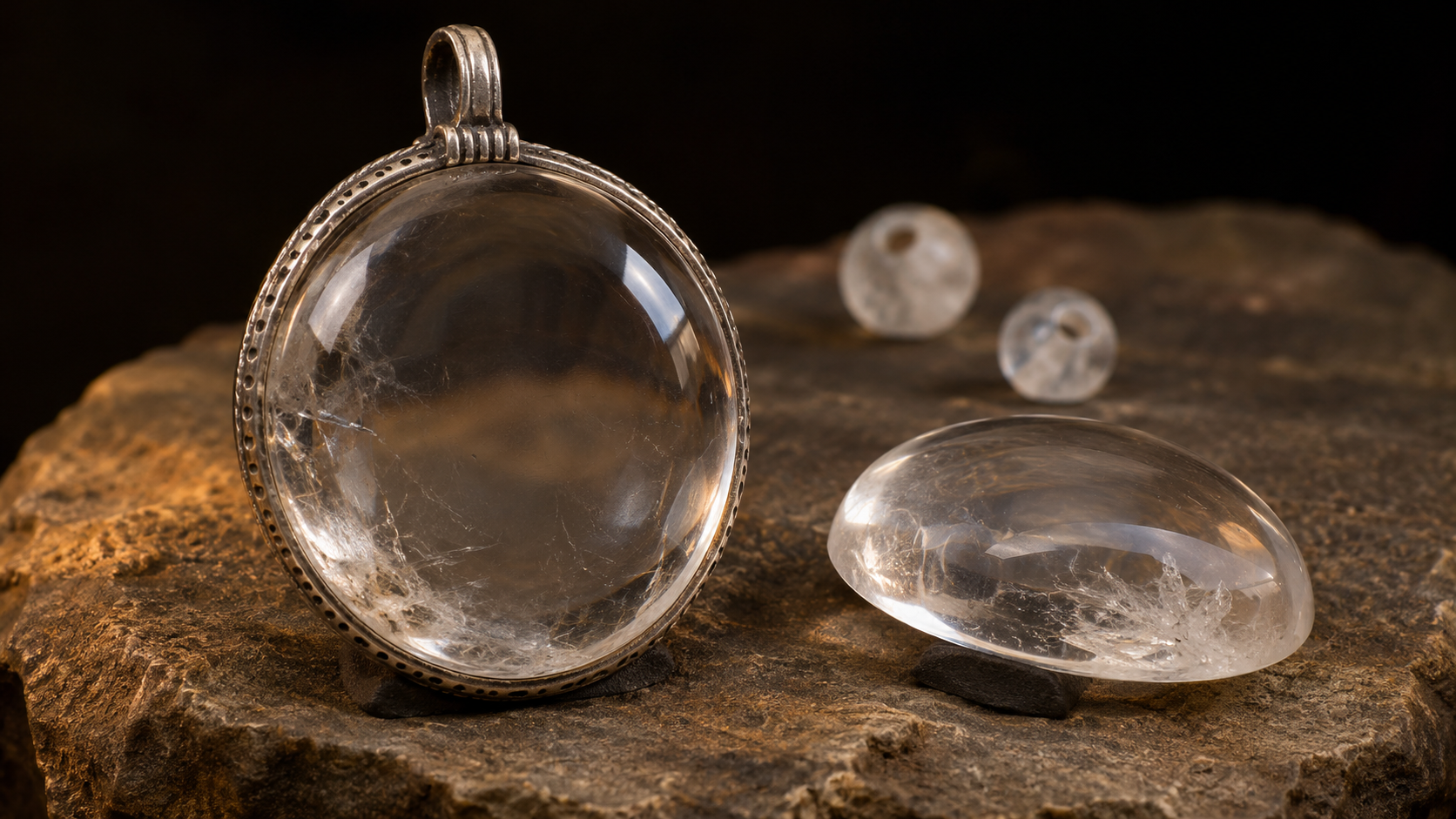
A pendant from Lilla Rone, in Lye Parish on Gotland, is described by the Swedish History Museum as a round rock crystal lens enclosed in silver, with traces of niello decoration on the edging. The museum attributes it broadly to eastern European or possibly more easterly origins. Its significance lies in the combination: the shaped crystal and decorated metalwork formed a wearable object.
Another elaborate pendant from the Rone hoard incorporates eleven polished rock crystals and ten differently shaped silver beads, some decorated with filigree. The museum suggests an eastern European, possibly Byzantine provenance.
These examples show that transparency could be integrated into complex jewellery rather than valued only as a property of an isolated stone. They also caution against treating “Viking” as a reliable statement of manufacture. An object worn or deposited in a Viking-world setting may have incorporated imported components or been acquired as a finished ornament.
From Rough Quartz to a Finished Object
Producing a bead, a rounded pendant and a lens-shaped piece involves different requirements. A bead needs an effective perforation and a shape suitable for threading; a pendant must work with its suspension or mounting; and a transparent curved object presents additional questions about surface regularity.
Archaeological finds can preserve intermediate stages that help reconstruct these processes. The Swedish History Museum catalogues a Gotland group containing partly worked pieces and more nearly finished lenses, while explicitly allowing the alternative interpretation that some unfinished pieces were intended as setting stones.
That qualification is useful. A curved blank does not always reveal the maker’s final intention, and a partially polished surface cannot automatically be assigned an optical function.
Evidence from Fröjel likewise includes rock crystal beads and traces relevant to manufacture. Such material is valuable because unfinished objects can retain information that polishing removes from a completed ornament. The evidence must nevertheless be assessed object by object before a specific workshop sequence can be reconstructed.
What Are the Visby Lenses?
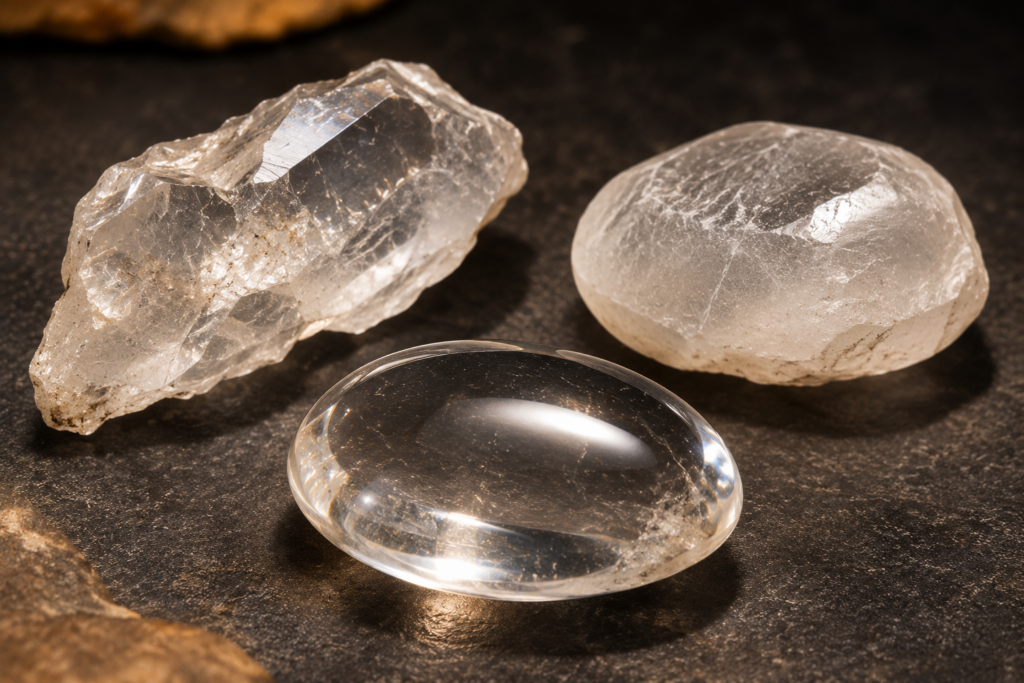
The name “Visby lenses” is commonly applied to a group of shaped rock crystal objects associated with Gotland. Their importance to optical history comes especially from a 1999 study by Olaf Schmidt, Karl-Heinz Wilms and Bernd Lingelbach, published in Optometry and Vision Science.
The researchers examined ten lens-shaped crystals using a specially designed light-section measurement method and assessed their image-forming qualities through spherical aberration. Some specimens had silver mountings and had been used as pendants, whereas others were unmounted and showed no evidence of jewellery use.
The two largest unmounted specimens were particularly notable. Their combined surface curvatures produced very low spherical aberration, and the authors compared their imaging quality with that of modern aspheric lenses used in applications such as projectors.
This finding concerns particular measured objects. It should not be expanded into a claim that every Gotland crystal pendant had equivalent optical performance.
How Can a Gemstone Function as a Lens?
A transparent material becomes a lens through the relationship between its refractive properties and its shaped surfaces. Light changes direction when passing between air and quartz, and appropriately curved surfaces can bring rays towards a focus.
A converging lens can act as a magnifier when the object being viewed lies within its focal length, producing an enlarged virtual image. Under other viewing conditions, it may form a real image instead. Consequently, the same curved piece can produce different effects depending on its position relative to the subject and observer.
Image quality also matters. In spherical aberration, rays passing through different zones of a lens fail to meet at the same focus. An aspheric surface departs from a simple spherical profile and can help reduce this error when appropriately designed.
The archaeological question is therefore more demanding than asking whether a crystal makes something appear larger. Researchers must examine how its surfaces, thickness and material work together.
Optical Performance and Historical Intention
A successful modern optical test establishes what an object can do under the test conditions. Recovering its original purpose requires additional evidence.
The distinction can be illustrated with a simple example: a polished convex ornament might magnify a nearby detail even if its maker primarily intended it to be attractive jewellery. Conversely, a piece selected for an optical effect might also be mounted and worn. Ornament and practical capability are not necessarily mutually exclusive.
The challenge is to determine which interpretation best fits a particular object. Useful evidence could include its mounting, wear, excavation context and relationship to other tools or workshop remains. Surface measurements alone cannot identify its user’s activity.
This is also why comparisons with modern optical components need careful wording. Similar performance in one measured respect does not imply identical manufacture, materials knowledge or intended application.
Did the Vikings Use Crystal Lenses as Tools?
Magnification is a reasonable possibility to investigate, and the Swedish History Museum itself presents the idea that shaped rock crystal could perhaps have assisted precision work. The tentative wording is important: a plausible application is not the same as demonstrated use.
The evidence discussed here does not establish that the Visby objects formed part of a telescope, nor that every lens-shaped crystal was used by a craftworker. A proposed instrument requires evidence for the arrangement and operation of its components, rather than the optical capability of one component alone.
The historically significant conclusion is already substantial. Some surviving rock crystal objects demonstrate accomplished shaping and measurable image-forming performance, while documented mounts establish ornamental use for particular pieces. Their full range of purposes remains a question for combined archaeological and optical investigation.
Understanding the Dates and Origins
Several different dates may belong to one gemstone object. The quartz formed geologically long before people collected it; shaping occurred later; a mounting might have been added or replaced; and deposition in a grave or hoard records another event.
These stages should not be collapsed into one date. Equally, a label such as “Viking-period find” need not mean that the object was made by a Scandinavian craftworker.
A University of St Andrews record for a silver-mounted crystal pendant found on Gotland explicitly lists its place of production as unknown. That is a useful model for responsible interpretation: uncertainty belongs in the account when the evidence cannot resolve it.
A Gemstone History Written in Light
Rock crystal offers an unusually direct connection between gemstone beauty and physical behaviour. Its transparency made it suitable for visually distinctive ornaments, while its refractive properties allowed carefully shaped pieces to produce effects that can still be examined experimentally.
In the Viking world, these material qualities intersected with trade, metalworking and personal adornment. The Visby lenses add a further dimension by showing how the study of historical gemstones can contribute to scientific questions about surface geometry and image formation.
For Natural Gems Belgium, their enduring interest lies in that combination. Understanding the mineral explains what the stone can do; understanding its archaeological setting helps us investigate what people actually did with it.
References & Further Reading
Schmidt, O., Wilms, K.-H., and Lingelbach, B. (1999). “The Visby Lenses.” Optometry and Vision Science, 76(9), 624–630.
Primary scientific research measuring ten lens-shaped rock crystals and assessing their optical performance. The abstract is publicly accessible through PubMed.
https://pubmed.ncbi.nlm.nih.gov/10498003/
https://doi.org/10.1097/00006324-199909000-00019
Swedish History Museum. “Pendant.” Object 106848_HST, Lilla Rone, Lye Parish, Gotland.
Museum documentation of a round rock crystal lens mounted in decorated silver.
https://vikingar.historiska.se/object_details.php?e=&l=en&object=1D6E07CB-C5FF-40A3-9502-8687F7BCD1A0
Swedish History Museum. “Pendant.” Object 106849_HST, Rone, Lye Parish, Gotland.
Museum documentation of an elaborate ornament combining polished rock crystals and silver beads.
https://vikingar.historiska.se/object_details.php?e=no&l=en&object=8AAFA969-E07B-42CD-AAEC-4B2DB44C3FCF
Swedish History Museum. “Set of beads.” Object 363827_HST, Birka grave Bj 507.
A documented assemblage containing fourteen rock crystal beads and twelve carnelian beads.
https://vikingar.historiska.se/object_details.php?e=&l=en&object=F91D3289-38A4-48B8-8B15-F5B6A61AE126
Swedish History Museum. “Beads.” Object 420401_HST, Birka.
Museum documentation discussing a mixed bead assemblage and connections with southeastern Europe and the Mediterranean region.
https://vikingar.historiska.se/object_details.php?e=&l=en&object=FC1CDCB4-560B-4B42-8358-DDA69FEA7199
Swedish History Museum / Swedish National Historical Museums. “Lins.” Object 914257_HST.
Collection documentation of partly worked and more nearly finished rock crystal pieces from Gotland, including uncertainty about their intended form.
https://samlingar.shm.se/object/78EE90BC-6BF9-48BD-910A-43D0AED84E67
Carlsson, D. “Harbours and trade during the Viking Age.” Gotland Archaeological Field School.
An archaeological research account explaining the investigation of Gotland’s harbour and trading networks.
https://www.gotland-fieldschool.com/frojel-discovery-programme/harbours-and-trade-during.html
Gotland Archaeological Field School. Fröjel excavation report, “news4.”
Primary field documentation discussing beads and evidence relevant to their manufacture.
https://www.gotland-fieldschool.com/news4.pdf
“Who resided in Ridanäs?: A study of mobility on a Viking Age trading port in Gotland, Sweden.” Journal of Archaeological Science: Reports.
Peer-reviewed archaeological research providing context for mobility, trade and manufacturing at the Gotlandic port.
https://www.sciencedirect.com/science/article/pii/S2352409X16304357
Hicklin, A. (2018). “Viking Crystal Pendant.” After Empire, University of St Andrews.
University research-project documentation of a silver-mounted crystal pendant found on Gotland, with its production location recorded as unknown.
https://arts.st-andrews.ac.uk/after-empire/2018/03/29/viking-crystal-pendant/
Australian Museum. “Quartz.”
Museum mineralogical information covering rock crystal, quartz varieties and physical properties.
https://australian.museum/learn/minerals/gemstones/quartz/
National Museum of Natural History, Sofia. “Quartz.” Gemmological classification.
Museum reference data covering quartz’s optical properties, birefringence and physical characteristics.
https://www.nmnhs.com/gemmology/classification/gem_id_en-4DA05-Quartz.html
OpenStax. University Physics, Volume 3, Chapter 2: Geometric Optics and Image Formation.
Academic background on refraction, lens behaviour and image formation.
https://openstax.org/books/university-physics-volume-3/pages/2-summary
OpenStax. College Physics, Section 26.6: Aberrations.
An explanation of spherical aberration and other limitations affecting optical images.
https://openstax.org/books/college-physics/pages/26-6-aberrations