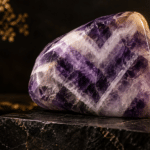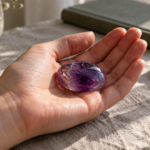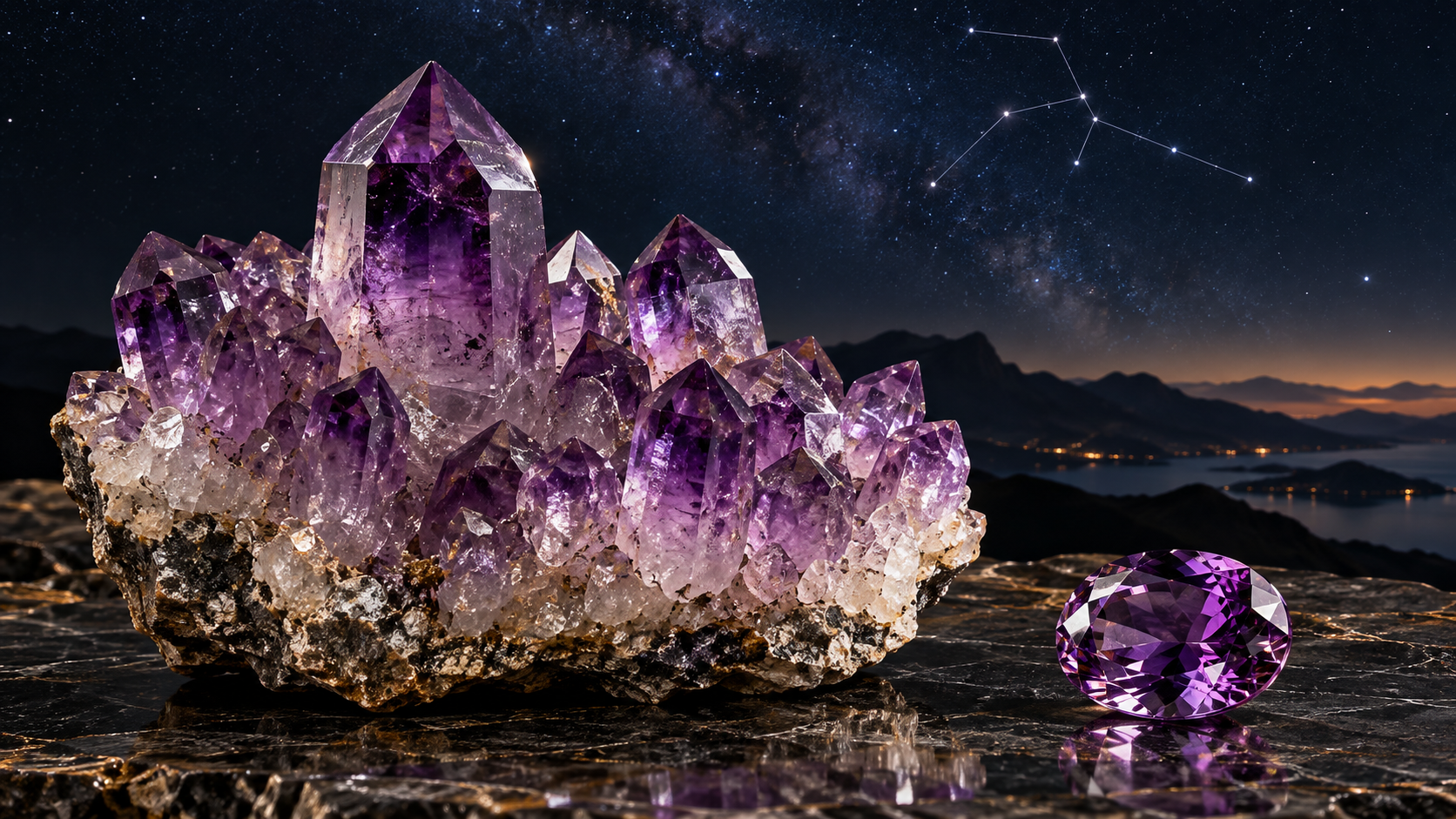
Exploring the relationship between astrology, gemstone symbolism, human experience and the measurable properties of natural amethyst.
Table of Contents
Introduction: Where the Cosmos Meets the Mineral World
For centuries, human beings have looked toward the stars and the Earth in search of meaning.
The movements of celestial bodies inspired systems of astrology, while gemstones became symbols of protection, wisdom, identity and spiritual connection.
Among these traditions, the relationship between Aquarius and amethyst offers a particularly interesting example of how cultural beliefs and natural science can intersect.
Aquarius, the eleventh sign of the Western zodiac, is traditionally associated with intellectual independence, innovation, humanitarian ideals and unconventional thinking.
Amethyst, the violet variety of quartz, has long been associated with clarity, temperance, reflection and spiritual awareness.
In contemporary crystal traditions, amethyst is frequently presented as an Aquarius zodiac stone, believed to support intuition, meditation and the exploration of higher consciousness.
But what does this association actually mean?
Can a gemstone establish a connection with celestial energies? Does its crystal structure explain its supposed metaphysical properties? And why do people sometimes report meaningful experiences when meditating with crystals?
To explore these questions, we must distinguish three different perspectives:
Gemmology investigates the measurable physical and chemical properties of gemstones.
Astrology and spiritual traditions explore symbolic relationships between gemstones, celestial bodies and human experience.
Psychology and neuroscience investigate perception, expectation, meditation and the ways personal beliefs can influence subjective experiences.
Understanding these perspectives allows us to appreciate amethyst’s cultural significance without confusing symbolic interpretations with scientifically demonstrated physical effects.
1. Aquarius: The Water Bearer of the Zodiac
The astronomical and astrological distinction
Aquarius is traditionally represented by the Water Bearer, a figure associated with pouring or carrying water.
Despite this imagery, Aquarius belongs to the air element within Western astrology, alongside Gemini and Libra.
In the tropical zodiac, Aquarius is conventionally associated with the period from approximately January 20 to February 18, although dates may vary slightly between popular calendars.
In astrology, Aquarius is commonly associated with:
- Independence and originality
- Intellectual curiosity
- Humanitarian ideals
- Innovation and unconventional thinking
- Social awareness and collective responsibility
- Personal freedom and individuality
These characteristics form part of the symbolic language of astrology.
They are not scientifically established personality traits determined by a person’s date of birth.
Aquarius in astronomy
From an astronomical perspective, Aquarius is a recognised constellation situated along the ecliptic.
The International Astronomical Union defines its official boundaries as part of the modern astronomical system of 88 constellations.
The astronomical constellation and the tropical astrological sign are not identical.
The tropical zodiac divides the ecliptic into twelve equal 30-degree segments, whereas the actual constellations vary in angular size.
The gradual precession of Earth’s rotational axis also means that the traditional tropical zodiac signs no longer correspond directly to the same background constellations as they did in antiquity.
This distinction is important when discussing supposed physical connections between zodiac signs and gemstones.
Astrology provides a symbolic framework; astronomy describes observable celestial objects and their physical behaviour.
2. Why Is Amethyst Associated with Aquarius?
Amethyst is widely promoted in modern gemstone traditions as a zodiac stone for Aquarius.
However, gemstone–zodiac associations have never formed one universally consistent historical system.
Different astrological schools, cultural traditions and modern birthstone lists assign different gemstones to the same zodiac signs.
Amethyst is also the recognised modern birthstone for February, which overlaps substantially with the traditional Aquarius period.
This calendar relationship helps explain its popularity as an Aquarius gemstone.
Other stones associated with Aquarius in various contemporary traditions include garnet, fluorite and labradorite.
These associations should be understood as cultural conventions rather than mineralogical classifications.
The symbolic connection
In contemporary crystal spirituality, amethyst is often linked to qualities that astrologers attribute to Aquarius.
Its purple colour is associated with contemplation, spiritual insight and higher awareness.
Aquarius, meanwhile, is symbolically connected with intellectual exploration, independent thought and new perspectives.
The resulting association is conceptually attractive: a gemstone traditionally linked with clarity and reflection becomes a symbolic companion for a zodiac sign associated with curiosity and unconventional thinking.
This relationship is meaningful within a spiritual or astrological framework.
It does not establish that the mineral emits an Aquarius-specific energy or that individuals born under Aquarius respond to amethyst differently from other people.
3. Amethyst: The Scientific Identity of the Aquarius Zodiac Stone
What is amethyst?
Amethyst is the purple to violet variety of crystalline quartz.
Its principal chemical composition is silicon dioxide:
SiO₂
Quartz belongs to the trigonal crystal system and commonly develops six-sided prismatic crystal habits.
Amethyst occurs in a wide range of purple colours, from pale lavender to deep violet.
Some specimens display colour zoning, with alternating areas of stronger and weaker pigmentation.
Others contain visible inclusions or growth structures that reveal aspects of their geological history.
Gemmological properties of amethyst
| Property | Scientific characteristics |
|---|---|
| Mineral species | Quartz |
| Gemstone variety | Amethyst |
| Chemical formula | SiO₂ |
| Crystal system | Trigonal |
| Colour | Violet to purple |
| Mohs hardness | 7 |
| Refractive index | Approximately 1.544–1.553 |
| Birefringence | Approximately 0.009 |
| Specific gravity | Approximately 2.65 |
| Lustre | Vitreous |
| Transparency | Transparent to translucent |
| Optical character | Uniaxial positive |
| Typical crystal habit | Six-sided prisms with rhombohedral terminations |
These properties are measurable and reproducible using established gemmological methods.
They provide a scientific basis for identifying natural amethyst and distinguishing it from certain imitations or other purple gemstones.
Why is amethyst purple?
The purple colour of amethyst is associated with iron-related defects and colour centres within the quartz crystal structure.
Natural irradiation contributes to the formation of these colour centres.
The resulting interactions between light and the crystal produce selective absorption, creating the characteristic violet appearance.
The intensity and distribution of colour depend on the crystal’s geological history and internal structure.
Heating can modify or eliminate the purple colour.
Some amethyst may develop yellow, orange or brownish colours following heat treatment, producing material commonly marketed as citrine.
This demonstrates that gemstone colour can result from specific atomic-scale processes rather than from an undefined spiritual energy.
4. Geological Formation: How Nature Creates Amethyst
Amethyst commonly forms when silica-bearing fluids deposit quartz inside cavities, fractures or other suitable geological environments.
Volcanic rocks can contain gas cavities that later become sites for mineral growth.
Over geological time, silica-rich fluids may enter these openings.
Under appropriate temperature, pressure and chemical conditions, quartz crystals gradually develop along cavity walls.
When iron-related colour centres form under suitable conditions, the resulting quartz may become purple amethyst.
Large crystal-lined cavities are commonly known as geodes.
Important geological sources
Amethyst is found in many parts of the world, including:
- Brazil
- Uruguay
- Zambia
- Madagascar
- Namibia
- Bolivia
- South Korea
- Selected regions of Europe and North America
Brazil and Uruguay are especially well known for amethyst geodes formed in volcanic geological environments.
Zambia is another important source of amethyst, including material displaying rich purple colour.
The geographic origin of a specimen may influence its appearance, but colour, transparency, inclusions and crystal growth characteristics vary within individual deposits.
5. Amethyst in Ancient History and Cultural Traditions
The Greek connection: Temperance and sobriety
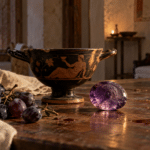
The name amethyst derives from the ancient Greek amethystos, traditionally interpreted as meaning “not intoxicated.”
In classical and later European traditions, amethyst became associated with sobriety, moderation and protection against drunkenness.
A familiar mythological narrative connects amethyst with Dionysus, the Greek god associated with wine.
However, some popular versions of this story are later literary developments rather than securely documented ancient Greek myths.
The historical association between amethyst and sobriety is genuine as a cultural tradition.
The belief that wearing amethyst prevents intoxication is not supported by modern medical evidence.

Amethyst in religious and ceremonial settings
Purple gemstones have been valued in numerous religious and ceremonial contexts.
Amethyst became associated with ecclesiastical jewellery, including rings worn by certain Christian clergy.
Its colour could symbolise spiritual devotion, restraint and religious authority.
Amethyst also appears in historical gemstone traditions connected with biblical and medieval interpretations of precious stones.
Nevertheless, identifying gemstones named in ancient texts requires caution.
Historical gemstone terminology was not always equivalent to modern mineralogical nomenclature.
Amethyst as a symbol of reflection
Across different traditions, amethyst has acquired associations with wisdom, restraint, contemplation and spiritual awareness.
These meanings developed through cultural history and religious symbolism.
They remain part of the gemstone’s heritage even though they do not describe measurable mineralogical forces.
6. The Metaphysical Interpretation: Amethyst as a Cosmic Bridge
In modern crystal spirituality, amethyst is often described as a gemstone that supports a connection between ordinary awareness and higher consciousness.
Some practitioners refer to this as an astral connection, a cosmic bridge or an alignment with universal energy.
Within this interpretive framework, amethyst is believed to encourage:
- Intuition and spiritual insight
- Inner calm and reflection
- Connection with higher consciousness
- Awareness during meditation
- Personal transformation
- Greater openness to new perspectives
For people who identify with Aquarius, these symbolic qualities may resonate with the sign’s traditional associations with intellectual independence and exploration.
What does science say?
There is no established scientific evidence that amethyst creates an astral connection, channels zodiac-specific energy or enables communication with celestial consciousness.
No reproducible physical mechanism has been demonstrated through which amethyst could selectively transmit planetary influences into the human nervous system or an aura.
This does not mean that a person’s experience while holding or meditating with amethyst is necessarily imaginary or meaningless.
Subjective experiences can be psychologically real and personally significant without requiring the proposed metaphysical mechanism to be physically demonstrated.
The distinction is between the experience itself and the explanation assigned to that experience.
A person may genuinely feel calmer while meditating with amethyst.
Scientific investigation, however, would need to determine whether the effect results from the gemstone, the meditation practice, expectation, environmental conditions or a combination of factors.
7. Crystal Energy: What Do Crystals Actually Do?
The word energy has different meanings in physics and spiritual traditions.
In physics, energy is a measurable quantity associated with the capacity of a system to perform work or produce physical change.
Crystals can interact with energy in scientifically established ways.
For example, quartz exhibits piezoelectric behaviour.
The piezoelectric properties of quartz
Certain quartz crystals generate an electrical response when mechanical stress is applied.
Conversely, an applied electrical field can produce mechanical deformation.
This is known as the piezoelectric effect.
Quartz’s piezoelectric properties are used in technologies such as oscillators, frequency-control components and electronic timing systems.
These applications depend on measurable physical relationships involving crystal symmetry, mechanical stress and electrical behaviour.
However, piezoelectricity does not demonstrate that an amethyst pendant emits beneficial spiritual vibrations, balances chakras or transmits astrological information.
The existence of a genuine physical property cannot be used as proof of an unrelated metaphysical claim.
Crystal structure and spiritual vibration
In spiritual literature, gemstones are sometimes described as possessing unique frequencies or vibrations.
All solid materials have vibrational modes at the atomic and molecular levels.
Crystalline solids also display measurable interactions with electromagnetic radiation.
These phenomena are studied through spectroscopy, crystallography and condensed-matter physics.
Yet there is no scientifically established relationship between these ordinary physical properties and the claimed ability of amethyst to improve intuition, attract cosmic energy or alter a person’s spiritual state.
The terminology may sound similar, but the scientific and metaphysical meanings are fundamentally different.
8. Aquarius, Amethyst and the Third Eye Chakra
In contemporary chakra-based crystal practices, amethyst is frequently associated with the third eye and crown chakras.
The third eye is symbolically linked with intuition, perception and inner awareness.
The crown chakra is associated with spiritual understanding and transcendence.
These associations are particularly popular in modern Western crystal-healing traditions.
It is important to recognise that the classical Indian traditions from which chakra concepts developed are diverse and historically complex.
Modern systems that assign particular gemstones to individual chakras are not necessarily identical to ancient South Asian religious teachings.
A traditional meditation practice
Some practitioners place an amethyst near the forehead or hold it while meditating.
The stone may serve as a symbolic focus for contemplation.
A simple practice could involve sitting comfortably, holding the stone and directing attention toward breathing.
The practitioner may choose an intention such as clarity, patience or openness to new ideas.
Within a spiritual interpretation, the gemstone may represent a connection with intuition or higher consciousness.
From a psychological perspective, the same practice can be understood as a structured exercise in attention, intention and mindful awareness.
The scientific perspective
Research suggests that some forms of meditation and mindfulness practice may support aspects of psychological well-being, although outcomes vary and the quality of evidence differs across interventions.
These findings do not establish that adding amethyst produces an additional therapeutic effect.
A gemstone can nevertheless function as a personally meaningful object or attentional cue during a meditation routine.
It should not be confused with a clinically validated medical treatment.
9. Why Do People Feel Something When Holding a Crystal?
One of the most interesting questions surrounding crystal practices concerns subjective experience.
Some individuals report warmth, tingling, calmness, heightened awareness or a sense of connection while holding gemstones.
These sensations can have several possible explanations.
Expectation and suggestion
Human perception is influenced by expectation.
When a person anticipates a particular experience, attention may become directed toward sensations that would otherwise receive little notice.
This does not necessarily involve deliberate imagination.
Expectation can influence how genuine bodily sensations are perceived and interpreted.
Attention and meditation
Quiet reflection can change awareness of breathing, muscle tension, skin contact and other physical sensations.
A person concentrating on a gemstone may become more aware of pressure, temperature differences or subtle tactile sensations.
Personal meaning and symbolism
Objects can carry emotional significance.
A gemstone associated with a birthday, a personal memory or a spiritual practice may evoke feelings of comfort, inspiration or connection.
Such responses are consistent with the broader psychological importance of symbolic objects.
The limits of current evidence
Scientific research has not established that amethyst itself produces the distinctive energetic sensations attributed to it in crystal-healing traditions.
Subjective experience and the proposed explanation must therefore be evaluated separately.
A meaningful personal experience does not automatically demonstrate an external energetic mechanism.
10. The Aquarius Personality: Astrology Versus Psychology
Western astrology describes Aquarius as independent, analytical, progressive and humanitarian.
These characteristics can provide a useful symbolic language for personal reflection.
However, scientific psychology does not recognise zodiac signs as validated predictors of personality.
Large-scale research has not demonstrated that birth signs reliably determine personality characteristics in the manner proposed by popular astrology.
Why can horoscope descriptions feel accurate?
One relevant psychological concept is the Barnum effect, also known as the Forer effect.
This describes the tendency for people to perceive broadly applicable personality statements as specifically relevant to themselves.
Descriptions such as “you value independence but sometimes seek reassurance” may feel highly personal even though they apply to many individuals.
This does not eliminate the cultural or personal value of astrology.
It does mean that astrology should not be presented as an established scientific method for determining personality.
Amethyst as a symbolic Aquarius companion
An Aquarius enthusiast may choose amethyst as a reminder of qualities they wish to cultivate.
For example, the stone might symbolise independent thinking, intellectual curiosity or emotional balance.
This is a valid personal or cultural use of symbolism.
It differs from claiming that the gemstone physically amplifies characteristics determined by celestial positions.
11. Practical Ways to Incorporate Amethyst into Daily Life
Amethyst can be appreciated through several different approaches.
Meditation and mindful reflection
An amethyst specimen can serve as a visual or tactile focus during meditation.
Its colour, crystal structure and personal associations may make it an appealing object for quiet contemplation.
The benefits of the meditation practice should not automatically be attributed to the gemstone.
Jewellery and personal adornment
Amethyst is suitable for many jewellery applications, including pendants, earrings, rings and bracelets.
Its Mohs hardness of 7 provides reasonable scratch resistance, although the gemstone remains vulnerable to impacts and other forms of damage.
Some people choose amethyst jewellery because of its Aquarius association.
Others appreciate its colour, affordability relative to many rarer gemstones, or historical significance.
These motivations can coexist.
Home and workspace decoration
Amethyst geodes, clusters and polished specimens can be incorporated into interior spaces.
In crystal traditions, they may symbolise harmony, clarity or spiritual reflection.
Scientifically, their presence has not been shown to alter the energy of a room in the metaphysical sense.
However, aesthetic enjoyment, personal symbolism and an inviting environment can contribute to an individual’s subjective experience of a space.
Personal rituals
An amethyst may be used during journaling, intention-setting or other reflective practices.
For example, someone may associate the stone with a commitment to intellectual openness or thoughtful decision-making.
The stone acts as a symbolic reminder rather than a demonstrated source of transformative physical energy.
12. Choosing an Amethyst: A Gemmological Buying Guide
Whether a gemstone is purchased for jewellery, collecting or spiritual symbolism, its physical characteristics remain important.
Colour
Fine amethyst commonly displays an attractive purple to violet colour.
Some specimens exhibit reddish or bluish secondary hues.
Colour zoning is common and may be visible in both rough and faceted material.
Transparency and inclusions
Transparent amethyst is frequently used for faceted gemstones.
More heavily included or translucent material may be suitable for carvings, beads and decorative specimens.
Natural inclusions can provide useful information about crystal growth, although they do not independently prove geographical origin.
Cut and workmanship
Faceted amethyst should be assessed for symmetry, proportions, polish and attractive light return.
Cabochons and carvings should be evaluated according to surface quality, form and craftsmanship.
Treatments
Amethyst may be heated or otherwise treated to modify its appearance.
Treatment disclosure is important, particularly when a seller makes specific claims about natural colour or untreated status.
Natural versus synthetic amethyst
Laboratory-grown quartz can possess essentially the same chemical composition and crystal structure as natural quartz.
Synthetic amethyst therefore cannot always be distinguished from natural amethyst by appearance alone.
Certain growth features, inclusions and advanced gemmological testing can assist identification.
A seller’s claim that a gemstone is natural should be supported by appropriate identification and transparency.
13. Amethyst, Aquarius and the Question of Personal Transformation
The idea that a gemstone can transform a person’s life is central to many modern crystal traditions.
For some individuals, amethyst represents an invitation to reflect, develop self-awareness or explore spiritual questions.
These experiences may have personal significance.
However, scientific evidence does not demonstrate that amethyst can independently change personality, determine destiny, manifest external events or create a measurable connection with astrological forces.
The more defensible interpretation is that gemstones can function as symbols, objects of attention and culturally meaningful companions.
Their physical properties are explained by mineralogy and physics.
Their spiritual meanings arise from historical traditions, belief systems and individual interpretation.
Their psychological significance may involve attention, expectation, memory and emotional association.
These perspectives need not be treated as identical or mutually interchangeable.
They address different kinds of questions.
14. Scientific Evidence and Spiritual Tradition: A Comparative Overview
| Subject | Spiritual or astrological interpretation | Scientific perspective |
|---|---|---|
| Aquarius association | Amethyst symbolises intuition, independence and higher awareness | A cultural association; no demonstrated zodiac-specific physical interaction |
| Purple colour | Associated with spiritual insight and higher consciousness | Produced by iron-related colour centres in quartz |
| Crystal vibrations | Believed to influence the human energy field | Physical vibrations exist, but claimed spiritual effects are unproven |
| Third eye chakra | Symbolically linked to intuition and inner perception | No established anatomical or measurable energy centre corresponding to the claimed chakra mechanism |
| Meditation | Amethyst is believed to deepen spiritual connection | Meditation can influence attention and experience; additional effects from amethyst are not established |
| Protection | Traditionally believed to protect against negative influences | No reliable evidence of supernatural protective properties |
| Emotional balance | Associated with calmness and harmony | Personal meaning, expectation and contemplative practices may influence subjective experience |
| Personal transformation | Believed to support spiritual growth | Reflective practices may contribute to personal development; gemstone-specific causation is unproven |
The purpose of this comparison is not to dismiss spiritual traditions, but to identify what is culturally meaningful, what is personally experienced and what can be demonstrated through scientific investigation.
15. Conclusion: Appreciating Amethyst Beyond a Single Perspective
Amethyst offers a remarkable meeting point between natural science and human symbolism.
Its purple colour originates from identifiable processes within the quartz crystal structure.
Its geological formation reveals the interaction of silica-rich fluids, mineral chemistry and geological time.
Its historical associations demonstrate how cultures have attributed meaning to gemstones across centuries.
Its connection with Aquarius belongs to a tradition of astrological symbolism that continues to inspire personal reflection and spiritual practice.
For scientifically oriented readers, amethyst provides an opportunity to explore crystallography, optical properties, mineral formation and human psychology.
For spiritually oriented readers, it can remain a meaningful symbol of intuition, contemplation and personal development.
The essential distinction is that a symbolic or personally meaningful experience does not require an unsupported scientific explanation to have cultural or individual value.
Amethyst does not need to possess demonstrable cosmic powers to be extraordinary.
Its natural beauty, geological history and centuries of human interpretation already make it a fascinating gemstone.
Natural Gems Belgium – Our Perspective
At Natural Gems Belgium, we believe that understanding a gemstone involves more than appreciating its appearance.
Every natural gemstone has a geological history, identifiable physical properties and, in many cases, a rich cultural heritage.
We welcome interest in traditional symbolism, astrology and spiritual practices while maintaining a clear distinction between belief and scientific evidence.
Our Learning Center explores these subjects through gemmology, history, cultural interpretation and responsible scientific communication.
This approach allows readers to appreciate gemstones according to their own interests while remaining informed about what is known, what is believed and what remains scientifically unproven.
References & Further Reading
The following resources are provided for scientific, historical and cultural context. They are institutional, academic or non-retail informational sources rather than competing gemstone product pages.
1. Gemological Institute of America (GIA) – Amethyst Gem Encyclopedia
Scientific overview of amethyst, its gemmological characteristics, colour, sources and gemstone properties.
2. Gemological Institute of America (GIA) – Amethyst Description
Information on the mineralogical identity, appearance and properties of amethyst.
https://www.gia.edu/amethyst-description
3. Gemological Institute of America (GIA) – Amethyst Quality Factors
Educational explanation of the colour, clarity, cut and carat-weight considerations relevant to amethyst.
https://www.gia.edu/amethyst-quality-factor
4. International Astronomical Union (IAU) – The Constellations
Official astronomical information about the 88 recognised constellations and their boundaries.
https://www.iau.org/public/themes/constellations
5. Encyclopaedia Britannica – Aquarius
Historical and astronomical background concerning the constellation and zodiac sign of Aquarius.
https://www.britannica.com/place/Aquarius-constellation
6. Encyclopaedia Britannica – Astrology
Overview of the historical development, cultural significance and scientific status of astrology.
https://www.britannica.com/topic/astrology
7. Encyclopaedia Britannica – Piezoelectricity
Scientific explanation of the piezoelectric effect and its physical applications.
https://www.britannica.com/science/piezoelectricity
8. National Center for Complementary and Integrative Health (NCCIH), U.S. National Institutes of Health – Meditation and Mindfulness: Effectiveness and Safety
Evidence-based overview of meditation, mindfulness, psychological effects and research limitations.
https://www.nccih.nih.gov/health/meditation-and-mindfulness-effectiveness-and-safety
9. National Center for Complementary and Integrative Health (NCCIH) – Placebo Effect
Scientific discussion of the influence of expectations and contextual factors on health-related experiences.
https://www.nccih.nih.gov/health/placebo-effect
10. Forer, B. R. (1949) – The Fallacy of Personal Validation: A Classroom Demonstration of Gullibility
Journal of Abnormal and Social Psychology, 44(1), 118–123.
Foundational psychological research concerning the tendency to interpret general personality descriptions as personally specific.
https://doi.org/10.1037/h0059240
11. Hartmann, P., Reuter, M., & Nyborg, H. (2006) – The Relationship Between Date of Birth and Individual Differences in Personality and General Intelligence: A Large-Scale Study
Personality and Individual Differences, 40(7), 1349–1362.
Empirical investigation of proposed relationships between astrological birth information and psychological characteristics.
https://doi.org/10.1016/j.paid.2005.11.017
Educational disclaimer: Astrological, spiritual and metaphysical associations are presented as cultural traditions and personal belief systems. They are not established medical or physical effects. This article does not recommend gemstones as substitutes for evidence-based healthcare.
© Natural Gems Belgium — NGB 2.0 Learning Center