
Table of Contents
Introduction: Colour Created by Imperfections in a Crystal
The colour of a gemstone is not always determined simply by the chemical elements present in its structure.
Some gemstones owe their appearance to electronic defects associated with imperfections in the crystal lattice.
These defects are commonly called colour centres, or color centers in American scientific terminology.
A colour centre can absorb particular wavelengths of visible light, changing the colour transmitted or reflected by the gemstone.
In some minerals, colour centres develop through natural exposure to ionising radiation.
In others, they can be modified by heating, light exposure or laboratory treatment.
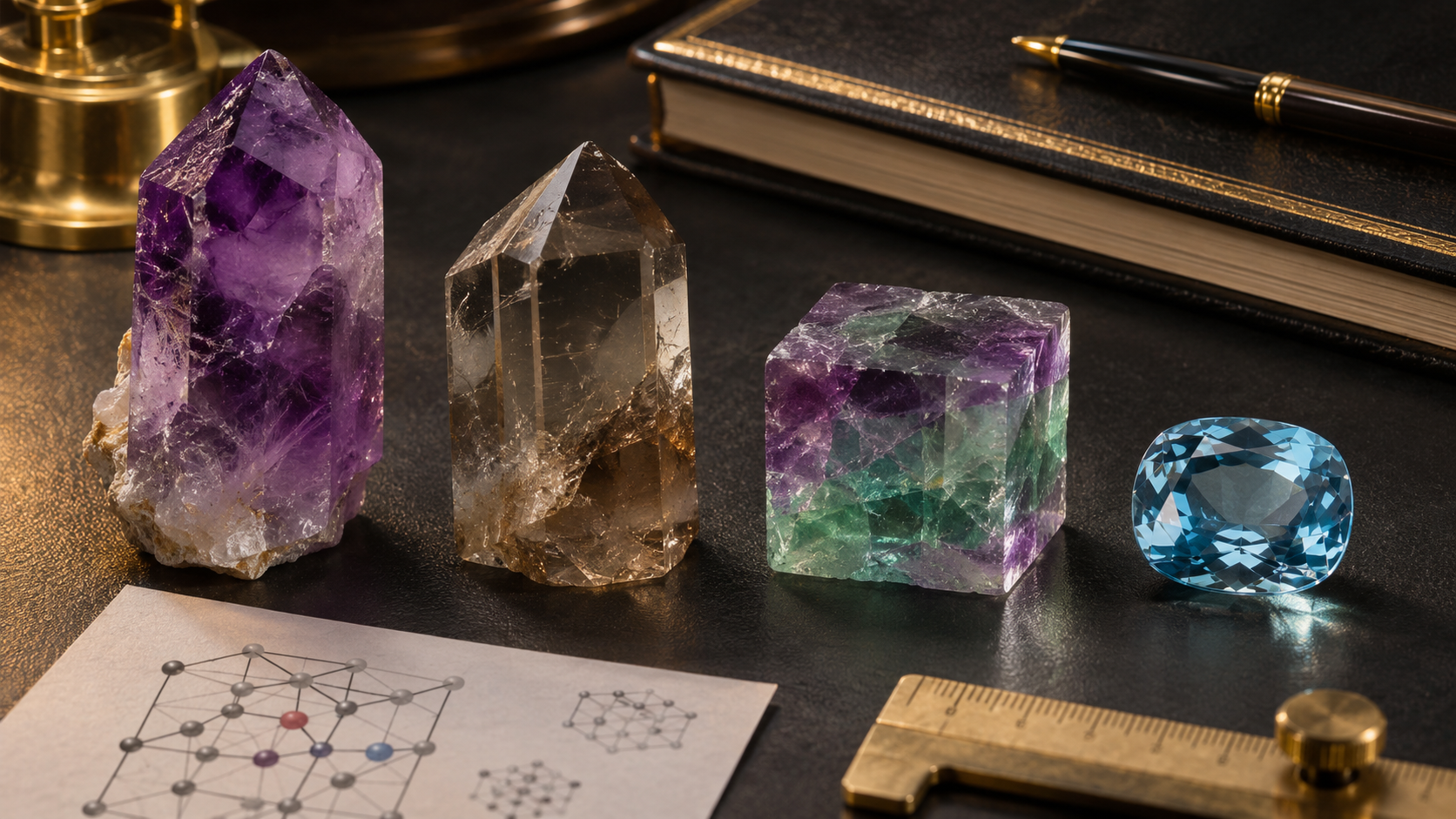
Smoky quartz is one of the best-known examples.
Its brown to nearly black appearance commonly results from radiation-induced electronic defects associated with aluminium in the quartz structure.
Amethyst also involves iron-related colour centres and irradiation.
Fluorite, topaz and diamond provide additional examples of how crystal defects influence gemstone colour.
Understanding these processes helps explain why two specimens of the same mineral species may look completely different.
It also demonstrates why natural gemstone colour, treatment history and colour stability must be considered separately.
1. What Is a Colour Centre?
A colour centre is an electronic defect in a crystal that absorbs light at particular wavelengths.
The defect may involve an electron or a positively charged electronic vacancy, commonly called a hole, trapped at a specific location.
Some colour centres are associated with missing atoms or ions.
Others involve impurity atoms or changes in electronic charge states.
The important feature is that the defect introduces electronic energy levels capable of interacting with light.
When light passes through the crystal, certain wavelengths may be absorbed.
The remaining wavelengths contribute to the gemstone’s observed colour.
However, not every crystal defect produces visible colour.
Some defects absorb only ultraviolet or infrared radiation.
Others may contribute to luminescence without strongly affecting the gemstone’s ordinary appearance.
2. Crystal Defects Are Not Always Physical Cracks
The word defect can be misleading outside mineral physics.
A crystal defect does not necessarily mean a visible fracture, inclusion or damaged surface.
At the atomic scale, a defect may involve one missing ion, one substituted atom or a trapped electron.
Such defects can exist within an otherwise transparent, well-formed crystal.
A gemstone can therefore possess colour-producing defects without showing visible structural damage.
This distinction is important.
A fracture affects the mechanical continuity of the crystal.
A colour centre affects its electronic and optical behaviour.
The two phenomena are not equivalent.
3. How Colour Centres Absorb Light
Visible light consists of photons with different energies.
When a photon enters a crystal, it may interact with an electronic state associated with a colour centre.
If the photon’s energy matches an allowed electronic transition, absorption may occur.
Other wavelengths may pass through the gemstone.
The resulting selective absorption changes the transmitted spectrum.
The observer perceives the remaining combination of wavelengths as colour.
This mechanism is different from colour caused by suspended mineral particles or thin-film interference.
It is also distinct from some forms of transition-metal absorption.
However, real gemstones may contain several colour-producing mechanisms simultaneously.
A single visible colour does not necessarily correspond to one isolated defect.
4. Natural Radiation and Gemstone Colour
Ionising radiation occurs naturally in geological environments.
Radioactive elements in surrounding rocks can emit radiation during their decay.
Some radiation can interact with electrons in nearby mineral structures.
Under suitable conditions, these interactions create or modify electronic defects.
Over geological time, colour centres may accumulate.
However, the final colour depends on several factors.
These include the crystal’s chemical composition, the availability of suitable defect sites, radiation exposure and thermal history.
Not every mineral becomes coloured when irradiated.
Not every irradiated mineral develops a stable colour.
The presence of natural radiation is therefore only one part of the process.
5. Does Natural Irradiation Make a Gemstone Radioactive?
A gemstone that acquired its colour through natural irradiation is not necessarily radioactive.
Radiation exposure and radioactivity are different concepts.
A crystal can absorb energy from radiation without becoming a continuing source of ionising radiation.
Smoky quartz, for example, commonly develops its colour through natural irradiation of suitable quartz material.
That colour does not itself indicate that the specimen is radioactive.
However, some mineral specimens can contain naturally radioactive elements or radioactive mineral inclusions.
Those materials require separate assessment.
Likewise, artificially irradiated gemstones must comply with applicable radiation-safety requirements before release into commerce.
Colour alone cannot establish radiological safety.
6. Smoky Quartz: A Classic Radiation-Induced Colour
Smoky quartz is a variety of crystalline quartz with brown, grey or nearly black coloration.
Its colour commonly involves aluminium-related defects within the quartz structure.
Aluminium may substitute for silicon in the crystal lattice.
This substitution creates a charge imbalance that can be compensated by other species.
Ionising radiation can alter the electronic state of the defect complex.
The resulting colour centre absorbs visible light and produces the smoky appearance.
Research published on irradiated quartz identifies aluminium-associated hole centres as important contributors to smoky colour.
However, natural smoky quartz can display variations in tone, distribution and intensity.
The precise appearance depends on the crystal’s chemistry and geological history.
7. Why Some Smoky Quartz Is Almost Black
Smoky quartz ranges from relatively pale brown to extremely dark material often called morion.
Greater absorption of visible light produces a darker appearance.
The concentration and distribution of colour centres can influence this absorption.
However, colour intensity is not a simple measurement of geological age.
A very dark specimen is not necessarily older than a pale specimen.
The availability of suitable defects, radiation history and subsequent heating can all affect the final appearance.
Crystal thickness also influences perceived darkness.
A thick specimen may appear considerably darker than a thin section of the same material.
Therefore, visual tone alone cannot reveal the radiation dose or formation history.
8. Amethyst: Iron, Irradiation and Purple Colour
Amethyst is the purple variety of quartz.
Its colour involves iron-related defects and irradiation.
Iron can be incorporated into quartz during crystal growth.
Under suitable conditions, irradiation modifies electronic states associated with these iron-bearing sites.
The resulting absorption produces the characteristic violet to purple appearance.
GIA’s research on radiation-induced gemstone colours identifies iron and irradiation as central to amethyst coloration.
However, the exact defect chemistry is more complicated than simply stating that iron turns quartz purple.
The oxidation state, crystallographic environment and irradiation history all matter.
Not all iron-bearing quartz becomes amethyst.
Suitable chemical and structural conditions must be present.
9. Why Amethyst Often Displays Colour Zoning
Amethyst frequently contains uneven colour distribution.
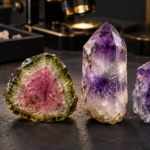
Some crystals display darker purple sectors and lighter or nearly colourless areas.
These patterns may reflect differences in iron incorporation, growth sectors and subsequent colour-centre development.
However, visible colour zoning is not necessarily identical to chemical zoning.
Two regions may contain similar total iron concentrations but differ in the proportion of optically active centres.
Likewise, changes in growth conditions can influence the distribution of impurities and defects.
Therefore, colour zoning should not be interpreted as a direct map of iron concentration without supporting analysis.
The patterns can nevertheless provide useful information about crystal growth.
10. Why Heating Can Change Amethyst Colour
Heat can modify the electronic defects responsible for gemstone colour.
In amethyst, heating may weaken or destroy the purple-producing centres.
Depending on the material, heating can produce yellow, orange, brownish or greenish appearances.
Some heated amethyst becomes citrine.
Certain suitable quartz materials can produce green prasiolite.
However, these transformations are not universal.
Different specimens respond differently because their defect chemistry and impurity distributions differ.
A heating result cannot be predicted reliably from colour alone.
The transformation is also not simply a matter of changing the gemstone’s commercial name.
It represents a physical change in the mechanisms controlling light absorption.
11. Natural Citrine Versus Heat-Treated Amethyst
Citrine is the yellow to orange variety of quartz.
Some citrine occurs naturally with its characteristic colour.
A substantial portion of commercial citrine is produced by heating suitable amethyst or other quartz material.
The resulting gemstone remains natural quartz as a mineral species.
However, its colour has been modified by human treatment.
This distinction is essential for transparent gemstone descriptions.
Natural mineral identity and untreated colour are separate characteristics.
A heat-treated citrine should not be described as untreated merely because the original quartz crystal formed naturally.
Likewise, the presence of yellow colour does not independently establish whether the stone was heated.
Treatment determination may require geological information, laboratory evidence or reliable supplier documentation.
12. Fluorite: Colour from Several Mechanisms
Fluorite has the chemical formula CaF₂.
It crystallises in the cubic crystal system.
Natural fluorite occurs in a wide variety of colours, including purple, green, blue, yellow and colourless.
Some fluorite colours involve radiation-related defects.
Other colours are associated with rare-earth elements or different electronic mechanisms.
GIA’s research on gemstone colour changes identifies natural irradiation as an important factor in certain fluorite colours.
However, fluorite colour cannot be explained by one universal mechanism.
Two purple fluorite specimens may not necessarily possess identical defect structures.
Some laboratory-irradiated fluorites also show colour instability under light exposure.
This demonstrates why colour-centre stability must be evaluated for the particular material.
13. Why Some Fluorite Colours Fade
Some colour centres are metastable.
This means that they can persist under certain conditions but change when sufficient energy becomes available.
Light or heat may alter trapped electronic states.
As the population of colour centres changes, visible absorption can decrease or shift.
The gemstone may become paler or change colour.
However, not all fluorite specimens fade at the same rate.
Stability depends on the specific colour mechanism, material and exposure conditions.
A fluorite specimen should not automatically be described as unstable merely because other fluorites are light-sensitive.
Conversely, permanent colour stability should not be promised without appropriate evidence.
14. Topaz: Irradiation and Blue Colour
Topaz is an aluminium fluorosilicate mineral.
Its ideal formula is commonly expressed as Al₂SiO₄(F,OH)₂.
Natural topaz occurs in several colours.
Strong commercial blue topaz is commonly produced through irradiation followed by heating.
GIA identifies this treatment sequence as an important commercial enhancement.
The treatment modifies colour-producing defects within the material.
However, the final appearance depends on the starting material and treatment conditions.
The commercial names Sky Blue, Swiss Blue and London Blue describe colour appearances rather than separate mineral species.
These names do not independently establish the exact treatment process.
Treatment disclosure should therefore be based on reliable information rather than marketing terminology.
15. Diamond: Colour Centres in a Different Crystal Structure
Diamond consists of carbon arranged in a cubic crystal structure.
Its colour may be influenced by impurities, structural defects and their interactions.
Some diamond colours involve nitrogen- or boron-related mechanisms.
Other colours are associated with vacancies and more complex defect centres.
Irradiation can create or modify certain colour-producing defects.
Subsequent heating may further alter their electronic configuration.
GIA’s gemstone treatment guidance describes irradiation and annealing as methods used to modify diamond colour.
However, not every coloured diamond owes its appearance to irradiation.
Natural and treated colour mechanisms may overlap in appearance.
Professional laboratory testing is often necessary for reliable conclusions.
16. Natural Irradiation Versus Artificial Irradiation
Natural irradiation occurs through geological processes without deliberate human intervention.
Artificial irradiation involves intentional exposure to radiation to alter a gemstone’s appearance.
Both processes may affect similar types of electronic defects.
Consequently, a gemstone’s colour-centre mechanism does not necessarily reveal whether the irradiation was natural or artificial.
This is especially important for quartz.
Routine visual examination may be insufficient to distinguish natural radiation-induced colour from laboratory-induced colour.
The distinction may require advanced analysis, reliable treatment history or other supporting evidence.
Where the evidence is insufficient, treatment status should not be asserted with certainty.
17. Why Artificial Irradiation Is Not the Same as Synthetic Growth
A natural gemstone may be irradiated after mining.
It remains a natural mineral crystal.
Its colour, however, has been treated.
A synthetic gemstone is grown through human-controlled processes.
These are different categories.
For example, natural topaz that has been irradiated remains natural topaz.
It should not be called synthetic topaz merely because its colour was modified.
Similarly, natural quartz that has been heated remains natural quartz.
Scientific descriptions must distinguish natural origin, treatment status and synthetic manufacture.
Confusing these concepts can mislead consumers.
18. How Heat Affects Colour-Centre Stability
Heating provides thermal energy that can change defect configurations.
Trapped electrons or holes may be released or redistributed.
Some defects become less abundant.
Others may transform into different electronic states.
The resulting optical absorption may change.
However, there is no universal temperature at which all gemstone colour centres disappear.
Different minerals and defect types respond differently.
Even within quartz, thermal behaviour depends on the material’s chemical and structural characteristics.
Published quartz studies demonstrate that heating can reduce smoky colour or produce other optical changes.
The effect depends on both temperature and exposure duration.
19. Why Light Can Affect Some Gemstone Colours
Light carries energy.
In certain materials, photons can induce changes in electronic states.
If the relevant colour centres are photosensitive, prolonged exposure may alter the gemstone’s appearance.
Some irradiated spodumene and beryl colours are known to fade under strong light.
GIA’s treatment guidance specifically notes colour-stability concerns for certain irradiated beryl and spodumene materials.
However, this does not mean every gemstone should be kept permanently in darkness.
The degree of risk depends on the mineral, colour mechanism and treatment history.
Care recommendations should therefore be material-specific.
20. Colour Centres Versus Trace-Element Colour
Trace elements and colour centres are closely related but not identical concepts.
A transition-metal ion may absorb light through electronic transitions associated with its local crystal environment.
A colour centre may involve a trapped electron, hole, vacancy or impurity-defect complex.
Some gemstone colours require both an impurity element and irradiation-induced electronic changes.
Amethyst provides an important example.
Iron is involved, but the purple colour also depends on defect-related electronic processes.
Smoky quartz similarly involves aluminium-related defects and irradiation.
Therefore, gemstone colour mechanisms cannot always be divided neatly into completely independent categories.
Several mechanisms may interact.
21. How Scientists Study Colour Centres
Colour centres can be investigated through several analytical techniques.
Optical absorption spectroscopy measures how a material absorbs light across different wavelengths.
Electron paramagnetic resonance can detect certain unpaired-electron states associated with defects.
Infrared spectroscopy may provide information about impurities and defect-related structures.
Luminescence measurements can reveal additional electronic behaviour.
However, no single technique provides a complete explanation for every gemstone.
Researchers often combine multiple methods with controlled experiments and mineralogical information.
Published studies of irradiated and heat-treated quartz demonstrate the value of combining optical spectroscopy with electron paramagnetic resonance.
22. Why Laboratory Treatment Detection Can Be Difficult
A laboratory may identify a colour mechanism without being able to establish its complete history.
For example, natural geological irradiation and artificial irradiation can sometimes produce similar electronic defects.
The resulting absorption features may overlap.
A gemstone may also have experienced natural heating during geological events.
This can complicate interpretation.
Therefore, identifying a colour centre is not necessarily equivalent to identifying a human treatment.
Professional treatment determination may require multiple analytical methods and reference data.
In some cases, a definitive conclusion is not possible.
An inconclusive result is scientifically preferable to an unsupported claim.
23. Colour Centres and Gemstone Durability
A gemstone’s physical durability and colour stability are separate properties.
Quartz has a Mohs hardness of 7.
Fluorite has a Mohs hardness of 4.
Topaz has a Mohs hardness of 8.
These values describe resistance to scratching, not the permanence of colour centres.
A hard gemstone may still contain a light-sensitive colour mechanism.
A softer gemstone may possess a stable colour.
Cleavage, toughness, thermal sensitivity and chemical resistance also affect practical durability.
Therefore, gemstone care should consider both mechanical properties and colour behaviour.
24. Practical Care for Colour-Centre Gemstones
Avoid unnecessary prolonged exposure to strong direct sunlight for gemstones known or suspected to have light-sensitive colour.
Do not expose gemstones to excessive heat during cleaning or jewellery repair.
Keep sensitive mineral specimens away from radiators, intense display lighting and other avoidable heat sources.
Use cleaning methods appropriate to the mineral species.
Fluorite, for example, requires more cautious mechanical handling than quartz because of its lower hardness and pronounced cleavage.
Topaz also has important cleavage characteristics.
Do not assume that a gemstone’s colour is permanent simply because the mineral itself is chemically stable.
If treatment or colour stability is uncertain, conservative care is appropriate.
25. Why Colour-Centre Research Matters for Gemstone Descriptions
Colour-centre science helps explain why a natural gemstone may display a colour that depends on its geological radiation history.
It also explains why human treatment can sometimes produce similar optical effects.
This has direct implications for gemstone descriptions.
A natural smoky quartz specimen should not automatically be labelled artificially irradiated.
A strongly coloured quartz specimen should not automatically be labelled untreated.
A heated amethyst sold as citrine should be described with appropriate treatment disclosure when the treatment is known.
A gemstone’s colour mechanism should not be confused with its geographical origin.
Accurate descriptions should distinguish observations, established scientific mechanisms and verified treatment information.
26. Common Misconceptions About Gemstone Colour Centres
All gemstone colours come from trace elements.
Incorrect. Some involve colour centres, charge-transfer processes, inclusions or structural effects.
A colour centre is a visible crack.
Incorrect. It is an electronic defect associated with the crystal structure.
Natural radiation always makes a gemstone radioactive.
Incorrect. Exposure to radiation does not necessarily make the material radioactive.
Every smoky quartz crystal has been artificially irradiated.
Incorrect. Smoky quartz also occurs naturally.
Every purple quartz crystal is untreated amethyst.
Incorrect. Irradiation can modify suitable quartz material.
Heating always destroys gemstone colour.
Incorrect. Heating can remove, modify or produce colour depending on the material.
All fluorite colours have the same cause.
Incorrect. Several colour mechanisms are possible.
A treated natural gemstone becomes synthetic.
Incorrect. Treatment and synthetic manufacture are different concepts.
Colour alone proves treatment status.
Incorrect. Similar appearances may result from different histories.
All colour-centre gemstones fade in sunlight.
Incorrect. Stability varies substantially between materials and defect types.
27. Practical Workshop: Observing Colour Stability Without Damaging Gemstones
This workshop is designed for gemstone collectors and students.
It is entirely observational and does not require irradiation, heating or destructive testing.
Step 1 – Select suitable specimens
Choose examples such as amethyst, smoky quartz, fluorite or topaz.
Step 2 – Record mineral identity
Document the species or variety using reliable identification information.
Step 3 – Photograph under controlled lighting
Use consistent illumination, camera settings and background.
Step 4 – Observe colour distribution
Record any visible zoning, uneven colour or changes in tone.
Step 5 – Examine transparency
Note whether the specimen is transparent, translucent or opaque.
Step 6 – Research the colour mechanism
Consult authoritative scientific references for the relevant mineral.
Step 7 – Record known treatment information
Distinguish documented treatments from assumptions.
Step 8 – Consider colour stability
Review reliable care information without deliberately exposing the gemstone to damaging conditions.
Step 9 – Avoid experimental heating or irradiation
Do not attempt to reproduce colour changes using household equipment or radiation sources.
Step 10 – Maintain a specimen record
Document mineral identity, observed colour, treatment information and scientific uncertainties.
The purpose is to understand colour-centre behaviour through observation and research, not to alter gemstones.
28. The Scientific Importance of Colour Centres
Colour centres demonstrate that gemstone appearance depends on more than bulk chemical composition.
Two crystals may contain the same major elements yet display different colours because of their electronic defect structures.
Natural irradiation can create or modify these defects.
Heat and light can sometimes change them.
Laboratory treatment may reproduce certain effects that also occur naturally.
This makes colour-centre research important for mineral physics, gemstone identification and treatment investigation.
However, the existence of a colour centre does not automatically establish whether the colour is natural or treated.
Scientific interpretation requires careful analysis and appropriate reference data.
Conclusion: The Invisible Defects Behind Visible Beauty
Gemstone colour can originate from extremely small changes within a crystal structure.
Electrons, holes, vacancies and impurity-related defects can alter how a mineral absorbs visible light.
Smoky quartz provides a classic example of aluminium-associated radiation-induced colour.
Amethyst demonstrates the interaction between iron-related defects and irradiation.
Fluorite, topaz and diamond illustrate the diversity of colour-centre mechanisms across different mineral structures.
Heat and light may modify some of these centres.
Artificial irradiation can also change gemstone colour.
However, natural irradiation and human treatment are not equivalent claims, even when they produce similar optical effects.
The central scientific principle is:
Gemstone colour centres are electronic defects that influence light absorption, and their formation, stability and modification depend on crystal chemistry, radiation history and environmental conditions.
Understanding colour centres adds an important dimension to modern gemmology.
It also reinforces the need for transparent treatment disclosure, evidence-based scientific descriptions and careful separation of natural mineral identity from colour history.
References & Further Reading
The following sources are authoritative scientific and educational references from the Gemological Institute of America, mineralogical research publications and established scientific literature. They address radiation-induced gemstone colours, quartz defect chemistry, gemstone treatments and colour stability.
1. Nassau, K. (1981) – The Effects of Heat and Radiation on Gemstones
Gems & Gemology, Summer 1981.
A foundational scientific review discussing the effects of irradiation and heating on gemstones, including fluorite, smoky quartz, amethyst, topaz and diamond.
https://www.gia.edu/doc/SU81.pdf
2. Gemological Institute of America – An Introduction to Gem Treatments
An institutional reference explaining irradiation, heat treatment, combination treatments, colour stability and treatment disclosure.
https://www.gia.edu/gem-treatment
3. Nunes, E. H. M., and Lameiras, F. S. (2005) – The Optical Absorption of Gamma-Irradiated and Heat-Treated Natural Quartz
A scientific investigation of radiation-induced colour centres in quartz using optical absorption, infrared spectroscopy and electron paramagnetic resonance.
4. Mineralogical Society of America – The Color of Smoky Quartz and Amethyst
A mineralogical reference discussing the optical properties and thermal behaviour of smoky quartz and amethyst, including historical experimental observations.
https://msaweb.org/msa/Collectors_Corner/arc/quartza.htm
5. Fritsch, E., and Rossman, G. R. (1988) – An Update on Color in Gems. Part 3: Colors Caused by Band Gaps and Physical Phenomena
Gems & Gemology, Spring 1988.
Part of a foundational scientific series explaining the different mechanisms responsible for gemstone colour and their relationship to electronic structure and physical phenomena.
https://www.gia.edu/gems-gemology/spring-1988-color-gems-fritsch
6. WebExhibits – Causes of Color: Color Centers
An educational scientific explanation of colour centres, radiation-induced defects and their effects on optical absorption.
https://www.webexhibits.org/causesofcolor/12.html
Scientific Interpretation and Limitations
Colour centres are electronic defects associated with crystal structures and should not be confused with visible fractures or inclusions.
Natural irradiation does not necessarily make a gemstone radioactive.
The same or similar colour centres may be produced by natural geological processes and artificial treatments.
Colour-centre identification does not always establish treatment history.
The thermal and light stability of gemstone colours depends on the mineral, defect type and exposure conditions.
Quartz colour transformations are material-dependent and should not be described using universal treatment temperatures.
Fluorite colour mechanisms are diverse and cannot be reduced to one universal explanation.
Colour, mineral identity, treatment status and geographical origin are separate scientific characteristics.
The practical workshop is observational and does not involve experimental irradiation, heating or destructive testing.
[…] of Mineralogy. Reference data for composition, cubic symmetry, hardness, perfect cleavage and colour zoning. Mineral data sheet, […]
[…] important mineral. The discussion covers its classification, formation, crystallography, colour mechanisms, refractive indices, microscopy, spectroscopy, natural and synthetic identification, durability and […]