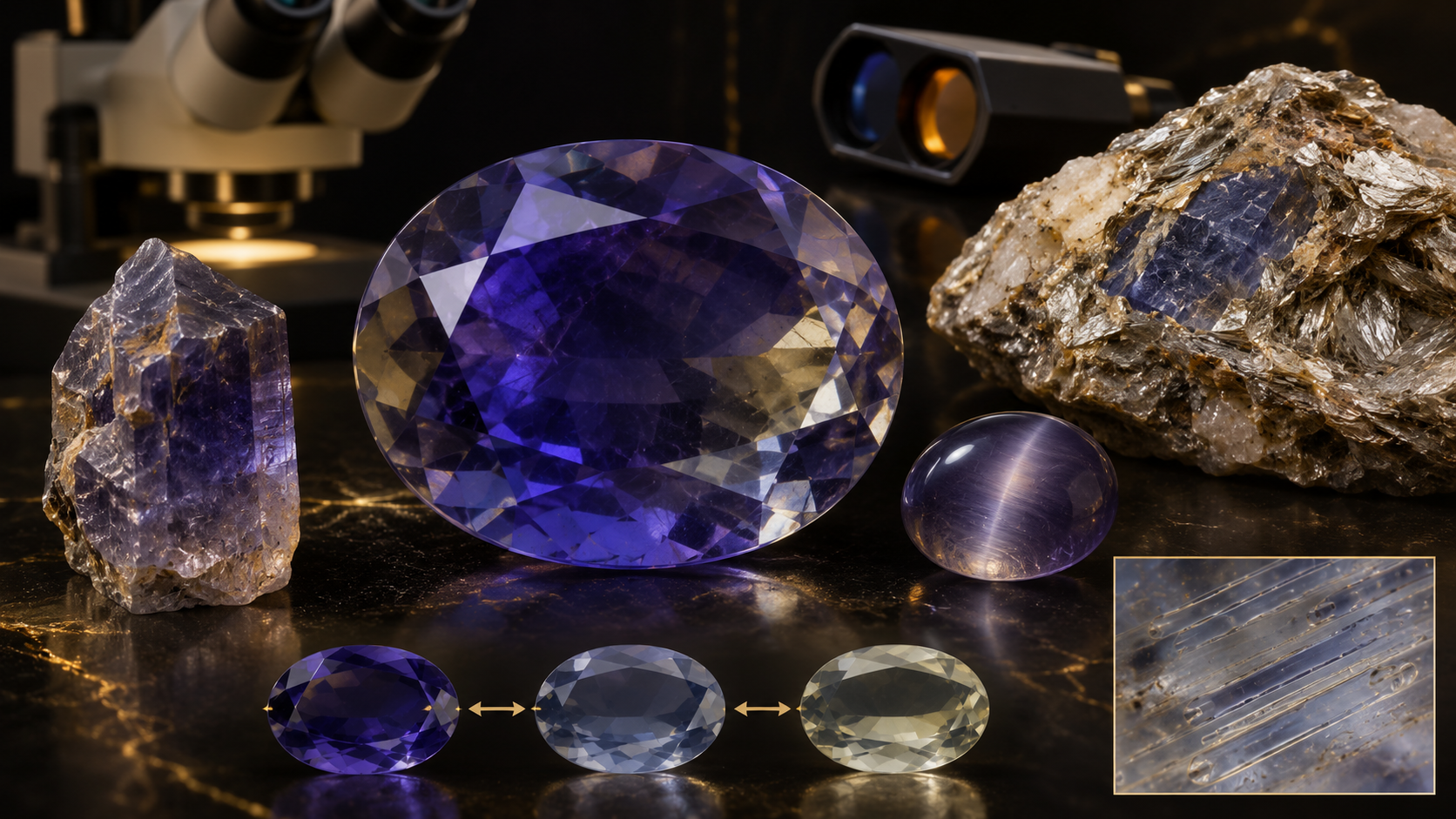
A gemstone that appears richly violet-blue from one direction, pale blue-grey from another and almost colourless or yellowish from a third offers an exceptional demonstration of optical crystallography. The iolite gemstone is one of the clearest examples of this phenomenon in gemmology.
Iolite is the accepted gemmological name for violet to violetish-blue cordierite, a magnesium–iron aluminium cyclosilicate belonging to the orthorhombic crystal system. Unlike sapphire, whose blue colour is often comparatively consistent across different viewing orientations, the iolite gemstone can display dramatic directional differences because of its exceptionally strong pleochroism.
This behaviour is not simply an attractive visual characteristic. It is a direct consequence of the mineral’s atomic structure, iron-related absorption mechanisms and interaction with polarised light. For the gem cutter, orientation is essential: an incorrectly oriented crystal may yield a pale or greyish finished gemstone despite containing an intensely coloured optical direction.
Cordierite also occupies an important position in metamorphic geology. It commonly forms in magnesium- and aluminium-bearing rocks subjected to elevated temperatures, particularly in suitable contact-metamorphic and regional metamorphic environments. Its occurrence and chemical composition can provide information about the evolution of metamorphic rocks.
Recent scientific research has added considerably to our understanding of the gemstone. A detailed 2023 investigation of Canadian iolite from the Thor-Odin dome in British Columbia documented variations in iron content, optical properties, inclusions and unusual cat’s-eye material. Microscopic examination revealed that the parallel features responsible for chatoyancy in certain specimens were hollow channels rather than conventional solid mineral needles.
Other documented specimens contain radiation-induced yellow halos around microscopic mineral inclusions, providing further evidence of the complex geological processes preserved within cordierite.
In this episode of the Nadia Gemstone Academy, we examine iolite as both a gemstone and a scientifically important mineral. The discussion covers its classification, formation, crystallography, colour mechanisms, refractive indices, microscopy, spectroscopy, natural and synthetic identification, durability and the limitations of geographic-origin determination.
Iolite demonstrates an essential principle of gemmology: the colour observed in a gemstone is not determined by chemical composition alone, but also by crystal structure, optical orientation and the geological history recorded within the material.
Table of Contents
Iolite (Cordierite): A Complete Gemmological Reference Guide
Introduction
Iolite is the violet to violetish-blue gem variety of cordierite, an orthorhombic magnesium–iron aluminium cyclosilicate renowned for exceptionally strong pleochroism.
Few transparent gemstones display such dramatic differences in colour according to viewing direction. A single crystal may appear intensely violet-blue along one optical direction, blue-grey along another and pale yellowish or nearly colourless along a third.
This characteristic, known as trichroism, is a consequence of the anisotropic optical behaviour of the cordierite crystal structure.
Although iolite is frequently compared with sapphire and tanzanite because of its blue-violet appearance, its mineralogical identity, refractive indices, density and optical properties are distinctly different.
Cordierite is also scientifically important as a constituent of metamorphic rocks. Its occurrence can provide information about temperature, pressure, rock chemistry and metamorphic evolution.
1. Mineralogical classification
Cordierite is a recognised mineral species belonging to the cyclosilicate class.
Its ideal chemical formula can be represented as Mg₂Al₃(AlSi₅O₁₈), equivalently written Mg₂Al₄Si₅O₁₈.
The structure contains interconnected silicate rings and aluminium-bearing structural units, with magnesium occupying sites that may also accommodate iron.
Cordierite belongs to a compositional and structural family that includes sekaninaite, the iron-dominant analogue.
The term iolite is used in gemmology for violet to violetish-blue gem-quality cordierite. It does not designate a separate mineral species.
The older commercial expression water sapphire is misleading because iolite is not corundum. It should be avoided in professional descriptions.
2. Crystal structure and morphology
Cordierite crystallises in the orthorhombic system.
Some crystals exhibit pseudohexagonal morphology, meaning that their external appearance can resemble sixfold symmetry even though the underlying crystal structure is orthorhombic.
This distinction is important in mineral identification.
Natural cordierite may occur as short prismatic crystals, granular aggregates or relatively large crystals embedded in metamorphic rocks.
Growth morphology, deformation and post-crystallisation alteration can influence the external appearance of specimens.
Transparent gemstone-quality material generally represents only a portion of the available rough, particularly where fracturing and inclusions are extensive.
3. Geological formation
Cordierite is strongly associated with metamorphic environments.
It commonly develops in rocks containing sufficient magnesium, aluminium and silica under elevated-temperature conditions.
Suitable geological settings include contact-metamorphic aureoles surrounding igneous intrusions and certain regionally metamorphosed sedimentary rocks.
In contact metamorphism, heat transferred from an intrusion can cause minerals within surrounding rocks to react and recrystallise.
Cordierite may develop as part of assemblages containing biotite, garnet, sillimanite, feldspar, quartz and other metamorphic minerals, depending on bulk-rock chemistry and metamorphic conditions.
It can also occur in certain igneous rocks and related geological environments.
Its presence alone does not establish one precise formation temperature or pressure.
4. Cordierite in metamorphic petrology
Cordierite is an important mineral in the study of high-temperature metamorphism.
Its stability is sensitive to pressure, temperature, bulk composition and the activities of fluid components.
In appropriate metamorphic assemblages, cordierite can help distinguish different pressure-temperature histories.
Cordierite-bearing rocks are particularly important in the study of granulite-facies terrains and high-temperature, comparatively low-pressure metamorphism.
However, a defensible geological interpretation requires the entire mineral assemblage rather than the identification of cordierite alone.
5. History and nomenclature
The mineral cordierite is named after the French geologist and mineralogist Pierre Louis Antoine Cordier.
The gemstone name iolite derives from the Greek word associated with violet.
Historically, the stone has occasionally been called water sapphire because of its transparent blue-violet appearance.
This name is scientifically incorrect and potentially misleading.
Iolite is not a variety of sapphire and does not belong to the corundum mineral species.
A popular tradition associates iolite with Viking navigation, suggesting that thin slices of the mineral were used to locate the Sun through polarised light.
Although the optical concept is scientifically plausible in principle, direct historical evidence that Vikings used iolite for this purpose is not established.
The story should therefore be presented as a tradition or hypothesis rather than a verified historical fact.
6. Gem-quality iolite
Transparent violet-blue cordierite is used principally for faceted gemstones.
The most desirable appearance generally combines attractive blue-violet colour, sufficient transparency and a cutting orientation that minimises unwanted pale directional colours.
The rough may contain strong colour even when some viewing directions appear almost colourless.
This makes orientation one of the most important considerations in iolite cutting.
Inclusion-rich material may instead be fashioned into cabochons, particularly where aligned internal features produce chatoyancy.
7. Trichroism
Trichroism is the defining optical feature of iolite.
It occurs in certain biaxial gemstones when absorption differs along three principal optical vibration directions.
In ordinary violet-blue iolite, these directions may display dark violet-blue, medium blue-grey and pale yellowish or nearly colourless appearances.
A dichroscope can demonstrate differences in transmitted colour components.
The effect can be extremely strong.
A crystal viewed from one direction may appear richly saturated, while the same crystal viewed along another direction appears remarkably pale.
This is not evidence of uneven dyeing or artificial colour enhancement.
It is a consequence of the mineral’s intrinsic optical anisotropy.
8. Trichroism versus colour change
Trichroism must be distinguished from colour change caused by different illumination sources.
In a trichroic crystal, directional absorption causes colour differences according to crystallographic orientation.
In alexandrite-type colour change, the gemstone’s apparent colour changes primarily because the spectral distribution of the illumination changes.
Iolite may display different colours through different facets under one consistent light source.
This is directional pleochroism, not necessarily a colour-change phenomenon.
9. Iron-related colour mechanisms
Iron is central to the colour of many violet-blue cordierite gemstones.
The mineral can incorporate iron in different oxidation states and structural environments.
Interactions involving Fe²⁺ and Fe³⁺ contribute to visible-light absorption and may produce strong directional colour differences.
The precise absorption behaviour depends on crystal chemistry and optical orientation.
Iron concentration also influences colour depth.
A useful example comes from the 2023 GIA investigation of Canadian cordierite, where material from one locality contained more iron and generally produced darker faceted gemstones than material from another locality.
However, colour intensity cannot be converted directly into an exact iron concentration without chemical analysis.
10. Optical properties
Iolite is doubly refractive and biaxial, usually with a negative optic sign.
GIA’s general gemstone reference gives a refractive-index interval of approximately 1.542–1.551 for typical iolite.
Commonly encountered birefringence is around 0.008–0.012, although composition and specimen-specific factors can produce deviations.
These values are useful reference figures, not absolute boundaries for every cordierite composition.
In the 2023 study of Canadian iolite, one specimen from the Blue Bear locality had measured indices of 1.538–1.548.
A specimen from the Blue Arrow locality yielded the unusually high values 1.610–1.620.
This is a significant reminder that unusual analytical results must be reported in their original sample context rather than silently incorporated into ordinary gemstone constants.
11. Specific gravity
Typical iolite has a specific gravity around 2.61.
This is relatively low compared with many other blue gemstones.
In the Canadian study, selected faceted and cabochon specimens yielded specific-gravity measurements between approximately 2.59 and 2.61.
The density difference between iolite and sapphire or tanzanite can support identification.
Nevertheless, density alone is not sufficient to establish species identity.
12. Hardness, cleavage and fracture
Cordierite generally has a Mohs hardness of 7–7.5.
It is therefore reasonably resistant to scratching under ordinary jewellery conditions.
However, hardness does not equal toughness.
Cordierite is brittle and possesses cleavage that must be considered during cutting, setting and wear.
Fracture is commonly uneven to subconchoidal.
The material may be vulnerable to chipping or impact damage, particularly where existing fractures or cleavage-related weaknesses are present.
13. Canadian iolite: the Thor-Odin dome
A detailed investigation published in Gems & Gemology in 2023 examined gem-quality cordierite from the Thor-Odin dome in British Columbia, Canada.
The study documented material from two localities, Blue Arrow and Blue Bear.
The research combined geological field observations, gemmological measurements, electron-probe chemical analysis, microscopy and scanning electron microscopy.
The investigators found that much of the cordierite rough was unsuitable for faceting because of extensive fractures and inclusions.
In some large crystals, gem-quality regions occurred only within limited portions of the specimen.
This finding demonstrates the importance of geological deformation and post-growth fracturing in determining usable gemstone yield.
14. Chemical variability in Canadian material
The Canadian study revealed compositional differences between the two localities.
Blue Arrow cordierite contained more iron than the studied Blue Bear material.
The difference correlated with the darker appearance of certain Blue Arrow gemstones.
The research also documented differences in minor-element concentrations.
This demonstrates how variations within one mineral species can affect optical appearance and gemmological measurements.
It also shows why measurements from one deposit should not automatically be applied to every occurrence worldwide.
15. Microscopic inclusions
Cordierite can contain a variety of internal features.
These may include mineral inclusions, fluid inclusions, fractures, growth structures and secondary alteration features.
The inclusion population depends on the geological environment and the crystal’s growth and deformation history.
Inclusions may reduce transparency, but they can also preserve valuable geological information.
Microscopy should therefore be regarded not merely as a clarity assessment but as a method for investigating mineral formation and subsequent alteration.
16. Cat’s-eye iolite
Chatoyancy, commonly called the cat’s-eye effect, occurs when light is reflected or scattered by numerous approximately parallel internal features.
When the gemstone is cut as a suitably oriented cabochon, these features can produce a narrow luminous band across the surface.
Cat’s-eye iolite is relatively uncommon compared with ordinary faceted material.
In the Canadian Blue Bear specimens investigated by GIA, translucent cordierite contained abundant aligned acicular features.
The researchers observed a distinct cat’s-eye effect in finished cabochons.
17. Hollow channels rather than mineral needles
One of the most scientifically interesting findings of the 2023 Canadian investigation concerned the nature of the chatoyancy-producing features.
Although they resembled needle-like inclusions under conventional observation, scanning electron microscopy revealed that the features were hollow cylindrical channels rather than solid mineral needles.
The channels were extremely narrow and contained fluid.
Their parallel alignment produced the directional scattering necessary for chatoyancy.
This finding illustrates an important limitation of ordinary microscopy.
A feature that resembles a solid mineral inclusion may actually represent a hollow or fluid-bearing structure.
Analytical confirmation can therefore change the geological interpretation.
18. Radiation halos
Another remarkable internal feature documented in iolite is the occurrence of yellow radiation halos.
A 2023 Gems & Gemology investigation described yellow discolouration surrounding certain microscopic mineral inclusions.
Raman spectroscopy identified inclusions including zircon, monazite and apatite.
Some of these minerals can contain radioactive trace elements.
Over geological time, radiation emitted from inclusions may alter the surrounding cordierite structure and produce localised colour effects.
The observed halos provide evidence of interactions between included minerals and their host crystal.
However, such halos are not a universal characteristic of iolite.
19. Aventurescent and bloodshot iolite
Certain cordierite gemstones contain reflective inclusions that create reddish or sparkling effects.
Material historically described as bloodshot iolite may contain hematite-related inclusions.
The red appearance is associated with internal mineral particles rather than the ordinary blue-violet body colour of transparent iolite.
Aventurescence occurs when reflective inclusions produce numerous small flashes of light.
This phenomenon should not be confused with trichroism, which arises from directional absorption within the host crystal.
20. Fluorescence
Ordinary iolite is commonly inert under long-wave and short-wave ultraviolet radiation.
However, fluorescence behaviour can vary with composition and internal features.
An inert UV response is therefore consistent with iolite but does not independently prove its identity.
Likewise, an unusual fluorescence reaction should prompt further examination rather than automatic rejection of the identification.
21. Absorption spectroscopy
Visible-light absorption spectroscopy provides information about the colour-producing processes in iolite.
Iron-related absorption is especially important.
Because the crystal is strongly pleochroic, spectra may vary with orientation.
A single unpolarised measurement may therefore fail to capture the full directional absorption behaviour.
Polarised spectroscopy can provide more detailed information about the relationship between optical direction and colour.
For professional interpretation, absorption features should be considered alongside chemical composition and other gemmological observations.
22. Raman spectroscopy
Raman spectroscopy can be used to confirm cordierite and distinguish it from other blue gemstones.
The technique measures vibrational characteristics associated with the crystal structure.
It is particularly useful when visual appearance and conventional measurements are inconclusive.
Raman microscopy can also identify certain mineral inclusions.
This approach was used in research involving radiation halos in iolite.
23. Treatments
Iolite is not commonly subjected to routine commercial colour enhancement.
Unlike some other gemstones, there is no widely established treatment process that consistently produces dramatic commercial colour improvements in ordinary iolite.
This does not mean that every specimen can automatically be certified untreated.
An individual gemstone may require examination for fracture filling, coatings or other unusual modifications.
Treatment status should be based on evidence rather than assumptions about the mineral species.
24. Synthetic cordierite
Cordierite-related materials can be produced under laboratory or industrial conditions.
However, synthetic iolite is not a major established commercial jewellery product.
The existence of laboratory-grown cordierite-related materials should not be confused with a widespread market for synthetic gem-quality iolite.
When an unusual specimen is encountered, natural versus synthetic origin should be investigated using appropriate microscopic, structural and chemical evidence.
Visual appearance alone is insufficient.
25. Iolite versus blue sapphire
Iolite can resemble blue sapphire, particularly when viewed along its strongest blue optical direction.
However, the two minerals are fundamentally different.
Sapphire is corundum, with the formula Al₂O₃ and a trigonal crystal structure.
Iolite is cordierite, an orthorhombic cyclosilicate.
Sapphire typically has considerably higher refractive indices and specific gravity.
Iolite’s exceptionally strong trichroism is also a valuable distinguishing feature.
The combination of refractometer, dichroscope and other standard tests can separate the two.
26. Iolite versus tanzanite
Tanzanite is the blue-violet variety of zoisite.
It may resemble iolite in colour and can also display strong pleochroism.
However, tanzanite has different refractive indices, specific gravity, crystal chemistry and absorption behaviour.
Tanzanite is also commonly associated with heat treatment to modify its colour appearance.
Iolite and tanzanite should therefore be distinguished through standard gemmological testing rather than visual colour alone.
27. Iolite versus blue spinel
Blue spinel is another possible look-alike.
Spinel is cubic and optically isotropic.
Iolite is orthorhombic and optically anisotropic.
Consequently, strong trichroism provides immediate evidence against ordinary spinel.
Refractive-index and density measurements offer additional confirmation.
28. Geographic-origin determination
Iolite occurs in several countries, including India, Sri Lanka, Myanmar, Madagascar, Tanzania, Namibia, Brazil and Canada.
Nevertheless, a precise geographic origin cannot reliably be established from blue-violet colour or trichroism alone.
Potential evidence includes inclusion assemblages, growth features, chemical composition and comparisons with authenticated reference populations.
Even with advanced testing, the evidence may be insufficient for a definitive origin conclusion.
In such circumstances, the scientifically appropriate result is to leave the origin undetermined.
29. Cutting orientation
Cutting orientation is particularly important for iolite.
A crystal with attractive deep-blue directional colour may appear much paler along another optical direction.
The cutter must balance colour, transparency, weight retention, shape and the distribution of inclusions.
The direction that maximises blue appearance may not always provide the highest yield.
This creates a technical challenge in which optical crystallography directly influences commercial gemstone appearance.
For chatoyant material, the orientation of the cabochon must also be selected in relation to the aligned internal features.
30. Durability and care
Iolite has sufficient hardness for many jewellery applications, but its brittle nature and cleavage require caution.
Rings and bracelets are more exposed to impact than pendants and earrings.
Protective settings may therefore be appropriate.
Avoid steam cleaning, particularly for included or fractured stones.
Ultrasonic cleaning is also best avoided when fractures or internal weaknesses are present.
The safest routine cleaning method is lukewarm water, mild soap and a soft cloth or brush.
Avoid strong chemicals, sudden temperature changes and unnecessary heating during jewellery repair.
31. Scientific importance
Iolite brings together several important aspects of gemmology.
Its chemical composition illustrates substitution between magnesium and iron.
Its orthorhombic structure demonstrates optical anisotropy.
Its trichroism provides a clear example of direction-dependent absorption.
Its metamorphic occurrence connects gemstone formation with geological pressure-temperature evolution.
Its inclusions preserve evidence of crystallisation, deformation and radiation effects.
Recent investigations of cat’s-eye iolite also demonstrate the importance of advanced microscopy in distinguishing solid inclusions from hollow channels.
For the practising gemmologist, iolite is therefore a valuable example of how optical, chemical and microscopic evidence must be combined to achieve a scientifically defensible interpretation.
Conclusion
Iolite is considerably more than an attractive violet-blue alternative to better-known gemstones.
It is a mineral whose crystal structure, chemistry and geological history can be studied through a combination of classical gemmological techniques and advanced laboratory analysis.
Its extreme trichroism illustrates the importance of crystallographic orientation, while its inclusions and unusual optical phenomena demonstrate how microscopic features can preserve evidence of complex geological processes.
Understanding iolite requires an integrated approach to mineralogy, metamorphic petrology, optical physics and gemstone identification.
That combination makes cordierite an especially instructive subject for both professional gemmologists and serious gemstone enthusiasts.
References & Further Reading
1. Gemological Institute of America – Iolite Gemstone
GIA gemstone reference covering mineral identity, chemical composition, colour, pleochroism, hardness, refractive index, specific gravity, quality factors and treatment information.
2. Belley, P. M. (2023). Iolite from the Thor-Odin Dome, British Columbia, Canada: Geology, Chemical Composition, Inclusions, and Cause of Chatoyancy.
Gems & Gemology, Fall 2023.
Primary scientific research examining Canadian cordierite, including geological occurrence, chemical composition, optical properties, microscopy and scanning electron microscopy of chatoyancy-producing channels.
https://www.gia.edu/gems-gemology/fall-2023-british-columbian-iolite
PDF version:
https://www.gia.edu/doc/fall-2023-british-columbian-iolite.pdf
3. Smith, T. & Jones, E. (2023). Yellow Radiation Halos in Iolite (Cordierite).
Gems & Gemology, Winter 2023.
Research note documenting yellow radiation halos surrounding inclusions identified as zircon, monazite and apatite, with discussion of radiation-induced alteration in cordierite.
https://my.gia.edu/gems-gemology/winter-2023-microworld-radiation-halos-in-iolite
4. Castillo, A. & Sehgal, A. (2017). Unusual Dark Orangy Red Cordierite.
Gems & Gemology, Spring 2017.
Laboratory report documenting an unusual cordierite colour and optical properties, illustrating the limitations of applying ordinary iolite constants to all compositions.
https://www.gia.edu/gems-gemology/spring-2017-labnotes-unusual-dark-orangy-red-cordierite
5. Gemological Institute of America – Edward J. Gübelin Collection: Cordierite–Iolite.
GIA reference specimen from Sri Lanka, including measured optical properties, specific gravity, fluorescence and gemmological observations.
https://www.gia.edu/dam/jcr%3A440d2b91-337b-4e94-9de0-cbb0631d6a44/cordierite-iolite-34802.pdf