Table of Contents
A Precious Jewel Hidden Inside a Toad?
Imagine a wealthy European traveller during the sixteenth century.
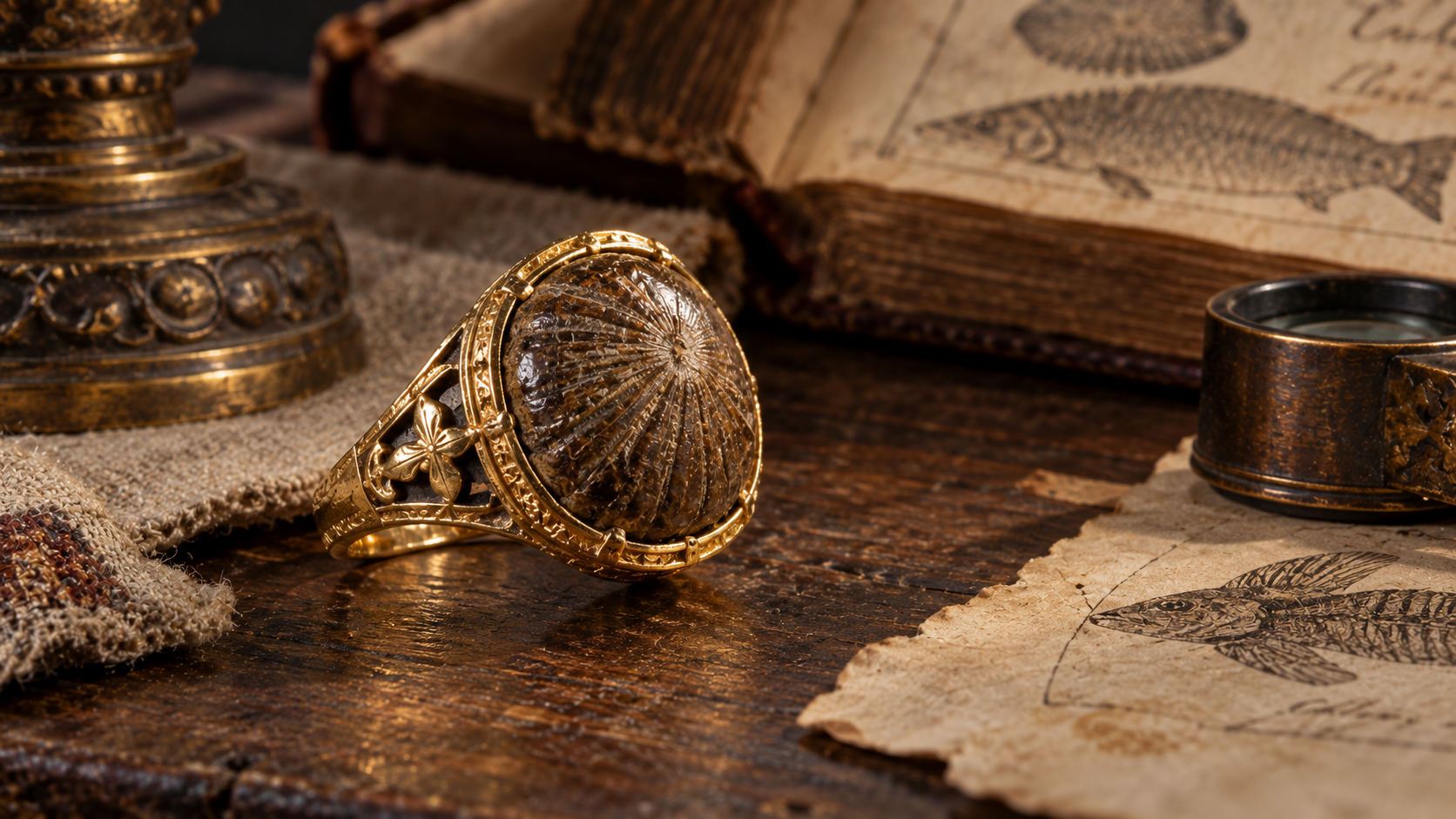
On one finger is a gold ring containing an unusual brownish-green stone.
The stone is neither emerald nor sapphire.
It possesses little of the brilliance associated with conventional precious gemstones.
Its surface is rounded, smooth and almost button-shaped.
Yet its owner may believe it offers something more valuable than beauty.
According to a widespread European tradition, the mysterious stone originated inside the head of a toad.
It was believed to possess remarkable powers.
Some accounts claimed that the stone would become warm, change colour or release moisture when poison was nearby.
Others described its supposed ability to neutralise venom or protect against illness.
The material was known as toadstone, lapis bufonius or crapaudine.
It appeared in rings, amulets and collections of unusual natural objects.
But the stone’s true origin was entirely different.
The medieval toadstone was usually the fossilised crushing tooth of an extinct prehistoric fish.
Its history reveals how natural objects acquired spiritual significance through folklore, religious interpretation and early medical theories.
The fascinating Toadstone amulet history reveals how natural objects acquired spiritual significance through folklore, religious interpretation and early medical theories.
It also provides an extraordinary example of the transition from traditional gemstone beliefs to scientific palaeontology.
What Exactly Is a Toadstone?
Despite its name, a toadstone does not originate inside a toad.
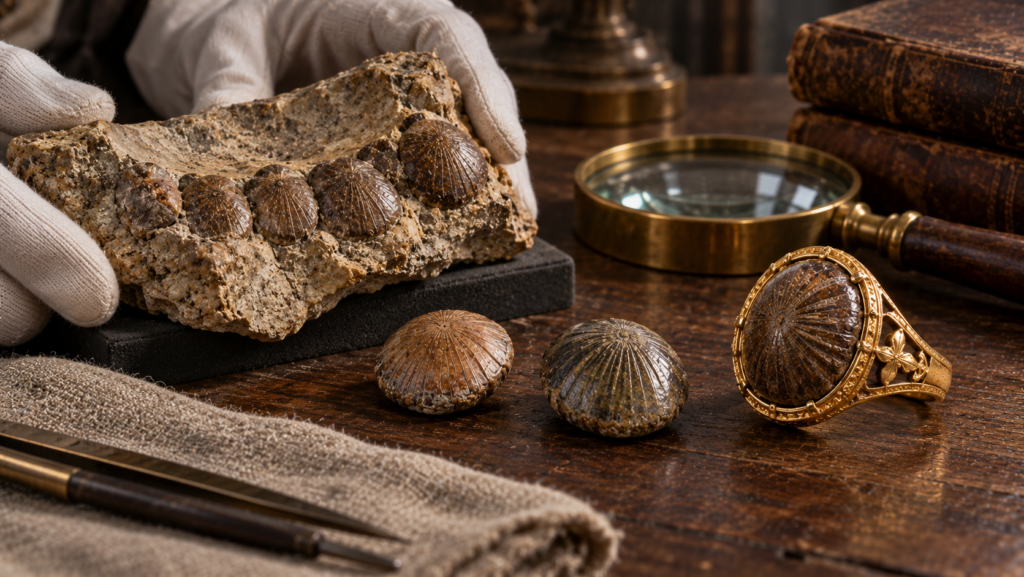
The material historically identified as toadstone was commonly a fossilised tooth from an extinct ray-finned fish.
These prehistoric animals included fishes traditionally classified within the genus Lepidotes.
Some fossils formerly assigned to that genus are now classified within Scheenstia.
The animals inhabited aquatic environments during the Mesozoic Era.
Their specialised teeth were adapted for crushing hard food.
Unlike the pointed teeth associated with many predatory fish, these crushing teeth possessed rounded surfaces.
Some were almost hemispherical.
Their compact shape made them particularly suitable for use as ornamental stones.
A fossil tooth could resemble a small polished cabochon even before extensive human modification.
This natural appearance contributed to its appeal.
From Prehistoric Fish to Medieval Jewellery
The geological history of a toadstone began millions of years before human civilisation.
The original tooth developed within the jaw of a living fish.
After the animal died, suitable burial conditions could preserve its hard tissues.
Over geological time, mineralisation and other fossilisation processes helped preserve the tooth’s structure.
The resulting fossil might eventually become exposed through erosion or excavation.
Its original biological function was no longer visible to someone unfamiliar with prehistoric fish anatomy.
Instead, the fossil appeared as a small, unusually regular natural object.
Its rounded form invited interpretation.
In medieval and early modern Europe, one explanation connected it with the supposed jewel hidden inside a toad.
The same fossil that a modern palaeontologist recognises as an ancient tooth could therefore become a precious protective amulet.
Why Did People Believe Toads Contained Gemstones?
Toads occupied an ambiguous position in European folklore.
They were familiar animals, yet their appearance and behaviour inspired a variety of beliefs.
Their skin was often associated with poison.
Some European toad species possess glands capable of secreting defensive toxic substances.
This biological characteristic helped support the animal’s reputation.
Within certain historical systems of natural interpretation, it seemed plausible that a creature associated with poison might also contain a substance capable of counteracting it.
The supposed toadstone became an example of this reasoning.
A dangerous animal was imagined to conceal a beneficial object.
The belief reflected an attempt to discover relationships between apparently opposing natural qualities.
However, the existence of toxic secretions in some toads does not establish that they produce protective gemstones.
They do not.
The Doctrine of Signatures
The toadstone tradition can be understood partly through the historical concept known as the Doctrine of Signatures.
This approach to natural medicine interpreted the appearance of plants, animals and other substances as clues to their possible uses.
An object’s colour, shape or resemblance to a body part could be considered meaningful.
Some interpretations placed these relationships within a Christian understanding of divine creation.
Nature was imagined as containing signs that revealed useful remedies.
The toadstone fitted this way of thinking.
Because toads were associated with poison, a stone supposedly originating from a toad might be interpreted as a remedy against poisonous substances.
Its rounded appearance could also encourage comparisons with particular organs or bodily conditions.
These associations were historically meaningful.
They were not established through controlled scientific experiments.
Modern medicine does not accept resemblance alone as evidence of therapeutic effectiveness.
The Toadstone as an Early Poison Detector
One of the most distinctive beliefs concerned the stone’s supposed reaction to poison.
Historical descriptions claimed that a toadstone could change its appearance when dangerous substances were nearby.
It might sweat.
It might become warm.
Its colour might change.
A ring containing the stone could therefore be regarded as a protective warning device.
Such beliefs are particularly understandable in historical environments where poisoning was feared.
But the claimed mechanism was not scientifically demonstrated.
A fossilised fish tooth does not possess an established ability to identify poisons reliably.
Changes in surface moisture or temperature can occur for ordinary environmental reasons.
They do not establish the presence of a toxic substance.
The historical belief reveals anxiety about danger and the desire for protection rather than a scientifically effective detection method.
A Fourteenth-Century Italian Toadstone Ring
One of the most important surviving examples belongs to the British Museum.
The museum catalogues a gold amulet ring produced in Italy during the fourteenth century.
Its projecting oval setting contains a toadstone.
The material is identified as a fossilised fish tooth.
The ring is especially significant because it combines the fossil with an engraved religious inscription.
Its decoration includes passages associated with the Christian scriptures.
One portion refers to Luke 4:30.
Another incorporates wording from John 1:14.
The inscriptions were interpreted within historical traditions of protective religious formulas.
The object therefore combined two forms of perceived protection.
One came from the natural material.
The other came from sacred words.
This makes the ring an exceptionally revealing example of medieval European amuletic jewellery.
Sacred Words and Protective Stones
The Italian ring demonstrates that medieval gemstone beliefs did not necessarily exist separately from Christian religious culture.
In some contexts, protective objects incorporated Christian prayers, scriptural passages or sacred names.
The words themselves could be regarded as meaningful.
When combined with a supposedly powerful natural substance, they created a complex amulet.
However, this practice should not be confused with an official doctrine shared by all medieval Christians.
Beliefs about amulets varied.
Religious authorities did not always approve of magical interpretations.
Individual owners could understand their jewellery differently.
The British Museum’s object provides evidence of one particular historical practice.
It does not demonstrate that every Christian community attributed supernatural powers to toadstones.
The Meaning of the Ring’s Inscription
The inscription on the British Museum ring is particularly interesting.
Its wording draws upon passages from the New Testament.
Luke 4:30 describes Jesus passing through a hostile crowd.
John 1:14 concerns the Word becoming flesh.
Such passages could acquire protective associations in medieval devotional and amuletic contexts.
The British Museum’s catalogue discusses the ring in relation to traditions of protection against illness and other dangers.
The exact personal intentions of its original owner are unknown.
Nevertheless, the combination of a fossil tooth and religious inscription demonstrates that the object was more than ordinary decorative jewellery.
Its materials and words participated in a historical system of protection.
Renaissance Europe and the Continuing Popularity of Toadstones
The belief did not disappear at the end of the Middle Ages.
Toadstone jewellery remained familiar during the Renaissance and early modern period.
The British Museum preserves a sixteenth-century gold ring containing a toadstone.
Its construction is comparatively restrained.
A rounded gold hoop expands into an oval setting holding the fossil.
The stone itself remains the central feature.
The survival of such objects demonstrates that the tradition continued beyond medieval manuscripts and folklore.
People commissioned, acquired and wore jewellery containing these fossils.
The stones were not merely imaginary substances described in books.
They were physical objects incorporated into actual rings.
The Cheapside Hoard: A Fossil Among Precious Treasures
An especially compelling example comes from London’s Cheapside Hoard.
The hoard contains an extraordinary collection of early modern jewellery and gemstones.
Among its contents was a polished fossil tooth identified as Lepidotus maximus in the London Museum catalogue.
The museum describes the object as lapis bufonius.
It is a rounded, polished crushing tooth.
The specimen measures approximately 20–22 millimetres across and weighs 6.74 grams.
Its geological age is approximately 150 million years.
The museum associates its working with the late sixteenth or early seventeenth century.
Its presence among valuable jewellery materials is particularly revealing.
A fossil tooth could occupy a place within the same material culture as precious gemstones and luxury ornaments.
Its value did not depend primarily on optical brilliance.
It depended upon rarity, interpretation and the powers people believed it possessed.
The Meaning of Lapis Bufonius and Crapaudine
The terminology surrounding toadstones reveals the geographical spread of the belief.
Lapis bufonius is a Latin expression associated with the toad.
Crapaudine derives from a French term connected with the same animal.
Historical sources also use related forms such as bufonites.
These names describe the supposed origin of the object.
They do not identify its true geological formation.
This distinction is important when reading historical gemmological literature.
An old name may preserve a cultural explanation rather than a scientifically accurate classification.
The history of toadstone terminology demonstrates how language can retain earlier interpretations long after their scientific basis has been rejected.
Shakespeare and the Jewel in the Toad’s Head
The belief became familiar enough to appear in English literature.
William Shakespeare refers to the supposed jewel inside a toad in As You Like It.
The reference appears in a speech about adversity.
The image depends upon a contrast.
An animal regarded as unattractive or dangerous supposedly contains something precious.
The audience was expected to recognise the association.
Shakespeare’s use of the image demonstrates that the belief circulated beyond specialised medical or lapidary texts.
It had entered the wider imaginative culture of early modern England.
The literary reference does not prove the existence of a gemstone inside a living toad.
It demonstrates the cultural familiarity of the idea.
How Was a Toadstone Supposed to Be Obtained?
Historical accounts sometimes provided elaborate instructions for obtaining the stone.
One tradition claimed that an old toad should be placed on a red cloth.
The animal would supposedly release the stone.
Other accounts described different procedures involving the animal.
These stories were part of the folklore surrounding the material.
They should not be interpreted as practical or ethical instructions.
Toads do not contain such stones.
The procedures were based on a mistaken understanding of the fossil’s origin.
Modern identification makes it unnecessary to involve living animals in any attempt to obtain a toadstone.
The material can be studied through palaeontology and museum collections.
A Fossil Tooth in the Crown of a Sacred Reliquary
The history of toadstones includes an especially remarkable royal and religious object.
A peer-reviewed study published in 2020 examined two brown stones incorporated into the crown on the reliquary bust of Charlemagne at Aachen Cathedral.
The research identified them as fossilised crushing teeth of a prehistoric fish classified as Scheenstia maximus.
The stones were positioned among more conventional precious and ornamental materials.
Their presence is striking.
A material now recognised as fossilised fish dentition had been incorporated into the decoration of a highly prestigious religious object.
The study examines the historical belief that such stones possessed protective and medicinal powers.
However, the presence of these fossils in the crown does not establish the precise intentions of every historical patron or craftsman involved.
The object demonstrates the material’s prestige and historical use.
Its individual symbolic interpretation requires caution.
Why Would a Fossil Be Treated as a Jewel?
Modern gemstone evaluation often emphasises characteristics such as colour, transparency, rarity, durability and cutting quality.
Historical valuation could involve additional considerations.
A natural object might be admired because it appeared extraordinary.
Its origin might be mysterious.
Its shape might resemble something significant.
Its reputed powers might make it desirable.
Toadstones possessed several of these qualities.
Their rounded surfaces resembled deliberately polished stones.
Their fossil origin was not widely understood.
Their association with toads supplied a memorable story.
And their supposed ability to protect against poison created practical and emotional appeal.
A fossil could therefore become a jewel without possessing the optical qualities of a conventional gemstone.
The Difference Between a Toadstone and a Cabochon
Toadstones are frequently described as cabochon-like.
A cabochon is a gemstone cut with a rounded or domed upper surface, usually with a relatively flat base.
The shape is commonly associated with materials such as opal, moonstone, turquoise and many ornamental stones.
A fossilised crushing tooth may possess a naturally rounded upper surface.
It can therefore resemble a cabochon without having been shaped entirely by a lapidary.
Some historical specimens were polished or modified.
Others retained much of their natural morphology.
The distinction is important.
A naturally domed fossil is not necessarily evidence of advanced gemstone cutting.
Its appearance may originate primarily from the anatomy of the prehistoric animal.
What Were the Prehistoric Fish Like?
The fishes associated with historical toadstones belonged to extinct groups of ray-finned fishes.
Some possessed robust jaws and rounded teeth adapted for crushing hard-shelled food.
Their dentition differed from the sharp, pointed teeth commonly associated with sharks.
A rounded crushing tooth distributed force across a relatively broad surface.
This adaptation helped the animal process resistant food items.
After fossilisation, individual teeth could be separated from the jaw.
Without the surrounding anatomy, their biological origin became less obvious.
The resulting objects were small, durable and unusually regular.
These characteristics helped them enter the world of historical gemstone folklore.
Why Fossils Inspired Supernatural Interpretations
Before the development of modern palaeontology, fossils were interpreted through many different frameworks.
Some were recognised as remains of once-living organisms.
Others were explained through religious narratives, unusual natural processes or folklore.
National Museums Scotland documents several examples.
Ammonites were sometimes interpreted as petrified snakes.
Belemnites were associated with thunderbolts or unusual animal-derived stones.
Fossilised fish teeth became toadstones.
These interpretations arose because people encountered unfamiliar natural forms without the scientific context now available.
The objects themselves were real.
The explanations attached to them varied.
This distinction is central to understanding historical crystal and gemstone beliefs.
Toadstones and the Fear of Poison
The supposed protective power of toadstones was closely connected with historical anxieties about poisoning.
Poison could be difficult to recognise.
Its effects might be sudden or delayed.
In periods when medical diagnosis and treatment were limited, people sought ways to identify and prevent danger.
An object believed to react to poison offered reassurance.
The toadstone was one such object.
Its reputation made it suitable for personal jewellery.
A ring could be worn continuously.
The stone remained close to the body.
The supposed protection therefore accompanied the wearer throughout daily life.
This practical aspect helps explain why toadstones were incorporated into rings rather than only preserved as curiosities.
Did Toadstones Really Neutralise Poison?
There is no reliable scientific evidence that fossilised fish teeth can neutralise poisons in the manner described by medieval and Renaissance traditions.
Nor is there evidence that they reliably detect toxic substances through changes in colour, temperature or moisture.
Their historical medical reputation was based on traditional interpretations rather than modern toxicological testing.
The same caution applies to claims that toadstones could treat epilepsy, kidney disorders or venomous bites.
These claims should not be presented as established medical facts.
A fossilised tooth is not a substitute for appropriate medical treatment.
Its historical importance lies in what people believed and how they used it.
From Protective Magic to the History of Medicine
Toadstones occupy an interesting position between folklore and medical history.
They were not always regarded as purely decorative charms.
Historical writers sometimes discussed them as substances with practical therapeutic applications.
Christopher Duffin’s research on fossilised fish teeth examines their place within pre-scientific medicine.
Such objects belonged to a period when medicinal substances could be selected through inherited authority, analogy, observation and religious interpretation.
The methods differed substantially from modern clinical research.
Nevertheless, these traditions form part of the history of medicine.
They reveal how people attempted to understand disease and protect themselves from harm.
The Role of Natural History Collections
The scientific interpretation of toadstones became clearer as natural history developed.
Researchers compared isolated fossils with teeth preserved in prehistoric fish jaws.
This allowed the supposed gemstones to be understood anatomically.
Their shapes were not mysterious products of toads.
They were specialised feeding structures.
Geological evidence placed them within ancient sedimentary deposits.
Comparative anatomy connected them with extinct fishes.
Museum collections now preserve both the fossil specimens and the historical jewellery made from them.
These two categories of evidence allow the complete story to be reconstructed.
A Ring Can Preserve Two Histories
A toadstone ring contains at least two different historical records.
The fossil preserves evidence of prehistoric life.
The jewellery preserves evidence of human craftsmanship and belief.
The fossil may be approximately 150 million years old.
The ring setting may be only a few hundred years old.
These dates describe different events.
The geological age concerns the animal and the formation of the fossil.
The historical date concerns the human transformation of the material into jewellery.
Confusing these timescales would produce an inaccurate interpretation.
Together, however, they make the object unusually fascinating.
Christian Symbolism and Folk Magic
The fourteenth-century Italian ring demonstrates that protective fossil jewellery could incorporate Christian religious language.
But the relationship between Christianity and amuletic practice was complex.
Some individuals used scriptural words or sacred names for protection.
Other religious authorities questioned or criticised practices they regarded as superstition.
The presence of Christian wording on an object does not automatically establish official religious approval.
Nor does it mean the wearer understood the ring as belonging to a separate religion.
Historical belief could combine devotional practice, inherited folklore and practical concerns about health.
Toadstone jewellery illustrates these overlapping categories.
Did Everyone Believe in Toadstones?
It would be inaccurate to assume that all medieval or Renaissance Europeans accepted the same explanations.
Natural history and medicine contained competing interpretations.
Some writers repeated traditional accounts.
Others questioned them.
The survival of toadstone rings demonstrates that the material was used.
It does not establish that every owner accepted every claim about its origin or powers.
A ring could be inherited.
It could be worn for personal reassurance.
It might be appreciated as an unusual natural object.
It could also be valued for its historical or religious associations.
The precise motivation of an individual wearer is not always recoverable.
The Modern Gemmological Classification of Toadstone
A toadstone is not a distinct mineral species.
It is a historical name applied to certain fossils, especially rounded fish teeth.
Its composition and preservation depend upon the original biological tissue and subsequent fossilisation processes.
The original tooth contained mineralised dental tissues.
During fossilisation, mineral components may be preserved or altered through interaction with the surrounding geological environment.
The resulting specimen is therefore best identified palaeontologically rather than treated as a conventional gemstone variety.
It should not be confused with jade, agate, jasper or other minerals merely because of its colour or polished appearance.
Accurate identification requires attention to its structure and fossil origin.
What Makes an Authentic Historical Toadstone?
An authentic historical toadstone may refer to two different things.
First, there is the fossil material itself.
A genuine fossilised crushing tooth can be identified through palaeontological characteristics.
Second, there is the historical object in which it was used.
A medieval or Renaissance ring requires separate assessment of its metalwork, construction, provenance and dating.
A genuine fossil placed into a modern ring does not make that ring medieval.
Similarly, an old ring containing an unidentified brown stone should not automatically be described as a toadstone.
Museum documentation and appropriate specialist examination are essential.
Toadstones in Modern Spiritual Interpretation
Contemporary crystal and gemstone traditions sometimes reinterpret historical protective objects.
A toadstone might be described as a symbol of safety, resilience or transformation.
These associations may be meaningful to an individual.
However, they should not automatically be presented as direct continuations of one uniform medieval tradition.
Historical toadstone beliefs focused especially on poison, illness and protection.
Modern concepts involving chakra balancing or vibrational energy belong to different spiritual frameworks.
There is no established scientific evidence that a fossilised fish tooth emits a healing energy field or alters the body’s physiological processes through supernatural means.
The historical symbolism remains worthy of study without requiring such claims.
What the Toadstone Reveals About Human Belief
The toadstone is a particularly revealing object because its true origin is so different from its traditional explanation.
The material was real.
Its unusual appearance was real.
Its use in jewellery was real.
The rings preserved in museums are real historical objects.
Yet the belief that the stone originated inside a toad was mistaken.
The supposed protective powers were not scientifically established.
This combination illustrates an important principle.
A natural object can acquire profound cultural significance through an explanation that later proves scientifically incorrect.
Understanding that process does not make the historical object less interesting.
It makes its cultural history more complex.
What Can We Establish with Confidence?
Museum collections, historical scholarship and palaeontology support several conclusions.
Toadstones were commonly fossilised crushing teeth of extinct fishes historically classified as Lepidotes and, in some cases, now classified as Scheenstia.
Their rounded form made them suitable for jewellery.
Medieval and Renaissance Europeans associated them with supposed gemstones found inside toads.
Historical traditions credited them with detecting or neutralising poison.
Surviving rings demonstrate that the fossils were incorporated into personal ornaments.
The British Museum preserves a fourteenth-century Italian gold ring combining a toadstone with Christian inscriptions.
A sixteenth-century gold toadstone ring also survives in the British Museum.
The London Museum preserves a fossil tooth from the Cheapside Hoard.
Scientific research has identified fossil fish teeth incorporated into the crown on the reliquary bust of Charlemagne at Aachen Cathedral.
Historical writers discussed toadstones in relation to poison, disease and protective medicine.
Modern palaeontology explains their origin through prehistoric fish anatomy and fossilisation.
There is no established scientific evidence that toadstones possess the supernatural protective or medical powers attributed to them.
Conclusion: A Gemstone That Was Never a Gemstone
The history of the toadstone is one of the most extraordinary examples of natural material becoming an object of spiritual belief.
Its story begins with prehistoric fishes living millions of years before human civilisation.
Their specialised crushing teeth survived as fossils.
Centuries later, Europeans encountered these rounded objects and interpreted them through the natural knowledge and religious ideas of their time.
The fossils became precious stones supposedly hidden inside toads.
They were placed into gold and silver rings.
They were associated with poison detection, protection and healing.
Some were combined with Christian inscriptions.
Others entered prestigious collections of jewellery and natural curiosities.
Today, museums preserve both the objects and the evidence needed to understand their true origins.
The toadstone therefore connects three very different fields.
Palaeontology explains the fossil.
History explains the jewellery.
The study of religion and folklore explains the beliefs.
Its significance lies not in scientifically proven magical powers, but in the remarkable transformation of a prehistoric fish tooth into a symbol of protection, hope and human attempts to understand the natural world.
For Natural Gems Belgium, this story demonstrates why the cultural history of natural materials deserves the same careful attention as their physical properties.
Not every object called a gemstone is a mineral.
Not every historical claim about a stone is scientifically correct.
And not every valuable natural object owes its importance to brilliance, transparency or rarity.
Sometimes its greatest value lies in the extraordinary history of what people believed it could do.
References & Further Reading
1. National Museums Scotland – Snakestones, Toadstones, and Other Myths About Fossils
https://www.nms.ac.uk/discover-catalogue/snakestones-toadstones-and-other-myths-about-fossils
Source description: Official museum educational article examining historical beliefs surrounding fossils, including toadstones, ammonites and belemnites. Explains the identification of toadstones as fossilised fish teeth and documents their supposed protective and medicinal properties.
2. British Museum – Fourteenth-Century Italian Toadstone Amulet Ring
https://www.britishmuseum.org/collection/object/H_AF-1023
Source description: Official collection record for a medieval Italian gold ring containing a fossilised fish tooth. Includes detailed scholarly discussion of its Christian inscriptions, protective associations and historical gemstone folklore.
3. British Museum – Sixteenth-Century Gold Toadstone Ring
https://www.britishmuseum.org/collection/object/H_AF-1024
Source description: Official museum catalogue documenting a sixteenth-century gold ring set with a toadstone. Identifies the material as a fossilised fish tooth and provides references to historical research on toadstone jewellery.
4. London Museum – Lepidotus maximus Palatal Tooth, Lapis Bufonis
Source description: Official museum record for a polished fossil fish tooth recovered as part of the Cheapside Hoard. Documents its dimensions, weight, approximate geological age and early modern identification as a toadstone.
5. British Geological Survey – Fish: Fossils, Geological History and Myths
Source description: Authoritative geological educational resource explaining the evolution of fishes and the historical misidentification of fossil teeth. Includes a dedicated discussion of toadstone beliefs and their scientific explanation.
6. Masaryk University – “Crapaudine” (Scheenstia Teeth): The Jewel of Kings
https://www.muni.cz/en/research/publications/1700879
Source description: Peer-reviewed research by Růžena Gregorová, Martin Bohatý, Dana Stehlíková and Christopher Duffin, published in 2020 in Acta Musei Moraviae, Scientiae Geologicae. Identifies fossil fish teeth incorporated into the crown of the reliquary bust of Charlemagne at Aachen Cathedral and examines their historical protective and medicinal associations.
7. Ashmolean Museum – Museum Secrets: Toad Vaccines and Magical Jewellery
https://ashmolean.org/museum-secrets
Source description: Museum educational series featuring curator Matthew Winterbottom’s examination of historical toadstone rings. Discusses the relationship between protective jewellery, disease anxiety and traditional beliefs. See Episode 9, which identifies several toadstone rings in the Ashmolean collection.
8. Science Museum Group – Finger Ring with Toadstone Amulet
Source description: Official collection record for a metal ring containing a toadstone in an oval claw setting. Provides material details and physical measurements, documenting another surviving example of this historical jewellery tradition.
9. Christopher Duffin – Fossilized Fish Teeth as Historical Medicines
Source description: Historical medical research article published in Hektoen International in August 2026. Examines toadstones and fossil shark teeth within pre-scientific medicine, including their supposed protective effects, historical names and relationship with the Doctrine of Signatures.
10. Science Museum Group – Fossil Tooth Amulet from Kent
https://collection.sciencemuseumgroup.org.uk/objects/co108010/fossil-tooth-amulet
Source description: Official collection record for a fossil tooth amulet carried in Kent, England, between approximately 1840 and 1910. Documents the continuation of fossil-based protective beliefs into later folk-medicine traditions.
Historical Belief, Cultural Evidence and Scientific Reality
Scientifically established: Historical toadstones were commonly fossilised crushing teeth from extinct prehistoric fishes.
Scientifically established: Their rounded appearance originated primarily from the anatomy of the original teeth.
Historically documented: Medieval and Renaissance Europeans incorporated these fossils into rings and amulets.
Historically documented belief: Toadstones were believed to originate inside the heads of toads.
Historically documented belief: Some people believed the stones could detect or neutralise poison.
Historically documented: Certain toadstone rings combined fossil material with Christian religious inscriptions.
Historically documented: The Cheapside Hoard included a polished fossil tooth identified as lapis bufonius.
Scientifically established: Toadstones do not originate inside living toads.
Scientific limitation: There is no reliable evidence that toadstones detect poisons, cure disease, prevent poisoning or possess supernatural protective powers.
Modern spiritual interpretation: Individuals may regard historical toadstones as symbols of protection or resilience, but such meanings should not be confused with measurable physical effects.
The toadstone illustrates how one natural object can possess several distinct identities: a prehistoric fossil, a historical ornament, a religious or magical symbol and a scientifically identifiable biological remnant.
Its cultural history is documented.
Its geological origin can be investigated.
Its supposed supernatural powers remain matters of historical belief rather than established scientific fact.