A small room can serve many purposes.
It may be a place for reading, working, resting or quiet contemplation.
A table may hold books, everyday objects and unfinished tasks.
A window allows natural light to enter.
And a comfortable chair offers somewhere to sit.
Nothing about the room necessarily makes it sacred.
Yet within many religious and spiritual traditions, particular spaces acquire meaning through their use, symbolism, preparation and the activities performed within them.
In contemporary crystal spirituality, Selenite is frequently associated with purification, clarity and the cleansing of unwanted energy.
Some practitioners believe that it clears negative vibrations from a room, purifies other crystals or creates a peaceful energetic environment.
Others place Selenite near doorways, meditation spaces or personal altars.
These interpretations are spiritual beliefs rather than scientifically established effects.
There is no reliable evidence that Selenite removes negative energy, purifies indoor air through supernatural vibrations or creates a measurable protective field.
Nevertheless, a gemstone can serve as a meaningful symbol.
And preparing a space can become a deliberate act of attention.
This article introduces an original contemporary practice:
The Selenite Sacred Space Ritual.
It combines one Selenite stone with practical preparation, symbolic intention and a short period of quiet reflection.
The ritual does not promise emotional healing.
It is not a historical reconstruction of an ancient Selenite ceremony.
And it does not require belief in supernatural crystal energy.
Instead, it explores one central idea:
A personal sanctuary is not necessarily a place separated from ordinary life. Sometimes, it is an ordinary place given a particular purpose.
Table of Contents
Selenite in Contemporary Crystal Spirituality
Selenite is commonly associated in modern crystal traditions with cleansing, spiritual clarity, purification and peaceful energy.
Some practitioners describe it as a stone that removes unwanted vibrations from its surroundings.
Others believe it can cleanse other gemstones, protect meditation spaces or support spiritual awareness.
It may be placed on a shelf, near a doorway or beside objects used for reflection.
These interpretations vary between practitioners and spiritual communities.
They should not automatically be presented as universal ancient teachings.
The contemporary use of Selenite for energetic cleansing should also be distinguished from historical religious purification practices.
Different cultures have developed their own rituals, symbols and theological explanations.
A modern gemstone arrangement does not become an ancient religious ceremony simply because it involves purification symbolism.
For the Sacred Space Ritual, Selenite represents one intention:
To prepare a chosen space for quiet, attention and personal reflection.
The stone does not cleanse the room through scientifically demonstrated supernatural energy.
Its role is symbolic.
What Makes a Space Sacred?
The meaning of sacred space varies between religious and cultural traditions.
Some sacred spaces are established through religious authority, consecration or longstanding communal practice.
Others are associated with particular landscapes, buildings, objects or events.
A temple, shrine, church, mosque or pilgrimage location may have significance that extends far beyond its physical appearance.
The religious historian Mircea Eliade explored distinctions between sacred and profane space in his influential work on religion.
His interpretations have also been debated and criticised within religious studies.
They should not be treated as a universal explanation of every religious tradition.
For the purposes of this article, a personal sanctuary is understood more modestly.
It is a space that an individual intentionally uses for reflection, meditation, prayer or quiet activity.
It does not claim the religious status of a consecrated temple or other established sacred site.
Purification in Religious Traditions
Purification has an important place in many religious traditions.
However, its meanings and practices differ considerably.
In some traditions, purification involves water.
In others, it may include prescribed prayers, ritual actions, abstentions or preparation before worship.
For example, Islamic practice includes wudu, a form of ritual washing associated with prayer.
Jewish traditions include forms of ritual immersion connected with particular religious requirements.
Hindu traditions contain diverse purification practices associated with worship, pilgrimage and daily religious life.
These practices have specific historical, theological and communal contexts.
They should not be reduced to a general belief in “cleansing negative energy.”
Nor should they be presented as interchangeable with contemporary crystal rituals.
The Selenite Sacred Space Ritual is a modern symbolic exercise.
It does not reproduce or replace religious purification.
The Difference Between Spiritual Cleansing and Physical Cleaning
The word cleansing can refer to very different activities.
Physical cleaning involves removing dust, dirt or other unwanted material.
Ventilation involves exchanging indoor and outdoor air.
Environmental safety may require appropriate cleaning methods, maintenance or professional intervention.
Spiritual cleansing, by contrast, may refer to beliefs about purification, blessing or the removal of unseen influences.
These concepts should not be confused.
There is no reliable evidence that Selenite removes airborne pollutants, disinfects surfaces or improves indoor air quality through crystal energy.
A Selenite stone cannot replace ventilation, cleaning or appropriate environmental safety measures.
For the Sacred Space Ritual, practical preparation comes first.
The symbolic element follows.
Why the Environment Matters for Quiet Activities
The surroundings in which an activity takes place can influence how easily it is performed.
Lighting, noise, temperature, seating and interruptions may affect comfort and attention.
A person attempting to read in a noisy environment may find the task more difficult.
Someone sitting in an uncomfortable chair may become distracted.
And a space filled with unrelated objects may not suit every form of reflection.
However, preferences vary.
Some people enjoy quiet, minimal environments.
Others prefer familiar objects, music or a more visually stimulating setting.
The Sacred Space Ritual does not prescribe one ideal room.
Its purpose is to help participants choose an environment appropriate to their own needs.
Introducing the Selenite Sacred Space Ritual
The following practice is an original contemporary symbolic exercise.
It is not an ancient Selenite ceremony.
It is not a clinically validated psychological intervention.
And it does not require belief in supernatural crystal energy.
The ritual takes approximately fifteen to twenty minutes.
You will need one Selenite stone, wand or small stable specimen.
A clean cloth and a comfortable place to sit may be helpful.
Choose a location that can be used safely.
A small table, reading corner, desk or quiet shelf may be suitable.
The ritual has three central themes:
Prepare. Designate. Pause.
Stage One – Choosing the Space
Begin by selecting a small area.
It does not need to be a separate room.
A corner of a living room may be sufficient.
A desk beside a window may also work.
Consider what you would like to use the space for.
Reading.
Quiet reflection.
Prayer.
Meditation.
Or another personally meaningful activity.
Choose one primary purpose.
The space does not need to serve every possible spiritual or wellbeing practice.
Stage Two – Practical Preparation
Before introducing the gemstone, prepare the area.
Remove unnecessary objects if appropriate.
Ensure that the surface is stable.
Check that the lighting is comfortable.
If the space requires cleaning, use suitable ordinary cleaning methods.
If ventilation is needed, follow appropriate indoor-air guidance.
Do not assume that a gemstone can remove pollutants or disinfect the environment.
The practical preparation is separate from the symbolic ritual.
Both may be meaningful, but they serve different purposes.
Stage Three – Placing the Selenite
Place the Selenite on a stable, dry surface.
A small ceramic dish, wooden tray or secure display stand may be suitable.
Avoid placing fragile specimens where they could fall.
The stone does not need to face a particular direction.
It does not require moonlight, water, incense or energetic activation.
Its symbolic purpose is to mark the space as one intended for quiet attention.
Consider one question:
What would I like this space to represent?
The answer may be simple.
Stillness.
Reflection.
Privacy.
Or an opportunity to pause.
Stage Four – Designating the Purpose
Choose a short statement describing the purpose of the space.
For example:
This is a place where I can read without unnecessary interruption.
Or:
This corner is reserved for a few minutes of quiet reflection.
The statement does not need to be spoken aloud.
It may be written in a notebook.
It is not a magical formula.
It does not activate the gemstone.
Its purpose is to clarify how the space will be used.
Stage Five – Removing Unnecessary Distractions
Consider which interruptions can reasonably be reduced.
Perhaps a telephone can be placed out of immediate reach.
A computer screen can be closed.
Or a television can be switched off.
However, not every interruption should be eliminated.
Some people need to remain reachable for family, caregiving or professional reasons.
The ritual should not encourage ignoring emergencies or essential responsibilities.
Choose realistic adjustments.
The objective is not perfect isolation.
It is an environment that supports the intended activity.
Stage Six – A Period of Quiet Attention
Sit comfortably in the chosen space.
You may leave the Selenite on the table.
There is no requirement to hold it.
Spend approximately three to five minutes engaging in a quiet activity.
You might read a short passage.
Observe the natural light.
Reflect on a question.
Or simply sit without undertaking another task.
There is no required emotional state.
You do not need to feel calm immediately.
And the exercise does not need to produce a spiritual experience.
Stage Seven – Observing the Space
After the quiet period, consider the environment.
Was the seating comfortable?
Was the lighting suitable?
Were there unnecessary distractions?
Would a small practical adjustment make the space easier to use?
The purpose is to evaluate the environment rather than the gemstone.
If the space is uncomfortable, change it.
If the location is unsuitable, choose another.
The ritual does not require loyalty to a particular arrangement.
Stage Eight – Closing the Ritual
Return any objects to their appropriate places.
Leave the Selenite on its secure display surface if desired.
Consider one final question:
What made this space useful for the activity I chose?
Perhaps it was the absence of unnecessary noise.
A comfortable chair.
Natural light.
Or the decision to reserve a few minutes for reflection.
The gemstone represents the intention.
The practical environment supports the activity.
The ritual is complete.
Selenite as a Symbolic Cleansing Stone
Within contemporary crystal spirituality, Selenite is often described as a cleansing stone.
Some practitioners believe it removes negative energy from rooms or other gemstones.
Others use it as a symbolic object when preparing a meditation area.
These are spiritual interpretations rather than scientifically established effects.
A Selenite stone may also serve as a reminder to maintain a chosen space.
For example, someone might see it on a reading table and remember to put away unrelated objects before beginning.
The stone does not physically clean the surface.
It represents the intention to prepare the area.
Selenite Near a Doorway
Some contemporary practitioners place Selenite near entrances.
They may believe it prevents unwanted energy from entering a home.
There is no reliable evidence that Selenite creates supernatural protective barriers.
However, a stone near a doorway can serve as a personal symbol.
It might remind someone to remove outdoor shoes where appropriate, put away belongings or transition from one activity to another.
These are ordinary practical actions.
The gemstone does not perform them through invisible energy.
A Selenite Wand for Symbolic Space Preparation
Selenite wands are sometimes used in modern crystal practices.
Practitioners may move them through the air while imagining that unwanted energy is being cleared.
Such energetic cleansing claims have not been scientifically demonstrated.
For a non-supernatural variation, a Selenite wand may simply be placed on a table while the participant prepares the space.
There is no need to wave it around the room.
Nor is there a requirement to point it toward objects or people.
The ritual can remain entirely stationary.
This reduces unnecessary handling and keeps the focus on the chosen activity.
Selenite and the Crown Chakra
Within contemporary seven-chakra spirituality, Selenite is frequently associated with the crown chakra.
Modern practitioners often connect this chakra with spiritual awareness, contemplation and a sense of connection beyond ordinary concerns.
Some believe Selenite balances or activates the energetic qualities of this centre.
These correspondences vary between spiritual communities.
Historical South Asian chakra traditions developed within diverse religious and philosophical contexts.
Modern gemstone-to-chakra charts should not automatically be presented as ancient or universal teachings.
There is no reliable biomedical evidence that Selenite balances an anatomical crown-chakra centre or improves spiritual awareness through gemstone energy.
For the Sacred Space Ritual, chakra symbolism is optional.
The gemstone may simply represent intentional stillness.
A Selenite Centre Stone for a Personal Sanctuary Arrangement
Contemporary crystal-grid practices sometimes place Selenite at the centre of arrangements intended to represent purification or spiritual clarity.
Practitioners may believe surrounding stones amplify its energetic influence.
These claims have not been scientifically demonstrated.
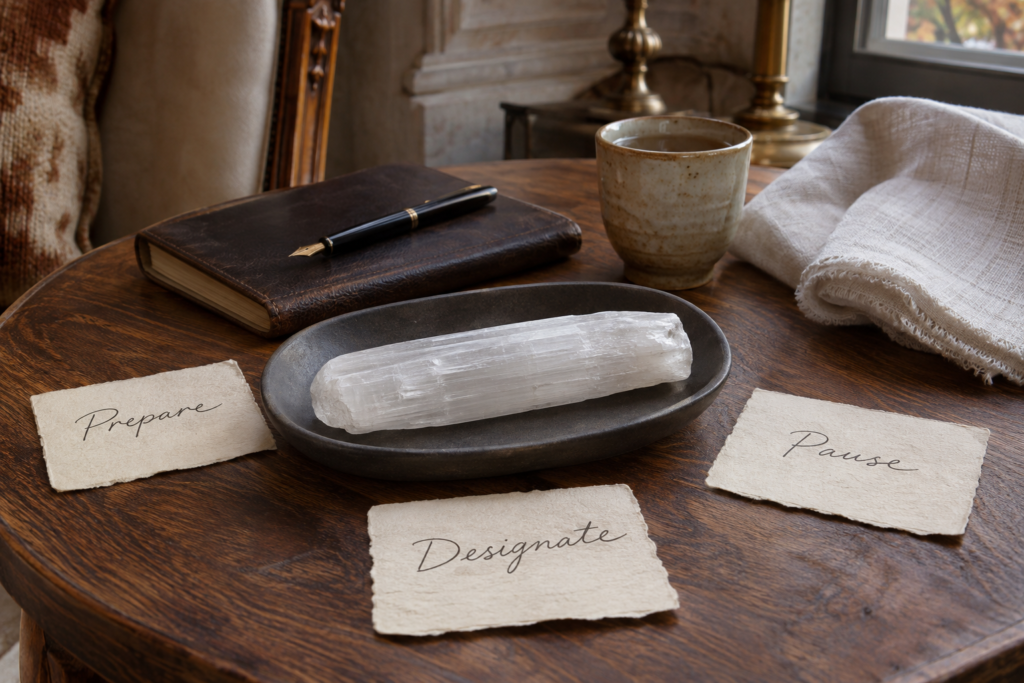
A simple symbolic arrangement can be created using one Selenite stone and three small paper cards.
Write one word on each card:
Prepare
Designate
Pause
Place the Selenite in the centre.
Arrange the cards around it.
The arrangement represents the stages of the ritual.
It does not generate a measurable cleansing field.
No additional gemstones are necessary.
Why a Sacred Space Does Not Need to Be Elaborate
Contemporary spiritual imagery sometimes presents meditation spaces filled with candles, incense, elaborate decorations and large gemstone collections.
Such arrangements may be personally meaningful to some practitioners.
However, they are not necessary.
A small table and comfortable chair may be sufficient.
A quiet corner may be more practical than a dedicated room.
And an ordinary notebook may be more useful than an elaborate display.
The Sacred Space Ritual does not require expensive objects.
It does not suggest that spiritual significance increases with the number of gemstones.
The purpose is to establish a personally meaningful use for the space.
Respecting Shared Spaces
Not everyone has a private room.
Some people share living spaces with family members, partners or housemates.
Others have limited space or changing schedules.
The ritual should respect these circumstances.
A shared table may be used temporarily.
A small tray may hold the objects needed for reflection.
And the arrangement can be put away afterward.
A personal sanctuary does not need to become a permanent installation.
Nor should it interfere with another person’s use of the space.
Consent and practical cooperation matter.
A Five-Minute Selenite Space Ritual
For a shorter version, choose a small stable surface.
Remove one unnecessary distraction.
Place the Selenite securely.
Identify the purpose of the space.
Spend a few minutes reading, reflecting or sitting quietly.
Then return the area to its usual condition if necessary.
The exercise does not need to be repeated daily.
And repetition does not increase the gemstone’s supernatural power.
Its meaning lies in the intentional preparation of the environment.
An Alternative Without a Gemstone
The same exercise can be completed without Selenite.
A small ceramic object.
A familiar book.
A photograph.
Or an ordinary notebook may serve as the symbolic marker.
The practical principles remain unchanged.
Prepare.
Designate.
Pause.
This matters because the exercise does not depend on a scientifically demonstrated gemstone effect.
Selenite is included because of its contemporary spiritual association with purification and clarity.
It is not a necessary therapeutic instrument.
Responsible Use of Selenite
Selenite should be handled with appropriate care.
Keep the stone dry and place it on a secure surface.
Avoid unnecessary contact with water or cleaning liquids.
Do not use the gemstone as a substitute for ordinary cleaning or environmental safety measures.
Avoid placing fragile specimens where they could fall or break.
Keep small fragments away from young children who might put them in their mouths.
A symbolic ritual does not require a large gemstone collection.
One specimen is sufficient.
There is no need to purchase additional crystals to strengthen the intention.
What Scientific Research Does Not Establish
Religious studies document diverse traditions involving sacred spaces and ritual purification.
Environmental health research examines indoor air quality, ventilation and practical cleaning methods.
Psychological research has investigated meditation, attention and environmental influences on behaviour.
However, these fields address different questions.
They do not establish that Selenite removes negative energy.
They do not demonstrate that the gemstone purifies indoor air through supernatural vibrations.
They do not prove that it balances anatomical chakra centres.
And they do not validate the Sacred Space Ritual as a clinical intervention.
The exercise is an original contemporary symbolic practice.
Its meaning depends on the participant’s interpretation.
Final Reflection: Creating Meaning Through Intention
Selenite cannot cleanse a room through scientifically demonstrated supernatural energy.
It cannot remove airborne pollutants.
It cannot guarantee spiritual clarity.
And it cannot replace appropriate cleaning, ventilation or healthcare.
Yet within contemporary crystal spirituality, its association with purification offers a meaningful symbolic starting point.
The Sacred Space Ritual explores a different understanding of cleansing.
Not the removal of invisible negative vibrations.
But the deliberate preparation of a place for a chosen activity.
A room does not need to be elaborate.
A ritual does not need to be complicated.
And a meaningful personal space does not require expensive objects.
Sometimes, a comfortable chair, a clear surface and a few uninterrupted minutes are enough.
The Selenite represents the intention.
The practical preparation supports the activity.
And the meaning belongs to the participant.
A personal sanctuary does not need to be separate from ordinary life.
It can begin when an ordinary space is given a clear and meaningful purpose.
References & Further Reading
The following sources provide historical, religious, environmental and health-education context for sacred spaces, purification practices, indoor environments and contemplative activities.
All references lead to informative, non-commercial resources from encyclopedic institutions, government agencies or established educational organisations.
None establishes supernatural cleansing, protective or chakra-balancing properties of Selenite.
1. Encyclopaedia Britannica – Sacred
Institution: Encyclopaedia Britannica
Type: Encyclopedic religious-studies reference
This resource introduces the concept of the sacred in religious and cultural contexts.
It provides background for understanding how spaces, objects and activities may acquire religious significance.
The source does not document modern Selenite cleansing rituals.
Direct source:
https://www.britannica.com/topic/sacred
2. Encyclopaedia Britannica – Purification Rite
Institution: Encyclopaedia Britannica
Type: Encyclopedic anthropology and religious-studies reference
This resource explains purification rites and their roles within different religious traditions.
It provides context for distinguishing historical religious purification from contemporary crystal-energy beliefs.
Direct source:
https://www.britannica.com/topic/purification-rite
3. Encyclopaedia Britannica – Wudu
Institution: Encyclopaedia Britannica
Type: Encyclopedic Islamic-studies reference
This resource explains wudu, the Islamic practice of ritual washing associated with prayer.
It illustrates how purification may have specific religious meanings and prescribed practices.
It should not be equated with modern gemstone cleansing.
Direct source:
https://www.britannica.com/topic/wudu
4. United States Environmental Protection Agency – Improving Indoor Air Quality
Institution: US Environmental Protection Agency
Type: Government environmental health education
This resource explains practical approaches to indoor air quality, including source control, ventilation and other environmental measures.
It supports the distinction between physical environmental management and unverified supernatural cleansing claims.
Direct source:
https://www.epa.gov/indoor-air-quality-iaq/improving-indoor-air-quality
5. National Center for Complementary and Integrative Health – Meditation and Mindfulness: Effectiveness and Safety
Institution: US National Institutes of Health
Type: Government evidence-based health education
This resource reviews research into meditation and mindfulness, including potential benefits, methodological limitations and possible adverse experiences.
It provides context for distinguishing optional contemplative exercises from established clinical interventions.
Direct source:
https://www.nccih.nih.gov/health/meditation-and-mindfulness-effectiveness-and-safety
Educational and Scientific Clarification
Selenite’s associations with energetic cleansing, purification, spiritual clarity, protection and the crown chakra belong to contemporary crystal spirituality.
These interpretations are not scientifically established therapeutic or supernatural properties.
There is no reliable evidence that Selenite removes negative energy, purifies indoor air through crystal vibrations, creates protective fields, improves spiritual awareness through gemstone energy or balances anatomical chakra centres.
The Sacred Space Ritual described in this article is an original contemporary symbolic exercise.
It is not a historically documented ancient ceremony.
It is not a clinically validated psychological intervention.
And it is not a substitute for professional healthcare, counselling or evidence-based treatment.
Research into sacred spaces, purification traditions, indoor environmental quality and meditation does not establish additional benefits from Selenite.
Participation should remain voluntary, flexible and appropriate to individual circumstances.
Gemstones and symbolic rituals should never replace appropriate medical treatment, psychological support or professional assistance.