A single crystal can become the focus of a personal ritual.
Several crystals arranged deliberately around a central intention can become something different: a crystal grid.
Within contemporary crystal practice, grids combine stones, geometry, symbolism and intention into one physical arrangement. Some are created for meditation. Others are built around themes such as grounding, protection, abundance, creativity or spiritual reflection.
And some are created around perhaps the most universal intention of all:
love.
For a heart-centred Rose Quartz crystal grid, Rose Quartz is one of the most frequently chosen stones.
Its soft pink appearance has become deeply connected within modern crystal traditions with love, compassion, emotional openness and self-love. Because of these associations, Rose Quartz can be particularly suitable as the center stone of a crystal grid designed for self-compassion and heart-centred meditation.
Using a Rose Quartz crystal grid can enhance the energy of love and compassion in your space.
The process does not need to be complicated.
A handful of stones, a quiet surface and a clearly chosen intention are enough to begin.
Table of Contents
What Is a Crystal Grid?
A crystal grid is an intentional arrangement of crystals around a central purpose.
Unlike carrying a pocket stone, where the practice travels with you, a grid normally remains in one place for a period of time.
It might be created on:
- a small table
- a meditation altar
- a wooden grid board
- a piece of natural fabric
- a bedside surface
- a dedicated corner of a room
Some practitioners use elaborate geometric templates.
Others simply arrange stones intuitively in circles, lines or symmetrical patterns.
The physical arrangement matters because creating the grid itself becomes part of the ritual.
You choose the stones.
You choose the centre.
You decide where each piece belongs.
And throughout that process, you repeatedly return to the intention behind the arrangement.
In contemporary metaphysical practice, crystals are often described as interacting energetically within such arrangements. Energy Muse, for example, describes center stones as focal points within crystal-grid work and recommends consciously placing surrounding stones while holding the chosen intention in mind.
For someone approaching crystal grids from a more contemplative perspective, the arrangement can also be understood as a physical representation of an intention.
Either way, the grid provides a visible place to return to.
Why Rose Quartz?
Few crystals are as closely associated with the symbolism of love as Rose Quartz.
Within contemporary crystal traditions, it is commonly called a stone of unconditional love and is associated with:
- self-love
- compassion
- tenderness
- emotional openness
- forgiveness
- relationships
- peaceful reflection
- heart-centred meditation
The Crystal Council describes Rose Quartz primarily through themes of love, compassion, peace and emotional nourishment and specifically discusses using the stone during meditation.
Energy Muse similarly associates Rose Quartz with love and self-love practices and recommends placing the stone over the heart as part of a personal crystal ritual.
Tiny Rituals connects Rose Quartz with the Heart Chakra and frequently recommends it for meditation, intention work, sacred spaces and crystal grids.
These are spiritual and metaphysical interpretations, rather than scientifically established properties of the mineral.
Within the tradition itself, however, the symbolism is remarkably coherent.
Rose Quartz represents the heart.
That makes it an intuitive starting point for a grid centred on self-love.
The Importance of the Center Stone
Look at almost any crystal grid and your attention naturally moves toward its centre.
That is precisely why the central crystal matters.
Within crystal-grid traditions, the center stone is often treated as the energetic and symbolic anchor of the arrangement.
It represents the primary intention.
The surrounding stones then reinforce, expand or complement that theme.
For a self-love grid, the center stone might therefore be:
one larger Rose Quartz palm stone
a polished Rose Quartz sphere
a Rose Quartz tower
a Rose Quartz heart
or simply:
a particularly meaningful piece of Rose Quartz from your own collection.
The stone does not need to be the largest or most expensive crystal you own.
Its importance comes from the role you assign to it.
If one particular Rose Quartz already has personal significance, that may make it a far more meaningful center stone than a visually perfect specimen with which you have no connection.
Choosing an Intention Before Building the Grid
Before arranging any crystals, decide what the grid represents.
“Love” is beautiful, but it is also extremely broad.
A more focused intention can make the ritual feel considerably more personal.
For example:
I choose to treat myself with greater compassion.
Or:
I allow myself to receive the same kindness I offer others.
Perhaps:
I create space for peaceful and honest relationships.
Or simply:
I am worthy of love and kindness.
There is no universal formula.
The intention should mean something to you.
Write it on a small piece of paper.
Then place that paper underneath the center stone.
This simple act gives the physical arrangement a clear purpose.
The crystals now surround something specific rather than an abstract idea.
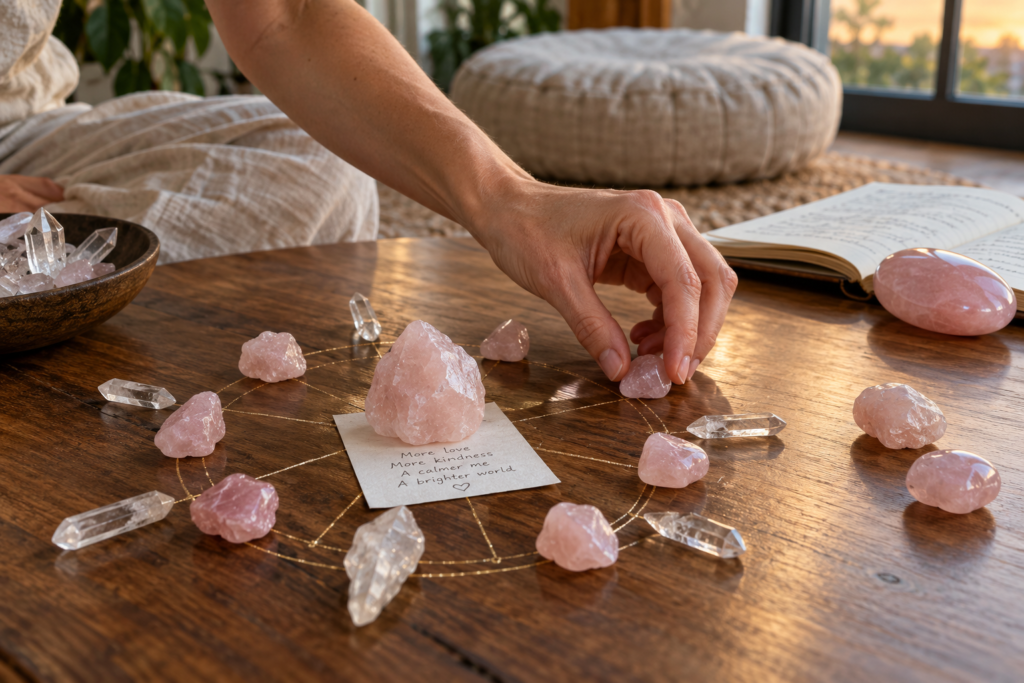
Building a Simple Rose Quartz Crystal Grid
You do not need dozens of crystals to create your first grid.
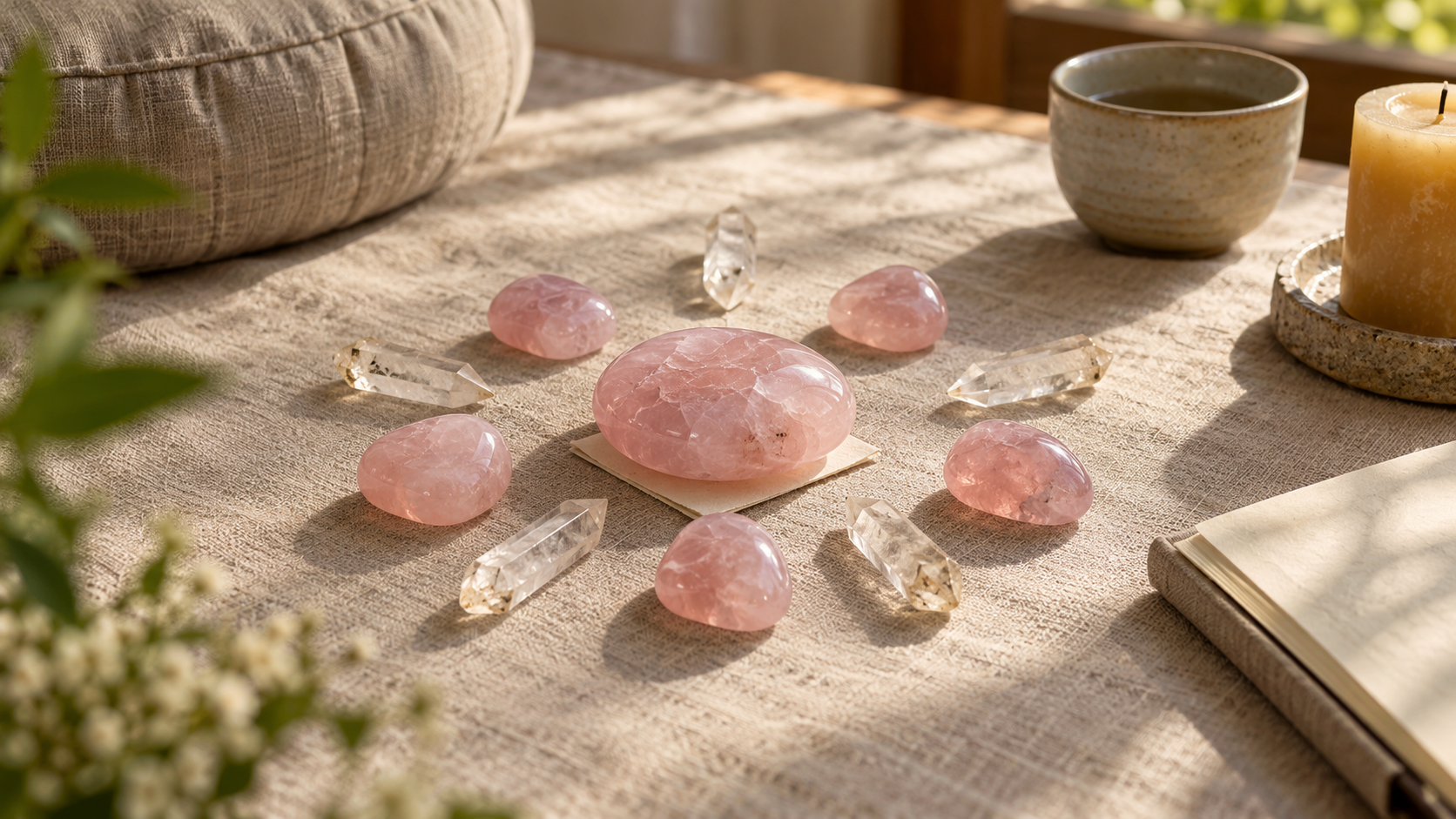
A simple arrangement can begin with:
- 1 Rose Quartz center stone
- 6 smaller Rose Quartz stones
- 6 Clear Quartz points or small polished stones
This creates a compact thirteen-stone layout.
If you do not own Clear Quartz, the entire grid can also be made from Rose Quartz.
The purpose is not to follow an inflexible recipe.
It is to create an arrangement that visually and symbolically supports your intention.
Step 1 — Choose a Quiet Place
Select somewhere the grid can remain undisturbed.
This might be beside your meditation cushion, on a small altar, on a dresser or in another quiet area of your home.
Try not to place it somewhere where stones constantly need to be moved.
Part of the value of a grid is its continuity.
You can return to the same arrangement tomorrow.
And the next day.
The physical space becomes associated with the practice.
Step 2 — Place Your Written Intention
Fold your written intention once and place it in the centre of the space.
You do not need to show it to anyone.
It can remain private.
In fact, a deeply personal sentence often works better than something written because it sounds impressive.
The grid belongs to you.
Step 3 — Place the Rose Quartz Center Stone
Place your chosen Rose Quartz directly over the written intention.
Pause here.
Do not immediately begin placing all the other crystals.
Hold the center stone first.
Take several slow breaths.
Think about the intention underneath it.
Then place the Rose Quartz down deliberately.
This becomes the heart of the grid.
Why Rose Quartz Works So Naturally as a Center Stone
Within crystal symbolism, the centre of a grid is often understood as the point from which the primary intention radiates outward.
Rose Quartz fits this position particularly well when the intention concerns compassion or love.
The Crystal Council associates Rose Quartz with awakening the heart toward love for oneself and others and with qualities such as compassion, peace and tenderness.
Tiny Rituals similarly presents Rose Quartz shapes as tools for Heart Chakra meditation, intention setting and grid work.
When Rose Quartz occupies the centre, every surrounding stone visually points back toward that central theme.
The heart remains the focus.
Step 4 — Create the First Circle
Arrange six smaller Rose Quartz stones around the center stone.
Do not worry about measuring the distances perfectly.
A roughly even arrangement is sufficient.
As you place each stone, you can mentally associate it with one aspect of self-love.
For example:
Compassion
Place the first stone.
Patience
Place the second.
Forgiveness
Place the third.
Acceptance
Place the fourth.
Kindness
Place the fifth.
Openness
Place the sixth.
Now the grid contains more than crystals.
It contains six deliberate ideas surrounding one central intention.
Step 5 — Add Clear Quartz as an Outer Layer
Clear Quartz is frequently used in contemporary crystal-grid traditions as an amplifying or supporting stone.
Energy Muse, for example, describes Clear Quartz as an intention amplifier and specifically recommends Clear Quartz forms for strengthening grid work.
Place six small Clear Quartz stones outside the Rose Quartz circle.
If they are points, many practitioners position the points outward when symbolically sending an intention into the surrounding space.
Alternatively, points can face inward when the practice is intended to draw attention toward the centre.
There is no universally accepted rule.
For this self-love grid, inward-facing points can be particularly meaningful.
They visually return everything toward the Rose Quartz centre.
The Finished Pattern
You now have three layers:
Centre:
Rose Quartz + written intention
Inner circle:
Six Rose Quartz stones representing aspects of self-love
Outer circle:
Six Clear Quartz stones supporting the central intention
Look at the arrangement before doing anything else.
Notice the geometry.
Notice the repetition.
Notice how your eye moves naturally toward the centre.
That visual focus is part of what makes crystal grids interesting meditation objects.
Activating the Grid
The word activation is frequently used within crystal-grid traditions.
It should not be understood as switching on a scientifically measurable field.
Rather, within spiritual practice it describes the moment when the practitioner consciously dedicates the completed arrangement to its intended purpose.
Sit in front of your grid.
Place your hands comfortably on your knees.
Take several slow breaths.
Then repeat your intention.
You can say it aloud or silently.
For example:
I choose to treat myself with compassion, patience and kindness.
Look at the center Rose Quartz as you repeat it.
Then allow your eyes to travel around the surrounding stones.
Return your attention to the centre.
The grid is now complete.
Using the Grid for Heart-Centred Meditation
A crystal grid becomes much more meaningful when it is actually used rather than simply displayed.
Sit comfortably in front of the arrangement.
Allow your breathing to settle.
Begin by looking at the central Rose Quartz.
Then close your eyes.
Bring your attention toward the centre of your chest.
Within modern chakra traditions, Rose Quartz is strongly associated with the Heart Chakra, often referred to by its Sanskrit name Anahata.
The Heart Chakra is traditionally connected with themes such as love, compassion, emotional openness and connection.
During meditation, you might imagine each breath creating more space around the heart.
You do not need to visualise coloured light or complicated energetic movements unless those practices appeal to you.
The meditation can remain very simple:
inhale — receive
exhale — soften
If your attention wanders, open your eyes briefly and look again at the center stone.
Then close them and continue.
In this way, the crystal grid becomes a visual meditation anchor.
Adding a Rose Quartz Palm Stone to the Practice
There is another way to deepen the ritual without changing the grid itself.
Keep one Rose Quartz palm stone separate from the arrangement.
When you sit down to meditate, hold this stone in your hands while facing the grid.
The smooth surface gives your hands something tangible to rest upon.
Tiny Rituals describes Rose Quartz palm stones as suitable for meditation, intention setting and Heart Chakra-oriented practices.
After meditation, return the palm stone beside the grid.
The next time you practise, use the same stone.
Over time, this creates a relationship between three elements:
the place
the grid
the stone in your hands
Repetition is what transforms the arrangement into a ritual.
Can Other Stones Be Added?
Absolutely.
Once the basic grid feels familiar, other crystals can be introduced according to the intention you want to explore.
For example, within contemporary crystal traditions:
Green Aventurine is often associated with emotional renewal and the Heart Chakra.
Rhodonite is frequently connected with compassion and forgiveness.
Amazonite is often used where emotional honesty and communication are part of the intention.
Moonstone may be incorporated into practices centred on emotional reflection and intuition.
Clear Quartz is commonly used to reinforce or amplify the central intention.
But more stones do not automatically create a better grid.
There is something powerful about visual simplicity.
If the intention is self-love, a Rose Quartz-dominated arrangement makes that intention immediately understandable every time you look at it.
Where Should You Keep the Grid?
Choose somewhere connected with the practice you want to develop.
A grid beside your meditation area encourages meditation.
A grid beside a journal can become part of reflective writing.
A grid near your bed may become part of an evening gratitude ritual.
A grid in a private corner can simply become a visual reminder to treat yourself more gently.
The location should make sense for the intention.
It does not need to be visible to visitors.
Crystal practice can be completely personal.
How Long Should a Crystal Grid Remain in Place?
There is no universal requirement.
Some contemporary practitioners maintain a grid for a particular number of days, while others leave it intact until they feel the intention has changed or the practice has naturally reached an end.
A useful approach is to avoid choosing an arbitrary duration.
Instead, ask:
Does this intention still matter to me?
If the answer is yes, continue working with the grid.
If the intention has changed, dismantle it consciously.
Remove each stone.
Fold or safely dispose of the written intention.
Clean the surface.
Then allow some time before creating another arrangement.
This gives the end of the ritual as much attention as its beginning.
A Crystal Grid Is More Than Decoration
A beautifully arranged group of crystals can certainly be decorative.
But within spiritual practice, its deeper value comes from interaction.
You built it deliberately.
You chose its centre.
You selected an intention.
You returned to it during meditation.
Perhaps you held the same Rose Quartz palm stone each time.
Eventually, seeing the grid itself can become a reminder of the commitment represented by it.
That is one of the most interesting aspects of working with physical objects in personal ritual.
They make something invisible visible.
An intention cannot normally be placed on a table.
But a crystal grid can.
Beginning With the Heart
Crystal practice can easily become complicated.
There are hundreds of stones, countless suggested correspondences and increasingly elaborate combinations.
But a meaningful practice does not require complexity.
One Rose Quartz.
Six surrounding stones.
One sentence written on paper.
Ten quiet minutes.
That is enough.
The symbolism of Rose Quartz gives the grid its language.
The arrangement gives the intention a physical form.
Meditation gives you time to engage with it.
And repetition gives the ritual personal meaning.
Whether you understand crystal grids primarily as energetic arrangements, symbolic spiritual tools or simply beautiful structures for focused intention, their value lies in the conscious relationship between the person, the stones and the purpose behind them.
At the centre of this particular grid sits Rose Quartz.
And at the centre of the practice sits something even simpler:
the decision to extend compassion inward as readily as we offer it to others.
The energetic, chakra and healing language discussed in this article reflects contemporary crystal traditions, metaphysical practices and personal spiritual beliefs. These interpretations are not presented as scientifically established medical effects, and crystal practices should not replace appropriate professional healthcare.