There is a difference between having nothing to do and deliberately choosing to do something slowly.
A person may have an entire afternoon free yet spend it moving restlessly between messages, household tasks and unfinished plans. Another may have only ten minutes available but use those minutes to complete one ordinary activity without rushing.
The difference is not necessarily the amount of available time.
It is the manner in which that time is experienced.
Within contemporary crystal spirituality, Howlite is frequently associated with patience, calmness, emotional restraint and the desire to slow down.
Some practitioners believe it quiets restless energy, encourages patience or helps establish a peaceful state of mind. Others carry Howlite as a pocket stone, hold a polished specimen during reflection or place it beside objects associated with contemplative activities.
These interpretations are spiritual beliefs rather than scientifically established therapeutic effects.
There is no reliable evidence that Howlite slows neurological activity through gemstone vibrations, treats anxiety or transmits calming energy into the body.
Nevertheless, a gemstone can serve as a personally meaningful symbol.
This article explores the relationship between Howlite’s contemporary spiritual associations, the philosophy of slow living and the practical experience of deliberately reducing the pace of an ordinary activity, specifically through a howlite mindful slowness ritual.
It also introduces an original exercise: the Howlite Mindful Slowness Practice.
This practice is often referred to as the howlite mindful slowness ritual and emphasizes the importance of taking time to engage with the present moment.
The intention is not to escape responsibilities or achieve a permanently peaceful emotional state.
It is to explore what happens when an everyday action is performed without unnecessary haste.
Table of Contents
Howlite in Contemporary Crystal Spirituality
Howlite is commonly described in modern crystal traditions as a stone associated with patience, tranquillity and self-restraint.
Some practitioners believe it helps calm an overactive mind, reduces impatience or encourages a more measured response to daily experiences.
Others associate it with peaceful contemplation or the symbolic release of unnecessary urgency.
These interpretations vary between spiritual communities and individual practitioners.
They should not automatically be presented as universal ancient teachings.
Howlite’s modern spiritual reputation is distinct from the long historical development of contemplative practices in religious and philosophical traditions.
For the exercise described here, Howlite represents one intention:
To experience an ordinary activity without treating speed as its principal measure of success.
The gemstone does not produce patience through supernatural energy.
Its role is symbolic.
Why Slowness Is Not the Same as Inactivity
Slowness is sometimes confused with passivity.
However, an activity can be performed slowly while remaining purposeful and productive.
A craftsperson may deliberately slow down when completing a delicate task.
A musician may practise a passage at a reduced tempo to develop precision.
A person preparing food may choose to work carefully rather than hurriedly.
In each case, slowness can be part of the activity rather than an interruption of it.
This distinction matters because contemporary discussions of wellbeing sometimes present slowing down as a universal solution to modern difficulties.
It is not.
Some situations require rapid decisions or immediate action.
Other circumstances involve responsibilities that cannot simply be postponed.
A mindful slowness practice should therefore be understood as a limited, voluntary exercise rather than a prescription for every aspect of life.
The Philosophy of Slow Living
The modern slow-living movement is often associated with broader cultural responses to accelerated lifestyles, standardisation and the expectation of constant efficiency.
The Slow Food movement, which developed in Italy during the 1980s, became an influential example of this approach.
Its emphasis on food culture, regional traditions and the social experience of eating contributed to wider discussions about the pace and quality of everyday life.
Over time, ideas associated with slowing down appeared in discussions of travel, education, craftsmanship and personal routines.
However, slow living is not a single ancient spiritual tradition.
It is a contemporary cultural concept with diverse interpretations.
Nor does it require a person to reject technology, employment or modern responsibilities.
For some individuals, deliberate slowness simply means allowing sufficient attention for a particular activity.
The Howlite practice described here draws on that limited principle.
It does not claim that the Slow Food movement historically used Howlite or promoted gemstone rituals.
Contemplative Traditions and Everyday Activities
Many religious and philosophical traditions have developed practices involving deliberate attention to ordinary actions.
Within Buddhist contemplative traditions, mindfulness can involve awareness of bodily activity, posture and changing experiences.
The Satipaṭṭhāna Sutta, for example, includes instructions concerning awareness in everyday activities.
These teachings belong to particular historical and religious contexts.
They should not be reduced to a modern productivity technique.
Nor should they be presented as evidence that Buddhist practitioners traditionally used Howlite.
The Howlite Mindful Slowness Practice is a contemporary adaptation inspired by the broad idea of bringing attention to ordinary actions.
It is not a reconstruction of a Buddhist ritual.
The Difference Between Mindfulness and Relaxation
Mindfulness and relaxation are sometimes treated as interchangeable.
However, they are not identical.
Mindfulness generally involves awareness of present experience, while relaxation refers to a reduction in tension or arousal.
A person may practise mindful attention while experiencing discomfort, uncertainty or frustration.
Likewise, someone may feel relaxed without deliberately practising mindfulness.
This distinction is important for responsible crystal spirituality.
A Howlite ritual should not promise that participants will feel calm.
Its purpose is to explore deliberate attention and pace.
A peaceful feeling may occur, but it is not a required outcome.
Why Ordinary Activities Can Become Meaningful
Everyday actions often receive little conscious consideration.
Folding fabric, arranging a table or preparing a drink may be performed automatically while attention is directed elsewhere.
Yet ordinary activities can acquire personal significance through the manner in which they are approached.
A familiar activity may be connected with family traditions, craftsmanship or a sense of continuity.
A simple task can also provide an opportunity to notice details that are usually overlooked.
This does not mean that every ordinary action should become a spiritual ceremony.
Nor does it establish that mindful attention always improves wellbeing.
It suggests only that the experience of an activity may differ according to how it is performed.
The Howlite practice explores this possibility without requiring supernatural explanations.
Introducing the Howlite Mindful Slowness Practice
The following exercise is an original contemporary symbolic practice.
It is not a historically documented ancient Howlite ceremony.
It is not a clinically validated treatment.
And it does not require belief in gemstone energy.
Allow approximately ten to fifteen minutes.
You will need one Howlite palm stone, pocket stone or small polished specimen.
Choose one safe, ordinary activity that can be performed without unnecessary urgency.
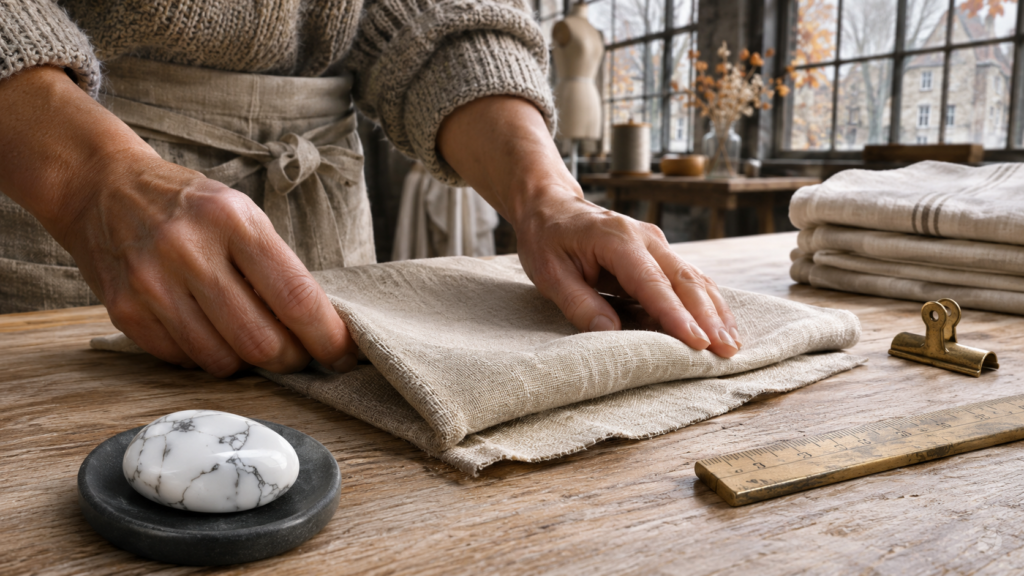
Suitable examples include folding clean linen, arranging a small collection of books or preparing a simple non-hazardous workspace.
The exercise follows four principles:
Choose. Notice. Slow. Complete.
Stage One – Choosing an Ordinary Activity
Select one manageable task.
It should be familiar enough that you do not need complicated instructions.
Avoid activities involving sharp tools, hot surfaces, driving or other situations where deliberately slowing down or dividing attention could create hazards.
The purpose is not to make an activity difficult.
It is to examine the pace at which you normally perform it.
Stage Two – Placing the Howlite
Place the Howlite on a stable surface near the chosen activity.
A small ceramic dish or wooden tray may be suitable.
Some contemporary practitioners believe Howlite emits calming energy or encourages patience.
These claims have not been scientifically demonstrated.
For this exercise, the gemstone represents the intention to proceed without unnecessary haste.
It does not need moonlight, incense, water or energetic activation.
Stage Three – Recognising the Usual Pace
Before beginning, consider how you would ordinarily complete the task.
Would you rush?
Would you attempt several activities simultaneously?
Would you become impatient if the task took longer than expected?
There is no need to criticise these habits.
The purpose is simply to recognise them.
Stage Four – Beginning Deliberately
Start the chosen activity.
Use a comfortable, natural pace.
Avoid deliberately exaggerating every movement.
The exercise is not intended to create artificial slowness.
Instead, allow enough time to perform each action attentively.
If folding linen, notice how the fabric is arranged.
If organising books, consider where each volume belongs.
The task remains practical.
Stage Five – Noticing the Impulse to Hurry
During the activity, you may notice an impulse to finish quickly.
Perhaps another task comes to mind.
Maybe you feel tempted to check a device.
Or you become impatient with the repetition.
These experiences are ordinary.
There is no requirement to eliminate them.
Simply recognise the impulse and decide whether it needs immediate attention.
The Howlite does not control these reactions through supernatural energy.
Stage Six – Allowing an Unhurried Rhythm
Continue the activity at a sustainable pace.
Avoid turning the exercise into a competition to see how slowly you can move.
Excessive slowness is not inherently beneficial.
The aim is to reduce unnecessary haste while maintaining the practical purpose of the task.
If the activity naturally requires a faster pace, respond appropriately.
Stage Seven – Completing the Task
Finish the activity.
Return the materials to their appropriate places.
There is no requirement to feel peaceful or transformed.
The task may have been pleasant, ordinary or mildly frustrating.
All are possible experiences.
Stage Eight – Reflecting on the Experience
Consider three questions:
Did I notice an impulse to hurry?
Did slowing down change how I approached the task?
Was the slower pace useful, unnecessary or inconvenient?
There is no correct answer.
The exercise is intended to encourage observation rather than produce a predetermined result.
The Howlite remains a symbolic companion.
Howlite as a Palm Stone for Intentional Pauses
Some contemporary crystal practitioners hold Howlite during meditation because they believe it encourages patience or emotional calm.
These effects have not been scientifically established.
A polished palm stone may nevertheless function as a personal reminder.
For example, someone might hold the stone briefly before beginning a routine activity and consider whether rushing is necessary.
The gemstone does not regulate the nervous system through supernatural energy.
Its significance depends on the intention assigned to it.
Howlite and Contemporary Chakra Associations
Howlite is sometimes associated with the crown chakra in modern crystal spirituality.
Other practitioners connect it with emotional balance or meditative awareness without assigning it to a specific chakra.
These interpretations are not universal.
Historical South Asian chakra traditions developed within diverse religious and philosophical contexts.
Modern gemstone-to-chakra correspondences should not automatically be presented as ancient teachings.
There is no reliable biomedical evidence that Howlite activates anatomical chakra centres or alters consciousness through chakra energy.
The mindful slowness exercise does not require any chakra interpretation.
A Howlite Centre Stone for a Simple Reflection Arrangement
Contemporary crystal-grid practices sometimes use Howlite in arrangements intended to represent calmness or patience.
Some practitioners believe surrounding gemstones amplify its energetic influence.
These supernatural claims have not been scientifically demonstrated.
A simple symbolic arrangement can be created with one Howlite stone and a folded piece of linen.
Place the gemstone on a small wooden surface.
Beside it, position an ordinary object associated with the activity you intend to perform.
For example, a book may represent unhurried reading.
A folded cloth may represent deliberate attention to household tasks.
The arrangement does not generate a measurable energetic field.
Its meaning is personal.
No additional gemstones are necessary.
A Three-Minute Howlite Practice
For a shorter variation, place Howlite beside a familiar object.
Choose one small task.
Complete it at a comfortable pace without deliberately multitasking.
When finished, consider whether the pace was appropriate.
The exercise is complete.
There is no need to repeat it until a particular feeling of tranquillity appears.
When Slowness Is Not Helpful
Deliberate slowness is not appropriate in every situation.
Emergencies require timely responses.
Some professional tasks involve strict safety procedures or time-sensitive responsibilities.
A person should not delay essential activities to complete a gemstone ritual.
Likewise, someone experiencing significant psychological distress should not rely on Howlite as a treatment.
The practice is intended as a voluntary reflection exercise.
It does not replace professional healthcare or practical support.
An Alternative Without Howlite
The same exercise can be completed without a gemstone.
A familiar keepsake, ordinary household object or written reminder may serve as the symbolic cue.
No object is necessary.
The essential principles remain unchanged:
Choose a suitable activity.
Notice the usual pace.
Proceed without unnecessary haste.
Reflect on the experience.
Howlite is included because of its contemporary spiritual association with patience and calmness.
It is not a necessary therapeutic instrument.
Responsible Use of Howlite
One gemstone is sufficient.
There is no need to purchase additional crystals to strengthen the practice.
Use a stone already owned if available.
Keep small gemstones away from young children who might put them in their mouths.
Position stones securely so they cannot fall or interfere with the activity.
Avoid using gemstones near food preparation surfaces where contamination could occur.
The practice should remain voluntary, practical and appropriate to individual circumstances.
What Scientific Research Does Not Establish
Psychological research has examined mindfulness, attention and aspects of wellbeing.
Cultural research has explored the development of slow-living movements and changing attitudes toward everyday activities.
Religious studies have investigated contemplative traditions involving awareness of ordinary actions.
These fields provide context for understanding deliberate slowness.
However, they do not establish that Howlite emits calming energy.
They do not demonstrate that gemstone vibrations reduce anxiety.
They do not prove that Howlite balances anatomical chakra centres.
And they do not validate the Howlite Mindful Slowness Practice as a clinical intervention.
The exercise is an original contemporary symbolic practice.
Its meaning depends on the participant’s interpretation.
Final Reflection: Slowness Is a Choice, Not a Property of a Stone
Howlite cannot guarantee calmness through scientifically demonstrated crystal energy.
It cannot eliminate impatience.
It cannot replace practical responsibilities.
And it cannot treat psychological or medical conditions.
Yet within contemporary crystal spirituality, its association with patience and tranquillity offers a meaningful symbolic starting point.
The philosophy of slow living invites reflection on the pace of everyday experience.
Contemplative traditions provide historical examples of deliberate attention to ordinary activities.
The Howlite Mindful Slowness Practice offers a modest contemporary interpretation.
It asks participants to choose one ordinary task and perform it without unnecessary haste.
The gemstone represents the intention.
The activity provides the opportunity.
And the experience belongs to the person performing it.
Slowness does not become meaningful because a gemstone contains peaceful energy. It becomes meaningful when we recognise that not every moment needs to be hurried.
References & Further Reading
The following sources provide cultural, historical, psychological and contemplative context for slow living, mindfulness and deliberate attention to everyday activities.
They are institutional, scholarly or educational resources rather than gemstone retailers or commercial crystal-healing websites.
None establishes supernatural calming or chakra-balancing properties of Howlite.
1. Slow Food – Our History
Institution: Slow Food International
Type: Non-profit cultural movement history
This resource explains the origins of the Slow Food movement and its development as a response to standardisation and accelerated food culture.
https://www.slowfood.com/about-us/our-history
2. Satipaṭṭhāna Sutta – Mindfulness Meditation
Source: SuttaCentral
Text: Majjhima Nikāya 10
Type: Early Buddhist primary text in translation
This discourse provides historical context for mindfulness practices, including awareness of bodily activity and ordinary experience.
https://suttacentral.net/mn10/en/sujato
3. Kabat-Zinn – Mindfulness-Based Interventions in Context: Past, Present, and Future
Publication: Clinical Psychology: Science and Practice
Published: 2003
Type: Peer-reviewed scholarly article
This article discusses the development and interpretation of mindfulness-based interventions within contemporary psychological and clinical contexts.
https://doi.org/10.1093/clipsy.bpg016
4. National Center for Complementary and Integrative Health – Meditation and Mindfulness: Effectiveness and Safety
Institution: US National Institutes of Health
Type: Government evidence-based health education
This resource reviews scientific research into meditation and mindfulness, including possible benefits, methodological limitations and adverse experiences.
https://www.nccih.nih.gov/health/meditation-and-mindfulness-effectiveness-and-safety
5. Encyclopaedia Britannica – Mindfulness
Institution: Encyclopaedia Britannica
Type: Encyclopedic psychology and religious-studies reference
This resource introduces mindfulness as a concept with historical roots in contemplative traditions and contemporary applications.
https://www.britannica.com/topic/mindfulness
Educational and Scientific Clarification
Howlite’s associations with patience, calmness, emotional restraint and chakra balance belong to contemporary crystal spirituality.
These interpretations are not scientifically established therapeutic or supernatural properties.
There is no reliable evidence that Howlite emits calming energy, treats anxiety, changes neurological activity through gemstone vibrations or balances anatomical chakra centres.
Mindfulness and contemplative practices have documented historical foundations and have been investigated in psychological research.
However, this research does not establish additional benefits from Howlite.
The Howlite Mindful Slowness Practice described in this article is an original contemporary symbolic exercise.
It is not a historically documented ancient ceremony, a clinically validated treatment or a substitute for professional healthcare.
Participation should remain voluntary, culturally respectful and appropriate to individual circumstances.