Growth rarely follows a perfect schedule in the context of moss agate mindful plant care.
A new leaf may appear after weeks of little visible change.
A plant may flourish during one season and remain almost unchanged during another.
Sometimes, even careful attention to moss agate mindful plant care cannot prevent a leaf from yellowing or a flower from fading.
Within contemporary crystal spirituality, Moss Agate is frequently associated with moss agate mindful plant care, nature, renewal, grounding and personal growth.
Some practitioners believe that it encourages a connection with the Earth, supports emotional balance or attracts the energetic qualities of natural abundance.
Others carry it during outdoor activities or place it near houseplants and garden arrangements.
These interpretations belong to contemporary spiritual belief systems. There is no reliable scientific evidence that Moss Agate transmits healing energy, stimulates plant growth through supernatural forces or directly improves psychological wellbeing.
Nevertheless, a gemstone can serve as a meaningful symbol.
Its appearance may remind someone of a natural landscape. Its presence may encourage reflection on the passing seasons, and its use within a deliberate routine may represent a personal intention.
This article explores a simple contemporary practice of moss agate mindful plant care that brings these ideas together:
The Moss Agate Living-Plant Pause.
Rather than attempting to accelerate growth through crystal energy, the exercise of moss agate mindful plant care encourages something more modest: observing a living plant, understanding its needs and responding with appropriate care.
It offers a different perspective on personal growth.
Not everything needs to happen quickly.
Not every moment requires intervention.
And sometimes, care begins with observation rather than action.
Table of Contents
Moss Agate in Contemporary Crystal Spirituality
Moss Agate is often associated with the natural world in modern gemstone spirituality.
Its distinctive green, landscape-like appearance has inspired symbolic connections with vegetation, forests, gardens and renewal.
Some contemporary practitioners regard it as a stone of growth.
Others associate it with stability, environmental harmony, abundance or the emotional experience of feeling connected to nature.
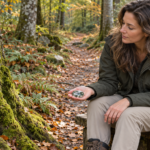
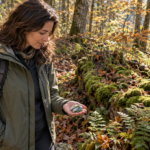
It may be carried as a pocket stone during a walk, held during reflection or positioned within a personal crystal arrangement.
These associations are not universal, and their historical origins should not be exaggerated.
Although stones and natural objects have held spiritual significance in many cultures, this does not establish that the specific modern meanings assigned to Moss Agate represent an uninterrupted ancient tradition.
For the Living-Plant Pause, Moss Agate serves as a symbol of attentive care.
The plant remains a living organism with its own needs.
The gemstone represents the participant’s intention to observe those needs thoughtfully.
The Spiritual Meaning of Growth
Growth is a recurring metaphor in contemporary spirituality.
People speak of personal development, emotional growth, renewal and transformation.
A plant offers an immediately understandable visual comparison.
It requires suitable conditions.
It responds to its environment.
And its development may change according to circumstances.
Yet the comparison has limitations.
Human beings are not plants.
Personal growth does not follow a predictable biological schedule, and psychological wellbeing cannot be measured by the speed of visible progress.
Nevertheless, the metaphor may encourage useful reflection.
A person might consider whether they are allowing sufficient time for learning.
Whether their expectations are realistic.
Or whether a particular situation requires patience rather than additional effort.
Moss Agate’s modern association with nature provides a symbolic starting point for these questions.
It does not establish that the stone itself causes personal transformation.
Why Plant Care Is Different From Manifestation
Some contemporary crystal rituals are based on manifestation.
Practitioners may believe that visualising an outcome or arranging particular gemstones influences external events through universal energy.
Moss Agate is sometimes incorporated into rituals intended to attract prosperity, fertility or new opportunities.
These are spiritual beliefs, not scientifically demonstrated effects.
The Living-Plant Pause follows a different approach.
Its objective is not to attract an outcome.
It is to respond appropriately to something that already exists.
A plant may need water.
It may require more suitable light.
It may need space.
Or it may simply need to be left undisturbed.
The participant’s task is to observe before deciding.
The gemstone symbolises care. The practical action depends on the plant’s actual condition.
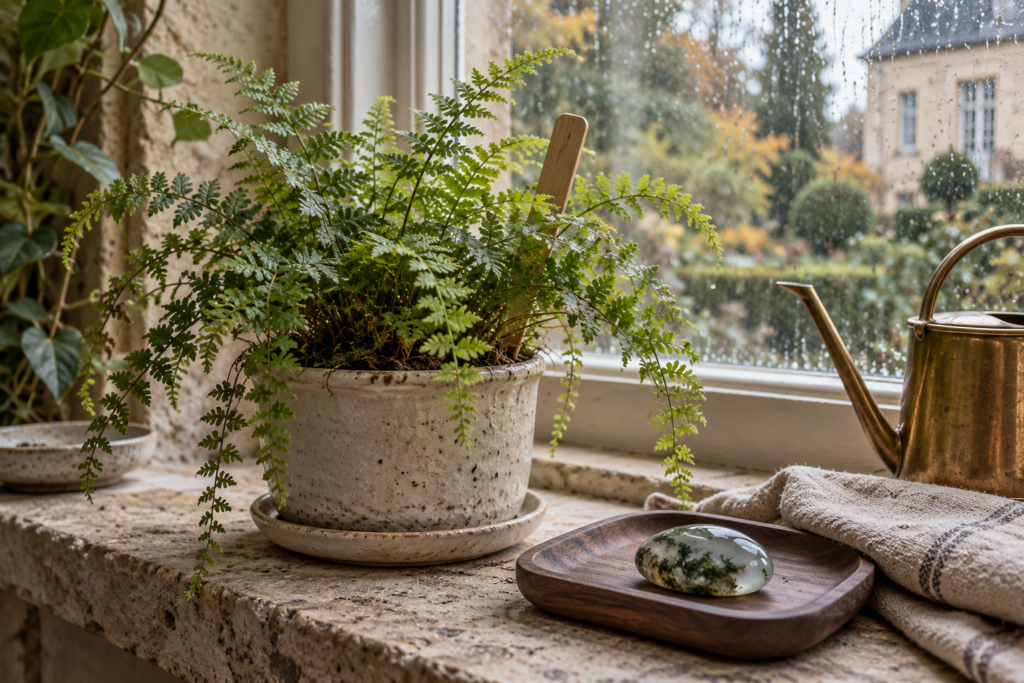
The Relationship Between Nature and Wellbeing
Scientific researchers have investigated how gardening and contact with nature relate to human wellbeing.
A 2017 meta-analysis by Masashi Soga, Kevin Gaston and Yuichi Yamaura examined research into gardening, including horticultural therapy.
The authors reported positive associations between gardening and several health-related outcomes.
However, the included studies differed in design, populations and interventions.
The findings should not be interpreted as proof that every gardening activity produces the same benefits for every individual.
More recent research has continued to examine these questions.
A 2026 systematic review of 47 randomised controlled trials investigated nature-based interventions, including gardening, horticultural therapy, nature walks and other outdoor activities.
Some trials reported significant benefits for mental-health outcomes.
Others reported conditional effects or no clear superiority over comparison activities.
This more nuanced evidence is important.
Nature-based activities may be helpful in certain circumstances, but they should not be presented as universally effective treatments.
And none of this research demonstrates additional therapeutic benefits from Moss Agate.
Nature Connectedness: More Than Being Outdoors
Researchers also use the term nature connectedness to describe a person’s subjective relationship with the natural world.
This may involve emotional attachment, a sense of belonging or the perception that nature forms part of one’s personal identity.
A 2014 meta-analysis examined the relationship between nature connectedness and happiness across 30 samples involving 8,523 participants.
The researchers identified a small but statistically significant positive association.
People reporting stronger connections with nature also tended to report somewhat higher levels of positive affect, vitality and life satisfaction.
However, an association does not establish causation.
The findings do not prove that increasing nature connectedness automatically produces happiness.
Nor do they establish that carrying a gemstone increases nature connectedness.
For the Living-Plant Pause, the research provides a useful educational context.
It encourages consideration of our relationship with living environments without attributing supernatural powers to the gemstone.
Introducing the Moss Agate Living-Plant Pause
The Living-Plant Pause is an original contemporary symbolic practice.
It is not an ancient ceremony.
It is not a recognised clinical intervention.
And it does not require belief in gemstone energy.
The exercise takes approximately ten minutes.
It can be performed beside a houseplant, on a balcony or in a small garden.
You will need:
- One Moss Agate palm stone, tumbled stone or small natural specimen.
- One healthy or reasonably established living plant.
- A clean, stable surface for the gemstone.
- Water and appropriate gardening tools only if the plant actually requires care.
A small potted plant is sufficient.
There is no need to create an elaborate altar or purchase special ritual equipment.
The gemstone should remain separate from the plant’s growing medium.
It does not need to be buried, soaked or placed among the roots.
The purpose is symbolic observation and appropriate plant care.
Stage One – Establishing the Space
Choose a plant that you can observe comfortably.
It might stand on a windowsill.
Perhaps it grows on a balcony.
Or it may be part of a small garden.
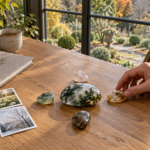
Place the Moss Agate on a nearby dry surface.
A wooden tray, flat stone or small ceramic dish is suitable.
The gemstone should not interfere with drainage, watering or plant growth.
Take a moment to observe the arrangement.
The living plant and the gemstone have different roles.
The plant is the subject of care.
The stone represents the intention to pay attention.
No energetic activation is required.
Stage Two – Observe Before Acting
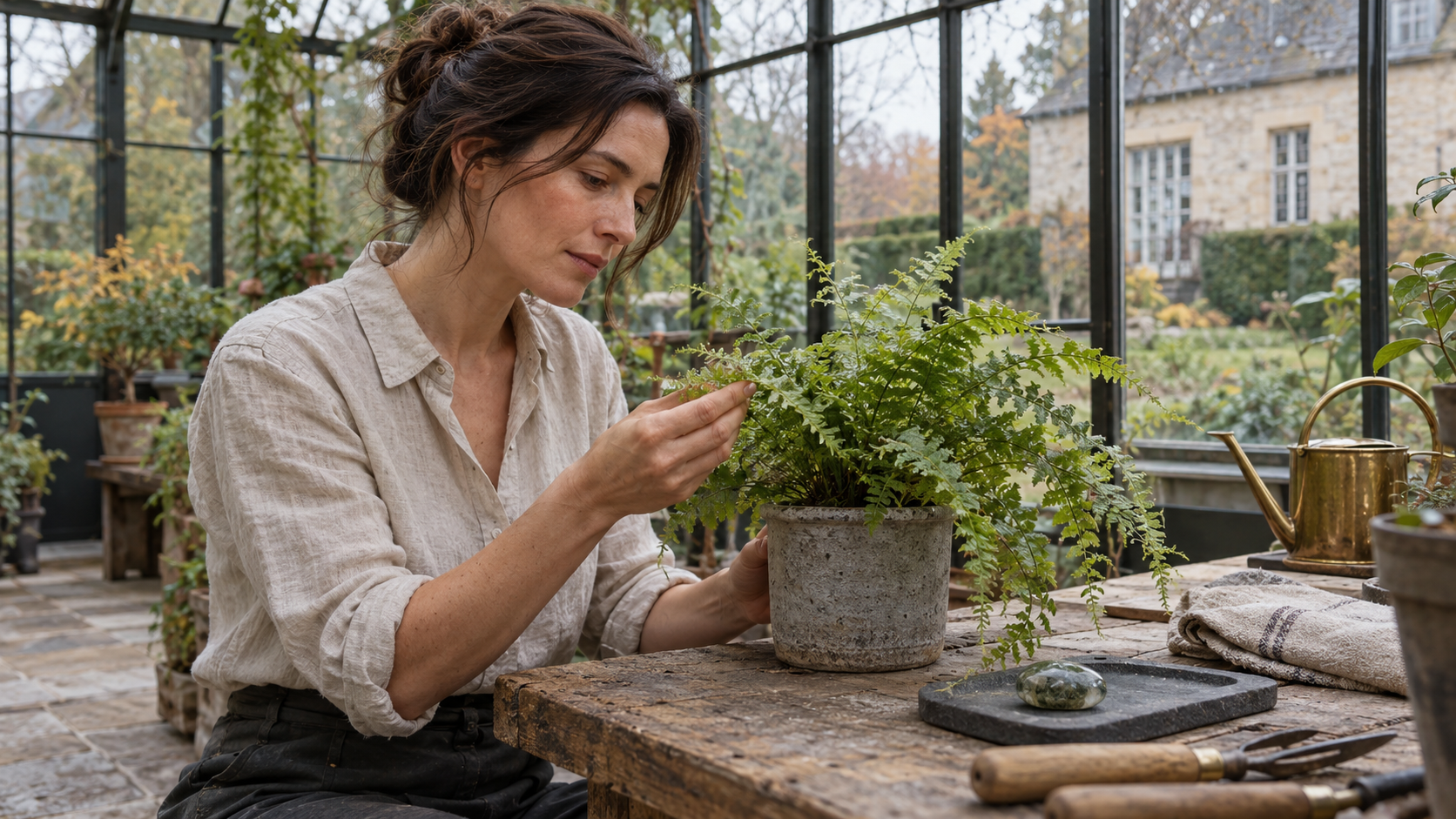
Look carefully at the plant.
Notice the leaves.
Their position.
Their appearance.
The surface of the growing medium.
And the surrounding light.
Avoid immediately assuming that something needs to be changed.
A plant may appear healthy without requiring intervention.
A slightly yellow leaf may be part of ordinary ageing.
A dry surface may or may not indicate that watering is needed.
Different plants have different requirements.
The Royal Horticultural Society recommends checking the growing medium rather than watering automatically according to a rigid schedule.
For this exercise, observation comes first.
The symbolic lesson is simple:
Care does not always mean doing more.
Sometimes, it means understanding what is necessary.
Stage Three – The Pause of Patience
Hold the Moss Agate briefly if you wish.
Alternatively, leave it on the tray.
Consider the following question:
Am I responding to what is actually needed, or to what I expected to happen?
Perhaps the plant has not produced a new leaf.
Perhaps a flower has faded.
Or perhaps its appearance has changed with the season.
These observations do not automatically indicate failure.
Plants have different growth patterns and environmental requirements.
The exercise invites patience without encouraging neglect.
If a plant needs practical attention, that need should be addressed.
Patience does not mean ignoring problems.
It means allowing observation to guide action.
Stage Four – One Appropriate Act of Care
After observing the plant, decide whether any practical action is necessary.
It may need watering.
It may require a more suitable location.
Perhaps a damaged leaf should be removed using appropriate gardening guidance.
Or the correct decision may be to do nothing.
Do not water a plant merely because the ritual includes a care stage.
Excess water can damage roots and contribute to plant decline.
The Royal Horticultural Society advises checking moisture and adapting care to the species and conditions.
The spiritual symbolism of Moss Agate does not change these requirements.
If the plant is healthy and requires no attention, the exercise is complete without further intervention.
This is an important part of the ritual.
Appropriate care is more valuable than unnecessary action.
Stage Five – Reflecting on Personal Expectations
Return your attention to the Moss Agate.
Consider whether the experience suggests a useful question about your own expectations.
Perhaps you have been impatient with a project.
Perhaps you expect visible progress every day.
Or perhaps you are trying to improve something that does not currently require intervention.
The plant is not a diagnosis of your personal circumstances.
Its growth pattern cannot reveal hidden psychological truths.
Nevertheless, it may provide a metaphor for reflection.
Ask yourself:
What requires attention?
What requires time?
And what might benefit from less interference?
There is no requirement to produce an answer.
The purpose is thoughtful observation rather than forced self-improvement.
Stage Six – Completing the Practice
Place the Moss Agate back on its tray.
Leave the plant in an appropriate location.
Clean any gardening tools used.
Wash your hands after handling soil or compost.
The ritual does not require a closing affirmation.
No special number of repetitions is necessary.
The stone does not need to remain beside the plant.
You may return it to a collection, keep it as a pocket stone or leave it on a nearby shelf.
The exercise is complete when the practical care and reflection have ended.
Why a Living Plant Makes the Ritual Different
Many crystal arrangements are static.
Gemstones may be positioned in circles, grids or decorative patterns.
Their symbolic meaning remains largely determined by the practitioner.
A living plant introduces another element.
It changes independently of our intentions.
It responds to environmental conditions.
And its needs may differ from our expectations.
This makes plant care an interesting subject for reflection.
The participant cannot simply decide that the plant should grow faster.
Nor can they substitute positive intentions for appropriate horticultural care.
The plant remains an independent living organism.
The gemstone remains a symbolic object.
This distinction gives the Living-Plant Pause its central meaning.
Moss Agate and the Heart Chakra
Within contemporary seven-chakra spirituality, Moss Agate is often associated with the heart chakra.
Modern practitioners may connect this chakra with compassion, emotional balance, connection and care.
Some also associate Moss Agate with grounding or broader Earth-related spiritual symbolism.
These correspondences are not universal.
Historical South Asian chakra traditions vary in their descriptions, symbolism and practices.
Modern systems that assign particular gemstones to specific chakras should not automatically be presented as ancient teachings.
There is no reliable biomedical evidence that Moss Agate balances an anatomical heart-chakra energy centre.
For the Living-Plant Pause, the heart-chakra association is optional.
Readers who appreciate this symbolism may interpret the gemstone as representing care and connection.
Others may simply use it as a visual reminder to observe the plant thoughtfully.
The practical exercise does not depend on chakra beliefs.
Earth Energy and Contemporary Crystal Beliefs
The expression Earth energy appears frequently in modern crystal spirituality.
Some practitioners use it to describe a spiritual connection with the natural world.
Others believe that gemstones transmit or concentrate energetic influences from the Earth.
These ideas belong to metaphysical belief systems.
They should not be confused with scientifically measurable forms of physical energy.
There is no reliable evidence that Moss Agate transfers a special Earth energy to a person or plant.
However, the expression can also be understood metaphorically.
A person may feel emotionally connected with natural surroundings.
They may value seasonal rhythms.
Or they may appreciate the experience of caring for living things.
Such experiences can be meaningful without requiring a supernatural explanation.
The Difference Between Caring and Controlling
One of the most interesting aspects of gardening is that outcomes cannot be controlled completely.
A gardener can provide suitable conditions.
But weather, pests, disease and other environmental factors may still influence the result.
Even indoor plants respond to changing conditions.
The Living-Plant Pause uses this uncertainty as a subject for reflection.
Care involves responsibility.
But responsibility does not guarantee a particular outcome.
This distinction can be useful when considering personal projects or relationships.
We may influence circumstances through our actions.
Yet not every result lies within our control.
The gemstone does not resolve this uncertainty.
It symbolises the intention to respond thoughtfully.
What the Royal Horticultural Society Says About Wellbeing Gardens
The Royal Horticultural Society has developed an evidence-informed Wellbeing Garden Blueprint.
Its approach considers gardens as environments that may support belonging, emotional wellbeing and ecological resilience.
The Blueprint draws on horticultural research and practical experience across different settings.
It recognises that the benefits of gardens depend on more than simply adding plants.
Design, accessibility, environmental conditions and the needs of the people using a space all matter.
This is relevant to the Living-Plant Pause.
A meaningful nature-related activity does not require a large private garden.
A modest container planting may provide an opportunity for observation and care.
However, access to green space is unequal.
Not everyone has the resources, physical ability or suitable environment to maintain plants.
The ritual should therefore remain adaptable rather than becoming an expectation.
A Moss Agate Pocket Stone for Nature Observation
A small Moss Agate can also be carried during an ordinary walk.
Within contemporary spirituality, some practitioners believe that carrying the stone strengthens their connection with nature.
This has not been scientifically demonstrated.
A simpler interpretation is to use the stone as a reminder to notice the environment.
During a walk, you might observe:
A tree changing with the season.
The texture of bark.
The movement of leaves.
A bird resting on a branch.
Or the appearance of plants growing between buildings.
There is no need to collect anything.
The exercise does not require entering protected habitats or disturbing wildlife.
The gemstone remains in your pocket.
The surrounding environment provides the experience.
A Palm Stone for Quiet Reflection
Some readers prefer a stationary practice.
A smooth Moss Agate palm stone can be held while sitting beside a window overlooking trees or plants.
Observe the scene for a few moments.
Notice movement, colour and changing light.
You do not need to regulate your breathing.
Nor must you adopt a particular meditation posture.
If thoughts arise, there is no requirement to suppress them.
The exercise is simply an opportunity to observe.
Research into mindfulness and meditation suggests that some structured practices may benefit certain aspects of wellbeing, although results vary and negative experiences are possible.
The Moss Agate reflection described here has not been clinically evaluated.
Its symbolic component should not be presented as a treatment for stress, anxiety or other conditions.
Raw Moss Agate or Polished Moss Agate?
Contemporary crystal practitioners sometimes assign different spiritual meanings to raw and polished stones.
Raw specimens may symbolise naturalness or an unaltered connection with the Earth.
Polished stones may be associated with comfort, calmness or ease of handling.
These interpretations are subjective.
There is no reliable evidence that one form possesses stronger healing or nature-connecting energy.
For the Living-Plant Pause, practical considerations are more important.
A smooth palm stone may be comfortable to hold.
A small natural specimen may be visually appealing on a nearby shelf.
A cabochon may serve as a discreet symbolic object.
The choice does not determine the effectiveness of plant care.
Can Moss Agate Help Plants Grow?
Within some contemporary crystal traditions, Moss Agate is believed to encourage plant growth or support garden vitality.
Practitioners may place it near flowerpots, seedlings or garden beds.
These beliefs are not supported by reliable scientific evidence.
Plants require suitable environmental conditions and appropriate care.
A gemstone cannot replace water, light, nutrients or suitable growing conditions.
There is no established evidence that placing Moss Agate beside a plant improves its growth through supernatural energy.
For this ritual, keep the gemstone separate from the growing medium.
Do not bury it among the roots or place it in a watering container.
The symbolic arrangement should never interfere with practical horticultural care.
The Moss Agate Garden Centre Stone
Readers who enjoy crystal arrangements may create a small symbolic display.
Place one Moss Agate on a clean wooden or ceramic tray.
Position the tray beside a suitable plant.
The gemstone represents attentive care.
The living plant represents the subject of observation.
No elaborate crystal grid is necessary.
Some modern practitioners believe that geometric gemstone arrangements amplify energetic intentions.
These claims have not been scientifically demonstrated.
For this exercise, a single centre stone is sufficient.
Adding more gemstones does not increase plant vitality or establish a measurable field of growth energy.
The simplicity of the arrangement helps preserve its purpose.
The Importance of Seasonal Change
Plant care changes throughout the year.
Some plants grow actively during warmer or brighter periods.
Others slow down during colder months.
Indoor conditions also change with heating, daylight and humidity.
The Living-Plant Pause can be adapted accordingly.
In spring, the exercise might focus on observing new growth.
In summer, it may involve checking water requirements more frequently.
In autumn, it may encourage attention to changing light and temperature.
In winter, it may involve recognising that slower growth does not necessarily indicate a problem.
These are general seasonal considerations.
Specific care should always be based on the plant species and its environment.
The spiritual symbolism of renewal does not override biological needs.
When a Plant Does Not Thrive
A plant may decline despite careful attention.
This does not indicate spiritual failure.
Nor does it mean that the Moss Agate was ineffective or that the participant’s intentions were insufficient.
Plant health depends on practical conditions.
A struggling plant may require adjustments in watering, light, temperature or other aspects of care.
The appropriate response is to investigate those conditions.
Sometimes a plant can recover.
Sometimes it cannot.
The Living-Plant Pause should never encourage guilt or the belief that negative thoughts have harmed a plant.
The gemstone does not control the outcome.
An Accessible Version Without Gardening
Not everyone can maintain a houseplant.
Some people have limited space.
Others have mobility restrictions.
Certain homes may not provide suitable growing conditions.
And some people simply do not enjoy gardening.
The practice can be adapted without purchasing or maintaining a plant.
Place the Moss Agate beside a window.
Observe a tree, garden or other natural feature outside.
Alternatively, visit an accessible public green space when circumstances permit.
The purpose is not to demonstrate gardening ability.
It is to encourage attentive observation of the natural world.
No particular environment is spiritually superior.
A Seven-Day Moss Agate Nature-Observation Practice
Readers who enjoy structured reflection may try a seven-day variation.
This is an original personal exercise, not a clinically validated intervention.
Day One — Notice
Observe a plant without changing anything.
Day Two — Understand
Learn one practical fact about the plant’s care requirements.
Day Three — Respond
Provide care only if the plant actually needs it.
Day Four — Observe Change
Notice whether anything has changed since the first day.
Day Five — Consider Patience
Reflect on an area of life where progress may require time.
Day Six — Recognise Limits
Consider the difference between what you can influence and what remains outside your control.
Day Seven — Review
Decide whether the practice was meaningful or useful.
There is no obligation to complete every day.
The exercise does not guarantee improved wellbeing.
Nor does repetition increase the gemstone’s supernatural power.
Environmental Responsibility in Crystal Practices
A nature-oriented spiritual practice should also consider its environmental impact.
Gemstones are physical materials obtained from the Earth.
Their extraction, processing and transportation can involve environmental and social considerations.
The symbolic association between Moss Agate and nature does not automatically make every gemstone-related activity environmentally beneficial.
For this ritual, use a stone you already own if possible.
There is no need to purchase multiple specimens.
Avoid leaving gemstones in forests, rivers or other natural environments as offerings.
Do not disturb wildlife or remove plants from protected areas.
And do not introduce decorative materials into habitats where they do not belong.
A meaningful connection with nature can include respect for the environment itself.
What Scientific Research Does Not Establish
Research into gardening, nature connectedness and mindfulness can provide useful educational context.
However, the evidence must be interpreted carefully.
Studies differ in methodology, duration and participant characteristics.
Some report positive outcomes.
Others find limited or inconsistent effects.
The Living-Plant Pause has not been scientifically tested as a complete intervention.
There is no evidence that adding Moss Agate increases the benefits of gardening or nature observation.
Nor can the gemstone be considered a treatment for anxiety, depression, stress-related disorders or other medical conditions.
The ritual is a symbolic reflective practice.
Its possible personal meaning should not be confused with established therapeutic effectiveness.
Growth Without Pressure
Contemporary self-improvement culture often encourages continuous progress.
Learn more.
Achieve more.
Become more productive.
Improve every day.
The Living-Plant Pause offers a different perspective.
A living plant does not produce visible growth at every moment.
Its condition depends on circumstances.
Sometimes the appropriate response is care.
Sometimes adjustment.
And sometimes patience.
This does not mean that human development follows the same rules.
But the metaphor may encourage a less demanding relationship with personal expectations.
Growth need not become another obligation.
Final Reflection: Care Before Growth
Moss Agate cannot make a plant grow through invisible energy.
It cannot guarantee personal transformation.
It cannot balance the heart chakra through a scientifically established mechanism.
And it cannot replace practical care or professional healthcare.
Yet within contemporary crystal spirituality, its association with nature and renewal provides a meaningful symbolic starting point.
The Living-Plant Pause transforms that symbolism into a simple question:
What does this living thing actually need?
Sometimes the answer is water.
Sometimes more suitable light.
Sometimes practical intervention.
And sometimes nothing at all.
The gemstone represents the intention to observe.
The plant provides the opportunity to practise care.
The outcome remains subject to the realities of the living world.
Perhaps the most useful lesson is not that growth can be accelerated through spiritual intention.
It is that attention, patience and appropriate action each have their place.
Moss Agate does not create growth through supernatural energy.
It can become a personal symbol of the intention to care for what is already growing.
And in that simple distinction, a contemporary crystal practice can find meaning without making promises that science cannot support.
References & Further Reading
The following sources provide scientific and educational context for gardening, nature connectedness, mindfulness, plant care and environmental wellbeing.
They are drawn from peer-reviewed academic publications, an established horticultural charity and a US government health-research institution.
None establishes supernatural healing, energetic or plant-growth properties of Moss Agate.
1. Soga, Gaston & Yamaura – Gardening Is Beneficial for Health: A Meta-Analysis
Authors: Masashi Soga, Kevin J. Gaston and Yuichi Yamaura
Publication: Preventive Medicine Reports
Published online: 14 November 2016; journal volume 2017
DOI: 10.1016/j.pmedr.2016.11.007
Type: Peer-reviewed meta-analysis
This study synthesised research examining gardening and horticultural therapy in relation to health outcomes.
The authors reported overall positive associations, while the included studies varied in design and methodology.
It provides scientific background for the possible wellbeing value of gardening activities.
It does not investigate gemstones.
Full open-access article:
https://pmc.ncbi.nlm.nih.gov/articles/PMC5153451
2. Capaldi, Dopko & Zelenski – The Relationship Between Nature Connectedness and Happiness: A Meta-Analysis
Authors: Colin A. Capaldi, Raelyne L. Dopko and John M. Zelenski
Publication: Frontiers in Psychology
Published: 2014
Type: Peer-reviewed meta-analysis
This study examined the relationship between subjective nature connectedness and happiness across 30 samples involving 8,523 participants.
The researchers identified a small but statistically significant positive association.
The findings concern reported psychological experiences and do not establish causation or gemstone-related effects.
Full open-access article:
https://pmc.ncbi.nlm.nih.gov/articles/PMC4157607
3. The Effectiveness of Nature-Based Interventions on Mental Health: A Systematic Review
Publication: Peer-reviewed systematic review
Published: 2026
Type: Review of randomised controlled trials
This review synthesised evidence from 47 randomised controlled trials involving nature-based interventions, including gardening, horticultural therapy and other outdoor activities.
The findings were mixed.
Some studies reported significant benefits, while others found conditional or no clear advantages over comparison conditions.
This provides an important contemporary perspective on both the possibilities and limitations of nature-based wellbeing practices.
Full open-access article:
https://pmc.ncbi.nlm.nih.gov/articles/PMC13326778
4. Royal Horticultural Society – Wellbeing Garden Blueprint
Institution: Royal Horticultural Society, United Kingdom
Type: Evidence-informed horticultural and wellbeing education
The RHS Wellbeing Garden Blueprint examines how gardens can be designed and used to support belonging, emotional wellbeing and ecological resilience.
It draws on horticultural research and practical experience.
The resource provides an institutional foundation for discussing plant care and access to green environments.
Direct source:
https://www.rhs.org.uk/advice/health-and-wellbeing/blueprint
Scientific background:
5. Royal Horticultural Society – How to Grow Houseplants
Institution: Royal Horticultural Society
Type: Educational horticultural guidance
This practical resource explains important aspects of houseplant care, including watering, environmental conditions and ongoing maintenance.
It emphasises checking plant needs rather than watering automatically according to a fixed schedule.
This guidance supports the Living-Plant Pause’s central principle of observing before acting.
Direct source:
https://www.rhs.org.uk/plants/types/houseplants/growing-guide
6. Royal Horticultural Society – Minimising Health Risks in the Garden
Institution: Royal Horticultural Society
Type: Educational garden-safety guidance
This resource discusses practical precautions when gardening, including hygiene, appropriate protective equipment and safe handling of soil and tools.
It supports the article’s emphasis on responsible plant care and washing hands after gardening.
Direct source:
https://www.rhs.org.uk/advice/health-and-wellbeing/minimising-health-risks-in-the-garden
7. National Center for Complementary and Integrative Health – Meditation and Mindfulness: Effectiveness and Safety
Institution: US National Institutes of Health, National Center for Complementary and Integrative Health
Type: Evidence-based health and wellness education
This resource reviews scientific research into meditation and mindfulness.
It discusses possible benefits, methodological limitations and potential negative experiences.
It provides context for the reflective elements of the Living-Plant Pause while making clear that mindfulness research does not validate supernatural gemstone properties.
Direct source:
https://www.nccih.nih.gov/health/meditation-and-mindfulness-effectiveness-and-safety
Educational and Scientific Clarification
Moss Agate’s associations with nature, renewal, personal growth, grounding, Earth energy and the heart chakra belong to contemporary crystal spirituality.
These interpretations are not scientifically established therapeutic or supernatural properties.
There is no reliable evidence that Moss Agate stimulates plant growth through gemstone energy, balances anatomical energy centres or directly improves psychological wellbeing.
The Living-Plant Pause described in this article is an original contemporary symbolic exercise.
It is not an ancient ceremony.
It is not a clinically validated psychological intervention.
And it is not a substitute for professional healthcare or appropriate horticultural guidance.
Scientific research concerning gardening, nature connectedness and mindfulness does not establish additional benefits from Moss Agate.
The exercise should remain voluntary and adaptable to individual circumstances.
Practical plant care must always be based on the needs of the plant rather than spiritual expectations.
Gemstones and symbolic practices should never replace medical treatment, psychological support or other appropriate professional assistance.