A forest rarely demands our attention.
It simply exists.
Leaves move with the wind.
Light passes between branches.
Rainwater collects on the bark of an old tree.
Moss grows quietly across fallen wood.
And countless small changes take place without requiring anyone to observe them.
Yet when we deliberately pay attention to these ordinary details, a familiar landscape can begin to feel different.
We may notice patterns that previously escaped us.
Hear sounds that were present all along.
Or become more aware of our relationship with the natural environment.
Across contemporary crystal spirituality, Moss Agate is frequently associated with growth, renewal, patience and connection with nature.
Some practitioners believe that the gemstone encourages emotional balance, strengthens an energetic relationship with the Earth or supports personal growth.
These interpretations are spiritual beliefs rather than scientifically established properties.
There is no reliable evidence that Moss Agate transmits healing energy, influences plant growth or produces measurable psychological benefits through a supernatural mechanism.
Nevertheless, the gemstone’s distinctive appearance can provide a meaningful visual symbol.
Its natural-looking green patterns often resemble miniature landscapes, vegetation or moss-covered branches.
This makes Moss Agate an interesting object for a contemplative practice centred on observing the natural world.
For today’s exercise, we combine its contemporary spiritual symbolism with ideas inspired by shinrin-yoku, the Japanese practice commonly translated as forest bathing.
The result is a simple, original exercise:
The Moss Agate forest bathing ritual.
It does not require an elaborate ceremony.
It does not involve placing gemstones in the forest.
And it does not depend on believing that crystals emit invisible energies.
Instead, it invites us to spend time noticing the environment around us.
Because sometimes, reconnecting with nature begins with learning to observe what is already there.
Table of Contents
Why Moss Agate?
Moss Agate has become particularly popular within contemporary nature-oriented crystal spirituality.
Practitioners frequently associate it with the natural world, personal growth, stability and renewal.
Some describe it as a stone of abundance.
Others believe it encourages a stronger relationship with plants, gardens and natural environments.
These associations are part of modern metaphysical interpretation.
They should not automatically be presented as ancient religious teachings.
Nor do they establish that the gemstone influences biological growth or human wellbeing.
For the present ritual, the meaning of Moss Agate is primarily visual and symbolic.
Its green, branching patterns may remind someone of leaves, roots or vegetation.
The comparison is aesthetic rather than supernatural.
A person observing the gemstone may be reminded of a woodland landscape.
That association can become the starting point for a deliberate exercise in environmental awareness.
The gemstone does not create the connection.
It represents the intention to pay attention.
What Is Forest Bathing?
Forest bathing is the English translation of the Japanese term shinrin-yoku.
The expression describes an approach to spending time in forests that emphasises immersion in the surrounding environment.
Unlike conventional hiking, forest bathing does not necessarily focus on distance, speed or reaching a destination.
The experience may involve walking slowly.
Pausing.
Observing vegetation.
Listening to natural sounds.
Or simply spending time in a woodland setting.
The modern shinrin-yoku movement developed in Japan during the early 1980s.
It subsequently attracted attention from researchers interested in relationships between natural environments and human wellbeing.
A US Forest Service publication, Urban Nature for Human Health and Well-Being, discusses forest bathing and its development in Japan.
The report also examines scientific research into the possible psychological and physiological effects of spending time in natural environments.
It is important to distinguish modern shinrin-yoku from older Japanese religious traditions.
Japanese cultural relationships with forests and natural landscapes have long and diverse histories.
However, the contemporary forest bathing movement should not simply be described as an unchanged ancient Shinto or Buddhist ceremony.
Its modern institutional development belongs to a more recent historical period.
The Moss Agate ritual introduced here is another contemporary adaptation.
This ritual combines the natural elements of moss agate with the practice of forest bathing for a transformative experience.
It is inspired by sensory engagement with nature but is not presented as an authentic Japanese religious practice.
Forest Bathing Is Not About Reaching a Destination
A conventional woodland walk may have a practical objective.
Completing a particular route.
Reaching a viewpoint.
Exercising.
Or travelling between two locations.
Forest bathing takes a different approach.
The environment itself becomes the focus.
Instead of asking how far we have walked, we may ask what we have noticed.
A change in birdsong.
The movement of a branch.
The texture of tree bark.
Or the way sunlight illuminates different parts of the forest floor.
There is no requirement to identify every species.
No need to collect natural objects.
And no obligation to experience a particular emotional response.
The purpose is simply to spend time attending to the environment.
This makes forest bathing an interesting context for contemporary gemstone symbolism.
Moss Agate can represent the intention to observe nature.
But the experience comes from the surroundings and the participant’s attention.
The Spiritual Meaning of Connection With Nature
Many spiritual traditions have developed ways of expressing relationships between humans and the natural world.
These relationships differ considerably between cultures.
Some involve particular landscapes regarded as sacred.
Others include religious obligations toward animals, plants or specific places.
Still others emphasise contemplation, gratitude or the recognition of humanity’s dependence on natural systems.
It would be inaccurate to reduce these diverse traditions to one universal concept of Earth energy.
Contemporary crystal spirituality often uses the language of energetic connection.
Practitioners may describe certain gemstones as helping them feel aligned with nature.
These statements express spiritual interpretations.
They do not establish the existence of a measurable energy transfer between gemstones, humans and forests.
For our ritual, connection with nature has a practical meaning.
It involves recognising that we are part of the natural environment rather than completely separate from it.
We depend on air, water, food and functioning ecosystems.
We also influence the places we visit.
This relationship can be explored through observation, environmental knowledge and responsible behaviour.
A gemstone may symbolise that awareness.
But the relationship itself exists independently of the stone.
What Does Science Say About Forest Bathing?
Scientific interest in forest bathing has increased substantially.
Researchers have investigated whether spending time in forests may influence mood, perceived stress, attention and certain physiological measurements.
A systematic review and meta-analysis published in the International Journal of Mental Health Nursing in 2023 examined forest bathing research.
The review included 36 articles involving 3,554 participants.
The authors reported findings suggesting that forest bathing may reduce symptoms of anxiety and depression.
However, the review found less consistent evidence for physiological outcomes.
A more recent systematic review and meta-analysis, published in Frontiers in Psychology in February 2026, examined short-term cardiovascular and mental health responses to shinrin-yoku.
Eleven studies met the review’s inclusion criteria.
The analysis reported associations with reductions in heart rate and certain negative mood measures.
However, the researchers emphasised important limitations.
The studies showed substantial differences in methodology and results.
Using the GRADE framework, the authors rated the certainty of the evidence as very low.
They concluded that forest bathing should be considered a potential complementary health-promotion activity rather than an independent treatment for cardiovascular or mental health disorders.
This distinction matters.
The research provides reasons to investigate nature-based wellbeing practices further.
It does not justify promising specific medical outcomes.
And it does not demonstrate that carrying Moss Agate increases the benefits of spending time outdoors.
Nature, Attention and the Five Senses
A woodland environment contains many forms of sensory information.
Light.
Movement.
Sound.
Temperature.
Texture.
And scent.
During ordinary daily activities, we may pay little attention to these details.
Our thoughts may be occupied with schedules, responsibilities or future plans.
A nature-noticing exercise provides an opportunity to direct attention toward the immediate environment.
This resembles certain principles used in mindfulness practices.
However, mindfulness is not simply another word for relaxation.
It involves deliberately attending to experience, often with an attitude of openness and without immediately judging what is noticed.
The US National Center for Complementary and Integrative Health explains that mindfulness and meditation have been investigated for various aspects of wellbeing.
Some approaches may provide benefits under particular conditions.
Nevertheless, research quality varies, and negative experiences are possible.
The Moss Agate Nature-Noticing Ritual uses ordinary sensory observation.
It is not a clinical mindfulness intervention.
Nor is it intended to produce a guaranteed psychological result.
Preparing Your Moss Agate Nature-Noticing Ritual
Choose one Moss Agate stone.
A small polished palm stone is convenient.
A tumbled pocket stone may also be used.
A cabochon or carefully handled natural specimen is equally suitable.
The shape does not determine the symbolic meaning.
Select a stone that is comfortable to carry.
You will also need access to a suitable outdoor environment.
A woodland path is ideal.
However, a public park, botanical garden or quiet green space can provide an alternative.
Choose a location that is legally accessible and appropriate for your mobility and circumstances.
Wear suitable footwear.
Check the weather.
Follow local safety guidance.
Avoid isolated or hazardous areas if they are unsuitable for you.
There is no requirement to walk a particular distance.
For this exercise, approximately fifteen to twenty minutes may be convenient.
This is a practical suggestion rather than a scientifically established therapeutic duration.
The ritual can be shortened or adapted.

The Moss Agate Nature-Noticing Ritual
The following practice is an original contemporary exercise.
It combines the modern spiritual symbolism of Moss Agate with sensory observation inspired by forest bathing.
It is not a traditional Japanese ceremony.
It is not a medically validated gemstone intervention.
The practice contains five stages.
Each stage focuses on a different aspect of the natural environment.
The gemstone remains a symbolic companion throughout.
Stage One – Begin With Observation
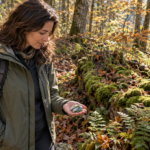
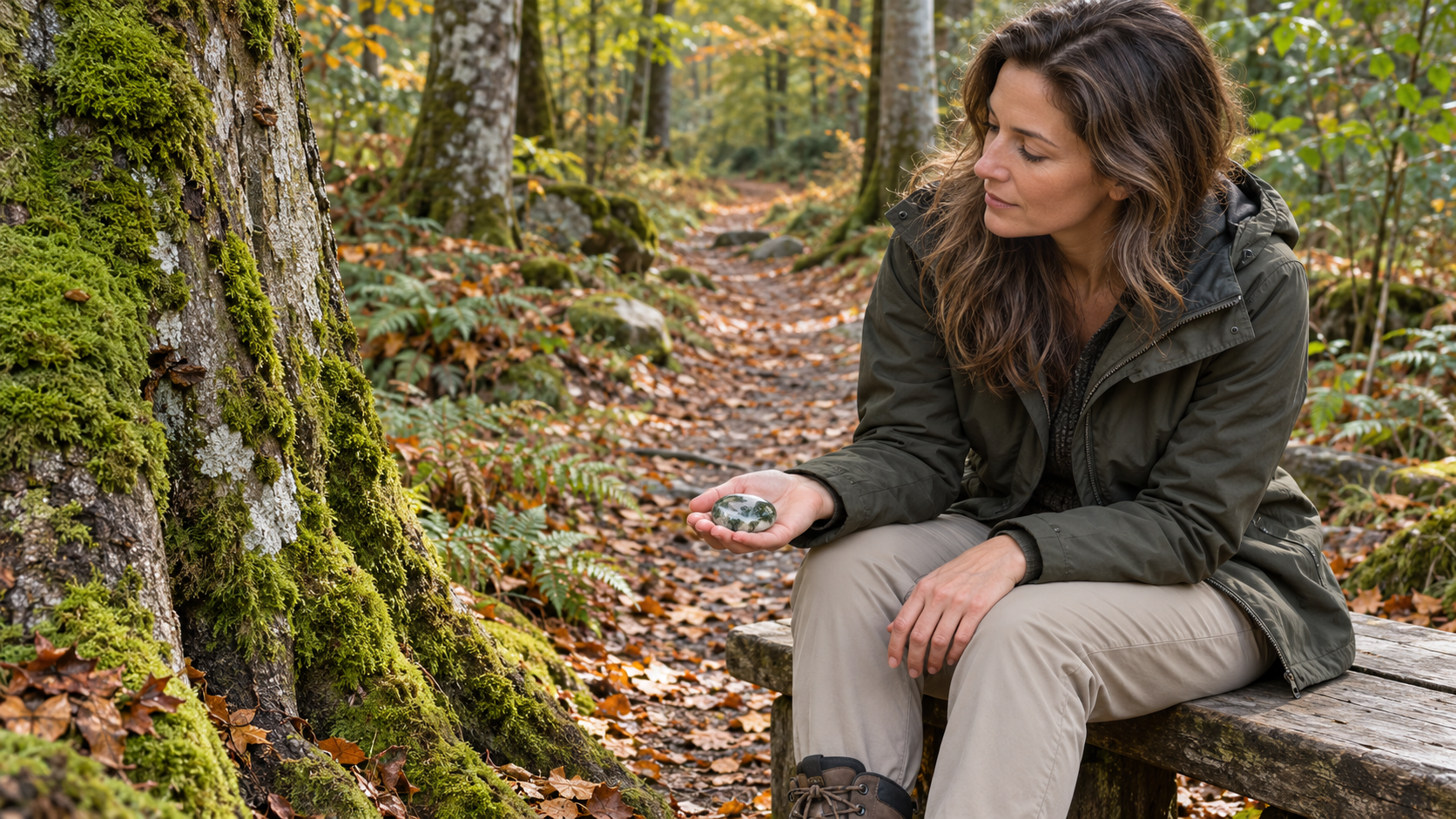
Before entering the woodland path, pause in a safe location.
Take the Moss Agate from your pocket.
Hold it comfortably in your hand.
Observe its appearance.
Notice the green patterns.
Their irregular shapes.
And the way they may resemble small natural landscapes.
There is no need to imagine energy entering your body.
The purpose is simply to observe.
Now look toward the surrounding environment.
Notice the difference between the small stone and the much larger landscape.
The gemstone may contain patterns that remind you of vegetation.
The forest contains living plants, animals and complex ecological relationships.
The resemblance is symbolic.
The two are not energetically connected through any scientifically demonstrated mechanism.
You may silently reflect:
I am here to observe, not to collect or control.
Return the stone to a secure pocket.
Begin walking at a comfortable pace.
Stage Two – Notice the Colours of the Forest
Choose a safe place to pause.
Look around.
Instead of attempting to observe everything, focus on colour.
How many different greens can you identify?
Perhaps the leaves are pale green.
The moss appears darker.
Some branches carry yellow or brown foliage.
Others remain almost black in the shade.
Notice how natural colours vary with lighting and distance.
There is no need to count precisely.
The purpose is to become more attentive.
If you wish, take the Moss Agate from your pocket.
Compare its visual patterns with the surrounding vegetation.
You may notice similarities.
You may also notice substantial differences.
The stone is not a miniature living ecosystem.
Its resemblance to natural vegetation is visual.
For contemporary spiritual practitioners, this comparison may symbolise connection with nature.
For other readers, it may simply be an interesting exercise in observation.
Both interpretations are compatible with the practice.
Why Small Details Matter
Natural environments contain an enormous number of details.
We cannot observe everything simultaneously.
Instead, attention selects particular features.
A branch moving in the wind.
A small plant growing beside a path.
Or sunlight passing through leaves.
Deliberately noticing these details may change the way we experience a familiar place.
The forest itself has not necessarily changed.
Our attention has.
This is an important distinction.
A meaningful experience does not require a supernatural explanation.
It can emerge from the relationship between perception and environment.
The Moss Agate serves as a reminder to look more carefully.
Stage Three – Listen Without Searching
Continue walking until you reach another suitable place to pause.
For this stage, focus on sound.
There is no need to close your eyes.
Remaining visually aware of the surroundings is often safer outdoors.
Listen for a short period.
Perhaps you hear birds.
Wind moving through branches.
Leaves shifting.
Distant traffic.
Or footsteps on the path.
Do not assume that every forest must be silent.
Natural environments can contain many sounds.
Human activity may also be audible.
The purpose is not to create perfect silence.
It is to notice what is present.
You may identify one nearby sound.
Then one farther away.
Notice how the sounds change.
If you hear birdsong, avoid approaching or disturbing the animals.
There is no need to record the sounds or identify the species.
Simply listen.
Natural Sounds and Wellbeing
Researchers have investigated the relationship between natural sound exposure and human wellbeing.
A systematic review and meta-analysis published in Science of the Total Environment in 2024 examined research involving natural sounds and health-related outcomes.
The subject includes sounds experienced in natural environments as well as recorded natural soundscapes.
This research is distinct from gemstone spirituality.
It concerns sensory experiences and their possible psychological or physiological effects.
Results from such studies should not be interpreted as proof that every natural sound produces relaxation.
Individual responses vary.
Some people enjoy birdsong.
Others may find certain sounds distracting or unpleasant.
The Moss Agate ritual therefore does not require a particular emotional reaction.
Listening is the practice.
Feeling peaceful is not an obligation.
Stage Four – Observe Texture Without Damaging Nature
The fourth stage focuses on texture.
Choose a safe place beside the path.
Look at the surfaces around you.
Tree bark.
Fallen leaves.
Weathered wood.
Stone.
Or moss growing naturally on the ground.
Notice the differences.
Some surfaces appear rough.
Others smooth.
Some look dry.
Others retain moisture.
You do not need to touch everything you observe.
In fact, avoiding unnecessary contact is often the more responsible choice.
Moss and other small plants can be delicate.
Do not remove them.
Do not scrape them from trees.
And do not disturb fragile vegetation for the sake of a spiritual exercise.
Instead, hold your own Moss Agate briefly.
Notice its surface.
Then observe the surrounding textures visually.
The gemstone provides a tactile object that belongs to you.
The living environment remains undisturbed.
Environmental Respect Is Part of the Practice
A spiritual practice focused on connection with nature should also consider its environmental consequences.
The US National Park Service promotes Leave No Trace principles for responsible outdoor recreation.
These include leaving rocks, plants and other natural objects where they are found.
Visitors are also encouraged to avoid damaging vegetation and disturbing wildlife.
These principles are especially relevant to gemstone rituals.
It may be tempting to create a crystal grid on the forest floor.
Arrange stones around a tree.
Or leave a gemstone as a symbolic offering.
However, placing foreign objects in natural environments may create unnecessary environmental impacts.
It can also conflict with park regulations.
For the Moss Agate Nature-Noticing Ritual, the most responsible approach is simple.
Bring your own gemstone.
Keep it with you.
Do not disturb natural objects.
And take everything home afterward.
The spiritual symbolism does not become weaker because nothing is left behind.
On the contrary, environmental respect can become part of the meaning of the practice.
Stage Five – Notice the Movement of Air
For the final stage, find a comfortable place to pause.
Remain standing or sit where permitted.
Notice the movement of air around you.
Perhaps there is a gentle breeze.
Perhaps the air is still.
You may feel a change in temperature between sunlight and shade.
Observe how leaves or branches respond to the wind.
There is no need to perform a special breathing technique.
Allow breathing to remain natural and comfortable.
The purpose is to notice the environment rather than control bodily processes.
If the weather is uncomfortable, move to a more suitable location.
There is no benefit in remaining exposed to cold, rain or other conditions that may be unsafe.
Take a final moment to observe the surroundings.
Then return the Moss Agate to your pocket.
The outdoor portion of the ritual is complete.
Returning Home: The Reflection Stage
The ritual can end when you leave the green space.
However, some people may enjoy a brief reflection afterward.
Place the Moss Agate on a clean table.
Sit comfortably.
Consider what you noticed.
Perhaps you remember a particular colour.
A sound.
An unusual texture.
Or the movement of light through the trees.
You may write one observation in a notebook.
For example:
The forest contained more shades of green than I expected.
Or:
I noticed birdsong that I usually ignore.
There is no requirement to interpret these observations spiritually.
They can remain simple descriptions.
The purpose is to acknowledge the experience.
The gemstone serves as a visual reminder of the time spent outdoors.
Moss Agate and the Symbolism of Growth
Within contemporary crystal spirituality, Moss Agate is frequently associated with growth.
Some practitioners believe it encourages personal development.
Others connect it with fertility, abundance or the wellbeing of plants.
These claims are not scientifically established.
The gemstone has not been shown to accelerate biological growth or influence reproductive health through an energetic mechanism.
Nevertheless, growth can be explored as a metaphor.
Plants develop under particular environmental conditions.
They require resources.
Their development is influenced by their surroundings.
Human learning and personal development also depend on circumstances, although the processes are very different.
The comparison should not be taken literally.
For the Moss Agate ritual, growth represents the possibility of becoming more attentive to the environment.
It does not promise personal transformation.
Sometimes, the most meaningful change is simply noticing something that was previously overlooked.
The Difference Between Nature Connection and Earth Energy
Contemporary spiritual language often describes gemstones as connecting people with Earth’s energy.
This phrase may have different meanings for different practitioners.
Some understand it metaphorically.
Others believe it describes an actual invisible force.
The scientific position requires a distinction.
The Earth contains many measurable physical processes and forms of energy.
However, these do not establish the existence of the specific healing or grounding energies attributed to gemstones in contemporary crystal spirituality.
There is no reliable evidence that Moss Agate transmits a special nature-healing energy to the human body.
A connection with nature can instead be understood through observable relationships.
Human beings depend on ecosystems.
We respond to environmental conditions.
We experience natural landscapes through our senses.
And our behaviour can affect the places we visit.
These relationships are real without requiring supernatural explanations.
Can a Gemstone Make Forest Bathing More Effective?
There is no reliable scientific evidence that adding Moss Agate makes forest bathing more effective.
The studies discussed in this article investigate nature exposure, forest-based activities and related psychological or physiological outcomes.
They do not establish additional benefits from carrying gemstones.
A person may nevertheless find the stone meaningful.
It may serve as a reminder to slow down.
Encourage them to remember a personal intention.
Or provide a familiar object associated with previous outdoor experiences.
These possibilities concern personal symbolism.
They should not be confused with demonstrated therapeutic effects.
The same nature-noticing exercise can be completed without any gemstone.
The forest remains the central experience.
A Pocket Stone for Everyday Nature Awareness
Not everyone has regular access to a forest.
Urban environments may provide limited green space.
Work schedules, mobility restrictions or weather conditions may also make outdoor activities difficult.
A Moss Agate pocket stone can be used as a symbolic reminder to notice small elements of nature during ordinary daily life.
A tree beside a street.
Plants growing in a garden.
Clouds moving across the sky.
Or changing daylight through a window.
The exercise does not require an elaborate ritual.
You may simply observe one natural detail.
There is no need to force a spiritual interpretation.
The stone represents the intention to remain attentive.
It does not create the natural environment or determine the experience.
A Moss Agate Ritual for Gardeners
Gardeners may find Moss Agate’s contemporary symbolism particularly appealing.
The gemstone is often associated with plants, abundance and growth.
Some crystal practitioners believe placing Moss Agate near plants improves their vitality.
Such claims are not scientifically established.
Plant health depends on biological and environmental factors.
A gemstone should not replace appropriate gardening knowledge.
However, Moss Agate can be used symbolically during a gardening reflection.
Place the stone on a table beside a gardening notebook.
Observe the plants in your care.
Consider their actual needs.
Perhaps a plant requires different watering.
More appropriate light.
Or protection from unsuitable conditions.
The meaningful action is responding to those needs.
The gemstone simply represents attentiveness to living things.
A Small Nature Observation Journal
A journal can extend the practice beyond a single woodland visit.
After spending time outdoors, record one or two observations.
You might describe the weather.
The appearance of a tree.
A bird you noticed.
Or a seasonal change.
Over time, these notes may reveal patterns.
Leaves changing colour.
Different flowering periods.
Or variations in the sounds of a familiar environment.
The journal does not need to become a scientific record.
Its purpose is personal observation.
However, accurate descriptions can encourage curiosity about the natural world.
The Moss Agate may remain beside the notebook as a symbolic reminder.
There is no need to attribute energetic properties to the stone.
Forest Bathing and Environmental Awareness
Research into human relationships with nature extends beyond individual wellbeing.
A global meta-analysis published in Biological Conservation in 2022 examined human–nature connectedness.
The researchers reviewed correlational and experimental evidence concerning people’s perceived relationship with nature.
Their findings suggested associations between stronger nature connectedness, certain wellbeing measures and environmentally supportive attitudes or behaviours.
However, correlations do not establish simple cause-and-effect relationships.
The research also does not demonstrate that a gemstone can increase environmental responsibility.
Nevertheless, it provides an interesting context for the Moss Agate ritual.
A practice that encourages observation may also create opportunities to reflect on how we treat natural environments.
The most meaningful expression of connection may be practical.
Respecting habitats.
Avoiding unnecessary disturbance.
And recognising the importance of ecological conservation.
Why We Should Not Leave Crystal Grids in Forests
Crystal grids are popular within contemporary gemstone spirituality.
Practitioners arrange stones in patterns that they may associate with intentions, energetic harmony or spiritual protection.
These meanings are part of modern metaphysical practice.
There is no reliable scientific evidence that crystal grids generate healing energy.
In a private indoor setting, a gemstone arrangement can function as a personal symbolic composition.
In a forest, however, the situation is different.
Natural environments are shared spaces.
They may contain fragile habitats.
Arranging stones on the ground can disturb vegetation or encourage the removal of natural materials.
Leaving gemstones behind may introduce objects that do not belong in the environment.
For these reasons, the Moss Agate Nature-Noticing Ritual does not include an outdoor crystal grid.
If someone wishes to create a symbolic arrangement, it is better to do so at home using objects they already own.
The forest should remain undisturbed.
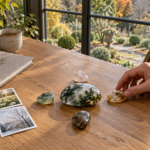
An Indoor Moss Agate Nature Arrangement
For readers who enjoy symbolic gemstone arrangements, a simple indoor composition can complement the outdoor practice.
Choose one Moss Agate as the central object.
Place it on a clean wooden surface.
You may position a notebook beside it.
A photograph of a woodland landscape can provide additional visual context.
The arrangement does not require other gemstones.
There is no need for sacred geometry.
No particular compass direction is necessary.
And the stone does not need to be energetically activated.
The composition serves as a personal reminder of the natural environment.
Its meaning comes from the associations chosen by the individual.
It is not a device for transmitting environmental or healing energy.
The Importance of Seasonal Change
Natural environments are constantly changing.
The same woodland may appear very different in spring, summer, autumn and winter.
Leaves emerge.
Plants flower.
Temperatures change.
Some animals become more visible.
Others are less easily observed.
A repeated nature-noticing practice can encourage awareness of these changes.
For example, someone may visit the same accessible woodland path once each month.
They may observe one familiar tree.
Notice changes in its appearance.
And record those observations.
The Moss Agate can serve as a consistent symbolic companion.
But the seasonal changes occur independently of the gemstone.
The value of the practice lies in observation.
What If the Forest Does Not Feel Relaxing?
Nature-based wellbeing practices are sometimes presented as universally peaceful.
But people respond differently to outdoor environments.
Some enjoy woodland settings.
Others may feel uncomfortable around insects, unfamiliar sounds or isolated paths.
Weather conditions may also affect the experience.
A forest is not automatically relaxing for everyone.
The Moss Agate ritual should therefore remain flexible.
Choose a location that feels appropriate.
A managed public garden may be preferable to a remote woodland.
A short visit may be more suitable than a long walk.
And some people may prefer observing nature from a window.
There is no spiritual requirement to endure discomfort.
If the practice becomes unpleasant, it can be stopped.
The gemstone does not need to be cleansed or recharged because the experience was uncomfortable.
The Scientific Limits of Nature-Based Wellbeing Claims
The growing body of research into nature exposure is promising.
However, it is important not to exaggerate the findings.
Studies differ in their participants, environments, duration and methods.
Some involve guided forest bathing programmes.
Others examine ordinary walks or exposure to natural scenery.
The outcomes measured also vary.
A positive result in one study does not mean that every woodland visit will produce the same effect.
The February 2026 systematic review is particularly useful because it explicitly evaluated evidence certainty.
Despite reporting potentially beneficial outcomes, the researchers rated the certainty of the evidence as very low.
This means that stronger research is required before making confident therapeutic claims.
The appropriate conclusion is that nature-based activities may support aspects of wellbeing for some people.
They should not be presented as guaranteed treatments.
And no scientific evidence establishes that Moss Agate provides additional healing effects.
The Spiritual Value of Paying Attention
Not every spiritual experience requires an extraordinary event.
For some people, meaning emerges through ordinary observation.
A familiar tree.
The movement of leaves.
The sound of rain.
Or the appearance of a small stone.
Contemporary crystal spirituality may interpret Moss Agate as a symbol of growth and connection with nature.
A scientifically oriented reader may appreciate the same object for its appearance and personal associations.
These perspectives do not need to be treated as identical.
The spiritual interpretation concerns meaning and belief.
The scientific perspective concerns evidence and observable processes.
The Moss Agate Nature-Noticing Ritual allows readers to explore the symbolic practice without confusing the two.
The Deeper Meaning of Moss Agate
Moss Agate’s appeal within contemporary nature-oriented spirituality is understandable.
Its patterns can evoke miniature landscapes.
Its appearance may remind someone of vegetation, branches or moss.
And its modern symbolic associations frequently emphasise growth and connection with the natural world.
Yet the most important part of the ritual takes place beyond the gemstone.
In the forest.
In the garden.
Or beside an ordinary tree.
The practice encourages attention to living environments.
It asks us to notice rather than collect.
To observe rather than disturb.
And to recognise that our relationship with nature involves responsibilities as well as personal experiences.
The gemstone remains a symbol.
The environment provides the experience.
And the individual chooses how to respond.
Reconnecting With the Natural World
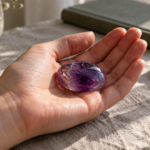
A small Moss Agate can fit comfortably into the palm of a hand.
Its green patterns may resemble a miniature landscape.
But the living world is far larger and more complex than anything represented by a gemstone.
Forests contain relationships that continue whether or not we notice them.
Plants grow.
Animals move.
Seasons change.
And ecosystems respond to countless environmental influences.
The Moss Agate Nature-Noticing Ritual does not claim to control these processes.
It does not promise healing energy.
Nor does it suggest that a gemstone can replace scientific understanding or environmental responsibility.
Instead, it offers a simple contemporary spiritual practice.
Carry a meaningful stone.
Spend time in a suitable natural environment.
Observe carefully.
And leave the place as you found it.
The symbolism can be personally significant without requiring supernatural explanations.
The Moss Agate represents our intention to notice.
The forest provides the opportunity to observe.
And our behaviour determines how respectfully we participate in the natural world.
Perhaps that is the most valuable lesson of this practice.
Connection with nature is not something a gemstone must create.
It is a relationship that already exists.
Sometimes, all we need is an opportunity to recognise it.
References & Further Reading
1. US Forest Service – Urban Nature for Human Health and Well-Being
Institution: United States Department of Agriculture, Forest Service
Published: 2018
Type: Government research synthesis and environmental education
A substantial educational report examining relationships between urban nature, green spaces and human health.
The publication includes a section on forest bathing, discussing the development of modern shinrin-yoku in Japan and research into nature exposure.
It provides historical and scientific context for the article’s discussion of forest bathing.
The report concerns natural environments and human wellbeing, not gemstone healing.
2. Siah et al. (2023) – The Effects of Forest Bathing on Psychological Well-Being: A Systematic Review and Meta-Analysis
Authors: Chiew Jiat Rosalind Siah and colleagues
Publication: International Journal of Mental Health Nursing
Published online: March 2, 2023
Journal issue: August 2023
Type: Peer-reviewed systematic review and meta-analysis
DOI: 10.1111/inm.13131
A scientific review examining 36 studies involving 3,554 participants.
The researchers investigated psychological and physiological outcomes associated with forest bathing.
The analysis reported potentially beneficial effects on symptoms of anxiety and depression, while physiological findings were less consistent.
The study provides evidence-based context for the article’s discussion of nature-oriented wellbeing practices.
https://pubmed.ncbi.nlm.nih.gov/36864583
3. Andrade et al. (2026) – Short-Term Cardiovascular and Mental Health Responses to Shinrin-Yoku (Forest Bathing): A Systematic Review and Meta-Analysis
Authors: Aurélio Matos Andrade and colleagues
Publication: Frontiers in Psychology
Published: February 11, 2026
Type: Peer-reviewed systematic review and meta-analysis
DOI: 10.3389/fpsyg.2026.1707829
A recent scientific review examining short-term cardiovascular and psychological responses to forest bathing.
Eleven studies met the inclusion criteria.
The authors reported potentially beneficial effects on selected outcomes, including heart rate and certain mood measures.
However, the certainty of evidence was rated very low because of methodological limitations, inconsistency and imprecision.
The researchers concluded that forest bathing should be regarded as a possible complementary health-promotion practice rather than an independent medical treatment.
https://pubmed.ncbi.nlm.nih.gov/41756503
4. US National Park Service – Nature Makes You…
Institution: United States National Park Service
Last updated: January 27, 2025
Type: Government environmental and public-health education
An educational overview of the potential benefits of spending time outdoors.
The resource discusses natural environments, sensory experiences, mood, attention and physical activity.
It provides general context for the relationship between nature exposure and wellbeing.
Individual claims should be interpreted in light of the limitations of the underlying research.
https://home.nps.gov/articles/naturesbenefits.htm
5. US National Park Service – Leave No Trace
Institution: United States National Park Service
Location: Natchez Trace National Scenic Trail
Type: Official environmental stewardship guidance
An authoritative explanation of Leave No Trace principles.
The resource encourages visitors to protect natural environments, avoid damaging vegetation and leave rocks, plants and other natural objects where they are found.
These principles directly support the article’s recommendation not to create outdoor crystal grids or leave gemstones in natural habitats.
https://home.nps.gov/natt/learn/leave-no-trace.htm
6. National Center for Complementary and Integrative Health – Meditation and Mindfulness: Effectiveness and Safety
Institution: US National Institutes of Health
Type: Evidence-based medical and wellness education
An authoritative overview of research into meditation and mindfulness.
The resource discusses potential benefits, limitations in scientific evidence and possible negative experiences.
It provides context for distinguishing optional sensory-awareness practices from established medical treatment.
https://www.nccih.nih.gov/health/meditation-and-mindfulness-effectiveness-and-safety
7. Human–Nature Connectedness as a Pathway to Sustainability: A Global Meta-Analysis
Publication: Biological Conservation
Published: 2022
Type: Peer-reviewed global meta-analysis
A scientific analysis examining relationships between human–nature connectedness, wellbeing and environmentally supportive attitudes or behaviours.
The research includes evidence from correlational and experimental studies.
It provides context for understanding why awareness of nature may be relevant to environmental responsibility.
The findings do not establish that gemstones influence ecological awareness or human wellbeing.
https://pubmed.ncbi.nlm.nih.gov/35865265
8. Zhu et al. (2024) – Effects of Natural Sound Exposure on Health Recovery: A Systematic Review and Meta-Analysis
Authors: Ruirui Zhu and colleagues
Publication: Science of the Total Environment
Published: April 15, 2024
Type: Peer-reviewed systematic review and meta-analysis
DOI: 10.1016/j.scitotenv.2024.171052
A scientific review investigating natural sound exposure and health-related outcomes.
The research includes natural sounds experienced directly and through recordings.
It provides context for the listening component of the Moss Agate Nature-Noticing Ritual.
The study does not investigate gemstones or spiritual energy.
https://pubmed.ncbi.nlm.nih.gov/38373459
Educational and Scientific Clarification
The associations between Moss Agate, growth, abundance, renewal, nature connection and energetic balance are contemporary spiritual interpretations. They are not scientifically established therapeutic or supernatural properties.
The Moss Agate Nature-Noticing Ritual presented in this article is an original contemporary contemplative exercise.
It is inspired by sensory engagement with natural environments and the modern Japanese practice of shinrin-yoku. It is not a reconstruction of an ancient Japanese religious ceremony.
Scientific research into forest bathing, mindfulness and nature exposure does not establish that Moss Agate produces additional psychological, physiological or energetic benefits.
The ritual should not be presented as a treatment for anxiety, depression, stress-related disorders or other medical conditions.
Gemstones and spiritual practices should not replace professional healthcare, psychological support or evidence-based treatment.
Outdoor activities should be adapted to individual circumstances, accessibility requirements, weather conditions and local environmental regulations.
The natural environment should remain undisturbed throughout the practice.