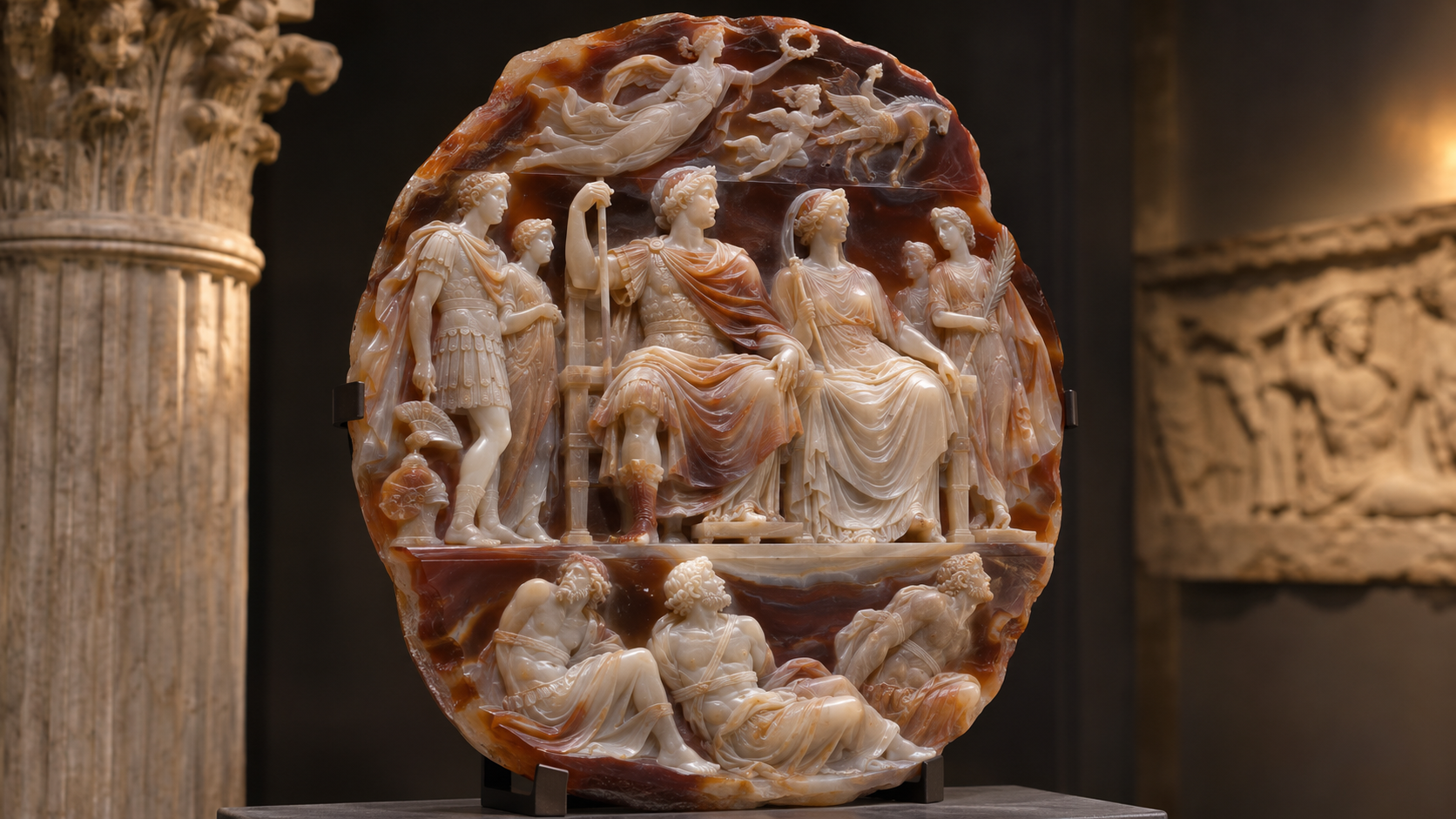
The Great Cameo of France transforms the natural colour bands of a gemstone into a densely populated image of imperial power. Pale bodies emerge against darker surroundings, while changes in colour help distinguish faces, garments and overlapping forms. Its effect depends on sculpture and mineral structure working together.
Known in French as the Grand Camée de France, the object is a Roman sardonyx cameo measuring approximately 31 by 26.5 centimetres. The Bibliothèque nationale de France identifies it as the largest cameo surviving from antiquity and catalogues its material as sardonyx with five layers.
Its exceptional scale makes it more than an enlarged version of a cameo brooch. It is a substantial carved gemstone whose imagery, material and later history invite investigation from several disciplines.
Table of Contents
Sardonyx: A Material Defined by Its Layers
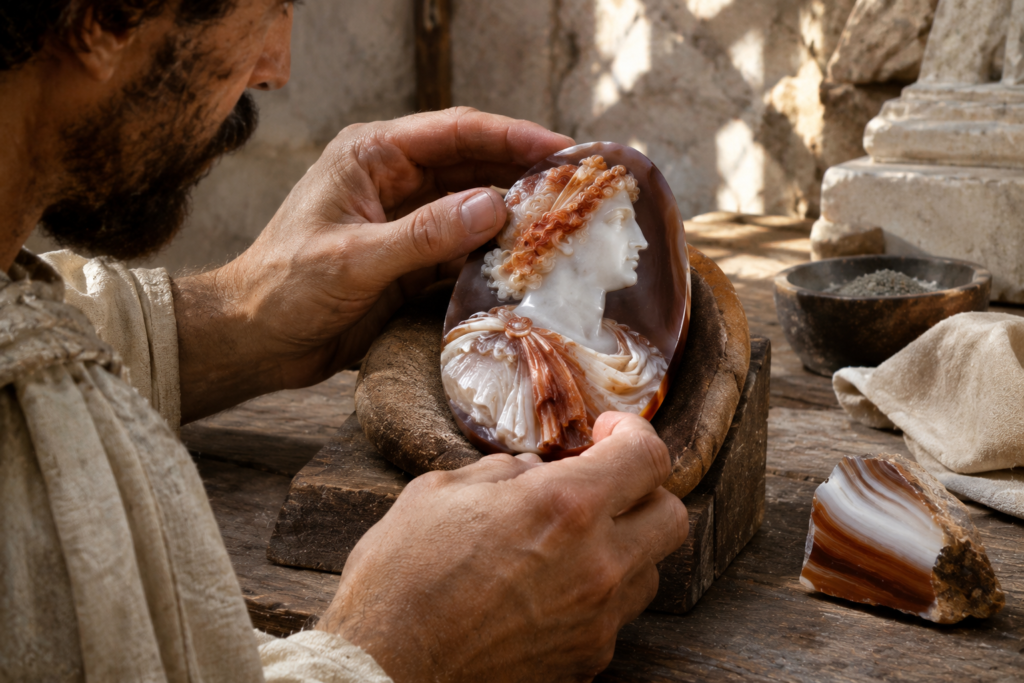
Sardonyx is a layered variety of chalcedony, belonging to the quartz family. Its name is associated with the combination of sard-coloured bands—typically reddish to brownish—with contrasting pale or darker chalcedony layers.
This places it within a different material category from a transparent quartz crystal. Chalcedony consists of very fine crystalline material, with individual crystals generally invisible to the unaided eye. Its appearance depends on the collective behaviour of that fine structure, together with variations in colour and translucency.
For a gem carver, those variations are opportunities as well as constraints. A pale layer can provide a figure against a darker background, but the thickness and position of the bands limit how deeply particular details can be developed.
The five layers in the Great Cameo are therefore not five separate stones assembled into a picture. They are the coloured strata exploited within one carved gemstone.
How a Cameo Differs from an Intaglio
A cameo preserves its principal image in relief by removing surrounding material. An intaglio reverses that relationship: its image is recessed into the surface and can produce a raised impression when pressed into a suitable medium.
This distinction affects both appearance and manufacture. In a layered cameo, the artist can use contrasting strata to separate subject and background. In an intaglio, the legibility of the recessed design and its potential impression are central considerations.
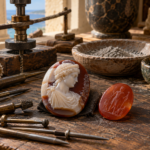
The Art Institute of Chicago’s research on a Roman sardonyx cameo describes the use of abrasive working methods and notes that carving slurry could obscure the developing surface. Such evidence helps explain the practical difficulty of ancient gem engraving.
It does not establish an identical sequence for the Great Cameo. Reconstructing its particular manufacture would require examination of its own surfaces, tool traces and alterations.
Carving Within a Natural Colour Sequence
The sculptor could not arrange the stone’s colour bands as freely as a painter chooses pigments. Instead, the composition had to accommodate an existing material structure.
That relationship becomes especially demanding when several bodies overlap. Removing stone to expose a lower band may create a useful contrast in one place while eliminating material needed for a neighbouring feature. The artist must therefore think across the whole image rather than treat every figure as an independent miniature sculpture.
The apparent ease of the finished surface can conceal these decisions. A face that reads immediately as pale flesh may owe its effect to extremely controlled retention of a thin coloured stratum.
This is one reason that gemstone relief rewards changing illumination. Raking light clarifies depth, whereas more frontal light can make colour boundaries easier to follow. The same surface can consequently appear more sculptural or more pictorial under different conditions.
Three Registers of Imperial Meaning
The composition is organised into three principal registers. In the interpretation developed by scholar Évelyne Prioux, the upper zone belongs to the divine and deceased, the middle presents the imperial family, and the lower contains defeated peoples.
These levels establish a hierarchy rather than a straightforward record of one gathering. The ruling dynasty occupies the central field, supported visually by the conquered below and connected with an exalted ancestral realm above.
Tiberius and Livia are generally recognised in the enthroned central pair. Other identifications depend on comparisons with portraits, coins and the historical circumstances proposed for the commission.
The arrangement therefore communicates dynastic legitimacy more securely than it identifies every individual. Its broad political purpose can remain intelligible even where the precise names attached to particular faces are disputed.
Why the Date Depends on the Portraits
The BnF presents a date around 23 CE, but this is a scholarly attribution rather than an inscription carved into the stone.
Prioux’s analysis connects an early-20s date with the deaths of Germanicus in 19 CE and Drusus the Younger in 23 CE. These losses changed the available lines of succession around Tiberius and gave new significance to the younger members of the family.
If a figure appears among the deceased rather than the living, that placement can help establish a possible chronological boundary. Conversely, a proposed identification may become difficult if the person’s age or status does not fit the rest of the composition.
Portrait identification and dating are thus interdependent. The strongest interpretation should explain the whole arrangement, not merely match one attractive facial resemblance.
The young Nero Julius Caesar discussed in this succession debate should also not be confused with the later emperor Nero.
A Statement About Succession, Not Necessarily an Official Announcement
Luca Giuliani’s study places the cameo within the politically sensitive question of Tiberius’s succession. His interpretation emphasises that promoting potential heirs through imagery is not equivalent to documenting an unambiguous imperial decision.
This distinction changes how the object can be read. Rather than illustrating a settled constitutional outcome, it may articulate hopes, loyalties or a preferred future within the imperial family.
The possible role of a patron is therefore important. An expensive image could seek to persuade or honour its recipient while presenting a carefully selected version of dynastic continuity.
Yet identifying that intention does not reveal a named commissioner with certainty. The image can support a political reading without supplying the full circumstances of its production.
The Conquered Figures and the Construction of Power
The lower register contributes to the imperial message by placing defeated peoples beneath the dynasty.
Their position is meaningful even without linking them to one precisely dated campaign. Within the composition, conquest provides a foundation for the family’s elevated status and anticipated continuity.
This is imperial representation rather than a neutral account of the people depicted. Their bodies and attributes serve a Roman argument about dominance.
Recognising that perspective helps prevent an important interpretative mistake: the scene should not be treated as an impartial group portrait in which all participants occupy equivalent roles. Its spatial organisation assigns profoundly unequal positions to rulers, ancestors and conquered subjects.
Ancient Stone, Changing Surface
A gemstone’s survival does not mean that every visible detail remains exactly as first carved.
Prioux discusses substantial ancient reworking of one female figure, drawing on technical analysis associated with Giuliani’s research. Such alteration matters because a modified hairstyle or face may no longer provide reliable evidence for the original identity.
The problem resembles the interpretation of a manuscript revised by a later hand. The surface can preserve more than one historical intervention, and those interventions must be distinguished before every detail is used to date the original work.
Material examination and art-historical interpretation therefore depend on one another. A persuasive name based on a portrait becomes less secure if the relevant features were subsequently changed.
From Imperial Image to Medieval Treasury Object
The cameo’s later significance extended far beyond its original Roman setting.
Catherine Fernandez’s study examines its reception in the treasury of the Sainte-Chapelle, where an ancient imperial object became part of a medieval environment of sacred kingship. Its value was not restricted to the accurate recognition of its Roman figures.
The precious stone, exceptional workmanship and antiquity could contribute to a new interpretation within a Christian royal collection. Medieval settings and surrounding objects helped shape what viewers understood the cameo to mean.
This is an important principle in the history of gemstones: reuse can preserve an object while transforming its significance. A later owner need not understand its first message in order to value it intensely.
A French History Without a French Origin
The name “Great Cameo of France” refers to the gemstone’s later history, not its place of carving or the geological source of its material.
The BnF records its presence in the Sainte-Chapelle treasury by the thirteenth century, while treating the proposed transfer from Baldwin II to Louis IX in 1247 as probable rather than certain.
In 1620, Peiresc described and reinterpreted the object as an ancient imperial image. Its subsequent history includes transfer to the Cabinet des Médailles in 1791, theft in 1804 and recovery in Amsterdam in 1805 after the loss of its mounting.
These events demonstrate why stone and frame must be studied separately. A gemstone may survive changes of ownership and display while its precious-metal surroundings are replaced or destroyed.
Sardonyx and the Roman Taste for Layered Images
The visual possibilities of layered stone also influenced Roman glassmaking.
The Metropolitan Museum of Art explains that cameo glass drew inspiration from prized sardonyx carvings and vessels. By carving through an outer layer of glass, a maker could reveal a contrasting colour beneath and imitate effects associated with banded stone.
Glass introduced a significant difference: its makers could create coloured layers rather than depend entirely on the distribution found in a natural gemstone. The resulting work still required exceptional technical skill.
The comparison reveals how influential gemstone aesthetics could be. Sardonyx was not simply one material among many; its appearance helped stimulate experimentation in another medium.
What Science Can Clarify
Scientific examination can help distinguish material composition, reveal structural features and document areas of damage or intervention. It cannot independently identify a Roman prince from the chemistry of the stone.
Likewise, sardonyx’s name does not establish the mine that supplied this particular piece. Historical statements about regions supplying carved stones must not be converted into an object-specific geological provenance without supporting evidence.
A useful investigation therefore separates several questions: what the material is, how it was worked, which surfaces were altered, what the imagery represents, and how the object moved between collections.
Each line of evidence becomes more valuable when its limits are kept visible.
Imperial Memory Carved Into a Gemstone
The Great Cameo of France unites material rarity, demanding craftsmanship and an ambitious political image. Its colour layers helped the sculptor organise a world of rulers, ancestors and conquered peoples, while later settings allowed that world to be understood differently.
For gemstone enthusiasts, it demonstrates how natural banding can become an active component of design. For historians, it shows how claims about identity, succession and legitimacy can be built into a precious object.
At Natural Gems Belgium, its lasting interest lies in that connection: the gemstone is both the substance of the artwork and one of the reasons the artwork could continue to acquire meaning across centuries.
References & Further Reading
Bibliothèque nationale de France. “Grand Camée de France.” Catalogue des monnaies, médailles et antiques, Camée.264.
The principal collection record covering material, dimensions, interpretation, provenance and later mountings.
https://medaillesetantiques.bnf.fr/ws/catalogue/app/collection/record/ark:/12148/c33gbcsv8
Bibliothèque nationale de France. “Les collections du musée de la BnF.”
Institutional overview identifying the cameo as five-layered sardonyx and presenting its approximate date and dimensions.
https://www.bnf.fr/fr/les-collections-du-musee-de-la-bnf
Prioux, É. “Le Grand Camée de France : la question de la transmission dynastique en images.” Utpictura18, Aix-Marseille Université.
A detailed scholarly interpretation of the composition, portrait identifications, succession context and altered features.
https://utpictura18.univ-amu.fr/rubriques/ressources/images-antiques/grand-camee-france-question-transmission-dynastique-en-images
Giuliani, L. (2006). “Leggere un’immagine. Il Grand Camée de France e la successione di Tiberio.” Storicamente, 2.
Research examining the image in relation to the political uncertainties surrounding Tiberius’s succession.
https://storicamente.org/giuliani
Fernandez, C. (2012). “Kingship and the Materiality of Cameos: The Afterlife of the Grand Camée in Capetian Paris.” Athanor, 30, 15–21.
Academic analysis of the cameo’s medieval reception and the significance of its material and treasury setting.
https://journals.flvc.org/athanor/article/download/126709/126263/207591
Art Institute of Chicago. “Cat. 137: Fragment of a Cameo Portraying Emperor Tiberius.” Roman Art at the Art Institute of Chicago.
Comparative museum research discussing sardonyx, relief carving and ancient gem-working techniques. This concerns a different cameo, not the Great Cameo of France itself.
https://publications.artic.edu/roman/api/epub/480/1946/print_view
Trentinella, R. (2003). “Roman Cameo Glass.” The Metropolitan Museum of Art, Heilbrunn Timeline of Art History.
Museum scholarship explaining how carved sardonyx influenced Roman layered-glass production.
https://www.metmuseum.org/essays/roman-cameo-glass
Australian Museum. “Quartz.”
Mineralogical background distinguishing crystalline quartz from fine-grained chalcedony.
https://australian.museum/learn/minerals/gemstones/quartz/
Gemological Institute of America. “August Birthstones.”
Educational background on sardonyx and its contrasting bands.
https://www.gia.edu/birthstones/august-birthstones