


Not every meaningful achievement arrives with a celebration.
Sometimes, progress is almost invisible.
A difficult task is finally completed.
A new skill becomes slightly easier.
A conversation goes better than expected.
Or a project that once seemed overwhelming begins to take shape.
These moments may pass quickly.
Attention moves to the next responsibility, and the achievement becomes another completed item on a list.
Yet there is another possibility.
We can choose to notice what has happened before moving on.
Within contemporary crystal spirituality, Citrine is frequently associated with optimism, abundance, confidence and personal success.
Some practitioners believe it attracts prosperity, strengthens positive energy or supports motivation through its connection with the solar plexus chakra.
Others carry Citrine as a pocket stone, place it near their workspace or incorporate it into personal rituals intended to represent achievement.
These interpretations are spiritual beliefs rather than scientifically established effects.
There is no reliable evidence that Citrine attracts money, increases confidence through gemstone vibrations or produces success through supernatural energy.
Nevertheless, a gemstone can serve as a meaningful personal symbol.
And psychological research has explored how people attend to and appreciate positive experiences.
This article introduces an original contemporary practice:
It combines one Citrine stone with a short exercise for recognising an achievement, appreciating the experience and acknowledging the effort involved.
The ritual does not promise happiness.
It is not an ancient Citrine ceremony.
And it does not require belief in crystal energy.
Instead, it explores one central idea:
An achievement does not need to be extraordinary to deserve a moment of recognition.
Table of Contents
Citrine in Contemporary Crystal Spirituality
Citrine is commonly associated in modern crystal traditions with abundance, prosperity, optimism and confidence.
Some practitioners call it a stone of success or manifestation.
Others believe it encourages motivation, attracts financial opportunities or strengthens personal determination.
Citrine may be carried during professional activities, placed beside a notebook or used as a centre stone in symbolic arrangements representing personal goals.
These interpretations vary between practitioners and spiritual communities.
They should not automatically be presented as universal ancient teachings.
Historical societies have used gemstones in ornaments, ceremonial objects and symbolic settings, but historical gemstone use does not establish the antiquity of every modern metaphysical association.
For the Citrine Savouring Ritual, the stone represents one intention:
To recognise a meaningful experience before immediately turning toward the next task.
The gemstone does not generate success through supernatural energy.
Its role is symbolic.
What Is Savouring?
In psychology, savouring refers to processes through which people attend to, appreciate or enhance positive experiences.
A person might savour an enjoyable meal, a meaningful conversation, a beautiful landscape or the satisfaction of completing a task.
Savouring can involve an experience happening now.
It may also involve remembering something positive from the past or anticipating a future event.
Researchers Fred Bryant and Joseph Veroff have examined savouring as an important concept in the study of positive experience.
Their work distinguishes savouring from simply experiencing pleasure.
A positive event may occur without receiving much attention.
Savouring involves deliberately engaging with the experience.
However, this does not mean that every pleasant moment must be analysed.
Nor does it mean that savouring produces happiness for everyone.
The practice is an invitation to notice, not an obligation to feel positive.
Savouring Is Not the Same as Gratitude
Gratitude and savouring are related but distinct concepts.
Gratitude often involves recognising a benefit or kindness received.
For example, someone may feel grateful when a friend provides assistance.
Savouring focuses more broadly on appreciating a positive experience.
A person may savour completing a difficult drawing, learning a new phrase in another language or enjoying a quiet moment outdoors.
The experience does not necessarily involve another person’s generosity.
The Citrine Savouring Ritual concentrates on recognising personal achievements and meaningful moments.
It does not require writing a gratitude letter.
It does not require sharing appreciation with another person.
And it does not involve asking for future abundance.
The focus is on acknowledging something that has already occurred.
Abundance as a Spiritual Symbol
Within contemporary crystal spirituality, Citrine is often associated with abundance.
For some practitioners, abundance refers primarily to financial prosperity.
Others interpret it more broadly as opportunity, creativity, confidence or a sense of sufficiency.
Some believe that Citrine attracts prosperity through energetic vibrations.
These supernatural claims have not been scientifically demonstrated.
The Citrine Savouring Ritual uses a different interpretation.
Here, abundance is not defined as unlimited wealth or continuous success.
Instead, it refers to recognising experiences that already have personal value.
A completed task.
An acquired skill.
A moment of enjoyment.
Or a small but meaningful improvement.
This interpretation does not imply that material hardship can be solved through positive thinking.
Financial circumstances are influenced by practical, social and economic factors.
A gemstone cannot replace financial planning, employment opportunities or appropriate support.
Why Small Achievements Matter
Many activities require gradual progress.
Learning a language involves repeated practice.
Developing a creative skill may take months or years.
Completing a complicated project often involves numerous smaller tasks.
These intermediate steps can be easy to overlook.
Someone may focus so strongly on the final objective that they fail to recognise meaningful progress along the way.
Acknowledging a small achievement does not mean exaggerating its importance.
It simply involves describing what has been accomplished.
For example:
I completed the first section of the project.
Or:
I practised a difficult skill for twenty minutes.
These statements are concrete.
They do not require claims of exceptional success.
The Citrine Savouring Ritual begins with this kind of realistic recognition.
The Difference Between Savouring and Forced Positivity
Positive experiences can be meaningful without denying difficult circumstances.
A person may complete a small task while facing significant challenges.
They may enjoy a peaceful moment during an otherwise demanding week.
Or they may feel satisfied with progress while remaining uncertain about the future.
Savouring does not require ignoring these realities.
It should not be used to pressure someone into happiness.
Nor should it suggest that negative emotions are signs of spiritual failure.
The purpose is to notice an experience that genuinely feels worthwhile.
If no such experience comes to mind, the ritual can be postponed.
There is no requirement to manufacture positivity.
Introducing the Citrine Savouring Ritual
The following practice is an original contemporary symbolic exercise informed by general psychological concepts of savouring.
It is not an ancient Citrine ceremony.
It is not a clinically validated gemstone intervention.
And it does not require belief in supernatural crystal energy.
The ritual takes approximately ten to fifteen minutes.
You will need one Citrine pocket stone, palm stone or cabochon.
A notebook and pen are optional.
Choose a comfortable place where you can reflect without unnecessary interruptions.
The ritual has three central themes:
Notice. Appreciate. Remember.
Stage One – Choosing a Small Achievement
Begin by identifying one recent achievement.
It does not need to be impressive to other people.
Perhaps you completed a task that had been delayed.
Learned something useful.
Finished a creative activity.
Or managed a responsibility that required effort.
Choose something that genuinely matters to you.
Avoid comparing the achievement with someone else’s accomplishments.
The purpose is personal recognition rather than competition.
Stage Two – Placing the Citrine
Place the Citrine on a stable surface beside you.
A small ceramic dish or wooden tray may be suitable.
The stone does not need to touch your body.
It does not require sunlight, moonlight, water, incense or energetic activation.
Its symbolic purpose is to represent recognition of the achievement.
Consider one question:
What did I actually accomplish?
Try to answer without exaggeration.
A specific description is more useful than a vague statement about success.
Stage Three – Remembering the Experience
Think briefly about the activity.
What were you doing?
What required attention or effort?
What changed between the beginning and the end?
You may remember a particular detail.
The final sentence of a written assignment.
The moment a practical problem was solved.
Or the completion of a small handmade object.
There is no need to reconstruct every step.
Choose one detail that helps you remember the experience.
Stage Four – Recognising the Effort
Consider what contributed to the achievement.
Perhaps you prepared carefully.
Asked for assistance.
Practised repeatedly.
Or adapted your approach when something did not work.
Not every positive outcome results entirely from personal effort.
Circumstances, opportunities and help from others may also contribute.
The purpose is not to claim complete control over success.
It is to recognise what happened realistically.
Stage Five – Allowing a Moment of Appreciation
Pause briefly.
You may look at the Citrine or simply leave it beside your notebook.
Consider whether the achievement brings a sense of satisfaction, relief, enjoyment or another response.
There is no required feeling.
Some accomplishments produce excitement.
Others bring only quiet relief.
And some may feel less significant than expected.
All of these responses are possible.
The ritual does not require a particular emotional outcome.
Stage Six – Describing What Was Meaningful
Write one or two sentences about the experience.
For example:
I finished a task that required several attempts, and I appreciate the persistence involved.
Or:
I enjoyed learning something new, even though I am still a beginner.
The statement should remain truthful.
Avoid turning the exercise into a declaration that every goal will succeed.
The purpose is to recognise the present achievement.
Stage Seven – Creating a Memory Cue
If you wish, place the Citrine beside the written reflection for a few moments.
The stone can serve as a symbolic reminder of the experience.
Some practitioners might interpret this as storing positive energy in the gemstone.
There is no scientific evidence that Citrine stores emotional experiences or personal intentions through supernatural mechanisms.
The memory belongs to the person.
The gemstone is simply an associated object.
Stage Eight – Closing the Ritual
Read your reflection once more.
Consider one final question:
What would I like to remember about this experience?
Perhaps it is the satisfaction of completing something.
The value of practice.
Or the enjoyment of the activity itself.
There is no need to create a new goal immediately.
The ritual is not intended to turn every achievement into another productivity target.
Return the Citrine to its usual place.
The practice is complete.
Citrine as a Pocket Stone for Everyday Recognition
Some contemporary crystal practitioners carry Citrine because they associate it with prosperity, optimism or personal confidence.
They may believe the gemstone attracts positive opportunities.
These claims have not been scientifically established.
A Citrine pocket stone can also serve as a personal reminder to recognise progress.
For example, someone might notice it after finishing a task and take a moment to acknowledge the work involved.
The stone does not create achievement through supernatural energy.
It represents a chosen intention.
A Citrine Palm Stone for Quiet Savouring
A Citrine palm stone may be used during a short seated reflection.
Place it comfortably in your hand or on a nearby table.
Recall one enjoyable experience from the day.
Perhaps it was a conversation.
A meal.
A creative activity.
Or a pleasant moment outdoors.
Notice one specific detail that made the experience meaningful.
There is no need to extend the reflection beyond a few minutes.
The purpose is not to repeat the experience perfectly.
It is to appreciate something that has already happened.
Citrine and the Solar Plexus Chakra
Within contemporary seven-chakra spirituality, Citrine is frequently associated with the solar plexus chakra, commonly called Manipura.
Modern practitioners often connect this chakra with confidence, personal power, motivation and self-expression.
Some believe Citrine strengthens or balances the energetic qualities of this centre.
These correspondences vary between spiritual communities.
Historical South Asian chakra traditions developed within diverse religious and philosophical contexts.
Their teachings should not be reduced to modern gemstone-colour charts.
There is no reliable biomedical evidence that Citrine balances an anatomical solar plexus chakra or improves confidence through crystal energy.
For the Savouring Ritual, chakra symbolism is optional.
The gemstone may simply represent recognition of a meaningful achievement.
A Citrine Centre Stone for an Achievement Arrangement
Contemporary crystal-grid practices sometimes place Citrine at the centre of arrangements intended to represent prosperity, manifestation or success.
Practitioners may believe surrounding stones amplify its energetic influence.
These claims have not been scientifically demonstrated.
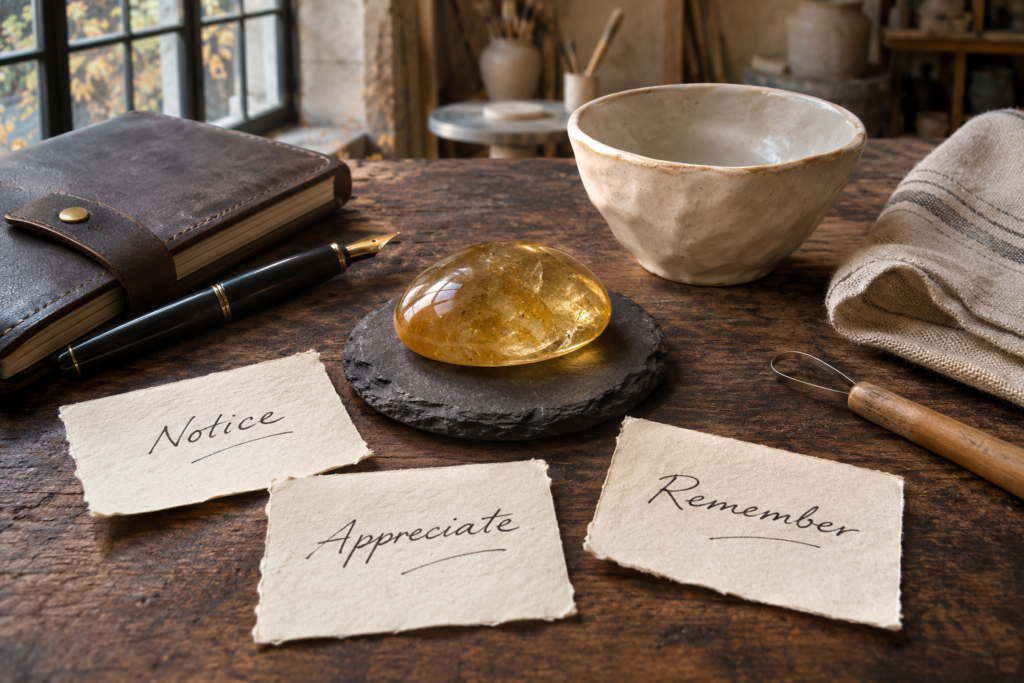
A simple symbolic arrangement can be created using one Citrine stone and three small paper cards.
Write one word on each card:
Notice
Appreciate
Remember
Place the Citrine in the centre.
Arrange the cards around it.
The arrangement represents the stages of the ritual.
It does not generate a measurable prosperity field.
No additional gemstones are necessary.
Savouring Without Turning Life Into a Competition
An achievement does not need to be compared with someone else’s success.
Social comparison can influence how people evaluate their progress.
A small accomplishment may appear insignificant when measured against an idealised image of another person’s life.
The Citrine Savouring Ritual deliberately avoids ranking achievements.
It does not ask whether the participant has done more than someone else.
Instead, it asks whether the experience had personal meaning.
This approach does not eliminate social comparison.
It simply provides an alternative focus during the exercise.
When an Achievement Does Not Feel Rewarding
Sometimes, completing a task produces little satisfaction.
A person may be tired.
The task may have been unpleasant.
Or the outcome may not match expectations.
The ritual should not require someone to celebrate an experience that does not feel positive.
It is acceptable to acknowledge completion without describing it as joyful.
For example:
I finished the task, but it was demanding and I need to rest.
This is a valid reflection.
Savouring is not an obligation.
And a gemstone should never be used to dismiss difficult emotions.
A Five-Minute Citrine Savouring Practice
For a shorter variation, place Citrine beside a notebook.
Identify one recent positive experience.
Write three brief responses:
What happened?
What made it meaningful?
What would I like to remember?
Spend a moment considering the answers.
Then close the notebook.
The practice can be completed in a few minutes.
It does not need to be repeated daily.
And repetition does not increase the gemstone’s supernatural power.
Its meaning lies in the reflection itself.
An Alternative Without a Gemstone
The same exercise can be completed without Citrine.
A familiar notebook.
A small photograph.
A handmade object.
Or an ordinary personal keepsake may serve as the symbolic reminder.
No object is required.
The essential principles remain unchanged.
Notice.
Appreciate.
Remember.
This distinction matters because the exercise does not depend on scientifically established gemstone effects.
Citrine is included because of its contemporary spiritual association with abundance, optimism and success.
It is not a necessary therapeutic instrument.
Responsible Use of Citrine in Personal Rituals
A symbolic practice does not require a large gemstone collection.
One stone is sufficient.
A specimen already owned is entirely appropriate.
There is no need to purchase additional crystals to strengthen the intention.
Place the gemstone on a stable surface.
Keep small stones away from young children who might put them in their mouths.
Avoid treating crystal rituals as substitutes for practical action, financial planning or professional support.
The ritual should remain simple, safe and voluntary.
Its focus is recognition rather than the accumulation of spiritual objects.
What Scientific Research Does Not Establish
Psychological research has investigated savouring, positive experiences and subjective wellbeing.
These studies may help explain why deliberate attention to enjoyable experiences is of interest to researchers.
However, they do not establish that Citrine attracts prosperity.
They do not demonstrate that the gemstone increases motivation through supernatural energy.
They do not prove that Citrine balances anatomical chakra centres.
And they do not validate the Citrine Savouring Ritual as a clinical intervention.
The exercise is an original contemporary symbolic practice.
Its meaning depends on the participant’s interpretation.
Final Reflection: Recognising What Has Already Happened
Citrine cannot guarantee prosperity through scientifically demonstrated crystal energy.
It cannot create success without action.
It cannot ensure happiness.
And it cannot replace practical decisions or appropriate professional support.
Yet within contemporary crystal spirituality, its association with optimism and abundance offers a meaningful symbolic starting point.
The Citrine Savouring Ritual explores a different understanding of achievement.
Not the pursuit of endless success.
Not the expectation that every effort must produce a reward.
And not the belief that positive thinking can overcome every difficulty.
Instead, it invites a person to recognise something that has already happened.
A completed task.
A small improvement.
A moment of enjoyment.
Or an experience worth remembering.
The Citrine represents the intention.
The experience provides the meaning.
And the recognition belongs to the participant.
Not every achievement needs an audience.
Sometimes, it is enough to notice that something worthwhile has happened before moving on.
References & Further Reading
The following sources provide psychological, educational and contemplative context for savouring, positive experiences, appreciation and mindfulness.
All references are informative resources from academic publications, university-based educational programmes or government health institutions.
None establishes supernatural prosperity-enhancing, confidence-enhancing or chakra-balancing properties of Citrine.
1. Bryant & Veroff – Savoring: A New Model of Positive Experience
Authors: Fred B. Bryant and Joseph Veroff
Publisher: Lawrence Erlbaum Associates
Published: 2007
Type: Academic book on positive psychology
This scholarly work develops the concept of savouring and explores how people attend to and appreciate positive experiences.
It provides the principal psychological framework for this article.
Academic publication DOI:
https://doi.org/10.4324/9781315088426
2. Greater Good Science Center – Savoring Walk
Institution: University of California, Berkeley
Programme: Greater Good in Action
Type: University-based educational exercise
This resource describes a practical activity intended to encourage deliberate attention to positive aspects of everyday experience.
It provides a research-informed example of savouring without reference to gemstone energy.
Direct source:
https://ggia.berkeley.edu/practice/savoring_walk
3. Greater Good Science Center – Mental Subtraction of Positive Events
Institution: University of California, Berkeley
Programme: Greater Good in Action
Type: University-based educational exercise
This resource explores a reflective approach to appreciating positive experiences by considering how life might have differed without them.
It offers additional context for the psychological study of appreciation.
Direct source:
https://ggia.berkeley.edu/practice/mental_subtraction_of_positive_events
4. National Center for Complementary and Integrative Health – Meditation and Mindfulness: Effectiveness and Safety
Institution: US National Institutes of Health
Type: Government evidence-based health education
This resource reviews research into meditation and mindfulness, including potential benefits, methodological limitations and possible adverse experiences.
It helps distinguish voluntary contemplative exercises from clinically established interventions.
Direct source:
https://www.nccih.nih.gov/health/meditation-and-mindfulness-effectiveness-and-safety
5. Greater Good Science Center – Greater Good in Action
Institution: University of California, Berkeley
Type: University-based collection of research-informed wellbeing practices
This educational resource provides additional exercises relating to positive experiences, appreciation, mindfulness and interpersonal wellbeing.
It offers broader context for exploring voluntary reflective activities.
Direct source:
Educational and Scientific Clarification
Citrine’s associations with abundance, prosperity, optimism, motivation, manifestation and the solar plexus chakra belong to contemporary crystal spirituality.
These interpretations are not scientifically established therapeutic or supernatural properties.
There is no reliable evidence that Citrine attracts money, generates success through gemstone vibrations, improves confidence through crystal energy or balances anatomical chakra centres.
The Citrine Savouring Ritual described in this article is an original contemporary symbolic exercise.
It is not a historically documented ancient ceremony.
It is not a clinically validated psychological intervention.
And it is not a substitute for professional healthcare, counselling or evidence-based treatment.
Research into savouring and positive experiences does not establish additional benefits from Citrine.
Participation should remain voluntary, flexible and appropriate to individual circumstances.
Gemstones and symbolic rituals should never replace appropriate medical treatment, psychological support or professional assistance.