Few gemstone collections have generated more discussion than a collection that may no longer exist, particularly the Biblical High Priest gemstones. The study of the Biblical High Priest gemstones is vital for understanding ancient Israelite culture and spirituality.
The Book of Exodus describes an extraordinary garment made for the Israelite High Priest.
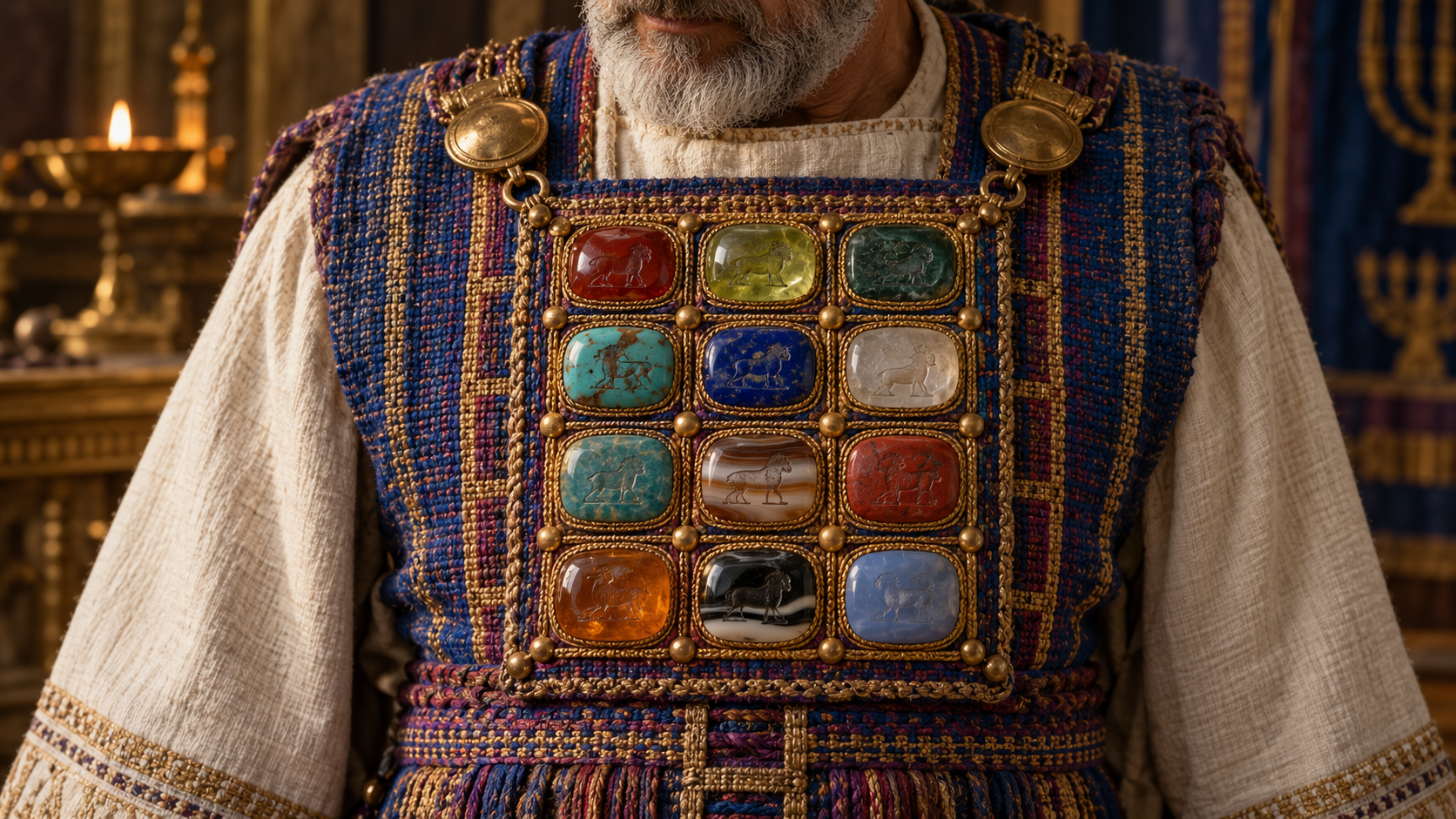
At its centre was a square textile object traditionally known as the ḥōšen, often translated as the breastpiece, breastplate, or more specifically the breastpiece of decision.
Into it were mounted twelve precious stones.
They were arranged in four rows.
Each stone represented one of the twelve tribes of Israel.
Each carried a tribal name engraved upon it like a seal.
The High Priest was to carry those names over his heart when entering the sanctuary.
For centuries, translators, rabbis, theologians, mineralogists, historians and gemmologists have tried to answer an apparently simple question:
What were the twelve stones?
The answer is surprisingly difficult.
Modern English translations provide familiar names such as carnelian, emerald, sapphire, amethyst, agate, beryl and jasper.
Older translations may offer ruby, topaz, carbuncle, diamond, ligure, onyx or chrysolite.
The problem is that the Hebrew gemstone vocabulary of the biblical texts developed in an ancient world whose systems of classifying stones were very different from modern mineralogy.
A word translated today as sapphire may not mean corundum sapphire.
A word now used in modern Hebrew for diamond may not have referred to diamond in antiquity.
And a stone translated as emerald may have belonged to an entirely different green material.
This makes the High Priest’s breastpiece much more than a religious jewellery story.
It is also an extraordinary case study in historical gemmology.
And it offers an important lesson for anyone studying ancient crystal beliefs:
A modern gemstone name printed in a translation is not automatically proof that the ancient text referred to the mineral carrying that name today.
Table of Contents
The Breastpiece in the Book of Exodus
The principal description appears in Exodus 28.
The breastpiece was to be made from materials also used in the ephod:
gold,
blue yarn,
purple yarn,
crimson yarn,
and fine twisted linen.
It was described as square and doubled.
Into it were placed four rows containing three stones each.
The Hebrew names are:
First row:
odem
pitdah
bareqet
Second row:
nophekh
sappir
yahalom
Third row:
leshem
shevo
achlamah
Fourth row:
tarshish
shoham
yashfeh
The text then provides the key to their religious significance.
There were twelve stones because there were twelve tribal names.
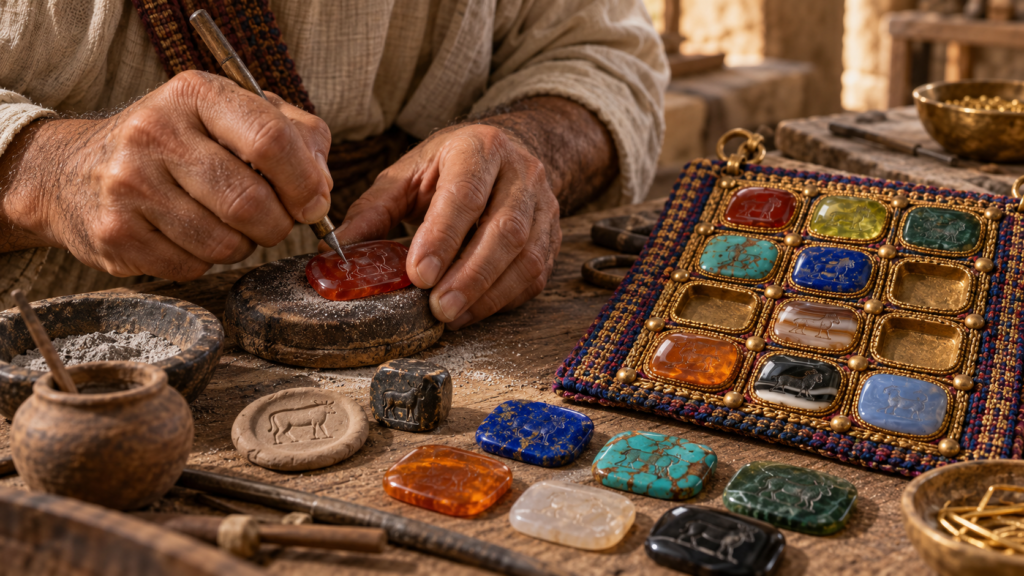
Each stone was to be engraved in the manner of a seal.
The breastpiece therefore did not merely display precious materials.
It carried names.
Twelve Stones, Twelve Tribes
The gemstones represented the tribes of Israel collectively.
This is essential.
Modern spiritual literature sometimes tries to assign an independent metaphysical property to each biblical stone:
one stone for courage,
another for healing,
another for prosperity,
another for protection.
But that is not what Exodus 28 actually says.
The text focuses on correspondence between:
twelve stones
and
twelve names.
The High Priest carries these names when entering the sacred space.
Exodus 28:29 describes Aaron carrying the names of the Israelites on the breastpiece over his heart “for remembrance” before God.
The stones therefore participate in a theology of representation.
The priest does not enter only as an individual.
Symbolically, Israel enters with him.
Gemstones as Memory
This theme appears elsewhere in the priestly garments.
Two additional stones were mounted on the shoulders of the ephod.
Six tribal names were engraved on one and six on the other.
Exodus describes these explicitly as stones of remembrance.
This gives us a strong biblical basis for interpreting the engraved gemstones.
Their significance is connected with memory, identity and representation.
The stone preserves a name.
The name represents a people.
The priest carries that representation into sacred service.
This is much more historically grounded than assigning a generic “vibration” to each mineral.
Why Engrave a Gemstone?
The instruction says the names were to be engraved like a seal.
That comparison belongs naturally within the material culture of the ancient Near East.
Engraved stone seals had been used in neighbouring societies for thousands of years.
They could communicate identity.
Ownership.
Administrative authority.
And social status.
Cylinder seals and stamp seals were often carved from attractive or prestigious stones.
A seal could transform a person’s name or identity into a durable physical impression.
The breastpiece uses a related idea.
Each tribe is not merely associated with a colour.
Its name is permanently cut into a prestigious stone.
Gemstone and Identity Become One Object
Consider what engraving does to a gemstone.
Before engraving, the stone is simply a precious natural material.
After engraving, it carries language.
The mineral and the name become one object.
That distinction is important.
The stone’s cultural meaning no longer comes only from:
colour,
rarity,
transparency,
or polish.
Its inscription gives it an additional identity.
A red stone and a blue stone may possess different appearances.
But in the breastpiece, what makes each one socially distinct is also the tribal name it bears.
The sacred object combines geology with writing.
No Original Breastpiece Has Been Archaeologically Recovered
An important limitation must be stated immediately.
There is no surviving archaeological breastpiece that can simply be taken to a gemmological laboratory and analysed.
We do not possess the twelve original stones described in Exodus.
There is therefore no opportunity to use:
Raman spectroscopy,
refractive-index testing,
chemical analysis,
microscopy,
or trace-element analysis
to establish their mineral identities directly.
Everything depends upon the interpretation of words.
This is why philology becomes so important.
Ancient Gem Names Are Not Modern Mineral Species
Modern gemmology classifies stones through measurable properties.
Chemical composition.
Crystal structure.
Optical behaviour.
Specific gravity.
Hardness.
Spectroscopy.
Microscopic characteristics.
Ancient stone terminology developed before those scientific systems existed.
A name might refer to:
colour,
appearance,
geographic origin,
use,
commercial category,
or another characteristic.
Several visually similar minerals may therefore have shared terminology.
Conversely, one mineral family might have been divided into several named categories based mainly on colour.
Translating such terminology into a single modern mineral name can produce false certainty.
The Translation Problem
The problem becomes obvious when different Bible translations are compared.
One translation may call bareqet emerald.
Another may translate a neighbouring word as carbuncle.
One translation identifies sappir as sapphire.
Another may interpret it as lapis lazuli.
Modern Hebrew uses yahalom for diamond.
Yet the biblical yahalom may have been something completely different.
These disagreements are not trivial.
They reflect thousands of years of linguistic change.
The Septuagint Complicated the Story
One of the most influential ancient translations of the Hebrew Bible was the Greek Septuagint.
Its gemstone vocabulary profoundly influenced later interpretation.
Greek gemstone names subsequently passed into other translation traditions.
But translating one ancient stone name into another ancient language does not necessarily solve the mineralogical problem.
The Greek translator was already interpreting the Hebrew.
Later translators then interpreted the Greek.
Modern readers can therefore inherit a chain of identification that appears traditional while remaining mineralogically uncertain.
This is one reason recent scholarship has returned to comparative linguistics, archaeology and historical trade data.
A Modern Translation Is Not a Gemological Laboratory Report
This point is crucial for Natural Gems Belgium.
When a contemporary English Bible prints the word:
emerald,
sapphire,
diamond,
or beryl,
that does not mean a laboratory identification has been established.
It means the translators selected an English word they considered appropriate for an ancient Hebrew term.
Some identifications are more plausible than others.
Some remain highly contested.
Readers should therefore distinguish:
translation certainty
from
mineralogical certainty.
They are not the same thing.
Was Biblical Sappir Really Sapphire?
This is one of the best examples.
The Hebrew word sappir clearly resembles the source of the English word sapphire.
That resemblance can encourage the assumption that the biblical stone must have been blue corundum.
But historical gemstone terminology complicates this.
In many ancient contexts, words related to sappir were associated with lapis lazuli.
Lapis was one of the most prestigious blue stones of the ancient Near East.
It had been imported over enormous distances from regions such as Badakhshan in present-day Afghanistan.
A major modern philological study by Ephraim S. Ayil therefore identifies biblical sappir with lapis lazuli rather than modern corundum sapphire.
This is not merely a colour question.
It involves historical vocabulary, ancient trade and material availability.
Lapis and the Divine Realm
The possibility that sappir refers to lapis lazuli also fits broader biblical imagery.
Exodus 24 describes a vision beneath the feet of the God of Israel resembling a pavement of sappir.
Ezekiel describes a throne-like appearance using the same stone terminology.
In the wider ancient Near East, lapis lazuli was frequently associated with extraordinary luxury and divine environments.
Mesopotamian literature describes divine spaces adorned with precious stones.
The intense celestial blue of lapis made it particularly effective in imagery involving the heavens and sacred splendour.
This does not prove every occurrence of sappir means lapis.
But it demonstrates why simply reading “sapphire” in English can conceal an important historical problem.
Was Yahalom Diamond?
Perhaps the most striking case is yahalom.
In modern Hebrew, yahalom means diamond.
This has led many readers to assume that the sixth stone in the breastpiece was a diamond.
Recent philological and archaeogemological research strongly challenges that identification.
Ephraim S. Ayil’s 2024 open-access study concludes that the identity of biblical yahalom remains unresolved.
More importantly, he argues that diamond is historically implausible.
Why?
Because diamonds available to the ancient world came principally from India.
They are not securely documented as ordinary gemstone material in the ancient Israelite context described by the biblical tradition.
There is also a technological problem.
The Engraving Problem
Exodus says that each breastpiece stone was engraved like a seal.
Diamond presents a major difficulty.
Diamond is extraordinarily hard.
It cannot simply be engraved with the same abrasive techniques used for softer ornamental stones.
If the twelve stones were all engraved with tribal names, a true diamond would have presented exceptional technological challenges.
This does not logically make engraving an ancient diamond impossible under every imaginable circumstance.
But it makes the familiar modern translation significantly less convincing.
The important conclusion is therefore not:
“We know what yahalom was.”
It is:
“We have strong reasons not to identify it casually as diamond simply because modern Hebrew uses the same word.”
A Recent Archaeogemological Reconstruction
Ayil’s 2024 study, Identifying the Stones of Classical Hebrew, combines comparative historical linguistics with information about which stones were actually available within the ancient Near Eastern world.
His proposed reconstruction of the breastpiece differs substantially from many familiar Bible translations.
Among his proposals are:
odem — carnelian
pitdah — peridot
bareqet — greenstone
nophekh — turquoise
sappir — lapis lazuli
yahalom — unidentified
leshem — amazonite
shevo — agate
achlamah — red jasper
tarshish — amber
shoham — onyx
yashfeh — blue chalcedony
This should not be treated as a final universally accepted list.
It is a recent scholarly reconstruction.
Its importance lies partly in demonstrating how different the results can become when modern mineral names are not simply inherited from earlier translations.
Where Did the Traditional Lists Come From?
The familiar lists did not appear from nowhere.
Generations of Jewish and Christian translators attempted to make sense of obscure stone names.
Ancient Greek translation influenced Latin.
Latin influenced later European traditions.
Rabbinic commentators developed additional interpretations.
Medieval lapidary literature introduced still more gemstone associations.
Eventually, the breastpiece became one of the most famous gemstone lists in Western religious culture.
But tradition and historical identification are different questions.
A gemstone may acquire a long religious association even if the original biblical stone represented a different mineral.
That later tradition is historically meaningful in its own right.
It simply belongs to a later stage in the story.
The Breastpiece Was More Than Twelve Stones
The Hebrew expression is commonly rendered breastpiece of decision or breastpiece of judgment.
This title becomes particularly important in Exodus 28:30.
The text instructs that the Urim and Thummim be placed inside or within the breastpiece.
Aaron was then to carry the instrument of decision concerning Israel over his heart before God.
The exact nature of the Urim and Thummim remains uncertain.
Biblical texts suggest that they functioned in some form of authorised decision-making or divination.
But the twelve gemstones themselves should not automatically be identified with the Urim and Thummim.
Did the Twelve Stones Light Up to Give Answers?
A popular later idea imagines the letters engraved on the gemstones illuminating in order to spell divine responses.
This is fascinating religious tradition.
But it is not what Exodus explicitly says.
The biblical text distinguishes the stones from the Urim and Thummim.
Later Jewish interpretation developed different explanations of how the breastpiece and the oracle functioned.
Some medieval commentators understood sacred writing or the divine name as being placed within the breastpiece.
Such traditions deserve study.
They should simply be distinguished from the earliest textual description.
The Difference Between Biblical Religion and Crystal Divination
The presence of an oracular element can easily be misunderstood through the lens of modern crystal spirituality.
A reader might imagine that the twelve stones acted as divinatory crystals because of their inherent energies.
That interpretation is not supported by the biblical passage.
The authority of the breastpiece belongs to the priestly and religious system described in the text.
The gemstones carry tribal names.
The Urim and Thummim belong to the process of decision.
The entire object operates within a sacred institutional context.
There is no statement that an emerald vibration, sapphire frequency or amethyst energy produces divine knowledge.
Did Individual Stones Possess Magical Powers?
Exodus does not provide a list of metaphysical properties for the twelve stones.
It does not say:
odem gives courage.
sappir produces wisdom.
achlamah heals emotion.
shoham protects against evil.
The religious significance of the stones lies primarily in their collective arrangement, inscriptions and priestly setting.
A recent philological study by Ayil specifically argues that the Hebrew Bible does not present the breastpiece as a collection of stones whose individual magical properties generate its sacred function.
This makes the biblical object fundamentally different from many modern crystal correspondences.
Collective Meaning Rather Than Individual Crystal Energy
Modern gemstone spirituality often focuses on the individual mineral.
What does amethyst do?
What does carnelian attract?
What does turquoise protect?
The breastpiece works differently.
Its central logic is collective.
Twelve stones.
Twelve names.
One priestly garment.
One community represented before the divine.
The symbolism depends upon plurality.
No tribe is represented by the entire breastpiece alone.
No one stone replaces the others.
The full object is complete because all twelve are present.
This can be read as one of the most sophisticated aspects of the design.
Difference is preserved.
Unity is created.
The Gemstones and the Divine Realm
A fascinating recent interpretation by biblical scholar Ilona N. Rashkow places the breastpiece within the wider gemstone imagery of the ancient Near East.
Ezekiel 28 describes an Edenic or divine environment ornamented with precious stones.
Many of the stones named there correspond to the same Hebrew terms appearing in the High Priest’s breastpiece.
Ancient Mesopotamian literature likewise describes divine landscapes containing gemstone trees and temples ornamented with precious materials.
Rashkow therefore proposes that the High Priest’s gemstone-rich clothing visually equips him for entry into the divine realm.
This is a scholarly interpretation rather than an explicit statement in Exodus.
But it provides an important cultural context.
Gemstones in the ancient Near East could signify more than personal wealth.
They could evoke the splendour of gods, temples and sacred space.
Precious Materials and Sacred Difference
The High Priest’s garments were intentionally exceptional.
Gold.
Fine textiles.
Intense colours.
Engraved stones.
These materials distinguished the priest visually from ordinary dress.
This principle is familiar across many historical religious traditions.
Sacred officials may wear unusual materials because their ceremonial role is different from everyday social activity.
The gemstones therefore contribute to the creation of sacred distinction.
Their rarity matters.
Their colour matters.
Their polish matters.
Their inscriptions matter.
And their placement over the heart matters.
Were the Stones Faceted?
Almost certainly not in the modern brilliant-cut sense.
The familiar faceted gemstone is the result of lapidary technologies and optical principles developed across much later historical periods.
Ancient Near Eastern stones were commonly:
polished,
engraved,
cut as beads,
fashioned as cabochons,
or shaped as seal stones.
The instruction to engrave the tribal names strongly suggests surfaces suitable for inscription.
Therefore, a historically plausible reconstruction of the breastpiece should not depict twelve modern brilliant-cut gems.
A round brilliant diamond next to an emerald-cut emerald and a precision-faceted sapphire may look attractive.
It is visually misleading.
Seal Engraving Changes the Reconstruction
The phrase “engraved like a seal” offers one of the best clues to the likely appearance of the stones.
Ancient Near Eastern seals often possessed smooth surfaces suitable for carving.
The stones may therefore have appeared more like carefully polished plaques, cabochons or seal stones than modern jewellery gems.
Their visual impact would have come from:
natural colour,
polish,
gold settings,
and engraved writing.
Not from modern pavilion facets or computer-optimised brilliance.
This distinction is particularly important when creating educational imagery.
The Ancient Near East Was a Gemstone Trading World
The biblical gemstone vocabulary developed within a region positioned between major ancient trade networks.
Egypt possessed access to several decorative stones and mineral resources.
Mesopotamia imported prestigious materials from surrounding regions.
Lapis lazuli could travel from Afghanistan.
Turquoise circulated from important mining regions including Sinai.
Carnelian appeared throughout ancient jewellery traditions.
Agates, chalcedonies and other siliceous materials were extensively worked.
Ancient Israel existed geographically between these powerful commercial worlds.
The vocabulary of its gemstones reflects this broader cultural environment.
Geography Helps Identify Ancient Stones
This is where archaeogemology becomes particularly useful.
Suppose a translation proposes a gemstone that was not known to circulate in the relevant historical region.
That does not automatically make the translation impossible.
But it creates a problem that must be addressed.
Conversely, if a proposed stone was widely available, linguistically plausible and archaeologically documented, the identification becomes stronger.
The best reconstruction therefore combines:
language,
archaeology,
geology,
trade history,
and lapidary technology.
No single discipline can solve the breastpiece alone.
One Stone Name Can Change Meaning Over Centuries
The yahalom problem illustrates semantic change perfectly.
Today the word means diamond in Hebrew.
That does not require it to have meant diamond in every earlier period.
Languages constantly change.
The English word “ruby” has historically been applied to some red gems that modern gemmology identifies as spinel.
The famous Black Prince’s “Ruby” in the British Crown Jewels is actually a red spinel.
Historical names can therefore survive even when mineralogical classification changes.
Biblical gem terminology deserves the same caution.
Colour Is Helpful—but Dangerous
Some biblical stone names may be related to colour.
Odem, for example, is associated etymologically with redness.
That makes a reddish stone plausible.
But several gemstones can be red.
Carnelian.
Red jasper.
Garnet.
Spinel.
Ruby.
Even glass can imitate many of them.
Colour alone cannot establish mineral identity.
Likewise, a green ancient stone might be:
malachite,
green chalcedony,
amazonite,
serpentinite,
or another material.
Ancient vocabulary and archaeological availability must also be considered.
The Problem with “Emerald”
Emerald is a particularly instructive example.
Modern emerald is the chromium- and/or vanadium-coloured green variety of beryl.
Its geological sources are restricted.
When an ancient term is translated as emerald, the question is not simply:
“Was the stone green?”
We must also ask:
Were emeralds from known geological deposits available to that culture at the relevant period?
Did the ancient term have a linguistic relationship with known words for green stones?
Did ancient writers use a broader colour category than modern gemmologists?
A translation may correctly communicate “valuable green stone” while being too specific mineralogically.
Why “Topaz” Can Also Be Misleading
Ancient topazios terminology does not map perfectly onto modern topaz.
Historically, the name was associated with material from the Red Sea region that is now often connected with peridot.
This is another warning.
A modern mineral name can descend from an ancient word while changing its mineralogical referent over time.
Consequently, reading “topaz” in an ancient translation does not always mean the aluminium fluorosilicate mineral recognised as topaz today.
Historical gemmology demands attention to terminology in its own period.
The Breastpiece and the Heart
Exodus repeatedly emphasises that the breastpiece was worn over the heart.
The text states that Aaron was to carry the names of Israel there when entering the sanctuary.
This imagery naturally encourages symbolic interpretation.
The people are represented close to the priest’s heart.
The instrument of decision is also carried there.
Yet caution remains appropriate.
The modern idea that gemstones worn over the chest must correspond to the Heart Chakra belongs to a different religious history.
The biblical breastpiece should not be reinterpreted as an ancient chakra device.
The Heart Chakra Is Not the Biblical Context
Modern spiritual diagrams may assign green stones to the heart centre.
Emerald is often associated with the Heart Chakra.
If a translation identifies one breastpiece stone as emerald, a modern practitioner may therefore assume the breastpiece contained deliberate chakra symbolism.
There is no historical evidence for this.
Chakra traditions developed within South Asian religious and philosophical systems.
The priestly garments of Exodus belong to an ancient Israelite textual and ritual tradition.
Connecting the two without evidence merges unrelated systems.
The physical position over the chest is not enough to establish continuity.
Are the Twelve Stones the Origin of Modern Birthstones?
The breastpiece has often been connected with later traditions of twelve birthstones.
Over time, commentators associated sets of twelve stones with:
tribes,
months,
zodiac signs,
and later Christian apostles.
Eventually, gemstone lists became linked with modern birthstone traditions.
But the modern commercial birthstone system is not simply the unchanged breastpiece of Exodus.
Centuries of translation, reinterpretation and commercial standardisation separate them.
The existence of twelve stones encouraged later symbolic correspondences.
The exact mineral identities and modern monthly assignments, however, are later developments.
Modern Lists Create an Illusion of Ancient Precision
This is one of the most interesting consequences of the breastpiece tradition.
Modern graphics often display twelve perfectly identified gemstones:
Ruby.
Topaz.
Emerald.
Turquoise.
Sapphire.
Diamond.
Jacinth.
Agate.
Amethyst.
Beryl.
Onyx.
Jasper.
The diagram looks authoritative.
The neatness is deceptive.
It combines translation choices from different historical periods with modern mineral names.
The original Hebrew text is far less mineralogically precise to us today.
A visually confident chart may therefore conceal substantial scholarly uncertainty.
Does Uncertainty Reduce the Religious Meaning?
Not at all.
The original theological symbolism does not depend upon modern gemmologists identifying every mineral.
We know what the stones did within the text.
They represented the tribes.
They carried engraved names.
They formed part of sacred priestly clothing.
They were worn before God as remembrance.
Their exact geological species is fascinating—but secondary to that religious function.
In some ways, acknowledging uncertainty improves interpretation.
It prevents the modern gemstone industry from replacing the ancient text with a commercially convenient list.
A Better Way to Think About the Twelve Stones
Rather than asking:
“Which crystal property belongs to each tribe?”
the biblical description encourages different questions:
Why were twelve different stones chosen?
Why were the names engraved?
Why were precious materials necessary?
Why were they carried over the heart?
Why did the priest wear the collective identity of Israel when entering sacred space?
These questions remain grounded in the text.
And they reveal a much richer symbolic structure.
Diversity Within Unity
The breastpiece contains twelve different stones rather than twelve identical stones.
That diversity is visually important.
Different colours.
Different materials.
Different names.
Yet all are arranged within one object.
For a modern reader, this can provide an elegant reflection on collective identity without claiming an ancient doctrine not stated in the text.
The tribes retain their individual names.
Yet the High Priest carries them together.
Difference is preserved within unity.
That interpretation arises directly from the structure of the object rather than from invented gemstone energies.
Preciousness as Religious Language
Why gemstones at all?
Why not write the names on ordinary clay?
The use of valuable materials communicates importance.
Across the ancient Near East, precious stones belonged to elite and sacred contexts.
Temples, royal jewellery and divine imagery employed rare materials because rarity and splendour helped distinguish exceptional spaces and people.
The breastpiece belongs within that wider visual environment.
The tribes are not represented on disposable substances.
Their names are engraved on precious stones framed in gold.
The material communicates dignity.
Does a Sacred Gemstone Need Magical Power?
No.
An object can be sacred because of:
what it represents,
where it is used,
who is authorised to wear it,
what is written upon it,
and the religious system in which it participates.
The breastpiece demonstrates this clearly.
Its sacred function does not require the stones to emit invisible energies.
Their significance arises from the complete ritual object.
This is an important principle for studying gemstone spirituality historically.
The Urim and Thummim: A Separate Mystery
The Urim and Thummim remain among the most enigmatic objects in the Hebrew Bible.
Exodus places them within the breastpiece.
Other biblical passages associate them with obtaining decisions.
Exactly what they looked like and how they functioned is uncertain.
Later Jewish traditions proposed different explanations.
Some understood them through sacred names or written formulas.
Others focused on revelatory processes associated with the priestly garment.
What should be avoided is the unsupported assumption that the twelve stones themselves functioned like modern divination crystals.
The biblical text does not say that.
Later Jewish Interpretation
Jewish interpretation of the breastpiece continued for centuries.
Rabbinic and medieval commentators examined:
the stone names,
the tribal arrangement,
the Urim and Thummim,
and the symbolism of the priestly garments.
These later traditions are important parts of Jewish intellectual history.
They should not be flattened into one timeless explanation.
A medieval interpretation is evidence for medieval Jewish thought.
It is not automatically evidence for how an early Israelite audience understood the object.
Dating interpretations carefully preserves the historical development of the tradition.
Later Christian Symbolism
Christian writers also developed gemstone symbolism.
The Book of Revelation describes the foundations of the New Jerusalem using twelve precious stones.
Later interpreters connected gemstones with apostles, virtues and celestial symbolism.
Such traditions contributed to the enormous symbolic history of gems in European Christianity.
They are historically significant.
But they should not be retroactively read into Exodus.
The breastpiece belongs first to the Israelite/Jewish textual tradition from which these later interpretations developed.
A Modern Spiritual Reflection Without Inventing Ancient Beliefs
The breastpiece can still inspire contemporary reflection without pretending that modern practices are ancient.
Imagine twelve natural stones.
Do not assign healing powers to them.
Instead, let each represent a person, community, responsibility or value that matters to you.
The practice is inspired by the textual idea of carrying names.
One stone might represent family.
Another friendship.
Another responsibility.
Another remembrance.
The important element is not the mineral’s supposed energy.
It is what you choose to remember.
This would be a modern reflective practice inspired by biblical symbolism, not a reconstruction of ancient Israelite ritual.
That distinction should remain explicit.
Gemmology and Religious Studies Ask Different Questions
A gemmologist asks:
What mineral is this?
What is its refractive index?
What is its chemical composition?
How was it formed?
Is it natural?
Was it treated?
A historian of religion asks:
What did this object represent?
Who could wear it?
What text describes it?
What ritual did it belong to?
How did later communities interpret it?
Neither discipline replaces the other.
The breastpiece becomes particularly fascinating precisely because the two forms of inquiry meet.
What Can We Say with Confidence?
Several conclusions are strongly supported.
The Book of Exodus describes a priestly breastpiece containing twelve different precious stones.
The stones are arranged in four rows.
Each corresponds to one of the twelve tribal names.
Each is engraved like a seal.
The High Priest carries those names over his heart as remembrance before God.
The breastpiece is also associated with the Urim and Thummim, whose precise physical nature remains uncertain.
No original breastpiece has been recovered for direct gemmological analysis.
The identities of several Hebrew gemstone names remain disputed.
Modern English translations should therefore not be treated as laboratory identifications.
Recent philological and archaeogemological research proposes substantially different mineral identifications from many traditional translations.
In particular, modern Hebrew yahalom does not provide sufficient evidence that the biblical stone was diamond.
Likewise, biblical sappir may refer to lapis lazuli rather than corundum sapphire.
The biblical text itself does not assign individual healing, chakra or energetic properties to the twelve gemstones.
What Remains Uncertain?
We do not know the mineral identity of every stone with certainty.
We do not possess the original stones.
We do not know exactly how the inscriptions looked.
We cannot reconstruct the breastpiece’s precise colours confidently unless the stone identifications are established.
We do not fully understand the physical nature or mechanism of the Urim and Thummim.
And we cannot assume later Jewish, Christian or modern metaphysical interpretations existed unchanged in the earliest period represented by the text.
These uncertainties are not weaknesses.
They are the reality of responsible historical research.
Conclusion: Twelve Stones, Twelve Names, One Sacred Memory
The High Priest’s breastpiece is one of the most compelling gemstone objects described in religious literature.
Its twelve stones have inspired centuries of translation, theological interpretation and gemmological speculation.
Yet perhaps the most important element has often been overshadowed by the search for mineral names.
The stones carried people.
Not literally.
But through their names.
Each gemstone represented part of a community.
Each inscription preserved an identity.
Together, the twelve stones were carried over the heart of the High Priest when he entered sacred space.
That symbolism is clearly documented.
The exact mineralogical identities are not.
At Natural Gems Belgium, that distinction matters.
We can appreciate the possibility that sappir was lapis lazuli rather than sapphire.
We can examine why yahalom was probably not diamond.
We can compare ancient trade networks and lapidary technology.
But we should not replace uncertainty with attractive-looking claims.
Nor should we convert the breastpiece into a modern chakra chart or crystal-healing system.
Its history is already more interesting than that.
The twelve stones demonstrate that the spiritual meaning of a gemstone can come not from an invisible force supposedly contained within the mineral, but from the name, memory, community and sacred purpose entrusted to it.
The minerals remain mysterious.
The symbolism does not.
Twelve stones.
Twelve names.
And one remarkable attempt to carry an entire people into sacred remembrance.
References & Further Reading
1. Sefaria — Exodus 28
https://www.sefaria.org/Exodus.28?lang=en
Source description: Primary biblical text containing the principal description of the High Priest’s breastpiece, the twelve stones, their engraved tribal names and the Urim and Thummim. Sefaria’s translation explicitly notes that the identities of several gemstone terms are uncertain.
This is the essential primary-text reference for the article.
2. Sefaria — Exodus 39
https://www.sefaria.org/Exodus.39
Source description: Second biblical description of the construction of the priestly garments. It repeats the four rows of stones and describes the engraved shoulder stones as stones of remembrance for the Israelites.
Useful for comparing the instructions of Exodus 28 with the account of their execution.
3. Ephraim S. Ayil — Identifying the Stones of Classical Hebrew: A Modern Philological Approach
https://www.degruyterbrill.com/document/isbn/9789004678002/html
Source description: Open-access scholarly monograph published by Brill in 2024. Ayil combines comparative historical linguistics with archaeological and gem-material evidence to reassess stone terminology in the Hebrew Bible.
The study is particularly important because it challenges several familiar modern identifications and explicitly addresses the stones of the priestly breastpiece.
4. Ephraim S. Ayil — The Ḥōšen: Priestly Breastplate
https://brill.com/display/book/9789004678002/BP000002.pdf
Source description: Dedicated chapter from Ayil’s open-access study examining the High Priest’s breastpiece and the history of efforts to identify its twelve stones.
Especially valuable for distinguishing the gemstone-bearing breastpiece from later ideas concerning magical stones and the Urim and Thummim.
5. Ephraim S. Ayil — Yāhălōm
https://brill.com/display/book/9789004678002/9789004678002_webready_content_text.pdf
Source description: The book’s chapter on yahalom explains why the biblical term cannot responsibly be assumed to mean diamond simply because that is its meaning in modern Hebrew.
Ayil argues that diamond is historically and technologically implausible in this context and concludes that the ancient stone’s identity remains unresolved.
6. Hong Kong Baptist University — Identifying the Stones of Classical Hebrew
Source description: Academic research record for Ephraim Ayil’s peer-reviewed monograph. Summarises the methodology of combining comparative linguistics with archaeogemological data rather than relying uncritically on ancient translations.
Useful institutional reference for the scholarly basis of the revised gemstone identifications.
7. Ilona N. Rashkow / TheTorah.com — Gemstones of the Gods: The Symbolism of the High Priest’s Breastpiece
https://www.thetorah.com/article/gemstones-of-the-gods-the-symbolism-of-the-high-priests-breastpiece
Source description: Scholarly 2026 article examining the gemstone symbolism of the breastpiece within the wider religious imagery of the ancient Near East.
Rashkow compares the stones of Exodus with gemstone imagery in Ezekiel, Mesopotamian literature and descriptions of divine environments, proposing that the gemstone-rich priestly garment visually associates the High Priest with sacred space.
8. Søren Lorenzen / TheTorah.com — Colors of Holiness: Clothing the High Priest to Match the Tabernacle
https://www.thetorah.com/article/colors-of-holiness-clothing-the-high-priest-to-match-the-tabernacle
Source description: Scholarly examination of the colours and materials used in the High Priest’s garments.
Discusses the engraved shoulder stones and the twelve coloured breastpiece stones within the wider visual programme of the Tabernacle.
Useful for understanding the stones as part of an integrated sacred garment rather than isolated gems.
9. Cambridge University Press — Exodus
https://www.cambridge.org/core/books/exodus/0BBD532445DFE6B3D2BA9CB53E3E6906/listing
Source description: Academic biblical commentary providing the broader textual context for the Tabernacle, priestly vestments and gemstones specified for the ephod and breastpiece.
Useful for placing the precious stones within the complete priestly and sanctuary system described in Exodus.
10. The Metropolitan Museum of Art — Ancient Near Eastern Cylinder Seal
https://www.metmuseum.org/art/collection/search/327321
Source description: Museum record demonstrating the long ancient Near Eastern tradition of engraving precious and decorative stones as seals.
The Met explains that such seals functioned as marks of ownership or identification. This provides useful material-cultural context for Exodus’ instruction that the tribal names be engraved into the breastpiece stones “like seal engravings.”
11. The Metropolitan Museum of Art — Ancient Art in Miniature: Near Eastern Seals
Source description: Metropolitan Museum publication examining ancient Near Eastern seal materials, carving and imagery.
Discusses the extensive movement of valuable stones through ancient trade networks, including lapis lazuli from Badakhshan, and provides broader archaeological context for the use of gemstones as engraved prestige objects.
12. The Metropolitan Museum of Art — Sumerian Necklace from Ur
https://www.metmuseum.org/toah/works-of-art/33.35.47
Source description: Museum documentation of jewellery from the Royal Cemetery at Ur incorporating gold and lapis lazuli.
Provides archaeological evidence for the high prestige, sophisticated working and long-distance circulation of coloured stones in the ancient Near East well before later modern gemstone classifications existed.
13. Gemological Institute of America — Birthstones
https://www.gia.edu/birthstones
Source description: GIA overview of the modern birthstone tradition and the gemstone lore associated with individual months.
Useful as a modern comparison demonstrating how later gemstone correspondences and symbolic traditions differ from the original biblical description of twelve engraved tribal stones.
Historical Tradition, Gemmology and Modern Spiritual Interpretation
The twelve stones of the High Priest provide an excellent example of why different categories of evidence must remain separate.
Textually established: Exodus describes twelve stones arranged in four rows and engraved with twelve tribal names.
Religiously established within the text: The High Priest carries these names over his heart as remembrance before God.
Textually established: The Urim and Thummim are associated with the breastpiece and with priestly decision-making.
Historically uncertain: The exact physical nature of the Urim and Thummim remains unknown.
Gemmologically uncertain: Several Hebrew gemstone names cannot be identified securely with modern mineral species.
Philologically plausible but still scholarly reconstruction: Recent research proposes identifications including carnelian, peridot, turquoise, lapis lazuli, amazonite, agate, red jasper, amber, onyx and blue chalcedony, while leaving yahalom unidentified.
Historically problematic: Identifying biblical yahalom automatically as diamond simply because modern Hebrew uses that meaning.
Historically plausible: Biblical sappir may have referred to lapis lazuli rather than modern corundum sapphire.
Not stated by Exodus: Individual chakra, healing, manifestation or energetic properties for each breastpiece stone.
Later tradition: Jewish and Christian commentators developed additional interpretations of the stones, the Urim and Thummim and their symbolic correspondences over many centuries.
Modern metaphysical interpretation: Contemporary spiritual systems sometimes assign universal energies, chakras or healing functions to gemstones now identified with the breastpiece.
Scientific limitation: No established scientific evidence demonstrates that gemstones emit supernatural forces capable of healing, divination or chakra activation.
The historical and religious importance of the breastpiece does not require such claims.
Its documented symbolism is already exceptionally powerful:
precious natural materials,
engraved human identities,
collective representation,
sacred remembrance,
and a priest carrying the names of an entire community over his heart.