The first documented alexandrite specimens were small crystal fragments from an emerald-mining district in Russia’s Ural Mountains. The surviving evidence places the find in 1833. A letter described the daylight-to-candlelight change in 1834, a Scottish physicist published an account of the effect in 1835, and a Russian scientific society recorded the name alexandrite in 1842. Each date answers a different question about how the gemstone entered the historical record, contributing to our understanding of alexandrite history. (1, 2)
The later mining history also changed as new evidence emerged. A gemstone purchased by a London museum in 1873 and a second one examined in Paris more than a century after its donation show how early Sri Lanka supplied fine alexandrite. In Brazil, field reporting from the late 1980s documents how one small mining locality transformed the supply of the gem. Together, those records offer a history built from letters, specimens, field observations and laboratory measurements. (3–5)
The rich and varied alexandrite history unfolds through the ages, revealing how this remarkable gemstone has captivated gem enthusiasts and collectors alike.
Table of Contents
The first documented find in the Ural emerald mines
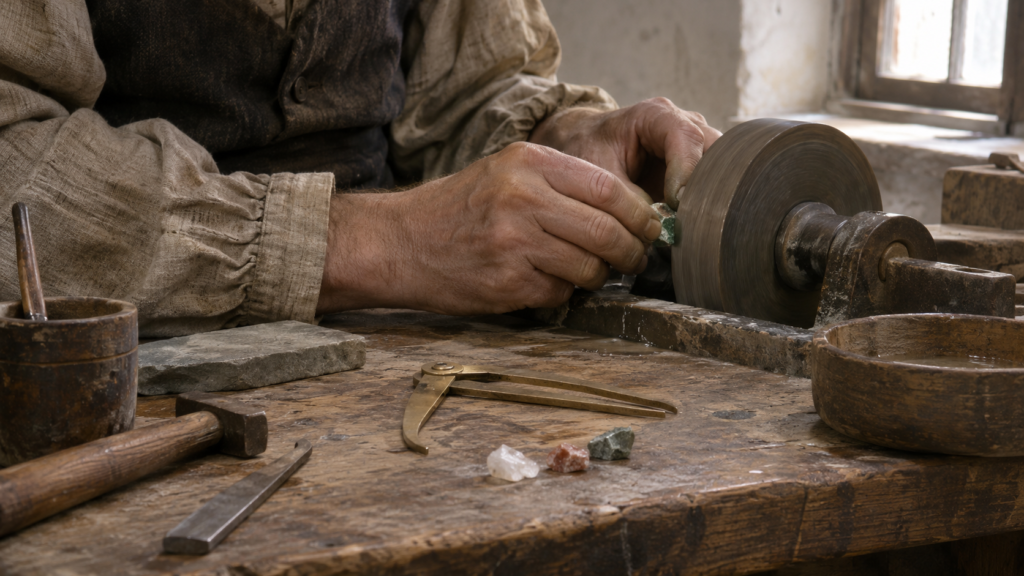
The story begins in the Tokovaya emerald-mining district, near present-day Yekaterinburg. The emerald workings were already being developed in 1831. At the time, Yakov Vasilievich Kokovin (1784–1840) directed the Yekaterinburg lapidary works and supervised mining in the district, particularly around Sretensky. He had trained at the Academy of Arts in St Petersburg and succeeded his father at the lapidary works in 1818. His professional background combined stoneworking, knowledge of local materials and direct access to the mines. (1)
In 1833, small, unusual crystals were recovered during the emerald workings. An archival study by Karl Schmetzer and Evgenii Burlakov credits Kokovin with recognising the significance of the material and getting specimens into the hands of people who could examine them. His June 1834 letter to Prince Gagarin helps establish that sequence. The surviving records leave the identity of the individual who physically recovered the first fragments unresolved. Sretensky is central to the district’s early mining history, while the published evidence places the first alexandrite find in the Ural emerald workings at district level. (1)
There is an earlier reference worth knowing. In 1832, the mineralogist Dmitrii Sokolov published a note about chrysoberyl from the Urals. Its significance is that the parent mineral was already reported from the region. The 1833 fragments and the specimen correspondence that followed provide the firmer starting point for the history of its colour-changing variety. (1)
How the specimens reached the scientists
Lev Alekseevich Perovskii (1792–1856) was vice-president of the imperial department that managed the estates and income of the ruling family. He also collected minerals. Through that position he received material from the Ural mines and circulated specimens for examination. In January 1834, he sent two small fragments to Nils Gustaf Nordenskiöld (1792–1866), a Finnish mineralogist and mining official. Perovskii had already noticed that the hardness and crystal form suggested chrysoberyl. (1)
In St Petersburg, Franz von Wörth (1786–1856) examined specimens submitted by Perovskii. The Russian Imperial Mineralogical Society’s later account credits von Wörth with identifying the mineral as chrysoberyl using crystal-angle measurements and blowpipe examination. Nordenskiöld investigated material from the same district and passed a specimen on to the Scottish physicist David Brewster (1781–1868). Each person contributed a different part of the identification. (1, 2, 10)
A larger batch recovered in 1834 made the optical behaviour easier to document. Some specimens were trillings, in which three crystal individuals are joined in a repeated twin arrangement. In a May 1834 letter to Nordenskiöld, Perovskii described crystals that looked dark green by daylight and red by candlelight. The letter provides a dated observation of the effect. The circumstances of the very first observation remain uncertain. (1)
Who first published the colour change?
In February 1835, David Brewster published the earliest known scientific description specifically concerned with the colour-changing Ural chrysoberyl. He used the term cymophane, a name then used for chrysoberyl, and described the optical behaviour of the sample Nordenskiöld had sent him. The paper predates the earliest documented publication of the name alexandrite. In 1839, the mineralogist Gustav Rose published a crystallographic description of Ural chrysoberyl, including its characteristic cyclic twins. (1, 2)
In 1842, an anniversary volume of the Russian Imperial Mineralogical Society documented Nordenskiöld’s proposal to name the variety in honour of Crown Prince Alexander Nikolayevich, the future Tsar Alexander II. The frequently retold birthday story associates the discovery with the prince’s coming-of-age celebrations in April 1834. The chronology in the surviving correspondence puts the first known specimens in 1833 and records fragments already travelling to Nordenskiöld in January 1834. It is possible to date the public naming record to 1842, while the date of any earlier private discussion remains uncertain. (1)
Why alexandrite changes colour
Alexandrite is a variety of chrysoberyl, an orthorhombic beryllium aluminium oxide with the formula BeAl₂O₄. Some aluminium sites in the crystal structure are occupied by trivalent chromium, Cr³⁺. The chromium produces selective absorption in the visible spectrum, including a strong band in the yellow region. In an alexandrite with a pronounced change, the spectrum transmitted by the stone has separated regions towards the green and red. (3, 6)
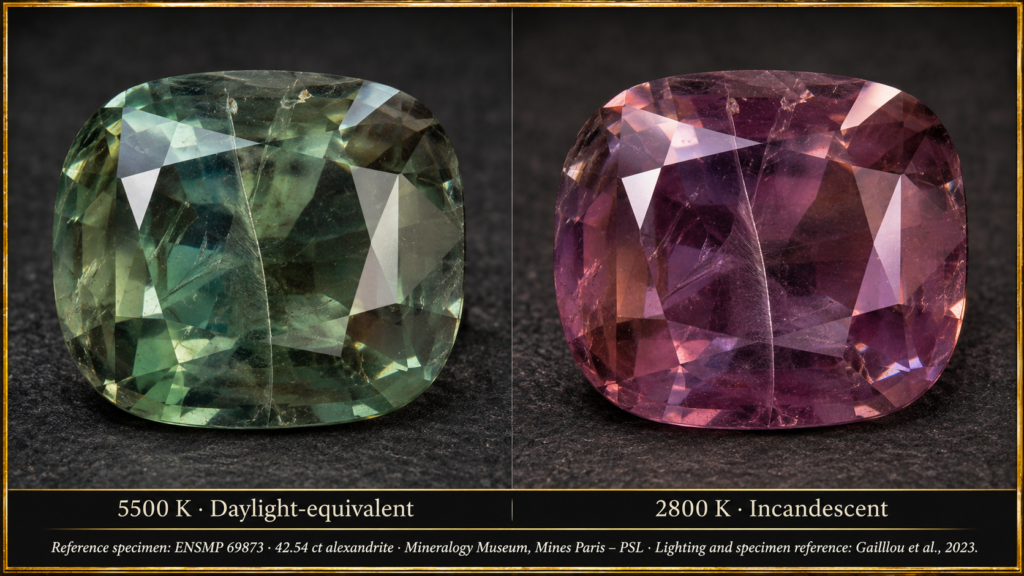
Daylight and incandescent light supply different proportions of those wavelengths. Under daylight-equivalent illumination, the green or blue-green contribution can dominate. A tungsten lamp or candle supplies proportionally more long-wavelength light, and red, purplish red or reddish purple can dominate. A 2020 study modelled why the change can remain striking even after the eye adapts to the illumination. The absorption band separates the green and red contributions sufficiently that normal visual colour adaptation can leave a large difference in perceived hue. The strength and exact colours depend on the specimen, its orientation and the spectra of the light sources. (3, 6)
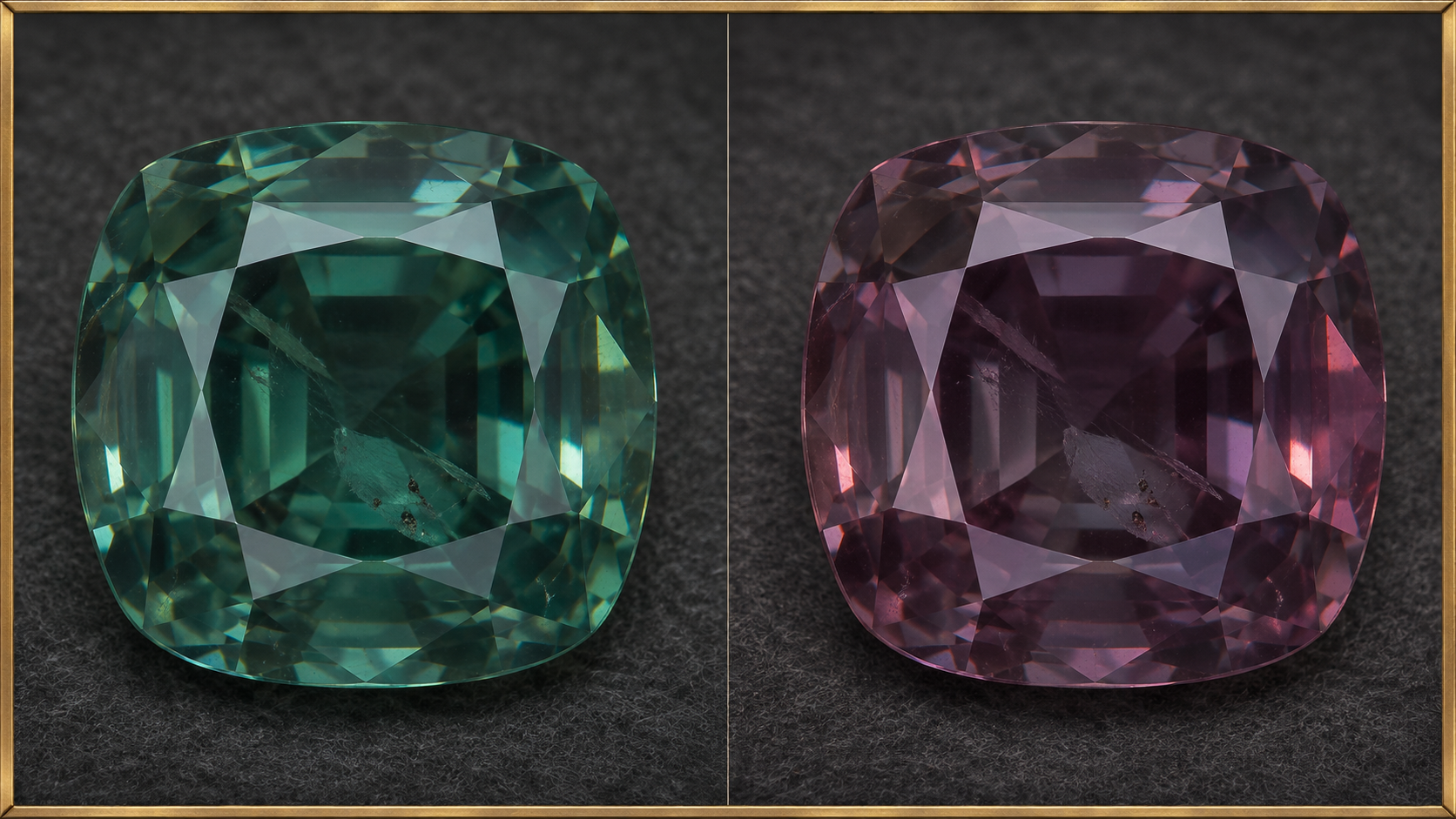
Pleochroism is a second property of alexandrite. It can be examined by comparing light travelling through different directions in the crystal. To illustrate the alexandrite effect itself, the cleanest comparison is to hold a single specimen in a fixed orientation, keep the viewing geometry consistent and change the illumination. A side-by-side view made this way enables the reader to follow the same facets and inclusions through both photographs. (3, 6)
From the first district to new sources
Russia – Sretensky, Krasnobolotnoye and Mariinskoye
The early workings around Sretensky, also called Sretenskoye or Sverdlovskoye in different sources, were part of a wider belt of emerald deposits. Krasnobolotnoye became known for important alexandrite specimens in the late 1830s. Mariinskoye, also encountered as Malyshevskoye in the literature, developed as the district’s largest mining operation historically. An 1853 geological map by C. Grewingk, published in 1854, shows how several of these workings were distributed along the same mining belt. It gives a much better sense of the discovery landscape than a single pin on a modern map. (1, 3)
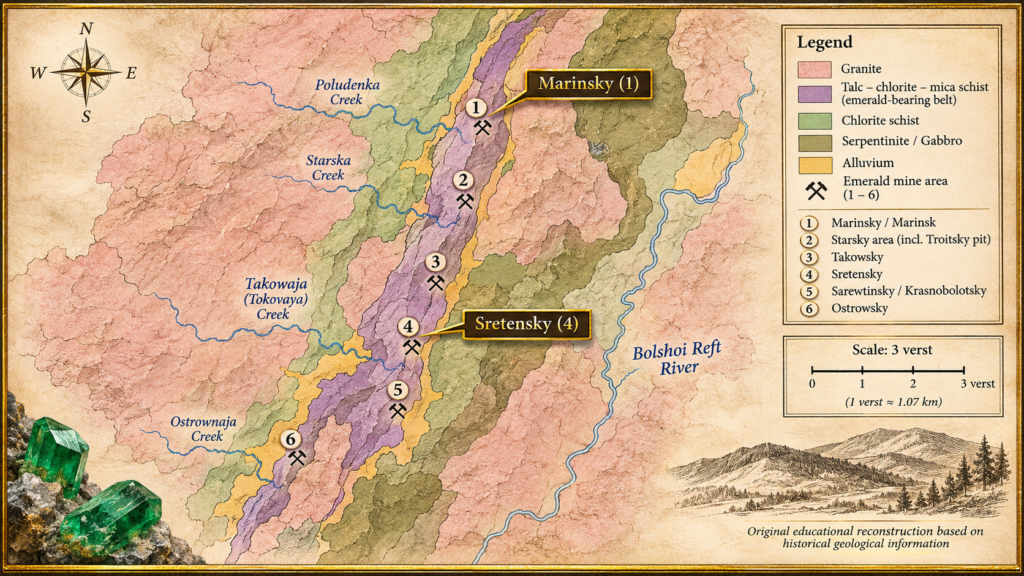
The district also illustrates the geological association between alexandrite and emerald. Beryllium-bearing fluids interacting with suitable host rocks can produce different minerals as local conditions vary. Emerald is a silicate, while chrysoberyl is an oxide. Small changes in the local chemical environment can favour one over the other, helping explain why different workings in the same district earned different reputations. A recent Gems & Gemology geological review describes emerald as the principal product at Mariinsky-Priisk, with alexandrite recovered as a by-product. (3, 7)
Sri Lanka – the nineteenth-century specimens and the Pelmadulla report
Alexandrite has been recovered from Sri Lanka’s secondary gem deposits. In this setting, weathering releases crystals from their original rocks, and transport and sedimentation concentrate some of them in gem-bearing gravels. The locality where a gem is recovered can therefore differ from the rock in which it originally crystallised. Published accounts identify the Ratnapura district and Southern Province among the relevant areas. (3, 4)
The nineteenth-century evidence is unusually revealing. Research published in 2023 notes that London’s Natural History Museum purchased a 43.18 ct alexandrite attributed to Sri Lanka in 1873. The same study examined a 42.54 ct stone donated in 1882 by the French lapidary Henri Garreaud to the mineralogy museum of the Paris School of Mines. Its original register recorded only a broad geographical designation. Microscopy, spectroscopy and trace-element analysis, including relatively high iron and gallium, led the authors to infer a Sri Lankan origin. That is a modern laboratory attribution of a historical object. The exact recovery locality remains open. (4)
In 1923, fine alexandrite was reported from the Pelmadulla deposits in the Ratnapura district. This is an important named-locality milestone. The museum records show that Sri Lankan material was already known decades before that report. (3, 4)
Tanzania – from Lake Manyara’s bedrock to Tunduru’s gravels
Material from Lake Manyara entered the market in the 1960s. It is associated with a primary deposit, with alexandrite occurring in phlogopite-bearing schist. Tunduru, in southern Tanzania, represents a different geological setting. Its material is recovered from secondary alluvial deposits. Alexandrite from Tunduru was reported alongside other gems from the area at the Tucson show in 1996. These two localities illustrate how the same variety can reach the surface through very different geological histories. (3)
Brazil – Malacacheta and the Hematita discovery
The Malacacheta area of Minas Gerais produced fine alexandrite from the mid-1970s, with peak production in the early 1980s. The next major development came at Lavra de Hematita. Keith Proctor’s field account, published in 1988, traces the rise of the Hematita material to October 1986. A later GIA review gives 1987 as the discovery year. Taken together, the publications place the turning point in 1986–87, with a difference in the year used to date it. (3, 5)
One documented Hematita specimen is the 17.08 ct Whitney Alexandrite, now at the Smithsonian’s National Museum of Natural History. The same cushion-cut specimen appears teal under daylight and raspberry-coloured under incandescent illumination in the museum’s published comparison. It gives a concrete example of the quality and optical behaviour behind Hematita’s importance. (8)
India and the wider source record
Indian alexandrite was known by the 1980s, with production subsequently documented in several regions. Published research also records material from Zimbabwe, Madagascar and Myanmar. These records concern deposits of different sizes and degrees of documentation. A dated specimen, a mine mentioned in a survey and a locality with sustained production each establish a different kind of milestone. (3, 9)
When a colour-changing stone also has a cat’s eye
Some alexandrites additionally display chatoyancy. In a suitably oriented cabochon, parallel internal needles or channels can concentrate reflected light into one bright band. The band runs across the dome and appears to move when the stone or a small light source moves. The stone can still change its overall hue as the illumination changes. In that specimen, the cat’s eye and the colour change are two independently observable phenomena. (5, 11)
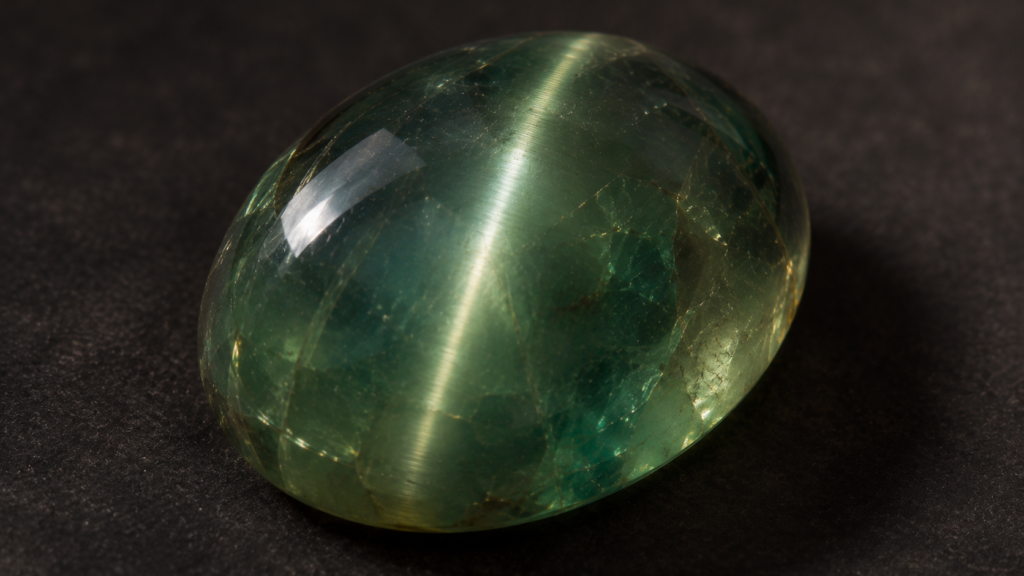
Proctor’s 1988 report already documents natural cat’s-eye alexandrites cut from Hematita material. That establishes a publication date for specimens from that locality. The identity and discovery date of the earliest natural cat’s-eye alexandrite worldwide remain unresolved in the sources used here. Technical literature also describes exceptionally rare asterism in natural chrysoberyl, where intersecting light bands form a star. That broader chrysoberyl record leaves open the date of the first natural star specimen that also met the criteria for alexandrite. (5, 11)
How modern laboratories revisit an old discovery
A stone with a striking colour change can come from several countries. Modern origin studies compare reference specimens with documented provenance and use combinations of trace-element chemistry, microscopic inclusions and optical observations. A GIA study published in 2019 examined material from Russia, Sri Lanka, Brazil, Tanzania and India with this approach. Such results can support a geographical attribution. Connecting a historical gem to a specific mine or a particular mining year usually calls for additional collection, trade or field records. (3, 4)
The Paris specimen shows what this adds to the history. Its date of donation has been known since 1882. Its likely geological origin became clearer through testing published in 2023. Both pieces of evidence matter, and they answer different questions. The same principle applies to the beginning of the story. The 1833 find, the 1834 correspondence, the 1835 optical paper and the 1842 naming record together explain how unfamiliar crystals from an emerald mine became a recognised gemstone variety.
References & Further Reading
- Schmetzer, K. & Burlakov, E. V. (2021). The Discovery and Naming of Alexandrite and Phenakite: Separating Fact from Fiction. The Journal of Gemmology, 37(5), 496–513. Archival correspondence, early publications, biographies and the historical map of the Ural emerald district.
- Brewster, D. (1835). Notice of the Optical Properties of a New Mineral Supposed to Be a Variety of Cymophane. The London, Edinburgh, and Dublin Philosophical Magazine and Journal of Science, 6(32), 133–134. The link opens the digitised journal volume at the Biodiversity Heritage Library.
- Sun, Z., Palke, A. C., Muyal, J., DeGhionno, D. & McClure, S. F. (2019). Geographic Origin Determination of Alexandrite. Gems & Gemology, 55(4), 660–681. Locality histories, sample photography and analytical methods. For the early discovery chronology, see the later archival study in reference 1.
- Gaillou, E. et al. (2023). An Historical Alexandrite from the Mineralogy Museum of Paris School of Mines. The Journal of Gemmology, 38(8), 796–803. Study of the 42.54 ct specimen donated in 1882 and evidence for nineteenth-century Sri Lankan alexandrite.
- Proctor, K. (1988). Chrysoberyl and Alexandrite from the Pegmatite Districts of Minas Gerais, Brazil. Gems & Gemology, 24(1). Contemporary reporting on Malacacheta, Lavra de Hematita and natural cat’s-eye material.
- Xie, F. et al. (2020). Explanation of the Colour Change in Alexandrites. Scientific Reports, 10, 6130. The optical mechanism and the contribution of human colour adaptation.
- Gemological Institute of America. The Diversity of Gemstone Deposits. Gems & Gemology. Geological context for the association of emerald and alexandrite and a recent account of the Ural district.
- Smithsonian National Museum of Natural History. Whitney Alexandrite. Museum record and two-light comparison for a documented Hematita specimen.
- Gemological Institute of America. Field Gemology: Building a Research Collection and Understanding the Development of Gem Deposits. Field context for Brazilian, Indian and other alexandrite sources.
- The Metropolitan Museum of Art. Sir David Brewster, by Hill and Adamson, circa 1844. Public-domain portrait and biographical context.
- Schmetzer, K. et al. (2016). Characterization of Oriented Inclusions in Cat’s-eye, Star and Other Chrysoberyls. The Journal of Gemmology, 35(1), 28–54. Technical study of the structures associated with chatoyancy and asterism.