
Table of Contents
The Stone That Could Be Worth More Than Its Golden Container
Imagine entering the private collection of a wealthy European noble during the late seventeenth century.
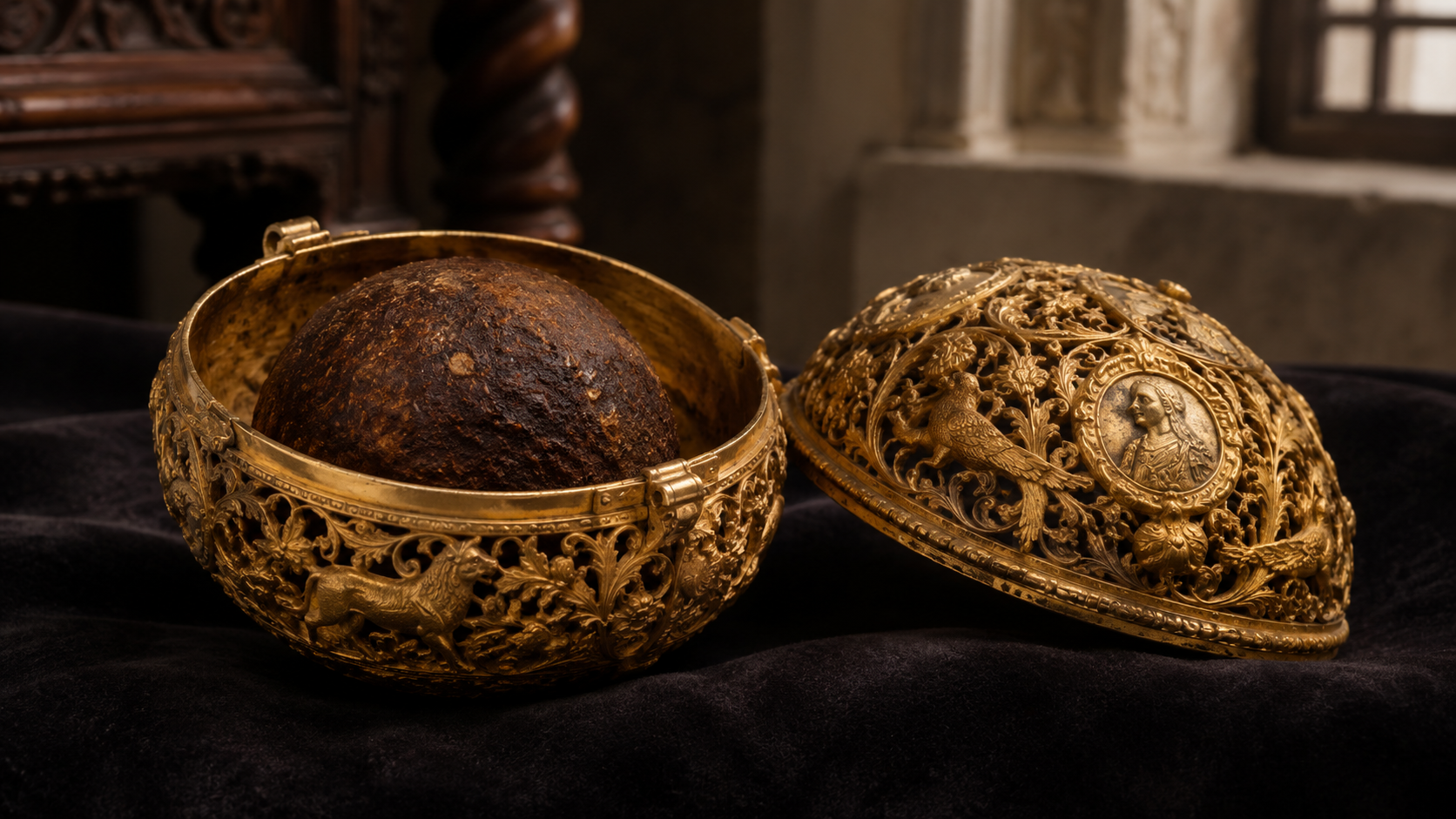
Among precious vessels, imported curiosities and finely crafted objects stands a small, egg-shaped container made from gold.
Its surface is covered with delicate openwork decoration. Tiny animals and curling foliage appear among the metal ornaments. The craftsmanship alone would make it an extraordinary possession.
Yet the most valuable object is concealed inside.
It is a brownish, rounded substance known as a Goa stone.
Unlike a sapphire, ruby or emerald, this stone was not extracted from a geological deposit. It was deliberately manufactured by combining several ingredients, potentially including animal substances, resins and powdered precious gems.
Its reputation was remarkable.
People believed that a small quantity scraped from its surface and mixed with a drink could counteract poisoning or treat serious illness.
These claims were never established through modern clinical science. Nevertheless, they helped make Goa stones prestigious objects in early modern Europe.
The Metropolitan Museum of Art preserves an exceptional Goa stone and gold case dating from the late seventeenth or early eighteenth century. Its existence reveals how medicine, religious institutions, precious materials and luxury craftsmanship intersected in the Portuguese colonial world.
The history of Goa stones demonstrates how gemstones could acquire supposed medicinal and protective significance through cultural beliefs, medical theories and religious networks—without possessing scientifically demonstrated supernatural powers.
Their story belongs to a fascinating chapter in the history of natural materials, when the distinction between medicine, alchemy, religious devotion and luxury collecting was often very different from that of today.
What Exactly Is a Goa Stone?
A Goa stone was a manufactured medicinal compound intended to imitate the highly valued natural bezoar.
Natural bezoars are concretions that develop within the digestive systems of certain animals.
They can contain compacted hair, plant fibres, mineral substances and other materials, depending upon their formation.
Historically, bezoars were particularly associated with goats and other ruminants.
They acquired a reputation as antidotes to poison.
Goa stones were artificial alternatives.
Rather than forming inside an animal, they were prepared by combining selected substances into a compact, rounded object.
The Wellcome Collection explains that Goa stones could include ingredients such as bezoar material, resin, musk and crushed precious gemstones.
The exact recipes were not necessarily identical.
Their compositions could vary according to producer, period and intended use.
This makes it important to distinguish between a natural bezoar and a manufactured Goa stone.
Although both were associated with historical medical beliefs, they were materially different objects.
Why Were They Called Goa Stones?
The name derives from Goa, on the western coast of India.
Goa became an important centre of Portuguese colonial administration and maritime trade following the Portuguese conquest of the city in 1510.
During the sixteenth and seventeenth centuries, the territory developed into a major centre of commercial, religious and cultural exchange.
Portuguese institutions connected Goa with Europe, Africa and other parts of Asia.
The Jesuit order established an important presence there.
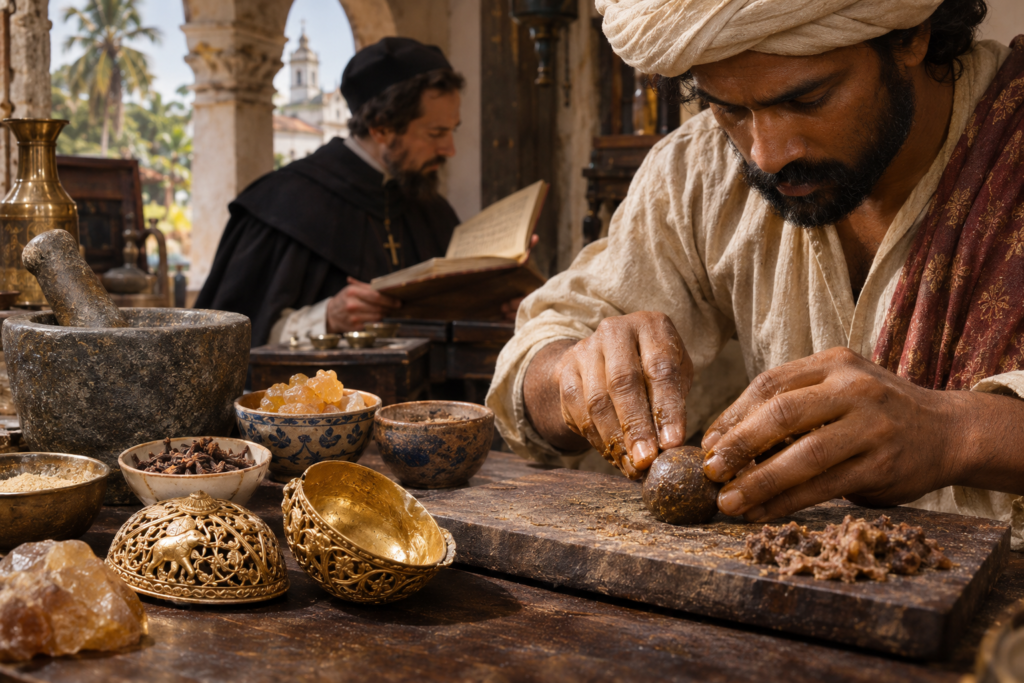
Within this environment, the manufacture of artificial medicinal stones became associated with Jesuit missionaries.
The Metropolitan Museum identifies Goa stones as artificial bezoars manufactured by Jesuit priests living in Goa.
Their production illustrates the movement of materials, ideas and medical practices across early modern imperial networks.
However, Goa’s population and medical culture were diverse. The manufacture of Goa stones by particular Jesuit communities should not be presented as a universal Indian or Christian religious practice.
The Jesuits and the Early Modern World of Medicine
The Society of Jesus, commonly known as the Jesuits, was founded in the sixteenth century.
Its members became active in education, missionary work and scholarly exchange across several continents.
Jesuit institutions participated in the circulation of scientific, geographical and medical knowledge.
In Goa, some missionaries became associated with the preparation of artificial bezoars.
This activity occurred within an early modern medical environment in which natural history, inherited medical authorities, empirical observations and religious worldviews frequently overlapped.
A medicinal substance could be valued because of its reported effects, its ingredients, its rarity or the reputation of its producer.
However, the manufacture of Goa stones does not mean that their supposed healing properties were an official doctrine of Christianity.
They were historical medical products made within particular institutional and cultural circumstances.
Natural Bezoars: The Original Inspiration
To understand Goa stones, it is necessary to examine the natural bezoars they imitated.
A bezoar is a mass of material that accumulates in an animal’s gastrointestinal tract.
Modern medicine recognises several types of bezoars, classified according to their principal components.
Some contain hair.
Others contain plant fibres or other substances.
Historically, bezoars obtained from animals were valued for their supposed ability to neutralise poisons.
Their reputation spread through medical traditions in different parts of Asia and Europe.
By the early modern period, bezoars had become expensive commodities.
The Wellcome Collection describes their extraordinary prestige among European elites, including their association with fears of deliberate poisoning.
Their high value encouraged the production of substitutes.
Goa stones emerged within this wider market for supposedly protective medicinal materials.
Why Was Poisoning Such a Powerful Fear?
Poison occupied an important place in early modern political imagination.
European courts were environments in which rivalry, succession disputes and struggles for influence could produce considerable anxiety.
Stories of secret poisoning circulated widely.
The fear was not always proportionate to the documented frequency of such crimes.
Nevertheless, substances believed to counteract poison could become highly desirable.
A bezoar was attractive because it promised protection against a danger that might be difficult to detect.
The Wellcome Collection describes bezoars as objects sought by aristocrats concerned about poisoning.
This helps explain why a Goa stone could become a luxury possession.
Its value was linked not only to its ingredients but also to the protection people believed it offered.
The Role of Precious Gemstones in Goa Stones
One of the most remarkable aspects of Goa stones is the reported inclusion of powdered precious gemstones.
The Wellcome Collection identifies crushed precious gems among ingredients used in some historical formulations.
The Metropolitan Museum also describes Goa stones as compounds containing organic and inorganic substances.
This does not mean that every surviving example contains the same gemstones.
Nor does it establish that every historical recipe included rubies, emeralds or diamonds.
Precise composition requires documentary or analytical evidence for the individual object.
Nevertheless, the inclusion of gemstone material reveals an important feature of early modern medical thought.
Precious substances were sometimes considered suitable ingredients in elaborate remedies.
Their rarity and established cultural prestige could contribute to their perceived medicinal value.
Why Grind a Precious Gemstone into Powder?
Modern gemmology values gemstones for their colour, clarity, optical properties, durability and craftsmanship.
Grinding a valuable gem into powder destroys many of the qualities that make it desirable as jewellery.
Yet historical medical systems sometimes valued substances for reasons unrelated to their ornamental appearance.
A gemstone might be regarded as medicinally significant because of inherited textual traditions, perceived purity, rarity or supposed natural virtues.
The inclusion of powdered gems in some Goa stones belongs to this historical context.
It should not be interpreted as evidence that crushed gemstones actually cured disease.
Mineral powders can also present health risks depending upon their chemical composition, particle size and contaminants.
Historical use is not proof of safety.
Goa Stones and the Idea of Hidden Natural Virtues
Early modern natural philosophy frequently explored the possibility that substances possessed properties not immediately apparent to the senses.
Some effects were observable.
Others were proposed through inherited medical theories or analogies.
Gemstones, minerals, metals and animal-derived substances were all investigated within this broader intellectual environment.
The supposed medicinal properties of Goa stones reflected these historical assumptions.
Their reputation was not based upon modern pharmacological trials.
Instead, it developed through reported experiences, established authorities, commercial reputation and cultural expectations.
This distinction is essential.
A belief in hidden natural virtues is a historical subject.
It is not scientific evidence that a gemstone possesses an invisible healing field.
How Were Goa Stones Used?
The Metropolitan Museum explains that Goa stones were historically used by scraping or grating a small quantity from the surface.
The resulting material could be mixed with water or tea and consumed.
The Wellcome Collection likewise documents this practice.
The preparation was believed to treat various illnesses and counteract poisons.
Some historical claims extended to serious infectious diseases, including plague.
However, these were beliefs associated with early modern medicine.
They should not be treated as valid medical instructions.
There is no reliable clinical evidence supporting Goa stones as effective treatments for poisoning or infectious disease.
Ingesting unidentified historical mineral or animal-derived preparations could be dangerous.
A Masterpiece in Gold: The Metropolitan Museum Goa Stone
One of the most important surviving examples is preserved by the Metropolitan Museum of Art.
The object is titled Goa Stone and Gold Case and dates to the late seventeenth or early eighteenth century.
Its accession number is 2004.244a–d.
The case is made from gold.
It consists of two rounded sections that enclose the medicinal stone.
Its surface incorporates pierced, repoussé and chased decoration.
The ornament includes foliage and representations of animals, including fantastic creatures.
The result is an extraordinary example of luxury metalworking.
The container was not merely practical packaging.
It transformed a medicinal compound into an object suitable for elite display and collecting.
Why Such an Elaborate Container?
The value of a Goa stone was expressed partly through its setting.
Gold and silver cases protected the material and enhanced its prestige.
The Metropolitan Museum explains that Goa stones were exported to Europe in specially manufactured containers.
Their elaborate craftsmanship reflected the wealth and status of their intended owners.
A valuable medicinal substance placed inside a gold case became simultaneously a remedy, a luxury object and a collectible curiosity.
This combination is characteristic of early modern collecting culture.
Objects were not always classified according to the strict distinctions used in modern museums.
A Goa stone could belong to the histories of medicine, decorative art, natural history and global trade at the same time.
The Animals and Fantastic Creatures on the Gold Case
The Metropolitan Museum’s gold case includes small animal figures and decorative foliage.
Some representations depict fantastic creatures such as unicorns and griffins.
These motifs contributed to the object’s elaborate visual character.
Unicorns were also associated with antidotal beliefs in European historical traditions.
However, the presence of a unicorn on one Goa stone case does not establish a single universal symbolic programme.
The decoration may reflect several influences, including luxury craftsmanship, European taste and associations with extraordinary natural substances.
Historical interpretation should distinguish between documented imagery and proposed symbolic meaning.
Another Surviving Example: The Silver-Gilt Goa Stone
The Metropolitan Museum preserves another important object titled Bezoar Stone with Case and Stand.
It dates to the seventeenth century and is attributed to India.
The surviving ensemble includes a Goa stone, an ornate silver case and a stand.
The silver was decorated through piercing, chasing and mercury gilding.
The museum notes that such objects were sought by European nobility.
It also records the belief that elaborate containers could enhance the medicinal effectiveness of their contents.
This is particularly revealing.
The protective reputation of the object extended beyond the compound itself.
Its setting could participate in the perceived efficacy of the remedy.
The idea illustrates how material luxury and historical medical belief could reinforce one another.
Precious Metals and the Appearance of Authority
Gold and silver possessed several qualities that made them appropriate for luxury containers.
They could be shaped into intricate forms.
They offered distinctive colours and reflective surfaces.
They were associated with wealth and status.
Their use in Goa stone cases communicated prestige.
However, the presence of precious metal did not make the contents medically effective.
The distinction between an object’s perceived authority and its demonstrated physical effects is central to understanding historical healing practices.
An elaborately decorated container could strengthen confidence in a remedy without establishing its pharmacological value.
The Global Journey from Goa to Europe
Goa stones were products of a connected early modern world.
Their manufacture involved materials and knowledge circulating through Portuguese colonial networks.
Their containers reflected skilled craftsmanship.
Their distribution connected India with European collectors and elites.
The Metropolitan Museum and Wellcome Collection both document the export of Goa stones to Europe.
These objects therefore provide evidence for the circulation of medical commodities alongside luxury goods.
They also illustrate how European demand influenced the manufacture and presentation of products in colonial trading centres.
The history of Goa stones cannot be separated from the unequal political and economic relationships of Portuguese colonial expansion.
Were Goa Stones Religious Objects?
Goa stones were manufactured in a setting that included Jesuit religious institutions.
However, they were primarily presented as medicinal preparations.
Their association with missionaries does not automatically make them sacramental objects.
They were not equivalent to Christian relics or liturgical vessels.
Their supposed protective properties belonged principally to historical medical beliefs.
Nevertheless, their manufacture by religious personnel demonstrates that religious and medical activities could overlap within early modern institutions.
The distinction is important.
A medicinal object produced by a priest is not necessarily an object of worship.
Medicine, Alchemy and Religious Belief
The history of Goa stones is sometimes described through the language of alchemy.
That description can be useful when discussing early modern experimentation with complex substances.
However, the term should not imply that every Goa stone was produced through a documented alchemical ritual.
The surviving museum evidence establishes the manufacture of artificial bezoars using combined materials.
It does not prove that every producer followed one particular esoteric system.
A more precise interpretation places Goa stones within the overlapping histories of compound medicine, natural philosophy, religious institutions and luxury trade.
This approach avoids turning a complex historical practice into a generic story of magical gemstones.
What Makes a Goa Stone Different from a Crystal?
A natural crystal possesses an ordered atomic structure.
Quartz, for example, is crystalline silicon dioxide.
Garnet belongs to a group of crystalline silicate minerals.
A Goa stone is fundamentally different.
It is an intentionally manufactured composite.
Its ingredients may include organic substances and mineral powders.
It does not possess one uniform mineralogical composition.
Nor is it a naturally crystallised gemstone.
Its historical association with precious gems arises from the materials sometimes incorporated into it.
The distinction is important for scientific classification.
A Goa stone should not be described as a natural gemstone species.
Can Gemstones Have Real Biological Effects?
Minerals and chemical compounds can interact with biological systems.
Modern medicine uses carefully characterised substances whose composition, dosage, efficacy and safety have been investigated.
However, this does not mean that every mineral or gemstone powder is medically beneficial.
Some substances can be toxic.
Others may be biologically inactive.
The presence of a precious gemstone in a historical preparation does not establish therapeutic value.
Claims about medicinal effectiveness require appropriate scientific evidence.
Goa stones illustrate the danger of confusing material rarity with medical efficacy.
The Modern Scientific Assessment
There is no reliable clinical evidence that Goa stones provide effective treatment for poisoning, plague or other serious diseases.
Their historical reputation should be understood as part of the development of medicine rather than as a validated therapeutic discovery.
Modern treatment of poisoning depends upon identifying the substance involved and providing appropriate medical care.
Some poisons have specific antidotes.
Others require supportive treatment and specialist toxicological management.
An unidentified compound containing mineral powders, animal products and resins cannot be assumed safe.
The historical use of Goa stones should never be reproduced as a home remedy.
The Symbolism of Protection
Protection is a recurring theme in the history of precious materials.
People have worn amulets, carried talismans and valued substances believed to guard against danger.
Goa stones belong to a particular version of this history.
Their reputation concerned bodily protection from poisoning and disease.
Their supposed effects were linked to historical medical theories.
They were not primarily modern chakra stones.
Nor were they necessarily intended for meditation or emotional grounding.
The meaning of protection therefore depends upon the specific historical context.
Using one general label such as protective gemstone can conceal important differences between traditions.
Goa Stones and Modern Crystal-Healing Claims
Contemporary crystal-healing practices sometimes attribute cleansing, protective or restorative properties to gemstones.
These beliefs may have personal or spiritual significance for practitioners.
However, they are not scientifically established medical treatments.
The historical use of powdered gems in Goa stones does not validate modern claims that gemstones emit healing frequencies.
The two traditions also differ substantially in their practices.
Goa stones were compound preparations intended for ingestion.
Modern crystal practices commonly involve wearing, holding or arranging stones.
They should not be treated as one continuous or uniform system.
Why Goa Stones Matter to Gemstone History
Goa stones occupy an unusual position in the history of precious materials.
They were not conventional jewellery.
They were not natural crystals.
They were not ordinary geological specimens.
Yet precious gemstones could form part of their composition.
Their history demonstrates that gems have been valued for purposes far beyond personal adornment.
Their perceived significance could extend into medicine, protection, religion and elite collecting.
The use of powdered precious materials also challenges modern assumptions about gemstone value.
A stone admired today for its optical beauty might once have been ground into a medicinal preparation.
This difference reveals how cultural expectations shape the meaning of natural substances.
The Museum Object as Historical Evidence
The surviving Goa stones and their containers are important because they provide direct material evidence.
Their manufacture can be examined.
Their ingredients may be investigated.
Their metalwork can be studied.
Their historical distribution can be reconstructed through museum records and documentary sources.
However, the survival of an object does not prove that the claims made about it were correct.
A gold case establishes the importance of the material to its owner or intended market.
It does not establish medicinal effectiveness.
This distinction is fundamental to responsible historical interpretation.
Conclusion: When Gemstones Entered the World of Medicine
Goa stones reveal a fascinating chapter in the history of natural materials.
Their manufacture took place within the interconnected world of Portuguese India.
Jesuit missionaries participated in their production.
Their recipes could incorporate animal substances, resins and powdered precious gems.
Their supposed medicinal effects made them desirable among European elites.
Their elaborate gold and silver containers transformed them into objects of extraordinary luxury.
Yet their reputation belonged to historical systems of belief and medicine.
The significance of Goa stones lies in their documented role within early modern medical culture, religious networks and global trade – not in scientifically demonstrated supernatural healing powers.
For Natural Gems Belgium, their history provides an important lesson.
Gemstones have not always been valued primarily for jewellery.
They have also appeared in medicinal recipes, protective traditions and complex systems of natural philosophy.
Understanding these practices requires historical respect without accepting unsupported medical claims.
The Goa stone is therefore more than an unusual curiosity.
It is a material witness to an age when the boundaries between gemstones, medicine, religious institutions and luxury were remarkably fluid.
Its true historical value lies in what it reveals about human attempts to understand and control the natural world.
References & Further Reading
1. Metropolitan Museum of Art – Goa Stone and Gold Case
https://www.metmuseum.org/art/collection/search/454738
Source description: Official museum catalogue of a late-seventeenth- to early-eighteenth-century Goa stone in an elaborate gold case. Documents its manufacture in Portuguese India, Jesuit associations, supposed medicinal use and exceptional metalwork.
2. Metropolitan Museum of Art – Bezoar Stone with Case and Stand
https://www.metmuseum.org/art/collection/search/452963
Source description: Seventeenth-century Goa stone with a silver-gilt container and stand. Provides evidence for the prestige of artificial bezoars among European nobility and the belief that ornate containers could enhance their medicinal effects.
3. Wellcome Collection – Stones for Healing
https://wellcomecollection.org/stories/stones-for-healing
Source description: Authoritative history-of-medicine article examining gemstones, talismans and healing beliefs. Includes a detailed discussion of Goa stones, their ingredients, Jesuit manufacture, European export and historical medical claims.
4. Wellcome Collection – Miracle Cure-Alls Throughout the Ages
https://wellcomecollection.org/stories/miracle-cure-alls-throughout-the-ages
Source description: Historical examination of supposed universal remedies, including natural bezoars and Goa stones. Discusses their extraordinary value, association with poisoning fears and place within early modern medicine.
5. Wellcome Collection – The Case of an Artificially Manufactured Goa Stone
https://wellcomecollection.org/works/stzb635k
Source description: Digitised historical collection object documenting the container of an artificial Goa stone and its former reputation as a remedy against poisoning and other illnesses.
6. Wellcome Collection – Bezoars and the Collection of Henri van Heurck
https://wellcomecollection.org/works/edvf8yap
Source description: Bibliographic record of R. van Tassel’s historical study of bezoars and the Henri van Heurck collection. Provides a specialist research lead for the study of bezoar collecting and historical medicinal beliefs.
Historical, Cultural and Scientific Distinctions
Historically documented: Goa stones were artificial medicinal compounds manufactured in Portuguese India, particularly in association with Jesuit communities.
Historically documented: Some formulations included resins, animal-derived substances and powdered precious gemstones.
Historically documented: Goa stones were exported to Europe and could be enclosed in elaborate gold or silver containers.
Historical medical belief: Goa stones were believed to counteract poisoning and treat various illnesses.
Historical religious context: Their manufacture was associated with Jesuit missionaries, but they were not Christian sacraments or universally prescribed religious objects.
Material classification: Goa stones are manufactured composites, not natural crystalline gemstones.
Scientific distinction: Natural bezoars are gastrointestinal concretions, whereas Goa stones were deliberately manufactured substitutes.
Historical interpretation: Their perceived protective power contributed to their prestige and commercial value.
Modern metaphysical comparison: Contemporary gemstone-healing beliefs differ from the historical medicinal use of Goa stones.
Scientific limitation: There is no reliable clinical evidence that Goa stones cure poisoning, infectious diseases or other medical conditions.
Safety qualification: Historical mineral and animal-derived preparations should not be ingested or reproduced as medical remedies.
The history of Goa stones demonstrates how precious materials could acquire supposed medicinal significance through cultural beliefs and historical medical systems.
Their composition belongs to materials science.
Their manufacture belongs to the history of compound medicine.
Their gold and silver containers belong to decorative art.
Their distribution belongs to colonial and global trade history.
Their association with Jesuit communities belongs to the history of religion.
Their claimed healing properties remain historical beliefs rather than scientifically established treatments.