Table of Contents
Introduction: What Makes a Gemstone Truly Rare?
A beautiful natural gemstone is the result of a geological process that may have taken place millions or even billions of years before its discovery.
Some gemstones form in relatively common minerals but only rarely achieve exceptional colour, transparency and size. Others require an unusual combination of chemical elements and geological conditions that occur in very few known deposits.
A fine ruby, a large alexandrite with a pronounced colour change, a transparent red beryl or a vivid copper-bearing tourmaline may therefore be rare for entirely different reasons.
Yet rarity is often oversimplified.
The words rare, precious, exclusive and investment grade are frequently used as though they describe the same characteristic. Scientifically, they do not.
A mineral may be rare in Earth’s crust but have limited commercial demand. Another may be geologically widespread but extremely difficult to recover in large, transparent, attractively coloured crystals.
A third may be available in considerable quantities but scarce in a particular size, colour or treatment category.
To understand gemstone rarity properly, we must distinguish geological abundance, deposit concentration, gem-quality yield, cutting recovery, market availability and consumer demand.
These factors interact, but they are not interchangeable.
1. Mineral Abundance Is Not the Same as Gemstone Abundance
Mineralogical abundance describes how frequently a mineral occurs in nature.
Gemstone abundance concerns the availability of material suitable for ornamental or gemmological use.
These are very different measurements.
Quartz, for example, is an abundant mineral in Earth’s crust. Nevertheless, particular varieties, unusual inclusions, exceptional colour patterns or remarkably large flawless crystals may be much less common.
Corundum occurs in a variety of geological environments. However, transparent ruby of attractive saturated red colour is substantially less common than ordinary non-gem corundum.
Beryl is another important example. Its varieties include emerald, aquamarine, morganite, heliodor and red beryl.
They share the same fundamental mineral framework, yet their geological occurrence and gem-quality availability differ enormously.
A mineral’s presence in a rock does not mean that the rock contains recoverable gemstones.
2. The Geological Conditions Required for Gem Formation
Gemstones crystallise in particular physical and chemical environments.
Important variables include temperature, pressure, fluid composition, available chemical elements, oxidation state and the evolution of the host rock.
Crystallisation also depends on whether suitable space and growth conditions exist.
Pegmatites may permit the development of relatively large crystals because of their unusual chemical compositions and crystallisation histories.
Metamorphic environments may produce ruby, sapphire, garnet and other minerals through reactions between pre-existing rocks.
Hydrothermal fluids may transport elements and contribute to the formation of mineralised veins and cavities.
Volcanic environments can also create distinctive gemstone deposits.
However, the presence of a suitable geological environment does not guarantee the formation of gem-quality crystals.
Small changes in chemistry, deformation, fluid activity or subsequent geological history may significantly affect the final material.
The U.S. Geological Survey emphasises that gemstones commonly occur sparsely rather than as continuous, high-grade bodies of recoverable gem material.
3. Why Gemstone Deposits Are Often Small and Irregular
Many economically important mineral commodities occur in deposits that can be evaluated by relatively continuous ore grades.
Gemstones often behave differently.
A valuable crystal may occur in a narrow vein, a small cavity, a pegmatite pocket or an isolated concentration of alluvial gravel.
One section of a deposit may contain excellent crystals while nearby rock produces almost nothing.
This irregular distribution makes gemstone mining difficult to predict.
Even when a geological formation is known to contain a valuable mineral, the quantity of cuttable material may remain uncertain.
Recovery is further complicated by fractures, weathering, difficult terrain and the possibility of damaging crystals during extraction.
Consequently, the existence of a deposit should not be confused with a predictable supply of finished gemstones.
4. Rarity Begins with Chemistry
The formation of a particular gemstone variety often depends on relatively small concentrations of colour-producing elements.
Ruby is coloured primarily by chromium within corundum.
Emerald owes its green colour principally to chromium and/or vanadium within beryl.
Alexandrite is a chromium-bearing variety of chrysoberyl whose absorption characteristics produce a distinctive illumination-dependent colour change.
Copper and manganese contribute to the characteristic colours of Paraíba-type tourmaline.
Red beryl owes its raspberry-red colour principally to manganese-related chromophores.
However, the presence of these elements alone is insufficient.
They must be incorporated into the appropriate crystal structure under suitable geological conditions.
The host mineral must also grow into crystals large and transparent enough for gemstone use.
The rare outcome is therefore not simply the presence of a particular chemical element, but the successful combination of chemistry, mineral formation and gem-quality growth.
5. Red Beryl: An Exceptional Geological Combination
Red beryl provides one of the clearest examples of geological rarity.
It is a red variety of beryl with the formula Be₃Al₂Si₆O₁₈.
Its colour is associated principally with manganese.
The Utah Geological Survey documents red beryl in volcanic environments in Utah and New Mexico, with the historically important gem-quality occurrence at the Ruby-Violet claims in Utah’s Wah Wah Mountains.
Its formation is associated with unusual rhyolitic volcanic conditions and the movement of mineralising fluids through fractures.
The crystals are commonly small.
Many are unsuitable for faceting because of their dimensions, fractures or other characteristics.
This creates two levels of scarcity.
First, the geological environment required for red beryl is uncommon.
Second, the proportion of crystals suitable for producing attractive finished gemstones is limited.
Historical estimates describing red beryl as vastly rarer than diamond illustrate this exceptional occurrence, but should not be interpreted as precise, globally standardised production statistics.
6. Why Large Red Beryl Is Particularly Unusual
A small crystal and a large crystal do not represent equivalent geological outcomes.
To produce a larger crystal, suitable growth conditions must persist for sufficient time without destructive interruption.
The mineral must have access to the necessary chemical components and space for continued development.
For red beryl, the geological circumstances often produce crystals measured in millimetres rather than large transparent masses.
A crystal may also contain fractures or inclusions that reduce its usable volume.
Therefore, the scarcity of a large faceted red beryl is much greater than the scarcity of merely finding the mineral.
The distinction between mineral occurrence and cuttable gemstone size is central to understanding rarity.
7. Alexandrite: Rarity Created by Colour and Optical Behaviour
Alexandrite is the colour-change variety of chrysoberyl, BeAl₂O₄.
It was identified in Russia’s Ural Mountains during the nineteenth century and became historically associated with the Russian imperial period.
The gemstone is known for its tendency to appear greenish or bluish green under daylight-equivalent illumination and reddish or purplish red under incandescent illumination.
This effect results from the interaction between chromium-related absorption and the spectral composition of the light source.
Not every chromium-bearing chrysoberyl displays an equally attractive or pronounced colour change.
Fine alexandrite requires a desirable combination of transparency, colour strength, colour-change contrast and size.
Consequently, a deposit may produce chrysoberyl without producing much fine alexandrite.
GIA identifies exceptional natural alexandrite as rare, even though additional sources have been discovered outside Russia, including Brazil, Sri Lanka and East Africa.
8. The Difference Between Alexandrite and Ordinary Chrysoberyl
Chrysoberyl itself is not necessarily alexandrite.
The alexandrite designation depends on the characteristic colour-change behaviour.
Yellowish, greenish or brownish chrysoberyl without the appropriate colour-change phenomenon should not automatically be described as alexandrite.
This illustrates a broader gemmological principle.
A rare gemstone variety may represent only a small subset of a larger mineral population.
The relevant rarity may therefore concern a particular optical property rather than the occurrence of the mineral species itself.
A large chrysoberyl crystal can be impressive without possessing the qualities that define fine alexandrite.
9. Ruby: Why Fine Red Corundum Is Scarce
Ruby is the red variety of corundum, Al₂O₃.
Corundum is extremely hard, with a Mohs hardness of 9.
However, gem-quality ruby requires more than a hard crystal.
The material must contain suitable chromium concentrations to produce an attractive red colour.
It must also have sufficient transparency, manageable inclusions and appropriate dimensions.
Geological formation may introduce fractures, mineral inclusions or growth features that limit the amount of usable material.
Some ruby deposits produce substantial quantities of lower-quality material but relatively few fine transparent crystals.
The scarcity of top-quality ruby is therefore not equivalent to the scarcity of corundum as a mineral.
10. Why Fine Ruby Becomes Rarer with Size
As a rough crystal increases in size, the probability of containing internal features that complicate cutting can increase.
A large ruby may contain fractures, uneven colour distribution, inclusions or growth irregularities.
The cutter must decide which portions can be retained without unacceptable compromises.
Producing a large, transparent, well-coloured ruby requires an unusually favourable combination of natural crystal growth and cutting possibilities.
This is why large fine rubies can be disproportionately scarce relative to smaller examples.
However, there is no universal mathematical formula that converts carat weight into rarity across all ruby deposits.
The relationship depends on the material and its geological population.
11. Emerald: Abundance, Fractures and Exceptional Clarity
Emerald is the green variety of beryl.
Its green colour is associated with chromium and/or vanadium.
Emerald crystals commonly contain inclusions and fractures.
These features may develop during growth or through subsequent geological processes.
GIA notes that significant fractures are common in emerald rough and that cutters must account for them when planning a finished gemstone.
Consequently, exceptionally transparent emeralds with attractive colour and limited visible inclusions are relatively scarce.
However, clarity standards for emerald should not simply be copied from diamond grading.
Some inclusions are expected and accepted in fine emerald.
The scientific and commercial question is whether they materially affect transparency, appearance or durability.
12. Why Emerald Treatment Matters to Rarity
Emeralds are frequently subjected to clarity enhancement.
Oil, resin or other filling materials may reduce the visibility of surface-reaching fractures.
This can improve apparent transparency.
However, treated and untreated emeralds are not identical categories of material.
A fine emerald with no detectable clarity enhancement may be rarer than a visually similar emerald whose fractures have been filled.
This does not mean that every treated emerald is undesirable.
It means treatment status changes how rarity and quality should be interpreted.
Treatment disclosure is therefore essential when comparing gemstones.
A rarity claim should specify whether it refers to natural formation, untreated condition, visual quality or some combination of these factors.
13. Diamond: A Useful Comparison
Diamond is one of the most recognised gemstones in the world.
It forms under conditions of high pressure and temperature, generally deep within Earth’s mantle.
Many economically important diamond deposits are associated with kimberlite or related geological processes that transported diamonds toward the surface.
Diamond formation is geologically exceptional.
However, the commercial diamond industry has historically recovered very large quantities of natural diamonds.
The U.S. Geological Survey’s 2025 Mineral Commodity Summaries estimated approximately 72 million carats of gem-quality natural diamond mine production worldwide in 2024.
This does not make every natural diamond common.
Large diamonds with exceptional colour and clarity are much less available than ordinary commercial stones.
The comparison illustrates why rarity must be evaluated at the appropriate quality and size level.
14. Diamond Rarity and Diamond Quality Are Separate Questions
A small commercial-quality natural diamond and an exceptionally large colourless diamond with high clarity represent very different supply categories.
Likewise, certain natural fancy-colour diamonds may be extraordinarily scarce.
The mineral species remains diamond in each case.
What changes is the frequency of the desired combination of properties.
Colour, clarity, size and natural origin can all influence rarity.
Natural and laboratory-grown diamonds must also be distinguished.
Laboratory-grown diamonds have essentially the same crystal structure and chemical composition as natural diamonds, but their production origin is different.
Their availability cannot be used directly to calculate the geological rarity of natural diamonds.
15. Demantoid Garnet: When Crystal Size Limits Supply
Demantoid is a green variety of andradite garnet.
It is valued for its high refractive index, strong dispersion and attractive green colour.
Historically important deposits occur in Russia’s Ural Mountains.
Additional sources have been identified in Namibia and other regions.
GIA’s research on Russian demantoid documents how the mineral commonly occurs as small grains rather than large well-formed crystals.
This creates a significant limitation on finished gemstone size.
A deposit may produce numerous small demantoids while only occasionally yielding rough suitable for large faceted stones.
The scarcity of larger examples is therefore directly related to geological crystal size and cutting recovery.
16. Why Horsetail Inclusions Do Not Automatically Establish Value
Some demantoid garnets contain distinctive fibrous inclusions known as horsetails.
These can be of scientific and collector interest.
However, not every horsetail-bearing specimen is automatically exceptional.
The visual effect, inclusion distribution, colour, transparency, size and overall quality all matter.
GIA research has also demonstrated that similar fibrous structures can occur in non-green andradite.
Therefore, the presence of a horsetail inclusion should not be treated as universal proof of demantoid identity or geographical origin.
An unusual inclusion may increase collector appeal in a particular specimen, but rarity and desirability remain separate considerations.
17. Paraíba Tourmaline: A Rare Colour-Producing Combination
Paraíba tourmaline is a trade variety designation applied to qualifying copper-bearing tourmaline with characteristic vivid blue-to-green colours.
The material became famous following discoveries in northeastern Brazil during the late 1980s.
Similar copper-bearing tourmalines were subsequently documented in Nigeria and Mozambique.
Their striking colours result principally from copper-related absorption, with manganese also playing an important role.
The availability of qualifying material depends on the geological occurrence of copper-bearing tourmaline and the proportion exhibiting suitable colour, transparency and size.
Importantly, the term Paraíba tourmaline does not necessarily mean that the gemstone was mined in Brazil.
The variety designation is not identical to a geographic-origin statement.
18. A New Discovery in Ethiopia: Why Rarity Is Not Static
Gemstone rarity is influenced by geological knowledge.
A deposit may exist long before it becomes known to the international gemstone trade.
On 27 August 2026, GIA and the Gübelin Gem Lab announced independent confirmation of a new Ethiopian source of copper-bearing tourmaline meeting the accepted definition of Paraíba tourmaline.
The laboratories established reference material and analytical datasets before confirming the new source.
This discovery is scientifically significant.
It demonstrates that the known geographical distribution of a gemstone variety can expand as new deposits are investigated.
However, the discovery of another source does not automatically mean that exceptional specimens will become abundant.
Production volume, colour quality, transparency, crystal size and recovery conditions still determine the supply of desirable finished gemstones.
Rarity is therefore a dynamic assessment rather than an immutable label.
19. Geological Rarity Versus Market Scarcity
Geological rarity concerns how frequently a material forms in nature.
Market scarcity concerns how much material is available for purchase relative to demand.
The two may differ considerably.
A mineral can be geologically uncommon but attract limited collector interest.
Another may be available from several deposits yet command strong demand for a particular colour or origin.
Market scarcity can also change because of mining interruptions, trade restrictions, inventory accumulation, fashion or new discoveries.
Therefore, price is not a direct scientific measurement of rarity.
A high price may reflect rarity, demand, branding, provenance, quality or several factors simultaneously.
20. Why Historical Reputation Influences Gemstone Demand
Certain gemstone localities acquire reputations over long periods.
Mogok rubies, Kashmir sapphires and Colombian emeralds are familiar examples.
Their historical importance is connected with celebrated discoveries, trade networks, jewellery traditions and the exceptional qualities of some specimens.
However, geographical reputation does not guarantee that every gemstone from a particular region is of exceptional quality.
A poorly coloured gemstone from a famous source may be less attractive than a fine gemstone from a less celebrated deposit.
Scientific grading should evaluate the individual gemstone.
Provenance can provide additional historical or collector significance, but should not replace assessment of colour, clarity, cut and optical performance.
21. Cutting Yield: The Hidden Factor Behind Rarity
A rough gemstone rarely retains its entire original weight after faceting.
Material is removed to create suitable proportions, eliminate undesirable fractures, improve colour orientation and achieve an attractive final shape.
Cutting yield can vary greatly.
A well-shaped, clean crystal may permit relatively efficient cutting.
An irregular or fractured crystal may require substantial material removal.
The final weight therefore represents only part of the original rough.
This means that a deposit producing many carats of rough does not necessarily produce many carats of fine finished gemstones.
The relationship between rough recovery and finished-gem supply is essential to understanding commercial rarity.
22. Why Large Clean Crystals Are Disproportionately Valuable
Imagine a hypothetical deposit yielding numerous small transparent crystals but very few larger ones.
If the largest crystals also contain fractures or colour zoning, the number of large finished gemstones may be extremely limited.
The scarcity increases when several quality requirements must be satisfied simultaneously.
A gemstone may need to be:
- sufficiently large;
- transparent;
- attractively coloured;
- free from serious fractures;
- suitable for an effective cut;
- correctly identified and represented.
Each requirement can reduce the usable population.
However, these factors are not statistically independent, and no universal multiplication formula can calculate rarity across all deposits.
Meaningful quantitative claims require deposit-specific data.
23. Why Colour Quality Can Be Rarer Than the Mineral
Colour is one of the most important factors in coloured gemstone evaluation.
A deposit may produce a broad range of hues, tones and saturation levels.
Only a small proportion may fall within the range most desired by collectors or the market.
In ruby, attractive saturated red colour can be much less common than pale or purplish material.
In emerald, a desirable combination of green hue, saturation and transparency may be uncommon.
In copper-bearing tourmaline, vivid blue-to-green colours may be much more sought after than less saturated material.
However, colour preference is partly influenced by cultural and commercial factors.
Scientific rarity and aesthetic preference should therefore be distinguished.
24. The Role of Transparency and Inclusions
Gemstones are natural crystalline materials.
Inclusions may consist of other minerals, fluids, cavities, growth structures or fractures.
Some inclusions provide valuable evidence about geological formation.
Others influence transparency or durability.
For certain gemstone varieties, inclusions are expected and accepted.
For others, high transparency may be a particularly important quality characteristic.
The scarcity of a nearly inclusion-free gemstone therefore depends on the normal inclusion population of that material.
A clarity description should always be interpreted in the context of the gemstone species or variety.
25. Natural Rarity Versus Artificial Scarcity
A gemstone may become temporarily difficult to obtain because production has stopped or a distributor controls available inventory.
That does not necessarily mean the mineral is geologically rare.
Conversely, a genuinely rare mineral may remain relatively affordable because few buyers seek it.
Artificial scarcity can also arise through limited releases, selective marketing or withholding of inventory.
These commercial practices should not be confused with the geological processes that determine natural occurrence.
A credible rarity statement should identify the basis of the claim.
Is the material rare in nature?
Is gem-quality material rare?
Is a particular size or colour rare?
Or is the product simply scarce in the current market?
These are different statements.
26. Why New Deposits Can Change the Market
The discovery of a new gemstone deposit can influence supply.
However, the consequences are not always straightforward.
A deposit may initially produce exceptional specimens and later decline.
Another may yield large quantities of lower-quality material.
Some sources produce stones with characteristics that differ from those of established deposits.
New material may expand the market by introducing a previously inaccessible colour or size range.
It may also stimulate additional scientific research into geological formation and geographic-origin determination.
The discovery of Ethiopian copper-bearing tourmaline in 2026 illustrates why gemstone knowledge must remain open to revision.
27. Why Rarity Claims Need Evidence
Statements such as “one of the rarest gemstones in the world” can be difficult to verify.
Reliable worldwide production statistics are unavailable for many coloured gemstones.
Artisanal mining, informal trading, private collections and incomplete reporting complicate estimates.
Different authors may compare mineral occurrences, rough production, faceted production or high-quality specimens without using equivalent definitions.
Consequently, precise rankings of gemstone rarity should be treated cautiously unless supported by clearly defined data.
A scientifically responsible description might say:
“Large, transparent red beryl suitable for faceting is exceptionally scarce because of its limited known geological occurrences and generally small crystal sizes.”
This is more informative than an unsupported claim that a particular gemstone is exactly a certain number of times rarer than diamond.
28. How Collectors Should Evaluate Rare Gemstones
A collector should first establish the gemstone’s identity.
The next step is to understand the specific form of rarity involved.
Is the mineral species itself uncommon?
Is the gemstone variety unusual?
Is the colour exceptional?
Is the size unusual for the material?
Does the specimen display a rare optical phenomenon?
Is the treatment status relevant?
Does the gemstone have documented historical or geological provenance?
These questions help separate scientifically meaningful characteristics from marketing language.
An unusual gemstone can be fascinating even when its commercial value is modest.
Rarity and monetary value are not identical.
29. Why Gemstone Rarity Is Not an Investment Guarantee
Rare gemstones are sometimes promoted as investment assets.
However, geological rarity does not guarantee future price appreciation.
Gemstone markets are influenced by liquidity, buyer preferences, treatment disclosure, grading consistency, provenance and economic conditions.
A rare gemstone may be difficult to resell.
Another may have a narrow specialist collector market.
Price quotations may also vary significantly between retail and secondary-market transactions.
Therefore, rarity should be understood as one characteristic of a gemstone, not as a promise of financial performance.
Scientific descriptions should avoid unsupported investment claims.
30. How Rarity Relates to NGB Gemstone Grading
Natural Gems Belgium evaluates faceted gemstones through five principal categories:
Color, Clarity, Cut, Optical Performance and Overall Appeal.
Each category contributes up to 20 points, producing a final score out of 100.
Rarity should not automatically increase the score.
A rare mineral may have poor colour or a weak cut.
A relatively common mineral may produce a visually exceptional gemstone.
The grading score should therefore describe the individual gemstone’s observed quality.
Geological rarity, provenance and collector significance can be documented separately.
This preserves the distinction between quality evaluation and market scarcity.
31. Rough Gemstones Require a Different Perspective
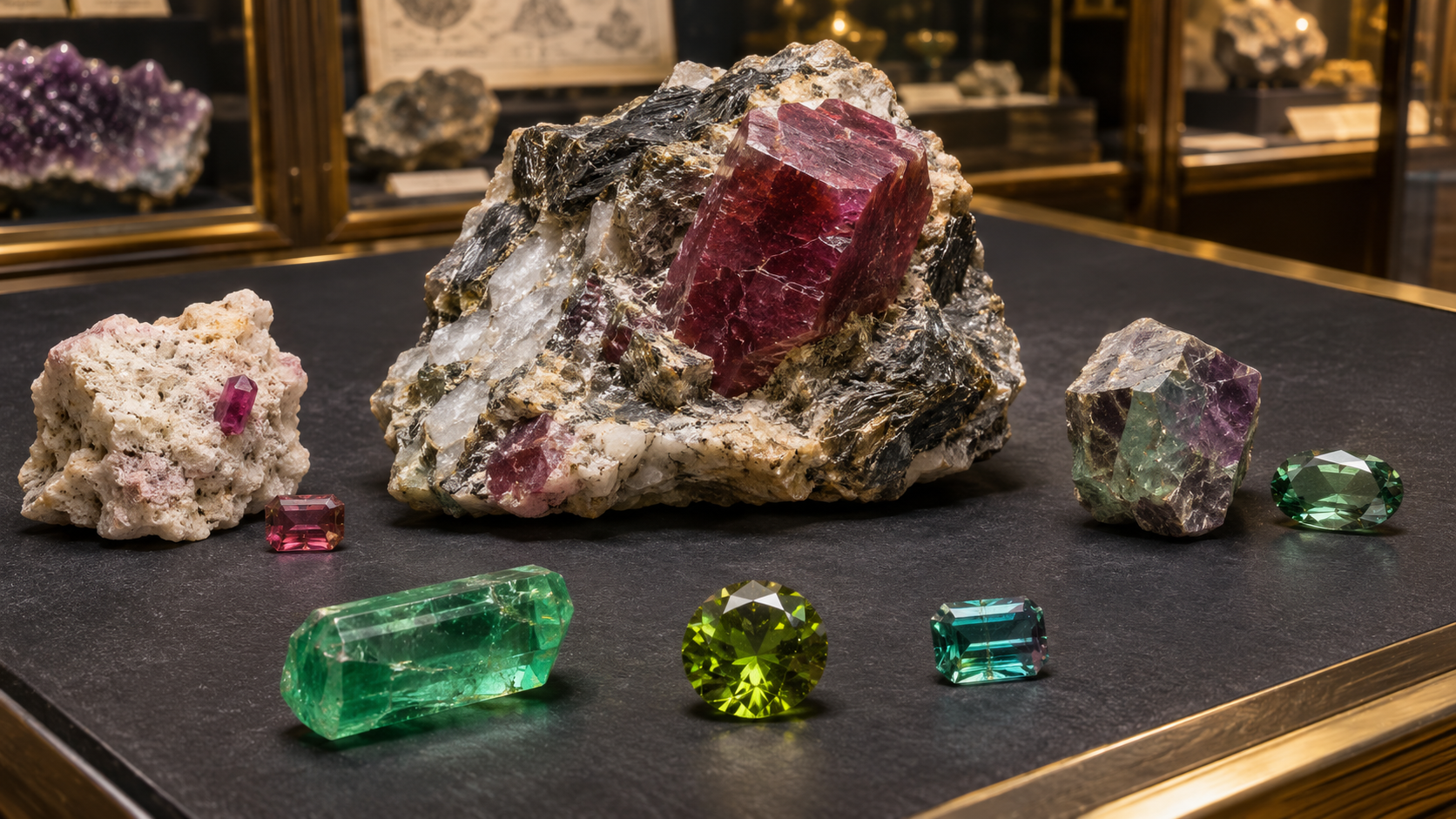
For rough gemstones, rarity may relate to crystal morphology, natural character, colour, size or potential cutting yield.
A large rough crystal may be valuable as a mineral specimen even if it is unsuitable for faceting.
A smaller transparent crystal may offer better faceting potential.
For decorative mineral specimens, the natural arrangement, crystal development and preservation of the original form can be more important than theoretical cutting yield.
The intended use of the material therefore influences how rarity and desirability should be interpreted.
A specimen should not be described as exceptionally rare solely because it is unusual in shape.
32. Common Misconceptions About Rare Gemstones
A rare mineral is always an expensive gemstone.
Incorrect. Demand and quality influence price.
Diamond is the rarest gemstone.
Incorrect. Many gem materials are substantially less common in particular geological or gem-quality categories.
Every ruby is rarer than every sapphire.
Incorrect. Rarity depends on quality, colour, size and the populations being compared.
A famous origin guarantees exceptional quality.
Incorrect. Individual gemstone characteristics remain essential.
A new deposit makes a gemstone common.
Not necessarily. Production and quality may remain limited.
Large crystals always produce large faceted gemstones.
Incorrect. Fractures, shape and inclusions can greatly reduce yield.
Untreated gemstones are always superior.
Incorrect. Treatment status is important, but overall quality requires separate evaluation.
The most expensive gemstone must be the rarest.
Incorrect. Price reflects more than geological occurrence.
Rarity can always be expressed as an exact worldwide ranking.
Incorrect. Reliable comparable production data are often unavailable.
33. The Scientific Meaning of Gemstone Rarity
Gemstone rarity is best understood as a sequence of geological and practical filters.
A suitable geological environment must exist.
The necessary chemical components must be available.
The mineral must crystallise.
The appropriate colour-producing conditions must occur.
Crystals must reach useful dimensions.
They must survive geological processes and extraction.
They must possess sufficient quality for their intended purpose.
Finally, they must be recovered, documented and made available.
A gemstone may be scarce because one of these conditions is unusually restrictive.
Another may be scarce because several moderately restrictive conditions occur together.
This explains why rarity cannot be reduced to a single universal property.
Conclusion: Rarity Is More Than a Name
The world’s rare gemstones are products of geological history.
Some require unusual chemical environments.
Others are uncommon because their crystals rarely reach significant size.
Some mineral species are widespread, but only a tiny proportion of their crystals possess the colour, transparency and durability required for exceptional gemstones.
Red beryl illustrates the importance of unusual volcanic chemistry and restricted gem-quality occurrence.
Alexandrite demonstrates how a distinctive optical phenomenon can define a rare gemstone variety.
Ruby and emerald show how exceptional colour and transparency can be much scarcer than the host mineral itself.
Demantoid reveals how limited crystal size constrains the availability of larger faceted stones.
Diamond demonstrates the difference between substantial commercial production and the scarcity of exceptional individual specimens.
Paraíba-type tourmaline illustrates how new geological discoveries can change our understanding of supply.
The central scientific principle is:
Gemstone rarity is determined not simply by how often a mineral occurs, but by how frequently nature produces crystals with the particular combination of composition, colour, transparency, size and quality that makes them desirable.
For collectors, this understanding encourages informed appreciation.
For gemmologists, it provides a framework for evaluating rarity claims.
For gemstone businesses, it supports accurate descriptions that distinguish geological facts from commercial marketing.
And for Natural Gems Belgium, it reinforces a fundamental principle of scientific transparency:
describe the gemstone’s observable quality, document its geological and gemmological significance, and avoid presenting rarity as an unsupported guarantee of value.
References & Further Reading
The following sources are authoritative scientific and educational resources from government geological surveys and the Gemological Institute of America. They address gemstone-forming environments, rare mineral varieties, crystal size, gem-quality yield, geographic discoveries and gemstone quality.
1. United States Geological Survey – Natural Gemstones: Geologic Environment
An overview of gemstone formation in pegmatites, metamorphic rocks, volcanic environments and alluvial deposits, explaining why recoverable gem material is commonly distributed irregularly.
https://pubs.usgs.gov/gip/gemstones/environment.html
2. Utah Geological Survey – What Utah Gemstone Is Rarer Than Diamond?
Carl Ege’s geological discussion of red beryl, its discovery history, chemistry, volcanic formation and unusually restricted gem-quality occurrences. Historical price and rarity estimates should be interpreted in their original context.
3. Gemological Institute of America – Alexandrite Gem Overview
An institutional reference describing alexandrite’s mineral identity, colour-change phenomenon, historical discovery and exceptional rarity of fine material.
https://www.gia.edu/alexandrite
4. Gemological Institute of America – Emerald Quality Factors
Explains the importance of colour, transparency, inclusions, fractures, cutting decisions and clarity enhancement in emerald evaluation.
https://www.gia.edu/articles/emerald-quality-factor
5. Gemological Institute of America – Large and Fine Demantoid from Russia
Gems & Gemology, Spring 2020.
A detailed account of Russian demantoid deposits, crystal size limitations and the exceptional scarcity of large fine faceted stones.
https://www.gia.edu/gems-gemology/spring-2020-gemnews-large-and-fine-demantoid-from-russia
6. Gemological Institute of America – Geographic Origin Determination of Paraíba Tourmaline
Gems & Gemology, Winter 2019.
A scientific investigation of copper-bearing tourmaline from Brazil, Nigeria and Mozambique, including trace-element chemistry, geographic-origin determination and variety nomenclature.
https://www.gia.edu/gems-gemology/winter-2019-paraiba-tourmaline-geographic-origin-determination
7. Gemological Institute of America and Gübelin Gem Lab – New Ethiopian Source of Copper-Bearing Tourmaline
Joint research announcement, 27 August 2026.
Documents the independent scientific confirmation of Ethiopian copper-bearing tourmaline meeting the accepted Paraíba tourmaline definition.
8. United States Geological Survey – Mineral Commodity Summaries 2025
Official USGS publication containing global natural gem-quality diamond mine production estimates and mineral commodity statistics. Figures refer to their specified reporting years.
https://pubs.usgs.gov/periodicals/mcs2025/mcs2025.pdf
9. Gemological Institute of America – Unusual Horsetail and Columnar Inclusions in Demantoid
Gems & Gemology, Winter 2022.
Scientific documentation of unusual inclusions in demantoid and their mineralogical interpretation.
Scientific Interpretation and Limitations
Mineral abundance, gem-quality rarity, market scarcity and commercial value are different concepts.
Rarity comparisons require consistent definitions of material quality, size, production and geological occurrence.
Reliable worldwide production statistics are unavailable for many coloured gemstones.
Historical rarity ratios and price estimates should not be presented as current universal measurements.
Gemstone quality depends on the individual specimen and should not be inferred solely from mineral species or geographic origin.
Treatment status can affect the availability and commercial interpretation of particular gemstone categories.
The discovery of additional deposits may change known supply without necessarily making exceptional material abundant.
Rarity does not guarantee future price appreciation or investment liquidity.