

Table of Contents
Introduction: Small Chemical Differences, Remarkable Gemstone Colours
Two gemstones can share the same fundamental mineral structure yet display dramatically different colours.
Ruby and sapphire provide one of the clearest examples.
Both belong to the mineral species corundum, whose ideal chemical formula is Al₂O₃.
Pure corundum is colourless.
Yet natural corundum can be red, blue, pink, yellow, green, purple or nearly colourless.
The explanation often involves very small quantities of additional chemical elements incorporated into the crystal.
These are commonly called trace elements.
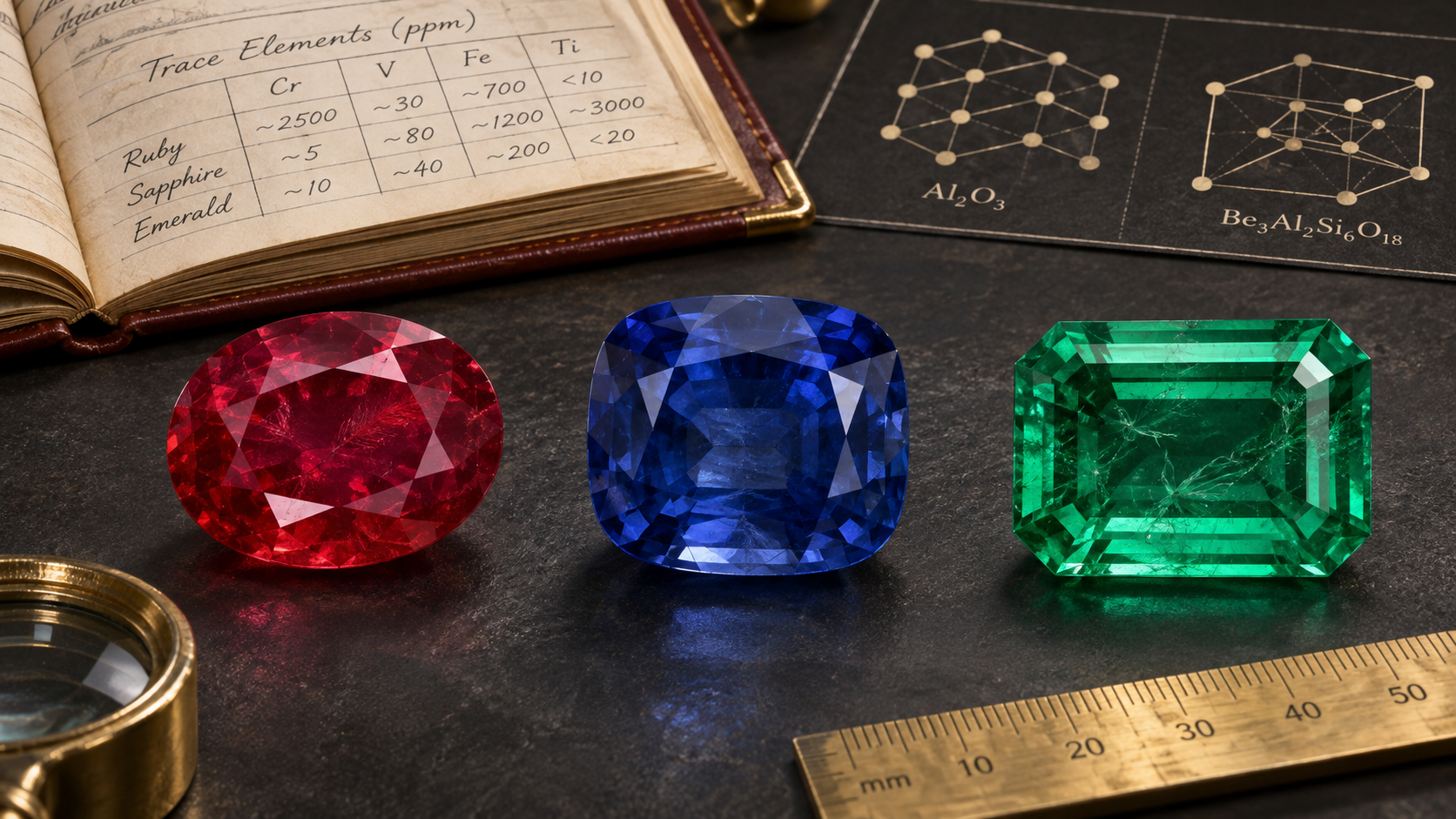
Chromium can produce the red colour of ruby.
Interactions involving iron and titanium can produce the blue colour of sapphire.
Chromium and vanadium contribute to the green colour of many emeralds.
However, the relationship between chemical composition and gemstone colour is not always straightforward.
Different elements can produce different colours depending on their oxidation state, crystallographic position and interactions with neighbouring atoms.
Furthermore, not every gemstone colour is caused by trace elements.
Some colours arise from structural defects, charge-transfer processes, inclusions or optical phenomena.
Understanding gemstone trace elements therefore requires examining crystal chemistry, light absorption and the analytical methods used in modern gemmology.
1. What Are Trace Elements?
A trace element is a chemical element present in relatively small quantities within a material.
In gemstones, trace elements may be incorporated into the crystal structure during growth.
Their concentrations are often expressed in parts per million.
One part per million by mass corresponds to one milligram of a substance per kilogram of material.
However, gemmological laboratories may report trace-element concentrations using different conventions.
Parts per million by weight and parts per million on an atomic basis are not interchangeable without conversion.
This distinction is important when comparing published laboratory results.
GIA’s research on corundum chemistry explains why atomic concentration units are useful when studying colour mechanisms involving substitution within the crystal lattice.
Trace elements are chemically significant even when their concentrations are extremely low.
However, their presence does not automatically mean they influence visible colour.
Some trace elements contribute to colour.
Others are useful mainly as geological indicators.
2. Major Elements Versus Trace Elements
The major elements of a mineral define its fundamental chemical composition.
Corundum consists primarily of aluminium and oxygen.
Beryl has the ideal formula Be₃Al₂Si₆O₁₈.
Quartz consists of silicon dioxide, SiO₂.
Trace elements may enter these mineral structures in comparatively small amounts.
They can sometimes substitute for major elements at specific crystallographic sites.
For example, chromium may substitute for aluminium in corundum.
This substitution can alter how the crystal interacts with visible light.
However, the ability of an element to enter a crystal depends on several factors.
These include ionic size, electrical charge, crystal structure and the chemical conditions during growth.
Not every element can substitute freely into every mineral.
3. Why Crystal Structure Matters
A gemstone is not simply a mixture of chemical elements.
Its atoms are arranged in an ordered crystal structure.
The positions available within that structure influence which trace elements can be incorporated.
An element may occupy a particular crystallographic site only if the substitution is chemically and structurally feasible.
Differences in ionic radius and charge can limit substitution.
Some substitutions require charge compensation involving other ions or crystal defects.
This means that the same chemical element may behave differently in different minerals.
Chromium in corundum does not necessarily produce the same colour as chromium in beryl.
The surrounding crystal structure changes the electronic energy levels involved in light absorption.
Therefore, gemstone colour cannot be predicted reliably from the name of a trace element alone.
4. How Trace Elements Influence Light Absorption
Visible light contains a range of wavelengths.
When light enters a gemstone, some wavelengths may be absorbed while others are transmitted or reflected.
The observed colour depends partly on the wavelengths that remain available to the eye.
Transition-metal ions can possess electronic energy levels that interact with visible light.
When an appropriate photon is absorbed, an electronic transition may occur.
This selective absorption contributes to gemstone colour.
However, the precise mechanism depends on the element, its oxidation state and its environment within the crystal.
GIA’s foundational colour research by Emmanuel Fritsch and George Rossman explains the importance of dispersed metal ions in gemstones.
Their work also distinguishes these mechanisms from charge transfer, colour centres and optical effects.
5. Chromium: The Colouring Element of Ruby
Ruby is the red variety of corundum.
Chromium is the principal chromophore responsible for its characteristic red colour.
In corundum, trivalent chromium can substitute for aluminium.
This changes the crystal’s absorption characteristics.
Certain wavelengths are absorbed more strongly than others, producing the characteristic red appearance.
Chromium can also contribute to fluorescence under suitable excitation.
However, ruby colour is not determined by chromium concentration alone.
Iron content, crystal orientation, absorption characteristics and other factors may influence appearance.
Two rubies containing chromium may display different hues, saturation levels and fluorescence responses.
The presence of chromium is therefore fundamental to ruby colour but does not independently establish gemstone quality or geographical origin.
6. Why Chromium Can Produce Green Emerald
Emerald is the green variety of beryl.
Chromium and vanadium are important chromophores in many emeralds.
In the beryl crystal structure, these elements interact with light differently than chromium does in corundum.
As a result, chromium-bearing emerald can appear green while chromium-bearing ruby appears red.
This illustrates the importance of crystal structure.
The chemical element alone does not determine the final colour.
The surrounding atomic environment influences which wavelengths are absorbed.
Iron may also affect emerald colour and optical characteristics.
However, emerald chemistry varies between deposits.
Not every emerald contains identical proportions of chromium, vanadium and iron.
7. Vanadium and Gemstone Colour
Vanadium is another important transition element in gemstone colour.
It may contribute to green coloration in emerald.
It can also influence colour in certain varieties of corundum and other minerals.
However, the resulting appearance depends on the mineral structure and the oxidation state of vanadium.
It would be incorrect to describe vanadium as a universally green-producing element.
Its colour effects vary between materials.
Vanadium may also be measured as part of a gemstone’s trace-element profile.
In some cases, its concentration provides useful information about geological formation conditions.
However, vanadium content alone does not establish geographical origin.
8. Iron and Titanium: The Blue Sapphire Connection
Blue sapphire is one of the most important examples of colour involving interactions between different trace elements.
Its blue colour commonly involves iron and titanium.
In corundum, interactions between iron and titanium ions can produce intervalence charge-transfer absorption.
This mechanism differs from the simple absorption behaviour of isolated chromium ions.
The interaction can strongly influence which wavelengths are absorbed.
The resulting transmitted light produces the characteristic blue appearance.
However, the presence of iron and titanium does not automatically guarantee a desirable blue colour.
Their concentrations, oxidation states, distribution and interactions matter.
Other colour mechanisms may also contribute to the appearance of sapphire.
GIA’s colour research distinguishes charge-transfer processes from dispersed-ion colour mechanisms.
9. Iron Can Influence Several Gemstone Colours
Iron occurs in many gemstone minerals.
It can exist in different oxidation states, particularly Fe²⁺ and Fe³⁺.
These forms may influence light absorption differently.
Iron is important in the colour of aquamarine, certain garnets, tourmalines and sapphires.
However, the resulting colour depends on the mineral structure and other chemical factors.
An iron-bearing gemstone is not necessarily blue.
Iron can contribute to yellow, green, brown and other appearances.
It can also influence fluorescence by reducing or modifying luminescence in certain gemstones.
The exact effects require mineral-specific interpretation.
10. Manganese and Pink Gemstones
Manganese contributes to colour in several gemstone materials.
Certain manganese-bearing minerals or varieties display pink, red or purple coloration.
Pink tourmaline and morganite are important examples in which manganese-related chemistry can contribute to colour.
However, manganese can exist in different oxidation states.
Its colour effects depend on the crystal structure and chemical environment.
Heat treatment or irradiation may alter the appearance of some manganese-bearing materials.
Therefore, colour should not be interpreted as a simple direct measurement of manganese concentration.
The presence of manganese is one part of a broader crystal-chemical system.
11. Why Some Trace Elements Do Not Produce Visible Colour
Not every trace element is a chromophore.
Some elements are present at concentrations too low to influence visible appearance significantly.
Others do not produce strong absorption within the visible spectrum in a particular mineral structure.
Nevertheless, these elements can be useful in geological research.
Magnesium and gallium, for example, are important in the chemical analysis of ruby and sapphire.
Their concentrations may help distinguish certain geological environments.
GIA’s research on corundum origin determination uses trace elements including magnesium, titanium, vanadium, chromium, iron and gallium.
However, these elements do not all contribute equally to visible colour.
A chemical fingerprint and a colour mechanism are related but distinct concepts.
12. Trace Elements and Gemstone Growth
A gemstone’s trace-element composition can reflect aspects of the environment in which it crystallised.
The surrounding melt, fluid or rock may supply particular elements.
Their incorporation depends on mineral stability, crystal chemistry and growth conditions.
As conditions change, the concentrations incorporated into the growing crystal may also change.
This can produce chemical zoning.
Some zoning is visible as colour bands.
Other zoning may be detectable only through analytical methods.
However, chemical zoning is not always a direct record of changing temperature.
Changes in fluid composition, growth rate, crystal chemistry and other factors may contribute.
Interpretation requires geological context.
13. Chemical Zoning and Colour Zoning
Chemical zoning describes variations in composition within a crystal.
Colour zoning describes visible differences in colour.
The two may be related but are not identical.
A sapphire may display blue and colourless growth zones because of differences in colour-causing components.
A garnet may contain measurable chemical zoning without obvious visible colour bands.
Some visible colour patterns can also be influenced by defects or other mechanisms.
Therefore, a photograph of colour zoning does not provide a complete chemical analysis.
Laboratory measurements may be needed to establish which elements or defects are responsible.
14. What Is a Gemstone Chemical Fingerprint?
A chemical fingerprint is a measured pattern of elemental concentrations.
For example, a laboratory may measure magnesium, titanium, vanadium, chromium, iron and gallium in a sapphire.
The relative concentrations may be compared with data from gemstones of documented origin.
Some deposits produce characteristic ranges or combinations of elements.
These patterns can support geological classification or geographical origin research.
However, the term fingerprint should not imply uniqueness.
Different deposits may produce overlapping chemical profiles.
A chemical fingerprint is therefore evidence to be interpreted statistically and geologically, not an infallible identity code.
15. Why Laboratories Analyse Trace Elements
Trace-element analysis serves several purposes in gemmology.
It can help investigate colour mechanisms.
It may support the distinction between natural and certain synthetic materials.
It can contribute to treatment detection.
It may provide evidence about geological formation environments.
It can also support geographical origin determination.
However, these applications require different analytical strategies.
A method suitable for detecting relatively abundant elements may not detect extremely low concentrations of another element.
Likewise, a trace-element profile useful for geological classification may be insufficient for identifying a specific mine.
The analytical method must match the scientific question.
16. LA-ICP-MS: Measuring Very Small Concentrations
Laser ablation–inductively coupled plasma–mass spectrometry is commonly abbreviated LA-ICP-MS.
It is an important technique for trace-element analysis in modern gemmological laboratories.
A laser removes a very small quantity of material from the sample surface.
The material is transported into a plasma, where it is ionised.
A mass spectrometer measures ions according to their mass-to-charge ratios.
This allows laboratories to quantify very low concentrations of selected elements.
GIA uses LA-ICP-MS in research on ruby, sapphire and emerald.
However, the method is microdestructive.
It creates a small ablation mark.
The sampling location, analytical standards and detection limits are important considerations.
LA-ICP-MS should not be described as completely non-destructive.
17. Why Calibration Standards Matter
Accurate chemical analysis requires appropriate calibration.
A laboratory must compare instrument responses with materials containing known elemental concentrations.
However, different sample materials can behave differently during analysis.
This is known as a matrix effect.
GIA’s 2017 research demonstrated the importance of matrix-matched standards for corundum trace-element analysis.
Standards made from corundum with carefully characterised elemental concentrations can improve measurement accuracy.
This is particularly important when analysing elements present at very low levels.
Without suitable calibration, apparent differences between gemstones may partly reflect analytical error.
Therefore, laboratory quality control is essential when interpreting chemical fingerprints.
18. Detection Limits and Analytical Uncertainty
Every analytical method has limitations.
An element may be present below the instrument’s detection limit.
In that case, failure to detect it does not necessarily prove complete absence.
Analytical uncertainty also affects measured concentrations.
Small differences between samples may not be meaningful if they fall within measurement uncertainty.
For origin research, laboratories must consider calibration, detection limits, sampling location and natural chemical variation.
This is especially important in corundum, where some diagnostically useful elements occur at very low concentrations.
Scientific interpretation should not treat every reported number as perfectly exact.
19. Trace Elements in Ruby and Sapphire Origin Research
Ruby and sapphire may form in different geological environments.
Their trace-element profiles can reflect aspects of those environments.
GIA’s 2019 research on blue sapphire geographic origin determination explains how chemical data are compared with reference samples.
However, metamorphic sapphires from different regions can display strongly overlapping chemistry.
In such cases, trace-element analysis alone may not establish a reliable origin.
The laboratory must consider inclusions, spectroscopy and other evidence.
If the evidence remains ambiguous, an inconclusive origin conclusion is scientifically appropriate.
This is a central principle of responsible gemstone origin determination.
20. Why Some Sapphire Origins Are Difficult to Separate
Different geological deposits can produce gemstones with similar chemistry.
This is especially challenging when the host environments share comparable mineralogical conditions.
Corundum also incorporates only a limited range of trace elements in substantial measurable quantities.
As a result, the chemical differences between some deposits may be small.
GIA’s blue sapphire research demonstrates that certain geographical sources cannot always be separated using trace-element data alone.
The problem is not necessarily a lack of sophisticated equipment.
It may reflect genuine geological similarity.
No analytical technique can reliably distinguish two sources if their measurable characteristics overlap too strongly.
21. Trace Elements in Emerald Origin Research
Emerald provides another important example.
GIA’s 2019 study of emerald geographic origin determination examined samples from Colombia, Zambia, Afghanistan, Madagascar, Russia, Brazil, Ethiopia and China.
The researchers combined inclusion observations, spectroscopy and trace-element chemistry.
Elements such as lithium, potassium, iron, rubidium and cesium were useful in comparing deposits.
However, some emeralds from different sources displayed overlapping characteristics.
The study emphasised that an inconclusive origin should be reported when the evidence is insufficient.
This demonstrates why chemical analysis must be interpreted within a broader gemmological framework.
22. Trace Elements and Natural Versus Synthetic Gemstones
Natural and synthetic gemstones may share the same mineral species and fundamental chemical structure.
A synthetic ruby is still corundum.
A synthetic emerald is still beryl.
However, growth environments can influence trace-element composition.
GIA’s 1998 research demonstrated that trace-element chemistry could help separate many natural and synthetic rubies.
Nevertheless, chemical analysis is not universally definitive.
Some synthetic materials may overlap chemically with natural gemstones.
Laboratories therefore combine chemical measurements with growth structures, inclusions and other diagnostic observations.
A single element should not automatically be treated as proof of natural or synthetic origin.
23. Trace Elements and Treatment Detection
Some gemstone treatments alter colour through changes in chemical or structural conditions.
Heat treatment may modify existing colour centres, oxidation states or interactions between elements.
Other treatments can introduce additional chemical components.
Beryllium diffusion treatment of corundum is an important example.
GIA’s analytical research explains why sensitive techniques such as LA-ICP-MS became important for detecting very low concentrations of beryllium.
However, the presence of beryllium alone must be interpreted carefully.
Detection and treatment conclusions depend on concentration, distribution, geological context and other evidence.
Treatment identification is a separate scientific question from geographic origin determination.
24. Why Colour Alone Cannot Reveal Trace-Element Concentrations
A gemstone’s visible colour results from the interaction of light with its internal structure.
The observed appearance also depends on the illumination, viewing direction, thickness and cutting geometry.
Two gemstones with similar colour may have different trace-element concentrations.
Conversely, two gemstones with similar concentrations may display different appearances because of other optical or chemical factors.
Therefore, colour should not be used as a quantitative chemical measurement.
A deep-blue sapphire cannot be assigned an exact iron or titanium concentration by visual inspection.
A vivid-red ruby cannot be assigned a chromium concentration from a photograph.
Laboratory analysis is required for quantitative conclusions.
25. Trace Elements and Gemstone Quality
Trace elements can influence colour, but chemical composition alone does not determine gemstone quality.
A gemstone’s appearance depends on colour distribution, transparency, inclusions, cut and optical performance.
A ruby with a higher chromium concentration is not automatically more valuable.
A sapphire with a particular iron-titanium ratio is not automatically superior.
A chemically distinctive emerald may still contain significant fractures.
Gemstone quality and chemical composition must therefore be evaluated separately.
For NGB grading, trace-element chemistry can provide scientific context but should not replace established visual and gemmological evaluation criteria.
26. Common Misconceptions About Gemstone Trace Elements
Trace elements are impurities that always reduce gemstone quality.
Incorrect. Some trace elements produce the colours that make gemstones desirable.
Chromium always produces red gemstones.
Incorrect. Its colour effect depends on the crystal structure.
All blue sapphires contain the same iron and titanium concentrations.
Incorrect. Concentrations and colour mechanisms vary.
Every trace element affects visible colour.
Incorrect. Some are mainly useful as geological indicators.
A chemical fingerprint uniquely identifies a mine.
Incorrect. Different deposits may have overlapping chemistry.
LA-ICP-MS is completely non-destructive.
Incorrect. It removes a small amount of sample material.
A gemstone’s colour reveals its exact chemical composition.
Incorrect. Quantitative analysis is required.
Trace-element analysis always proves natural origin.
Incorrect. It must be combined with other evidence.
A laboratory must always assign a country of origin.
Incorrect. An inconclusive conclusion is appropriate when evidence is insufficient.
27. Practical Workshop: Understanding Colour and Chemical Evidence
This workshop is designed for collectors and gemstone enthusiasts.
It is observational and non-destructive.
Step 1 – Select several gemstones
Choose examples such as ruby, sapphire, emerald, aquamarine or garnet.
Step 2 – Record the mineral species
Distinguish the mineral species from its commercial variety name.
Step 3 – Observe colour
Describe hue, tone and saturation under consistent lighting.
Step 4 – Compare related varieties
For example, compare ruby and sapphire as varieties of corundum.
Step 5 – Research established colour mechanisms
Use authoritative mineralogical and gemmological references.
Step 6 – Distinguish colour mechanisms from chemical fingerprints
A chromophore explains colour, while a trace-element profile may provide additional geological information.
Step 7 – Record uncertainty
Do not assign exact elemental concentrations from appearance.
Step 8 – Examine laboratory reports where available
Identify whether the report contains measured chemistry, treatment conclusions or geographic origin opinions.
Step 9 – Avoid unsupported origin claims
Do not infer a country or mine from colour alone.
Step 10 – Document observations
Create a simple record of gemstone species, visible colour and scientifically supported interpretation.
The objective is to understand the difference between visual observation and laboratory evidence.
28. Why Trace Elements Matter to Scientific Gemmology
Trace elements connect the chemistry of gemstones with their geological formation and optical behaviour.
They help explain why chemically similar minerals can display different colours.
They provide information about the conditions under which crystals grew.
They support research into natural and synthetic gemstones.
They can assist with treatment detection and geographical origin investigation.
However, their interpretation requires analytical precision.
Chemical fingerprints are not universally unique.
Colour mechanisms are not always controlled by one element.
Laboratory conclusions depend on reference data and multiple lines of evidence.
Scientific transparency therefore requires distinguishing measured chemistry from inferred geological history.
Conclusion: Small Elements, Major Scientific Significance
Trace elements may represent only a tiny fraction of a gemstone’s total composition.
Yet their influence can be substantial.
Chromium contributes to the red colour of ruby.
Chromium and vanadium influence the green colour of emerald.
Iron-titanium interactions help produce blue sapphire.
Other trace elements provide useful evidence about mineral formation and geological environments.
Modern analytical techniques can measure extremely small concentrations and compare chemical profiles with documented reference collections.
However, chemical analysis is not an infallible method of identifying geographical origin.
Different deposits may produce overlapping compositions.
The central scientific principle is:
Trace elements can influence gemstone colour and provide valuable geological information, but their significance depends on crystal structure, chemical interactions and careful interpretation alongside other evidence.
For gemmologists, trace-element chemistry is an essential part of modern gemstone research.
For collectors, it explains the extraordinary diversity of natural gemstone colours.
For responsible gemstone descriptions, it reinforces the distinction between measurable properties, scientific interpretation and unsupported claims.
References & Further Reading
The following references are authoritative scientific publications from the Gemological Institute of America and peer-reviewed gemmological research. They focus on gemstone colour mechanisms, trace-element analysis, analytical calibration, treatment detection and geographic origin determination.
1. Fritsch, E., and Rossman, G. R. (1987) – An Update on Color in Gems. Part 1: Introduction and Colors Caused by Dispersed Metal Ions
Gems & Gemology, Fall 1987, Volume 23, Number 3.
A foundational scientific explanation of colour mechanisms involving transition-metal ions in gemstones, including ruby and emerald.
https://www.gia.edu/gems-gemology/fall-1987-color-gems-fritsch0
2. Stone-Sundberg, J., et al. (2017) – Accurate Reporting of Key Trace Elements in Ruby and Sapphire Using Matrix-Matched Standards
Gems & Gemology, Winter 2017.
Explains why carefully calibrated trace-element measurements are essential for reliable corundum chemistry, colour research and origin investigations.
https://www.gia.edu/gems-gemology/winter-2017-accurate-reporting-key-trace-elements
3. Groat, L. A., et al. (2019) – A Review of Analytical Methods Used in Geographic Origin Determination of Gemstones
Gems & Gemology, Winter 2019, Volume 55, Number 4.
A comprehensive review of analytical techniques used in gemstone origin research, including LA-ICP-MS, spectroscopy and chemical fingerprint interpretation.
4. Palke, A. C., et al. (2019) – Geographic Origin Determination of Blue Sapphire
Gems & Gemology, Winter 2019, Volume 55, Number 4.
A detailed investigation of trace-element chemistry, inclusions and the limitations of distinguishing blue sapphires from different geographical deposits.
https://www.gia.edu/gems-gemology/winter-2019-blue-sapphire-geographic-origin-determination
5. Saeseaw, S., et al. (2019) – Geographic Origin Determination of Emerald
Gems & Gemology, Winter 2019, Volume 55, Number 4.
Examines emeralds from multiple geographical sources and explains how inclusions, spectroscopy and trace-element chemistry contribute to origin research.
https://www.gia.edu/gems-gemology/winter-2019-emerald-geographic-origin-determination
6. Mulhmeister, S., et al. (1998) – Natural and Synthetic Rubies on the Basis of Trace-Element Chemistry
Gems & Gemology, Summer 1998, Volume 34, Number 2.
A peer-reviewed study demonstrating the usefulness and limitations of trace-element chemistry in distinguishing natural and synthetic ruby.
https://www.gia.edu/gems-gemology/summer-1998-separating-natural-synthetic-rubies-mulhmeister
Scientific Interpretation and Limitations
Trace-element concentrations may be reported in different units, including parts per million by weight and atomic parts per million.
Colour mechanisms depend on crystal structure, oxidation state and electronic interactions, not simply the presence of a particular element.
Not all trace elements produce visible colour.
Chemical zoning does not necessarily correspond directly to visible colour zoning.
Trace-element fingerprints are not universally unique to individual deposits.
Geographical origin determination requires comparison with appropriate reference collections and other gemmological evidence.
LA-ICP-MS is a microdestructive analytical method.
Detection limits, calibration standards and measurement uncertainty must be considered.
Natural origin, treatment status, colour mechanism and geographical provenance are separate scientific questions.
An inconclusive laboratory result may be the most accurate conclusion when available evidence is insufficient.
[…] watch housed inside an emerald is an unusual meeting of geological material and mechanical invention. The gemstone must provide […]