From the thunderbolts of Zeus to the mysterious depths of Poseidon’s seas, discover how gemstones, sacred images and precious ornaments connected the ancient Greeks with their divine world.
Table of Contents
Introduction: When Precious Stones Belonged to the World of the Gods
Imagine entering a sanctuary in ancient Greece.
The air carries the scent of incense. Offerings are arranged near the altar. A bronze statue of a deity stands beneath the light of the Mediterranean sun.
Among the precious possessions dedicated to the gods might be finely worked jewellery, gold ornaments and engraved gemstones.
To modern eyes, these objects may appear primarily decorative.
For the ancient Greeks, however, an ornament could also carry a personal, religious or protective significance.
A ring bearing the image of Athena might invoke the goddess’s wisdom and protection. A gemstone engraved with Aphrodite could express devotion to love and beauty. A carefully chosen offering might become part of a worshipper’s relationship with a particular deity.
In Greek religion, the boundaries between ordinary life, artistic expression and the divine world were often closely intertwined.
The gods were believed to influence war, agriculture, marriage, seafaring, health and countless other aspects of human existence.
Precious objects could therefore serve as expressions of devotion, gratitude, identity and hope.
But did every Greek god possess a particular gemstone?
The answer is more fascinating than a simple list.
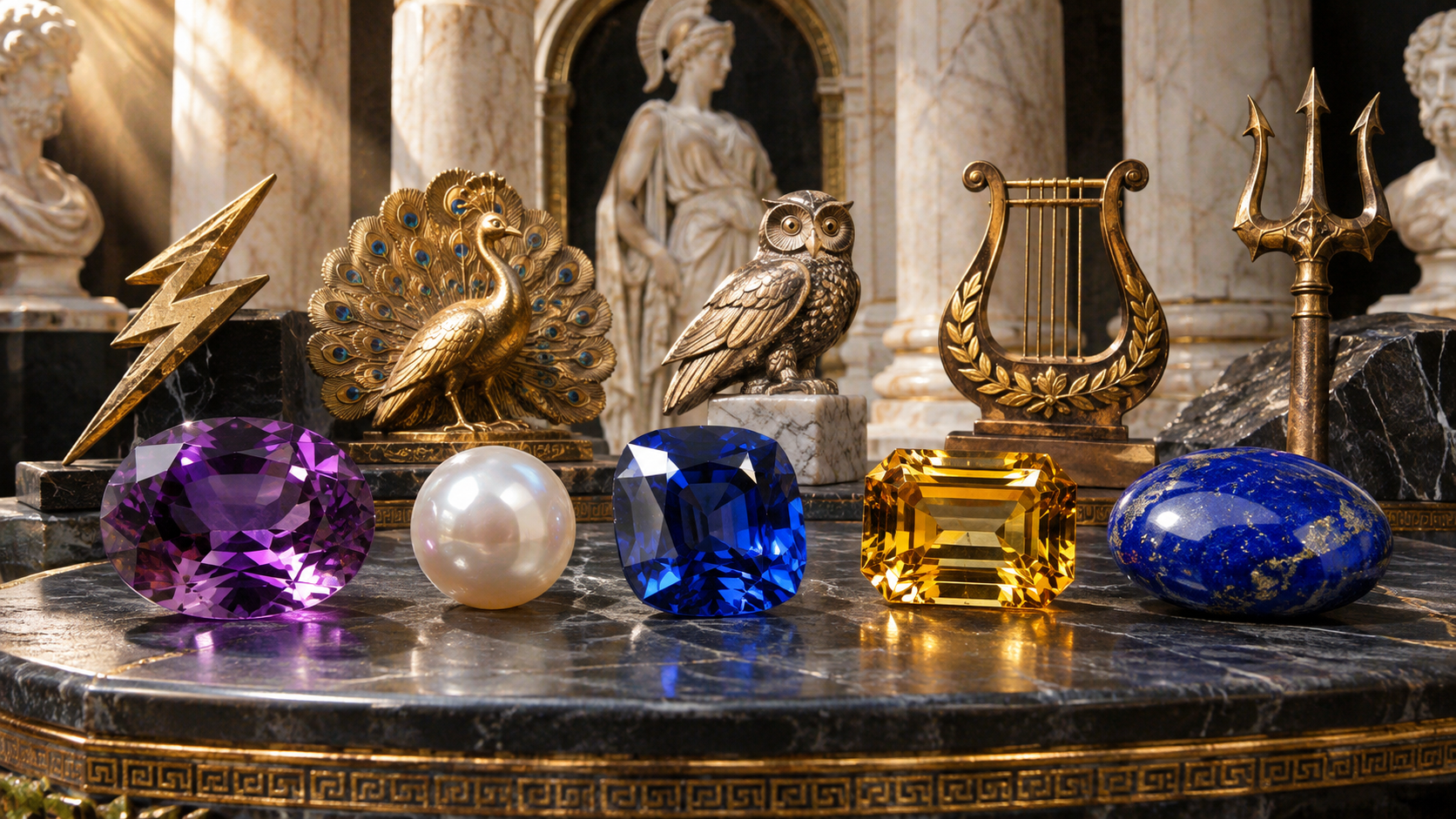
Ancient evidence confirms that gemstones and engraved rings could carry divine images, protective meanings and religious significance. Yet the familiar modern pairings of Zeus with amethyst, Hera with pearls, Athena with sapphire, Apollo with topaz and Poseidon with lapis lazuli are not all documented as fixed ancient religious traditions.
These combinations can nevertheless provide a compelling way to explore the symbolism of Greek mythology, provided that we distinguish historical evidence from later interpretations.
Let us enter the world of Olympus and discover how the beauty of gemstones came to reflect the imagined powers of the gods.
1. The Sacred World of Ancient Greek Religion
Ancient Greek religion was polytheistic.
Its followers honoured numerous gods and goddesses, each associated with particular powers, responsibilities and aspects of the natural or human world.
Zeus ruled the sky and exercised authority over divine and human affairs.
Hera was closely connected with marriage and queenship.
Athena represented wisdom, strategy and skilled craftsmanship.
Apollo was associated with prophecy, music, healing and light.
Poseidon governed the sea, earthquakes and horses.
These divine figures were not understood merely as abstract ideas.
They appeared in mythology, poetry, religious festivals, local cults, household practices and the visual arts.
Religion as a relationship between mortals and immortals
Greek worship frequently involved prayers, sacrifices, festivals and offerings.
A person might approach a deity to seek protection, express gratitude or request assistance.
The relationship between worshipper and god was often expressed through acts of reciprocity.
A valuable object dedicated in a sanctuary could demonstrate devotion or acknowledge a perceived divine favour.
Such offerings are commonly described as votive offerings.
Why precious materials mattered
Gold, silver, carved stones and finely crafted jewellery were valuable because of their rarity, beauty and the skill required to work them.
Dedicating a precious object could therefore represent a meaningful sacrifice of personal wealth.
The significance of a gemstone was not necessarily determined by a special mineral-to-deity correspondence.
It might instead derive from its engraved image, its inscription, the circumstances of its dedication or the religious identity of its owner.
This is an essential distinction when interpreting ancient Greek gemstone traditions.
2. Gemstones as Sacred Images, Seals and Amulets
The ancient Greeks developed extraordinary skills in engraving small gemstones.
These carved stones are commonly known as intaglios when the design is cut below the surface.
They could be mounted in rings and used to create impressions in wax or clay.
The practical function of engraved gemstones
A seal could identify its owner, authenticate a document or protect personal property.
The engraved image might depict a human figure, an animal, a mythological scene or a deity.
Such objects combined artistic craftsmanship with practical usefulness.
The religious function
When an engraved gemstone depicted a god or goddess, it could also carry religious significance.
A divine image might express the owner’s devotion or invoke a protective association.
Some ancient gems were used as amulets, objects believed to provide protection against danger or harmful influences.
Others were dedicated to temples as valuable offerings.
The Metropolitan Museum of Art documents both the practical and religious roles of engraved gemstones, including their use as personal ornaments, seals, magical amulets and votive gifts.
A personal connection with the divine
For an ancient wearer, a gemstone ring could therefore become more than an accessory.
It might combine personal identity, social status, craftsmanship and devotion to a particular deity.
The religious meaning depended not only on the mineral but also on the image, inscription and cultural context.
3. Zeus and Amethyst: Divine Authority, Order and Moderation
Zeus, ruler of Olympus
Zeus was the supreme ruler of the Olympian gods.
He governed the sky, thunder and lightning and was associated with kingship, justice, oaths and the maintenance of cosmic order.
His most recognisable symbol was the thunderbolt.
The eagle, oak tree and sceptre also appeared among his attributes.
In mythology, Zeus could be both protector and punisher.
He defended divine authority and social obligations, yet his stories also reveal the complex and sometimes contradictory behaviour of the Olympian gods.
The symbolic attraction of amethyst
Amethyst is a purple gemstone traditionally associated with moderation, clarity and protection against intoxication.
Its Greek-derived name, amethystos, means “not intoxicated.”
Ancient and later traditions connected the stone with sobriety and the control of excess.
These qualities provide an appealing symbolic parallel with Zeus as the guardian of order.
The purple colour also lends itself to modern associations with kingship and divine authority.
A modern symbolic interpretation
In contemporary gemstone spirituality, amethyst may be paired with Zeus to represent:
- Divine authority and sovereignty
- Wisdom and sound judgement
- Protection
- Moderation and self-control
- Balance between power and responsibility
A person interested in Greek mythology might choose amethyst as a symbolic reminder of these qualities.
What does ancient evidence establish?
Amethyst was known in the ancient Mediterranean and appears in Hellenistic and later gemstone traditions.
However, the available evidence does not establish amethyst as Zeus’s universally recognised sacred gemstone.
Zeus was more consistently identified through his divine attributes, including the thunderbolt and eagle, than through one particular mineral.
The Zeus–amethyst pairing is therefore best understood as a later symbolic interpretation inspired by the gemstone’s colour and traditional meanings.
This does not prevent the association from having personal significance for modern admirers of Greek mythology.
4. Hera and Pearls: Marriage, Queenship and Sacred Bonds
Hera, queen of the gods
Hera was the wife of Zeus and queen of Olympus.
She was particularly associated with marriage, legitimate unions and the social institutions surrounding family life.
Her cult was important in several Greek communities.
Major sanctuaries dedicated to Hera existed at places such as Samos and Argos.
Her mythology presents a powerful and complex goddess.
She could defend marriage and family relationships while also displaying anger, jealousy and fierce determination.
Pearls as symbols of beauty and devotion
Pearls possess a distinctive beauty.
Unlike most gemstones, which form through geological processes, pearls are produced by certain molluscs.
Their soft lustre and delicate appearance have inspired associations with purity, femininity and enduring affection.
In modern gemstone symbolism, these qualities make pearls a natural companion to Hera’s association with marriage.
The spiritual interpretation
Pearls can symbolically represent:
- Commitment and fidelity
- Marriage and partnership
- Family bonds
- Dignity and queenship
- Emotional maturity
Within a contemporary mythological interpretation, a pearl necklace may evoke Hera’s role as protector of marriage.
Historical context
Pearls were valued as luxury objects in the ancient Mediterranean, particularly in later Hellenistic and Roman contexts.
However, the existence of pearl jewellery does not establish a fixed ancient theological rule connecting Hera exclusively with pearls.
Her established sacred symbols included the peacock in later iconographic traditions, as well as the cow and other attributes associated with her cult.
The Hera–pearl relationship is therefore a meaningful symbolic comparison rather than a universally documented ancient Greek gemstone assignment.
5. Athena and Sapphire: Wisdom, Protection and Strategic Insight
Athena, goddess of wisdom
Athena was one of the most important deities in the Greek pantheon.
She was associated with wisdom, skilled craftsmanship, strategic warfare and the protection of cities.
Athens regarded her as its patron goddess.
The Parthenon, one of the most celebrated buildings of ancient Greece, was dedicated to Athena Parthenos.
Her traditional attributes included the owl, olive tree, helmet, spear and aegis.
Why sapphire evokes Athena
Blue sapphire is often associated in later gemstone traditions with truth, loyalty, wisdom and mental clarity.
Its deep blue colour can symbolically evoke the heavens, intellectual depth and calm judgement.
These associations correspond closely with Athena’s mythological identity.
The spiritual interpretation
In modern gemstone symbolism, sapphire may represent:
- Wisdom and knowledge
- Discernment and clear thinking
- Strategic judgement
- Loyalty and truth
- Protection through understanding
A sapphire worn as a symbolic tribute to Athena can therefore express admiration for learning, reason and personal responsibility.
Historical evidence: Athena on engraved gemstones
There is stronger historical evidence for the depiction of Athena herself on ancient gemstones than for a fixed Athena–sapphire association.
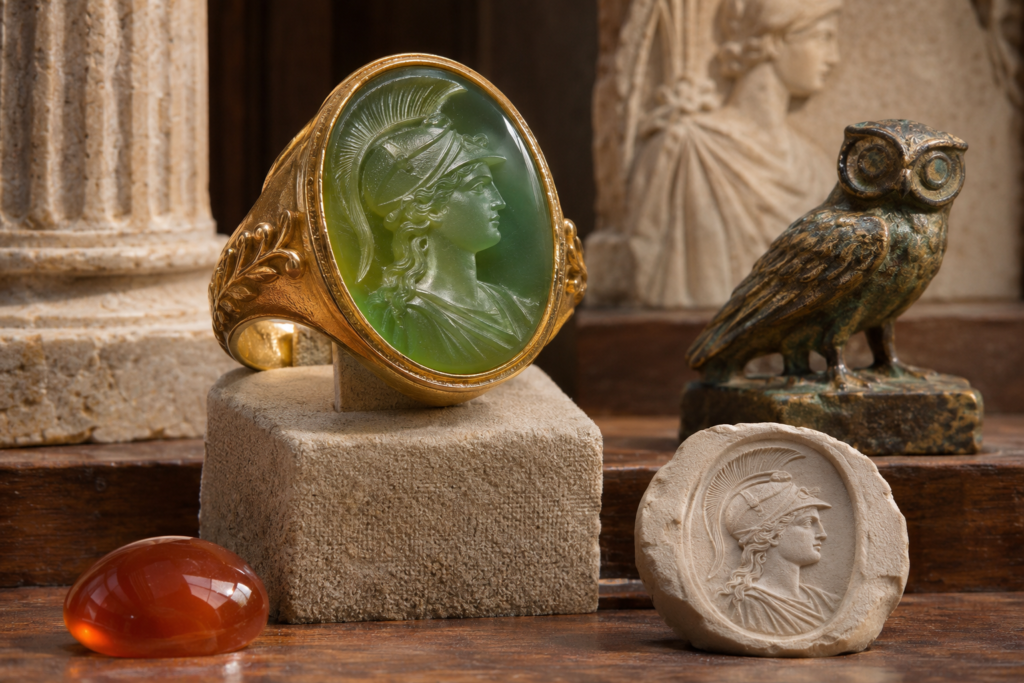
The J. Paul Getty Museum preserves a Roman-period cameo ring depicting Minerva, the Roman goddess identified with Greek Athena.
The museum describes the ring as functioning similarly to an amulet, with the image of the goddess placing its wearer under her protection.
Interestingly, the gemstone is chrome chalcedony rather than sapphire.
This distinction reveals an important feature of ancient gemstone spirituality.
The divine image engraved into a stone could matter more than the particular mineral chosen.
A person might seek Athena’s protection through her image without requiring the gemstone to be sapphire.
6. Apollo and Golden Topaz: Light, Prophecy and Inspiration
Apollo, god of prophecy and the arts
Apollo was associated with prophecy, music, poetry, archery and healing.
He was also connected with purification and divine order.
His sanctuary at Delphi was among the most influential religious centres of ancient Greece.
Pilgrims and representatives of Greek cities travelled to Delphi to consult the oracle.
Apollo’s symbols included the lyre, bow and laurel.
In later classical traditions, he became increasingly associated with solar imagery, although Helios was the distinct personification of the sun in much of earlier Greek mythology.
The golden symbolism of topaz
Golden and yellow gemstones naturally evoke sunlight, warmth and illumination.
Modern gemstone symbolism frequently associates golden topaz with confidence, creativity and personal inspiration.
These themes make it an appealing symbolic companion to Apollo.
The spiritual interpretation
Golden topaz may be used in contemporary mythological symbolism to represent:
- Artistic inspiration
- Illumination and clarity
- Creative expression
- Confidence
- The search for truth
For a musician, writer or artist, the Apollo–topaz association can serve as a personal symbol of creativity and dedication.
The historical complication
Ancient gemstone names do not always correspond to modern mineralogical classifications.
The ancient term topazion was associated with gemstones from the Red Sea region, particularly material now identified as peridot.
It would therefore be misleading to assume that every ancient reference to topaz describes the modern mineral topaz.
There is also insufficient evidence to establish golden topaz as Apollo’s fixed sacred gemstone.
The relationship is best presented as a later symbolic interpretation connecting the gemstone’s golden colour with Apollo’s divine attributes.
7. Poseidon and Lapis Lazuli: The Depths of the Sea
Poseidon, ruler of the waters
Poseidon was the Greek god of the sea, earthquakes and horses.
His most familiar symbol was the trident.
In mythology, he could calm the waters or unleash violent storms.
His temperament often reflected the unpredictable power of the sea itself.
For maritime communities, divine protection during voyages was a matter of considerable importance.
Sailors could pray or make offerings to Poseidon in the hope of favourable conditions.
Lapis lazuli and the colour of the deep sea
Lapis lazuli is admired for its rich blue colour, often accompanied by pale calcite and golden pyrite inclusions.
Its appearance can evoke the deep ocean or a night sky scattered with stars.
This makes it an attractive symbolic gemstone for Poseidon.
The spiritual interpretation
Within modern gemstone mythology, lapis lazuli may represent:
- The mysteries of the sea
- Emotional depth
- Inner strength
- Protection during journeys
- Respect for powerful natural forces
Its blue colour creates an immediate visual connection with Poseidon’s domain.
Ancient Greek evidence and limitations
Lapis lazuli was known in the ancient world, particularly through trade networks connecting the Mediterranean with regions farther east.
However, there is no sufficient basis for presenting it as Poseidon’s universally recognised sacred gemstone.
The trident, horse and marine imagery were much more firmly established symbols of Poseidon.
A lapis lazuli ornament depicting Poseidon would be a meaningful mythological object, but the gemstone’s colour alone does not establish an ancient religious association.
8. Aphrodite and Garnet: Love, Beauty and Desire
Aphrodite, goddess of love
Aphrodite governed love, desire, beauty and attraction.
Her mythology explored the powerful effects of affection and passion on both gods and mortals.
Her cult and imagery were widespread across the Greek world.
Gemstones and the imagery of Aphrodite
Engraved gemstones provide particularly interesting evidence of Aphrodite’s representation in ancient art.
Hellenistic gem engravers depicted the goddess in a variety of poses and compositions.
A notable garnet ring from approximately 200 BCE, discussed in Metropolitan Museum research, shows Aphrodite holding a shield and spear.
This is an example of an actual ancient gemstone bearing the goddess’s image.
The symbolism of garnet
Red garnet can symbolically evoke passion, attraction and vitality.
Its intense colour makes it an appealing gemstone for a modern association with Aphrodite.
But the historical evidence is more specific: we can identify surviving garnets engraved with Aphrodite, rather than claim that every red garnet was sacred to her.
This is an especially valuable distinction between documented ancient practice and modern spiritual interpretation.
9. Dionysus and Amethyst: Wine, Ecstasy and Moderation
Dionysus, god of wine and transformation
Dionysus was associated with wine, theatre, ecstatic celebration and the transformation of ordinary experience.
His worship could involve music, dance and ritual expressions of altered social boundaries.
His mythology explored the relationship between order and excess, restraint and liberation.
Amethyst and the fear of intoxication
Amethyst’s ancient association with sobriety creates a particularly interesting contrast with Dionysus.
The gemstone’s name reflects the idea of being protected from drunkenness.
Later mythological storytelling developed explanations connecting amethyst with Dionysus or Bacchus.
However, popular modern accounts of the god transforming a maiden named Amethyst into stone should not be presented as securely documented early Greek mythology.
The symbolic relationship
The Dionysus–amethyst pairing offers a rich metaphor.
Dionysus represents intoxication and ecstatic experience.
Amethyst represents moderation and restraint in gemstone lore.
Together, they evoke the tension between pleasure and self-control.
This relationship is more directly connected to amethyst’s traditional name and reputation than the proposed Zeus–amethyst pairing, although individual mythological stories still require careful historical dating.
10. Tyche and Carnelian: Fortune, Prosperity and the Uncertainty of Life
Tyche, goddess of fortune
Tyche personified fortune, chance and the unpredictable circumstances of human life.
She became especially prominent in the Hellenistic period.
Her imagery could include a cornucopia, symbolising abundance, and other attributes associated with changing fortune.
A documented ancient gemstone
The J. Paul Getty Museum preserves a remarkable Hellenistic gold signet ring dating to approximately 225–175 BCE.
The ring contains a carnelian gemstone engraved with the figure of Tyche, known to the Romans as Fortuna.
She appears with attributes including a double cornucopia and sceptre.
The object provides direct evidence that a gemstone could carry the image of a deity associated with prosperity and fortune.
Spiritual interpretation
Carnelian is associated in modern gemstone traditions with confidence, vitality and motivation.
When combined with the image of Tyche, it can also evoke the ancient themes of prosperity, chance and the uncertainty of human affairs.
The historical importance lies in the engraved divine figure and the object’s cultural context, not in proof that carnelian itself could alter fortune.
11. How the Ancient Greeks Used Gemstones in Religious Life
Personal rings and divine protection
Engraved rings could display gods, heroes or mythological scenes.
For some wearers, these images expressed devotion or invoked divine protection.
A ring could be both a practical seal and a personal religious object.
Offerings to the gods
Ancient temple inventories record jewellery and precious objects dedicated as offerings.
Such gifts might express gratitude, fulfil a vow or seek divine favour.
The value of an offering could be associated with its material, craftsmanship or personal significance.
Amulets and protective beliefs
Some gemstones were used as amulets.
The protective qualities attributed to these objects could depend on inscriptions, images, ritual practices or beliefs about the stones themselves.
The traditions were not uniform across every Greek city or historical period.
Wealth, identity and status
Gemstones also communicated social standing.
Expensive materials and skilled engraving demonstrated access to wealth and craftsmanship.
An ornament might therefore carry several meanings simultaneously: beauty, personal identity, religious symbolism and status.
12. The Evolution of Gemstone Magic in the Hellenistic and Roman Worlds
Greek gemstone traditions did not remain unchanged.
During the Hellenistic period, Greek culture interacted extensively with Egyptian, Near Eastern and other religious traditions.
These exchanges contributed to new artistic forms and increasingly complex religious imagery.
The development of magical gems
In the Greek-speaking and Roman imperial worlds, some engraved stones carried divine figures, sacred names, protective symbols and magical inscriptions.
These objects are often studied under the category of magical gems.
Their imagery could combine elements from several religious traditions.
For example, the J. Paul Getty Museum preserves a Roman-period lapis lazuli gem depicting Bes-Pantheos and Anubis.
Although the object belongs to a later, culturally mixed religious environment, it demonstrates how gemstones could become carriers of complex protective and theological symbolism.
Why historical context matters
A Roman magical gem made centuries after classical Athens should not automatically be treated as evidence of a uniform earlier Greek belief.
The ancient Mediterranean was culturally diverse.
Gemstone practices changed with time, place, religious exchange and individual preference.
Recognising these differences makes the history more interesting rather than less spiritual.
13. The Gods, Their Attributes and Their Gemstone Interpretations
The following comparison distinguishes established divine attributes from modern gemstone associations.
| Greek deity | Established mythological domain | Gemstone interpretation | Historical assessment |
|---|---|---|---|
| Zeus | Sky, thunder, justice, kingship | Amethyst — authority and moderation | Modern symbolic pairing; no fixed ancient assignment established |
| Hera | Marriage, queenship, family | Pearl — fidelity and devotion | Symbolic comparison; not an established exclusive sacred gemstone |
| Athena | Wisdom, strategy, craftsmanship | Sapphire — clarity and wisdom | Modern pairing; ancient divine images survive on other gemstones |
| Apollo | Prophecy, music, healing, light | Golden topaz — inspiration and illumination | Later symbolism; ancient topaz terminology differs from modern mineralogy |
| Poseidon | Sea, earthquakes, horses | Lapis lazuli — depth and maritime power | Colour-based interpretation; no universal ancient pairing established |
| Aphrodite | Love, beauty, desire | Garnet — passion and attraction | Actual ancient garnet imagery depicting Aphrodite is documented |
| Dionysus | Wine, ecstasy, theatre | Amethyst — moderation and sobriety | Connected with the stone’s traditional reputation; later myths require caution |
| Tyche | Fortune, chance, prosperity | Carnelian — vitality and good fortune | Hellenistic carnelian ring engraved with Tyche is documented |
This comparison shows that the relationship between gemstones and gods was more varied than a single fixed correspondence system.
Sometimes the meaning came from the gemstone’s colour.
Sometimes it came from a traditional belief about the material.
In other cases, the most important element was the image of the deity engraved into the stone.
14. The Spiritual Meaning of Greek Gemstones Today
Ancient Greek mythology continues to inspire contemporary jewellery, meditation and personal symbolism.
A person may choose a gemstone because its colour or traditional meaning reminds them of a particular deity.
Amethyst may represent wisdom and moderation.
Pearls may symbolise marriage and devotion.
Sapphire may evoke Athena’s clarity of thought.
Golden topaz may suggest artistic inspiration.
Lapis lazuli may recall the power and mystery of the sea.
Such interpretations can be meaningful expressions of personal spirituality.
Modern practice and ancient religion
Contemporary Hellenic religious practitioners may approach the Greek gods as living objects of devotion rather than merely literary characters.
Their practices and interpretations vary.
It is important not to assume that every modern practitioner assigns the same gemstones to the same gods.
Likewise, modern crystal-healing systems should not automatically be described as direct continuations of ancient Greek ritual practice.
Historical inspiration and historical continuity are different claims.
Personal meaning
A gemstone can serve as a reminder of a mythological story or a quality that someone wishes to cultivate.
For example, a sapphire may remind its wearer to approach a difficult decision with Athena-like wisdom.
The personal significance of that practice does not require the existence of a universally documented ancient sapphire ritual.
15. A Brief Scientific Perspective: The Natural Properties Behind the Symbolism
The gemstones discussed in Greek mythology have different mineralogical identities.
| Gemstone | Scientific identity | Characteristic feature |
|---|---|---|
| Amethyst | Purple quartz, SiO₂ | Iron-related colour centres |
| Pearl | Organic gem formed by molluscs | Nacreous lustre |
| Sapphire | Corundum, Al₂O₃ | Blue colour generally linked to iron-titanium interactions |
| Topaz | Aluminium fluorosilicate | Distinctive crystal chemistry and cleavage |
| Lapis lazuli | Rock composed mainly of lazurite and other minerals | Intense blue colour, sometimes with pyrite |
| Garnet | Group of silicate minerals | Wide range of colours and compositions |
| Carnelian | Orange-to-red chalcedony | Colour associated with iron-bearing components |
These properties can be investigated through gemmology, mineralogy and spectroscopy.
Physical properties versus divine associations
Gemstones interact with light and possess measurable chemical and structural characteristics.
Their colours can inspire powerful symbolic interpretations.
However, scientific research has not established that amethyst transmits Zeus’s authority, sapphire communicates Athena’s wisdom or lapis lazuli channels Poseidon’s power.
The religious significance of an ancient gemstone must be understood through historical evidence, cultural context and the beliefs of its users.
Its physical properties belong to the natural sciences.
Can a gemstone carry spiritual meaning without measurable supernatural power?
Yes, in the sense that an object can possess cultural, symbolic or devotional significance for the person who values it.
A gemstone may represent a deity, commemorate a ritual or remind someone of a mythological story.
That meaning is not the same as a scientifically measurable force.
Both aspects can be discussed respectfully without confusing them.
16. Conclusion: Where Mythology and Precious Stones Meet
The relationship between gemstones and the gods of ancient Greece reveals a world in which art, religion and personal identity were deeply connected.
Precious stones could be engraved with divine images, worn as protective ornaments or dedicated as valuable gifts in sanctuaries.
Their beauty and craftsmanship made them powerful expressions of human devotion.
The surviving evidence also reveals a more complex history than the modern idea that every Olympian god possessed one specific sacred gemstone.
Some associations are later symbolic interpretations.
Others are supported by actual archaeological objects.
A garnet engraved with Aphrodite, a carnelian ring depicting Tyche and a protective cameo bearing Athena’s Roman counterpart provide tangible connections between gemstones and ancient divine imagery.
The myths of Zeus, Hera, Athena, Apollo and Poseidon continue to inspire gemstone symbolism today.
Their stories speak of authority, love, wisdom, creativity and the overwhelming power of nature.
The most enduring connection between gemstones and the Greek gods may not be a hidden force inside the stone, but the human desire to give precious natural materials a sacred and meaningful place in the world.
For admirers of mythology, these gemstones remain beautiful reminders of the stories and beliefs that shaped ancient Mediterranean civilisation.
Natural Gems Belgium – Our Perspective
At Natural Gems Belgium, we explore gemstones through their geological origins, cultural history, religious symbolism and natural beauty.
We recognise that gemstones can carry spiritual significance within both historical and contemporary traditions.
Our Learning Center approaches these subjects with respect for religious beliefs while distinguishing documented historical practices from later interpretations.
Scientific gemmology explains the measurable properties of gemstones.
History and archaeology reveal how people used them.
Mythology and theology illuminate the meanings that different communities attributed to them.
Together, these perspectives help us appreciate gemstones as natural materials and as objects of extraordinary human significance.
References & Further Reading
The following references prioritise museums, scholarly publications and educational institutions. They document ancient gemstone craftsmanship, religious imagery and historical interpretations without linking to competing gemstone retail pages.
1. The Metropolitan Museum of Art – Antique Engraved Gems and Renaissance Collectors
Historical discussion of engraved gemstones, seals, amulets, religious offerings and their significance in Greek and Roman society.
https://www.metmuseum.org/essays/antique-engraved-gems-and-renaissance-collectors
2. The Metropolitan Museum of Art – Cameo Appearances
Educational essay examining ancient gemstone engraving, divine imagery and the development of cameos.
https://www.metmuseum.org/essays/cameo-appearances
3. The Metropolitan Museum of Art – Greek Art: From Prehistoric to Classical
Museum educational publication, including discussion of Greek engraved gemstones and their artistic and practical functions.
https://www.metmuseum.org/-/media/files/learn/for-educators/publications-for-educators/greek.pdf
4. The J. Paul Getty Museum – Cameo Gem with Minerva Set into a Hollow Ring
Archaeological object documenting the protective significance of a goddess’s image engraved into a gemstone ring.
https://www.getty.edu/art/collection/object/103WFQ
5. The J. Paul Getty Museum – Ring Inset with Intaglio Representing Fortuna
Hellenistic carnelian signet ring depicting Tyche/Fortuna, providing direct evidence of divine imagery on precious stones.
https://www.getty.edu/art/collection/object/103Z04
6. The J. Paul Getty Museum – Getty Museum Acquires Collection of Ancient Engraved Gems
Museum publication documenting Greek, Etruscan and Roman engraved gemstones, including mythological subjects.
https://www.getty.edu/news/getty-acquires-collection-ancient-engraved-gems
7. The Metropolitan Museum of Art – Art of the Hellenistic Kingdoms: From Pergamon to Rome
Scholarly museum publication discussing Hellenistic gemstone engraving, garnet jewellery, Aphrodite imagery and amethyst in ancient literature.
8. The J. Paul Getty Museum – Engraved Gem with Bes-Pantheos and Anubis
Roman-period lapis lazuli magical gem illustrating the religious complexity of later Mediterranean gemstone traditions.
https://www.getty.edu/art/collection/object/103XYN
9. The Metropolitan Museum of Art – Onyx Intaglio: Incantation in Greek Letters
Museum collection record of a Roman-period engraved gemstone bearing a protective magical inscription.
https://www.metmuseum.org/art/collection/search/249035
10. The Metropolitan Museum of Art – Popular Religion: Magical Uses of Imagery in Byzantine Art
Historical discussion of later gemstone amulets and beliefs concerning the protective and medicinal properties of stones.
https://www.metmuseum.org/essays/popular-religion-magical-uses-of-imagery-in-byzantine-art
11. Gemological Institute of America (GIA) – Gem Encyclopedia
Scientific reference for gemstone composition, identification, physical properties and geological origins.
https://www.gia.edu/gem-encyclopedia
Historical note: Modern gemstone-to-deity correspondences are identified as symbolic interpretations unless supported by specific ancient literary or archaeological evidence.
Educational note: Traditional magical and protective gemstone beliefs are presented as religious and cultural interpretations, not scientifically established physical effects.
© Natural Gems Belgium — NGB 2.0 Learning Center