

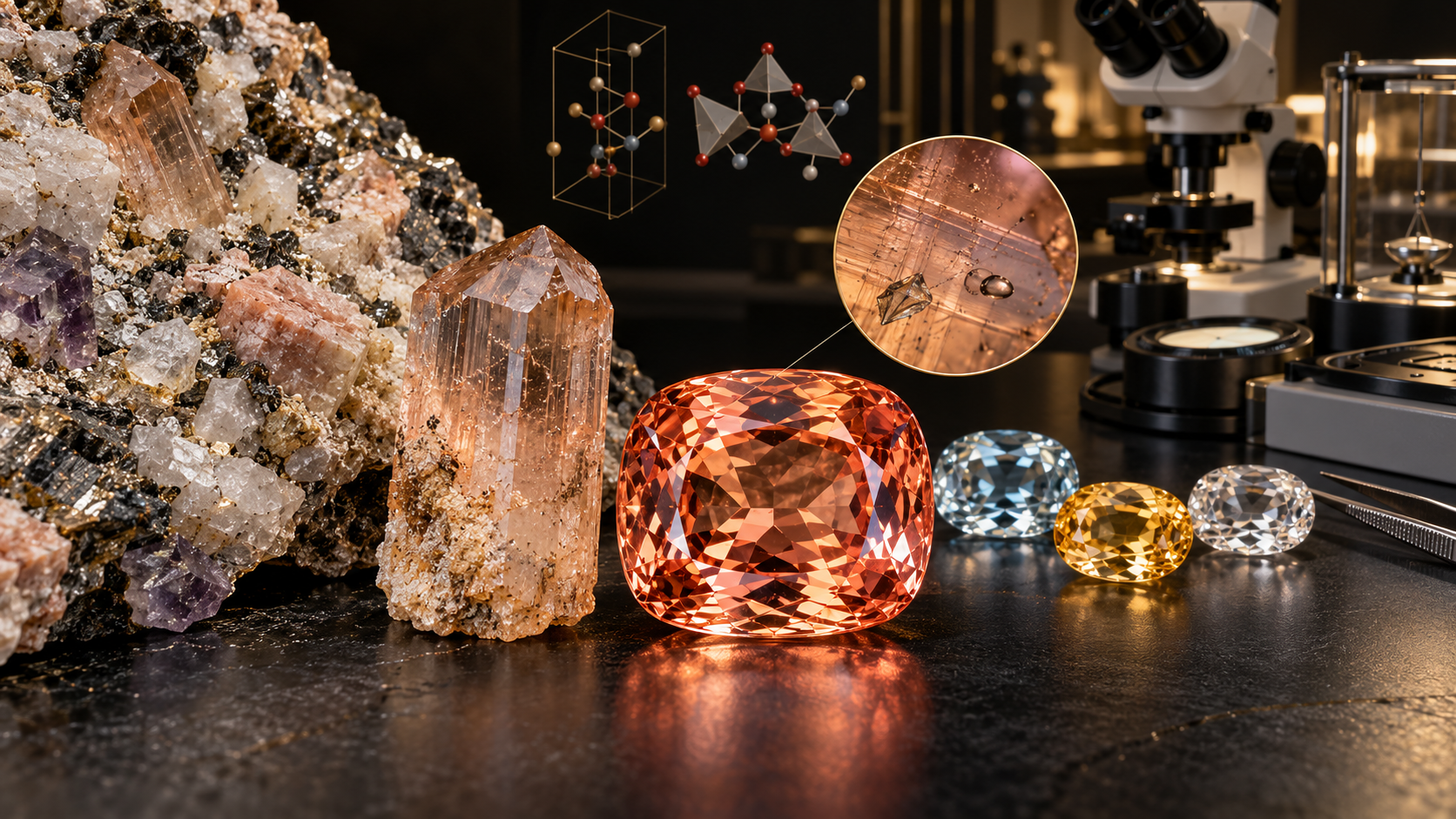
Topaz is an aluminium fluorosilicate mineral with the chemical formula Al₂SiO₄(F,OH)₂. Its exceptional transparency, wide colour range, orthorhombic crystal structure and distinctive optical properties make it an important subject in both classical and advanced gemmology.
Although topaz is widely associated with blue gemstones, its natural colour diversity extends considerably further. Colourless, yellow, orange, brown, pink, red and occasionally naturally blue material can occur. These colours reflect different combinations of trace-element chemistry, structural defects and geological processes.
One of the mineral’s most scientifically interesting characteristics is the substitution of hydroxyl groups for fluorine within its crystal structure. This chemical variation influences refractive index, density and other measurable properties, demonstrating why gemmological constants must be interpreted as ranges rather than universal fixed values.
Topaz also illustrates an essential distinction between hardness and toughness. Despite its Mohs hardness of 8, the mineral possesses perfect basal cleavage. A sharp impact in an unfavourable direction can therefore split a crystal along a crystallographic plane.
Its geological formation is equally diverse. Topaz commonly crystallises in fluorine-rich granitic pegmatites, hydrothermal veins and altered granitic rocks known as greisens. Certain deposits, including the historically important Imperial topaz occurrences near Ouro Preto in Brazil, have more complex geological histories involving mineralising fluids and metamorphosed host rocks.
Modern gemmology must also address extensive commercial colour enhancement. Most strongly coloured blue topaz is produced through irradiation followed by controlled heating, while selected yellowish or brownish-orange material can be heated to produce attractive pink colours.
In this Nadia Gemstone Academy reference guide, we examine topaz from its atomic structure and geological formation to its optical properties, colour mechanisms, microscopic features, treatments, identification methods and practical durability.
The objective is to understand the topaz gemstone not simply as a colourful gemstone, but as a mineral whose chemistry, crystallography and geological history provide essential evidence for professional gemmological investigation.
Table of Contents
Topaz: A Gemmological Reference Guide
Introduction
Topaz is a naturally occurring aluminium fluorosilicate mineral with the idealised chemical formula Al₂SiO₄(F,OH)₂.
It belongs to the nesosilicate mineral class and crystallises in the orthorhombic crystal system.
The mineral is widely recognised for its transparency, brilliant vitreous lustre and extensive colour range. However, its scientific importance extends considerably beyond its appearance as a gemstone.
Topaz provides an important example of how chemical substitution, crystal structure, geological environment and treatment processes influence the physical and optical properties of a mineral.
Its fluorine–hydroxyl chemistry is particularly significant.
Variation in the relative proportions of fluorine and hydroxyl within the crystal structure affects refractive index, density and other measurable properties.
Topaz is also distinguished by its perfect basal cleavage, an important characteristic that affects both professional identification and practical durability.
Modern gemmology must additionally consider the extensive use of irradiation and heat treatment to produce commercial blue topaz, together with the possibility of surface coatings and other modifications.
Understanding topaz therefore requires a combination of mineralogical classification, geological interpretation, optical testing, microscopic examination and, where necessary, advanced laboratory analysis.
1. Mineralogical Classification
Topaz belongs to the silicate mineral class.
More specifically, it is classified as a nesosilicate, or orthosilicate.
Its chemical formula is:
Al₂SiO₄(F,OH)₂
The principal structural components are aluminium, silicon, oxygen, fluorine and hydroxyl.
The mineral is orthorhombic.
Topaz is a mineral species rather than a mineral group containing numerous commercially recognised gemstone species.
Blue topaz, pink topaz and colourless topaz are descriptive colour categories within the same species.
Terms such as Imperial topaz and Sherry topaz have historical and commercial significance but do not represent separate mineral species.
This distinction is important because commercial terminology is not always equivalent to formal mineralogical classification.
2. Crystal Structure
Topaz crystallises in the orthorhombic crystal system.
The crystal structure contains isolated SiO₄ tetrahedra associated with aluminium coordination polyhedra.
Fluorine and hydroxyl occupy crystallographic positions within this framework.
The orthorhombic structure produces three mutually perpendicular crystallographic axes of unequal length.
Unlike cubic minerals, orthorhombic crystals are optically anisotropic.
Consequently, topaz is doubly refractive.
Its optical character is biaxial positive.
The relationship between crystal structure and optical behaviour is fundamental to professional identification.
3. Crystal Morphology
Topaz commonly forms elongated prismatic crystals.
Well-developed crystals may display longitudinal striations along their prism faces.
Terminations can consist of pyramidal, domed and other crystallographic faces.
The exact morphology depends on growth conditions.
Some crystals are short and relatively broad.
Others form exceptionally elongated prisms.
Large, transparent topaz crystals are known from several geological environments.
Because topaz can form in open cavities, crystals may develop well-defined external faces.
However, crystal habit alone is not sufficient for identification.
Some topaz crystals can resemble quartz or other prismatic minerals.
Crystallographic observations should therefore be combined with optical and physical testing.
4. Fluorine–Hydroxyl Substitution
One of the most scientifically important characteristics of topaz is the substitution between fluorine and hydroxyl.
The chemical formula is commonly expressed as:
Al₂SiO₄(F,OH)₂
Fluorine and hydroxyl can occupy corresponding positions within the crystal structure.
The relative proportions vary between natural specimens.
This substitution affects several physical properties.
These include refractive index, specific gravity, unit-cell dimensions and optical axial angle.
Research on pink topaz from Pakistan demonstrated that partial replacement of fluorine by hydroxyl can produce measurable differences in optical and crystallographic characteristics.
Consequently, a single refractive-index value cannot adequately describe the complete natural topaz population.
Fluorine-rich material generally exhibits lower refractive indices than more hydroxyl-rich material.
This relationship provides an important connection between mineral chemistry and classical gemmological measurements.
5. Geological Formation
Topaz commonly forms in geological environments enriched in fluorine.
Fluorine availability is particularly important because it influences mineral stability and the chemical behaviour of late-stage magmatic and hydrothermal fluids.
Important formation environments include granitic pegmatites, hydrothermal veins, greisens and cavities within certain volcanic rocks.
Topaz can also occur in metamorphic or metasomatic geological settings.
These environments are not identical.
Each may involve different temperatures, pressures, fluid compositions and host-rock chemistry.
Therefore, topaz does not have one universal geological formation pathway.
6. Formation in Granitic Pegmatites
Granitic pegmatites are among the important geological environments in which topaz crystallises.
Pegmatites commonly represent late-stage products of magmatic differentiation.
As a granitic magma evolves, certain elements and volatile components may become concentrated within the remaining melt.
Fluorine can influence the mobility and distribution of several elements.
Under suitable chemical conditions, topaz may crystallise together with minerals such as quartz, feldspar, mica and fluorite.
Open cavities can allow the development of relatively large, well-formed crystals.
These cavities are particularly important for the formation of transparent mineral specimens.
However, not every granitic pegmatite contains topaz.
Its occurrence depends on the specific chemical evolution of the magmatic system.
7. Hydrothermal Formation
Topaz can also crystallise from hydrothermal fluids.
These fluids may circulate through fractures, cavities and permeable zones within rocks.
When temperature, pressure or chemical composition changes, dissolved mineral components can precipitate.
Fluorine-rich fluids can create favourable conditions for topaz crystallisation.
The resulting mineralisation may occur within veins or replacement zones.
The exact chemical reactions depend on the host rock and fluid composition.
Hydrothermal topaz formation is particularly important when interpreting deposits that are not directly associated with large open pegmatite cavities.
8. Greisen Environments
Greisen is a hydrothermally altered rock commonly associated with granitic systems.
During greisenisation, late-stage fluids interact with the original granite.
Minerals such as feldspar can be altered or replaced.
Quartz and mica commonly become important components of the resulting rock.
Topaz may form where fluorine-rich fluids provide suitable chemical conditions.
Other associated minerals can include fluorite, cassiterite and additional minerals characteristic of evolved granitic systems.
Greisen-related topaz therefore provides information about the late stages of magmatic and hydrothermal evolution.
9. Volcanic Occurrences
Topaz also occurs in certain volcanic environments.
Fluorine-rich rhyolitic systems can contain cavities in which topaz crystallises.
These cavities may develop during cooling and volatile release.
Topaz can form alongside quartz, fluorite and other minerals.
Some volcanic occurrences produce small, well-formed crystals.
The geological conditions differ from those of large granitic pegmatites.
Consequently, the size, morphology and associated mineral assemblages of the crystals may also differ.
10. Brazil – Ouro Preto and Imperial Topaz
The Ouro Preto region of Minas Gerais, Brazil, is one of the world’s most historically important sources of fine-coloured topaz.
The region is particularly associated with orange, reddish-orange, pink and reddish-pink material.
The commercial term Imperial topaz is strongly associated with these colours.
Important mining localities include the Capão and Vermelhão deposits.
The geological setting is more complicated than a simple pegmatite occurrence.
Topaz-bearing veins and cavities occur within deeply weathered metasedimentary host rocks.
Fault-controlled mineralising fluids are believed to have played an important role.
The geological origin of the deposits has been investigated for many decades, and aspects of the mineralisation history remain subjects of scientific interpretation.
Research on the Capão mine has documented a broad range of topaz colours.
Some brownish-yellow or orange material can be transformed into peach or pink colours through heat treatment.
The deposits therefore provide an important example of the relationship between natural colour, geological formation and commercial enhancement.
11. Pakistan – Katlang Pink Topaz
Pakistan is an important source of naturally pink topaz.
The Katlang occurrence, in the Mardan region, has been investigated in gemmological research.
Unlike the classic pegmatite model, the studied pink topaz occurs within calcite veins associated with recrystallised limestone.
Research published in Gems & Gemology in 1986 documented crystals ranging from pink to brownish and colourless material.
The study established that chromium was the principal chromophore responsible for the pink colour.
It also demonstrated that fluorine–hydroxyl substitution influenced refractive indices, optical axial angle, density and crystallographic parameters.
The Katlang deposit is therefore particularly valuable for understanding the interaction between trace-element chemistry and mineral structure.
12. Russia – Ural Mountains
The Ural Mountains have a long historical association with topaz.
Russian deposits produced fine-coloured material that became important in European jewellery and royal collections.
The term Imperial topaz has historical connections with Russian royalty.
However, its exact historical development is not universally described in the same way.
Different accounts associate the term with Russian imperial use and with the later prominence of Brazilian topaz.
From a modern mineralogical perspective, Imperial topaz remains a trade designation rather than a formally recognised mineral variety.
13. United States – Mason County, Texas
Mason County, Texas, is an especially important locality for scientific research on natural blue topaz.
The area produces colourless, blue and brownish topaz.
Much of the material occurs in secondary alluvial deposits derived from granitic and pegmatitic geological environments.
A detailed study published in Gems & Gemology in Winter 2023 examined 83 topaz samples.
The researchers used classical gemmological measurements together with Raman spectroscopy, FTIR spectroscopy, UV-Vis-NIR spectroscopy and trace-element analysis.
The investigated samples displayed refractive indices between approximately 1.615 and 1.625.
Their average measured refractive index was close to 1.620.
Some specimens displayed naturally blue colour.
The study is important because it confirms that blue topaz is not exclusively a product of artificial irradiation.
However, natural blue colour is generally much less common in the commercial gemstone market than treated blue material.
14. Other Important Sources
Topaz occurs in several additional countries.
These include Sri Lanka, Nigeria, Madagascar, Namibia and other regions.
The United States also contains important occurrences in Utah.
Some deposits produce exceptional mineral specimens.
Others yield transparent material suitable for faceting.
Not every topaz occurrence produces commercially significant gemstones.
The quality and characteristics of the material depend on crystal size, transparency, colour, fractures and geological conditions.
15. Physical Properties
Topaz has a Mohs hardness of 8.
Its specific gravity is commonly approximately 3.53.
A frequently reported natural range is approximately 3.49–3.57.
The mineral possesses a vitreous lustre.
Transparent material is common, although translucent and opaque specimens also occur.
Its fracture is generally subconchoidal to uneven.
However, the most important mechanical property is its perfect basal cleavage.
This characteristic has major implications for both gemstone identification and jewellery durability.
16. Perfect Basal Cleavage
Topaz possesses perfect cleavage parallel to the basal crystallographic plane.
The cleavage plane is designated:
{001}
It is perpendicular to the crystallographic c-axis.
Cleavage represents the tendency of a crystal to separate along planes of relative structural weakness.
In topaz, a sufficiently strong impact can cause separation along this plane.
The resulting surface may be relatively smooth and planar.
This characteristic is particularly important because topaz is otherwise a relatively hard mineral.
Its hardness provides good resistance to scratching.
However, hardness does not prevent cleavage.
A topaz gemstone may therefore resist surface abrasion while remaining vulnerable to a sharp impact.
Professional gem cutters must consider cleavage orientation when planning and polishing a stone.
Jewellers must also avoid applying excessive pressure during setting.
17. Refractive Index
Topaz is doubly refractive.
Its refractive index varies with chemical composition.
GIA lists a common gemmological reference range of approximately:
1.619–1.627
Broader mineralogical ranges are reported for the three principal refractive indices.
These can extend approximately from 1.606 to 1.644 across different specimens and compositions.
The three principal refractive indices are conventionally designated:
nα
nβ
nγ
Because topaz is biaxial, all three are relevant.
However, the broad published ranges should not be interpreted as three simultaneously measured values for an individual gemstone.
A particular specimen will possess its own internally consistent set of principal indices.
18. Birefringence
The birefringence of topaz is generally approximately:
0.008–0.010
This is considerably lower than the birefringence of zircon.
Consequently, topaz does not normally exhibit the conspicuous pavilion-facet doubling characteristic of high-type zircon.
The exact birefringence depends on composition and crystallographic orientation.
A refractometer is therefore particularly useful for establishing the optical properties of topaz.
19. Optical Character
Topaz is optically biaxial positive.
This follows from its orthorhombic crystal structure and the relationship between its principal refractive indices.
A polariscope can demonstrate that a transparent specimen is doubly refractive.
However, a polariscope alone does not establish that the gemstone is topaz.
Numerous other minerals are also doubly refractive.
The optical character should therefore be considered alongside refractive index, specific gravity and microscopic evidence.
20. Dispersion
Topaz has a commonly quoted dispersion of approximately:
0.014
This is relatively modest compared with gemstones such as diamond or high-type zircon.
Dispersion describes the variation of refractive index with wavelength.
It contributes to the separation of white light into spectral colours.
However, the visible appearance of a gemstone also depends on cutting, transparency, body colour and lighting conditions.
Topaz can display attractive brilliance without exhibiting exceptionally strong spectral fire.
21. Pleochroism
Topaz is pleochroic.
Its optical anisotropy allows different colour components to be observed along different crystallographic directions.
The strength of the effect varies considerably.
Colourless topaz does not display visible pleochroic colour differences.
Blue topaz commonly exhibits weak pleochroism.
Pink, red and orange material may show more distinct colour variation.
Pleochroism can influence gemstone cutting.
The orientation selected by the cutter may affect the apparent hue and saturation of the finished gemstone.
22. Colour Chemistry
Topaz is generally classified as an allochromatic gemstone.
Its colours arise from trace elements, crystal defects and associated electronic processes rather than from an essential colour-producing element in its ideal chemical formula.
Important mechanisms include chromium-related absorption and defect-related colour centres.
These mechanisms do not operate identically in every specimen.
Consequently, the complete colour range of topaz cannot be explained by one universal chromophore.
23. Pink and Red Topaz
Chromium is particularly important in naturally pink and red topaz.
Cr³⁺ can substitute into the crystal structure and produce characteristic absorption.
The resulting colour depends on concentration and other aspects of the crystal environment.
The Katlang study documented chromium as the principal cause of pink colour in the investigated Pakistani specimens.
Natural pink and red topaz are relatively uncommon compared with colourless material.
Some commercial pink topaz has also been produced by heating suitable naturally coloured starting material.
Therefore, a pink appearance does not automatically establish an untreated colour origin.
24. Yellow, Orange and Brown Topaz
Yellow, orange and brown colours may arise from different combinations of trace elements and crystal defects.
Some colours are associated with electronic defects that absorb particular wavelengths of visible light.
Certain brown and yellowish-orange colours can be modified by heating.
Some colour centres are sensitive to temperature or prolonged exposure to intense light.
The stability of a particular specimen therefore depends on the underlying colour mechanism.
It is scientifically inappropriate to assume that all naturally brown or yellow topaz will respond identically to treatment.
25. Natural Blue Topaz
Naturally blue topaz exists.
The Mason County deposits of Texas provide an important documented example.
A 2023 scientific investigation established that naturally blue material occurs among the topaz recovered from the region.
The study also demonstrated the importance of spectroscopic and trace-element investigation.
Nevertheless, the existence of natural blue topaz should not be confused with the much greater commercial availability of treated blue material.
Most strongly coloured blue topaz sold in the jewellery trade has undergone irradiation and heat treatment.
26. Irradiation and Blue Topaz
Irradiation is the principal treatment used to produce commercially important blue topaz.
Suitable colourless or pale material can be exposed to controlled radiation.
Different irradiation methods include gamma radiation, high-energy electrons and neutron irradiation.
The radiation modifies electronic defects within the crystal.
Subsequent heating can further change the absorption characteristics.
The resulting colours range from pale blue to more saturated blue.
Commercial terms such as Sky Blue, Swiss Blue and London Blue describe general colour appearances.
They do not represent separate mineral species.
They also do not reliably identify the precise irradiation method used.
The final colour depends on the starting material and treatment conditions.
27. Can Treated Blue Topaz Be Identified?
This is an important professional gemmological question.
Identifying a gemstone as topaz is generally straightforward when suitable measurements can be obtained.
Determining whether its blue colour is natural or artificially induced is a different problem.
Natural and treated blue topaz can possess overlapping refractive indices, densities and other classical properties.
They may also exhibit related defect-associated absorption features.
Consequently, ordinary gemmological testing does not always establish colour origin conclusively.
A strongly saturated blue appearance provides a commercial reason to suspect treatment, but it is not equivalent to direct laboratory proof.
Professional reporting should distinguish mineral identification from treatment determination.
Where colour origin cannot be established, the limitation should be stated rather than replaced with an unsupported conclusion.
28. Irradiation and Radiation Safety
Artificial irradiation must not be confused with the natural radioactive decay processes discussed in minerals such as zircon.
Irradiation of topaz is a controlled industrial treatment.
Certain irradiation methods can temporarily induce radioactivity in the treated material.
This is particularly relevant to neutron irradiation and some accelerator-based processes.
Regulatory systems therefore control the release of treated gemstones where induced radioactivity is possible.
In the United States, the Nuclear Regulatory Commission requires appropriate licensing, decay periods and radiological testing for relevant materials before commercial release.
Properly regulated and released irradiated gemstones are not considered a significant consumer radiation hazard.
The presence or absence of induced radioactivity cannot be determined from colour alone.
Radiological testing requires suitable equipment and qualified procedures.
29. Heat Treatment
Heat treatment is also important in topaz.
Some yellowish-pink or brownish-orange specimens can be heated to modify their colour.
In selected material, heating can reduce unwanted yellow or brown components and produce a more attractive pink appearance.
Studies of Brazilian Imperial topaz have documented this process.
However, treatment response is not universal.
The final colour depends on the original chemical composition, defect structure and treatment conditions.
Heating may also affect existing fractures.
Consequently, treatment must be performed under controlled conditions.
30. Surface-Coated Topaz
Surface coatings are another important form of topaz enhancement.
A thin artificial film can be deposited on the gemstone surface.
The coating may modify the apparent colour or create an iridescent appearance.
One well-known commercial example is Mystic topaz.
This material generally consists of natural topaz with an artificial surface coating.
The multicoloured appearance is therefore not an intrinsic natural optical phenomenon of the topaz crystal.
Coatings can be damaged by abrasion, polishing or inappropriate cleaning.
Professional microscopic examination may reveal coating irregularities, scratches or differences in colour between coated and uncoated surfaces.
31. Microscopic Examination
Microscopic examination provides valuable information about topaz.
Possible internal features include fluid inclusions, mineral crystals, growth tubes, colour zoning and partially healed fractures.
Some topaz contains two-phase or multiphase fluid inclusions.
These may preserve evidence of the conditions under which the crystal formed.
However, the interpretation of inclusions must be deposit-specific.
Not every topaz crystal contains the same inclusion assemblage.
32. Fluid Inclusions
Fluid inclusions are particularly important in geological research.
They may contain liquid, vapour or multiple phases.
Some inclusions preserve evidence of the composition of the mineralising fluid.
Under appropriate laboratory conditions, fluid-inclusion research can provide information about crystallisation temperature, pressure and fluid chemistry.
However, individual inclusion appearances should not be used to invent formation temperatures.
Reliable geological interpretation requires appropriate analytical methods.
33. Mineral Inclusions
The 2023 investigation of Texas topaz documented several mineral inclusions.
These included quartz, albite, anorthite, muscovite, rutile, pseudobrookite and columbite-tantalite group minerals.
The researchers also observed fluid and melt inclusions.
Some contained carbon dioxide.
These observations demonstrate that topaz can preserve a complex geological record.
However, the mineral assemblage documented in Texas should not be assumed to occur in every topaz-producing region.
Different geological environments produce different inclusion populations.
34. Growth Structures and Colour Zoning
Topaz may exhibit visible growth structures and colour zoning.
Colour can vary between different regions of a crystal.
Some crystals display stronger colour near particular growth zones.
These features may reflect changes in trace-element availability or defect formation during growth.
In the Texas study, ultraviolet luminescence imaging revealed additional growth zoning that was not always obvious under ordinary illumination.
This demonstrates the value of combining conventional microscopy with specialised imaging techniques.
35. Absorption Spectroscopy
UV-Vis-NIR spectroscopy is useful for investigating topaz colour.
A 2023 study of Texas topaz documented several absorption features.
These included bands around 417 nm, 460–480 nm and 640 nm in particular sample groups.
The researchers associated these features with different colour-related defects.
However, these wavelengths should not be presented as fixed universal diagnostic lines for all topaz.
Their presence, intensity and spectral shape depend on the specimen.
Chromium-bearing pink topaz can display different absorption characteristics.
Professional interpretation requires comparison with suitable reference spectra.
36. Infrared Spectroscopy
FTIR spectroscopy can provide information about the hydroxyl component of topaz.
Because hydroxyl can substitute for fluorine, infrared absorption is particularly relevant to structural chemistry.
Different OH-related absorption features may be observed depending on composition.
However, quantitative determination of the fluorine–hydroxyl ratio requires appropriate analytical calibration and methodology.
An infrared absorption feature alone does not automatically provide a precise OH concentration.
37. Raman Spectroscopy
Raman spectroscopy is useful for mineral identification and inclusion analysis.
The vibrational spectrum of topaz reflects its crystal structure.
Raman measurements can help distinguish topaz from visually similar materials.
The method can also identify mineral inclusions when suitable reference spectra are available.
In the Texas investigation, Raman spectroscopy contributed to the identification of several included minerals.
Raman spectroscopy is therefore valuable both for confirming mineral identity and for investigating geological history.
38. Fluorescence
Topaz exhibits variable fluorescence.
Some specimens are inert under ultraviolet radiation.
Others display yellow, orange, cream, greenish or bluish responses.
Chromium-bearing material may exhibit red luminescence under appropriate excitation.
The response depends on trace-element chemistry, defects and excitation wavelength.
The 2023 Texas study demonstrated that specialised ultraviolet imaging can reveal luminescent growth bands.
However, fluorescence is not independently diagnostic of topaz identity or geographic origin.
39. Synthetic Topaz
True synthetic topaz is not a routinely encountered commercial gemstone material.
Unlike synthetic ruby, sapphire, emerald or spinel, laboratory-grown topaz has not become an established mass-market jewellery product.
A 2024 review of analytical techniques in gemmology identified topaz among the few gemstone minerals for which synthetic production is not established for commercial gem use.
This does not eliminate the need for careful identification.
A gemstone sold as topaz may still be another natural mineral, glass, an assembled stone or a different manufactured material.
The distinction between a synthetic counterpart and an imitation is important.
A synthetic counterpart must have essentially the same mineral identity as its natural equivalent.
An imitation merely resembles the appearance of the intended gemstone.
40. Topaz Versus Citrine
Citrine is a yellow-to-orange variety of quartz.
Its chemical formula is SiO₂.
Topaz is Al₂SiO₄(F,OH)₂.
The two minerals have different crystal structures and physical properties.
Quartz is trigonal.
Topaz is orthorhombic.
Quartz generally has a refractive index near 1.54–1.55 and a specific gravity near 2.65.
Topaz generally has higher refractive indices and a specific gravity near 3.53.
Topaz also possesses perfect basal cleavage, whereas quartz does not have comparable cleavage.
These characteristics allow professional gemmologists to distinguish the two minerals.
41. Topaz Versus Aquamarine
Aquamarine is a blue-to-greenish-blue variety of the mineral species beryl.
Its chemical formula is Be₃Al₂Si₆O₁₈.
Beryl crystallises in the hexagonal system.
Topaz crystallises in the orthorhombic system.
Aquamarine is optically uniaxial negative.
Topaz is biaxial positive.
Their refractive indices and specific gravities also differ.
Aquamarine typically has lower refractive indices and substantially lower density than topaz.
These differences are especially useful when distinguishing pale blue gemstones.
42. Topaz Versus Glass
Glass can imitate the appearance of transparent topaz.
However, ordinary glass is amorphous and optically isotropic.
Topaz is crystalline and doubly refractive.
Glass may contain rounded gas bubbles, flow structures or other manufacturing features.
Topaz may contain natural mineral inclusions and crystallographically controlled growth structures.
Nevertheless, microscopic appearance alone should not be used as the sole identification criterion.
A combination of optical and physical tests provides more reliable evidence.
43. Geographic-Origin Determination
Determining geographic origin is considerably more difficult than identifying topaz as a mineral species.
Many deposits produce specimens with overlapping optical and physical properties.
Inclusions can provide geological information, but individual inclusion species are rarely unique to one geographic locality.
Advanced trace-element analysis may provide additional evidence.
The 2023 Texas study investigated the possibility of using trace-element chemistry and statistical modelling to distinguish Mason County topaz.
The researchers identified useful chemical relationships involving elements such as germanium, gallium, scandium, titanium, phosphorus, niobium, tantalum and tungsten.
These results demonstrate the potential of advanced chemical fingerprinting.
However, geographic-origin determination requires reliable reference populations and careful statistical interpretation.
It should not be based on colour or a single trace element.
44. Hardness Versus Toughness
Topaz provides an excellent example of why hardness and toughness must be distinguished.
Hardness measures resistance to scratching.
Toughness describes resistance to fracture or breakage.
Topaz has a Mohs hardness of 8.
This makes it harder than quartz and many other familiar gemstones.
However, its perfect basal cleavage reduces its resistance to certain impacts.
A hard blow in an unfavourable direction may split the gemstone.
Consequently, topaz can be highly scratch-resistant while remaining relatively fragile under mechanical stress.
This distinction is important for gem cutters, jewellers and gemstone owners.
45. Cutting Considerations
Professional topaz cutting requires attention to cleavage orientation.
A cutter must evaluate the rough crystal before selecting the final orientation.
The objective is to produce an attractive gemstone while reducing the risk of cleavage-related damage.
Colour orientation can also be important in strongly pleochroic material.
Some crystals display different colour intensities along different crystallographic directions.
The cutter must therefore balance colour, yield, proportions and mechanical stability.
Because topaz can form large transparent crystals, considerable flexibility may be available in selecting gemstone shapes.
However, cleavage remains a major consideration.
46. Jewellery Durability
Topaz is used in rings, earrings, pendants, bracelets and other jewellery.
Its hardness provides good resistance to ordinary surface abrasion.
However, its cleavage makes protective settings advisable.
Rings exposed to frequent impact require particular care.
A pendant or earring may experience fewer mechanical stresses than a ring worn during daily activities.
Existing fractures and surface treatments can further influence practical durability.
Consequently, jewellery suitability should be assessed individually rather than determined solely from Mohs hardness.
47. Cleaning and Care
Warm water, mild soap and a soft brush are generally suitable for cleaning untreated topaz.
Ultrasonic cleaning should be avoided.
Steam cleaning is also unsuitable because of the risk associated with cleavage and sudden temperature changes.
High heat and abrupt thermal changes may cause damage.
Certain yellow-to-brown colours can also fade after prolonged exposure to intense heat or sunlight.
Coated topaz requires additional care because the artificial surface layer can be damaged by abrasion or polishing.
Professional jewellery repair should take these characteristics into account.
48. Why Topaz Matters to Professional Gemmology
Topaz demonstrates several fundamental principles of gemstone science.
Its chemical formula reveals the importance of fluorine and hydroxyl within a silicate crystal structure.
Its orthorhombic symmetry explains its biaxial optical behaviour.
Its refractive-index variation illustrates the relationship between chemical substitution and measurable gemmological properties.
Its geological occurrences demonstrate the importance of fluorine-rich magmatic and hydrothermal environments.
Its colours reveal the interaction between trace elements and crystal defects.
Its commercial blue material provides an important example of irradiation and heat treatment.
Its inclusions preserve evidence of geological formation.
Its trace-element chemistry offers possibilities for geographic-origin research.
Finally, its perfect basal cleavage demonstrates why hardness alone cannot describe gemstone durability.
Topaz is therefore much more than a familiar blue gemstone.
It is a mineral whose structure, chemistry, geological history and treatment behaviour provide an exceptionally useful foundation for advanced gemmological investigation.
References & Further Reading
The following references are scientific, educational or regulatory resources. They are not gemstone product pages.
1. Gemological Institute of America – Topaz Gem Encyclopedia
General mineralogical classification, chemical composition, refractive index, birefringence, specific gravity, hardness, colours and gemmological characteristics.
2. Gemological Institute of America – Topaz Description
Authoritative reference covering natural colour mechanisms, chromium-related colours, commercial colour designations and pleochroism.
https://www.gia.edu/topaz-description
3. Bassoo, R., Eames, D., Hardman, M. F., Befus, K. & Sun, Z. – Topaz from Mason County, Texas
Gems & Gemology, Winter 2023.
Detailed scientific investigation of 83 natural topaz samples, including geology, microscopy, optical properties, spectroscopy, trace-element chemistry and geographic-origin analysis.
https://www.gia.edu/gems-gemology/winter-2023-texas-topaz
4. Gübelin, E., Graziani, G. & Kazmi, A. H. – Pink Topaz from Pakistan
Gems & Gemology, Fall 1986.
Scientific investigation of pink topaz from Katlang, including chromium-related colour, fluorine–hydroxyl substitution, refractive indices, crystal chemistry and treatment experiments.
https://www.gia.edu/gems-gemology/fall-1986-pink-topaz-gubelin
5. Nassau, K. – Altering the Color of Topaz
Gems & Gemology, Spring 1985.
Foundational scientific discussion of irradiation, heat treatment, induced colour centres and the limitations of conventional treatment identification.
https://www.gia.edu/gems-gemology/spring-1985-topaz-color-nassau
6. Sauer, D. A., Keller, A. S. & McClure, S. F. – An Update on Imperial Topaz from the Capão Mine, Minas Gerais, Brazil
Gems & Gemology, Winter 1996.
Research on Brazilian Imperial topaz, deposit characteristics, natural colour variations, heat treatment and gemmological properties.
https://www.gia.edu/gems-gemology/winter-1996-imperial-topaz-brazil-sauer
7. Keller, P. C. – The Capão Topaz Deposit, Ouro Preto, Minas Gerais, Brazil
Gems & Gemology, Spring 1983.
Historical and geological investigation of the Capão topaz deposit and its mineralisation.
https://www.gia.edu/gems-gemology/spring-1983-topaz-brazil-keller
8. Shigley, J. E. – Historical Reading List: Imperial Topaz from Minas Gerais, Brazil
Gemological Institute of America, 1 March 2024.
Extensive scholarly reference concerning the geological formation, mineral chemistry, mining history and scientific literature of Brazilian Imperial topaz.
https://my.gia.edu/reading-list-imperial-topaz
9. Gemological Institute of America – Topaz History and Lore
Historical gemstone nomenclature, the development of the Imperial topaz designation and cultural history.
https://www.gia.edu/topaz-history-lore
10. Gemological Institute of America – Topaz Care and Cleaning Guide
Scientific guidance concerning cleavage, toughness, hardness, thermal stability, coatings and appropriate cleaning procedures.
https://www.gia.edu/topaz-care-cleaning
11. Gemological Institute of America – An Introduction to Gem Treatments
Educational reference explaining irradiation, heat treatment, surface coatings and the identification limitations of treated gemstones.
https://www.gia.edu/gem-treatment
12. Shigley, J. E. – Analytical Techniques in Gemology: A Historical Overview
Gems & Gemology, Winter 2024.
Professional review of gemmological analytical methods, microscopy, spectroscopy, chemical analysis and the development of laboratory identification techniques.
https://www.gia.edu/gems-gemology/winter-2024-analytical-techniques-overview
13. U.S. Nuclear Regulatory Commission – Backgrounder on Irradiated Gemstones
March 2024.
Official regulatory information concerning gemstone irradiation, induced radioactivity, safety testing and controlled commercial release.
14. Geosciences LibreTexts – Topaz
Educational mineralogical reference covering chemical composition, crystal structure, refractive indices, birefringence, dispersion, optical character and fluorine–hydroxyl substitution.
https://geo.libretexts.org/Bookshelves/Geology/Gemology/16%3A_Gemstones/16.68%3A_Topaz
[…] Topaz has a Mohs hardness of 8, making it considerably more scratch-resistant than quartz. […]