From an Unknown Stone to a Defensible Gemmological Conclusion
An unknown gemstone is placed on the desk.
It is transparent.
Blue.
Faceted.
At first glance, it might be:
- sapphire;
- spinel;
- aquamarine;
- blue zircon;
- topaz;
- tourmaline;
- glass;
- synthetic material;
- another blue gem entirely.
The first task of the gemmologist is not to guess which one it is.
The first task is to collect evidence.
Professional gemstone identification works by progressively testing physical and optical properties until incompatible possibilities can be eliminated.
One observation rarely proves identity.
Instead, the process builds a dataset.
Colour provides an initial description.
The microscope reveals internal structure.
Refractive index measures optical behaviour.
The polariscope distinguishes optical classes.
The dichroscope investigates pleochroism.
The spectroscope examines selective absorption.
Specific gravity contributes density information.
When these independent observations agree, identification confidence becomes increasingly strong.
But another principle is equally important:
know when classical gemmology has reached its limit.
Identifying a stone as corundum is not necessarily the same as proving it is natural.
Identifying ruby is not the same as proving it is unheated.
Identifying emerald is not the same as determining whether fissures contain oil or resin.
Identifying sapphire is not the same as determining whether it came from Sri Lanka, Madagascar or another source.
Those questions may require advanced laboratory methods.
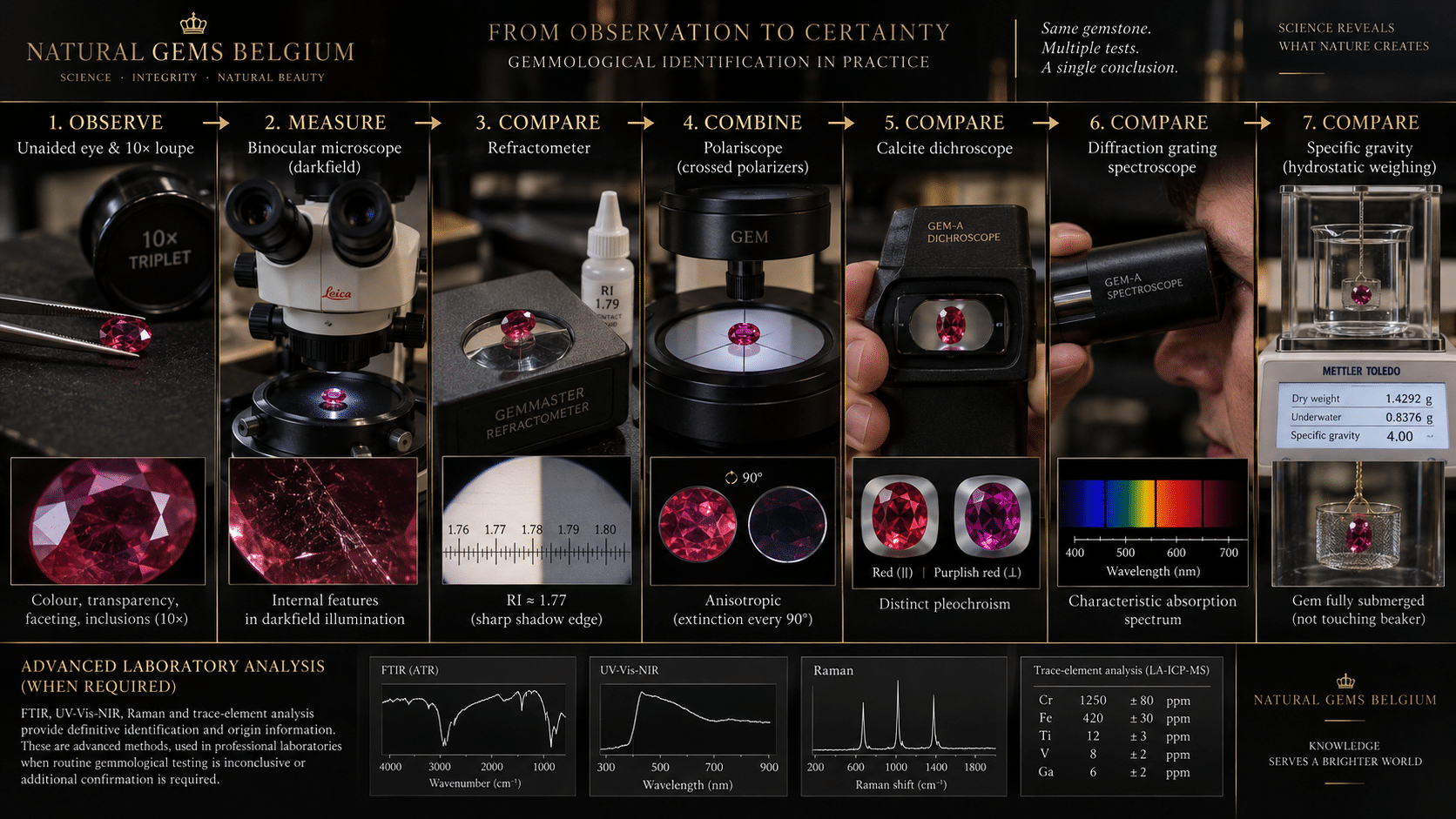
A disciplined gemmologist therefore follows five broad stages:
Observe → Measure → Compare → Combine → Conclude
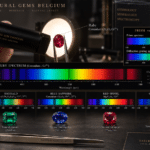
This guide brings the practical instruments of the Natural Gems Belgium Learning Center together into one complete identification workflow.
Table of Contents
1. Identification Is a Process of Elimination
GIA teaches gemstone identification as a progressive testing method.
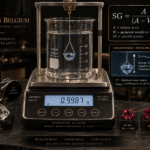
The objective is not to perform every available test blindly.
Instead:
- collect reliable observations;
- compare them with known gemstone properties;
- eliminate incompatible candidates;
- perform additional tests where ambiguity remains.
Each test should answer a question.
2. Start Without an Instrument
Before reaching for the refractometer or microscope, look at the stone.
Record what is immediately observable:
- colour;
- transparency;
- lustre;
- shape;
- cutting style;
- apparent condition;
- visible zoning;
- obvious inclusions;
- surface wear.
These observations are not sufficient for identification.
But they determine which tests may be useful next.
3. Do Not Begin with a Name
This is one of the most important habits in gemmology.
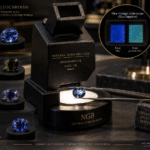
Avoid beginning with:
“This looks like sapphire.”
Instead begin with:
“Transparent blue faceted stone.”
Why?
Because naming the stone too early creates:
confirmation bias.
Once the observer expects sapphire, every later observation can unconsciously be interpreted as supporting sapphire.
Description should precede interpretation.
4. Record Colour Precisely
Instead of:
blue
record something closer to:
medium slightly greenish blue
or:
dark violetish blue.
Colour alone rarely identifies a gemstone.
But accurate colour description helps narrow possibilities and later interpret:
- pleochroism;
- absorption;
- zoning;
- treatment-related features.
5. Observe Transparency
Classify broadly as:
- transparent;
- translucent;
- opaque.
A transparent material allows objects or transmitted detail to be seen relatively clearly through it.
A translucent material transmits light but not clear detail.
An opaque material transmits essentially no visible light through ordinary thickness.
This simple observation immediately affects which instruments are appropriate.
6. Observe Lustre
Lustre describes how the surface reflects light.
Gemstones may show:
- vitreous;
- adamantine;
- resinous;
- waxy;
- pearly;
- silky
and other appearances.
Lustre is supportive rather than usually diagnostic.
But an obviously inappropriate lustre can eliminate candidates.
7. Examine the Cutting Style
Record whether the specimen is:
- faceted;
- cabochon;
- bead;
- carving;
- rough;
- assembled object.
For faceted stones, note:
- brilliant style;
- step cut;
- mixed cut;
- rose cut;
- unusual custom cut.
The form determines which surfaces are available for testing.
8. Check Whether the Stone Is Loose or Mounted
This matters immediately.
A loose gemstone can usually be:
- weighed;
- immersed where safe;
- rotated freely;
- positioned easily on a refractometer.
A mounted gemstone introduces:
- metal obstruction;
- restricted viewing;
- reflections;
- limited access to facets.
Hydrostatic specific gravity generally requires a loose specimen.
9. Look for Immediate Red Flags
Before testing further, check for signs of:
- doublet or triplet construction;
- obvious coating;
- surface-reaching filler;
- glued components;
- unusual facet junctions;
- foil backing.
If the specimen is assembled, interpreting its physical constants as though it were one homogeneous mineral can be misleading.
10. Move to the 10× Loupe
The loupe is the fastest magnified inspection tool.
Use a fully corrected:
10× loupe.
Examine:
- facet edges;
- polish;
- girdle;
- inclusions;
- fractures;
- surface-reaching features;
- colour zoning;
- possible assembly boundaries.
The loupe may already reveal whether more detailed microscopy is necessary.
Usually it is.
11. Surface Condition Can Provide Clues
Look for:
- scratches;
- abrasions;
- chipped facet junctions;
- polishing marks;
- cavities.
These observations may support information about hardness and durability.
But do not identify a stone from scratch resistance or surface wear alone.
Many factors influence wear.
12. Avoid Destructive Scratch Testing
Traditional mineralogy uses Mohs hardness testing.
Routine examination of valuable cut gemstones generally should not.
Scratching a gemstone to determine hardness can:
- damage the specimen;
- reduce value;
- create unnecessary risk.
Professional gem identification prioritises non-destructive methods.
13. Move to the Microscope
The gemmological microscope is among the most powerful classical identification instruments.
GIA continues to describe microscopy as central to coloured-stone examination even in laboratories equipped with advanced analytical instrumentation.
The microscope can reveal evidence that no bulk measurement can show.
14. Begin with Low Magnification
Do not immediately use maximum magnification.
Start low.
Survey the entire gemstone.
Look for:
- colour zoning;
- large inclusions;
- fractures;
- growth structures;
- assembly boundaries;
- surface features.
Then increase magnification where necessary.
15. Use Darkfield Illumination
Darkfield is a fundamental gemmological illumination method.
Light enters the gemstone from the sides while the direct illumination is blocked from the observer.
Inclusions can appear bright against a dark background.
This is especially useful for transparent faceted gemstones.
16. Change the Illumination
No single lighting mode reveals everything.
Depending on the specimen, use:
- darkfield;
- brightfield;
- fibre-optic illumination;
- reflected light;
- transmitted light;
- diffused light.
Rotate the gemstone while changing illumination.
A feature invisible in one geometry may become obvious in another.
17. Search for Natural Growth Evidence
Natural gemstones can contain:
- mineral crystals;
- fluid inclusions;
- healed fissures;
- growth zoning;
- needles;
- platelets;
- negative crystals.
These may support geological formation.
But one inclusion should rarely be interpreted in isolation.
Natural and laboratory-grown stones can sometimes contain superficially similar features.
18. Search for Synthetic Growth Evidence
Laboratory-grown gemstones may show characteristic features related to their growth process.
Depending on material and method, examples can include:
- curved growth structures;
- gas bubbles;
- flux inclusions;
- seed-related structures;
- synthetic growth zoning.
But synthetic technology evolves.
Do not assume every synthetic gemstone will display a textbook inclusion.
19. Search for Treatment Evidence
Microscopy may reveal:
- altered inclusions from heating;
- healed fissures;
- glass-filled fractures;
- flux residues;
- surface-reaching filling;
- diffusion-related colour concentration;
- coating boundaries.
Some treatments are readily visible microscopically.
Others require advanced spectroscopy.
20. Describe Before Interpreting
Instead of immediately writing:
“heated sapphire inclusion”
first record:
“partially healed fissure with altered internal crystals.”
Then interpret the observation in combination with the rest of the evidence.
Again:
observation first, conclusion second.
21. Measure Refractive Index
For a suitable polished gemstone, the refractometer is usually one of the strongest classical identification instruments.
Refractive index measures how strongly light changes velocity and direction when entering the material.
Different gemstone species occupy characteristic RI ranges.
22. Use a Suitable Polished Facet
A conventional refractometer requires good optical contact between:
- gemstone;
- contact liquid;
- refractometer prism.
A flat polished facet is ideal.
Rough material may not provide a usable surface.
23. Record the Actual Reading
Do not record:
“sapphire RI.”
Record:
1.762–1.770
if those are the measured values.
Raw data are more useful than premature interpretation.
24. Rotate the Stone
For anisotropic gemstones, RI may change with orientation.
Take multiple readings while rotating the gemstone.
This can reveal:
- single refraction;
- double refraction;
- birefringence.
It also reduces the chance of missing a second reading.
25. Calculate Birefringence Where Appropriate
Birefringence is the difference between the highest and lowest relevant refractive indices.
For example:
1.770 − 1.762 = 0.008
This value can provide additional evidence for identification.
26. Understand the Refractometer Limit
A conventional gem refractometer using standard high-RI contact liquid has an upper practical range around:
1.81.
Materials above the instrument limit may show:
over the limit — OTL.
OTL is not a failed test.
It is information.
It eliminates many lower-RI possibilities.
27. Rough Stones May Need Another Route
If the stone lacks a polished facet, do not force a refractometer measurement.
Move to other properties such as:
- polariscope reaction;
- spectroscopy;
- microscopy;
- specific gravity.
Gem-A specifically notes the usefulness of hydrostatic SG for rough specimens that cannot be tested conventionally on a refractometer.
28. Use the Polariscope
The polariscope helps determine how the gemstone interacts with polarized light.
It can separate broad optical categories such as:
- singly refractive;
- doubly refractive;
- aggregate behaviour.
This can eliminate large groups of candidates quickly.
29. Rotate Through a Full Cycle
Place the gemstone between crossed polarizers.
Rotate it through:
360°.
Observe whether it:
- remains dark;
- alternates light and dark;
- shows anomalous patterns;
- displays aggregate reactions.
One stationary observation is insufficient.
30. Singly Refractive Behaviour
Cubic crystals such as spinel and garnet are normally:
singly refractive.
They generally remain dark during rotation between crossed polarizers.
But strain can produce anomalous double-refraction effects.
Therefore polariscope interpretation must be careful.
31. Doubly Refractive Behaviour
Most non-cubic crystalline gemstones are anisotropic.
They generally alternate between:
- light;
- dark
as they rotate.
Examples include:
- corundum;
- beryl;
- tourmaline;
- quartz;
- topaz;
- zircon.
This reaction immediately separates them from normal cubic candidates.
32. Aggregates Behave Differently
Polycrystalline and aggregate materials can produce:
- mottled;
- patchy;
- complex
reactions.
Jade and chalcedony, for example, should not be interpreted exactly like a single transparent crystal.
Understanding structure is essential.
33. Use the Conoscope When Useful
A conoscope can reveal interference figures in suitable doubly refractive gemstones.
These can help determine whether a crystal is:
- uniaxial;
- biaxial.
This provides another layer of identification.
But optic figures require correct orientation and practice.
Absence of a visible figure does not prove absence of anisotropy.
34. Use the Dichroscope for Pleochroic Stones
Pleochroism occurs when anisotropic coloured gemstones absorb light differently according to crystallographic direction.
A dichroscope separates directional colours so they can be compared simultaneously.
This is particularly useful for gems such as:
- sapphire;
- ruby;
- tourmaline;
- tanzanite;
- iolite.
35. Pleochroism Supports Crystal Behaviour
Suppose a blue gemstone displays two distinct directional colours.
That supports anisotropic optical behaviour.
It can help distinguish it from a singly refractive blue spinel.
But pleochroism should still be combined with RI and other tests.
36. Absence of Visible Pleochroism Is Not Absolute Proof
Pleochroism may be:
- weak;
- masked by saturation;
- difficult to see because of orientation.
A negative dichroscope observation is therefore less powerful than a strong positive one.
37. Use the Spectroscope
The handheld spectroscope examines selective absorption of visible light.
Instead of measuring how strongly light refracts, it asks:
Which wavelengths are being absorbed?
This can provide evidence about colour-producing mechanisms.
38. Look for Lines, Bands and Cut-Offs
Observe the complete spectrum.
Record:
- narrow absorption lines;
- broad absorption bands;
- strongly absorbed regions;
- cut-offs.
Do not search only for the pattern you expect.
39. Chromium Is a Useful Example
Chromium can produce characteristic absorption in:
- ruby;
- emerald;
- spinel;
- garnet;
- other gems.
Therefore a chromium-type spectrum is useful evidence.
But it is not a species identification by itself.
The host mineral still has to be established.
40. Broad Absorption Can Be Difficult
Some colour mechanisms create broad absorptions rather than sharp lines.
Blue sapphire provides an important example through Fe²⁺–Ti⁴⁺ intervalence charge transfer.
Broad absorption may be much harder to recognise with a handheld spectroscope than with quantitative UV-Vis-NIR spectroscopy.
Therefore:
no obvious handheld spectrum does not mean no absorption exists.
41. Measure Specific Gravity Where Useful
Specific gravity adds a completely different physical property:
density relative to water.
This can be especially useful when:
- RI candidates overlap;
- the stone is rough;
- RI is over the refractometer limit;
- another independent property is needed.
42. Hydrostatic Specific Gravity
For a suitable loose, water-safe gemstone:
- weigh it in air;
- suspend it fully in water;
- record apparent underwater weight.
Then calculate:
SG = A / (A − W)
where:
A = weight in air
and:
W = apparent weight in water.
43. Watch for Air Bubbles
Air bubbles attached to the gemstone create additional buoyancy.
They can distort the underwater reading significantly.
Inspect:
- cavities;
- rough surfaces;
- drill holes;
- fractures.
Repeat the measurement if necessary.
44. SG Is Especially Useful for Rough
A rough gemstone may have no polished surface suitable for refractometry.
Hydrostatic weighing does not require a polished facet.
That makes SG an important complementary test for rough gem material.
45. Now Build the Dataset
At this stage, an unknown faceted gemstone might have:
Colour: blue
Transparency: transparent
RI: 1.762–1.770
Birefringence: approximately 0.008
Polariscope: doubly refractive, uniaxial
Dichroscope: blue / greenish-blue directional colours
SG: approximately 4.00
Spectroscope: compatible iron-related absorption
Microscope: natural-looking corundum inclusion scene
These observations converge strongly toward:
natural blue sapphire / corundum
at the species and variety level.
But treatment and origin may still be unresolved.
46. Think in Terms of Convergence
Good gem identification resembles solving simultaneous equations.
A candidate must satisfy:
RI + birefringence + optical character + SG + spectrum + microscopy
where relevant.
A species inconsistent with one strong measurement can often be eliminated.
47. One Strong Contradiction Matters
Suppose a blue gemstone looks exactly like sapphire.
But its RI is:
1.577–1.583.
That is inconsistent with corundum and highly compatible with beryl.
The visual impression should be abandoned.
Evidence outranks appearance.
48. Example: Aquamarine
Possible dataset:
Colour: light blue
RI: approximately 1.577–1.583
DR: yes
Optical character: uniaxial
SG: around 2.72
These properties converge strongly toward:
beryl.
With the appropriate colour:
aquamarine.
49. Example: Blue Spinel
Possible dataset:
Colour: blue
RI: around typical spinel range
Polariscope: singly refractive
Pleochroism: absent
SG: around 3.6 for ordinary spinel
This dataset separates spinel effectively from sapphire and aquamarine.
Further work may still be necessary to determine colour cause and natural versus synthetic status.
50. Example: Ruby Versus Red Spinel
Both can be:
- transparent;
- red;
- chromium-bearing.
But:
Ruby
Corundum.
Doubly refractive.
RI around 1.76–1.77.
SG around 4.00.
Spinel
Cubic.
Singly refractive.
RI around 1.72 for many natural spinels.
SG commonly around 3.6.
Several independent tests separate them rapidly.
51. Example: Garnet Versus Ruby
Some garnets can overlap corundum in specific gravity.
Therefore SG alone may fail.
But garnet is cubic and normally singly refractive.
Ruby is anisotropic and doubly refractive.
The polariscope and refractometer solve what SG alone cannot.
This is exactly why multi-property identification works.
52. Example: Quartz Versus Beryl
Quartz and beryl occupy relatively close density ranges compared with sapphire.
But their:
- RI;
- birefringence;
- optical properties
differ.
Again, SG is not asked to solve the entire identification.
It contributes one constraint.
53. The Most Efficient Test Is the One That Eliminates the Most Candidates Safely
Do not perform tests merely because instruments are available.
Ask:
What uncertainty remains?
If RI has already separated two candidates completely, another test may simply confirm the result.
If RI overlaps, optical character or SG may be much more informative.
Testing should be purposeful.
54. Use Non-Destructive Tests First
A sensible hierarchy prioritises methods that do not alter the gemstone.
Examples include:
- observation;
- magnification;
- RI;
- polariscope;
- dichroscope;
- spectroscope;
- suitable hydrostatic SG.
Avoid unnecessary destructive or invasive testing.
55. Safety Matters
Testing should not damage the specimen.
Examples:
- do not scratch valuable stones to test hardness;
- do not immerse water-sensitive materials casually;
- do not force mounted stones onto instruments;
- handle RI contact liquid according to safety instructions;
- avoid thermal testing.
Identification is not successful if the gemstone is damaged in the process.
56. Record Negative Results Too
A negative result can be highly useful.
Examples:
No visible pleochroism
RI over limit
No diagnostic handheld absorption observed
No reaction under long-wave UV
SG measurement unreliable because of trapped air
These observations constrain interpretation and preserve transparency.
57. “Could Not Determine” Is a Valid Result
Scientific testing sometimes reaches a boundary.
If evidence does not support a reliable conclusion, record:
inconclusive
or:
additional laboratory testing required.
Never convert uncertainty into certainty merely to complete an identification.
58. Species Identification Is Not the Same as Natural Origin
Suppose all classical properties establish:
corundum.
That does not automatically establish:
natural corundum.
Laboratory-grown ruby and sapphire are still corundum.
They can share:
- RI;
- SG;
- birefringence;
- basic absorption properties
with natural material.
Natural versus laboratory-grown determination may require microscopic and advanced analytical evidence.
59. Synthetic Does Not Mean Imitation
This distinction is essential.
A synthetic ruby is:
laboratory-grown corundum with essentially the same basic crystal structure and chemical identity as ruby.
A red glass imitation is:
not corundum.
A synthetic gemstone and a simulant are fundamentally different categories.
GIA makes this distinction explicit in gem identification training.
60. Treatment Is a Separate Question
After identifying the gemstone species, ask:
Has it been treated?
Treatment can include:
- heating;
- diffusion;
- irradiation;
- fracture filling;
- impregnation;
- coating;
- dyeing;
- other modification.
Some treatments can be detected with classical microscopy.
Others cannot.
61. Heat Treatment Can Require Advanced Testing
Microscopy may reveal heat-related evidence.
But absence of obvious heat features does not always prove:
unheated.
For commercially important gemstones, laboratories may combine:
- microscopy;
- FTIR;
- UV-Vis-NIR;
- photoluminescence;
- other analytical methods.
62. Geographic Origin Is a Higher-Level Determination
Identifying:
natural ruby
does not determine:
- Myanmar;
- Mozambique;
- Madagascar;
- Vietnam;
- another source.
Geographic-origin determination relies on comparison with reference populations and can involve:
- inclusion scenes;
- trace-element chemistry;
- spectroscopy;
- geological context.
It is a probabilistic laboratory determination, not a simple instrument reading.
63. When Classical Gemmology Should Stop
Escalate to a professional laboratory when the commercial question involves:
- natural versus laboratory-grown;
- subtle treatment;
- heat-treatment status;
- diffusion;
- sophisticated filling;
- geographic origin;
- unusual colour cause;
- rare material;
- conflicting standard results.
Knowing when to stop is part of professional competence.
64. Advanced Laboratory Tools
Modern gem laboratories use instruments far beyond the classical bench.
Important examples include:
FTIR spectroscopy
UV-Vis-NIR spectroscopy
Raman spectroscopy
photoluminescence spectroscopy
EDXRF
LA-ICP-MS
Each interrogates a different aspect of the material.
65. FTIR Spectroscopy
Fourier-transform infrared spectroscopy measures absorption in the infrared region.
GIA uses FTIR routinely for materials including:
- corundum;
- chrysoberyl;
- jade;
- quartz.
It can assist with:
- certain treatment determinations;
- natural versus laboratory-grown separation;
- polymer impregnation;
- heat-treatment evidence in appropriate materials.
66. UV-Vis-NIR Spectroscopy
UV-Vis-NIR measures absorption across:
- ultraviolet;
- visible;
- near-infrared
wavelengths.
It can reveal colour-producing chromophores much more precisely than a handheld spectroscope.
GIA routinely applies it to coloured gemstones including:
- sapphire;
- emerald;
- tourmaline;
- cobalt spinel.
67. Raman Spectroscopy
Raman spectroscopy examines characteristic vibrational behaviour of materials.
The resulting spectrum can act like a structural fingerprint.
It is extremely useful for:
- gemstone identification;
- inclusion identification;
- rough or aggregate materials;
- specimens unsuitable for conventional RI testing.
68. EDXRF
Energy-dispersive X-ray fluorescence provides elemental composition information.
It is non-destructive.
GIA uses chemical data to help investigate:
- treatment;
- coatings;
- natural versus laboratory-grown status;
- geographic origin
where appropriate.
69. LA-ICP-MS
Laser ablation inductively coupled plasma mass spectrometry provides highly sensitive trace-element analysis.
A tiny amount of material is ablated by laser.
GIA uses such trace-element data extensively for:
- geographic-origin comparisons;
- natural versus laboratory-grown separation;
- some treatment investigations.
This is advanced laboratory analysis, not routine bench gemmology.
70. Reference Collections Matter
An instrument does not produce expertise by itself.
A laboratory result becomes meaningful when compared with:
- known materials;
- reference spectra;
- chemical databases;
- documented inclusions;
- origin samples.
GIA’s field gemology programme has built extensive known-origin reference collections precisely for this purpose.
71. Identification Confidence Comes from Independent Evidence
Suppose microscopy suggests natural sapphire.
That is useful.
Now add:
- corundum RI;
- correct birefringence;
- uniaxial optical behaviour;
- appropriate SG;
- compatible absorption.
Each independent observation makes the conclusion more robust.
72. Agreement Is Stronger Than Repetition
Measuring RI five times is not the same as obtaining five independent properties.
A stronger dataset combines:
- RI;
- optical character;
- SG;
- spectrum;
- microscopy.
Independent physical principles provide stronger convergence than repeated measurement of one property.
73. Contradictions Must Be Investigated
Suppose:
RI suggests beryl
but:
SG suggests corundum.
Do not simply choose whichever result matches your expectation.
Investigate.
Possible causes include:
- incorrect RI reading;
- poor optical contact;
- air bubble in SG measurement;
- composite construction;
- wrong stone;
- instrument error.
Contradictory evidence is a signal to repeat the work.
74. Calibrate Your Instruments
Reliable identification depends on reliable instruments.
Maintain:
- clean refractometer prism;
- appropriate RI liquid;
- accurate balance;
- clean microscope optics;
- correctly aligned polariscope;
- suitable spectroscope illumination.
A sophisticated workflow cannot compensate for poorly functioning equipment.
75. Clean the Gemstone Between Tests
Fingerprints and residue can interfere with:
- microscopy;
- refractometry;
- hydrostatic wetting.
Clean handling improves repeatability.
Use appropriate stone cloths and tweezers.
76. Use a Consistent Worksheet
For every unknown gemstone, record the same categories.
Basic Observation
Colour:
Transparency:
Lustre:
Cut:
Dimensions:
Weight:
Magnification
Inclusions:
Growth features:
Fractures:
Treatment indicators:
Assembly indicators:
Optical Data
RI:
Birefringence:
Optical character:
Pleochroism:
Spectrum:
Physical Data
SG:
UV reaction if tested:
Interpretation
Candidates:
Eliminated candidates:
Provisional identification:
Unresolved questions:
Laboratory escalation required:
This turns identification into a reproducible process.
77. Separate Facts from Interpretations
Consider:
Fact: RI 1.762–1.770.
Interpretation: consistent with corundum.
Fact: alternating light/dark polariscope reaction.
Interpretation: anisotropic.
Fact: rutile-like needles under magnification.
Interpretation: potentially supportive of natural corundum, subject to full inclusion context.
Keeping these categories separate reduces overstatement.
78. Use Confidence Language Appropriately
Different conclusions deserve different wording.
Strong Physical Identification
“The measured properties are consistent with natural corundum; microscopic features support natural origin.”
Unresolved Treatment
“No definitive treatment conclusion can be made from the present tests.”
Laboratory Required
“Advanced laboratory analysis is recommended to determine treatment status.”
Precision in language is part of scientific practice.
79. Never Turn a Possibility into a Fact
If an inclusion:
could be consistent with heating
do not write:
“stone is heated.”
If chemistry:
could support a geographic source
do not write:
“origin is Sri Lanka.”
Evidence must justify the strength of the claim.
80. The Commercial Importance of Correct Identification
Gemstone identity influences:
- value;
- disclosure;
- consumer confidence;
- treatment terminology;
- product description;
- insurance;
- laboratory reporting.
A ruby, synthetic ruby and red glass simulant can look similar to an inexperienced observer while representing completely different products.
Correct identification protects both seller and buyer.
81. A Fast First-Pass Workflow
For routine loose transparent gemstones:
1. Visual observation
2. 10× loupe
3. Microscope
4. Refractometer
5. Polariscope
6. Dichroscope where relevant
7. Spectroscope where useful
8. Specific gravity if needed
9. Compare the complete dataset
10. Escalate unresolved high-value questions
This is not a rigid law.
Testing order can change according to the specimen.
82. Rough-Stone Workflow
For rough material:
1. Observe crystal morphology
2. Loupe/microscope
3. Polariscope if possible
4. Dichroscope if transparent enough
5. Spectroscope if suitable
6. Hydrostatic SG
7. Raman or laboratory analysis if required
A refractometer may become useful later if a small polished window is available.
83. Mounted-Stone Workflow
For mounted gemstones:
1. Visual observation
2. Microscope
3. Accessible RI measurement where possible
4. Polariscope if geometry permits
5. Dichroscope
6. Spectroscope
7. UV where relevant
Hydrostatic SG is normally unavailable because the setting contributes to the measurement.
Advanced laboratory analysis may sometimes be performed with the stone still mounted.
84. Opaque-Stone Workflow
Opaque gemstones require a different emphasis.
Transmission-based tools may be ineffective.
Prioritise:
- microscopy;
- reflected-light observation;
- structure;
- lustre;
- SG where safe;
- Raman;
- chemical analysis where required.
No single workflow fits every gem material.
85. Organic Gem Materials Need Their Own Logic
Pearl, amber and coral are not tested exactly like transparent crystalline gemstones.
Their:
- structure;
- density;
- optical properties;
- durability
require material-specific procedures.
The general principle remains the same:
choose tests appropriate to the material.
86. Practical Identification Example: Unknown Blue Stone
Initial observation:
Transparent medium blue oval mixed cut.
Possible candidates:
- sapphire;
- spinel;
- aquamarine;
- zircon;
- topaz;
- tourmaline.
Refractometer
1.762–1.770.
Immediately eliminates most candidates.
Polariscope
Doubly refractive.
Supports corundum.
Dichroscope
Distinct blue / greenish-blue directional colours.
Compatible.
SG
Approximately 4.00.
Compatible.
Microscope
Natural corundum-type inclusion scene.
Conclusion:
natural sapphire strongly supported.
Question still open:
treatment and geographic origin.
That is where the classical workflow stops unless sufficient treatment evidence is present.
87. Practical Identification Example: Unknown Red Stone
Observation:
Transparent vivid red.
Candidates:
- ruby;
- red spinel;
- garnet;
- glass;
- synthetic materials.
RI
Approximately 1.718.
Polariscope
Singly refractive.
Ruby is eliminated.
SG
Approximately 3.60.
Supports spinel.
Spectroscope
Chromium-related absorption.
Compatible with red spinel.
Microscope
Natural-looking inclusion scene.
Provisional conclusion:
natural red spinel strongly supported.
Advanced analysis may still be required if natural/synthetic determination is commercially critical.
88. Practical Identification Example: Pale Blue Rough
Observation:
Transparent to translucent pale blue rough crystal.
No polished refractometer facet.
Microscope
Natural-looking growth and inclusions.
Dichroscope
Directional colour present.
SG
Approximately 2.72.
Candidate list narrows strongly toward beryl.
If morphology and other properties agree:
aquamarine becomes highly plausible.
Raman spectroscopy could provide rapid definitive mineral identification if needed.
89. Evidence Classification
| Statement | Classification |
|---|---|
| Professional gem identification uses multiple physical and optical properties | Established gemmological practice |
| Progressive testing can eliminate incompatible candidates | Established identification methodology |
| RI is a major classical identification property | Established gemmological principle |
| Polariscope behaviour helps distinguish optical classes | Established optical method |
| Dichroscope observations can reveal pleochroism | Established optical method |
| Spectroscopy reveals selective absorption | Established spectroscopic principle |
| Hydrostatic SG supplies independent density evidence | Established physical method |
| Microscopy can reveal inclusions, growth and some treatment evidence | Established gemmological practice |
| One classical property uniquely identifies every gemstone | Incorrect |
| Identifying a mineral automatically proves natural origin | Incorrect |
| Identifying a gemstone automatically proves treatment status | Incorrect |
| Classical testing normally proves geographic origin | Incorrect |
| Advanced spectroscopy and chemistry can be required for treatment, origin and natural/synthetic determination | Established modern laboratory practice |
90. The NGB Evidence-Based Identification Sequence
For practical use, the entire workflow can be condensed to:
1. OBSERVE
Describe what is actually present.
2. MAGNIFY
Search for internal and external evidence.
3. MEASURE RI
Establish optical constants where possible.
4. DETERMINE OPTICAL BEHAVIOUR
Use the polariscope and conoscope.
5. EXAMINE PLEOCHROISM
Use the dichroscope where relevant.
6. EXAMINE ABSORPTION
Use the spectroscope.
7. MEASURE DENSITY
Use hydrostatic SG when appropriate.
8. COMPARE
Check which species satisfies the complete dataset.
9. INVESTIGATE CONTRADICTIONS
Repeat questionable measurements.
10. CONCLUDE ONLY WHAT THE EVIDENCE SUPPORTS
Do not overstate.
11. ESCALATE
Use a professional laboratory when treatment, natural/synthetic status, unusual chemistry or geographic origin remains unresolved.
91. The Most Important Rule
The purpose of gemmology is not to make the fastest possible guess.
It is to reach the strongest conclusion justified by the evidence.
Sometimes that conclusion is:
ruby.
Sometimes:
natural ruby, treatment undetermined.
Sometimes:
corundum; further testing required.
And sometimes the scientifically correct answer is:
inconclusive with the available equipment.
That is not failure.
That is disciplined gemmology.
Conclusion
Gemstone identification is not a magic trick performed with one instrument.
It is a structured investigation.
An unknown stone begins as a set of possibilities.
Observation narrows them.
Magnification reveals structure.
The refractometer measures optical constants.
The polariscope establishes optical behaviour.
The dichroscope reveals directional colour.
The spectroscope exposes selective absorption.
Specific gravity adds density.
Each test contributes another independent piece of evidence.
The strongest identification occurs when those properties converge.
But professional gemmology also requires knowing where the evidence stops.
Classical tests may establish:
corundum.
Microscopy may strongly support:
natural sapphire.
Yet the question:
heated or unheated?
may require FTIR or other advanced analysis.
The question:
Sri Lanka or Madagascar?
may require microscopic comparison, spectroscopy and trace-element chemistry against known-origin reference material.
The question:
natural or laboratory-grown?
may require evidence that extends beyond ordinary bench testing.
Modern gemmology therefore operates on two connected levels.
The classical gemmologist uses:
observation + physical properties + optical properties + microscopy.
The advanced laboratory adds:
spectroscopy + chemistry + reference databases + specialised imaging.
Neither level invalidates the other.
Modern laboratory analysis is built upon the same principle that governs the loupe, refractometer and hydrostatic balance:
measure something real about the material and compare it with reliable evidence.
That principle transforms gemstone identification from opinion into science.
So when the next unknown stone arrives on the desk, resist the temptation to ask:
“What does this look like?”
Begin instead with:
“What can I measure?”
Then:
observe → measure → compare → combine → conclude.
That is the foundation of evidence-based gemstone identification.
References & Further Reading
Gemological Institute of America — Gem Identification: Introduction and Progressive Testing Method. GIA’s educational material describes gem identification as a reliable progressive process in which standard testing procedures progressively eliminate alternatives and combines the refractometer, polariscope, dichroscope, loupe, microscope, spectroscope and related equipment.
https://elearning-samples.gia.edu/Gem_Identification/Page9.html
Gemological Institute of America — Gem Identification: Equipment. Reference to the classical equipment required in GIA practical gem-identification training, including the 10× loupe, refractometer, polariscope, dichroscope and spectroscope, with microscopy and other instruments recommended as additional tools.
https://elearning-samples.gia.edu/Gem_Identification/Page12.html
Gemological Institute of America — Gem Identification Course. Current GIA course overview describing practical identification of more than 60 gemstone species, natural versus laboratory-grown separation, treatment detection and the point at which professional laboratory services should be used.
https://www.gia.edu/gem-education/course-gem-ident
Gemological Institute of America — Gem Identification Lab Class. Current professional training reference documenting hands-on use of microscopes, refractometers, polariscopes, dichroscopes, prism and handheld spectroscopes and loupes to identify natural, laboratory-grown, imitation and assembled stones.
https://hongkong.gia.edu/lab/gem-identification
The Gemmological Association of Great Britain — Gemmology Laboratory Classes. Current Gem-A training reference covering practical use of refractometers, spectroscopes, polariscopes, conoscopes, dichroscopes, colour filters, UV and hydrostatic determination of specific gravity across natural, artificial, treated, rough, fashioned and mounted gem materials.
https://gem-a.com/education/lab-classes/
The Gemmological Association of Great Britain — Understanding Specific Gravity and Why It Is Vital to Gemmologists. Practical reference for hydrostatic specific-gravity measurement, including its particular usefulness for rough material that lacks a polished facet suitable for conventional refractometer testing.
https://gem-a.com/gem-hub/specific-gravity-gemstones-gemmology/
Gemological Institute of America — Analysis of Gemstones at GIA Laboratories. Gems & Gemology, Winter 2024. Comprehensive modern overview of professional gemstone analysis, including microscopy, FTIR, UV-Vis-NIR, Raman, photoluminescence, EDXRF and LA-ICP-MS and their roles in identity, treatment, natural versus laboratory-grown determination and geographic-origin work.
https://www.gia.edu/gems-gemology/winter-2024-gemstone-analysis
Gemological Institute of America — How GIA Analyzes Colored Stones from Start to Finish. Accessible overview of the current laboratory workflow showing how gemmologists move from visual and microscopic examination into advanced spectroscopy and chemical analysis when questions of treatment, origin or natural versus laboratory-grown status require further evidence.
https://hongkong.gia.edu/gia-news-research/guide-how-gia-analyzes-colored-stones
Jin, S., Renfro, N. D., Palke, A. C., Ardon, T. & Homkrajae, A. — Application of UV-Vis-NIR Spectroscopy to Gemology. Gems & Gemology, Winter 2024. Authoritative review explaining how quantitative optical spectroscopy reveals chromophores and supports varietal identification, treatment detection and geographic-origin work in modern gem laboratories.
https://www.gia.edu/gems-gemology/winter-2024-uv-vis-nir-spectroscopy
Adamo, I. et al. — Aquamarine, Maxixe-Type Beryl, and Hydrothermal Synthetic Blue Beryl: Analysis and Identification. Gems & Gemology, Fall 2008. Useful case study demonstrating why difficult gemological separations may require a combination of classical properties, microscopy, chemistry, UV-Vis-NIR and infrared spectroscopy rather than reliance on a single test.
https://origin.prod.author.gia.edu/gems-gemology/fall-2008-aquamarine-beryl-analysis-identification-adamo
Gemological Institute of America — Scientific Instruments Help Researchers Tell Gem Stories. Overview of how GIA researchers integrate light analysis, atomic-structure analysis, chemical analysis and imaging with reference databases when reaching gemstone-identification conclusions.
https://www.gia.edu/research-instruments
The Gemmological Association of Great Britain — Sir Henry A. Miers and the Development of Scientific Gemmology. Historical Gem-A reference describing Miers’s advocacy for identifying gemstones through measurable physical properties such as refractive index and specific gravity and instruments including the refractometer, dichroscope and polariscope rather than relying on appearance or opinion.
https://gem-a.com/news/henry-miers-history/