Table of Contents
Introduction: A Gemstone Born Far Beneath the Continents
A natural diamond may appear remarkably simple.
It is composed almost entirely of carbon, one of the most familiar chemical elements on Earth.
Yet the geological circumstances responsible for producing natural diamonds are anything but ordinary.
Most natural diamonds recovered from economically important deposits originated approximately 150–200 kilometres beneath Earth’s surface.
Some formed considerably deeper, in regions of the mantle that humans have never directly explored.
Many crystallised hundreds of millions or billions of years before the volcanic events that eventually carried them toward the surface.
A diamond found in a river deposit today may therefore have experienced several distinct chapters of geological history.
First, carbon-bearing fluids or melts circulated through the deep mantle.
Under suitable physical and chemical conditions, diamond crystals began to grow.
These crystals could remain within mantle rocks for immense periods of time.
Much later, an unusual volcanic event transported them upward.
Eventually, weathering and erosion might release the diamonds from their volcanic host rock.
Rivers could then transport and concentrate them within sedimentary deposits.
This geological journey is extraordinary not simply because of the depths involved, but because diamonds preserve evidence of conditions that existed deep inside our planet long before the modern landscape developed.
Their internal inclusions can contain minerals that formed under enormous pressures.
Their isotopic characteristics can reveal ancient geological events.
Their crystal structures can preserve records of growth, deformation and partial dissolution.
For scientists, natural diamonds are therefore much more than valuable gemstones.
They are exceptionally durable geological archives containing information about Earth’s deep interior and its evolution through time.
Understanding their formation requires exploring the relationship between carbon, pressure, temperature, mantle rocks, plate tectonics and volcanic activity.
1. Diamond: A Crystalline Form of Carbon
Diamond is a mineral composed of carbon.
Its chemical formula is C.
However, carbon can occur in several structurally different forms.
Two of the best-known natural crystalline forms are diamond and graphite.
Both are composed of the same chemical element.
Their physical properties differ because their carbon atoms are arranged differently.
In diamond, each carbon atom is strongly bonded to four neighbouring carbon atoms in a three-dimensional network.
This arrangement produces a remarkably rigid crystal structure.
In graphite, carbon atoms form strongly bonded sheets, with much weaker interactions between adjacent layers.
These structural differences explain why diamond and graphite behave so differently.
Diamond has a Mohs hardness of 10, making it the hardest mineral on the conventional Mohs scale.
Graphite is comparatively soft.
Diamond also has a density of approximately 3.52 g/cm³, compared with approximately 2.26 g/cm³ for graphite.
The denser arrangement of carbon atoms becomes particularly important under the enormous pressures found deep within Earth.
Under suitable mantle conditions, diamond is the thermodynamically stable crystalline form of carbon.
Near Earth’s surface, graphite is the stable form under ordinary equilibrium conditions.
However, diamond does not spontaneously transform into graphite at an observable rate under normal surface conditions.
It persists because the transformation faces a substantial kinetic barrier.
This property is called metastability.
It helps explain how diamonds can survive at Earth’s surface even though they formed under conditions very different from those we experience.
2. Why Natural Diamonds Form Deep Within Earth
Diamond formation requires an unusual combination of physical and chemical conditions.
High pressure is particularly important because it favours the dense diamond crystal structure.
Temperature also plays a major role.
However, pressure and temperature alone do not guarantee that diamonds will form.
Suitable carbon-bearing material must be present.
The surrounding chemical environment must also permit diamond crystallisation.
According to geological research reviewed by GIA, many lithospheric diamonds form at depths of approximately 150–200 kilometres.
Typical formation temperatures are estimated at approximately 900–1,300°C.
These figures describe common conditions associated with cratonic diamonds rather than universal limits for every natural diamond.
Some diamonds originate at considerably greater depths.
The exact conditions depend on the geological environment.
A crucial distinction is that diamonds do not simply appear wherever mantle pressure is sufficiently high.
The availability of carbon, the composition of surrounding rocks and the movement of chemically active fluids all influence their formation.
Diamond crystallisation is therefore both a physical and a geochemical process.
3. The Ancient Continental Roots Where Many Diamonds Form
Many economically important natural diamonds are associated with ancient continental regions known as cratons.
Cratons are parts of Earth’s continental lithosphere that have remained relatively stable over very long geological periods.
They often contain exceptionally old crustal rocks.
Beneath these regions, the lithospheric mantle can extend to considerable depths.
These thick mantle roots are sometimes described as cratonic keels.
Their thermal structure is especially important.
The continental lithosphere beneath old cratons can remain relatively cool compared with the convecting mantle at similar depths.
This allows the pressure-temperature conditions favourable to diamond stability to occur within the cratonic mantle.
Diamond-bearing mantle rocks may remain stored within these regions for immense periods.
Important diamond-producing regions associated with ancient cratonic geology include parts of southern Africa, northern Canada and Siberia.
However, the presence of an ancient craton does not automatically mean that economically recoverable diamonds are present.
Suitable diamond-forming events must have occurred.
The diamonds must also have survived subsequent geological processes.
Finally, an appropriate transport mechanism must have brought them toward the surface.
These requirements help explain why economically important diamond deposits are relatively uncommon.
4. The Mantle Rocks Associated with Diamond Formation
Diamonds can occur in different geological environments within the mantle.
Two particularly important rock associations are peridotite and eclogite.
Peridotite
Peridotite is the dominant rock type of Earth’s upper mantle.
It consists mainly of magnesium- and iron-rich silicate minerals.
Olivine is commonly abundant.
Orthopyroxene and clinopyroxene may also occur.
Depending on pressure and composition, garnet or spinel can be present.
Certain peridotitic mantle environments provide suitable conditions for diamond formation.
Diamonds associated with these rocks may contain inclusions such as chromium-rich pyrope garnet, olivine or other mantle minerals.
These inclusions can help researchers identify the geological environment in which the diamond developed.
Eclogite
Eclogite is a high-pressure rock consisting principally of garnet and clinopyroxene.
The clinopyroxene is commonly omphacite.
Some mantle eclogites are interpreted as remnants of oceanic crust that were transported into the mantle through subduction.
Other origins are also possible.
Diamonds associated with eclogitic environments may contain inclusions of garnet, omphacite or sulphide minerals.
These inclusions can provide information about the geological processes that affected the mantle before or during diamond formation.
The distinction between peridotitic and eclogitic diamond associations is important because the two environments can record different aspects of Earth’s geological history.
It also demonstrates that natural diamonds do not all share one identical formation pathway.
5. Do Diamonds Really Form from Coal?
One of the most persistent misconceptions about natural diamonds is that they form when coal is subjected to extreme pressure.
This explanation is misleading for the great majority of natural diamonds recovered from conventional gemstone deposits.
Coal forms from accumulated organic material within sedimentary environments.
These environments occur in Earth’s crust.
Most natural diamonds, by contrast, form much deeper within the mantle.
Many diamonds are also far older than the geological periods during which the coal deposits familiar to us formed.
Modern diamond research indicates that natural diamond crystallisation commonly involves carbon-bearing fluids or melts moving through mantle rocks.
The carbon may originate from different geological reservoirs.
Some carbon has been present within Earth’s interior for immense periods.
Other carbon may have entered the mantle through geological recycling.
Consequently, the familiar image of a lump of coal being compressed into a diamond does not accurately represent the formation of most natural diamonds.
This distinction is supported by research published in Gems & Gemology, including the 2018 review by Karen V. Smit and Steven B. Shirey.
6. Carbon-Bearing Fluids and the Growth of Diamond Crystals
Modern geological research has significantly changed our understanding of how diamonds crystallise.
Diamond growth is commonly associated with the movement of carbon-bearing fluids or melts through mantle rocks.
These fluids may contain carbon in different chemical forms.
Their composition depends on the surrounding geological environment.
Changes in temperature, pressure and chemical conditions can influence whether carbon remains dissolved or crystallises as diamond.
The oxidation state of the system is particularly important.
In simplified terms, the chemical environment determines which carbon-bearing species are stable and whether diamond precipitation is possible.
Researchers describe diamond as a metasomatic mineral because its formation commonly involves chemically active fluids or melts interacting with existing mantle rocks.
This is an important departure from the idea that diamond formation is simply the mechanical compression of solid carbon.
Diamond crystals may grow through several episodes.
Their internal structures can preserve evidence of changing growth conditions.
Some diamonds contain distinct growth zones.
Others show evidence that crystal growth was interrupted by periods of dissolution.
A diamond can therefore record a complex geological history even before it begins its journey toward Earth’s surface.
7. The Role of Plate Tectonics
Plate tectonics influences diamond formation through the movement and recycling of geological material.
Earth’s outer shell is divided into tectonic plates.
These plates move slowly over geological time.
At subduction zones, one tectonic plate descends beneath another.
Oceanic crust and associated sediments can be transported into the mantle.
These materials may carry carbon, water and other chemical components.
As they descend, they encounter increasing pressures and temperatures.
Chemical reactions can release fluids.
Some of these fluids may migrate through surrounding mantle rocks.
Under suitable conditions, carbon transported through these processes may contribute to diamond formation.
This creates an important connection between processes occurring near Earth’s surface and the formation of gemstones far below it.
Material that once formed part of an oceanic environment may eventually participate in chemical reactions deep within the mantle.
However, not every diamond contains carbon derived from subducted oceanic material.
Different diamonds can originate from different carbon reservoirs and geological processes.
The importance of plate tectonics lies in its ability to move rocks and chemically active materials through Earth’s interior over immense timescales.
8. Superdeep Diamonds: Gemstones from the Lower Mantle
Most familiar natural diamonds are associated with the continental lithospheric mantle.
However, some diamonds form at much greater depths.
These are commonly described as superdeep or sublithospheric diamonds.
They originate below the continental lithosphere.
Some form within the mantle transition zone.
Others preserve evidence of formation in the lower mantle.
The mantle transition zone extends approximately from 410 to 660 kilometres beneath Earth’s surface.
The lower mantle begins below this region.
Research has identified diamond inclusions that indicate formation at depths approaching several hundred kilometres and, in certain cases, around 800 kilometres.
These depths are extraordinary.
They are far beyond the reach of conventional geological drilling.
Scientists investigate these environments indirectly through seismic measurements, high-pressure experiments and rare mineral samples transported to the surface.
Superdeep diamonds provide unusually valuable evidence because they can preserve minerals and chemical signatures from these inaccessible regions.
Some exceptional large, high-clarity diamonds are associated with deep mantle formation.
However, size and clarity alone do not establish that a particular diamond is superdeep.
That conclusion requires appropriate scientific evidence.
9. Diamonds as Windows into Earth’s Deep Water Cycle
One of the most remarkable discoveries in diamond research concerns water within Earth’s mantle.
Water does not necessarily exist as liquid reservoirs in deep mantle rocks.
Instead, hydrogen can be incorporated into the crystal structures of certain minerals.
High-pressure minerals such as ringwoodite can accommodate water-related components within their structures.
In 2014, researchers reported the first terrestrial occurrence of ringwoodite preserved inside a natural diamond from Brazil.
The mineral inclusion provided direct evidence that water-bearing minerals can exist within Earth’s mantle transition zone.
Subsequent research has expanded our understanding of water storage and transport in the deep Earth.
These discoveries are important because water influences the physical properties of mantle rocks.
It can affect melting behaviour, mineral reactions and deformation.
Water-bearing fluids may also participate in diamond formation.
However, the discovery of water-bearing ringwoodite in a diamond does not prove that the entire mantle transition zone contains a uniform quantity of water.
Local conditions may vary considerably.
The scientific importance lies in demonstrating that diamonds can preserve direct samples of minerals formed in environments otherwise inaccessible to observation.
10. How Old Are Natural Diamonds?
Many natural diamonds are exceptionally ancient.
Geological research has identified diamonds that formed approximately 3.5–3.3 billion years ago.
These diamonds crystallised during the Archean Eon.
Earth itself is approximately 4.54 billion years old.
Some natural diamonds therefore preserve evidence of conditions that existed during a substantial portion of our planet’s early history.
However, not every natural diamond is billions of years old.
Diamond formation has occurred during different geological periods.
Some diamond populations are considerably younger.
Different generations of diamonds may even occur within the same deposit.
This means that a mine does not necessarily contain diamonds of one uniform age.
The geological history of a diamond population can involve multiple formation events separated by enormous intervals of time.
The age of a diamond must also be distinguished from the age of the volcanic rock that eventually transported it.
These are frequently very different.
11. How Scientists Determine the Age of Diamonds
Determining the age of a natural diamond is more complicated than dating many other minerals.
Diamond consists predominantly of carbon.
Its crystal structure generally contains very low concentrations of the radioactive elements commonly used for geological dating.
Consequently, scientists often investigate mineral inclusions trapped within diamonds.
These inclusions may contain elements suitable for radiometric dating.
Examples include garnet, clinopyroxene and sulphide minerals.
Several isotope systems can be used.
These include samarium-neodymium, rubidium-strontium and rhenium-osmium.
Radiometric dating relies on the predictable decay of radioactive isotopes into daughter isotopes.
By measuring isotope ratios and applying established decay constants, researchers can calculate geological ages.
However, interpretation requires care.
An inclusion may have crystallised during diamond formation.
Alternatively, a pre-existing mineral may have been enclosed by a growing diamond.
In the second case, the inclusion may be older than the diamond itself.
Researchers must therefore evaluate the relationship between the inclusion and its diamond host.
The most reliable conclusions combine isotopic measurements with mineral chemistry, geological context and evidence of how the inclusions formed.
This is why the geological age of an individual commercial diamond cannot normally be determined simply from its appearance.
12. A Diamond May Be Much Older Than Its Kimberlite
One of the most important discoveries in diamond geology is that diamonds are often dramatically older than the volcanic rocks containing them.
The kimberlites of the Kimberley region in South Africa provide a classic example.
Research has shown that some diamonds from this region formed more than a billion years ago, with certain populations exceeding three billion years in age.
The kimberlite eruptions that transported them occurred much later.
The relevant Kimberley volcanic events date to approximately 84 million years ago.
This enormous difference in age demonstrates that the diamonds did not simply crystallise from the erupting kimberlite magma.
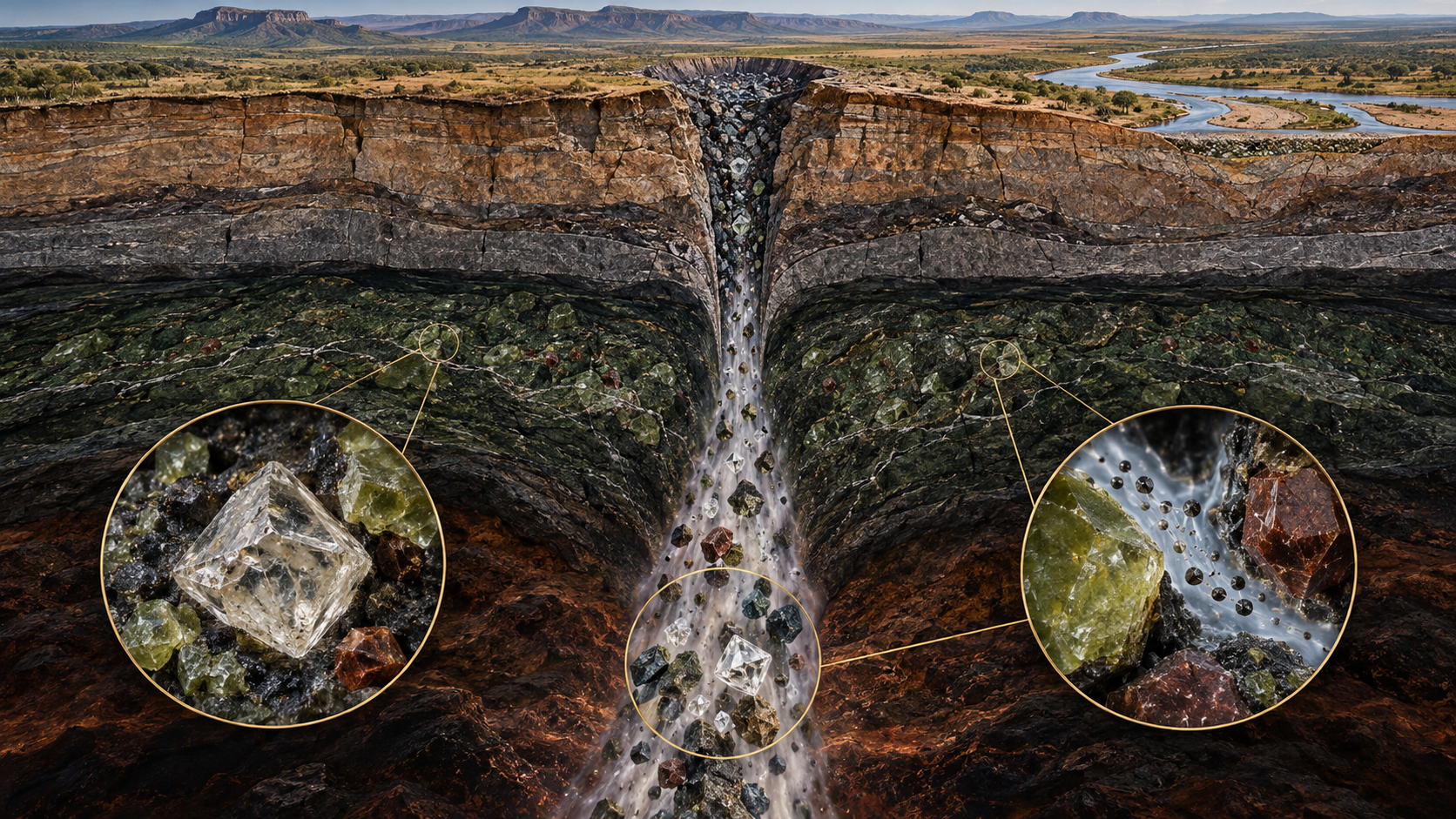
Instead, the magma collected pre-existing diamonds from the mantle and transported them toward the surface.
The distinction is fundamental.
Diamond formation and diamond transport are separate geological processes.
The time between these events may span hundreds of millions or billions of years.
During that interval, diamonds can remain preserved within mantle rocks beneath ancient continents.
13. Kimberlite: Earth’s Extraordinary Diamond Transport System
Kimberlite is a distinctive type of mantle-derived igneous rock.
It is generally rich in magnesium and relatively poor in silica compared with many common volcanic rocks.
Kimberlite commonly contains olivine and may include fragments of rocks derived from different depths.
These fragments are called xenoliths.
Individual foreign crystals transported by the magma are known as xenocrysts.
Kimberlite magmas can originate at considerable depth and ascend rapidly through Earth’s lithosphere.
Their volatile-rich compositions contribute to unusual eruptive behaviour.
Some eruptions produce steep-sided volcanic conduits commonly described as kimberlite pipes.
These structures can contain mixtures of volcanic material, mantle-derived minerals and fragments of surrounding rocks.
Diamonds are transported within this material.
However, the presence of kimberlite does not automatically mean that diamonds are present.
Many kimberlite occurrences contain no economically significant diamond concentrations.
Kimberlite is therefore best understood as a potential transport mechanism rather than a guarantee of diamond mineralisation.
14. Why Kimberlite Eruptions Must Be Extremely Rapid
Diamonds are stable under the high-pressure conditions in which they commonly form.
During transport toward Earth’s surface, pressure decreases dramatically.
The diamonds may also interact with chemically reactive magma and fluids.
Under these changing conditions, diamond surfaces can undergo partial dissolution.
This process is called resorption.
If transport conditions are sufficiently destructive, diamonds may lose material or develop altered crystal shapes.
Rapid ascent is therefore important for successful diamond preservation.
Research reviewed in Gems & Gemology indicates that some kimberlite magmas may travel approximately 150–200 kilometres in periods ranging from less than ten hours to around two days.
These estimates describe exceptionally rapid geological transport.
They are not universal travel times for every kimberlite eruption.
The precise behaviour depends on the magma and geological conditions.
Nevertheless, the evidence demonstrates why kimberlite volcanism is so unusual.
The magma must transport material from deep within Earth through the overlying lithosphere while preserving at least some of its diamond cargo.
15. What Is a Kimberlite Pipe?
A kimberlite pipe is a volcanic structure associated with the ascent and emplacement of kimberlite magma.
Many pipes have steeply inclined sides.
Their geometry can vary considerably.
Some broaden toward the surface.
Others are narrower or more irregular.
The upper portions may contain volcanic fragments and material produced during explosive activity.
Deeper portions may contain different kimberlite textures and intrusive features.
The surrounding country rock can also be incorporated into the volcanic material.
Consequently, kimberlite pipes are geologically complex.
Their shape, composition and internal structure vary between deposits.
Some economically important diamond mines exploit these pipes directly.
However, diamonds can also occur in other kimberlite bodies, including dikes.
A pipe should therefore not be imagined as a simple vertical cylinder filled uniformly with diamonds.
Diamond concentrations can be highly irregular.
Some sections may contain more diamonds than others.
The geological structure must be investigated carefully before the economic potential of a deposit can be assessed.
16. Lamproite: Another Route to Earth’s Surface
Kimberlite is the best-known volcanic carrier of natural diamonds.
However, it is not the only one.
Certain lamproite magmas have also transported diamonds toward Earth’s surface.
Lamproite is a distinctive potassium-rich, magnesium-bearing igneous rock.
Its mineralogical and chemical characteristics differ from those of kimberlite.
Only a limited number of lamproite occurrences are known to contain economically significant diamond deposits.
The Argyle diamond deposit in Western Australia is an important geological example associated with lamproite.
The existence of diamond-bearing lamproite demonstrates that diamonds can reach the surface through more than one type of mantle-derived magma.
Nevertheless, kimberlite remains the dominant transport mechanism for most economically important natural diamond deposits.
17. What Happens to a Diamond During Volcanic Transport?
A diamond’s external appearance can change during its geological journey.
Natural diamonds may originally develop crystal forms such as octahedra.
However, many rough diamonds do not retain perfectly developed crystal faces.
Some display rounded surfaces.
Others show triangular depressions known as trigons.
Complex surface textures may also be present.
These characteristics can develop through growth, dissolution, deformation or later geological processes.
For example, chemically reactive mantle fluids may partially dissolve a diamond before volcanic transport.
Kimberlite magma may produce additional resorption.
Later weathering and sediment transport can modify the surface further.
The resulting rough crystal may therefore preserve evidence of several different geological events.
A rounded rough diamond is not necessarily a poorly formed crystal.
Its shape may reflect a long history of growth and partial dissolution.
This is an important distinction when examining natural rough diamonds.
18. From Kimberlite to River Deposits
The geological journey of a diamond does not necessarily end when kimberlite reaches Earth’s surface.
Once exposed, kimberlite can undergo weathering.
Chemical and physical processes gradually break down the host rock.
Diamonds are comparatively resistant to many forms of weathering.
As the surrounding rock disintegrates, diamonds may be released.
Rainfall, rivers and gravity can then transport them.
Over time, some diamonds accumulate within sedimentary deposits.
These are known as secondary or placer deposits.
Alluvial diamond deposits occur in river-related sediments.
Other deposits may develop in ancient sedimentary formations.
Diamonds can also be concentrated in coastal or marine environments.
The United States Geological Survey recognises alluvial, beach and sedimentary diamond deposits as important secondary geological occurrences.
This explains why a natural diamond may be discovered far from the volcanic rock that originally brought it toward Earth’s surface.
The location where a diamond is recovered is not necessarily the location where it formed.
Nor is it necessarily close to the original volcanic source.
19. How Geologists Search for Diamond-Bearing Deposits
Diamond exploration often begins with geological investigation rather than direct diamond discovery.
Geologists study the regional geological setting.
Ancient cratonic areas may be considered favourable exploration environments.
Researchers also investigate volcanic structures and geophysical anomalies.
Another important method involves searching for indicator minerals.
Certain minerals can occur in association with diamond-bearing mantle rocks and kimberlite.
Examples include chromium-rich pyrope garnet, chromium-bearing diopside, chromite and magnesium-rich ilmenite.
Their chemical compositions can provide information about the geological environment from which they originated.
However, finding a red garnet or another visually similar mineral does not establish the presence of diamonds.
Indicator-mineral exploration requires chemical analysis.
Specific compositional characteristics are used to assess whether the minerals may have originated from favourable mantle conditions.
Even a promising indicator-mineral assemblage does not guarantee an economically viable diamond deposit.
Further geological investigation is required.
20. Mineral Inclusions: Tiny Samples of Earth’s Interior
In commercial gemstone evaluation, inclusions are often discussed in relation to clarity.
However, in scientific diamond research, inclusions can be exceptionally valuable.
A mineral trapped within a growing diamond may preserve evidence of its formation environment.
Because diamond is chemically resistant and mechanically robust, it can protect certain inclusions from later geological alteration.
Researchers can examine these inclusions using specialised analytical techniques.
Examples include Raman spectroscopy, electron microscopy, X-ray diffraction and isotope analysis.
The resulting information can reveal mineral identity, chemical composition and aspects of the pressure-temperature environment.
Some inclusions contain minerals associated with the continental lithospheric mantle.
Others preserve evidence of considerably deeper geological conditions.
Certain diamonds contain inclusions that provide information about the movement of carbon, water and other elements through Earth’s interior.
A diamond that appears imperfect from a jewellery perspective may therefore be scientifically exceptional.
This demonstrates why commercial clarity and scientific importance are fundamentally different concepts.
21. Why Some Diamonds Are Colourless and Others Are Coloured
Natural diamond colour can result from several different mechanisms.
An ideal diamond crystal composed of carbon without significant colour-producing defects would be colourless.
However, natural diamonds can contain impurities and structural defects.
Nitrogen is one of the most important impurity elements.
Depending on its concentration and arrangement within the crystal structure, nitrogen can contribute to yellow coloration.
Boron can produce blue coloration in certain diamonds.
Plastic deformation of the crystal lattice can contribute to pink or brown colours.
Other colours may involve different combinations of impurities, defects and geological processes.
The relationship between colour and geological formation is complex.
For example, some rare blue diamonds have been linked through inclusion research to deep mantle environments.
However, colour alone does not establish a diamond’s formation depth.
A blue diamond should not automatically be classified as superdeep solely because of its appearance.
Scientific conclusions require appropriate analytical evidence.
22. Natural Diamonds and Laboratory-Grown Diamonds
Natural and laboratory-grown diamonds share the same fundamental diamond crystal structure.
Both consist of crystalline carbon.
Both can display the characteristic physical and optical properties of diamond.
The principal distinction concerns their formation history.
Natural diamonds develop through geological processes within Earth or, in certain unusual occurrences, through other natural high-pressure events.
Laboratory-grown diamonds are produced through controlled technological processes.
Two important laboratory methods are high-pressure high-temperature synthesis and chemical vapour deposition.
The resulting crystals are diamonds, but they do not share the same geological history as mantle-derived natural diamonds.
A laboratory-grown diamond does not preserve billions of years of mantle residence.
Likewise, it cannot contain a naturally enclosed mantle mineral inclusion that records an ancient geological event unless that material was deliberately incorporated through an artificial process.
Distinguishing natural and laboratory-grown diamonds can require specialised gemmological testing.
Visual appearance alone is not always sufficient.
The scientific distinction concerns origin and growth history rather than whether the material possesses a diamond crystal structure.
23. Can Every Natural Diamond Be Assigned a Precise Geological Age?
No.
Although some natural diamond populations have been dated successfully, precise geological dating is not available for every individual diamond.
The difficulty arises from the nature of diamond itself and the limited availability of suitable inclusions.
Many gem-quality diamonds contain few or no inclusions suitable for radiometric dating.
Others contain inclusions whose relationship to diamond growth is uncertain.
Even when a diamond originates from a well-studied deposit, the mine may contain several populations formed at different times.
Consequently, assigning the age of a particular diamond based solely on its mining locality may be scientifically unjustified.
A statement such as “this diamond is three billion years old” should therefore be supported by appropriate evidence.
A more accurate general statement is that many natural diamonds formed hundreds of millions to billions of years ago.
The precise age depends on the individual diamond or the geological population to which it can reliably be assigned.
24. A Simplified Timeline of a Diamond’s Geological Journey
Consider a hypothetical natural diamond associated with an ancient continental craton.
The following sequence illustrates how its geological history might develop.
Stage 1 — Ancient continental development
A stable continental region develops over geological time.
A thick lithospheric mantle root forms beneath it.
Stage 2 — Carbon-bearing fluid movement
Carbon-bearing fluids or melts migrate through suitable mantle rocks.
Chemical conditions permit diamond crystallisation.
Stage 3 — Diamond growth
The diamond grows at great depth.
Mineral inclusions may become enclosed within the crystal.
Stage 4 — Mantle residence
The diamond remains within mantle rocks for hundreds of millions or billions of years.
Additional geological events may modify its structure or surface.
Stage 5 — Kimberlite eruption
A much younger volcanic event transports the diamond toward Earth’s surface.
The diamond survives rapid ascent and changing pressure-temperature conditions.
Stage 6 — Weathering
The kimberlite becomes exposed and gradually breaks down.
The diamond may be released from its volcanic host rock.
Stage 7 — Sedimentary transport
Water or other geological processes transport the diamond.
It may become concentrated in an alluvial or other secondary deposit.
Stage 8 — Human discovery
The diamond is eventually recovered.
Its geological history can be investigated through its crystal structure, inclusions and geological context.
This timeline is illustrative.
Not every diamond follows every stage, and the durations vary enormously.
Nevertheless, it demonstrates why the formation, transport and recovery of a diamond must be treated as distinct events.
25. Common Misconceptions About Diamond Geology
Misconception: Natural diamonds are made from compressed coal.
For most conventional natural diamond deposits, this is incorrect.
Diamond crystallisation commonly involves carbon-bearing fluids or melts in the mantle.
Misconception: Kimberlite magma creates the diamonds it contains.
Generally incorrect.
Most diamonds transported by kimberlite crystallised before the volcanic eruption.
Misconception: All natural diamonds are billions of years old.
Incorrect.
Many are extremely ancient, but different diamond populations formed at different times.
Misconception: Every kimberlite contains diamonds.
Incorrect.
Many kimberlite occurrences are not diamond-bearing or do not contain economically significant concentrations.
Misconception: Diamonds form only at one specific depth.
Incorrect.
Many form around 150–200 kilometres deep, while some originate much deeper.
Misconception: A diamond’s country of recovery identifies its original formation environment.
Not necessarily.
Diamonds may be transported by volcanic processes and later redistributed through sedimentary systems.
Misconception: Diamond inclusions are scientifically undesirable.
Incorrect.
Inclusions can preserve valuable information about mantle mineralogy and geological history.
Misconception: A diamond’s colour proves its formation depth.
Incorrect.
Colour may provide clues about defects or impurities, but geological interpretation requires additional evidence.
Misconception: Diamond’s hardness means it cannot break.
Incorrect.
Diamond is highly resistant to scratching but can fracture or cleave under suitable mechanical stress.
Misconception: Every natural diamond can be assigned an exact age.
Incorrect.
Precise age determination requires suitable analytical evidence.
26. Why Diamonds Are Important to Modern Geological Research
Natural diamonds occupy a unique position in Earth science.
Most rocks accessible at Earth’s surface formed within the crust or relatively shallow geological environments.
Even volcanic rocks derived from the mantle often undergo substantial changes during ascent.
Diamonds can preserve evidence of deeper conditions.
Their inclusions may retain mineralogical and chemical information from environments hundreds of kilometres beneath the surface.
Their ages provide evidence of ancient mantle processes.
Their carbon isotopic compositions can contribute to research into Earth’s carbon cycle.
Some diamonds record the recycling of material through subduction.
Others provide evidence of chemical conditions within the deep mantle.
Researchers also use diamond inclusions to investigate the geological evolution of ancient continental roots.
These studies connect mineralogy, geochemistry, geophysics and plate tectonics.
The scientific value of a diamond therefore extends far beyond its optical appearance.
A small crystal may preserve information about geological processes that occurred billions of years before its discovery.
27. What This Geological History Means for Gemstone Collectors
For collectors, understanding diamond geology adds an important dimension to the appreciation of natural gemstones.
A diamond is not simply a transparent crystal with exceptional hardness.
It is the product of geological processes that may involve immense depths, extreme pressure, chemically active fluids and long periods of preservation.
Its external form may reflect growth and dissolution.
Its inclusions may record ancient mantle conditions.
Its present location may result from volcanic transport followed by millions of years of weathering and erosion.
However, geological appreciation should remain separate from unsupported claims about an individual gemstone.
A natural diamond’s geological history cannot normally be reconstructed in complete detail without specialised research.
The general scientific principles described here apply to natural diamond formation, but they do not establish the precise age, formation depth or geological pathway of every individual specimen.
At Natural Gems Belgium, gemstone education aims to distinguish between scientifically established mineralogical characteristics and interpretations requiring additional evidence.
This distinction is essential for accurate gemstone documentation.
Conclusion: A Journey Across Depth and Geological Time
Natural diamonds are among the most remarkable geological materials found at Earth’s surface.
Many formed approximately 150–200 kilometres beneath ancient continents.
Others originated at depths reaching several hundred kilometres.
Their formation involved carbon-bearing fluids or melts interacting with mantle rocks under extraordinary physical and chemical conditions.
Some diamonds remained preserved within Earth’s mantle for billions of years.
Much later, rare volcanic eruptions transported them upward.
Kimberlite and certain lamproite magmas acted as geological delivery systems.
Subsequent weathering and erosion sometimes released the diamonds into rivers, sedimentary deposits and coastal environments.
Their journey therefore connects deep mantle chemistry, plate tectonics, volcanic activity and surface geology.
Yet perhaps their greatest scientific importance lies in the evidence they preserve.
Mineral inclusions can reveal the composition of mantle rocks.
Isotopic measurements can constrain ancient geological events.
High-pressure minerals can provide direct information about regions of Earth that remain inaccessible to conventional exploration.
For gemmologists and collectors, this geological perspective transforms the way natural diamonds can be understood.
A diamond is not merely a beautiful crystal recovered from the ground.
It is a surviving fragment of Earth’s deep geological history, transported across extraordinary distances and preserved through immense intervals of time.
References & Further Reading
The following references have been selected from peer-reviewed gemmological research, geological publications and scientific resources provided by recognised institutions.
They support the article’s explanations of diamond crystallisation, mantle geology, geological age, plate tectonics, kimberlite volcanism, mineral inclusions and secondary diamond deposits.
All references include direct URLs to scientific or educational publications rather than commercial gemstone product pages.
1. Smith, Evan M.; Shigley, James E. – The Extraordinary Backstory of Natural Diamonds: A Diamond Is (and Has Been) Forever
Publication: Gems & Gemology
Volume: 60, Number 3
Published: Fall 2024
Institution: Gemological Institute of America
A comprehensive scientific review of natural diamond formation and geological history.
The article discusses the pressure-temperature conditions of diamond crystallisation, ancient continental mantle roots, diamond ages, superdeep diamonds and volcanic transport.
It provides an updated scientific overview of the relationship between diamond formation and Earth’s long-term geological evolution.
https://www.gia.edu/gems-gemology/fall-2024-diamond-reflections
2. Smit, Karen V.; Shirey, Steven B. – Diamonds from the Deep: How Do Diamonds Form in the Deep Earth?
Publication: Gems & Gemology
Volume: 54, Number 4
Published: Winter 2018
Institution: Gemological Institute of America
An important scientific explanation of diamond crystallisation in Earth’s mantle.
The article discusses carbon-bearing fluids and melts, peridotitic and eclogitic environments, plate tectonics, subduction and superdeep diamond formation.
It also explains why the popular theory that natural diamonds generally form from compressed coal is incorrect.
https://www.gia.edu/gems-gemology/winter-2018-how-do-diamonds-form-in-the-deep-earth
3. Smit, Karen V.; Shirey, Steven B. – Kimberlites: Earth’s Diamond Delivery System
Publication: Gems & Gemology
Volume: 55, Number 2
Published: Summer 2019
Institution: Gemological Institute of America
A detailed scientific examination of kimberlite volcanism and its role in transporting diamonds toward Earth’s surface.
The article explains kimberlite composition, volcanic structures, eruption history, diamond preservation and the geological distinction between diamond formation and kimberlite emplacement.
https://www.gia.edu/gems-gemology/summer-2019-kimberlites-earths-diamond-delivery-system
4. Smit, Karen V.; Shirey, Steven B. – Diamonds from the Deep: How Old Are Diamonds? Are They Forever?
Publication: Gems & Gemology
Volume: 55, Number 1
Published: Spring 2019
Institution: Gemological Institute of America
A detailed explanation of diamond geochronology.
The publication examines radiometric dating, isotope systems, mineral inclusions and the geological evidence demonstrating that many diamonds are considerably older than their kimberlite host rocks.
https://www.gia.edu/gems-gemology/spring-2019-how-old-are-diamonds-are-they-forever
5. Smit, Karen V.; Shirey, Steven B. – What Have Diamond Ages Taught Us?
Publication: Gems & Gemology
Volume: 56, Number 4
Published: Winter 2020
Institution: Gemological Institute of America
A scientific review of the relationship between diamond ages, continental evolution and mantle processes.
The article examines multiple episodes of diamond formation and the information provided by isotopic dating of diamond inclusions.
https://www.gia.edu/gems-gemology/winter-2020-what-have-diamond-ages-taught-us
6. Smit, Karen V.; Shirey, Steven B. – Diamonds Are Not Forever! Diamond Dissolution
Publication: Gems & Gemology
Volume: 56, Number 1
Published: Spring 2020
Institution: Gemological Institute of America
An advanced scientific discussion of diamond dissolution and resorption.
The publication explains how mantle fluids and kimberlite magmas can modify diamond surfaces.
It also discusses rapid volcanic transport and the geological origins of different rough diamond surface characteristics.
https://www.gia.edu/gems-gemology/spring-2020-diamond-dissolution
7. Smit, Karen V.; Shirey, Steven B. – Diamonds Help Solve the Enigma of Earth’s Deep Water
Publication: Gems & Gemology
Volume: 54, Number 2
Published: Summer 2018
Institution: Gemological Institute of America
A scientific review examining evidence for water-bearing minerals and fluids within Earth’s mantle.
The article discusses ringwoodite inclusions, high-pressure ice and the role of subduction in transporting water into the deep Earth.
8. Shirey, Steven B.; Shigley, James E. – Recent Advances in Understanding the Geology of Diamonds
Publication: Gems & Gemology
Volume: 49, Number 4
Published: Winter 2013
Institution: Gemological Institute of America
A comprehensive scientific review of diamond geology.
The publication discusses the distribution of diamond deposits, mantle environments, diamond ages, kimberlite emplacement and geological exploration methods.
It also explains the importance of chemically characterised indicator minerals in diamond exploration.
https://www.gia.edu/gems-gemology/wn13-advances-diamond-geology-shirey
9. Smit, Karen V.; Shirey, Steven B. – The Lengthy Vertical Journey of Superdeep Diamonds
Publication: Gems & Gemology
Published: Spring 2024
Institution: Gemological Institute of America
An advanced examination of superdeep diamond formation and geological transport.
The article discusses evidence for the movement and storage of diamonds originating in deep mantle environments.
It also explains how diamond formation ages can differ substantially from the ages of the volcanic events that eventually transported them.
https://www.gia.edu/gems-gemology/spring-2024-diamond-reflections
10. United States Geological Survey – Descriptive Model of Diamond Pipes
Author: Dennis P. Cox
Institution: United States Geological Survey
Publication: Mineral Deposit Models, Bulletin 1693
An official geological deposit model describing diamond-bearing kimberlite and related volcanic occurrences.
The resource examines geological environments, pipe structures, associated minerals and exploration indicators.
It provides useful context for understanding the geological characteristics of primary diamond deposits.
https://pubs.usgs.gov/bul/b1693/html/bull9fhv.htm
11. United States Geological Survey – Descriptive Model of Diamond Placers
Author: Dennis P. Cox
Institution: United States Geological Survey
Publication: Mineral Deposit Models, Bulletin 1693
An official geological model describing secondary diamond concentrations in alluvial, beach and sedimentary environments.
The publication explains how diamonds may be redistributed after weathering and erosion of their original host rocks.
It provides a geological foundation for understanding why diamonds can be recovered far from their original volcanic sources.
https://pubs.usgs.gov/bul/b1693/html/bull2xv7.htm
12. McCallum, M. E.; Eggler, D. H. – Diamonds in an Upper Mantle Peridotite Nodule from Kimberlite in Southern Wyoming
Publication: Science
Volume: 192, Number 4236
Published: 1976
Research record: United States Geological Survey
DOI: 10.1126/science.192.4236.253
A scientific investigation documenting diamonds within a mantle-derived peridotite nodule recovered from kimberlite in Wyoming.
The research provides direct geological evidence connecting natural diamonds with upper mantle rocks.
The studied material was interpreted as originating from approximately 130–180 kilometres beneath Earth’s surface.
Scientific Interpretation and Limitations
Natural diamond formation is not a single uniform geological process.
Diamonds can originate in different mantle environments, at different depths and during different geological periods.
The frequently cited formation depth of approximately 150–200 kilometres applies to many lithospheric diamonds but does not describe all natural diamonds.
Likewise, geological ages determined for particular diamond populations should not automatically be assigned to every individual diamond from the same region.
Kimberlite and lamproite are important volcanic transport mechanisms, but their presence does not guarantee economically significant diamond mineralisation.
Mineral inclusions can provide valuable information about diamond formation, although their interpretation requires appropriate analytical evidence and consideration of whether the inclusions formed before or during diamond crystallisation.
The scientific principles presented in this article describe established geological processes and research findings.
They should not be interpreted as proof of the precise age, formation depth or geological origin of an individual gemstone without suitable supporting evidence.