

Table of Contents
Introduction: A Crystal Can Preserve Its Own Growth History
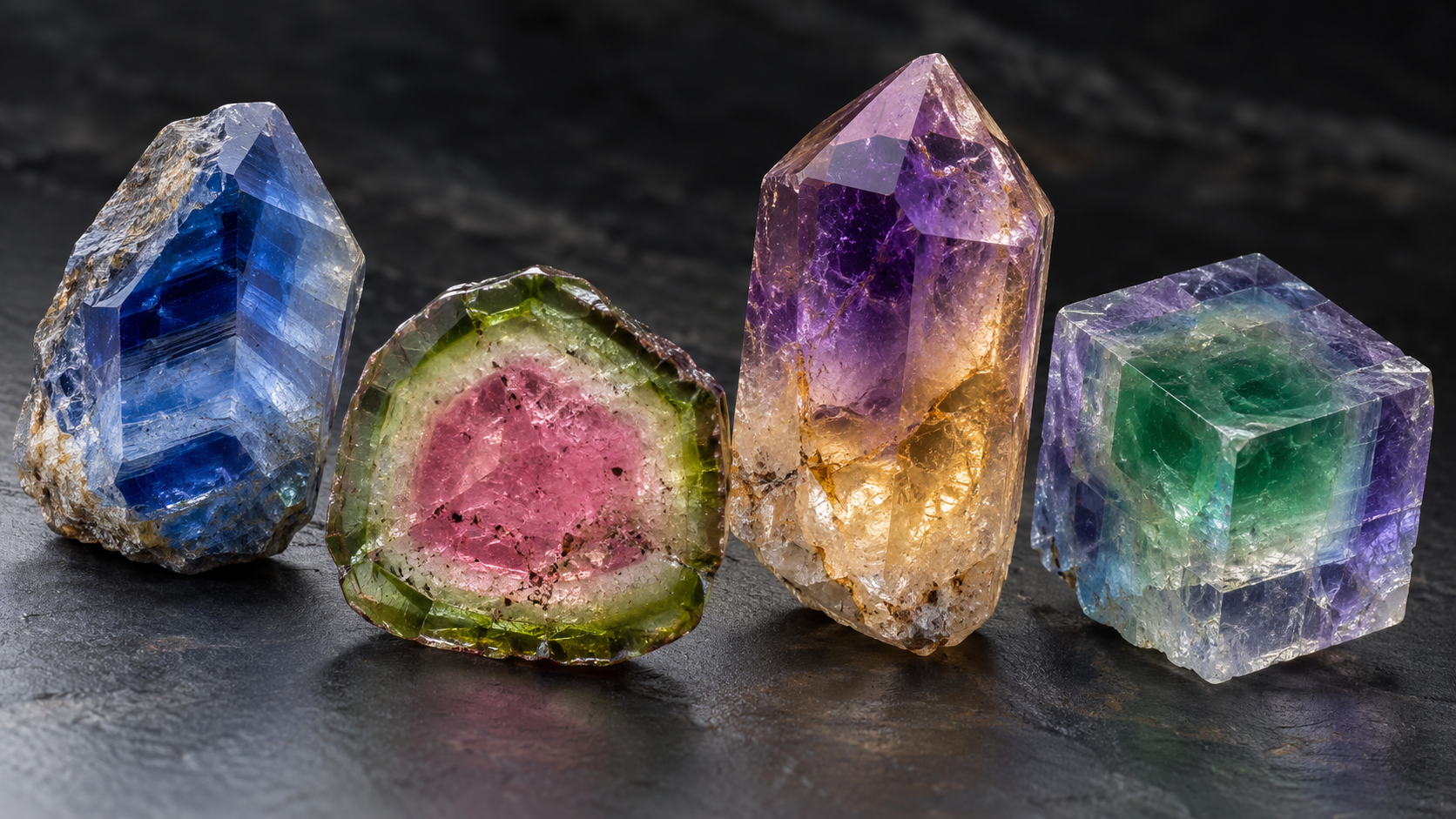
Imagine examining a natural blue sapphire under transmitted light.
At first glance, the gemstone appears uniformly blue.
However, when viewed from another direction, something remarkable becomes visible.
The blue colour is not distributed evenly throughout the crystal.
Instead, it occurs in sharply defined angular bands.
Some regions are intensely saturated.
Others are pale blue or nearly colourless.
The boundaries between these regions may follow geometric patterns associated with the crystal’s internal structure.
Now consider a tourmaline crystal.
Its centre may be pink while its outer regions are green.
Alternatively, one end may be green while the opposite end is pink.
A third example is ametrine, where purple amethyst and yellow-to-orange citrine occupy different regions of the same quartz crystal.
These differences are examples of gemstone colour zoning.
Colour zoning occurs when colour is distributed unevenly within a gemstone.
It may appear as bands, layers, sectors, patches or contrasting regions.
In many natural crystals, these patterns reflect differences in chemical composition or structural conditions associated with crystal growth.
However, not every colour zone originates through the same mechanism.
Some patterns reflect changing concentrations of trace elements.
Others result from crystallographic sector-dependent incorporation of impurities.
Still others involve colour centres, radiation-related processes or later modifications.
The scientific significance of colour zoning extends far beyond appearance.
Under appropriate conditions, these patterns can provide evidence about the environment in which a crystal developed.
They may help gemmologists understand growth structures.
They can influence how rough gemstones are oriented and cut.
They may also contribute to distinguishing natural gemstones from certain laboratory-grown materials.
However, colour zoning must never be treated as an infallible indicator of natural origin.
Understanding what colour zoning reveals—and what it cannot prove—is essential to accurate gemmological interpretation.
1. What Is Gemstone Colour Zoning?
Colour zoning describes a non-uniform distribution of colour within a gemstone.
The variation may involve differences in hue, saturation or tone.
For example, a blue sapphire may contain alternating regions of intense blue and pale blue.
A tourmaline may display pink and green regions.
An amethyst crystal may contain alternating purple and nearly colourless areas.
A fluorite crystal may exhibit a green centre surrounded by blue or purple outer zones.
These patterns can occur within a single continuous crystal.
They do not necessarily indicate that different mineral species are present.
A gemstone containing two colours can still consist entirely of one mineral species.
For example, ametrine consists of quartz.
Its purple and yellow-to-orange regions represent different colour varieties of the same mineral.
Similarly, a blue-and-yellow sapphire remains corundum throughout.
The distinction is important because colour variation does not automatically imply a change in mineral identity.
Colour zoning is primarily a description of colour distribution.
Explaining its cause requires additional mineralogical evidence.
2. How Colour Develops Inside a Gemstone
To understand colour zoning, we must first consider why gemstones possess colour.
The colour of a mineral depends on how it interacts with visible light.
Certain wavelengths are absorbed more strongly than others.
The remaining transmitted or reflected light contributes to the colour perceived by an observer.
In many gemstones, selective absorption is influenced by trace elements or defects within the crystal structure.
These colour-producing mechanisms are often described as chromophores.
A chromophore may involve an individual ion, a combination of ions or an electronic defect.
For example, chromium is responsible for the red colour of ruby.
In blue sapphire, an important colour-producing mechanism involves interactions between iron and titanium.
The GIA’s quantitative research on corundum identifies several important chromophores, including Cr³⁺, Fe³⁺, V³⁺ and Fe²⁺–Ti⁴⁺.
These mechanisms produce different absorption characteristics.
Their combined effects can create the broad range of colours observed in natural corundum.
If the distribution of colour-producing components varies within a crystal, different regions may absorb light differently.
The result can be visible colour zoning.
However, the relationship is not always as simple as a direct correspondence between total trace-element concentration and colour intensity.
The oxidation state of an element, its structural environment and its interaction with other defects may also be important.
This distinction is especially relevant to quartz and certain other minerals in which colour centres contribute to visible colour.
3. Crystal Growth Is Not Always Chemically Uniform
Natural gemstones form under geological conditions that can change over time.
A crystal may grow within a fluid, melt or other suitable mineral-forming environment.
As growth proceeds, atoms and ions become incorporated into its structure.
However, the surrounding environment does not necessarily remain constant.
The composition of the growth medium may change.
Temperature may vary.
Pressure may change.
The availability of particular trace elements may increase or decrease.
The chemical conditions controlling oxidation states may also evolve.
Consequently, successive regions of a growing crystal may incorporate different amounts or forms of colour-producing components.
One growth interval may produce a strongly coloured region.
Another may produce a pale region.
If the crystal continues growing, these differences can become preserved as internal zones.
This process is often described as growth zoning.
In favourable circumstances, the resulting pattern provides a partial record of the crystal’s development.
However, a visible colour boundary does not necessarily correspond to one sudden geological event.
The relationship between growth conditions, chemical incorporation and visible colour can be complex.
Scientific interpretation therefore requires more than simply counting colour bands.
4. Oscillatory Zoning: Repeated Changes During Crystal Growth
One important zoning pattern is oscillatory zoning.
It occurs when a crystal develops successive zones with changing chemical or physical characteristics.
The pattern may consist of repeated bands or layers.
These zones can sometimes follow the external shape of the growing crystal.
In suitable specimens, the pattern resembles a sequence of nested crystal outlines.
Oscillatory zoning may reflect variations in the growth environment or the interaction between crystal growth and the surrounding medium.
However, repeated zoning does not always require large external geological disturbances.
Chemical and kinetic processes operating near the growing crystal surface can also contribute.
The result is a sequence of regions with different compositions or optical characteristics.
In coloured gemstones, these differences may become visible as alternating darker and lighter bands.
In other minerals, oscillatory chemical zoning may be present without producing obvious colour differences.
Therefore, visible colour zoning represents only one possible expression of growth-related chemical variation.
5. Sector Zoning: Why Different Crystal Faces Can Produce Different Colours
Another important phenomenon is sector zoning.
Unlike zoning produced by successive growth intervals, sector zoning reflects differences associated with crystallographically distinct growth sectors.
A crystal grows through the advancement of its external faces.
Different crystal faces may incorporate impurities differently.
This can occur even when those faces are exposed to broadly similar environmental conditions.
As growth continues, the regions associated with different faces may develop distinct chemical compositions.
These differences can produce contrasting colours.
Sector zoning may create geometric patterns within the crystal.
Its boundaries can reflect the internal relationship between crystallographic growth directions.
A particularly important example occurs in natural ametrine.
The purple and yellow-to-orange sectors of certain Bolivian quartz crystals are related to differences between crystallographic growth sectors.
Research on the Anahí ametrine deposit established that its characteristic colour combination occurs naturally.
The precise mechanisms responsible for the contrasting colour sectors involve complex crystal chemistry and geological conditions.
This illustrates an important principle.
Not every colour boundary represents a change from one growth period to another.
Some boundaries reflect differences between regions growing simultaneously on different crystallographic faces.
6. Sapphire: One of the Most Important Examples of Colour Zoning
Sapphire is particularly well known for its internal colour zoning.
It belongs to the mineral species corundum, Al₂O₃.
Corundum crystallises in the trigonal crystal system.
Its crystals may display external forms associated with hexagonal symmetry.
In natural blue sapphires, colour zoning frequently appears as angular bands.
These bands may follow crystallographic growth directions.
A sapphire may contain alternating regions of strong blue and pale blue.
In some specimens, nearly colourless regions occur alongside intensely coloured areas.
The GIA identifies colour zoning as a common characteristic of natural sapphire.
It also explains that cutters must consider zoning when deciding how to orient rough material.
The concentration of colour may be highly uneven.
A small region of intense blue can have a substantial influence on the appearance of the finished gemstone.
This means that the visible colour of a faceted sapphire does not necessarily represent the colour distribution throughout its entire volume.
The optical appearance depends partly on how light travels through the different coloured regions.
7. Why Sapphire Colour Zones Can Be Angular
Angular colour zoning is particularly informative because it may reflect the crystallographic structure of the growing mineral.
Corundum has an ordered atomic arrangement.
Its external growth forms are controlled by crystallographic relationships.
When changes in colour-producing components become incorporated into successive growth regions, the resulting boundaries may follow these geometries.
Consequently, a natural sapphire can display straight or angular colour bands.
Under appropriate viewing conditions, some patterns resemble portions of hexagonal outlines.
However, the appearance depends on the orientation of the gemstone.
A crystal viewed along one direction may show a different pattern from the same crystal viewed from another direction.
Faceting further complicates observation.
Light entering the gemstone may undergo multiple internal reflections.
These reflections can make internal zones appear displaced or repeated.
Therefore, the visible pattern in a finished gemstone is influenced by both its internal growth structure and its optical geometry.
8. Colour Zoning and the Cutting of Sapphire
Colour zoning can strongly influence gemstone cutting decisions.
A cutter must consider several competing objectives.
These include colour appearance, weight retention, proportions, symmetry and optical performance.
In a sapphire with uneven colour distribution, the orientation of the rough may determine whether the finished stone appears evenly coloured.
For example, a small intensely blue region near the pavilion or culet can contribute strongly to the face-up appearance.
The GIA describes how cutters may orient a sapphire so that concentrated colour influences a larger portion of the visible gemstone.
This can create an attractive face-up appearance even when the rough contains significant zoning.
However, the result depends on the geometry of the colour distribution and the cutting design.
A cutter cannot always eliminate the visual influence of strong zoning.
Some gemstones retain obvious colour bands after faceting.
In other cases, the zoning becomes difficult to detect without changing the viewing direction.
This illustrates why evaluating a gemstone only from its face-up appearance may not reveal its complete internal colour distribution.
9. Ruby: Colour Zoning in Chromium-Bearing Corundum
Ruby is the red variety of corundum.
Its characteristic colour is principally associated with chromium.
However, chromium concentration and the resulting colour are not necessarily distributed uniformly throughout every ruby crystal.
Some natural rubies contain colour zones associated with their growth history.
These may appear as variations in red saturation.
Other specimens may contain growth structures that become visible under specialised lighting.
The interpretation of ruby colour zoning requires care.
Different types of internal structures may coexist.
These can include growth bands, twinning features, mineral inclusions and healed fractures.
Not every visible line represents a colour zone.
Likewise, not every colour difference corresponds directly to a change in chromium concentration.
Other chromophores and structural factors may influence the observed appearance.
A complete gemmological examination considers the relationships between these features rather than interpreting each observation in isolation.
10. Tourmaline: A Remarkable Record of Changing Growth Chemistry
Tourmaline provides some of the most visually spectacular examples of gemstone colour zoning.
It is a complex group of borosilicate minerals.
Tourmaline crystals can incorporate a wide range of chemical elements.
Their compositions may vary considerably between species and even between regions of an individual crystal.
This chemical flexibility contributes to their extraordinary colour diversity.
Tourmaline may display pink, green, blue, yellow, brown, colourless or nearly black regions.
In certain crystals, these colours occur together.
Two major zoning arrangements are particularly important.
Longitudinal colour zoning
Different colours occur along the length of the crystal.
For example, one end may be pink while the opposite end is green.
Concentric or core-to-rim colour zoning
Different colours occur between the centre and outer regions of the crystal.
The classic example is watermelon tourmaline.
GIA research on tourmalines from Luc Yen, Vietnam, documents complex colour zoning both along the crystallographic c-axis and from the crystal centre toward its outer regions.
The study demonstrates that colour distribution in tourmaline can be highly variable.
These patterns reflect the interaction between crystal chemistry and growth conditions.
11. Watermelon Tourmaline: A Natural Core-to-Rim Colour Structure
Watermelon tourmaline is a particularly recognisable example of colour zoning.
A typical specimen contains a pink or reddish central region surrounded by green outer material.
The appearance resembles the interior and rind of a watermelon.
This pattern can develop when the chemical conditions associated with crystal growth change as the crystal develops.
The resulting composition of later growth regions differs from that of earlier regions.
However, not every watermelon tourmaline has an identical chemical history.
The term describes a characteristic colour arrangement rather than one unique geological formation mechanism.
The colour boundaries may be sharp or gradual.
Some crystals contain additional intermediate zones.
Others show irregular colour distributions.
Watermelon tourmaline is frequently cut into polished slices.
This cutting style exposes the relationship between the central and outer colour zones.
The result is a gemstone whose internal growth structure becomes the principal decorative feature.
Unlike many uniformly coloured gemstones, the value and appeal of watermelon tourmaline may depend on the visibility and attractiveness of its zoning.
12. Amethyst: Purple Colour Distribution in Quartz
Amethyst is the purple variety of quartz.
Its colour is associated with iron-related defects and the effects of irradiation.
Natural amethyst crystals frequently display uneven colour distribution.
Some specimens contain alternating purple and nearly colourless regions.
Others exhibit angular or sector-related zoning.
In certain geological occurrences, distinctive patterns are associated with the crystal’s growth history.
GIA research on Moroccan amethyst from Boudi documents characteristic hourglass colour zoning.
Other studies have described oscillatory and sector zoning in amethyst from different geological environments.
These patterns can provide information about crystal growth.
However, the interpretation must account for the mechanisms responsible for colour development.
The visible purple colour of amethyst is not simply determined by the total amount of iron present.
The formation and stability of particular colour centres are also important.
Consequently, differences in colour intensity may reflect both chemical characteristics and processes affecting colour centres.
This makes amethyst an especially interesting material for studying the relationship between crystal growth and colour formation.
13. Ametrine: Two Colours Within One Quartz Crystal
Ametrine is one of the clearest demonstrations that a single mineral crystal can contain distinctly different colours.
It combines purple amethyst and yellow-to-orange citrine regions.
Both belong to quartz, SiO₂.
The mineral identity remains the same throughout the crystal.
The colour differences arise from the different states and environments of iron-related colour-producing mechanisms.
The natural occurrence of ametrine from Bolivia has been investigated through geological and experimental research.
A landmark study of the Anahí deposit, published in Gems & Gemology in 1994, established that its amethyst-citrine colour combination occurs naturally.
The study also examined the relationship between colour zoning and crystallographic growth sectors.
The distinctive purple and yellow regions make ametrine particularly suitable for specialised cutting designs.
A cutter may orient the gemstone to display both colours prominently.
In some designs, the boundary between the colours becomes a central visual feature.
In others, reflections and facet arrangements create complex colour patterns.
This illustrates an important distinction in gemstone evaluation.
Colour zoning is not always considered undesirable.
In ametrine, the contrasting colour zones are fundamental to the gemstone’s identity and appeal.
14. Fluorite: Colour Zoning in a Cubic Mineral
Fluorite is calcium fluoride, CaF₂.
It crystallises in the cubic crystal system.
Fluorite occurs in a remarkable range of colours, including purple, green, blue, yellow and colourless.
Some crystals contain sharply contrasting colour regions.
These may form bands or zones associated with different stages or sectors of crystal development.
The causes of fluorite colour can be complex.
They may involve trace elements, lattice defects and colour centres.
Consequently, a visible colour boundary does not necessarily correspond directly to a change in the concentration of one chemical element.
GIA research has documented prominent colour zoning in fluorite specimens.
A 2025 report on fluorite from Nigeria described crystals containing green central regions and blue outer zones.
Such specimens demonstrate how colour zoning can produce striking patterns in naturally formed mineral crystals.
However, colour zoning alone cannot establish the precise cause of colour.
Additional analytical techniques may be required to distinguish different colour-producing mechanisms.
For mineral collectors, these patterns are often especially attractive because they reveal aspects of the crystal’s internal organisation.
15. Can Colour Zoning Reveal the Sequence of Crystal Growth?
In some circumstances, yes.
A crystal may preserve internal boundaries corresponding to successive growth regions.
If these boundaries can be related reliably to crystallographic structure, they may help reconstruct aspects of growth.
For example, a crystal with concentric growth zones may contain an older central region surrounded by later material.
However, this interpretation requires caution.
Not every coloured region represents a separate growth episode.
Sector zoning can develop through differences between simultaneously growing crystal faces.
Post-growth processes can also modify colour.
Irradiation, diffusion and changes in defect populations may influence the final appearance.
Therefore, a simple sequence of colours cannot always be interpreted as a direct chronological record.
The strongest interpretations combine colour zoning with other evidence.
This may include crystal morphology, growth structures, inclusions, chemical analysis and geological context.
16. Colour Zoning Versus Pleochroism
Colour zoning is sometimes confused with pleochroism.
These are different phenomena.
Colour zoning concerns the spatial distribution of colour within a gemstone.
Pleochroism concerns differences in light absorption according to crystallographic viewing direction.
A pleochroic gemstone may appear to display different colours when viewed along different directions.
This does not necessarily mean that its chemical composition varies spatially.
For example, blue sapphire may show different colour components depending on the viewing direction.
Tourmaline can also exhibit pronounced pleochroism.
A gemstone may possess both pleochroism and colour zoning.
The two effects can interact visually.
This can complicate interpretation when the stone is rotated.
The distinction is important because observing a change in colour with viewing direction does not automatically establish the presence of internal colour zones.
A gemmologist must determine whether the observed variation is related to spatial colour distribution, directional optical behaviour or a combination of both.
17. Colour Zoning Versus Colour Change
Colour zoning should also be distinguished from the colour-change phenomenon.
A colour-change gemstone displays different apparent colours under different illumination conditions.
This occurs because the gemstone’s absorption characteristics interact differently with the spectral composition of the light source.
Alexandrite provides a classic example.
Certain sapphires and garnets may also display colour change.
Colour zoning, by contrast, concerns differences between regions within the gemstone.
A gemstone may possess both characteristics.
However, the presence of two colours in one crystal does not automatically mean that it exhibits colour change.
A pink-and-green tourmaline is not necessarily a colour-change gemstone.
Likewise, a sapphire with blue and yellow zones should not be described as colour changing merely because both colours are visible.
Accurate terminology is important when documenting gemstone optical properties.
18. Colour Zoning and Natural Versus Synthetic Gemstones
Colour zoning can provide useful information during the identification of natural and laboratory-grown gemstones.
However, it must be interpreted within the context of the material and its growth method.
Certain synthetic corundum crystals produced by the Verneuil flame-fusion process display curved growth banding.
This contrasts with the angular growth zoning commonly observed in many natural sapphires.
The distinction can be diagnostically valuable.
GIA research published in 2019 documented curved banding in flame-fusion synthetic sapphire.
However, the interpretation is not universally simple.
Laboratory-grown gemstones can be produced using several different techniques.
These include flame fusion, flux growth and hydrothermal growth.
Different methods can produce different internal structures.
Some synthetic materials display angular or complex growth features.
A GIA study of hydrothermal synthetic ruby and sapphire documented zigzag and mosaic-like zoning patterns.
Consequently, it would be scientifically incorrect to conclude that every gemstone displaying straight or angular zoning must be natural.
Likewise, the absence of curved zoning does not establish natural origin.
The correct conclusion is that particular growth patterns can provide evidence consistent with particular formation methods.
A reliable identification must consider the complete collection of gemmological observations.
19. Why One Internal Feature Is Not Enough to Prove Natural Origin
Gemstone identification requires the interpretation of multiple characteristics.
A single internal feature may be suggestive without being conclusive.
This is particularly important when distinguishing natural from synthetic gemstones.
For example, certain growth structures are commonly associated with natural corundum.
However, unusual synthetic materials can sometimes reproduce features that are normally considered characteristic of natural stones.
A GIA report published in 2022 documented a synthetic sapphire containing Rose channels and twinning features more commonly encountered in natural corundum.
The investigation demonstrated why such features cannot always be used independently to establish natural origin.
The same caution applies to colour zoning.
An angular pattern may support a particular interpretation.
However, it does not replace comprehensive identification.
Depending on the gemstone, examination may require microscopy, spectroscopy, chemical analysis and other appropriate techniques.
The objective is to reach a conclusion supported by several independent observations.
20. How Gemmologists Examine Colour Zoning
Colour zoning may be visible to the unaided eye.
However, subtle patterns often require controlled examination.
Transmitted light can be particularly useful because it passes through the gemstone and reveals differences in internal colour distribution.
Magnification may help distinguish individual bands or boundaries.
The viewing direction is also important.
A pattern that appears weak from one direction may become obvious when the gemstone is rotated.
Immersion techniques can sometimes improve the visibility of internal structures by reducing certain surface reflections.
However, immersion liquids must be appropriate for the gemstone.
Some materials and treatments can be affected by liquids.
For routine observation, non-invasive methods should be preferred.
A useful examination sequence involves first observing the gemstone face-up, then examining it from the pavilion and rotating it under controlled illumination.
The objective is to determine whether the colour variation remains fixed within the gemstone and how its appearance changes with viewing direction.
The observer should also distinguish true colour zoning from reflections, extinction, windowing and other optical effects associated with faceting.
21. How Cutting Can Conceal or Emphasise Colour Zoning
A rough gemstone may contain strongly contrasting colour regions.
However, the appearance of the finished gemstone depends partly on cutting orientation.
Faceting controls the paths followed by light entering and leaving the stone.
This influences how colour is perceived.
A cutter may orient a gemstone to minimise visible zoning.
Alternatively, the cutting design may deliberately emphasise contrasting colours.
These approaches serve different aesthetic objectives.
In fine blue sapphire, a relatively uniform face-up colour is often preferred.
Consequently, the cutter may attempt to reduce the visible influence of colour zoning.
In watermelon tourmaline or ametrine, the opposite may be desirable.
The cutting design may aim to preserve and display the contrasting regions.
Neither approach is universally superior.
The appropriate choice depends on the gemstone material and the intended visual result.
However, a cutting design should not be evaluated solely by its ability to conceal zoning.
Proportions, symmetry, polish, optical performance and weight retention also matter.
The final gemstone represents a balance between these considerations.
22. Does Colour Zoning Reduce Gemstone Value?
The effect of colour zoning on value depends on the gemstone and its intended appearance.
For many transparent faceted gemstones, uniform colour is considered desirable.
Strong uneven zoning may reduce visual appeal.
This is particularly relevant when the zoning produces unattractive patches or abrupt changes in tone.
However, the effect is not universal.
Certain gemstones are valued specifically because they contain contrasting colour regions.
Examples include ametrine, watermelon tourmaline and some parti-coloured sapphires.
In these materials, attractive zoning can become an important positive feature.
The visibility of the zoning also matters.
A gemstone may contain substantial internal zoning while appearing relatively uniform face-up.
Another may display only limited internal variation but show a highly noticeable colour boundary in its finished form.
Consequently, the presence of zoning should not automatically produce a fixed grading deduction.
Its influence must be evaluated in relation to the gemstone’s overall appearance and the expectations associated with that material.
23. Colour Zoning and Gemstone Clarity
Colour zoning is sometimes discussed alongside clarity characteristics.
However, it is useful to distinguish colour distribution from inclusions.
An inclusion is a material or structural feature enclosed within, or associated with, the gemstone.
Examples include mineral crystals, fluid inclusions and certain internal discontinuities.
Colour zoning may arise from differences within the gemstone’s own crystal structure.
It does not necessarily involve a separate included substance.
Therefore, colour zoning is not automatically equivalent to a mineral inclusion or fracture.
Nevertheless, zoning can affect visual transparency and appearance.
Strongly contrasting colour regions may make a gemstone appear less visually uniform.
Some growth zones may also coincide with concentrations of inclusions.
These relationships should be evaluated separately.
A gemmological description benefits from identifying the actual feature rather than grouping all internal variations under one general clarity label.
24. Colour Zoning and Gemstone Treatments
The presence of colour zoning does not establish whether a gemstone has been treated.
Some natural gemstones possess zoning that developed during their geological formation.
Certain treatments may modify colour distribution.
Others may create new colour patterns.
For example, some diffusion treatments can produce colour concentrated near the surface of a gemstone.
This differs from many natural growth-related zoning patterns.
However, the distinction cannot always be established by simple visual inspection.
Heat treatment may also alter the appearance of certain colour centres or chromophores.
Its effects depend on the gemstone material and treatment conditions.
Therefore, the presence of colour zoning should not be used as a substitute for treatment identification.
A natural gemstone may be zoned and untreated.
A natural gemstone may be zoned and treated.
A synthetic gemstone may also display zoning.
These possibilities must remain separate during gemmological evaluation.
25. Can Colour Zoning Identify a Gemstone’s Country of Origin?
Colour zoning may contribute to the interpretation of a gemstone’s geological history.
However, it does not independently establish geographic origin.
Similar growth conditions can occur in different geological regions.
Gemstones from different countries may display overlapping internal characteristics.
For example, angular colour zoning occurs in natural sapphires from multiple geographic sources.
A particular zoning pattern may be more frequently observed in certain populations.
Nevertheless, a reliable origin determination requires additional evidence.
Professional laboratories may compare microscopic characteristics, trace-element chemistry, spectroscopy and documented reference collections.
Even with these methods, some origin determinations remain inconclusive.
Therefore, a sapphire should not be assigned to Sri Lanka, Madagascar or another country solely because of its colour zoning.
The pattern may be scientifically interesting without being geographically diagnostic.
26. What Colour Zoning Can Tell a Gemstone Collector
For collectors, colour zoning provides a valuable opportunity to observe mineral growth characteristics.
A natural crystal may preserve patterns that are difficult to appreciate in a uniformly coloured faceted gemstone.
Transparent mineral specimens are particularly useful because light can pass through the crystal.
Polished slices may reveal internal zoning more clearly.
Examples include tourmaline slices, zoned fluorite and certain quartz specimens.
However, observation should remain scientifically cautious.
A beautiful pattern may suggest differences in crystal growth.
It does not automatically reveal the exact temperature, pressure or chemical composition of the growth environment.
Likewise, the number of visible bands cannot necessarily be converted into a number of years or growth events.
The most appropriate approach is to regard colour zoning as evidence that can contribute to geological interpretation.
It is not a complete geological record by itself.
27. Colour Zoning in Natural Gems Belgium Product Evaluation
At Natural Gems Belgium, colour distribution is relevant to the individual evaluation of natural gemstones.
For faceted gemstones, the NGB grading framework considers colour, clarity, cut, optical performance and overall appeal.
Colour zoning may influence several of these categories.
For example, uneven colour distribution may affect the colour assessment.
Cutting orientation may determine whether the zoning is visible face-up.
The interaction between colour distribution and faceting may also influence optical appearance.
However, these effects should not be counted repeatedly without justification.
A gemstone containing attractive multicolour zoning may possess excellent overall appeal.
Another gemstone may display zoning that significantly reduces its visual uniformity.
The assessment should remain specific to the individual specimen.
For rough gemstones, zoning can also influence faceting potential.
A cutter may need to consider whether the desired colour regions can be retained in the finished stone.
For mineral specimens and decorative crystals, zoning may be a desirable characteristic rather than a limitation.
This is why the scientific description of the feature should remain separate from its commercial evaluation.
28. Practical Example: Two Blue Sapphires With Different Colour Distributions
Consider two natural blue sapphires.
Both have similar dimensions and comparable overall saturation.
The first sapphire contains relatively uniform blue colour throughout most of the crystal.
The second contains alternating dark-blue and pale-blue growth zones.
When viewed face-up, both gemstones may initially appear attractive.
However, closer examination reveals differences.
The first sapphire maintains a relatively consistent appearance during rotation.
The second displays noticeable changes in colour distribution as different internal zones become visible.
Depending on the cutting orientation, the second gemstone may show stronger colour in certain directions.
Neither gemstone can be evaluated adequately using the presence or absence of zoning alone.
The final assessment must consider colour quality, cutting proportions, optical performance and overall appearance.
The example demonstrates why individual gemstone evaluation is more informative than applying one general rule to all colour-zoned stones.
29. Practical Example: A Colour-Zoned Tourmaline Crystal
Now consider a natural tourmaline crystal with a pink centre and green outer regions.
In a conventional faceted gemstone, the distribution of these colours may be difficult to preserve attractively.
However, cutting the crystal into a polished transverse slice can reveal the entire core-to-rim pattern.
The resulting gemstone displays the natural zoning as its central visual characteristic.
The colour distribution is no longer something to minimise.
It becomes the reason for choosing that cutting style.
This demonstrates how gemstone cutting can transform an internal mineralogical feature into an important aesthetic element.
The value of the finished object depends on the attractiveness of the pattern, the quality of the material and the craftsmanship involved.
30. Common Misconceptions About Gemstone Colour Zoning
Several misunderstandings occur frequently.
Misconception: Colour zoning proves that a gemstone is natural.
Incorrect. Certain synthetic gemstones also display colour zoning and growth structures.
Misconception: Every colour band represents a separate geological event.
Incorrect. Some zoning reflects differences between crystallographic growth sectors or other processes.
Misconception: Colour zoning always reduces gemstone quality.
Incorrect. Attractive zoning can be highly desirable in materials such as ametrine and watermelon tourmaline.
Misconception: A uniformly coloured gemstone cannot be natural.
Incorrect. Many natural gemstones possess relatively uniform colour.
Misconception: All colour zoning results from different trace-element concentrations.
Incorrect. Colour centres, oxidation states and structural factors may also contribute.
Misconception: Colour zoning and pleochroism are the same phenomenon.
Incorrect. Colour zoning concerns spatial variation, while pleochroism concerns directional light absorption.
Misconception: A gemstone’s geographic origin can be determined from its colour bands alone.
Incorrect. Reliable origin determination requires additional evidence.
Misconception: Colour zoning indicates that a gemstone has not been treated.
Incorrect. Zoning and treatment status are separate characteristics.
31. The Scientific Importance of Colour Zoning
Colour zoning demonstrates that crystals are not always chemically or optically uniform.
Even when a crystal belongs to one mineral species, different regions may preserve distinct characteristics.
These variations can provide information about mineral growth.
They may reveal differences in trace-element incorporation.
They may reflect crystallographic growth sectors.
They may record changes in the surrounding environment.
In some cases, they may also provide evidence of later processes affecting colour.
The scientific value of zoning becomes particularly significant when visual observations are combined with analytical techniques.
Spectroscopy can investigate colour-producing mechanisms.
Chemical analysis can examine trace-element distributions.
Microscopy can reveal growth structures and associated inclusions.
Crystallographic information can help interpret the geometry of internal boundaries.
Together, these methods provide a more complete understanding of the gemstone’s history.
The important principle is that colour zoning should be interpreted as part of a broader mineralogical system.
Its meaning depends on the material, its structure and the evidence available.
Conclusion: A Visible Record of Crystal Development
Gemstone colour zoning is one of the most interesting connections between natural beauty and mineralogical science.
A blue sapphire may preserve angular growth bands.
A ruby may contain variations in chromium-related colour.
A tourmaline may develop contrasting colours along its length or between its centre and outer regions.
An amethyst may display sector-related purple zoning.
Ametrine can contain purple and yellow-to-orange regions within one quartz crystal.
Fluorite may exhibit striking colour boundaries associated with its complex colour-producing mechanisms.
These patterns demonstrate that crystal growth is not always uniform.
The chemical and physical conditions influencing mineral development may change.
Different crystal faces may incorporate colour-producing components differently.
Later processes may also influence the final colour distribution.
For gemmologists, zoning can provide useful evidence about growth structures and identification.
For gemstone cutters, it can influence orientation and design.
For collectors, it offers a visible connection to the mineral’s internal history.
For buyers, it helps explain why two gemstones of the same mineral species may display very different appearances.
However, the scientific interpretation must remain precise.
Colour zoning does not automatically prove natural origin.
It does not independently establish geographic provenance.
It does not guarantee untreated status.
And it does not necessarily reduce gemstone quality.
The importance of colour zoning lies not simply in the presence of different colours, but in what their distribution can reveal about the mineral’s structure and development.
A natural gemstone is more than a beautiful object.
It is the product of physical and chemical processes operating within the Earth.
In some gemstones, those processes have left visible patterns that allow us to investigate part of the crystal’s remarkable geological history.
References & Further Reading
The following references are selected from scientific research and educational publications by the Gemological Institute of America.
They provide supporting information about crystal growth, gemstone colour, zoning mechanisms, synthetic gemstone identification and the relationship between colour distribution and cutting quality.
The references are informational and do not direct readers to gemstone product listings or commercial retail blogs.
1. A Quantitative Description of the Causes of Color in Corundum
Authors: Emily V. Dubinsky, Jennifer Stone-Sundberg and John L. Emmett
Publication: Gems & Gemology, Spring 2020, Volume 56, Number 1
A detailed scientific investigation of the principal chromophores responsible for colour in corundum.
Explains the roles of chromium, iron, titanium and vanadium, including the relationship between trace-element chemistry and visible-light absorption.
https://origin.prod.gia.edu/gems-gemology/spring-2020-corundum-chromophores
2. Sapphire Quality Factors
Institution: Gemological Institute of America
An authoritative educational reference covering sapphire colour, clarity, cutting and colour zoning.
Explains how angular colour zoning influences cutting orientation and the face-up appearance of finished sapphires.
https://www.gia.edu/sapphire-quality-factor
3. Colored Gemstone Value Factors
Author: Al Gilbertson
Publication: GIA Research, 9 August 2018
An extensive discussion of the factors influencing coloured gemstone appearance and value.
Includes the importance of colour uniformity and the evaluation of visible zoning.
4. Factors in Colored Stones That Interact to Affect Value
Institution: Gemological Institute of America
Examines how colour zoning interacts with cutting orientation, gemstone proportions and optical appearance.
Includes examples involving sapphire, ametrine and multicoloured tourmaline.
https://www.gia.edu/gia-news-research-some-factors-that-interact-to-affect-value
5. An Update on Tourmaline from Luc Yen, Vietnam
Publication: Gems & Gemology, Summer 2017
A scientific investigation of tourmaline chemistry and colour distribution.
Documents longitudinal and core-to-rim colour zoning and discusses the relationship between crystal growth and chemical composition.
https://origin.prod.gia.edu/gems-gemology/summer-2017-tourmaline-luc-yen-vietnam
6. Tourmaline Quality Factors
Institution: Gemological Institute of America
An educational reference explaining tourmaline colour diversity, multicoloured crystals and watermelon tourmaline.
Includes examples of colour zoning along and across crystal growth directions.
https://www.gia.edu/tourmaline-quality-factor
7. The Anahí Ametrine Mine, Bolivia
Authors: Paulo M. Vasconcelos, Hans-Rudolf Wenk and George R. Rossman
Publication: Gems & Gemology, Spring 1994, Volume 30, Number 1
A landmark scientific study establishing the natural occurrence of amethyst-citrine colour zoning in quartz from Bolivia.
Examines geological conditions and crystallographic sector zoning.
https://origin.prod.author.gia.edu/gems-gemology/spring-1994-amethyst-citrine-bolivia-vasconcelos
8. Ametrine Quality Factors
Institution: Gemological Institute of America
Explains how the distribution of purple and yellow-to-orange colour regions influences ametrine cutting and visual appeal.
https://www.gia.edu/ametrine-quality-factors
9. Moroccan Amethyst: Mining and Marketing
Authors: Andrew Lucas and Tao Hsu
Publication: Gems & Gemology, Spring 2017
Documents distinctive hourglass colour zoning in natural amethyst from the Boudi region of Morocco.
10. Multi-Color-Zoned Quartz from Brazil
Author: Jaroslav Hyršl
Publication: Gems & Gemology, Fall 2017
Describes a complex natural quartz occurrence containing several colour and mineralogical zones.
Provides an example of how changing growth conditions can produce successive internal structures.
https://origin.prod.author.gia.edu/gems-gemology/fall-2017-gemnews-multi-color-zoned-quartz-brazil
11. Curved Banding in Flame-Fusion Synthetic Sapphires
Author: E. Billie Hughes
Publication: Gems & Gemology, Summer 2019, Volume 55, Number 2
Documents curved growth banding in flame-fusion synthetic sapphire.
Explains the diagnostic significance of these features in comparison with angular zoning commonly encountered in natural corundum.
12. Some Diagnostic Features of Russian Hydrothermal Synthetic Rubies and Sapphires
Authors: Karl Schmetzer and Adolf Peretti
Publication: Gems & Gemology, Spring 1999, Volume 35, Number 1
An important study demonstrating that hydrothermal synthetic corundum can exhibit complex angular, zigzag and mosaic-like growth structures.
Relevant to the limitations of identifying natural gemstones through zoning patterns alone.
13. Synthetic Sapphire with Rose Channels
Authors: Ugo Hennebois, Aurélien Delaunay, Annabelle Herreweghe, Stefanos Karampelas and Emmanuel Fritsch
Publication: Gems & Gemology, Fall 2022, Volume 58, Number 3
Documents a synthetic sapphire displaying internal features more commonly associated with natural corundum.
Demonstrates the importance of combining multiple observations during gemstone identification.
https://www.gia.edu/gems-gemology/fall-2022-gemnews-synthetic-sapphire-with-rose-channels
14. New Fluorite Deposit in Nigeria
Author: Cristiano Brigida
Publication: Gems & Gemology, Spring 2025, Volume 61, Number 1
Describes natural fluorite crystals containing distinct green and blue colour zones.
Provides a documented example of contrasting colour distribution in fluorite.
https://www.gia.edu/gia-website/gems-gemology/spring-2025-gemnews-new-fluorite-deposit-nigeria0
15. Beryl Crystal in Fluorite
Authors: Ian Nicastro and Nathan Renfro
Publication: Gems & Gemology, Spring 2018, Volume 54, Number 1
A gemmological microscopy report documenting prominent colour zoning and internal inclusions in natural purple fluorite.
https://www.gia.edu/gems-gemology/spring-2018-microworld-beryl-crystal-fluorite
[…] Its body colour, sometimes called background colour, is the general appearance of the stone underneath the play-of-colour. […]