

Table of Contents
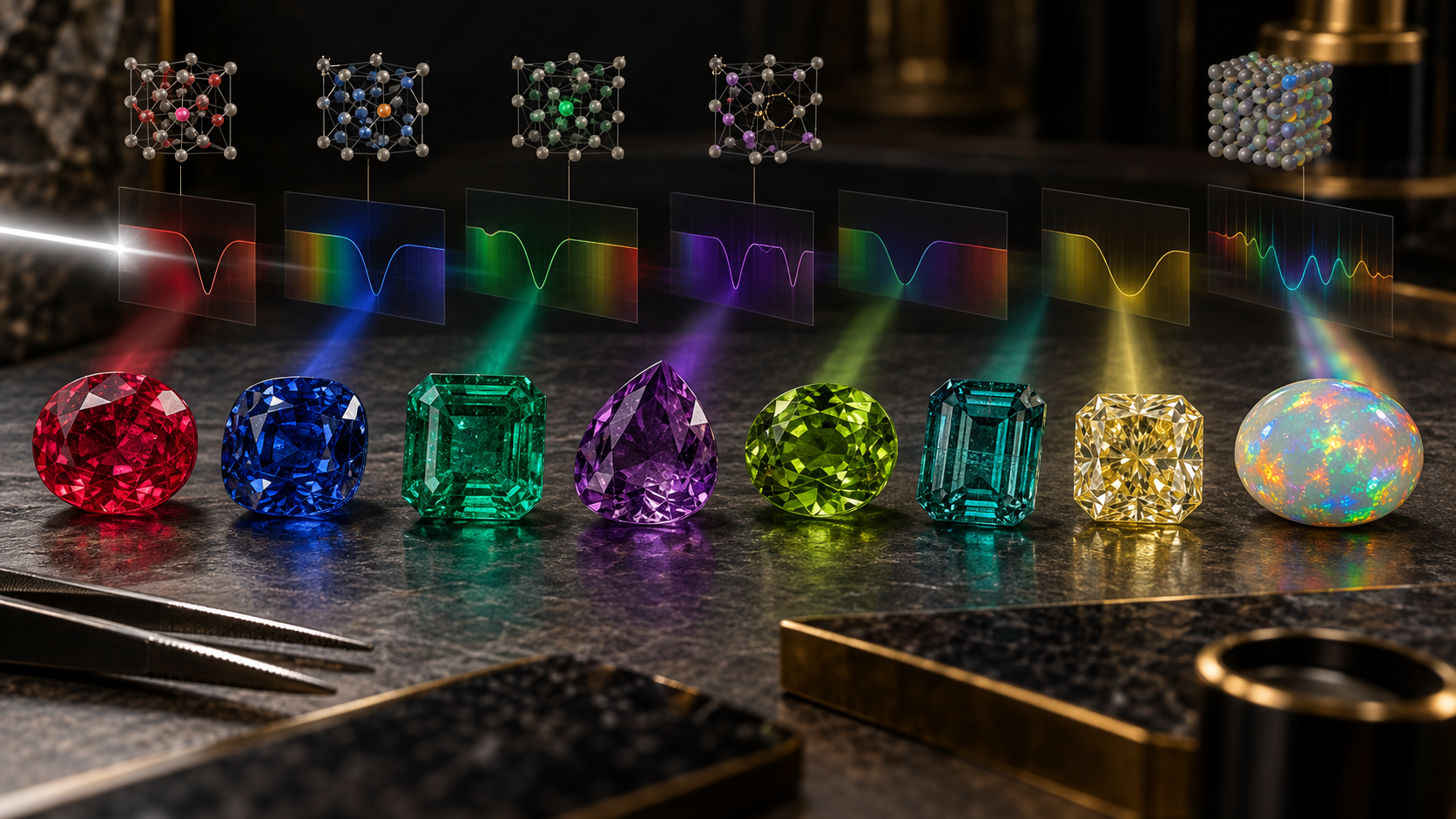
Why Is Ruby Red, Emerald Green and Sapphire Blue?
Take three gemstones:
ruby
emerald
and:
blue sapphire.
Ruby is red.
Emerald is green.
Sapphire is blue.
That sounds elementary.
But ask the next question:
WHY?
The answer leads directly into quantum physics, mineral chemistry and crystallography.
Ruby and blue sapphire make the problem especially interesting because both are the same mineral:
corundum.
Their fundamental chemical composition is:
Al₂O₃.
Pure corundum is essentially colourless.
Yet introduce particular atomic substitutions and defects and corundum can become:
- red;
- blue;
- yellow;
- orange;
- purple;
- pink;
- green.
Emerald presents another puzzle.
Pure beryl:
Be₃Al₂Si₆O₁₈
is colourless.
Yet chromium or vanadium entering appropriate structural sites can transform it into intense green emerald.
Then consider amethyst.
Its purple colour cannot adequately be explained simply by saying:
“there is iron in quartz.”
Radiation-related changes in the crystal create colour-producing defect centres.
Blue sapphire is different again.
Its colour arises principally from an interaction involving neighbouring:
iron and titanium.
And precious opal can display spectacular colour even though its play-of-colour is not produced primarily by a conventional chromophore at all.
The colours arise from the interaction of light with ordered microscopic structure.
So the phrase:
“trace elements cause gemstone colour”
is sometimes correct.
But it is profoundly incomplete.
To understand gemstone colour properly, we need to investigate:
LIGHT
↓
ATOMS
↓
ELECTRONS
↓
CRYSTAL STRUCTURE
↓
DEFECTS
↓
ENERGY
↓
COLOUR
PART I — COLOUR BEGINS WITH LIGHT
Visible light represents only a small part of the electromagnetic spectrum.
Human vision responds approximately to wavelengths from:
about 400 to 700 nanometres.
Shorter visible wavelengths appear approximately:
violet and blue.
Longer wavelengths appear approximately:
orange and red.
White light contains a broad range of visible wavelengths.
When white light encounters a gemstone, several things can happen.
Light can be:
- reflected;
- refracted;
- scattered;
- absorbed;
- transmitted;
- diffracted;
- interfered with.
Gemstone body colour is commonly produced because certain visible wavelengths are:
selectively absorbed.
The wavelengths that remain and reach our eyes determine the colour we perceive.
PART II — COLOUR IS OFTEN THE LIGHT THAT SURVIVES
Imagine white light entering a transparent gemstone.
If the stone absorbs much of the:
green and blue
part of the spectrum while transmitting more red light, it may appear:
red.
If it absorbs substantial red and blue components while transmitting green wavelengths, it may appear:
green.
This gives us a fundamental rule:
THE COLOUR WE SEE IS NOT NECESSARILY THE COLOUR MOST STRONGLY ABSORBED.
Quite often, it is the colour of the wavelengths that remain after selective absorption.
This is why absorption spectroscopy is so powerful in gemmology.
It tells us which wavelengths the gemstone removes from the incident light.
PART III — WHY WOULD A CRYSTAL ABSORB ONLY CERTAIN WAVELENGTHS?
Now we reach the atomic scale.
Atoms contain electrons occupying permitted energy states.
An electron can sometimes move from one allowed energy state to another by absorbing:
energy.
A photon of light carries energy.
If the photon’s energy corresponds to the difference between two allowed electronic states, the photon can be absorbed.
Because photon energy is related to wavelength, only particular wavelengths may be absorbed strongly.
The gemstone therefore removes selected portions of visible light.
The remaining transmitted or reflected wavelengths produce:
colour.
PART IV — THE CRYSTAL MATTERS AS MUCH AS THE ELEMENT
A common oversimplification says:
“Chromium makes gemstones red.”
But consider:
Chromium in corundum
Produces:
ruby red.
Chromium in beryl
Can produce:
emerald green.
The colouring ion can be:
Cr³⁺
in both cases.
Yet the colours are dramatically different.
Why?
Because an ion does not exist in isolation inside a gemstone.
It occupies a particular site within a:
crystal structure.
The surrounding atoms alter the electronic energy levels of the ion.
This interaction is described through concepts including:
CRYSTAL FIELD THEORY.
PART V — THE CRYSTAL FIELD
Transition-metal ions contain partially filled:
d orbitals.
In a free ion, several of these electronic states may have the same energy.
Place the ion inside a crystal and surrounding negatively charged ligands interact with its electrons.
The energy levels split.
The exact splitting depends on factors including:
- the identity of the ion;
- its oxidation state;
- the geometry of the crystallographic site;
- distances to surrounding atoms;
- the chemical nature of the surrounding ligands;
- distortions in the local structure.
The energy difference between these split states determines which wavelengths can be absorbed.
Therefore:
THE SAME ELEMENT CAN PRODUCE DIFFERENT COLOURS IN DIFFERENT MINERALS.
This is one of the central principles of gemstone colour.
PART VI — CHROMIUM: RUBY VERSUS EMERALD
Ruby provides the classic example.
Small amounts of:
Cr³⁺
substitute for:
Al³⁺
in corundum.
The chromium ion interacts with the surrounding oxygen environment.
This creates electronic transitions that strongly absorb portions of visible light.
Ruby transmits substantial red wavelengths.
The result is:
RED.
Now place Cr³⁺ into beryl.
The local crystal environment is different.
The splitting of chromium’s electronic energy levels changes.
The absorption bands shift.
The resulting transmitted light is predominantly:
GREEN.
So chromium itself does not possess a fixed gemstone colour.
Its colour-producing behaviour depends on:
the host crystal.
PART VII — VANADIUM AND EMERALD
Chromium is not the only important emerald chromophore.
Vanadium can also contribute strongly to emerald’s green colour.
Modern research demonstrates that some natural emerald deposits are:
vanadium-dominant.
For example, GIA’s investigation of emerald from Zhen’an, China, found that its vivid green colour arises principally from significant vanadium, while chromium concentrations are comparatively low.
This is important because the statement:
“Emerald is green because of chromium”
is incomplete.
A better statement is:
Emerald colour is principally associated with chromium and/or vanadium, with iron also influencing the resulting colour.
PART VIII — CHROMOPHORES
A colour-producing element, ion or structural feature is commonly described as a:
CHROMOPHORE.
Important gemstone chromophores include transition-metal ions such as:
- chromium;
- iron;
- titanium;
- manganese;
- vanadium;
- copper.
But a chromophore does not always operate as a single isolated ion.
Colour can also result from:
- interactions between neighbouring ions;
- electron transfer;
- trapped electrons or holes;
- lattice defects;
- band-structure effects;
- physical optical structures.
Therefore the term should not encourage us to imagine that every gemstone has one simple “colour atom.”
PART IX — IDIOCHROMATIC GEMSTONES
Gemologists traditionally distinguish between:
idiochromatic
and:
allochromatic
colour.
An idiochromatic mineral is one in which the colour-producing element is an essential component of the mineral’s normal chemistry.
Consider:
PERIDOT.
Peridot is gem-quality olivine.
Iron is an essential component of the olivine solid-solution chemistry and is responsible for its characteristic green colour.
The colouring element is not merely an accidental trace impurity.
Colour is intrinsic to the mineral’s composition.
Other useful idiochromatic examples include:
rhodochrosite
where manganese is an essential constituent of MnCO₃.
Gem-A notes that rhodochrosite is therefore idiochromatic.
PART X — ALLOCHROMATIC GEMSTONES
An allochromatic mineral would be colourless in an ideally pure state.
Colour is produced by impurities, defects or other non-essential features.
Corundum is a classic example.
Pure Al₂O₃ is colourless.
Add chromium appropriately:
ruby.
Introduce the right iron-titanium relationships:
blue sapphire.
Beryl is another classic allochromatic mineral.
Pure beryl is colourless.
Different trace elements can produce:
- emerald;
- aquamarine;
- morganite;
- heliodor
and other colours.
The host mineral provides the structure.
The impurities and defects modify how it interacts with light.
PART XI — RUBY: A SINGLE-ION EXAMPLE
Ruby is one of the clearest examples of colour produced primarily by a dispersed transition-metal ion.
Cr³⁺ substitutes for Al³⁺.
Its electronic transitions absorb strongly in parts of the visible spectrum.
Ruby’s spectrum characteristically contains chromium-related absorption bands and sharp features.
Red wavelengths are transmitted strongly.
Ruby can also show intense:
red fluorescence.
That fluorescence is related to the same chromium ion but represents a different optical process:
absorbed energy is re-emitted as longer-wavelength light.
Colour and fluorescence are related.
They are not identical phenomena.
PART XII — WHY RUBY CAN LOOK DIFFERENT UNDER DIFFERENT LIGHT
A gemstone’s perceived colour does not depend only on the stone.
It also depends on:
the illumination.
Daylight, incandescent light and different LED sources contain different distributions of wavelengths.
If the illumination contains relatively little energy at wavelengths a gemstone transmits efficiently, its appearance changes.
Ruby’s red fluorescence can also contribute to its visual appearance under light containing suitable excitation wavelengths.
Therefore gemstone colour is produced by an interaction between:
LIGHT SOURCE + GEMSTONE + OBSERVER.
Colour is not an isolated property floating inside the stone.
PART XIII — BLUE SAPPHIRE: A DIFFERENT MECHANISM
Blue sapphire demonstrates why “trace-element colour” can be misleading.
Its blue colour is not adequately explained by:
iron alone
or:
titanium alone.
The important mechanism involves neighbouring:
Fe²⁺
and:
Ti⁴⁺
ions occupying aluminium sites in corundum.
Light can induce electron transfer between these ions.
This mechanism is called:
INTERVALENCE CHARGE TRANSFER
or:
IVCT.
PART XIV — Fe²⁺–Ti⁴⁺ INTERVALENCE CHARGE TRANSFER
When Fe²⁺ and Ti⁴⁺ occupy appropriate neighbouring sites, absorption of a photon can drive an electron-transfer process.
This produces a broad absorption band.
GIA research places an important Fe²⁺–Ti⁴⁺ absorption band around:
580 nm.
That region lies approximately in the yellow portion of the visible spectrum.
Removing yellow/orange wavelengths strongly from white light allows transmitted light to appear:
blue.
Only a very small population of appropriate Fe-Ti pairs can create substantial blue colour.
This is a remarkably efficient chromophore.
PART XV — WHY BLUE SAPPHIRE CAN BE ZONED
Trace elements are not always distributed uniformly during crystal growth.
Different growth zones can contain different concentrations and configurations of colour-producing defects.
Corundum may therefore show:
blue colour zoning.
Under immersion or magnification, the gemologist may observe:
- straight colour bands;
- angular zoning;
- alternating blue and colourless areas.
These structures record changes during crystal growth.
Colour can therefore become evidence of:
growth history.
PART XVI — HEAT TREATMENT AND BLUE SAPPHIRE
The colour mechanism of sapphire helps explain why heat treatment can modify colour.
Heating can alter:
- oxidation states;
- defect populations;
- trace-element distribution;
- the availability of titanium;
- Fe-Ti pair formation.
Under appropriate reducing conditions, Fe³⁺ can be converted toward Fe²⁺.
Titanium released from rutile or otherwise made available can participate in Fe²⁺–Ti⁴⁺ pairs.
The result can be stronger:
blue colour.
Heat treatment is therefore not “painting” the sapphire blue.
It modifies atomic-scale conditions that control light absorption.
PART XVII — AMETHYST: A COLOUR-CENTRE PROBLEM
Now consider quartz.
Pure quartz:
SiO₂
is colourless.
Amethyst is purple quartz.
Iron is involved.
But iron alone does not fully explain the colour.
Natural irradiation interacting with iron-related defects creates the colour-producing configuration.
This belongs to another major class of colour mechanism:
COLOUR CENTRES.
PART XVIII — WHAT IS A COLOUR CENTRE?
A colour centre is a defect in the crystal lattice capable of selectively absorbing visible light.
Such defects may involve:
- missing atoms;
- displaced atoms;
- trapped electrons;
- trapped electron vacancies or “holes”;
- impurity-related defect complexes.
Radiation can create or modify these defects by transferring energy to electrons.
Once the defect acquires electronic states that absorb visible wavelengths, the crystal becomes coloured.
The remarkable consequence is:
a colourless crystal and a coloured crystal may have nearly the same bulk chemical composition.
The difference can exist at the defect level.
PART XIX — NATURAL IRRADIATION
The word:
irradiation
does not automatically mean artificial treatment.
Minerals in the Earth are naturally exposed to radiation generated by radioactive elements and their decay products.
Over geological timescales, this radiation can alter defect populations.
Natural irradiation contributes to colour in several gem materials.
Amethyst is a familiar example.
Some coloured diamonds provide others.
Therefore:
radiation-induced colour can be entirely natural.
PART XX — ARTIFICIAL IRRADIATION
Humans can also expose gemstones to controlled radiation.
This can create or modify colour centres.
Gem materials that may be irradiated commercially include examples of:
- diamond;
- topaz;
- quartz;
- beryl;
- tourmaline
depending on the desired effect and material.
Subsequent heating—annealing—may further alter defect states and therefore colour.
This explains why colour-treatment detection can require spectroscopy.
The final colour alone may not reveal its history.
PART XXI — BLUE TOPAZ
Natural topaz is often colourless or only lightly coloured.
Much of the intense blue topaz seen commercially owes its colour to treatment involving:
irradiation
and often:
subsequent heat treatment.
The treatment creates or modifies colour-producing defects.
This is a useful reminder:
the colour of a gemstone does not necessarily reveal whether the colour formed:
inside the Earth
or:
after mining.
The mechanism may be similar while the history differs.
PART XXII — DIAMOND: DEFECTS, NITROGEN AND COLOUR
Diamond demonstrates another extraordinarily complex colour system.
An ideally pure, structurally perfect diamond would be colourless.
Real diamonds contain:
- impurities;
- vacancies;
- aggregated defects;
- plastic deformation.
Nitrogen is the most important impurity in many diamonds.
But saying:
“nitrogen makes diamond yellow”
is again incomplete.
The arrangement of nitrogen atoms matters.
PART XXIII — NOT ALL NITROGEN PRODUCES YELLOW
Nitrogen can occur in diamond as:
- isolated substitutional atoms;
- pairs;
- larger aggregates;
- complex defect centres.
Some configurations absorb visible light strongly.
Others do not.
GIA research shows that isolated nitrogen atoms—known as:
C centres
—can produce strong yellow colour.
Pairs of nitrogen atoms known as:
A centres
do not themselves produce comparable visible yellow colour.
Therefore:
CONFIGURATION MATTERS AS MUCH AS COMPOSITION.
Two diamonds can contain nitrogen yet show completely different colours.
PART XXIV — PINK AND RED DIAMONDS
Many natural pink and red diamonds owe their colour not principally to a conventional transition-metal chromophore but to defects associated with:
plastic deformation.
Deformation of the diamond lattice creates optical centres that absorb selected wavelengths.
The result can be:
- pink;
- red;
- brownish pink;
- purplish pink
depending on defect structure and other factors.
This is colour created by:
structural imperfection.
In gemstones, imperfection can create extraordinary beauty.
PART XXV — BLUE DIAMOND
Many natural blue diamonds contain:
boron.
Boron substituting within the diamond lattice can alter electronic behaviour and produce blue colour.
Type IIb diamonds contain measurable boron and can also exhibit electrical conductivity unlike most diamonds.
Here the colour mechanism connects gemmology with:
semiconductor physics.
Again, gemstone colour extends far beyond simple pigment chemistry.
PART XXVI — BAND THEORY
In some materials, colour is better explained by considering broad electronic:
energy bands
rather than isolated atomic transitions.
In solids, enormous numbers of atomic orbitals combine into bands of permitted electronic energies.
The separation between important bands is called the:
band gap.
If photons of certain visible energies can promote electrons across relevant energy gaps, those wavelengths are absorbed.
Band structure can therefore contribute to gemstone colour.
This approach is particularly important in understanding certain:
diamonds
and other gem materials.
PART XXVII — COPPER-BEARING TOURMALINE
Tourmaline demonstrates another spectacular transition-metal colour system.
Copper-bearing tourmalines—often associated commercially with the term:
Paraíba
when nomenclatural requirements are satisfied—can display intense:
- blue;
- greenish blue;
- bluish green;
- violet
colours.
Copper is an important chromophore.
Manganese can also contribute.
Treatment may modify the relative influence of colour-producing species.
The almost electric appearance of fine copper-bearing tourmaline is therefore rooted in:
selective electronic absorption
rather than any actual emission of blue light.
PART XXVIII — MANGANESE
Manganese is another important gemstone chromophore.
Depending on:
- oxidation state;
- crystal environment;
- concentration;
- associated chromophores
manganese can contribute to:
- pink;
- red;
- orange;
- violet
colours.
Examples include:
rhodochrosite
rhodonite
morganite
and some:
tourmalines.
But once again, the same element does not guarantee the same colour.
Host structure controls the electronic environment.
PART XXIX — IRON: THE GREAT COLOUR MODIFIER
Iron is extraordinarily important in gemmology.
It can occur in different oxidation states, particularly:
Fe²⁺
and:
Fe³⁺.
It can produce or influence:
- green;
- yellow;
- brown;
- blue
colour depending on the host and mechanism.
Iron participates in:
- isolated-ion transitions;
- intervalence charge transfer;
- interactions with other trace elements.
It can also suppress fluorescence.
Therefore iron is not merely:
“the element that makes stones yellow.”
Its role depends on chemistry and crystal structure.
PART XXX — OXIDATION STATE
Why distinguish Fe²⁺ from Fe³⁺?
Because:
oxidation state changes electronic configuration.
That changes which electronic transitions are possible.
Consequently, the same chemical element in different oxidation states can interact with visible light differently.
Heat treatment can sometimes alter oxidation states.
That is one reason heating can alter gemstone colour without adding any external dye.
The atoms were already present.
Their:
electronic condition changed.
PART XXXI — CONCENTRATION MATTERS
Even when the colour mechanism remains the same, concentration affects appearance.
A low concentration of chromophore may produce:
pale colour.
A greater effective concentration may produce:
strong saturation.
But the relationship is not always perfectly simple.
Colour also depends on:
- path length;
- crystal orientation;
- multiple chromophores;
- absorption-band strength;
- inclusions and scattering;
- lighting.
Therefore:
more chromium ≠ automatically better ruby.
Colour quality is an optical outcome, not simply an elemental concentration measurement.
PART XXXII — PATH LENGTH
Imagine light travelling through:
1 mm
of coloured crystal.
Now imagine it travelling through:
10 mm
of the same material.
The longer path gives the crystal more opportunity to absorb wavelengths.
The perceived colour can therefore deepen.
This is one reason cutting affects colour.
A gemstone’s:
- depth;
- pavilion angles;
- orientation;
- windowing;
- extinction
can strongly alter apparent colour even though the chemistry remains unchanged.
PART XXXIII — CUT DOES NOT CREATE THE CHROMOPHORE
A cutter cannot normally create chromium inside a ruby through faceting.
But cutting determines:
how light travels through the stone.
That affects:
- absorption path;
- internal reflection;
- brightness;
- extinction;
- face-up colour distribution.
Thus gemstone colour has at least two different levels:
Intrinsic colour mechanism
What wavelengths does the material absorb?
Optical presentation
How does the fashioned gemstone route light through that material?
Both influence what the customer sees.
PART XXXIV — PLEOCHROISM
In anisotropic gemstones, absorption can vary with crystallographic direction.
This produces:
PLEOCHROISM.
A gemstone can therefore show different colours when viewed along different directions.
Ruby may show different red components.
Tourmaline can display dramatically different colour intensities along different axes.
Iolite famously shows strongly different blue-violet, yellowish and nearly colourless directions.
This happens because:
light polarised in different crystallographic directions encounters different absorption.
Colour is therefore connected directly to:
crystal orientation.
PART XXXV — WHY CUTTERS CARE ABOUT PLEOCHROISM
Suppose a rough crystal displays:
- beautiful blue along one direction;
- unattractive grey or dark colour along another.
The cutter must choose an orientation balancing:
- best face-up colour;
- weight retention;
- inclusions;
- cleavage;
- optical performance.
Colour orientation can therefore determine the final value of the fashioned gemstone.
This is particularly important for strongly pleochroic materials such as:
- tanzanite;
- tourmaline;
- iolite;
- some corundum.
The atomic origin of colour eventually affects:
cutting decisions at the bench.
PART XXXVI — COLOUR ZONING
A crystal does not necessarily grow under constant conditions.
During growth, the environment can change.
Trace-element availability may fluctuate.
Oxidation conditions may change.
Growth rates may change.
Defects may vary.
This can create:
colour zoning.
Examples include:
- angular zoning in sapphire;
- colour sectors in amethyst;
- multicoloured tourmaline;
- zoning in emerald.
Colour zoning is therefore not merely aesthetic.
It can record:
changes during crystal formation.
PART XXXVII — AMETRINE
Ametrine provides a striking example.
Different regions of one quartz crystal can display:
purple amethyst
and:
yellow citrine-like colour.
The crystal demonstrates that different defect states and growth/thermal histories can exist within one continuous piece of quartz.
One mineral.
One crystal.
Two visibly different colour regions.
Colour is therefore not equivalent to mineral identity.
PART XXXVIII — COLOUR CHANGE
Some gemstones appear different under different light sources.
Alexandrite is the classic example.
Why?
The gemstone’s absorption spectrum lies in such a way that its perceived colour depends strongly on the spectral distribution of the illumination.
Daylight contains a different balance of wavelengths from incandescent light.
The gemstone selectively transmits certain regions.
Change the light source and the visual balance changes.
Colour-change behaviour is therefore an interaction between:
absorption spectrum
and:
illumination spectrum.
PART XXXIX — THE OBSERVER MATTERS TOO
Colour perception ultimately occurs in:
the human visual system.
Different observers can perceive colour slightly differently.
Surroundings matter.
Adaptation matters.
Lighting matters.
Background matters.
This is why professional gemstone colour evaluation requires:
controlled viewing conditions.
The stone has physical absorption properties.
But the colour description is a perceptual result.
PART XL — NOT ALL GEM COLOUR IS ABSORPTION COLOUR
Until now we have concentrated mainly on body colour produced by selective absorption.
But gemstones can display colour through entirely different optical phenomena.
Consider:
PRECIOUS OPAL.
Its play-of-colour does not arise principally because a transition-metal ion selectively absorbs visible wavelengths.
Instead, ordered microscopic silica structures interact physically with light.
Diffraction and interference produce spectral colours.
This belongs to:
PHYSICAL OPTICS.
PART XLI — PRECIOUS OPAL
Precious opal contains ordered arrays of silica spheres on an appropriate scale.
Light interacting with this structure can undergo:
diffraction.
Different wavelengths are reinforced at different viewing geometries.
The result is:
play-of-colour.
Move the stone.
Move the light.
The colours shift.
This is fundamentally different from the stable red body colour of ruby produced by chromium absorption.
Both are colour.
But the physical mechanisms are different.
PART XLII — LABRADORITE
Labradorite can display:
labradorescence.
This spectacular blue, green, yellow or orange sheen arises from optical interaction with fine internal structures related to exsolution within feldspar.
Again, the visible colour is not simply:
“a blue trace element.”
Physical structure manipulates light.
The gemstone becomes an optical system.
PART XLIII — IRIDESCENCE AND THIN-FILM INTERFERENCE
Very thin layers can produce colour through:
interference.
Light reflected from different interfaces travels slightly different distances.
Certain wavelengths reinforce one another.
Others cancel.
The result can be shifting rainbow-like colours.
Similar optical principles occur in:
- soap bubbles;
- oil films;
- some shells;
- some gemstone surface or internal structures.
Structural colour is therefore not unique to gemstones.
It is a general physical phenomenon.
PART XLIV — SCATTERING
Scattering can also influence gemstone appearance.
Very small particles or structures can redirect particular wavelengths more strongly than others.
This can contribute to:
- haziness;
- glow;
- sheen;
- certain body colours.
Again, not every colour requires a conventional chromophore.
The optical microstructure matters.
PART XLV — A BETTER CLASSIFICATION OF GEMSTONE COLOUR
Instead of saying:
“Gemstones are coloured by trace elements,”
use a broader framework.
Gemstone colour can arise through:
1. DISPERSED METAL IONS
Example:
Cr³⁺ in ruby
2. CHARGE TRANSFER
Example:
Fe²⁺–Ti⁴⁺ in blue sapphire
3. COLOUR CENTRES / LATTICE DEFECTS
Example:
irradiation-related defects in amethyst
4. BAND-STRUCTURE EFFECTS
Important in:
diamond and other materials
5. PHYSICAL OPTICAL PHENOMENA
Examples:
opal play-of-colour
labradorescence
iridescence
This model explains far more than the phrase:
trace elements.
PART XLVI — WHY SPECTROSCOPY WORKS
If gemstone colour results from selective absorption, we can measure that absorption.
That is exactly what:
UV-VIS-NIR SPECTROSCOPY
does.
The instrument measures how strongly a gemstone absorbs light at different wavelengths across the ultraviolet, visible and near-infrared regions.
The result is an:
absorption spectrum.
Peaks and bands correspond to electronic processes within the material.
The spectrum can therefore reveal information about:
- chromophores;
- defects;
- treatments;
- growth environment;
- sometimes geographic origin.
Colour becomes:
measurable physics.
PART XLVII — THE HANDHELD SPECTROSCOPE
A traditional gemological spectroscope allows the observer to see absorption features directly.
Dark lines or bands appear where wavelengths have been absorbed.
It is less quantitatively powerful than modern laboratory spectrometers.
But the principle is the same.
The gemologist is literally observing:
which colours of light the gemstone removes.
This makes spectroscopy one of the most conceptually elegant tools in gemmology.
PART XLVIII — COLOUR AND IDENTIFICATION
Colour alone is rarely enough to identify a gemstone.
But:
cause of colour
can become extremely useful.
If spectroscopy reveals a chromium spectrum, possibilities narrow.
If a blue gemstone shows absorption consistent with Fe-Ti interactions in corundum, that supports sapphire.
If a diamond shows particular defect-related absorption, colour origin can be investigated.
Thus:
visible appearance is weak evidence.
But:
the physics producing that appearance can be powerful evidence.
PART XLIX — COLOUR AND TREATMENT DETECTION
Many gemstone treatments aim to modify:
colour.
Examples include:
- heating;
- irradiation;
- diffusion;
- coating;
- dyeing.
Understanding natural colour mechanisms helps laboratories detect these modifications.
If heating alters oxidation states or defect populations, spectroscopy may reveal corresponding changes.
If irradiation creates new colour centres, those defects may produce characteristic absorptions.
Treatment detection is therefore inseparable from:
colour science.
PART L — DIFFUSION TREATMENT
In diffusion treatment, colour-causing elements can be introduced into or redistributed within the near-surface region of a gemstone under high-temperature conditions.
The resulting colour may be genuine absorption colour produced by chromophores within the crystal.
But the distribution was:
artificially modified.
Again we must separate:
colour mechanism
from:
colour history.
A colour can be physically real while its distribution has been treatment-induced.
PART LI — COATINGS
Coatings represent a different strategy.
Instead of changing the crystal’s internal chromophores, a thin surface layer modifies:
- transmitted light;
- reflected light;
- interference effects.
The observed colour can therefore come partly or largely from:
the surface
rather than the bulk gemstone.
Microscopy and careful inspection can sometimes reveal:
- worn facet junctions;
- coating concentrations;
- scratches;
- uneven colour.
The same apparent colour can have radically different physical origins.
PART LII — DYES
Porous or fractured gem materials can sometimes be coloured with:
dyes.
The colour-producing substance is introduced into:
- pores;
- fractures;
- grain boundaries.
This is fundamentally different from chromium substituting into the crystal lattice during natural ruby growth.
Both can create visible colour.
Only one is an intrinsic crystallographic chromophore.
Understanding mechanism prevents superficial conclusions.
PART LIII — WHY “NATURAL COLOUR” IS A COMPLEX CLAIM
A gemstone may contain naturally occurring chromophores yet have had its colour modified by treatment.
A sapphire may contain natural iron and titanium but undergo heat treatment that changes their effective colour-producing relationships.
A diamond may contain natural defects but be irradiated after mining to create additional colour centres.
Therefore:
natural material
does not automatically mean:
natural colour.
Growth origin and colour origin are separate questions.
PART LIV — WHY TWO RUBIES ARE NOT THE SAME RED
Two rubies can contain chromium yet differ dramatically in:
- hue;
- tone;
- saturation;
- fluorescence;
- transparency.
Why?
Because colour depends on more than the presence of Cr³⁺.
Relevant variables include:
- chromium concentration;
- iron concentration;
- other trace elements;
- crystal orientation;
- path length;
- inclusions;
- treatment;
- cut;
- lighting.
“Chromium causes ruby red” is therefore only the beginning of the explanation.
PART LV — WHY TWO SAPPHIRES ARE NOT THE SAME BLUE
Blue sapphire colour depends on:
- Fe-Ti pair populations;
- iron concentration;
- oxidation state;
- zoning;
- orientation;
- heat-treatment history;
- cut.
Too much absorption can make sapphire:
overly dark.
Too little can make it:
pale.
The most desirable visual result exists between these extremes.
Gemstone colour quality is therefore a balance between:
absorption and light return.
PART LVI — WHY COLOUR CAN AFFECT VALUE SO STRONGLY
For many coloured gemstones, colour is one of the most important value factors.
But market value responds to perceived:
- hue;
- tone;
- saturation;
- evenness;
- brightness.
These commercial descriptors are the macroscopic result of microscopic and atomic physics.
A trace quantity of an element measured in:
parts per million
can influence the value of a gemstone by enormous amounts.
Few examples connect quantum-scale events with luxury markets as directly as gemstones do.
PART LVII — FROM ATOM TO AUCTION
Consider ruby.
At the smallest level:
Cr³⁺ substitutes for Al³⁺.
↓
Crystal-field interactions modify electronic energy levels.
↓
Certain visible wavelengths are absorbed.
↓
Red light is preferentially transmitted.
↓
The crystal appears red.
↓
Cut determines how efficiently that colour is presented.
↓
Human observers evaluate hue, tone and saturation.
↓
Markets assign rarity and value.
The chain runs:
ATOM → ELECTRON → PHOTON → GEMSTONE → HUMAN PERCEPTION → VALUE
That is gemstone colour science.
PART LVIII — THE NGB COLOUR-MECHANISM WORKFLOW
When investigating gemstone colour, ask:
STEP 1 — WHAT IS THE HOST MATERIAL?
Corundum?
Beryl?
Quartz?
Diamond?
Tourmaline?
Opal?
↓
STEP 2 — IS THE COLOUR IDIOCHROMATIC OR ALLOCHROMATIC?
Is the colouring element essential to the mineral?
Or is colour caused by impurities/defects?
↓
STEP 3 — WHAT IS THE LIKELY MECHANISM?
Single transition-metal ion?
Charge transfer?
Colour centre?
Band structure?
Physical optics?
↓
STEP 4 — WHICH CHROMOPHORES OR DEFECTS ARE INVOLVED?
Cr?
Fe?
Ti?
V?
Mn?
Cu?
Nitrogen?
Vacancies?
↓
STEP 5 — WHAT DOES SPECTROSCOPY SHOW?
Does measured absorption support the proposed mechanism?
↓
STEP 6 — IS THE COLOUR DISTRIBUTION NATURAL?
Growth zoning?
Surface concentration?
Diffusion?
Coating?
↓
STEP 7 — COULD TREATMENT HAVE MODIFIED THE COLOUR?
Heat?
Irradiation?
Diffusion?
Dye?
Coating?
↓
STEP 8 — DOES MICROSCOPY SUPPORT THE HISTORY?
↓
COLOUR INTERPRETATION
This is considerably more powerful than:
“It is blue because it contains iron.”
PART LIX — FIVE STONES, FIVE DIFFERENT STORIES
RUBY
Colour:
Red
Major mechanism:
Cr³⁺ transition-metal absorption in corundum
BLUE SAPPHIRE
Colour:
Blue
Major mechanism:
Fe²⁺–Ti⁴⁺ intervalence charge transfer
AMETHYST
Colour:
Purple
Major mechanism:
iron-related irradiation-induced colour centres
YELLOW DIAMOND
Colour:
Yellow
Important mechanisms:
nitrogen-related lattice defects
PRECIOUS OPAL
Colour:
Play-of-colour
Major mechanism:
physical interaction of light with ordered microscopic structure
All are coloured gemstones.
Their colour mechanisms are fundamentally different.
PART LX — THE MOST IMPORTANT CONCEPT
If only one principle from this article is remembered, make it this:
AN ELEMENT DOES NOT HAVE ONE GEMSTONE COLOUR.
Chromium can contribute to:
red ruby
and:
green emerald.
Iron can contribute to:
yellow
green
blue
and:
brown
depending on host structure, oxidation state and interactions.
Manganese can contribute to:
pink
red
orange
and:
violet.
The colour belongs to the:
ELEMENT + OXIDATION STATE + CRYSTAL SITE + HOST STRUCTURE + DEFECT ENVIRONMENT
not to the element alone.
PART LXI — A SECOND IMPORTANT CONCEPT
Not every gemstone colour requires a colouring element.
Colour can arise from:
defects.
It can arise from:
electron transfer.
It can arise from:
band structure.
It can arise from:
diffraction and interference.
Therefore the scientifically correct question is not simply:
“Which element makes this stone blue?”
It is:
“WHICH PHYSICAL MECHANISM CAUSES THIS MATERIAL TO INTERACT WITH VISIBLE LIGHT IN THIS WAY?”
That question opens the door to modern gemmology.
Conclusion
Gemstone colour begins with something deceptively simple:
white light.
But by the time that light returns to our eyes, it may have interacted with:
- transition-metal ions;
- neighbouring atomic pairs;
- trapped electrons;
- lattice vacancies;
- crystal-field environments;
- electronic energy bands;
- microscopic layered structures;
- ordered arrays of particles.
The resulting colour can therefore reveal information about:
chemistry
crystal structure
growth
defects
treatment
and sometimes:
geological history.
Ruby is red because chromium in corundum selectively absorbs visible wavelengths according to the electronic environment created by the corundum crystal field.
Emerald can be green because chromium or vanadium in beryl encounters a different structural environment and therefore produces different absorption.
Blue sapphire demonstrates a more complex mechanism:
Fe²⁺–Ti⁴⁺ intervalence charge transfer.
Amethyst demonstrates:
irradiation-related colour centres.
Yellow diamond demonstrates the importance of:
nitrogen defect configuration.
Pink diamond can record:
plastic deformation of the lattice.
Precious opal demonstrates that spectacular colour may arise not principally from chromophores at all but from:
physical optics.
These examples dismantle the simplistic idea that:
one element = one colour.
Instead, gemstone colour emerges from the interaction of:
matter and light at multiple scales.
At the atomic scale, electronic energy levels determine which photons can be absorbed.
At the crystallographic scale, the host structure determines the environment of those electrons.
At the microscopic scale, zoning, defects and physical structures modify optical behaviour.
At the macroscopic scale, cut controls light paths.
And finally:
the illumination and the human visual system determine what we perceive.
That is why gemstone colour can be simultaneously:
beautiful
and:
scientifically informative.
When a gemologist looks at a ruby, the observation is not merely:
red.
Behind that red lies:
chromium
↓
crystal-field splitting
↓
selective absorption
↓
transmission
↓
fluorescence
↓
human perception.
When the gemologist looks at blue sapphire, the blue becomes evidence of:
atomic relationships between iron and titanium.
When the gemologist looks at amethyst, purple can record:
radiation and lattice defects.
And when the gemologist rotates precious opal and watches spectral colours move across its surface, the colour reveals:
ordered microscopic structure interacting with visible light.
The colours of gemstones are therefore not decorations added to minerals.
They are:
VISIBLE CONSEQUENCES OF THE PHYSICS AND CHEMISTRY INSIDE THEM.
And once we understand that principle, colour stops being merely something we admire.
It becomes something we can:
measure
interpret
and:
use as evidence.
References & Further Reading
Fritsch, E. & Rossman, G. R. — “An Update on Color in Gems. Part 1: Introduction and Colors Caused by Dispersed Metal Ions.” Gems & Gemology, Fall 1987.
Foundational GIA review explaining gemstone colour perception and colour caused by dispersed transition-metal ions. Particularly important for understanding crystal-field effects and why ions such as chromium produce different colours in different host minerals, including ruby and emerald.
https://my.gia.edu/gems-gemology/fall-1987-color-gems-fritsch0
Fritsch, E. & Rossman, G. R. — “An Update on Color in Gems. Part 2: Colors Involving Multiple Atoms and Color Centers.” Gems & Gemology, Spring 1988.
The second part of GIA’s classic colour series examines mechanisms involving multiple atoms and lattice defects, including charge-transfer processes responsible for blue sapphire and irradiation-related colour centres.
https://origin.prod.gia.edu/gems-gemology/spring-1988-gem-color-fritsch
Fritsch, E. & Rossman, G. R. — “An Update on Color in Gems. Part 3: Colors Caused by Band Gaps and Physical Phenomena.” Gems & Gemology, Summer 1988.
Completes the scientific framework with band theory and physical-optical colour mechanisms. Includes gemstone colours arising from whole-crystal electronic structure and phenomena such as precious opal play-of-colour and feldspar optical effects.
https://www.gia.edu/gems-gemology/summer-1988-color-gems-fritsch
Emmett, J. L. et al. — “A Quantitative Description of the Causes of Color in Corundum.” Gems & Gemology, Spring 2020.
Advanced modern treatment of corundum chromophores. Particularly important for Fe²⁺–Ti⁴⁺ intervalence charge transfer in blue sapphire and for understanding the complex relationships among trace elements, charge compensation, trapped holes and corundum colour.
https://www.gia.edu/gems-gemology/spring-2020-corundum-chromophores
Jin, S., Renfro, N. D., Palke, A. C., Ardon, T. & Homkrajae, A. — “Application of UV-Vis-NIR Spectroscopy to Gemology.” Gems & Gemology, Winter 2024.
Modern GIA review explaining how wavelength-selective absorption is measured using UV-Vis-NIR spectroscopy and how electronic transitions create gemstone colour. Also demonstrates the practical use of chromophore identification in treatment detection, varietal determination and geographic-origin research.
https://www.gia.edu/gems-gemology/winter-2024-uv-vis-nir-spectroscopy
Breeding, C. M., Eaton-Magaña, S. & Shigley, J. E. — “Naturally Colored Yellow and Orange Gem Diamonds: The Nitrogen Factor.” Gems & Gemology, Summer 2020.
Detailed scientific examination of nitrogen-related colour in diamond. Particularly useful for understanding why the mere presence of nitrogen does not determine colour: different nitrogen configurations and defect centres have dramatically different optical effects.
https://www.gia.edu/gems-gemology/summer-2020-naturally-colored-yellow-orange-diamonds
Shigley, J. E. et al. — “Optical Defects in Diamond: A Quick Reference Chart.” Gems & Gemology, Summer 2013.
Useful scientific reference to optical centres in diamond, including lattice defects responsible for absorption, colour and luminescence. Provides important context for pink/red colour associated with deformation-related defects and other diamond colour mechanisms.
https://origin.dev.author.gia.edu/gems-gemology/summer-2013-shigley-optical-defects-diamond
Gemological Institute of America (GIA) — Gübelin Gem Project Research Database.
GIA’s research resource based on hundreds of important gemstones from the Gübelin Collection. Its beryl data emphasise that pure beryl is colourless and that chromium/vanadium, iron and manganese produce different coloured beryl varieties including emerald, aquamarine, heliodor and morganite.
https://origin.prod.author.gia.edu/gia-gubelin-gem-project-research
Guo, Y., Zheng, Y.-Y. & Yu, X.-Y. — “Characterization of Emeralds from Zhen’an County in Shaanxi, China.” Gems & Gemology, Winter 2025.
Recent GIA research demonstrating an important real-world example of vanadium-dominant emerald colour. The studied emeralds contain substantial vanadium while chromium is comparatively low, reinforcing that emerald green cannot correctly be attributed to chromium alone.
https://www.gia.edu/gems-gemology/winter-2025-emerald-from-shaanxi-china
Gem-A — “American Gemstones: Sweet Home Mine Rhodochrosite from Colorado.”
Useful reference for idiochromatic colour. Gem-A explains that manganese is an essential component of rhodochrosite (MnCO₃), making the mineral idiochromatic, while substitution by iron, calcium and magnesium can modify colour strength.
https://gem-a.com/gem-hub/american-gemstones-sweet-home-rhodochrosite-colorado/
Gem-A — “A Passion for Working Fire Obsidian.”
Provides an accessible discussion of physical-optical colour mechanisms including diffraction, interference, iridescence, labradorescence and precious-opal play-of-colour. Useful for distinguishing structural colour from conventional selective-absorption body colour.
https://gem-a.com/gem-hub/fire-obsidian-iridescent-gemstone/
Gem-A — “Fluorescence in Diamonds.”
A useful complement to the colour discussion, examining how impurity and defect centres can produce fluorescence and phosphorescence in different diamond types, including boron-bearing type IIb and defect-related pink diamonds.
https://gem-a.com/gem-hub/fluorescence-in-diamonds/
[…] Gemstone colour stability describes the ability of a gemstone to retain its colour under particular environmental conditions. […]
[…] gemstones can look remarkably similar. They may share the same colour, transparency, size and cutting style, yet belong to completely different mineral […]
[…] colours result from several different […]